


 by Tom Gurney
Tom Gurney BSc (Hons) is an art history expert with over 20 years experience
Published on June 19, 2020 / Updated on September 27, 2026
Email: tomgurney1@gmail.com / Phone: +44 7429 011000
Dancing Girl: movement drawn across a handkerchief
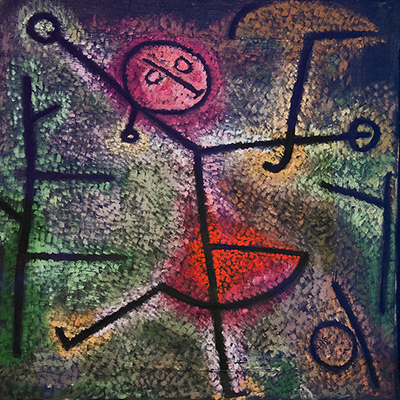
Paul Klee made Dancing Girl in 1940, the final year of his life. The painting belongs to the Art Institute of Chicago, which records its medium as oil on cloth, its dimensions as 53.3 × 51.2 cm, and its accession number as 1959.172. The museum says Klee began with his own monogrammed handkerchief: the embroidered “P K” remains at the lower right. The inherited image on this page matches those distinctive features. This material fact gives the picture a more specific starting point than a generic “drawing on canvas.”[1][2]
A bright round head, a small red body and long black limbs create a figure that seems to spring across a mottled field. One arm reaches high toward the upper left; the other stretches to the right. The legs diverge below the skirt-like red shape. The figure is legible at once, but no smooth anatomical contour encloses it. Gesture, balance and the spacing between lines do most of the work. A dark curved form at the top may be read as an umbrella, and the Art Institute's educational material calls the setting rain; the lines also remain open as abstract marks rather than a fully described weather scene.[1][3]
A figure made from lines and pauses
The head is an uneven red-pink circle with a few small dark features. Its tilt makes the figure look alert or surprised, though the painting gives no story explaining an emotion. Below it, black strokes leave gaps where a neck or shoulder might be expected. The viewer completes the connection. The body widens into a saturated red semicircle or skirt, the strongest patch of colour in the picture, then narrows again into long legs. The visual movement comes from these abrupt changes of width and direction.[1]
One foot extends sideways and the other points down, so the body can seem to turn and skip at the same time. The extended arms nearly reach the work's lateral edges. Several adjacent strokes are independent of the figure: a vertical and short crossbars at left, a dark diagonal at right, a circular sign near the lower right. They keep the dancer from becoming a solitary stick figure against empty space. The lines establish a field of competing directions, and the coloured ground holds them together.[1]
The background is not a neutral blank. Small dark and light touches create a rough, shifting surface; green, grey, violet and red patches appear to flicker beneath the linear figure. It is tempting to assign every stroke a tree, blade of grass or falling raindrop. The museum's rain reading is useful, but the image does not require every mark to be translated into a landscape detail. Its force lies in the way a few bodily cues emerge from a busier painted surface.[1][3]
The title calls the subject a girl. That word gives a possible age and gender to the figure, but it does not identify a sitter or a particular dance. Nothing in the owner record supports the former site's claim that this was a statement about women's social position or Klee's feelings about women. Those assertions turned an open, playful image into an invented biography. A viewer can instead attend to what the painting demonstrably offers: an exaggerated pose, quick directional changes and a comic tension between the small red body and the long black reach of the limbs.[1]
Why the cloth matters
The Art Institute describes a particularly personal material choice. Klee laid his own handkerchief over the painting surface, incorporating its monogram into the finished work. A museum educational text explains that the cloth's edges can be found on close inspection and that the initials in the lower-right circle identify it as Klee's. The public object record lists the inscription as “P K,” signed at lower right. In the small inherited web image, that circle is visible, but its embroidery and the cloth edge are difficult to judge in detail. The museum's account is stronger evidence for the handkerchief than the compressed reproduction alone.[1][3]
Cloth is therefore both support and an object with a prior use. This is not simply a painted figure transferred onto a conventional canvas. The initialed fabric adds an element of chance or found material to the planned arrangement of colour and line. It also puts Klee's mark in an unexpected place: the signature did not have to be painted at the end if his initials were already part of the cloth. The Art Institute calls this characteristic of the humour in his late work. “Humour” here is the museum's interpretation, made plausible by the meeting of an ordinary pocket object with a dancing figure, rather than an assertion that the artist meant the image to be merely cheerful.[1][3]
The museum's account of Klee's final years gives context without turning the work into an autobiography. It notes his dismissal from the Düsseldorf Academy in 1933, his move to Switzerland, a period of diminished output and renewed production between 1937 and 1940. That sequence corrects the old page's story of a career suddenly “rekindled” only in 1940. Neither political pressure nor illness can be read directly from the dancer's smile or pose. The painting is a work made within those circumstances, not a coded report of a single event.[1]
The work's identity and history
The Art Institute's provenance begins with Klee and then Lily Klee in Bern. It records the Klee-Gesellschaft from 1946, a sale to Curt Valentin in 1948, and later transfers through Lynne Thompson and the Fairweather-Garnett Gallery to George B. and Mary Young in 1951. George B. Young gave it to the Art Institute in 1959. The museum names the basis for several stages of this chain, including its own curatorial files and the Paul Klee Foundation's 2004 research. The entries make the ownership sequence traceable without implying that every transaction was witnessed by a single source.[1]
The museum also lists a 1948 Buchholz Gallery exhibition, where the painting appeared as catalogue no. 39, and later showings in New Haven and Chicago. Its bibliography cites Paul Klee: Catalogue Raisonné, volume 8, catalogue no. 8995. That printed entry was not directly inspected for this page; its number is reported through the owning museum's record. The exact-image and material match is stronger evidence for the web page's identity than title alone, because Klee made other works about dance.[1]
One important distinction is Klee's Tänzerin of 1932, a different, much larger oil on canvas documented in a Christie's sale catalogue. An art-and-dance reference from the Deutsches Tanzarchiv likewise lists the 1932 Tänzerin separately from late dance subjects. A shared translation such as “Dancer” can make these works look interchangeable in search results. The square 1940 handkerchief painting in Chicago is the one reproduced on this page.[4][5]
The painting's most concrete surprise is enough for a close reading: a small, quick-moving figure made on a personal piece of cloth, with the artist's initials woven into the visual game. Its red body and reaching black limbs make the pose vivid from a distance. Closer attention reveals a more complicated relation between improvised-looking gesture, carefully placed colour and a support that already carried Klee's name. That relation is more specific and more interesting than a fixed moral message invented for the dancer.[1]
Related artworks
Explore eight other Klee works from the researched artwork cluster.
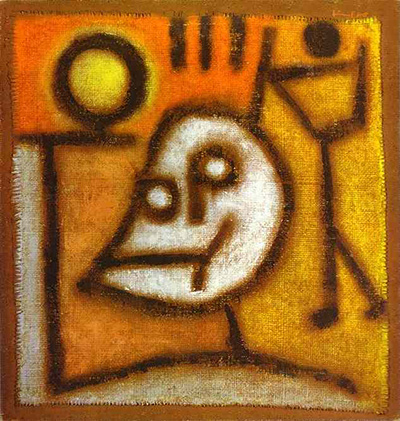
Death and Fire
1940
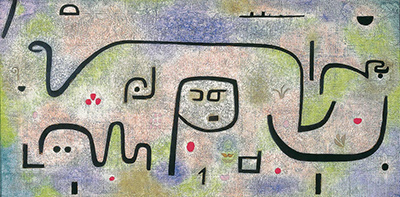
Insula Dulcamara
1938
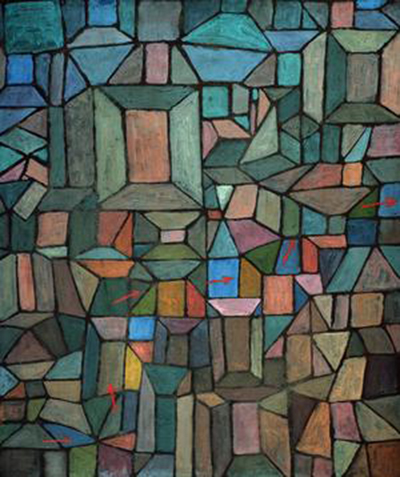
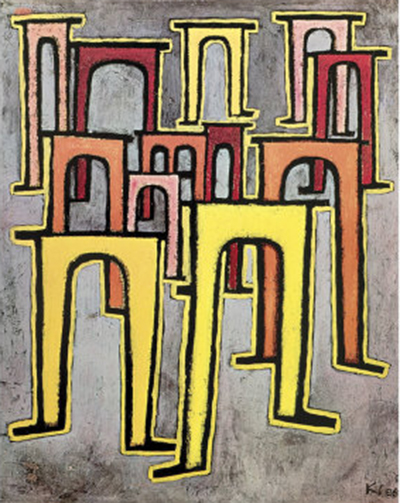
Viaducts Break Ranks
1937
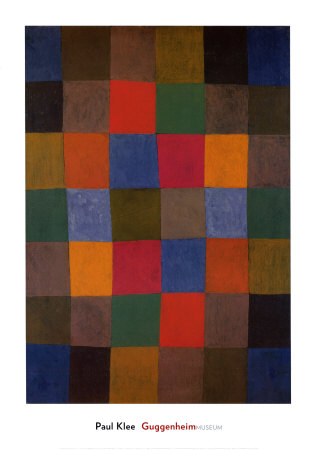
New Harmony
1936
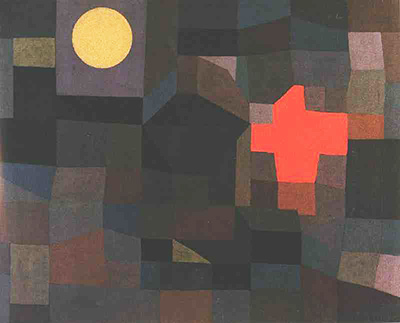
Fire Full Moon
1933
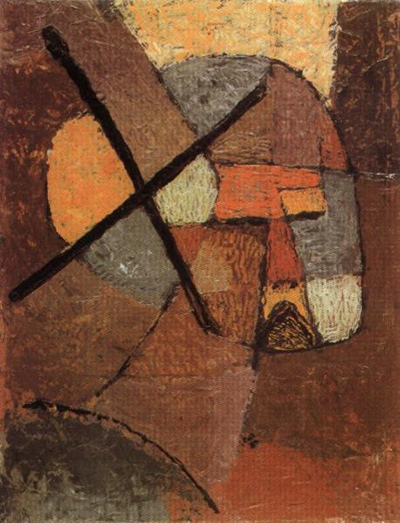
Struck from the List
1933
Ad Parnassum
1932
References
- Art Institute of Chicago, Dancing Girl, object record, with public collections API record directly inspected for medium, dimensions, 1959.172 accession, “P K” inscription, curatorial description, provenance, exhibition history and indirect citation of Paul Klee: Catalogue Raisonné, vol. 8, no. 8995. The printed entry was not directly inspected.
- Art Institute of Chicago, collection search, independently listing the 1940 work in the owner's collection, View source.
- Art Institute of Chicago, Look a Little Closer, educational guide, museum text reproduced at Paperzz, section on Dancing Girl: handkerchief edges, embroidered initials and the museum's rain reading. The institution's object record independently confirms the monogrammed handkerchief, View source.
- Christie's, Tänzerin, primary sale catalogue for the distinct oil on canvas painted in 1932, View source.
- Deutsches Tanzarchiv Köln, Nele Lipp, Tanz Malerei – Ein Lexikon, dance-art reference distinguishing Klee's 1932 Tänzerin and other dance works, View source.