


 by Tom Gurney
Tom Gurney BSc (Hons) is an art history expert with over 20 years experience
Published on June 19, 2020 / Updated on September 27, 2026
Email: tomgurney1@gmail.com / Phone: +44 7429 011000
Angel, Still Female: an angel in transition
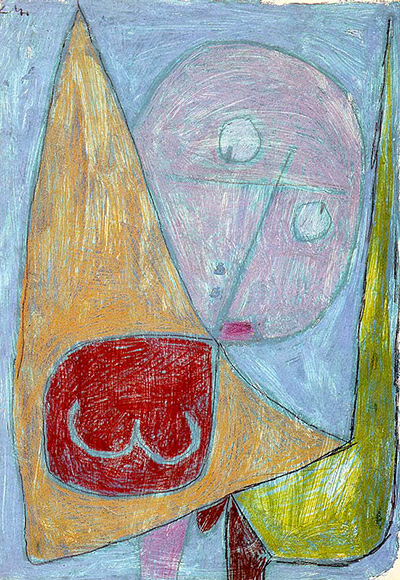
Paul Klee called this work Engel, noch weiblich, translated by the Jewish Museum as Angel, Still Female. The inherited title of this page, Angel Still Feminine, is a looser English rendering. The coloured picture shown here is 1939, 1016 (CD 16). It belongs to the Zentrum Paul Klee, Bern and measures 41.7 × 29.4 cm. The Jewish Museum's 2026 exhibition checklist identifies its medium as chalk on primed paper on cardboard. These details matter because Klee also made a closely related drawing under the same German title, 1939, 1017. The two are connected, but they are separate works.[1][2]
A round face, unequal eyes, vivid wings and a body assembled from remarkably few shapes make the angel easy to recognize and hard to settle. One eye turns upward; the other appears to glance down toward the breasts. An orange wing and a green wing extend on opposite sides. Pink and red legs descend against a pale blue field. Klee does not offer the assured symmetry or remote perfection expected of a conventional heavenly messenger. The figure is caught in the middle of becoming something else. The small word noch—“still” or “yet”—makes that unsettled state part of the title itself.[2][3][4]
The coloured angel and its drawn counterpart
The 1939, 1016 number identifies the coloured work reproduced on this page. In her German-language study of Klee's angels, art historian Harriet Zilch describes it as coloured wax chalk over blue paste colour on paper and records its dimensions as 41.7 × 29.4 cm. The museum exhibition checklist uses the broader medium description “chalk on primed paper on cardboard.” The descriptions differ in detail and terminology. Both identify a worked paper image mounted on cardboard; a small web reproduction cannot independently establish the exact sequence of its layers.[1][2]
Zilch also discusses the related 1939, 1017 drawing, made in drawing medium on paper and then held by Galerie Berggruen & Cie in Paris according to her 2005 dissertation. She treats the coloured image as a version of that linear composition. The numerical distinction prevents two easy errors: assigning the drawing's materials or former location to the coloured picture, and treating two catalogue entries as one. Here the blue ground and opposed warm and cool wings belong to the 1016 image. They are essential to how this page's picture works.[2]
The blue does more than stand for sky. It gives the compact figure an open, even field and lets the colours of its body stand out. The orange and green shapes suggest wings, yet their unequal size and angle make flight look tentative rather than effortless. The circular head is prominent in relation to the torso, and the line of its face leads the eye back to the chest. The red form below is part of a body whose anatomy Klee deliberately makes conspicuous and strange. Zilch specifically reads the chest marks as breasts and notes the red lips, different coloured legs and uneven gaze.[2]
At this scale the angel is almost a sign made of colour: head, eyes, breasts, wings, legs. It is also a personality. The sideways or divided gaze can look comic and uncertain. Klee does not paint an ideal body whose parts fit a single, stable scheme. Instead he lets the title and the visible body disagree gently. This is still a female angel, but “still” implies a future state the picture cannot show. The figure's awkwardness gives that transition a face.[2][3][4]
What “still female” may mean
Zilch places Engel, noch weiblich among Klee's angels concerned with change, alongside titles such as Unfinished Angel and Angel, Still Ugly. In her account, the breast marks and downward glance register earthly sex at the point when the angel is moving toward another form of existence. She relates that possibility to a Christian tradition in which angels are not defined by human sexual roles. That is her interpretation of the work's title and imagery, not a documented statement by Klee explaining this particular drawing or its coloured version.[2]
The Jewish Museum's 2026 exhibition text gives a related but differently framed reading. It says that Angel, Still Female looks down to check whether she still has breasts and describes an adaptation to a transitional identity. The exhibition places the imperfect angels amid Klee's experience of isolation and exile and reads humour into the cycle. This curatorial account connects the figure to its historical moment. Its claim about the whole cycle and the Nazi regime is an interpretive frame; the breasts, off-centre gaze and provisional title remain the most direct object-specific evidence.[1][3]
An earlier reading is especially precise about the eyes. In a 1986 Guggenheim lecture, Klee scholar Jürgen Glaesemer described one eye as looking up toward heaven and the other as checking what remains of the angel's breasts. Zilch cites his German-language treatment of the same motif. The two accounts show a long line of scholarship that has regarded the mismatched eyes as part of the joke and the anxiety of transition, rather than as a simple mistake in drawing.[2][4]
The word “female” therefore does not merely label a character. It marks a condition in time. Read literally, the figure has breasts and a body with different coloured limbs. Read through the title, those physical signs may be temporary. Neither the title nor the image tells us exactly what the angel will become. The resulting uncertainty is productive: humour, embodied identity and the thought of a life beyond ordinary human categories coexist in a few marks.[2][3][4]
A late work without a single biographical key
Klee made the work in 1939, during his final years in Switzerland after leaving Germany in 1933. The 2026 exhibition relates his imperfect angels to exile and to the destructive political climate. Glaesemer also saw a comic reckoning with mortality in the late angels. These contexts help explain why the work can feel both playful and serious. They do not prove that its red and green shapes encode one specific political event, or that the painting records a particular thought about his own death.[1][3][4]
The coloured version sharpens this tension. The chalk line stays direct and almost childlike, while the blue ground and contrasting wings give the image a peculiar radiance. Its materials are modest: prepared paper on cardboard, not a monumental religious painting. Yet the small vertical format grants the figure a full space of its own. Instead of a heavenly scene with attendants or a narrative, there is one angel checking the evidence of its own body. Klee makes a theological question intimate and slightly absurd.[1][2][3]
The two versions also remind us that Klee revisited motifs rather than producing an isolated illustration and moving on. Zilch records the drawing and coloured work as distinct catalogue entries. Their relationship invites close comparison: what does the blue field do to a figure first articulated in line, and how do orange and green alter the sense of wings? Such questions are a route for further looking; the two records should not be collapsed into one object.[2]
Title, ownership and the image on this page
The Jewish Museum's checklist names the Zentrum Paul Klee, Bern as the holding institution for 1939, 1016. It also shows how one angel can be situated among several late works without losing its individuality. Angel Applicant (1939, 856) has a different title, materials and owner; Forgetful Angel (1939, 880) is another distinct work. Their titles describe hesitation, imperfect preparation or lapse rather than serene completion. Angel, Still Female gives that broader group a vivid bodily form and colour. The checklist records loans for an exhibition, so it does not establish that any one picture is continuously on display.[1][3]
The sequence of titles makes Klee's late angels feel surprisingly close to human behaviour. They check, forget, apply, remain unfinished. These are not simply decorative wings attached to ideal faces. They are figures in situations, though the situations may consist of nothing more than looking, becoming or realizing what remains. In Angel, Still Female, the colour makes that small drama unusually immediate: the body almost glows against blue, yet its unequal parts refuse an easy final answer.[1][2][3]
Klee's angel becomes memorable because it is neither a finished emblem nor a mere cartoon. The upward glance and downward check turn spiritual ascent into a bodily negotiation. The contrasting wings promise movement, while the title holds the figure for one instant in an unfinished state: an angel, and still female.[2][3][4]
Related artworks
Explore eight other Klee works from the researched artwork cluster.
Death and Fire
1940
Insula Dulcamara
1938
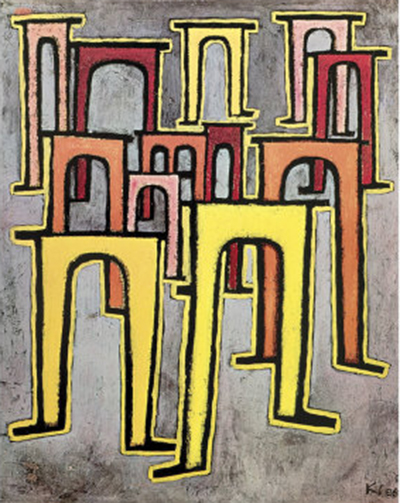
Viaducts Break Ranks
1937
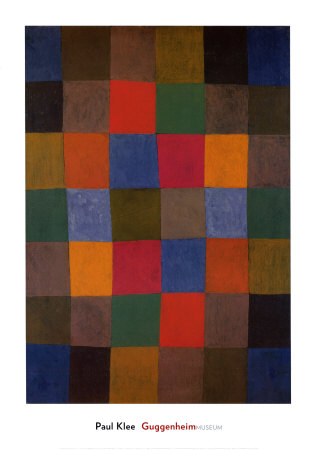
New Harmony
1936
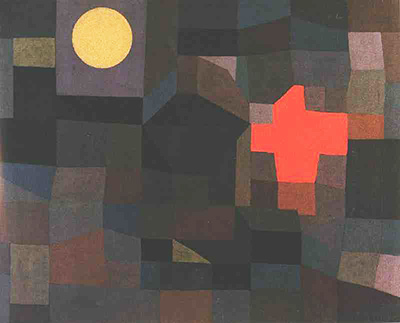
Fire Full Moon
1933
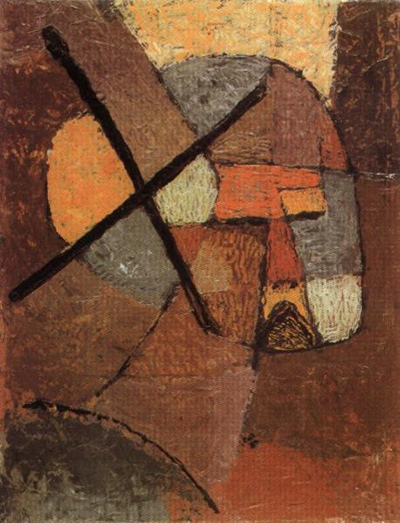
Struck from the List
1933
Ad Parnassum
1932
References
- The Jewish Museum, Paul Klee: Other Possible Worlds, exhibition checklist, English, 2026, p. 19: Angel, Still Female (Engel, noch weiblich), 1939, 1016, chalk on primed paper on cardboard, Zentrum Paul Klee, Bern; distinct from adjacent Angel Applicant entry, View source.
- Harriet Zilch, Die Engelsdarstellungen von Paul Klee. Verwendung und Verfremdung eines religiösen Sujets, German, Bamberg dissertation submitted 2004, examined 2005, especially pp. 163, 178–79 and catalogue pp. 269–70: distinction between 1939, 1016 and 1939, 1017, form, colour and interpretive context. Her more specific material terminology is attributed to her study, View source.
- The Jewish Museum, Paul Klee and Fascism, complete exhibition texts, English, 2026, p. 79: curatorial interpretation of the unfinished angels and this figure's downward glance. The adjacent captions in extracted PDF text are not used to identify the owner or medium, View source.
- Jürgen Glaesemer, “Paul Klee and German Romanticism,” Hilla Rebay Lecture, Guggenheim Museum Archives transcript, English, lecture 1986, transcript © 2018, p. 8: one eye directed upward, the other toward the breasts; a scholar's interpretation of the angel's irony, View source.