


 by Tom Gurney
Tom Gurney BSc (Hons) is an art history expert with over 20 years experience
Published on June 19, 2020 / Updated on September 27, 2026
Email: tomgurney1@gmail.com / Phone: +44 7429 011000
Flowers in Stone: Klee’s painted signs in 1939
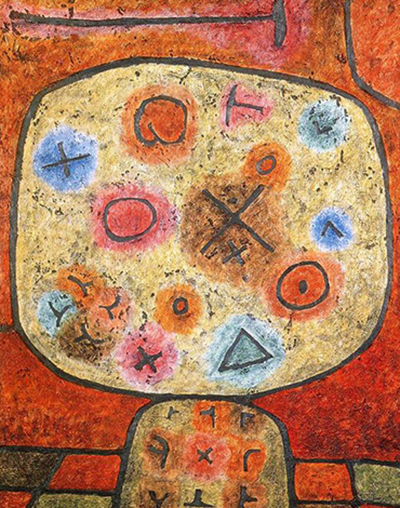
Paul Klee's Blumen in Stein (Flowers in Stone) is a 1939 oil painting in the Sprengel Museum Hannover. The museum's current collection entry describes oil on cardboard on wooden strips, measuring 49.6 × 39.8 cm, and identifies it as inventory D 3455. The work is recorded as a loan from the Kunststiftung Bernhard Sprengel und Freunde since 1992. An English study lists its annual number as 1939, 638 (GG 18); the museum records “1939. GG.18. ‘Blumen in Stein’ Klee” on a wooden strip at the back. These converging records fix the work's identity much more securely than a caption attached to a print.[1][2]
The painting shows a large, pale, round-cornered form within a red-orange field. Coloured circles and small angular signs occupy the pale interior. A central dark crossing looks like a bold X, with smaller marks nearby. Other shapes resemble a plus sign, a ring, a triangle, an arrowhead or a letter, though none forms a sentence that can be read with confidence. A smaller pale panel below contains further marks. The relation between the two panels can suggest a tablet, a flower bed, a stone surface or a partly imagined object. Klee supplies a title but leaves the pictured thing open.[1]
Where are the flowers?
The title prompts the viewer to find flowers in an apparently hard setting. Yet the coloured roundels are not botanical illustrations. They have neither consistent stems nor petals nor a shared scale. One can see flower-like spots—the rose circle at left, the orange ring at right, the pink and turquoise marks toward the bottom—without having to identify species. The pale oval could be read as stone, but no geological material is depicted literally. Both words of the title work as invitations to interpret the painted forms rather than labels on a realistic scene.[1]
The red and orange passages surrounding the centre give the pale form a clear edge. Their colour is mottled rather than uniform. Short dark lines at the top and down the right interrupt what might otherwise be a simple border. At the foot of the image, small dark and green-brown blocks sit beside the lower pale panel. They lend weight to the base but do not settle whether the whole arrangement is an object seen from above, a vertical monument or an invented diagram. It is this uncertainty that keeps the signs active as visual forms.[1]
The central oval is also far from blank. Thin speckling and changes of colour make its pale surface lively. Around the dark X are smaller signs, several of which seem to float between round patches rather than lie in a regular grid. Their distribution is loose but deliberate: different sizes and colours pull the eye across the interior, then back to the large central crossing. The lower panel repeats the idea of marks enclosed by a pale shape on a smaller scale. Looking becomes a movement between seeing a whole slab and reading separate symbols.[1]
The painting's surface is important to the title's tension. The outer red can seem rough, while the lighter interior may resemble a worn or stained stone. But a reproduction cannot establish the paint's true thickness, the sequence of layers or whether any texture was intended to imitate a specific rock. The Sprengel Museum's medium record establishes oil, cardboard and wooden strips; it does not describe a carved stone or flowers physically embedded in one.[1]
Marks between picture and writing
Several motifs look like signs rather than depictions. A plus, circle, X and triangle are simple enough to evoke writing or notation, even though they do not belong to a known alphabet here. Art historian K. Porter Aichele includes Flowers in Stone in the illustration list of her book Paul Klee's Pictorial Writing, with the same 1939/638/GG18 identity. The accessible sample provides that bibliographic placement but not the book's discussion of the painting on page 186. It is therefore evidence that the picture has been considered within a study of pictorial writing, not a basis for attributing a detailed argument to the author without reading that page.[2]
The Zentrum Paul Klee describes the artist's late interest in reduced, sign-like lines. Its account notes inspiration from various historic writing systems and stone markings, but it does not single out Blumen in Stein. The general context helps explain why these simple marks can operate both as forms to see and as signs one feels invited to decipher. It does not authorize assigning a fixed translation to the X, circles or triangle in this particular painting.[3]
The museum's own inscription record is a useful distinction. The words “Blumen in Stein” and the date code are documented on the reverse wooden strip; they are not the same as the dark marks within the painted oval. The former identify the object. The latter are elements of the composition. Treating the visible marks as if they were Klee's legible title or a secret message would collapse two different kinds of evidence.[1]
A painting from Klee's final years
The Zentrum Paul Klee records 1939 as the artist's most productive year, with 1,253 registered works, despite serious illness. That context places Blumen in Stein amid a large and varied body of late work. It does not tell us that this particular painting is an allegory of his health. The title's contrast of flowers and stone may invite thoughts of fragile life and hard matter, but the accessible owner record does not establish an autobiographical meaning.[4]
A second 1939 work, blaue Blume (Blue Flower), provides a useful comparison only if the two objects remain distinct. In the Zentrum Paul Klee's guide, blue flowers and leaf forms emerge from a dark ground, and the museum gives that work an explicitly botanical and Romantic reading. Blumen in Stein instead offers coloured signs inside pale enclosed shapes. The shared floral vocabulary shows Klee continuing to vary his treatment of plants; it does not make the Blue Flower interpretation a key to the Hannover painting.[5]
The large oval, emphatic border and array of marks make the painting less like flowers growing in a crack than like an image of flowers imagined through a sign system. That is one way to describe its visible organization, not a documented statement of Klee's intention. The marks may recall carving or writing, while their bright colours resist the idea of dead, inert stone. The title sets those modes of seeing into motion without resolving them.[1][2][3]
Ownership, catalogue identity and what remains open
The Sprengel Museum records “Klee” at the lower left of the picture and the title with 1939. GG.18 on the reverse wooden strip. Its provenance panel lists a 1979 purchase from Galerie Rosengart, Lucerne, and also names Galerie Neue Kunst Hans Goltz, Munich. The brief online sequence does not provide every transfer or date, so it should not be expanded into a complete ownership history. The museum's bibliography identifies the painting as no. 8344 in volume 8 of the printed Paul Klee: Catalogue raisonné (2004). That is an owner-supplied reference to the publication; the full printed entry has not been directly examined for this page.[1]
The museum's current photograph shows the original painting with its surrounding wooden strips. The smaller reproduction here crops out that structure and has colour and detail limits. The image is nevertheless sufficient to confirm the principal arrangement and to compare it with the museum photograph. It should not be used to infer exact brushwork or to decode tiny marks. A closer, source-approved reproduction and the printed catalogue entry would support more detailed study.[1]
Flowers in Stone is strongest when its ordinary nouns remain questions. A pale central field can feel stony, the coloured discs can feel floral, and the dark strokes can feel written. None need be reduced to a literal garden or a one-to-one cipher. The painting lets colour, surface and sign-like form hold those possibilities together.[1][2][3]
Related artworks
Explore eight other Klee works from the researched artwork cluster.
Death and Fire
1940
Insula Dulcamara
1938
Viaducts Break Ranks
1937
New Harmony
1936
Fire Full Moon
1933
Struck from the List
1933
Ad Parnassum
1932
References
- Sprengel Museum Hannover, online collection search for Blumen in Stein (German; open the sole result's detail view, object ID 3839, inv. D 3455): current owner record for title, English translation, date, oil/cardboard/wooden-strip medium, 49.6 × 39.8 cm size, loan, inscriptions, brief provenance and bibliography. The bibliography cites the printed Catalogue raisonné, vol. 8, no. 8344; that volume was not directly read here, View source.
- K. Porter Aichele, Paul Klee's Pictorial Writing, Cambridge University Press sample (2002), list of illustrations, p. ix, no. 79: identifies Flowers in Stone as 1939/638/GG18 and locates its discussion on p. 186. The sample does not include that discussion, View source.
- Zentrum Paul Klee, Mapping Klee (German, “Entwicklung neuer Zeichen”): institutional overview of Klee's late sign-making and historic-script interests. It does not identify this painting, View source.
- Zentrum Paul Klee, Kosmos Klee press kit (English), chronology for 1939: records 1,253 works and the artist's ill health. Context only, View source.
- Zentrum Paul Klee, “blaue Blume” (German owner guide): distinct 1939 painting and botanical interpretation used for comparison, not transferred as an interpretation of Blumen in Stein, View source.