

 by Tom Gurney
Tom Gurney BSc (Hons) is an art history expert with over 20 years experience
Published on June 19, 2020 / Updated on September 27, 2026
Email: tomgurney1@gmail.com / Phone: +44 7429 011000
Park of Idols: figures in a black ground
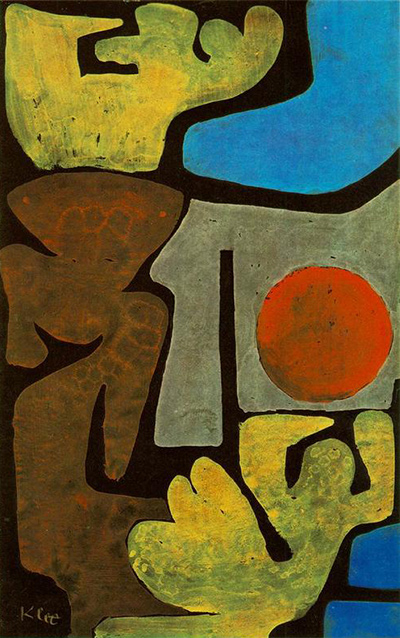
Paul Klee called this 1939 work Götzen-Park, commonly rendered in English as Park of Idols. The Zentrum Paul Klee identifies it as 1939, 282 and describes watercolour on a prepared ground on paper mounted on cardboard, measuring 32.7 × 20.8 cm. Its museum publication credits the work to the Zentrum Paul Klee in Bern as a gift from Livia Klee. A German exhibition catalogue gives Klee's own register notation as V 2 (282) and describes black-primed “Conceptpapier”; it also records a signature at lower left. These sources establish the object's identity and construction more securely than the old page's generic account of a picture “painted on blackened paper.”[1][2]
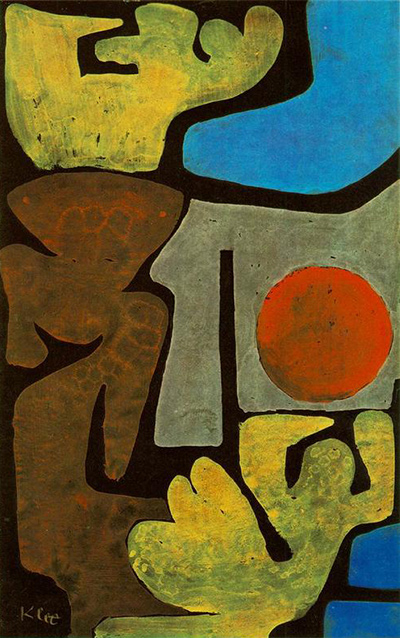
The composition is compact and vertical. Its dark field does not behave like an empty night sky. It separates large yellow, brown, pale grey and blue shapes, while also forming thick, branching channels between them. Near the middle right, a red-orange disc sits within a light grey zone. At the left, a brown form has the broad top and narrowing lower section of a roughly human figure. Yellow shapes at the top and bottom seem to reach toward the centre. The exact number and identities of the “idols” are less certain than the title suggests.[1][3]
How the black ground organizes the forms
The deepest black runs around the painted shapes and between their limbs or extensions. At the upper edge it encloses a yellow-green form with an irregular crown. At the right it defines the underside of a brilliant blue shape. Near the bottom it curls around another yellow-green passage. This black is an active boundary, making each coloured mass seem both separate and part of a shared field.[3]
The centre is especially ambiguous. A tall pale grey shape almost reads as a standing body, but it also serves as the setting for the round red disc. The disc might recall a sun, a face or an emblem. The painting does not provide a horizon or a conventional landscape that would establish it as an astronomical sun. The inherited page stated that it was a worshipped idol; that is a possible narrative imposed on the image, not an identified fact. Klee's title invites a search for figures without fixing their count or rank.[1][3]
The brown shape on the left carries several rounded projections and a dark opening. A viewer might read a head, shoulders and bent legs, but none of those parts is described with anatomical precision. The upper yellow form can suggest an antlered head or reaching arm, while the lower yellow form seems to rise through the black channel. These shifting readings make the painting feel populated. They also show why a rigid inventory of “three idols” oversimplifies what is actually visible.[3]
Blue occupies the upper right and reappears at the lower edge, giving the eye a route around the warmer centre. Yellow-green connects the top and bottom, while brown anchors the left. The red disc interrupts that circuit. Klee does not blend these hues into an atmospheric background. He places broad, irregular colour zones against a dark ground so that their edges carry much of the image's movement.[3]
The meaning of a “park”
The German compound Götzen-Park brings together an idol or false god (Götze) and a park. The title can make the forms seem like objects or beings arranged in a landscape, but the picture lacks paths, lawns, trees and other reliable markers of a literal public park. The spaces between the shapes may be read as passages. They may equally be the black ground that allows the forms to appear distinct. The title's mixture of a familiar place and unfamiliar occupants gives the scene a playful, uneasy character.[1][3]
The work was reproduced by the Zentrum Paul Klee in its publication accompanying the 2023 exhibition Paul Klee: Alles wächst, an exhibition focused on nature as one source of the artist's imagery. Its inclusion there makes a comparison with Klee's invented plant and creature forms productive. It does not prove that every coloured shape in this painting represents a botanical specimen or that the park depicts a real location.[1]
The museum publication places Götzen-Park close to other works concerned with growth, including was alles wächst! and Tanz-Pflanze. The titles encourage an imaginative relation among plants, movement and figures. This relation is a curatorial context, not evidence that Klee intended a single botanical code for Götzen-Park. The strong black channels could be looked at as gaps, paths or boundaries; their role in the design is clearer than a precise literal label.[1][3]
Paper, preparation and small scale
The two institutional descriptions agree on watercolour and a prepared paper support, though they use different levels of detail. The Zentrum Paul Klee says “watercolour on ground on paper on cardboard.” The German catalogue specifies watercolour on black-primed Conceptpapier and records 32.7 × 20.9 cm, one millimetre wider than the museum publication's 20.8 cm. The tiny difference may reflect measurement practice or what each cataloguer counted as the image edge; the evidence does not justify choosing one as a correction of the other.[1][2]
The prepared dark ground matters to the effect. The coloured forms are not merely floating against a naturally dark sheet. Their boundaries make sense in relation to a deliberately built surface, and the spaces between them remain visible as part of the composition. The small physical size is also easy to miss in a digital image: at roughly thirty-three centimetres high, this is an intimate sheet rather than a large mural. Its tall format concentrates the forms and the viewer's attention.[1][2][3]
The lower-left signature recorded by the exhibition catalogue is hard to assess from the inherited small reproduction, though a mark is visible there. Neither source used here supplies a full ownership chain before the gift from Livia Klee. The museum's current collection credit is secure; additional provenance should be added only when an institutional dossier or catalogue entry can be checked.[1][2][3]
Reading without overclaiming
The title does not tell us whether the idols are comic, frightening, sacred, false or simply strange. A later writer may see masks, creatures or a shrine. Those responses can be useful ways to describe the experience of the picture, provided they remain readings rather than claims about Klee's documented belief. The old page's account of the red circle as a sun worshipped beside other idols went beyond the available evidence. So did its broad statements about Klee's late work, colour theory and “Oriental” training, which did little to illuminate this specific sheet.[1][3]
The painting's strongest certainty is visual and material: a small prepared watercolour surface, a black network and coloured masses that almost become figures. Klee's name for it keeps those almost-figures in motion. As the eye travels from one to another, the black ground alternately looks like the space around them and the thing binding them together. That unresolved relationship is more interesting than a fixed tally of idols.[1][2][3]
Related artworks
Explore eight other Klee works from the researched artwork cluster.
Death and Fire
1940
Insula Dulcamara
1938
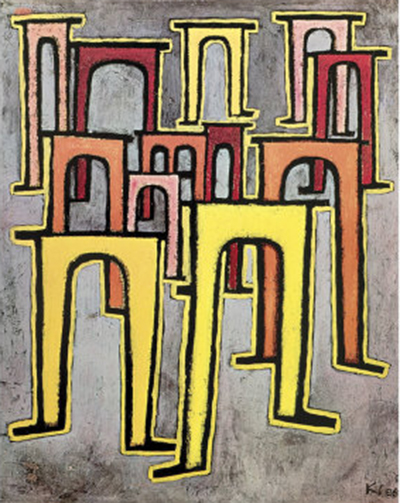
Viaducts Break Ranks
1937
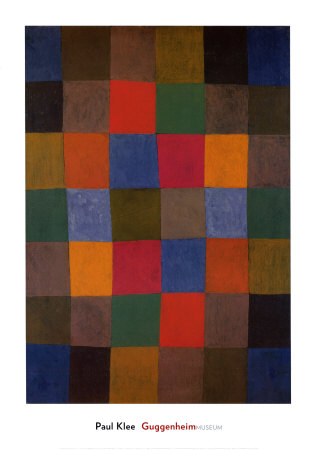
New Harmony
1936
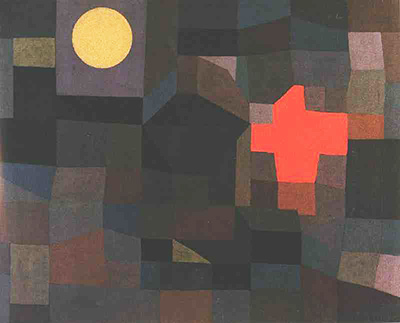
Fire Full Moon
1933
Struck from the List
1933
Ad Parnassum
1932
References
- Zentrum Paul Klee, Paul Klee: Alles wächst publication (German, 2023): reproduced Götzen-Park, 1939, 282; watercolour on ground on paper on cardboard, 32.7 × 20.8 cm; museum collection and Livia Klee gift; exhibition context, View source.
- German National Library, digitised contents of a Paul Klee exhibition catalogue (German): Götzen-Park, 1939, Conceptpapier black ground, 32.7 × 20.9 cm, signature lower left, artist's work-register notation V 2 (282). This is a catalogue listing rather than a conservation examination, View source.
- TheHistoryOfArt.org, inherited Park of Idols image: visual reference for the close reading; its 400 × 638-pixel provenance and reproduction rights are not independently established, so it remains the pre-existing splash and has not been used for new annotations, View source.