


 by Tom Gurney
Tom Gurney BSc (Hons) is an art history expert with over 20 years experience
Published on June 19, 2020 / Updated on September 27, 2026
Email: tomgurney1@gmail.com / Phone: +44 7429 011000
Characters in Yellow: signs across a painted textile
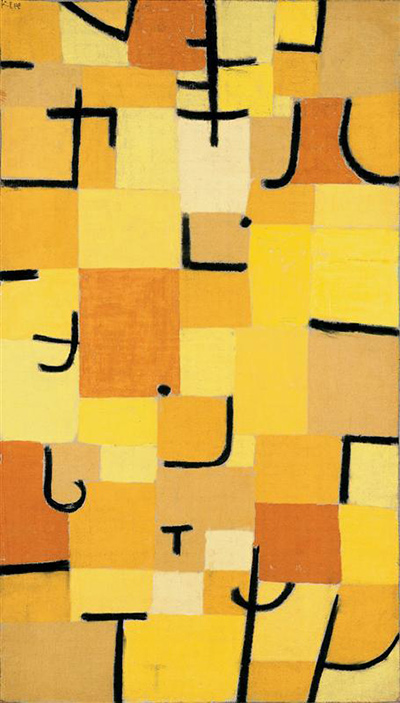
The work long called Characters in Yellow on this site is Paul Klee's Zeichen in Gelb, 1937, 210 (U 10). The Fondation Beyeler in Riehen/Basel, which owns it, translates the title as Signs in Yellow in English and Signes en jaune in French. Its record gives pastel on cotton over coloured paste on jute, on a stretcher, 83.5 × 50.3 cm, inventory 68.1. The inherited 400-pixel site image is a tight crop of the same work shown in the owner's framed photograph: the blocks, black marks and small upper-left signature align. The crop omits the original border and frame.[1][2][3]
The surface is upright and tall. Uneven rectangles in lemon, cream, ochre and orange fill it from side to side. Thick black marks cross some fields, stop abruptly in others, or enter from an edge. At a distance their arrangement looks like writing laid over a patchwork. Up close, the marks do not assemble into an alphabet a viewer can read. The original German Zeichen means signs or marks. “Characters” can suggest letters or people, and the picture permits such associations, but the owner's title does not name a set of human figures.[1][2]
A yellow field with interruptions
The colour blocks are not a rigid chessboard. Some are wide and shallow; others are nearly square or tall. Their edges meet at unequal points, so the eye steps through the painting rather than tracing one uniform grid. A pale central vertical area draws attention, but no single shape controls the whole. The alternation between near-white, vivid yellow and warm orange gives the surface both light and weight. It can seem woven, tiled or assembled from separate pieces, yet it remains one painted work on a layered textile support.[1][2]
The black signs supply a second rhythm. Near the top, short bars intersect or attach to a longer curve. Farther down, a hooked line interrupts a yellow block; another line bends across a warmer patch. Several strokes are cut by the image edge, implying that the pattern could continue beyond the visible rectangle. Others end inside the field, leaving an open question about whether they belong to a larger, hidden symbol. The pattern is precise enough to invite reading and incomplete enough to resist a fixed translation.[1][2]
Fondation Beyeler's 2017–18 exhibition guide reports that Ernst Beyeler called the work a “carpet of life.” Its German, English and French versions compare the light ground to a woven carpet and the black symbols to marks that distinguish colour zones. This is a useful analogy because the colour patches and strokes do seem interlaced. It is an attributed metaphor, not a technical claim that the image is literally a carpet or that each mark has a known word-equivalent.[2][3]
The museum also describes the painting as unusually buoyant. That response is understandable in the bright palette and lively spacing of signs. Still, cheerfulness is a viewing response, not the only possible emotion. The abrupt black bars can feel assertive against the warm colours, and the partial marks at the edges make the surface less settled than a decorative grid. The work supports both an immediate sense of light and a slower attention to interruption and incompletion.[2]
What the materials change
The owner's German medium line is unusually layered: Pastell auf Baumwolle auf Kleisterfarbe auf Jute auf Keilrahmen. In English, that is pastel on cotton, over coloured paste on jute, on a stretcher. The description identifies several distinct materials and a stretched support. It should not be reduced to oil on canvas or described as ordinary watercolour paper. Beyeler's account does not by itself establish exactly how Klee applied every mark; visual inspection of the reproduced surface cannot replace conservation analysis.[1]
The owner photograph includes grey and wooden framing around the painted field. The earlier site crop removes it and makes the coloured rectangles appear to run directly to the edge of the web image. The composition remains recognisable, but the full photograph is better evidence for the work's presentation and proportion. A 400-pixel image also compresses small shifts within the pastel and paste layers. The painting is 83.5 cm tall; its size on a screen is no indication of its physical scale.[1]
The small inscription at upper left is consistent with the owning museum’s note that Klee signed there. It also helps confirm that the reproduced composition depicts the same work.[1]
Title, context and later readings
The title matters to interpretation. German Zeichen can refer broadly to signs, symbols or marks; it does not specify whether they are readable letters, pictograms or features of imaginary people. The repeated T-like bars and hooks may bring writing to mind. A viewer might also find a face-like pairing or a bodily gesture in a few strokes. The image never supplies a key that turns these possibilities into a decoded message. The owner's translation “Signs in Yellow” keeps that openness better than a confident claim about “characters” as people.[1][2][3]
Beyeler's exhibition guide paired the 1937 painting with Klee's ludus Martis of 1938. The curators contrasted the ordered, light-coloured patchwork and black signs here with a more crowded blue ground and forceful symbols in the later work. They placed both within Klee's last period of intense production, when strong black lines or bars moved across bright fields. This comparison explains a formal direction without turning every late painting into an illustration of the same mood or event.[2][3]
The Fondation Beyeler records a substantial history for Zeichen in Gelb. The work stayed with Klee until 1940, then passed to Lily Klee, the Klee-Gesellschaft, and Rolf Bürgi before entering the Beyeler collection in 1968; the Beyeler Foundation has held it since 1992. Its listing cites the printed Catalogue raisonné Paul Klee, volume 7, no. 7146. That volume was not directly inspected for this page, so the citation is reported as the owner's bibliographic cross-reference rather than as an independently checked entry.[1]
The record also documents exhibitions beginning with Paul Klee. Neue Werke in Zürich in 1940, with later presentations in Bern, Basel, Paris, London and beyond. This history shows that the picture was visible and discussed well before the 2017–18 abstract-art exhibition. It does not prove that any one curatorial interpretation was Klee's own. What remains in front of the viewer is a warm field of unequal colour blocks and a sparse, mobile black vocabulary. The signs both organise that field and keep it open, inviting recognition without closing the act of looking.[1][2]
Related artworks
Explore eight other Klee works from the researched artwork cluster.
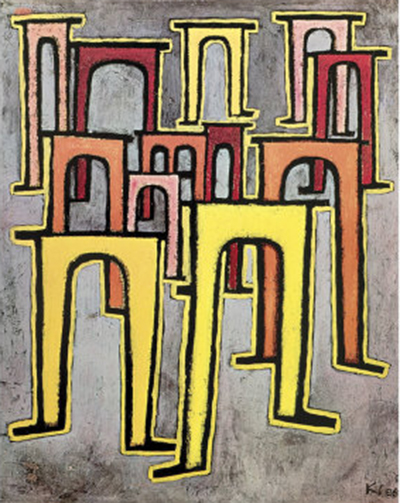
Viaducts Break Ranks
1937
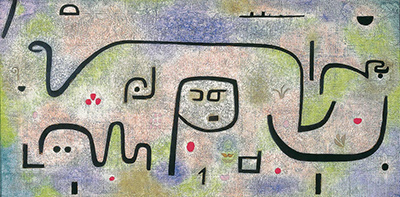
Insula Dulcamara
1938
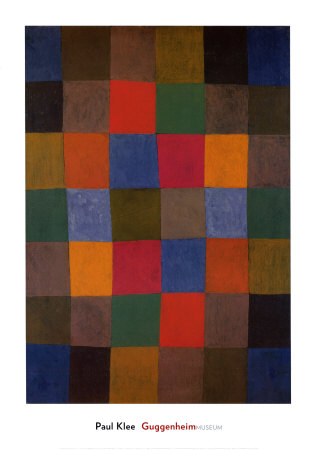
New Harmony
1936
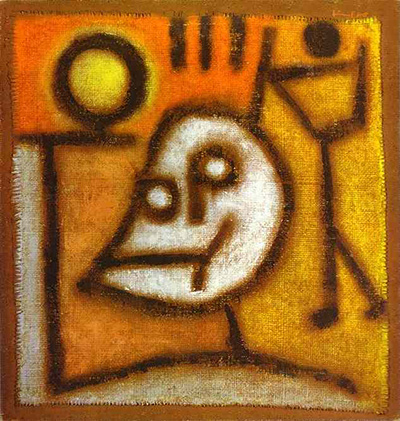
Death and Fire
1940
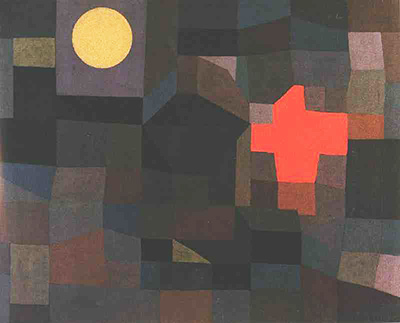
Fire Full Moon
1933
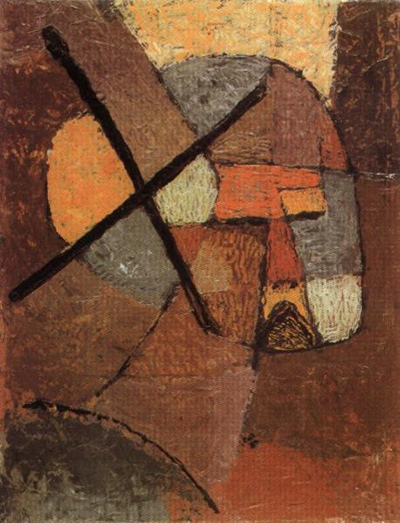
Struck from the List
1933
Ad Parnassum
1932
References
- Fondation Beyeler, Zeichen in Gelb, German owner record, with full-object photograph, materials, dimensions, signature, provenance, exhibitions and the owner's indirect reference to Catalogue raisonné Paul Klee, vol. 7, no. 7146. The printed volume was not directly inspected, View source.
- Fondation Beyeler, Paul Klee: The Abstract Dimension, English room guide, room 7, 2017–18: owner translation Signs in Yellow and the attributed “carpet of life” interpretation, colour and sign analysis, and comparison with ludus Martis, View source.
- Fondation Beyeler, Paul Klee: La dimension abstraite, French room guide, salle 7, with German exhibition text; the French title is Signes en jaune. The multilingual museum texts were compared directly.