

 Buy Art Prints Now
from Amazon
* As an Amazon Associate I earn from qualifying purchases.
Image reference [image]
 by Tom Gurney
Tom Gurney BSc (Hons) is an art history expert with over 20 years experience
Published on August 14, 2026 / Updated on August 14, 2026
Email: tomgurney1@gmail.com / Phone: +44 7429 011000
Miranda (1875): Introduction
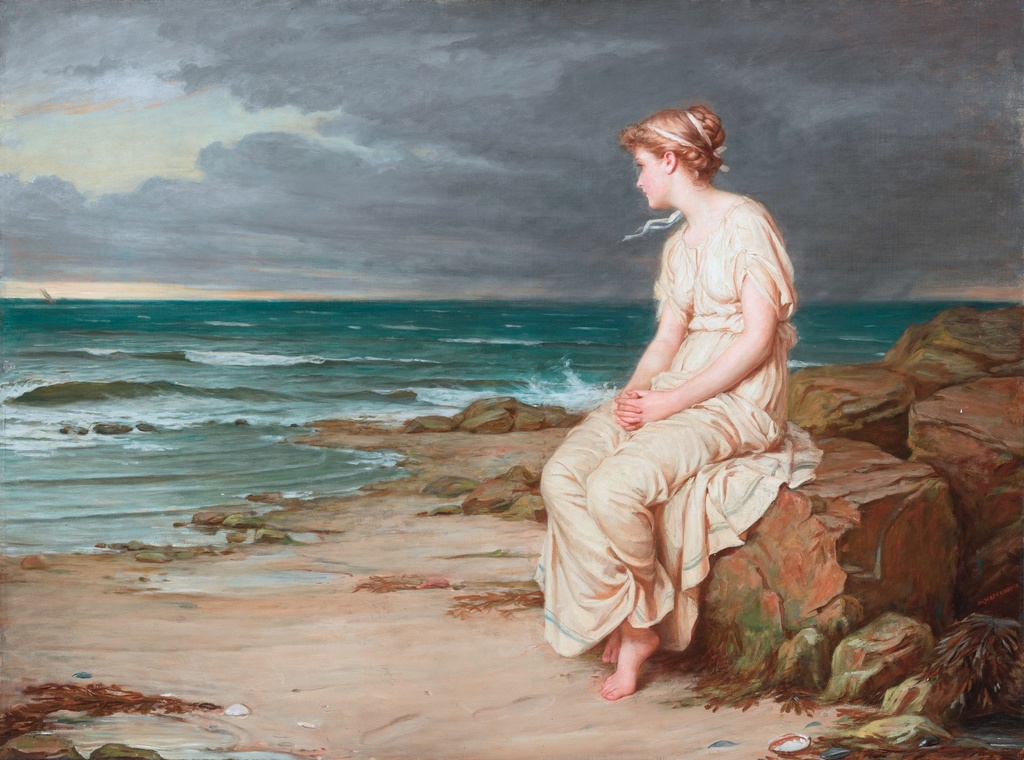
John William Waterhouse's 1875 Miranda imagines the heroine of Shakespeare's The Tempest before the tempest dominates her world. She sits on a rocky shore in classical dress, looking towards a distant ship beneath gathering clouds. Sea and sky are not yet violent. The drama exists as possibility.
This is the crucial difference from Waterhouse's famous Miranda – The Tempest of 1916, where waves smash around a listing vessel and the heroine watches apparent disaster. The 1875 painting is the larger early composition, measuring 76 by 101.5 centimetres, exhibited at the Royal Academy and now privately owned. Its quietness is purposeful: Waterhouse moves back from Shakespeare's opening crisis and gives Miranda a calm she cannot possess once Prospero raises the storm. [1] [2] [3]
At a Glance
- ArtistJohn William Waterhouse
- Date1875 [1]
- MediumOil on canvas [1]
- Dimensions76 × 101.5 cm (30 × 40 in.) [1]
- SignatureSigned “JW. WATERHOUSE” [1]
- CollectionPrivate collection [1]
- ExhibitionRoyal Academy, 1875, no. 76 [1]
- SubjectMiranda from William Shakespeare's The Tempest
- Depicted momentAn invented pre-tempest interval, with a distant ship and gathering clouds [2]
- Version warningDistinct from Waterhouse's 1916 storm composition and from a small related Miranda study [2] [3]
Contents
- Introduction
- What the painting shows
- Miranda in Shakespeare's play
- A moment before the action
- Ship, cloud and dramatic anticipation
- The seated figure and classical dress
- Island landscape and imagined viewpoint
- Royal Academy exhibition and early career
- Rediscovery and modern exhibition
- Comparison with the 1916 Miranda
What the painting shows
Miranda sits on a rock beside a calm or gently moving sea. Her body turns towards the water, and her gaze follows a ship travelling across the distant horizon. The vessel is small enough to remain secure within the landscape rather than dominate it.
Clouds accumulate behind or above the heroine. Their darkening forms introduce the possibility of change before wind and wave have made that change visible at the shore.
Waterhouse places the figure low within a broad horizontal canvas. Sea, sky and coastline are allowed substantial space, so Miranda belongs to an environment larger than her own body.
Her costume is classically draped rather than designed as a reconstruction of early-seventeenth-century or Italian dress. It moves the character outside ordinary Victorian time and connects the young Waterhouse with contemporary classical painting.
The figure appears pensive rather than alarmed. No raised arm, running posture or violently blown fabric converts attention into emergency.
The ship is the composition's narrative hinge. Without it, Miranda might be a generic woman by the sea. With it, the title begins to activate Shakespeare's plot.
Yet the distant vessel is not visibly breaking apart. The picture asks the viewer to know more than Miranda does: Prospero's storm and her meeting with Ferdinand lie ahead.
Miranda in Shakespeare's play
Miranda is the daughter of Prospero, the rightful Duke of Milan. Twelve years before the play begins, Prospero's brother Antonio usurped him with the support of Alonso, King of Naples, and father and child were put to sea. They survived on an island where Prospero developed his magic and commanded the spirit Ariel. [4] [5]
At the opening of the play, Alonso, Antonio and their companions sail near the island. Prospero uses Ariel to create a storm that appears to wreck the ship, while ensuring that nobody is harmed. [4] [5]
Miranda sees the suffering and responds with immediate compassion. She asks Prospero to calm the waters and says she has “suffered / With those that I saw suffer.” [5]
Prospero then tells her the history of their exile. Ariel reports that the ship and passengers are safe. Ferdinand, Alonso's son, is brought before Miranda, and the two fall in love at first sight. [5]
This sequence gives Waterhouse several possible moments: ignorance before the storm, horror during it, listening to Prospero, or astonishment at Ferdinand. The 1875 painting selects the first and quietest.
Miranda's compassion remains relevant even before it is activated. The isolated seated figure can be understood as the person who will soon refuse emotional distance from strangers in danger.
The painting should not suggest that she herself conjures the storm. Prospero commands Ariel, and the apparent wreck is part of his plan. [4] [5]
A moment before the action
Elizabeth Prettejohn describes the 1875 composition as unusually representing a moment before the action: Miranda watches the distant ship while ominous clouds gather behind her. [2]
This observation explains the painting's narrative originality. Shakespeare begins aboard a vessel already in violent weather, then moves to Miranda witnessing the event. Waterhouse invents an earlier pause.
Pre-narrative time gives viewers dramatic irony. Anyone familiar with The Tempest recognises that the ship carries people whose arrival will transform Miranda's life, including Ferdinand.
Miranda herself has no reason yet to attach destiny to the vessel. Her looking can be casual, curious or reflective.
The painting's stillness is therefore charged rather than empty. Calm sea is not the opposite of drama; it is drama delayed.
Waterhouse often chose moments adjacent to textual climax. A figure may listen, wait, prepare or cross a threshold. Such intervals allow psychology and environment to carry meaning without crowded action.
In 1875 that method was still emerging. Miranda demonstrates that the young artist could depart from literal illustration and construct an episode that Shakespeare implies but never stages.
The invention also belongs to painting's special relation with time. A static image cannot reproduce a whole tempest, but it can make the knowledge of a coming storm saturate one calm instant.
The choice gives Miranda a life beyond her function in Prospero's design. Shakespeare introduces her through crisis and explanation: first the storm, then the history her father has withheld. Waterhouse imagines her before those revelations, capable of attention without yet being assigned a response. The distant ship is not only a plot mechanism but an object she chooses to watch. This small extension of fictional time humanises the heroine. It suggests that her compassion in the next moment grows from an existing openness to the world beyond the island, even though the play never supplies this exact scene.
That quiet imaginative freedom is the early painting's lasting distinction.
Ship, cloud and dramatic anticipation
The distant ship is small in scale but enormous in consequence. It carries Miranda's future husband, her father's enemies and the political restoration that will return them to Milan. [4]
Its separation from the foreground makes that consequence unknowable to the seated woman. Viewers cross the distance through literary memory.
Clouds provide the first visible disturbance. They gather where the sea still appears manageable, allowing sky to move ahead of water in the narrative sequence.
The ship's horizontal course and Miranda's directed gaze form an invisible line. Her body anchors the near shore; the vessel activates the far one.
Because no wave hides or breaks the ship, the picture avoids the spectacle associated with marine disaster. It offers expectation rather than sublime terror.
This restraint makes the weather psychologically suggestive. The cloud can be read as the future entering the picture before Miranda recognises it.
One should not claim that the exact ship depicted is Alonso's vessel through visual evidence alone. The title and source make that identification appropriate, but no flag or portrait independently confirms it.
The vessel also prevents the landscape from becoming entirely timeless. A ship moves, arrives and departs. Even in a still image, it carries direction.
The seated figure and classical dress
Miranda's seated posture makes her part of the rocky foreground. She is supported by the island that has contained nearly all her remembered life.
Her pose is graceful, but grace does not eliminate alertness. Head and torso turn towards the horizon, registering an external object.
Classical dress places soft folds against hard stone. It also reflects the visual world in which Waterhouse trained, before his characteristic mixture of Pre-Raphaelite literary subjects and naturalist handling fully formed.
The costume is not Shakespearean stage evidence. The Tempest does not prescribe this garment, and the play's geography is deliberately unstable. Waterhouse uses antiquity as a visual language for remoteness and ideal form.
Miranda's face is not presented frontally. The lack of direct eye contact keeps attention within the fictional world and prevents the composition from becoming a conventional portrait.
Her solitude matters. Prospero is absent even though, within the play, he controls the conditions of the storm and much of her knowledge. Waterhouse gives Miranda a visual autonomy she does not fully possess in the drama.
That autonomy is temporary. The ship represents the convergence of paternal plan, political history and romantic future. Her body may be still, but forces outside the frame are already moving towards her.
Island landscape and imagined viewpoint
The island in The Tempest is a theatrical and poetic environment rather than a securely mapped location. Shakespeare fills it with sounds, spirits, rough ground, cells, shore and shifting perceptions. [4]
Waterhouse supplies a rocky coast suited to distant observation. It creates a plausible position from which Miranda might see a ship before the storm.
The broad horizon enlarges her isolation. She has grown up with Prospero, Ariel and Caliban rather than within a populated court. A vessel is contact with an unknown human world.
Sea occupies both separation and connection. It once carried Prospero and the infant Miranda into exile; it now carries the party that will end that exile.
The calm water therefore holds remembered danger and future possibility. Waterhouse need not paint the original abandonment for the element to carry that history.
Rock stabilises the foreground while clouds destabilise the sky. Miranda sits between durable island and changing weather.
The landscape is invented rather than topographical. Attempts to identify a real British or Italian shoreline need evidence beyond visual resemblance.
Its purpose is narrative orientation: one near spectator, one far ship and a world of water between them.
Royal Academy exhibition and early career
The painting was exhibited at the Royal Academy in 1875 as no. 76. [1] It was only Waterhouse's second Royal Academy exhibit, following Sleep and His Half-Brother Death in 1874.
That chronology makes the literary subject notable. Long before The Lady of Shalott, Ophelia and the mature Shakespearean works, he chose a solitary heroine defined by looking across water.
Waterhouse was still building a public identity. His early work moved among literary, supernatural and classical subjects before the archaeological richness of later-1870s paintings fully developed.
The Royal Academy provided visibility and professional competition. A large horizontal canvas would have needed to communicate across crowded exhibition rooms while rewarding closer literary recognition.
The title Miranda offered immediate cultural prestige. Shakespeare supplied a familiar character, while Waterhouse's invented moment demonstrated independence from literal stage illustration.
Calling the painting his “Royal Academy debut” would be incorrect. That distinction belongs to the 1874 work. It is better described as his second Academy exhibit and first known treatment of Miranda.
His later institutional success—Associate Royal Academician in 1885 and full Academician in 1895—can make the 1875 submission appear inevitable. It was instead an early claim for attention. [6]
Rediscovery and modern exhibition
The painting was in a Scottish private collection before appearing at Bonhams on 4 November 2004, lot 199. It was later sold at Sotheby's in London in December 2015. [1]
Its modern object history is frequently described as a rediscovery after more than a century. That phrase is useful if understood carefully: the painting had dropped from public scholarly view, not necessarily vanished physically.
From 2008 to 2010 it appeared in the international retrospective J. W. Waterhouse: The Modern Pre-Raphaelite, shown in Groningen, London and Montreal. [1]
This exhibition history brought the early composition into direct comparison with Waterhouse's mature art. It allowed viewers to see continuities usually obscured when only the 1916 Miranda is reproduced.
Private ownership still limits routine access. Auction photography and public-domain images carry much of the painting's present visibility.
Digital circulation has also created version confusion. Images are sometimes labelled simply Miranda – The Tempest without a year, allowing facts from 1875 and 1916 to migrate between objects.
Year, size and weather are the quickest controls: 1875, 76 × 101.5 cm, calm distant ship; 1916, 100.4 × 137.8 cm, violent apparent wreck. [1] [3]
Comparison with the 1916 Miranda
Waterhouse returned to Miranda about forty years later. The 1916 painting shows the heroine standing or bracing herself near a storm-torn sea as a ship lists among violent waves. [3]
The later canvas measures 100.4 by 137.8 centimetres and was exhibited at the Royal Academy and Liverpool in 1916. [3] It is larger and more dramatic than the 1875 work.
Christie's describes the contrast succinctly: the early girl sits pensively while a ship sails calmly; the late work uses thundering waves and dangerous rocks. [3]
The comparison reveals two approaches to the same character. Youthful Waterhouse imagines untroubled anticipation. Late Waterhouse makes compassionate horror visible through weather and bodily strain.
Both depend on the ship as a future-bearing object. In 1875 it approaches the narrative; in 1916 it appears to be destroyed within it.
Shakespeare ultimately reveals that no passenger has died. Prospero's spectacle is controlled, though Miranda does not know this when she reacts. [5] The late painting aligns the viewer with her mistaken perception; the early one suspends knowledge before perception becomes terror.
Neither should be described as a preparatory version of the other. They are finished paintings separated by a career, using different scales and narrative moments.
The emotional difference can also be expressed through distance. In the early painting, the wide interval between shore and ship protects Miranda from immediate sensation. She can see the vessel without hearing shouted orders, splitting timber or imagined cries. In the late canvas, wave and wreck occupy her sensory field. The spectator nearly hears the storm with her.
That transition matters because compassion is Miranda's defining response in Act 1. She does not know the travellers, yet their apparent suffering becomes her own. Prospero's first task is to reassure her that no harm has occurred. [5] The 1916 picture makes that ethical reflex explicit. The 1875 picture gives it a prehistory: a young woman already oriented towards human presence beyond her island.
Waterhouse also reverses the relation between figure and weather. In 1875 Miranda is calm while clouds gather outside her awareness. In 1916 the weather has entered her pose; bent body, driven dress and jagged coast translate storm into human form. Landscape moves from omen to force.
The long interval between versions invites biographical speculation, but restraint is necessary. The 1916 date falls during the First World War and near the end of Waterhouse's life, yet no cited statement says he repainted Miranda as an allegory of wartime shipwreck. Formal comparison is secure; personal confession is not.
What can be said is that the artist returned to an early question with decades of experience. The young painter trusted stillness and dramatic irony. The older painter trusted collision, movement and a heroine's bodily empathy. Neither answer cancels the other.
This pair is particularly valuable within Waterhouse's repeated-subject practice. His Shalott and Ophelia paintings often select different textual instants; the Mirandas go further by placing one image outside the staged action altogether. The 1875 canvas expands Shakespeare backwards. It asks what the heroine might have seen moments before the play needed her compassion.
The related small composition
A small oil titled Miranda, measuring 32 by 25.3 centimetres and signed with Waterhouse's initials, appeared at Christie's with attribution confirmed by Peter Trippi. [2]
It resembles the 1875 painting in style and composition, showing Miranda seated on a rocky outcrop in classical dress. Christie's notes that, unlike the large 1875 work, the small picture has no ship on the horizon. [2]
That absence moves it even further before Shakespeare's action. Without the vessel, the title alone identifies the heroine and her potential story.
The small picture should not be substituted for the Royal Academy canvas. Its dimensions, orientation details and object history differ.
Together, the two early treatments show Waterhouse testing how much narrative information a Miranda image required. Rock, sea, dress and contemplative pose could establish isolation; a ship transformed isolation into anticipation.
The relationship may be described as closely related, but the accessible catalogue does not definitively establish sequence or formal preparatory status. “Study” should therefore be used cautiously.
Version control makes the group richer. Rather than one image copied three times, Waterhouse's Mirandas form a set of experiments in before, during and around the tempest.
Related Pages
- Undine: Compare another early Waterhouse water-side figure with a different literary identity.
- Juliet: Compare a later Waterhouse Shakespearean heroine shaped by publication and title history.
- Cleopatra: Compare another literary-historical heroine handled through sources and reproductions.
Frequently Asked Questions
It was painted and exhibited at the Royal Academy in 1875. [1]
Not yet. Waterhouse invents a moment before Prospero's tempest begins.
It measures 76 by 101.5 centimetres. [1]
It is privately owned. [1]
No. The storm-filled Miranda – The Tempest dates from 1916 and is a separate canvas. [3]
No. She watches from the island. Prospero and Ariel ensure that the ship's passengers are unharmed. [4] [5]
The party includes Alonso, Antonio, Gonzalo and Ferdinand, the young man Miranda will meet and marry. [4]
Discussion
The 1875 Miranda is compelling because it locates destiny before spectacle. Nothing has broken; no wave has risen; the distant ship looks almost ordinary. Only title, cloud and literary memory reveal how much is approaching.
Waterhouse gives the young heroine an invented calm that Shakespeare never places on stage. That freedom allows the picture to explore anticipation rather than reaction.
Reader Insights
Which visible detail most changes the way you read this page?
Which source or comparison helps the work feel less familiar and more specific?
What question would you bring back to the painting after reading?
Join the Conversation
Share your reading of this page below.
References
- Image reference
- Wikimedia Commons / Sotheby's object data, “John William Waterhouse — Miranda,” date, medium, dimensions, signature, provenance and exhibition history for the 1875 painting. View source
- Christie's, “John William Waterhouse, Miranda,” object record and essay for the related small composition, including comparison with the 1875 Royal Academy work. View source
- Christie's, “John William Waterhouse, Miranda – The Tempest,” record and essay for the 1916 painting, with its dimensions, exhibitions and comparison to 1875. View source
- Folger Shakespeare Library, “About Shakespeare's The Tempest,” character and plot overview. View source
- Folger Shakespeare Library, William Shakespeare, The Tempest, Act 1, scene 2, Miranda's response, Prospero's explanation and the meeting with Ferdinand. View source
- Royal Academy of Arts, “John William Waterhouse RA,” artist record and institutional chronology. View source