



 by Tom Gurney
Tom Gurney BSc (Hons) is an art history expert with over 20 years experience
Published on June 19, 2020 / Updated on August 16, 2026
Email: tomgurney1@gmail.com / Phone: +44 7429 011000
Pieter Bruegel Census at Bethlehem: Introduction
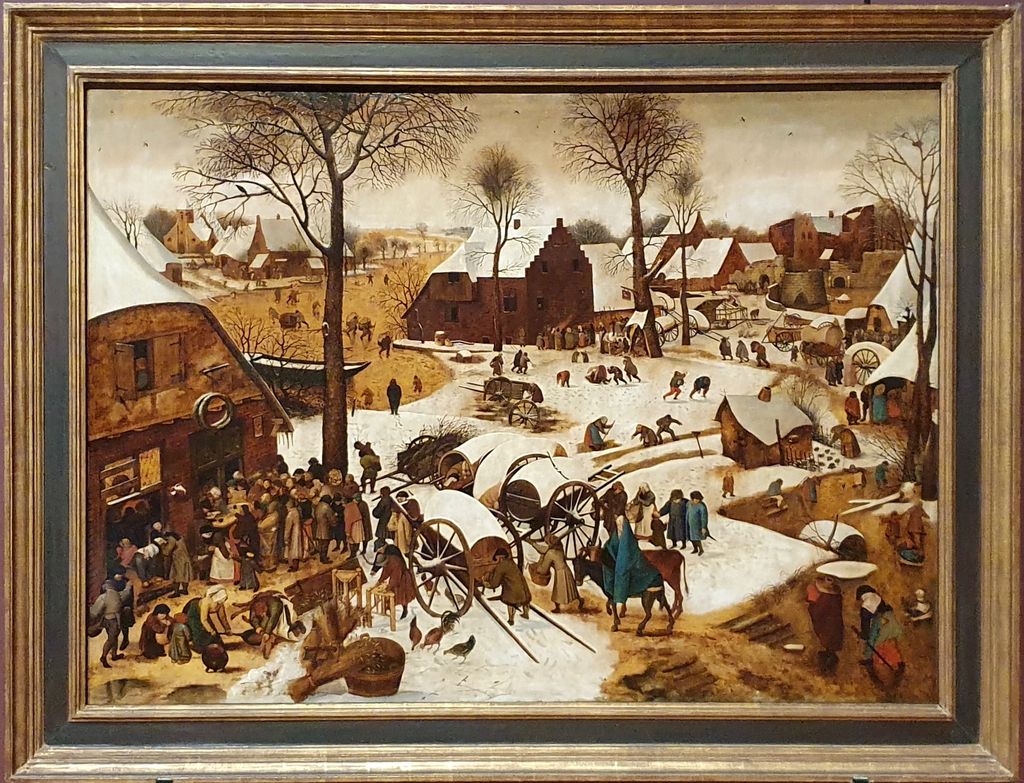
Pieter Bruegel the Elder's The Census at Bethlehem is one of the great biblical paintings of the northern Renaissance, but it hides its sacred story in plain sight. Joseph and Mary arrive in Bethlehem not as central, spotlit protagonists but as small figures in a crowded winter village. Around them, people register, pay, carry, slaughter, slide, queue, warm themselves, tend animals and move through snow.
Painted in 1566, the work is now in the Royal Museums of Fine Arts of Belgium in Brussels. The museum identifies it as De volkstelling te Bethlehem, oil on oak, signed and dated at the lower right, and measuring 115.5 x 163.5 cm [1]. It belongs to Bruegel's mature period, when he was living in Brussels and producing some of the most ambitious panel paintings of his career.
The painting's brilliance lies in its controlled misdirection. The title points to the Gospel of Luke, in which Joseph travels with the pregnant Mary to be registered under a decree of Caesar Augustus. Bruegel moves that episode into a sixteenth-century Netherlandish village under snow. The result is at once a religious picture, a winter landscape and a dense image of civic life [2] [3].
For readers coming to Pieter Bruegel the Elder through his peasant scenes or paintings, The Census at Bethlehem shows how flexible his art could be. He does not abandon biblical narrative. He embeds it inside ordinary time. The holy family enters a world of taxation, weather, local practice and daily necessity, and the viewer has to notice them amid everyone else.
At a Glance
- ArtistPieter Bruegel the Elder
- TitleThe Census at Bethlehem; Dutch title De volkstelling te Bethlehem
- Date1566
- Medium/supportOil on oak
- Dimensions115.5 x 163.5 cm
- Signature/dateSigned and dated lower right: BRVEGEL / 1566, according to the RMFAB record
- Present collectionRoyal Museums of Fine Arts of Belgium, Brussels
- InventoryInv. 3637
- SubjectJoseph and Mary arriving at Bethlehem for the Roman census, set in a contemporary Netherlandish winter village
- Related themesBiblical narrative, winter landscape, taxation, village life, Bruegel family copies
- Related Bruegel pagesPaintings, Landscapes and Seasons, Hunters in the Snow, Massacre of the Innocents, Workshop, Copies and Attribution
This work across Bruegel’s career
Tower of Babel
1563The Harvesters
1565Peasant Wedding
1568Children's Games
1560Triumph of Death
1562–1563Contents
- Introduction
- Object Facts And Brussels Context
- The Biblical Census In A Netherlandish Winter Village
- What Bruegel Shows
- Composition And Hidden Sacred Narrative
- Taxation, Civic Life And Contemporary Setting
- Winter Light, Snow And Daily Work
- Copies And Pieter Brueghel The Younger
- Relation To Massacre Of The Innocents And Other Winter Biblical Scenes
- Why The Painting Matters
- Annotated Details
Object Facts And Brussels Context
The Brussels painting is the autograph basis for the composition. RMFAB lists it under Pieter I Bruegel, dates it to 1566, and records it as oil on oak. The object record also notes its lower-right signature and date and gives the museum's acquisition from the Edmond Huybrechts sale in Antwerp in May 1902 [1].
Those basic facts matter because The Census at Bethlehem is also one of the Bruegel compositions that later circulated in copies. A viewer may encounter versions by Pieter Brueghel the Younger or by his workshop and assume they are the same object. They are not. The Brussels panel of 1566 is the original painting by Pieter Bruegel the Elder; later versions belong to the afterlife of the design.
The date places the work just after the great 1565 season paintings, including Hunters in the Snow, and before Bruegel's death in 1569. It therefore belongs to the moment when his winter imagery, broad landscapes and large crowds were reaching exceptional refinement. RMFAB's account of the painting stresses precisely that balance: the scene appears busy and dispersed, yet its colors, viewpoints and compositional lines are carefully ordered [2].
The museum context also helps explain why the picture has been read beyond its biblical subject. RMFAB presents the painting as one of its important Bruegel winter works, alongside Winter Landscape with Skaters and Bird Trap. A later RMFAB publication on Bruegel's winter scenes emphasizes historical context, the precarious conditions of winter life and the relation between Bruegel, patrons and central authority, while still treating these as matters for careful interpretation rather than simple political slogans [5].
Annotated Details from The Census at Bethlehem
Find Mary and Joseph among the carts, then follow the crowd towards the inn.
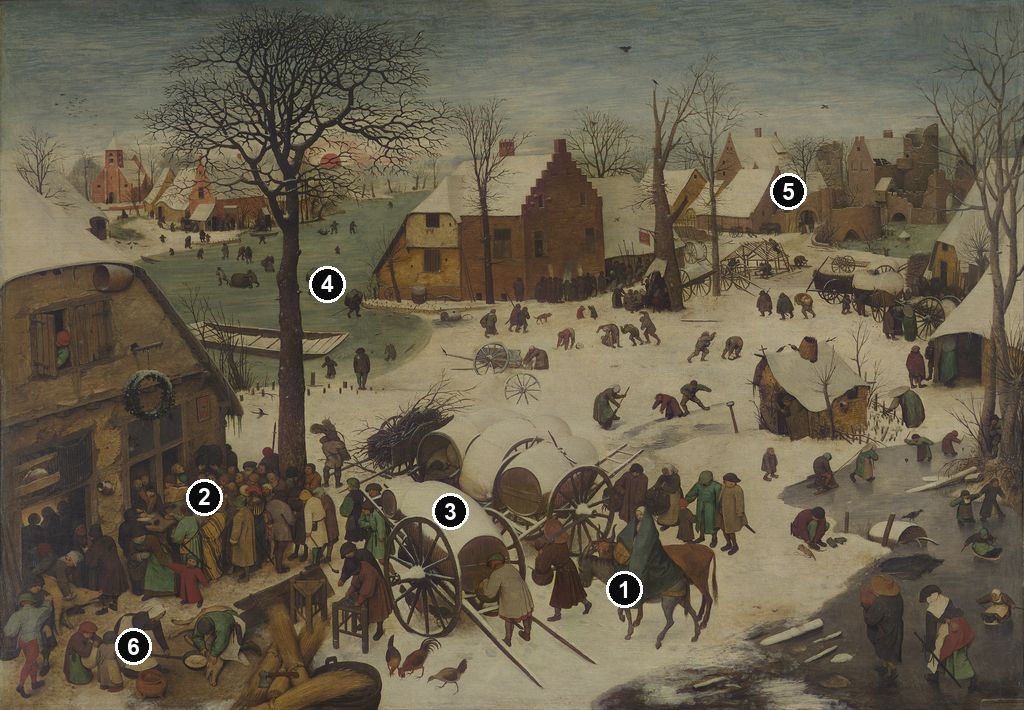
Details from THE CENSUS AT BETHLEHEM
Six details trace the biblical journey and the village around it.
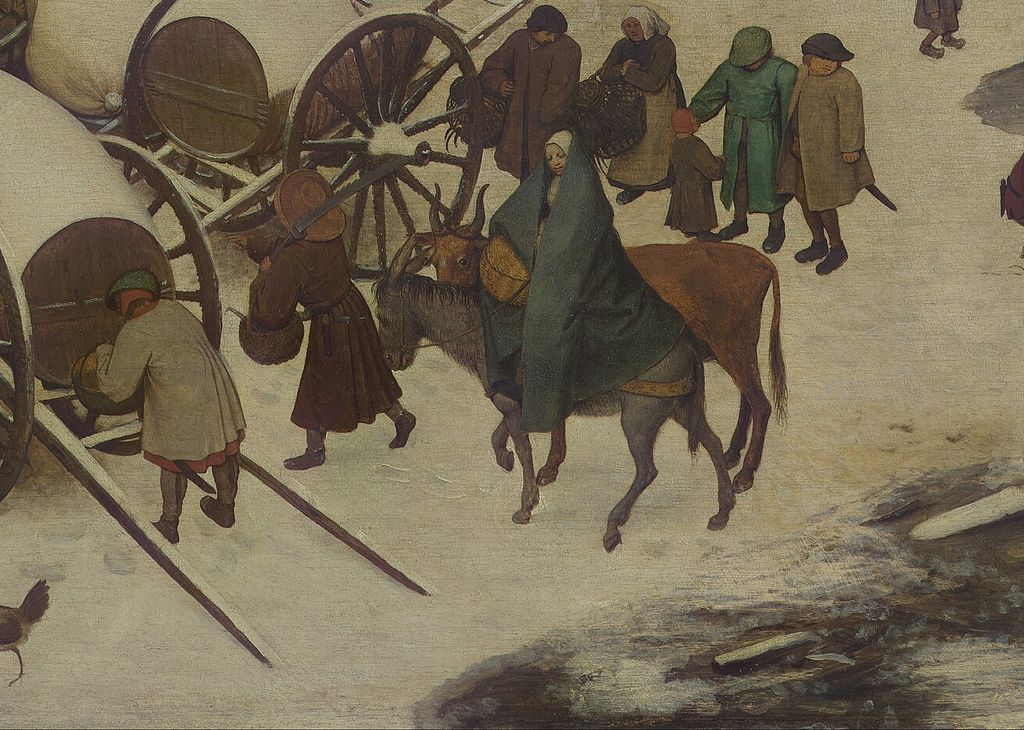
Mary and Joseph
Mary rides the donkey and Joseph walks ahead of her.
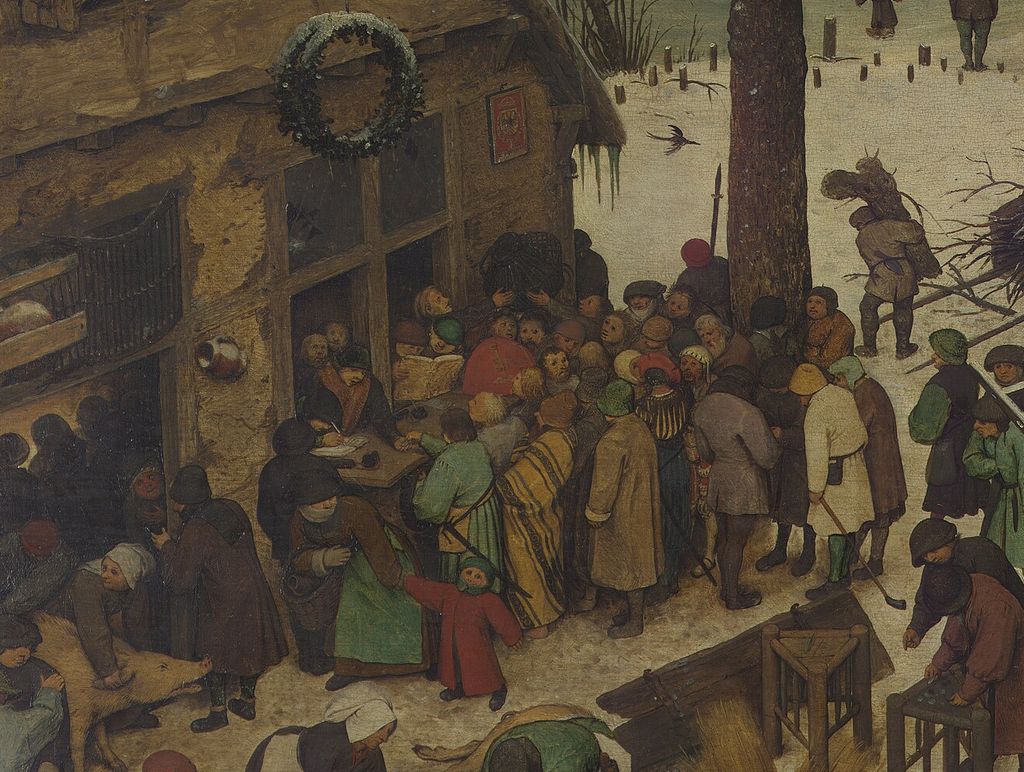
The registration crowd
People gather outside the building at the left.
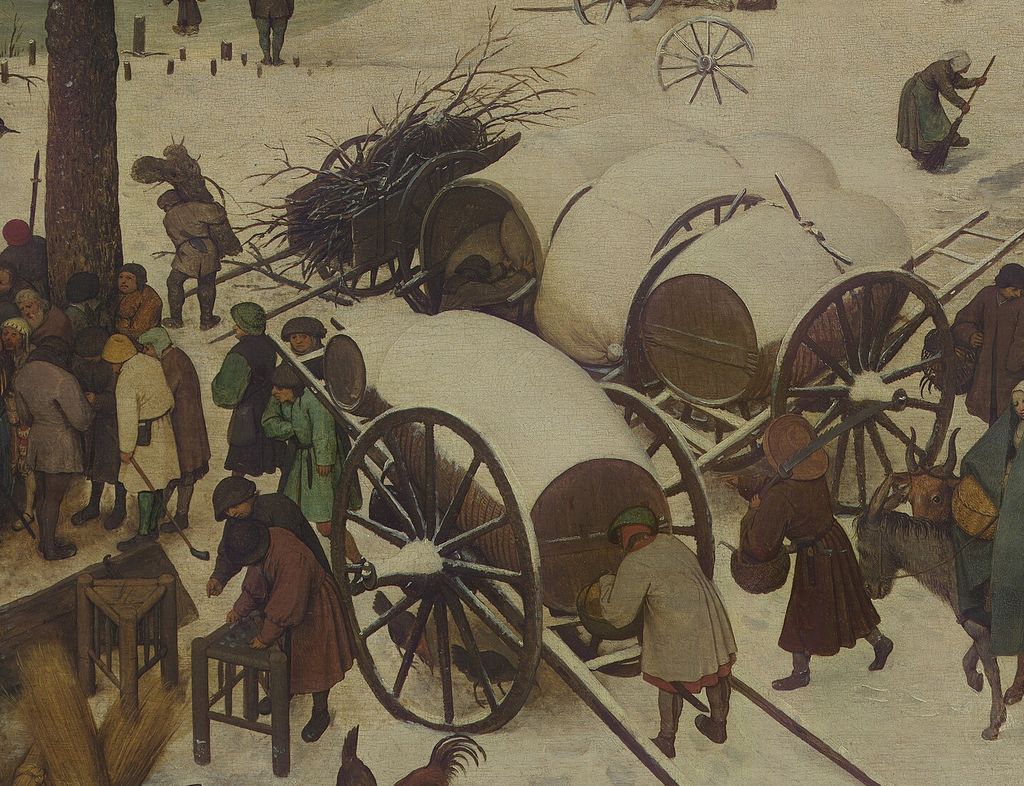
The covered carts
Spoked wheels and curved covers stand out against the snow.
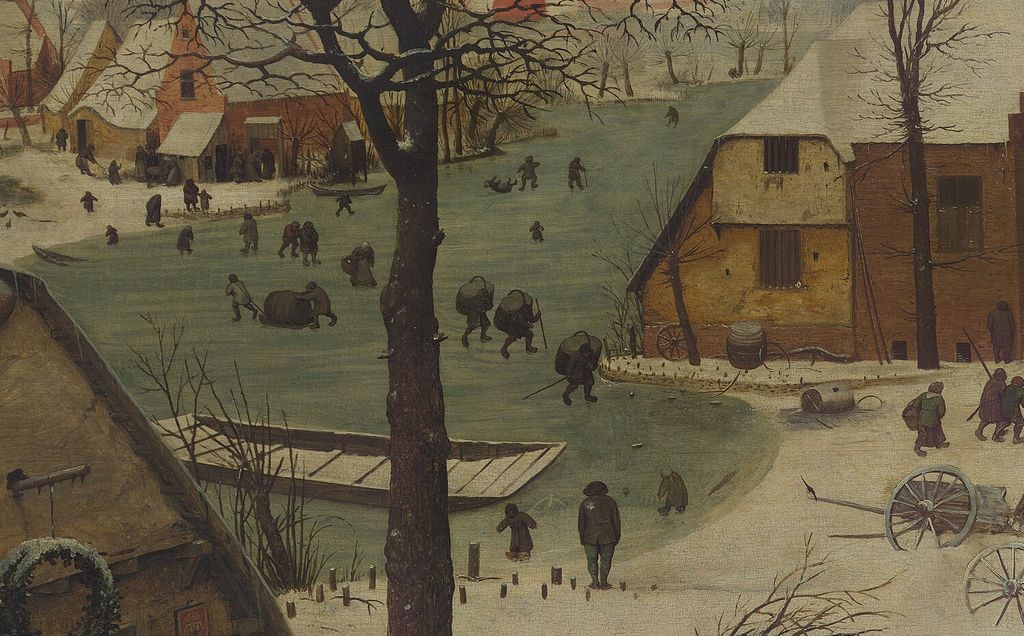
The frozen water
Small figures cross the greenish ice behind the large tree.
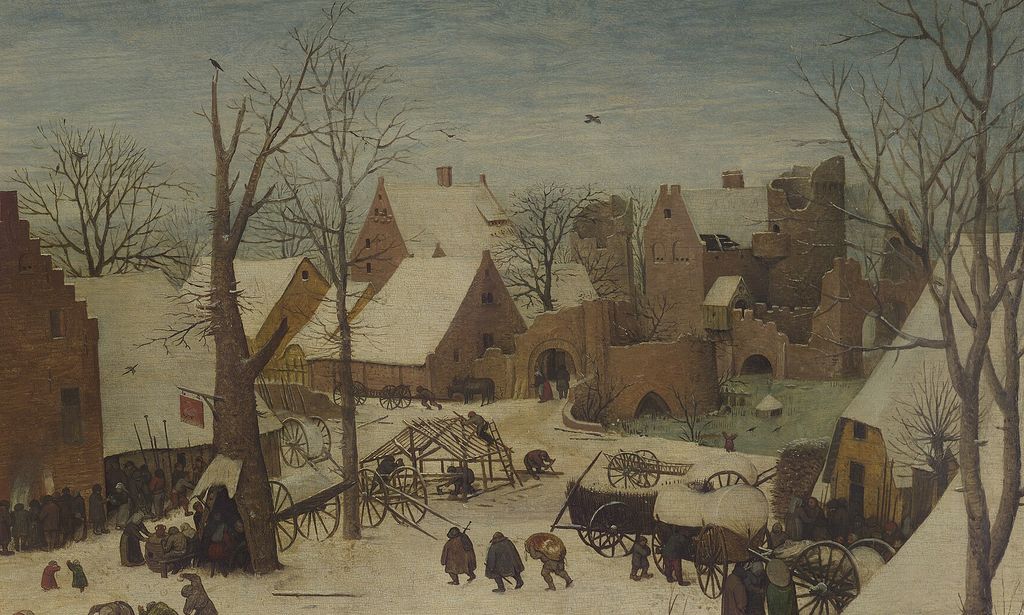
The village and ruined walls
Snow-covered roofs and broken masonry line the far edge of the village.
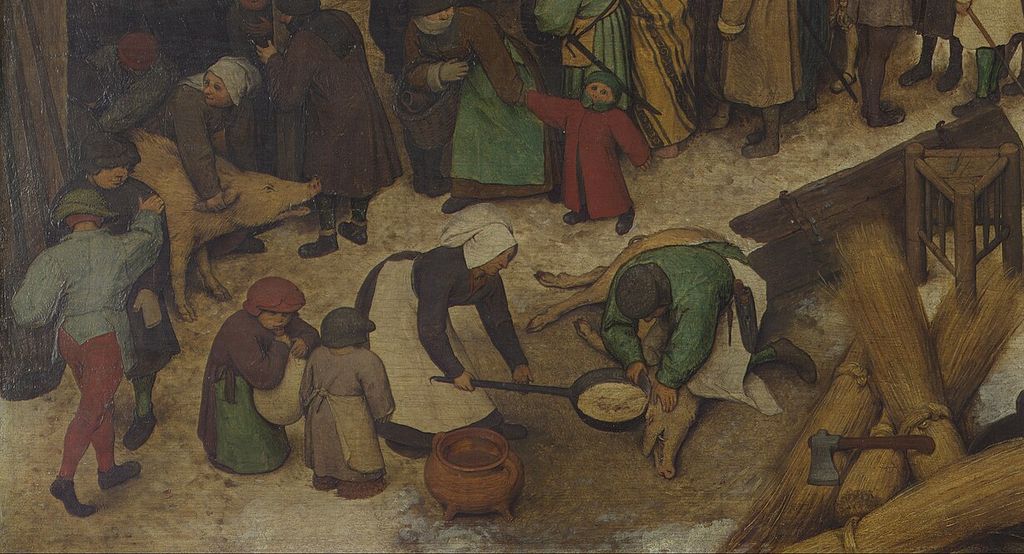
The work at the lower left
Several people crouch around a pig in the snow.
Pieter Bruegel the Elder, The Census at Bethlehem, 1566. Royal Museums of Fine Arts of Belgium, 3637. Reproduction via Wikimedia Commons.
The Biblical Census In A Netherlandish Winter Village
The biblical story comes from Luke's account of the decree that sends people to be registered. Joseph travels to Bethlehem with Mary, who is pregnant, because he belongs to the line of David. Bruegel includes that story, but he does not stage it in ancient Judea. He sets it in a snow-covered village of the Low Countries, with Flemish buildings, winter clothing, local tools and everyday movement [2] [3].
Mary is shown in a blue cloak, seated on a donkey. Joseph walks nearby, guiding the animal and approaching the place where registration is taking place. They are not large. They are not isolated. There is no theatrical beam of light, no empty foreground reserved for devotion, no compositional command that forces the viewer to see them first.
That decision is central to the painting. Bruegel makes the sacred arrival almost ordinary, but not trivial. The holy family enters the same cold, crowded, administratively burdened world as everyone else. The biblical event is not removed from daily life; it takes place inside it.
Museum Mayer van den Bergh usefully describes the picture as three things at once: a religious painting, a scene of everyday life and a winter landscape [3]. That formula is simple, but it gets close to the painting's special power. None of the three categories cancels the others. The winter setting is not decoration around the religious story. The daily activity is not background noise. The biblical subject gives the crowd a hidden center, while the crowd gives the biblical subject a human world.
Bruegel's transposition also belongs to a longer northern tradition in which sacred events could be placed in contemporary interiors, streets or landscapes. The RMFAB story compares the practice with earlier Netherlandish painting, where religious scenes were sometimes translated into familiar local settings [2]. Bruegel's version is more radical because the crowd and landscape are so dominant. Scripture does not arrive in a carefully cleared stage; it enters a village that is already full.
What Bruegel Shows
The first impression is snow and busyness. The village is white, grey, brown and ochre, punctuated by reds in clothing and signs. Roofs carry snow. Carts move through frozen ground. People crowd around the inn. Children play. Adults work. Animals are led, fed, loaded or slaughtered. The eye moves from one small action to the next.
Near the inn, people are registering and paying. One person appears to hand over money, while another figure records information. RMFAB identifies this gathering as a financial transaction and connects it with official registration [2]. The biblical census has been translated into the visible practices of payment, paperwork and waiting in line.
The inn is one of the composition's key anchors. Its sign reads In De Swaen, meaning At the Swan, according to the RMFAB story [2]. It is not a dignified classical building, but a tavern-like village structure, full of local social and administrative activity. The contrast is part of Bruegel's wit: the place where salvation history enters the painting is also a crowded point of bureaucracy and business.
Nearby, a pig is being slaughtered. This detail can feel blunt, even startling, because it is so physical. It marks winter as a season of food preparation, need and labor. RMFAB's close reading notes the pig-slaughter scene and also discusses how some historians have interpreted it in relation to taxation and hardship [2]. The safest way to read the detail is to let it remain both concrete and suggestive. It is a winter practice, a sign of material life and a possible pressure point in a painting about payment and authority.
Children are everywhere. Some play with spinning tops; others slide on frozen water or engage in snowball fights. RMFAB emphasizes the lively precision of these tiny actions, and Museum Mayer van den Bergh also notes the children playing around the registration scene and across the middle distance [2] [3]. Their games do not stop the biblical story. They show that, in Bruegel's world, large events unfold amid ordinary distractions.
Animals add another layer of life. The donkey carrying Mary is essential to the story, but there are also birds, chickens, pigs and a bull. RMFAB draws attention to the bull in the foreground, whose presence helps lead the viewer toward Mary and Joseph [2]. The animal world is not secondary. It makes the village dense, practical and physical.
Composition And Hidden Sacred Narrative
The painting looks crowded, but it is not disorderly. Bruegel uses a high viewpoint, allowing the viewer to look down into the village and across the snow. RMFAB notes that the vantage point sits above the action and helps organize the whole scene [2]. The viewer becomes a kind of elevated observer, able to see more than any single figure in the painting could see.
Diagonals structure the composition. One broad diagonal separates the closer lower-left zone from the farther upper-right distance. Another path leads from the inn toward the ruins in the distance and intersects near the center, where a loose wheel lies [2]. These lines matter because they keep the picture from becoming a scatter of anecdotes. The village is busy, but the eye is guided.
Vertical accents also help. Bare trees punctuate the snowy space and give rhythm to the distance. Buildings create blocks of weight. Hunched figures supply repeated dark shapes against pale ground. Bruegel balances geometric structures with moving bodies, so that the painting feels both stable and alive.
This is why the holy family can be almost hidden without being lost. Mary and Joseph are small, but once seen they quietly reorganize the picture. The viewer realizes that the crowd at the inn is not merely village business; it is the registration that brings them to Bethlehem. The everyday scene becomes the biblical scene.
Bruegel had used crowds and dispersed attention before, and he would continue to do so. But The Census at Bethlehem is especially subtle because the sacred subject is not simply one episode among many. It is the reason the painting has its title, yet Bruegel makes the viewer earn that recognition. Looking becomes a form of discovery.
The effect is different from a conventional nativity image. There is no manger in the center and no adoring circle arranged around the child. The painting takes place before the birth, in the administrative and physical conditions that precede it. Cold, distance, payment and crowded lodging become part of the story's atmosphere.
Taxation, Civic Life And Contemporary Setting
The painting's registration scene has often encouraged political readings. That is understandable. Bruegel painted the work in 1566, in the Habsburg Netherlands, at a moment of tension over rule, religion and taxation. The red cupboard or sign bearing the Habsburg arms above the inn, noted by RMFAB, makes authority visible in the village [2].
Still, the painting should not be reduced to a direct protest image. RMFAB raises the question of heavy taxation under Spanish rule and notes that some art historians have interpreted details such as the slaughtered pig in political terms, but the museum's wording remains exploratory [2]. That caution is important. Bruegel's scene can evoke the pressures of authority and taxation without needing to be treated as a one-message political poster.
What is certain is that Bruegel makes official registration look local and material. The census is not an abstract decree. It becomes a crowd outside an inn, a hand passing money, a clerk writing, villagers waiting in snow, animals standing nearby and daily labor continuing around the edges. Authority is present not as a remote imperial idea but as a small administrative event in a cold village.
This is where the contemporary setting matters most. The Roman census and sixteenth-century Low Countries are not fused by accident. Bruegel makes the biblical past legible through the social machinery of his own time. In doing so, he shows how sacred history can feel close, and how contemporary public life can acquire biblical weight.
The village itself is not romanticized. It is active, crowded and vulnerable. People work in winter conditions. They carry sacks, load carts, tend fires and negotiate ice. The RMFAB winter publication points to the precarious situation of local populations during winter and to the relationship between Bruegel's art, patrons and central power [5]. That context supports a serious reading of the painting's social world, provided we keep the language measured.
Bruegel's audience also matters. Like many of his mature paintings, this was not art made for the village people it depicts. Bruegel's patrons and collectors belonged to educated urban and courtly circles. That distance complicates the picture. It is observant and humane, but it is also a crafted image of ordinary life made for people with cultural and economic power.
Watch Bruegel’s art
Explore Bruegel with TheHistoryOfArt and artwork discussions from Smarthistory.
Pieter BRUEGEL Explained in 10 Minutes (updated)
A TheHistoryOfArt film about Bruegel.
Watch on YouTubeWinter Light, Snow And Daily Work
The Census at Bethlehem is one of Bruegel's great winter paintings. Snow covers the ground, roofs and roads, but it does not simplify the world into white silence. Instead, snow reveals tracks, labor, cold movement and social gathering. It makes the village harder to cross and easier to read.
RMFAB stresses Bruegel's skill in depicting snowy surfaces and winter skies, noting the subtle range of whites and the material handling of paint in the picture [2]. The snow is not a blank field. It has thickness, dirt, pressure and variety. People and animals leave marks in it. Buildings catch it. Frozen water turns it into play.
The winter setting also changes the biblical mood. Joseph and Mary are not arriving in a warm, luminous Bethlehem. They enter a cold northern village at the edge of evening. The painting has often been connected with the night before Christmas, a point made in the RMFAB story [2]. That temporal setting gives the picture a strong Advent feeling: the birth is near, but not yet visible.
Compared with Hunters in the Snow, painted the previous year, The Census at Bethlehem is more narrative and civic. Hunters makes winter itself the dominant subject: exhausted hunters, a frozen valley, skaters below and mountains beyond. The Census uses winter to transform a biblical event into a social world. Both paintings show Bruegel's gift for cold, but they use it differently.
The relation to Bruegel's landscapes and seasons is therefore strong, even though The Census at Bethlehem was not part of the seasons cycle. KHM's account of the Seasons emphasizes six large panels made for Niclaes Jongelinck's country house and divided according to a six-period Low Countries year [6]. The Census shares the same broad interest in weather, human scale and daily activity under seasonal pressure.
Bruegel's winter is never only picturesque. Cold makes people adapt. It turns water into a road or playground. It slows travel. It gathers people at fires and doors. It exposes poverty and labor. It also gives the painting its extraordinary visual unity.
Copies And Pieter Brueghel The Younger
The Antwerp copy has its own history. Museum Mayer van den Bergh dates its production provisionally to before 1600 and treats it as one of thirteen versions produced by Pieter Brueghel the Younger and his workshop. The museum points out that colours vary and that details can disappear or change between panels. Those changes matter especially in a picture whose subject is easy to walk past. A red garment, a dark animal or the people at the door can carry different weight in a copy. Begin a comparison with dated and identified panels, including the 1566 original in Brussels and the painting in Antwerp, then look at one incident at a time [3] [1].
The changes can also make the earlier image easier to understand. When a copy repeats an incidental detail, the comparison can reveal how much of the design the workshop transmitted. When a painter leaves one out, the record of what is lost can tell us which passages later owners saw. That is a question about transmission and the life of these particular panels. The familiar resemblance of the village scene alone cannot establish that two pictures share the same date, surface or maker [3] [4].
The fame of The Census at Bethlehem is visible in its copy tradition. Museum Mayer van den Bergh states that the original of 1566 is in Brussels and that its own copy was probably made before 1600. It also explains that Pieter Brueghel the Younger and his workers made thirteen versions in total [3].
This afterlife needs careful wording. Pieter Brueghel the Younger was Bruegel the Elder's son, but his versions are not the 1566 original. They are later works after the father's invention, sometimes varying color and sometimes omitting or changing details [3]. RMFAB also holds a 1610 version by Pieter II Brueghel after Pieter I Bruegel, oil on oak, signed and dated on a barrel [4].
The most intriguing evidence concerns preparatory material. Museum Mayer van den Bergh notes that a detail appears in all the copies but can only be seen in Bruegel the Elder's preparatory drawing. The museum concludes that Pieter Brueghel the Younger used that drawing by his father when making copies [3]. This is important because it suggests that the son was not merely copying the finished Brussels painting from sight.
RMFAB's story reaches a similar point through comparison. It notes differences between Bruegel the Elder's painting and copies, including color choices and details that are absent or misread. It also suggests that Pieter Brueghel the Younger may not have had direct access to the original painting and may have relied on preparatory sketches or related models [2].
For the wider problem of Bruegel attribution, this painting is a useful case study. The copy tradition is not an embarrassment around the original. It is evidence of demand, family inheritance and workshop practice. A copy can preserve clues about lost drawings or about how a famous design moved through the market. But the original object basis remains essential: the Brussels 1566 panel by Pieter Bruegel the Elder is not interchangeable with later Brueghel versions.
That distinction is explored more broadly in Workshop, Copies and Attribution. It is especially important for Bruegel because many compositions became famous through versions made after his death, and because the spelling difference between Bruegel the Elder and Brueghel the Younger often signals different generations and different kinds of object.
Relation To Massacre Of The Innocents And Other Winter Biblical Scenes
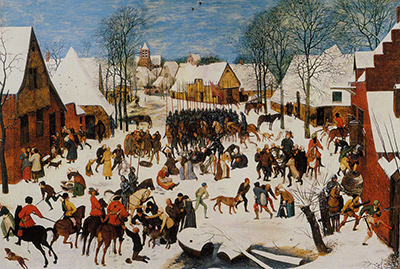
The Census at Bethlehem belongs beside Bruegel's other biblical scenes set in Netherlandish surroundings. The most important comparison is Massacre of the Innocents, a horrifying subject from Matthew translated into a snowy village under armed violence. The Royal Collection Trust identifies its painting as by Pieter Bruegel the Elder, about 1565-67, and explains that the original slaughtered children were painted over early in the work's history [7].
The comparison clarifies Bruegel's method. In both pictures, biblical events are not placed in a distant antique world. They happen in the social and political language of the sixteenth-century Netherlands: village streets, snow, soldiers or officials, crowds, local buildings and winter hardship. But the emotional registers differ. Massacre of the Innocents is violent and traumatic, even when later overpaint complicates what we see. The Census at Bethlehem is quieter, more bureaucratic and more anticipatory.
Both pictures also ask the viewer to look past ordinary appearances. In the Massacre, the visible surface can seem like plunder or village disorder until the biblical horror beneath the overpaint is understood [7]. In the Census, the scene can look like winter village life until Mary, Joseph and the registration theme become clear. Bruegel uses everyday visibility to conceal and reveal sacred history.
The relation to Winter Landscape with a Bird Trap is different. That painting is not a biblical narrative, but it shares Bruegel's fascination with village winter, small figures, ice and danger. RMFAB's winter publication treats Winter Landscape with Skaters and Bird Trap and The Census at Bethlehem as exceptional Brussels winter works [5]. Together, they show that winter was not a passing motif for Bruegel. It was a pictorial language for testing human activity against cold, risk and social order.
The relation to the seasons cycle adds one more dimension. The Census at Bethlehem is not one of the six seasonal panels, but it draws on the same ability to organize human life through weather. Bruegel's mature landscapes and winter scenes make the world feel coherent without making it simple.
Why The Painting Matters
The Census at Bethlehem matters because it changes how religious painting can work. It does not reject sacred narrative, and it does not turn the Bible into mere genre painting. Instead, it makes the sacred difficult to separate from daily life. Mary and Joseph arrive among people who are too busy, too cold, too burdened and too absorbed to recognize the scale of what is happening.
That hiddenness gives the painting its emotional force. The viewer knows more than the villagers. We can identify Mary in blue on the donkey; we can connect the crowd with Luke's census; we can see that the registration scene is not only local business. But Bruegel refuses the comfort of a cleared center. Revelation enters a world that is not ready for it.
The painting also matters as a winter landscape. Bruegel's snow has social intelligence. It reveals how people move, gather, work, play and endure. It changes the weight of carts, the behavior of children, the meaning of fire and the mood of authority. The weather is not background. It is one of the painting's main actors.
As a picture of civic life, the work is equally sharp. Registration, payment and official oversight are visible, but they do not dominate every inch. They are part of a larger web of ordinary necessity. Bruegel shows authority as something that touches villagers through queues, money, records and signs. That makes the painting historically suggestive without requiring an overconfident claim of direct political intent.
Finally, the copy tradition shows how powerful the image became. Pieter Brueghel the Younger and his workshop repeated the design, and later copies preserve clues about preparatory material and family transmission [3] [2]. The composition did not remain a single museum object. It became a Bruegel family inheritance.
For all these reasons, The Census at Bethlehem is one of the best places to understand Bruegel's mature art. It joins biblical story, winter landscape, crowd composition, social observation and the afterlife of copies in a single panel. It is full of noise and cold, but its deepest drama is quiet: the holy family has arrived, and almost no one notices.
Discussion
What feels most revealing about Pieter Bruegel the Elder: the village detail, the landscape setting, the moral wit, or the way everyday life becomes a complete world?
Reader Insights
Begin with one small action in a Bruegel scene, then follow how it connects to the surrounding figures, setting and rhythm of the whole image.
Connect the work to Northern Renaissance visual culture, printmaking, proverb traditions and Bruegel's interest in rural and urban life.
Which detail changes the interpretation most once you know the subject, date, proverb source or present collection?
Join the Conversation
Have a thought or observation about Pieter Bruegel the Elder? Share it below. Thoughtful responses may be added to this section as the Bruegel pages develop.
Frequently Asked Questions
Painted in 1566, the work is now in the Royal Museums of Fine Arts of Belgium in Brussels. The museum identifies it as De volkstelling te Bethlehem , oil on oak, signed and dated at the lower right, and measuring 115.5 x 163.5 cm . [1]
The Brussels painting is the autograph basis for the composition. RMFAB lists it under Pieter I Bruegel, dates it to 1566, and records it as oil on oak. [1]
Near the inn, people are registering and paying. One person appears to hand over money, while another figure records information. [2]
References
- Royal Museums of Fine Arts of Belgium, Pieter I Bruegel, De volkstelling te Bethlehem, View source.
- Royal Museums of Fine Arts of Belgium on Google Arts & Culture, The Census at Bethlehem, View source.
- Museum Mayer van den Bergh, The Census at Bethlehem, View source.
- Royal Museums of Fine Arts of Belgium, Pieter II Brueghel (naar Pieter I Bruegel), De volkstelling te Bethlehem, View source.
- Royal Museums of Fine Arts of Belgium, Bruegels wintertaferelen: Historici en kunsthistorici in dialoog, View source.
- Kunsthistorisches Museum Vienna, Six Seasons for a Dining Room, View source.
- Royal Collection Trust, Massacre of the Innocents, View source.








