


 by Tom Gurney
Tom Gurney BSc (Hons) is an art history expert with over 20 years experience
Published on June 19, 2020 / Updated on August 16, 2026
Email: tomgurney1@gmail.com / Phone: +44 7429 011000
Pieter Bruegel Disputed Attributions: Introduction
Pieter Bruegel the Elder's name is attached to some of the most famous images in northern Renaissance art, but not every Bruegel-related object has the same attribution status. Some paintings are accepted as autograph works by Bruegel the Elder. Some are copies after his compositions. Some are associated with his sons or wider family. Some preserve a Bruegel invention but may not be by his hand. A few remain under active technical and scholarly discussion.
This page is a concise guide to the main disputed or attribution-sensitive cases in the Bruegel pages. For a broader explanation of copies, family names and museum labels, see workshop, copies and attribution. For the main list of secure and questioned works together, see Bruegel paintings.
At a Glance
- Best habitread the artist line before relying on the title.
- Most famous questioned caseLandscape with the Fall of Icarus.
- Most important altered objectMassacre of the Innocents, where RCT identifies the painting as by Bruegel but explains early historic overpaint.
- Common copy problemworks after Bruegel, especially by Pieter Brueghel the Younger or his circle, may repeat famous compositions.
- Name cautionBruegel the Elder, Pieter Brueghel the Younger and Jan Brueghel the Elder are not interchangeable.
- Date cautiona work dated after 1569 cannot be by Pieter Bruegel the Elder, though it may preserve his design.
Contents
- Introduction
- Why Bruegel Attribution Is Complicated
- Landscape With The Fall Of Icarus
- Massacre Of The Innocents
- Winter Landscape With A Bird Trap
- The Wine Of Saint Martin's Day
- Bruegel, Brueghel And Copies
- How To Read Labels
- Why Disputed Attributions Matter
Why Bruegel Attribution Is Complicated
Bruegel's surviving painted oeuvre is small. The Royal Museums of Fine Arts of Belgium describes Bruegel originals as extremely rare and notes that only about forty paintings are preserved [1]. At the same time, Bruegel's compositions were copied and circulated widely, especially through his family.
That combination creates confusion. A museum visitor may see a familiar title and assume the object is by Pieter Bruegel the Elder. The label may say something more precise: "after Pieter Bruegel the Elder," "Pieter Brueghel the Younger," "circle of," "copy after," or "Pieter I Bruegel (?)". Those phrases change the meaning of the object.
Attribution is not only a question of market value. It affects interpretation. An accepted autograph painting can tell us about Bruegel's handling, support, revisions and design decisions. A copy can tell us about demand, transmission, workshop practice and lost models. A questioned painting can show where the evidence remains unsettled.
The safest approach is therefore exact language. Do not upgrade a cautious label in order to simplify a famous image.
Landscape With The Fall Of Icarus
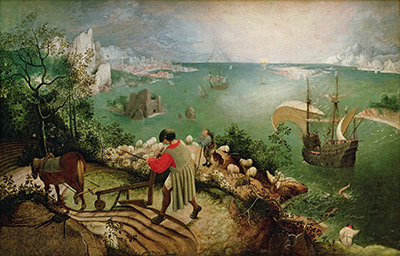
Landscape with the Fall of Icarus is the clearest attribution-sensitive artwork page in the Bruegel section. The Brussels painting is famous, but the Royal Museums of Fine Arts of Belgium currently lists it under "Pieter I Bruegel (?)" [2].
The museum announced on April 9, 2026 that new technical research was underway because doubts have been expressed about the painting's attribution, dating, painting technique and extent of restoration [3]. The work is being examined with the Royal Institute for Cultural Heritage using non-invasive analyses and scientific imaging, with results expected for an autumn 2028 Bruegel exhibition [3].
Public wording should therefore remain cautious. It is fine to call the composition famous, Bruegel-related or traditionally associated with Bruegel. It is not responsible to present the Brussels canvas as a secure autograph Bruegel work.
This does not make the painting unimportant. Its image of Icarus almost hidden in a landscape has shaped generations of viewers. The question is not whether the picture matters, but how the surviving object should be described.
Massacre Of The Innocents
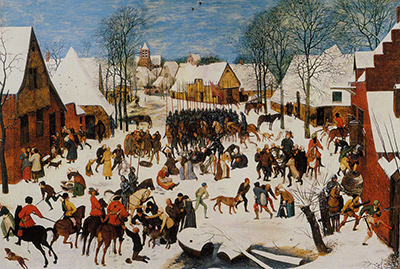
Massacre of the Innocents is not the same type of problem as Icarus. The Royal Collection Trust identifies its painting as by Pieter Bruegel the Elder, about 1565-67, RCIN 405787 [4]. The complication is the painting's early overpaint and copy history.
RCT explains that Bruegel originally painted the slaughter of children from the Gospel of Matthew in a snowy Netherlandish village. Very early in the painting's history, before 1621, the most disturbing details were painted over so that murdered children became bundles, food or animals [4]. During conservation in the 1980s, most of this old overpaint was retained because it had become part of the work's history [4].
There is also a related KHM version, but KHM identifies that object as a copy after Pieter Bruegel the Elder, probably by Pieter Brueghel the Younger [5]. The two objects should not be conflated. One is the Royal Collection painting with historic overpaint; the other is a copy-after comparison.
Watch Bruegel’s art
Explore Bruegel with TheHistoryOfArt and artwork discussions from Smarthistory.
Pieter BRUEGEL Explained in 10 Minutes (updated)
A TheHistoryOfArt film about Bruegel.
Watch on YouTubeThis case shows why object basis matters. A title alone cannot tell the full story.
Winter Landscape With A Bird Trap
Winter Landscape with a Bird Trap is a famous winter composition with an unusually large copy tradition. RMFAB identifies the Brussels 1565 winter scene as a Bruegel masterpiece and describes it as Bruegel's most-copied work [1].
The danger is treating every version of the image as the same painting. KHM notes a 1601 version in its own collection as a circle work and one of the oldest, highest-quality examples after the composition, not as an autograph work by Pieter Bruegel the Elder [6].
The practical rule is simple: when discussing the Brussels RMFAB painting, name that object. When discussing later versions, say copy, circle, follower or after Bruegel where the museum label does.
The copy tradition is not a weakness in the image's history. It is evidence of the composition's popularity. But popularity should not erase attribution.
The Wine Of Saint Martin's Day
The Wine of Saint Martin's Day shows the positive side of attribution research. The Prado identifies the painting as Pieter Bruegel the Elder, 1566-67, painted in glue-size tempera on linen [7].
The work entered the Prado for study in 2009. Prado's restoration account explains that cleaning and technical analysis revealed Bruegel's distinctive handling beneath later varnish and condition problems. The attribution was confirmed when a worn signature and remains of a Roman-numeral date reappeared [8].
This case is useful because attribution research does not always downgrade a work. Sometimes evidence supports acceptance. But it should not be treated as a promise that every questioned Bruegel-related painting will become autograph. Each object must be judged on its own evidence.
Bruegel, Brueghel And Copies
The spelling distinction is helpful, though older sources are not always consistent. Pieter Bruegel the Elder is usually written without the "h." His sons are normally written Pieter Brueghel the Younger and Jan Brueghel the Elder, with the "h."
Pieter Brueghel the Younger was especially important as a copyist after his father's compositions. KHM presents the elder artist as the founder of a painting dynasty and notes the later family afterlife of his work [6]. Copies by the son and workshop can be historically valuable, but they are not the same as paintings by the father.
This matters for pages such as Census at Bethlehem, where the original 1566 Brussels painting should be separated from later versions by Pieter Brueghel the Younger and his workshop. Museum Mayer van den Bergh explains that copies of the Census may preserve evidence connected to a preparatory drawing by Bruegel the Elder [9].
Copies can be evidence-rich. They can preserve lost details, show demand, reveal workshop practice or continue a famous invention. They simply need to be named accurately.
How To Read Labels
A changed date and an altered attribution can look similar on a label. The Antwerp panel of Dulle Griet shows why the distinction is worth keeping. Treatment revealed its dated signature and changed the date used for the same painting. The Düsseldorf drawing belongs to a different question. Christina Currie and her colleagues studied the sheet in relation to the Antwerp panel and found evidence that it was made after the painting. Its outlines and colours can preserve evidence of a composition’s transmission without turning the drawing into the original artist’s design for the panel [10] [11].
Before comparing the images, write down which institution holds each object and whether the caption describes a painting, drawing or print. Then check what changed in the account. A year revised after cleaning is a finding about the Antwerp panel. A shift from a preparatory drawing to an early copy is a change in how the Düsseldorf sheet fits into the history of the composition. That distinction is also useful for The Fall of Icarus, where the age of an object and its attribution remain separate claims [11] [3].
Here is a practical reading order:
- Start with the artist line, not the title.
- Check whether the label says Pieter Bruegel the Elder, Pieter Brueghel the Younger, after, copy after, circle, follower or attributed to.
- Check the date. Anything after 1569 cannot be by Pieter Bruegel the Elder.
- Check the support and medium, especially for technical cases such as Icarus or The Wine of Saint Martin's Day.
- Check whether the museum itself uses a question mark.
- Treat copies and questioned works as important, but do not silently upgrade them.
This is not pedantry. It is how the artwork keeps its real history.
Why Disputed Attributions Matter
Disputed attributions matter because they make viewers more honest. They prevent famous images from absorbing every object around them. They also reveal how art history works: through labels, technical study, comparison, conservation, provenance and changing evidence.
Bruegel is especially good for this kind of learning because his name became powerful quickly. His designs were copied. His sons built careers under the family name. Museums inherited objects with old labels, old restorations and old assumptions. Modern research has to sort through that history carefully.
The reward is not a smaller Bruegel. It is a clearer one. Secure paintings can be admired as secure paintings. Copies can be valued as copies. Questioned works can remain fascinating without being forced into certainty. That is the best way to respect both the artist and the objects that carry his reputation.
Discussion
What feels most revealing about Pieter Bruegel the Elder: the village detail, the landscape setting, the moral wit, or the way everyday life becomes a complete world?
Reader Insights
Begin with one small action in a Bruegel scene, then follow how it connects to the surrounding figures, setting and rhythm of the whole image.
Connect the work to Northern Renaissance visual culture, printmaking, proverb traditions and Bruegel's interest in rural and urban life.
Which detail changes the interpretation most once you know the subject, date, proverb source or present collection?
Join the Conversation
Have a thought or observation about Pieter Bruegel the Elder? Share it below. Thoughtful responses may be added to this section as the Bruegel pages develop.
Frequently Asked Questions
Bruegel's surviving painted oeuvre is small. The Royal Museums of Fine Arts of Belgium describes Bruegel originals as extremely rare and notes that only about forty paintings are preserved . [1]
Landscape with the Fall of Icarus is the clearest attribution-sensitive artwork page in the Bruegel section. The Brussels painting is famous, but the Royal Museums of Fine Arts of Belgium currently lists it under "Pieter I Bruegel (?)" . [2]
Massacre of the Innocents is not the same type of problem as Icarus . The Royal Collection Trust identifies its painting as by Pieter Bruegel the Elder, about 1565-67, RCIN 405787 . [4]
Winter Landscape with a Bird Trap is a famous winter composition with an unusually large copy tradition. RMFAB identifies the Brussels 1565 winter scene as a Bruegel masterpiece and describes it as Bruegel's most-copied work . [1]
References
- Royal Museums of Fine Arts of Belgium, "Bruegel. The Originals.", View source.
- Royal Museums of Fine Arts of Belgium, "Pieter I Bruegel (?) De val van Icarus.", View source.
- Royal Museums of Fine Arts of Belgium, "New technical study of The Fall of Icarus.", View source.
- Royal Collection Trust, "Massacre of the Innocents.", View source.
- Kunsthistorisches Museum, "Massacre of the Innocents.", View source.
- Kunsthistorisches Museum, "Pieter Bruegel the Elder.", View source.
- Museo Nacional del Prado, "The Wine of Saint Martin's Day.", View source.
- Museo Nacional del Prado, "The Wine of Saint Martin's Day" restoration and exhibition text, View source.
- Museum Mayer van den Bergh, "The Census at Bethlehem.", View source.
- Museum Mayer van den Bergh, Restoration Dulle Griet reveals unseen wealth of colour and fresh discoveries, View source.
- Christina Currie, Dominique Allart, Sonja Brink and Steven Saverwyns, The Coloured Drawing of the Dulle Griet in the Kunstpalast, Düsseldorf: New Findings on its Status and Dating, 2021, View source.







