


 by Tom Gurney
Tom Gurney BSc (Hons) is an art history expert with over 20 years experience
Published on June 19, 2020 / Updated on August 16, 2026
Email: tomgurney1@gmail.com / Phone: +44 7429 011000
Pieter Bruegel Wine of Saint Martin's Day: Introduction
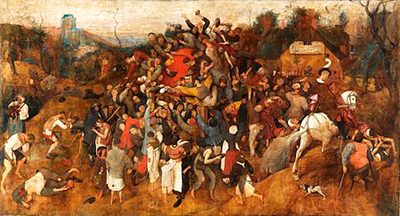
Pieter Bruegel the Elder's The Wine of Saint Martin's Day is one of the Prado's most important Bruegel works and one of the most striking rediscoveries in the artist's modern catalogue. The museum lists the painting as Bruegel the Elder, dated 1566-1567, made in glue-size on twill canvas, and measuring 148 x 270.5 cm [1].
The picture shows the Saint Martin's Day wine festival, a late autumn celebration attached to 11 November. Bruegel places a huge red wine barrel at the centre of the scene and packs the space around it with people trying to get wine in pots, jugs, hats, shoes and whatever else they can hold. At the right, Saint Martin divides his cloak for a beggar. The painting's force comes from the contrast between that act of charity and the disorderly appetite of the crowd [1] [2].
This page explains the object facts, the festival subject, Bruegel's crowd design, the importance of the tuchlein medium, and the Prado's confirmation and restoration of the painting. For wider context, see the overview of Pieter Bruegel the Elder, the guide to his paintings, and the introduction to Bruegel's style and technique.
At a Glance
- ArtistPieter Bruegel the Elder
- TitleThe Wine of Saint Martin's Day
- Date1566-1567
- Medium and supportGlue-size tempera on linen; Prado's technical data describes glue-size on twill / twill weave canvas
- Dimensions148 x 270.5 cm
- CollectionMuseo Nacional del Prado, Madrid
- Inventory numberP008040
- SubjectThe wine festival associated with Saint Martin's Day on 11 November
- Key visual contrastCrowd greed and drunken excess around the barrel set against Saint Martin's charity
- Modern importanceA major Bruegel rediscovery confirmed through Prado study, cleaning, signature evidence and restoration
This work across Bruegel’s career
Tower of Babel
1563The Harvesters
1565Peasant Wedding
1568Children's Games
1560Triumph of Death
1562–1563The Wine of Saint Martin's Day
This artworkContents
- Introduction
- Object Facts And Prado Context
- Saint Martin's Day And The Wine Festival
- The Barrel And The Crowd
- Saint Martin And The Charity Group
- Tuchlein And Glue-Size Tempera On Linen
- Rediscovery, Attribution And Restoration At The Prado
- Relation To Bruegel's Crowd Scenes
- Why The Painting Matters
- Annotated Details
Object Facts And Prado Context
The Prado collection record identifies The Wine of Saint Martin's Day as a work by Pieter Bruegel the Elder, dated 1566-1567, with the inventory number P008040 [1]. Its scale is exceptional: at 148 x 270.5 cm, it is a wide, crowded composition rather than a small devotional panel or a compact proverb picture.
The support and technique are just as important as the dimensions. Prado's collection data gives the technique as glue-size and the support as twill / twill weave canvas [1]. The museum's 2011 account describes the work as glue-size tempera on linen and explains that it belongs to a type often called a tuchlein: a painting made on unprimed cloth, prepared only with animal size and painted in a glue-bound tempera rather than in oil [2].
That matters because many famous Bruegel paintings, including works such as The Tower of Babel, are panel paintings. The Wine of Saint Martin's Day belongs to a more fragile tradition of painted cloth. Prado stresses that this technique was common in fifteenth- and sixteenth-century Flanders, but that relatively few examples have survived [2].
The painting also matters for the Prado's Bruegel holdings. When the museum presented the restored work in 2011, it noted that the acquisition gave the Prado two paintings by Bruegel the Elder: The Wine of Saint Martin's Day and The Triumph of Death [2]. The pairing is useful for readers because the two Prado pictures show very different sides of Bruegel's imagination. The Triumph of Death is a panoramic moral catastrophe; The Wine of Saint Martin's Day is a festive crowd scene in which appetite, disorder and charity collide.
Annotated Details from The Wine of Saint Martin’s Day
Follow the surge of people toward the wine, then look to the right where Martin divides his cloak.
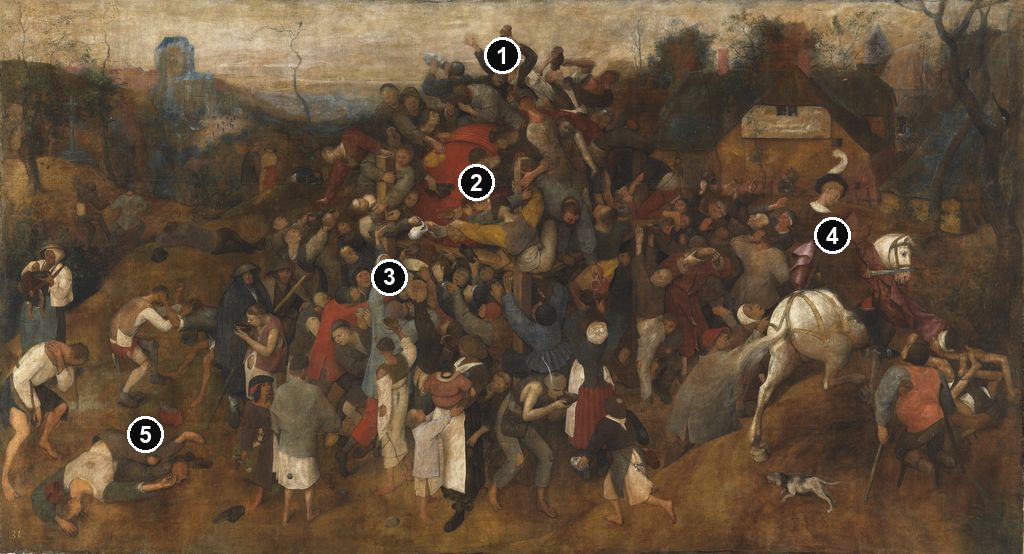
Details from THE WINE OF SAINT MARTIN’S DAY
The details bring the changes of height, gesture and pace into view.
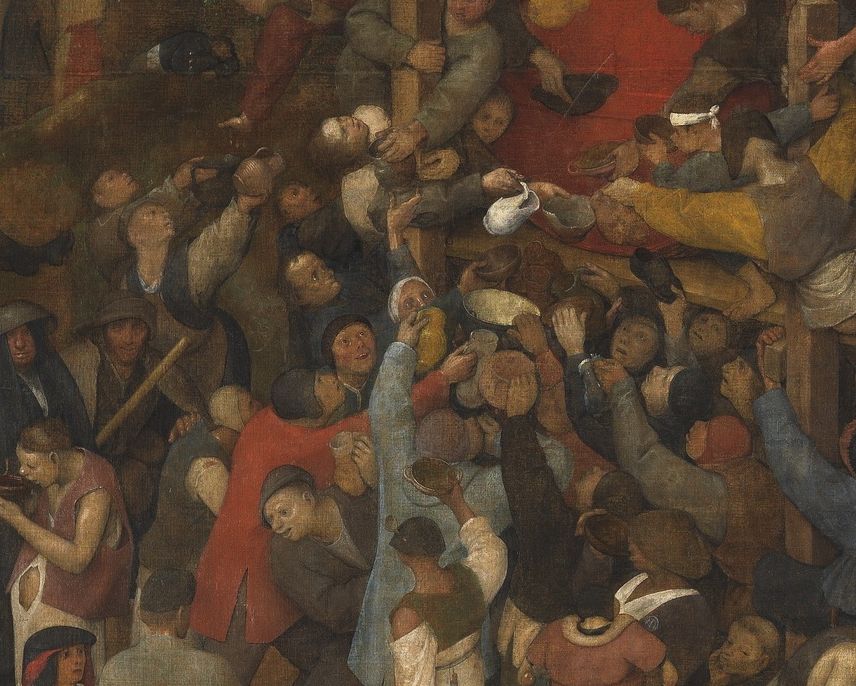
Raised cups
Held aloft above the press of bodies, the vessels have almost the whole sky behind them. This is where the crowd reaches its greatest height.
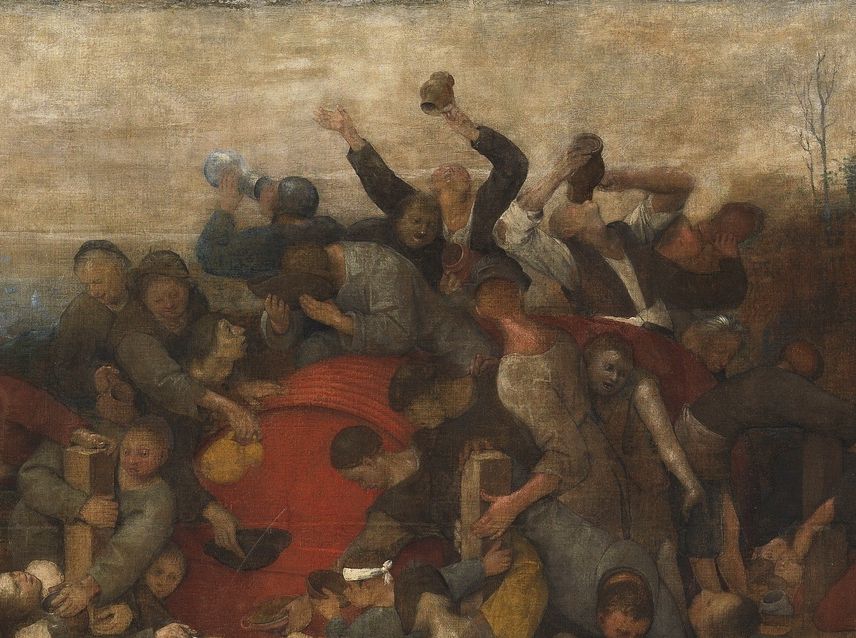
The red barrel
The barrel is surrounded by faces and outstretched hands. Its curved red surface makes it easier to follow the way the crowd gathers around its centre.
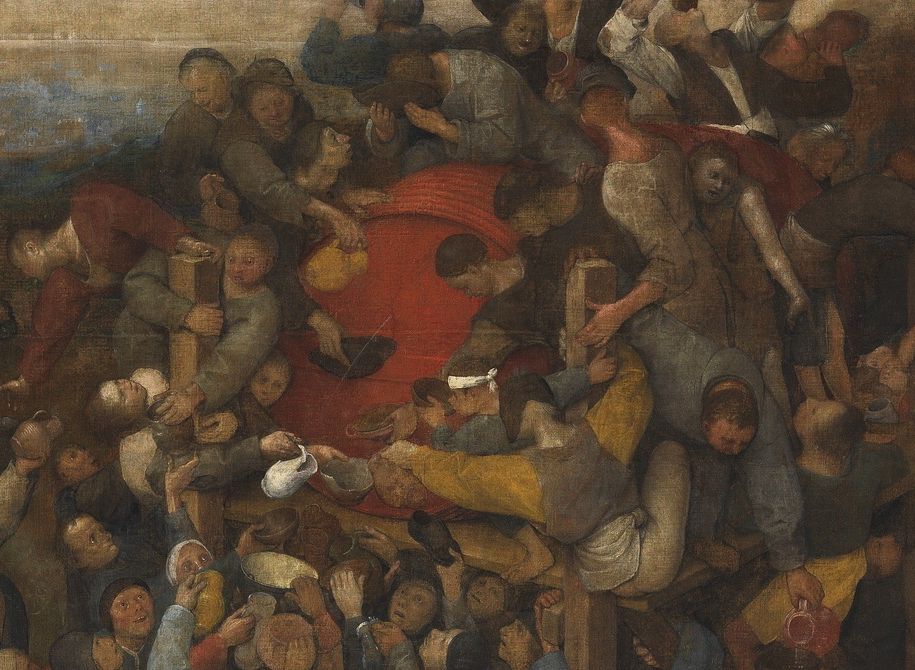
Reaching for the wine
A light sleeve and the vessels held overhead make the direction of the gestures clear. People at different heights are reaching into the same patch of space.
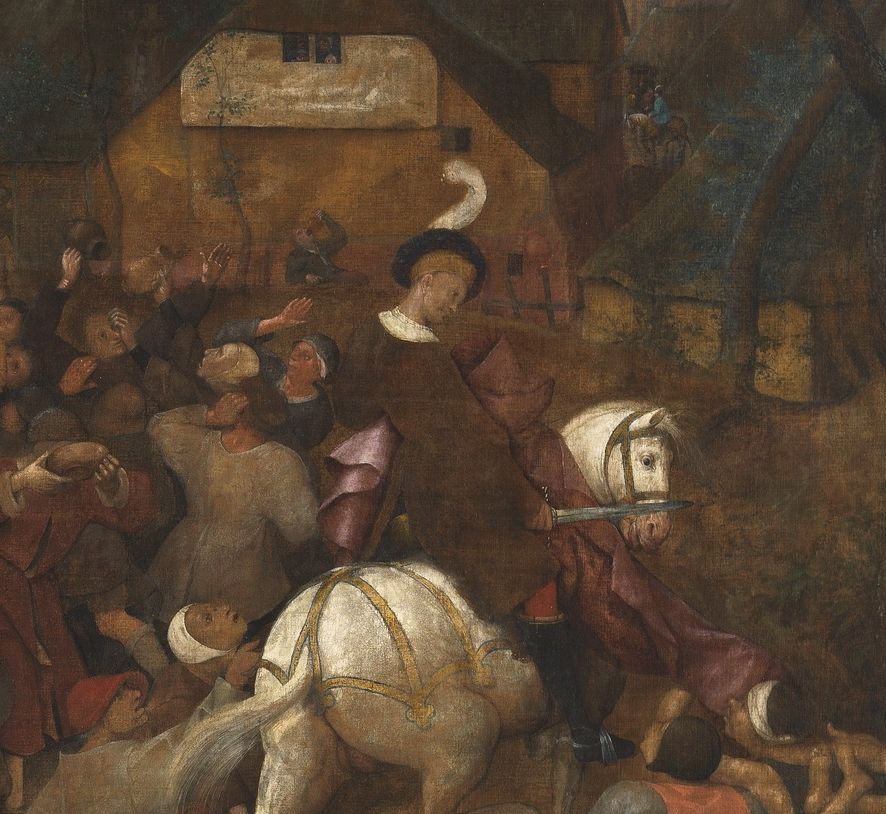
Martin and the cloak
Look at the rider’s hands, the line of the sword and the cloak. The pale horse makes this group legible beside the crush of people at the barrel.
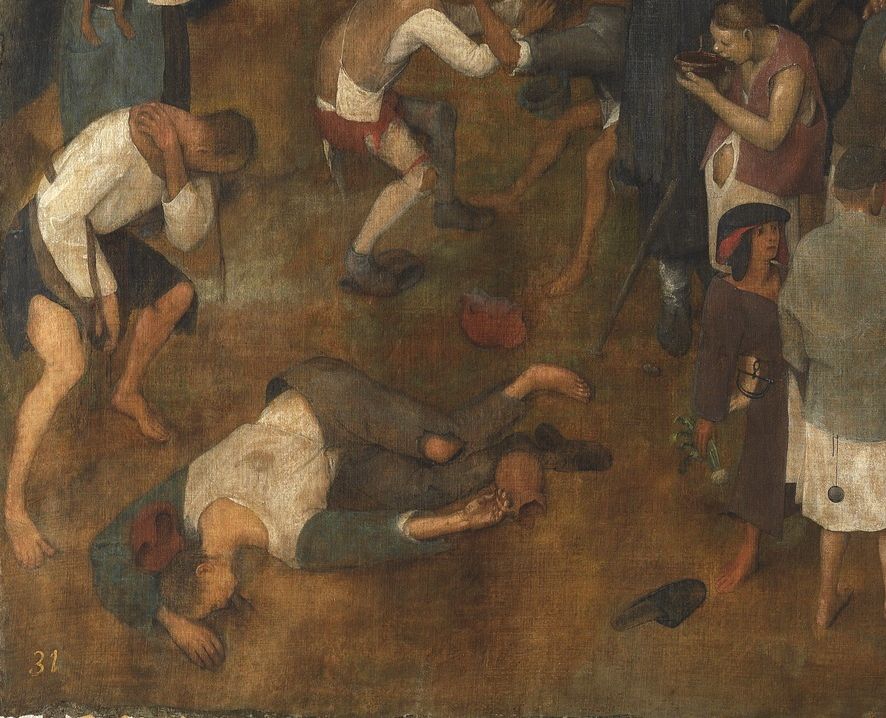
Along the road
At the edge of the scene the figures have more ground around them. Their postures range from kneeling to lying almost flat, a contrast with the bodies that climb toward the top of the barrel.
Saint Martin's Day And The Wine Festival
The painting's subject is not simply Saint Martin as an isolated holy figure. Prado explains that the 11 November feast was connected with several late autumn customs: eating Saint Martin's goose, the winter pig-killing, the end of the grape harvest, and the sampling of the year's new wine [1] [2].
Because the saint's day coincided with the end of the wine harvest, the feast became associated with the distribution of free wine to country people outside city gates. Bruegel uses that custom as the basis for a huge social scene. The setting is late autumn, with bare trees and a city gate that Prado says recalls the Porte de Hal in Brussels [2].
The date is important. Bruegel is not showing spring renewal, summer labor or a settled winter landscape. He is showing a threshold moment near the end of the agricultural year, when harvest, slaughter, drinking, feast custom and religious calendar meet. The result is a scene that feels neither fully sacred nor merely secular. Saint Martin is present, but the crowd has turned the day into a noisy scramble for wine.
Prado is careful on this point. The museum says that, despite the saint's presence, the picture is not a devotional work, but also not simply a genre scene. Its focus is the celebration of Saint Martin's Day as it was observed in Flanders and the Germanic world, where the feast could take on a near-carnival character [1] [2].
That framing helps prevent two easy mistakes. The first is to treat the painting as a conventional religious image, as if the saint's act alone controls the whole meaning. The second is to treat it as a neutral scene of everyday festivity. Bruegel gives the feast a moral charge. He turns custom into a test of appetite, charity and social behaviour.
The Barrel And The Crowd
The first thing most viewers notice is the vast red barrel raised on a wooden platform. Prado describes it as the centre of the composition, surrounded by a varied crowd of old and young men, women, children, peasants, beggars and thieves, all trying to get as much wine as possible [2].
Bruegel does not arrange this crowd as a tidy procession. He makes it climb, lean, press and sprawl. Some people have already filled their containers and returned to the ground. Others cling to the wooden supports, stretch across the barrel, or lean forward dangerously as wine comes out. Prado notes the range of containers: not only proper vessels, but hats and shoes [1] [2].
This is one of Bruegel's great crowd inventions. The people form a moving mass rather than a set of isolated figures. The eye can pause on individual incidents, but the larger impression is of collective pressure. The wine pulls bodies toward itself. Arms reach, backs bend, mouths open, and improvised vessels turn the feast into a test of ingenuity and desperation.
Prado describes the group as around one hundred figures and compares the mass of drinkers to a human mountain, even a kind of Tower of Babel made from drinkers [1] [2]. That comparison is especially suggestive for Bruegel. In the Vienna Tower of Babel, human labour piles itself into an impossible structure. Here, human appetite piles itself around a barrel.
The resemblance is not a claim that the two paintings have the same subject. It is a way to see Bruegel's compositional intelligence. He can make a crowd behave like architecture. He can use bodies to build a shape, then let that shape carry the meaning. Around the barrel, the crowd's physical structure expresses moral disorder.
Saint Martin And The Charity Group
On the right side of the painting, Saint Martin divides his cloak for a beggar. Prado notes that the saint is dressed like a fifteenth-century patrician, following a tradition in which Martin appears not as a rough soldier from antiquity but as a richly dressed figure of charity [2].
This group is much more stable than the crowd around the barrel. Prado contrasts the circular or mountain-like crowd at the centre with the more stable pyramidal group around Saint Martin [2]. The difference matters. Bruegel gives charity a shape: composed, deliberate, legible. He gives appetite another shape: crowded, unstable, excessive.
The saint's action is also quiet compared with the central frenzy. He is not the biggest figure in the painting and he does not dominate the composition by scale. Instead, Bruegel asks the viewer to find him beside the louder action. The moral contrast depends on looking carefully. The festival is named for Martin, but the crowd's behaviour threatens to drown out the virtue attached to his feast.
The scene therefore works by irony. A saint's day has become an occasion for greed. A feast connected with charity has become a struggle for consumption. The people around the barrel are not simply enjoying wine; many are competing for it, spilling toward it, and losing their composure because of it.
On the left, Prado identifies figures who show the effects of drinking: a person about to vomit, one lying unconscious, two men fighting, and a woman giving wine to a baby [1] [2]. These details make the moral argument harsher. Bruegel is not condemning festivity by itself. He is showing what happens when feast custom is overtaken by excess.
This concern connects the picture to Bruegel's wider peasant imagery, though the word "peasant" should not flatten the scene. The crowd includes different kinds of people, and the painting was made for a sophisticated culture of viewing. Bruegel's art often lets elite, urban or courtly viewers look at rural custom while also confronting human folly more generally.
Tuchlein And Glue-Size Tempera On Linen
The medium is not a technical footnote. It is central to why the painting looks and survives as it does. Prado explains that a tuchlein was painted on unprimed linen, usually prepared only with animal size. The paint consisted of glue-size tempera, which did not allow the thick impasto or translucent glazes familiar from oil painting [2].
This helps explain the surface. The method encouraged direct painting in one or two layers. Prado also notes that there is very little underdrawing, because such works were typically executed directly, alla prima [2]. In other words, the image depends on Bruegel's confidence of placement, outline and brushwork rather than on a heavily built oil technique.
The support described by Prado is a very fine, regular linen with a taffeta weave [2]. A cloth support of this kind is physically different from an oak panel. It can wrinkle, deform, split and respond to old lining treatments. The painting's later conservation history therefore cannot be separated from its original format.
Tuchlein paintings were also vulnerable because their glue-bound paint layers and cloth supports were less durable than oil on panel. Prado's comment that relatively few have survived gives the object an added historical importance [2]. The Wine of Saint Martin's Day is not merely another late Bruegel composition; it is a rare survival of a Flemish cloth-painting practice on an extraordinary scale.
The medium also affects how viewers should look. The painting's energy lies in outline, rhythm and tonal placement. Bruegel's red barrel, the dark accents of figures and scaffolding, the pale losses and recovered passages, and the fine network of bodies all belong to a technique that rewards close attention to surface. The picture is visually rich, but its richness is not the built-up depth of oil glaze. It is the speed, clarity and economy of a direct cloth technique.
Rediscovery, Attribution And Restoration At The Prado
The order of the discoveries matters. The painting reached the Prado for study in November 2009 through Sotheby’s. Bruegel’s name had already been associated with it in the collection it came from. The Prado examined the work as a painted textile and investigated the surface before the crucial evidence became legible. In September 2010 the signature reappeared during treatment, and the museum acquired the work later that year. At the public display in 2011, an X-ray and a video let viewers follow parts of the restoration beside the painting [2] [3].
Here the chronology of treatment helps explain how attribution works. The old association with Bruegel made the painting worth studying. The signature gave the museum a much stronger basis for attribution, in combination with examination of the object. And exposing parts of a mark on the fragile surface is a different achievement from making a faded textile look new. The restoration’s evidence for how the painting was made belongs alongside the subject, with its busy street and the saint’s quieter charitable action at one side [3] [1].
The modern history of The Wine of Saint Martin's Day is unusually dramatic. Prado says the painting came to the museum in November 2009 through Sotheby's from an old Spanish collection, where it had traditionally been attributed to Pieter Bruegel the Elder. It entered for study with a possible view to acquisition [2].
The collection record adds that the painting had been practically unknown, and that it had been mentioned and reproduced in a 1980 article by Matias Diaz Padron, who attributed it to Pieter Brueghel the Younger without having seen it first hand [1]. That earlier attribution history is part of why the Prado confirmation was so important. The work moved from a scarcely known, uncertainly understood canvas to an accepted Bruegel the Elder after direct study, technical examination and restoration.
Prado's 2011 account says technical analyses revealed Bruegel's distinctive pictorial handwriting beneath a thick polyester varnish. As that varnish was removed, the technique and style became visible again. The attribution was further confirmed when the signature reappeared in September 2010 [2].
The restoration also revealed the remains of a Roman-numeral date, recorded as "M.D.L [...]," and the collection record now lists the inscription "BRVEGEL" at the lower left [1] [2]. This evidence matters because Bruegel attributions cannot be upgraded by wishful thinking. In this case, the museum presented the accepted attribution as the result of examination, cleaning, signature evidence and conservation work.
Prado acquired the painting at the end of 2010 and presented it publicly after restoration in December 2011 [2]. The museum described the definitive attribution as one of the most important discoveries in Bruegel's oeuvre in many years [2]. That language should be understood carefully. It does not mean that all uncertain Bruegel-related works are likely to become autograph works. It means this particular painting survived with enough technical, stylistic and physical evidence to support a major change in status.
The restoration was complex. Prado describes work on both the support and the paint layer: removing later strips, old fills, repainting and inserts; dealing with splits and holes; removing the relining and old adhesive by controlled humidification; reinforcing weak areas; and mounting the painting in a system designed to support and protect the original cloth [2].
The paint-layer work aimed to make the composition readable again without pretending that losses had never occurred. Prado says the cleaning clarified the composition, groups of figures and landscape depth, while making Bruegel's black outlines, characteristic brushstrokes and hatched shadows easier to see [2].
The restoration also made changes in the working process visible. Prado identifies a major pentimento involving the figure drinking on the upper part of the barrel: Bruegel altered the spatial position of the barrel and covered an earlier white shirt with the barrel's red paint, though the white now shows through. Other changes include adjustments to Saint Martin's horse [2].
Those observations are valuable because they show the painting as a made object, not only an image with a title. Bruegel was composing directly on cloth, adjusting forms, clarifying space and using the barrel's colour as a structural force. The Prado's recovery of the surface allows the viewer to see more of that thinking.
Relation To Bruegel's Crowd Scenes
The Wine of Saint Martin's Day belongs with Bruegel's great scenes of collective behaviour. It is not a peasant interior like Peasant Wedding, not a proverb encyclopedia like Netherlandish Proverbs, and not an architectural meditation like The Tower of Babel. Yet it shares something with all of them: Bruegel's ability to make social action legible through structure.
The barrel group is the clearest example. Bruegel turns a crowd into a form that can be read from across the room, then fills that form with incident. This is the same kind of intelligence that makes his major paintings so durable. The viewer first sees the pattern, then enters the particulars.
The picture also extends Bruegel's interest in feast, custom and rural behaviour. In works connected to peasant imagery, Bruegel often shows communal events through a mixture of observation, comic force and moral pressure. Here, the Saint Martin festival gives him a subject where all three could meet. The custom is specific, the crowd is vivid, and the moral tension is built into the contrast between the saint and the drinkers.
The comparison with The Tower of Babel is especially productive because Prado itself invokes a Tower-like mass of drinkers [2]. In both cases, Bruegel thinks with accumulation. The tower accumulates bricks, floors, labourers and ambition. The Saint Martin painting accumulates bodies, vessels, gestures and appetite. Each pile becomes a moral image.
Yet The Wine of Saint Martin's Day is also distinct. The support is cloth, not panel. The scene is tied to a named autumn feast. The rediscovery history is central to the painting's modern importance. No other Bruegel page quite has this combination of festival subject, tuchlein technique and modern technical confirmation.
Why The Painting Matters
The painting matters first because it is a major accepted work by Pieter Bruegel the Elder. The Prado's object record gives the artist, date, medium, support, dimensions, inventory number and current collection status [1]. For an artist with a small surviving painted oeuvre, the recovery of a large late work is a major event.
It matters next because the subject is unusually rich. Saint Martin's Day brings together religious commemoration, seasonal change, food customs, wine harvest, free distribution, begging, charity and carnival-like excess. Bruegel does not reduce that mixture to a simple lesson. He lets the feast remain crowded, comic, harsh and morally unstable.
It matters technically because it preserves a large-scale example of glue-size tempera on linen. Prado's explanation of the tuchlein medium helps readers understand why the painting's survival, condition and restoration are all part of its meaning [2]. The object is fragile evidence of a practice that has left fewer surviving works than panel painting.
Finally, it matters because its modern history is evidence-led. The painting arrived at the Prado for study in 2009. Cleaning and technical work removed a distorting varnish layer, recovered the surface, brought back the signature and date remains, and supported the accepted attribution [2]. The result is not only a restored image. It is a case study in how conservation, connoisseurship, inscriptions, technique and museum scholarship can change the known shape of an artist's oeuvre.
For readers approaching Pieter Bruegel the Elder through his most famous crowd scenes, The Wine of Saint Martin's Day is essential because it shows him at full scale in a rare medium, on a popular festival subject, with charity and excess locked into one extraordinary composition. It is one of the clearest examples of why Bruegel's art still feels so alert to human behaviour: he can make a crowd funny, troubling and structurally brilliant at the same time.
Discussion
What feels most revealing about Pieter Bruegel the Elder: the village detail, the landscape setting, the moral wit, or the way everyday life becomes a complete world?
Reader Insights
Begin with one small action in a Bruegel scene, then follow how it connects to the surrounding figures, setting and rhythm of the whole image.
Connect the work to Northern Renaissance visual culture, printmaking, proverb traditions and Bruegel's interest in rural and urban life.
Which detail changes the interpretation most once you know the subject, date, proverb source or present collection?
Join the Conversation
Have a thought or observation about Pieter Bruegel the Elder? Share it below. Thoughtful responses may be added to this section as the Bruegel pages develop.
Frequently Asked Questions
Pieter Bruegel the Elder's The Wine of Saint Martin's Day is one of the Prado's most important Bruegel works and one of the most striking rediscoveries in the artist's modern catalogue. The museum lists the painting as Bruegel the Elder, dated 1566-1567, made in glue-size on twill canvas, and measuring 148 x 270.5 cm . [1]
The Prado collection record identifies The Wine of Saint Martin's Day as a work by Pieter Bruegel the Elder, dated 1566-1567, with the inventory number P008040 . Its scale is exceptional: at 148 x 270.5 cm, it is a wide, crowded composition rather than a small devotional panel or a compact proverb picture. [1]
The first thing most viewers notice is the vast red barrel raised on a wooden platform. Prado describes it as the centre of the composition, surrounded by a varied crowd of old and young men, women, children, peasants, beggars and thieves, all trying to get as much wine as possible . [2]
References
- Museo Nacional del Prado, "The Wine of Saint Martin's Day," collection record, View source.
- Museo Nacional del Prado, "The Prado is exhibiting for the first time The Wine of Saint Martin's Day by Pieter Bruegel the Elder," news and restoration article, 13 December 2011, View source.
- Museo del Prado, exhibition announcement reproduced by CODART, Museo del Prado exhibits The Wine of Saint Martin’s Day by Pieter Bruegel the Elder, 2011, View source.







