



 by Tom Gurney
Tom Gurney BSc (Hons) is an art history expert with over 20 years experience
Published on June 19, 2020 / Updated on August 16, 2026
Email: tomgurney1@gmail.com / Phone: +44 7429 011000
The Tower of Babel by Pieter Bruegel the Elder: Introduction
Pieter Bruegel the Elder's The Tower of Babel is one of the great feats of sixteenth-century Netherlandish painting: a biblical building site made so specific that it seems almost measurable, and so strange that measurement only deepens the wonder. Painted in 1563, the large Vienna panel turns the story of Babel into a panorama of stone, scaffolds, cranes, ramps, ships, workers, rulers, and half-finished ambition. It is not only a picture of an ancient tower. It is a picture of human coordination on a scale too vast for human beings to master.
The painting belongs to the Kunsthistorisches Museum in Vienna, whose record identifies it as an oil painting on oak wood, about 114.4 by 155.5 centimetres. Its size matters. This is not a small cabinet curiosity. Bruegel gives the tower room to press against the edges of sight, while still leaving the viewer close enough to examine individual craft activities: quarrying, carrying, lifting, measuring, laying, dressing stone, hauling mortar, and guiding supplies through a harbor crowded with ships. The subject comes from Genesis, but Bruegel's invention is intensely modern in feeling. The tower rises above a Flemish-looking port city, as if Babel had been rebuilt beside the commercial world Bruegel knew.
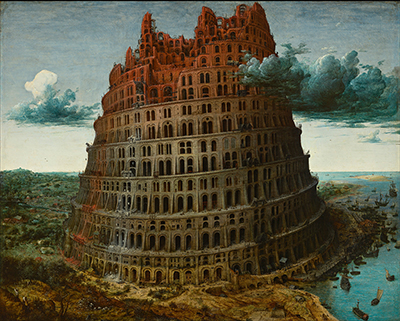
Bruegel painted more than one Tower of Babel. The Vienna panel is the monumental version, while the smaller Rotterdam painting, often called the Little Tower of Babel, is a later and more compact work in the collection of Museum Boijmans Van Beuningen. The two are closely related, yet they should not be folded into each other. Vienna is broader, more ceremonial, and more open to the city and sea. Rotterdam is smaller, darker, later in date, and more compressed in mood. Together they show Bruegel returning to the same biblical problem from another angle: how can a society build magnificently and still misread the limits of its own design?
At a Glance
- ArtistPieter Bruegel the Elder
- TitleThe Tower of Babel
- Date1563
- Mediumoil on oak panel
- Dimensions114.3 × 155.1 cm in the 2018 KHM exhibition catalogue
- Signatureinscribed at the bottom of a cuboid with Bruegel's name and the date 1563
- CollectionKunsthistorisches Museum Wien, Gemäldegalerie
- Known early historyrecorded with Nicolaas Jongelinck in 1566; probably passed to the city of Antwerp that year; later associated with Rudolf II and the collection of Leopold Wilhelm
- Related Bruegel workthe smaller Rotterdam Tower of Babel, circa 1568, in Museum Boijmans Van Beuningen
- Best first questionwhy does a painting about failed unity look so brilliantly organized?
This work across Bruegel’s career
Tower of Babel
1563The Harvesters
1565Peasant Wedding
1568Children's Games
1560Triumph of Death
1562–1563Contents
- Introduction
- The Biblical Subject
- What Bruegel Shows
- Architecture And Craft
- Scale, Harbor City, And Human Labor
- Antwerp, Rome, And Empire
- The Vienna Object
- The Vienna and Rotterdam Towers
- Copying And Fame
- A Close-Looking Guide
- Annotated Details
The Biblical Subject
The Tower of Babel story is brief, but its afterlife in art is enormous. In Genesis, humanity gathers on a plain and decides to build a city and a tower "with its top in the heavens." The project is described as collective, urban, technological, and proud. The builders use brick and bitumen. They want to make a name for themselves and avoid being scattered across the earth. God responds by confusing their language, so that they can no longer understand one another, and the project collapses. The place becomes Babel, associated with confusion, division, and the failure of human overreach. [6]
For an artist, the subject offers a powerful contradiction. The tower is a monument to unity, yet it foretells fragmentation. It demands architectural spectacle, but its meaning lies in breakdown. It allows the painter to stage a crowd, a city, a landscape, a sacred warning, and a study of work all at once. Bruegel seizes every part of that opportunity. His Babel is not a simple moral emblem in which pride receives a neat punishment. It is a world of practical intelligence, immense effort, technical skill, and collective blindness.
That tension is crucial to the painting's force. Bruegel does not make the builders foolish in any easy sense. They know how to build. They organize supplies, shape stone, move goods by water, use machines, and carve a great spiral structure out of material reality. The painting asks the viewer to admire them before judging them. It also asks a harder question: what if human skill can be real, even dazzling, and still be ordered toward an impossible end?
The biblical tower had long invited comparisons with pride, empire, vanity, and the instability of worldly achievement. Bruegel keeps those associations alive, but he grounds them in observation. The painting is full of particulars rather than slogans. Every little activity has weight. Every load must be carried. Every block must be raised. Every section of the tower depends on laborers who are tiny in relation to the structure they serve. Babel becomes a drama of proportion: human beings can imagine beyond themselves, but they remain embodied, limited, dependent on tools, language, command, weather, and time.
Annotated Details from The Tower of Babel
The numbered details move from Nimrod and the foreground masons through the tower's gates, hoists and upper scaffolding to the harbour and the city beyond.
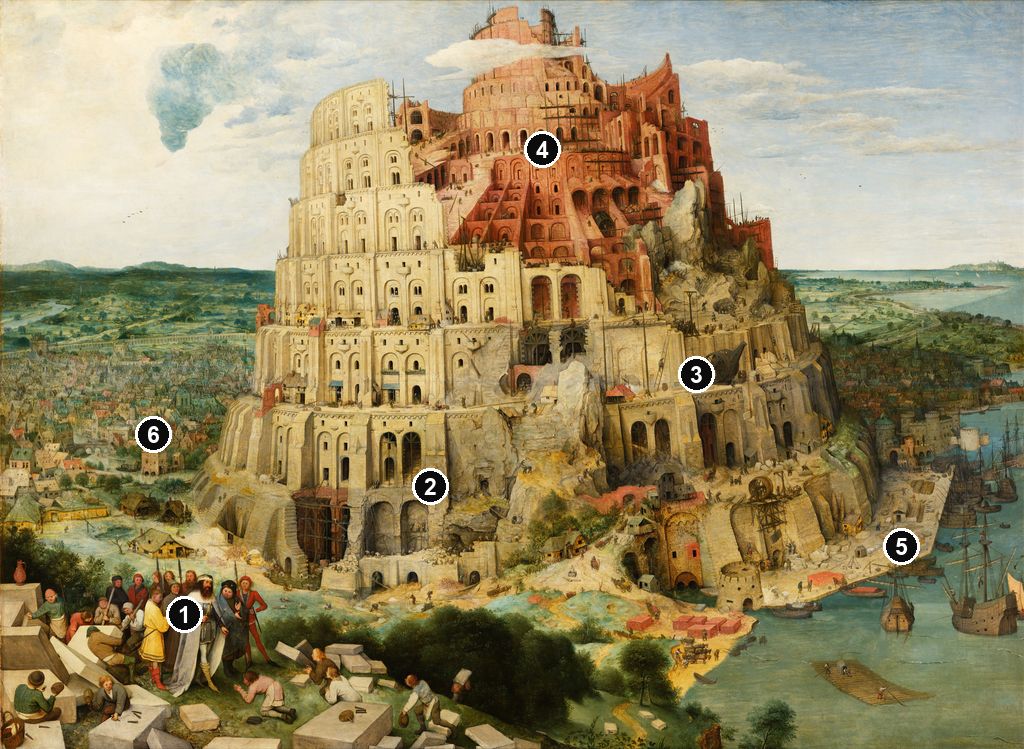
Details from THE TOWER OF BABEL
Close looking reveals a vast construction site assembled from tiny gestures, machines, materials, buildings and waterways.
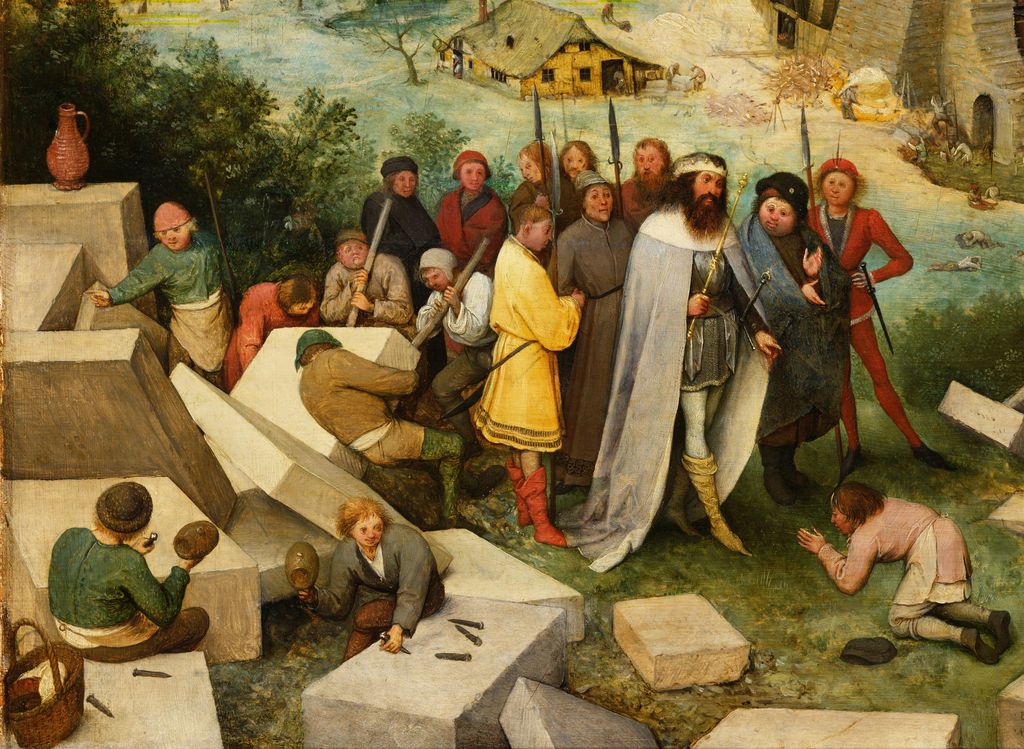
Nimrod and the kneeling masons
The richly dressed ruler advances beside his attendants while stonecutters kneel among blocks, tools and unfinished masonry in the foreground.
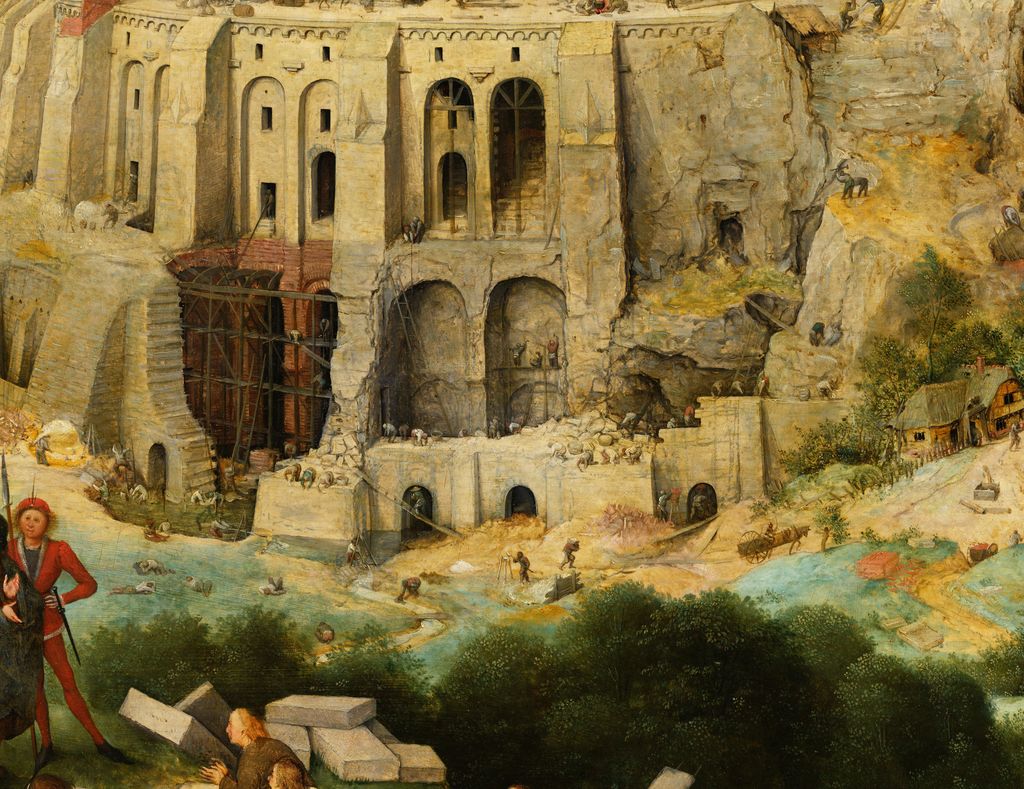
Lower gates, ramps and hoists
Dark arched openings, timber frameworks and steep paths expose the tower as an active worksite rather than a finished monument.
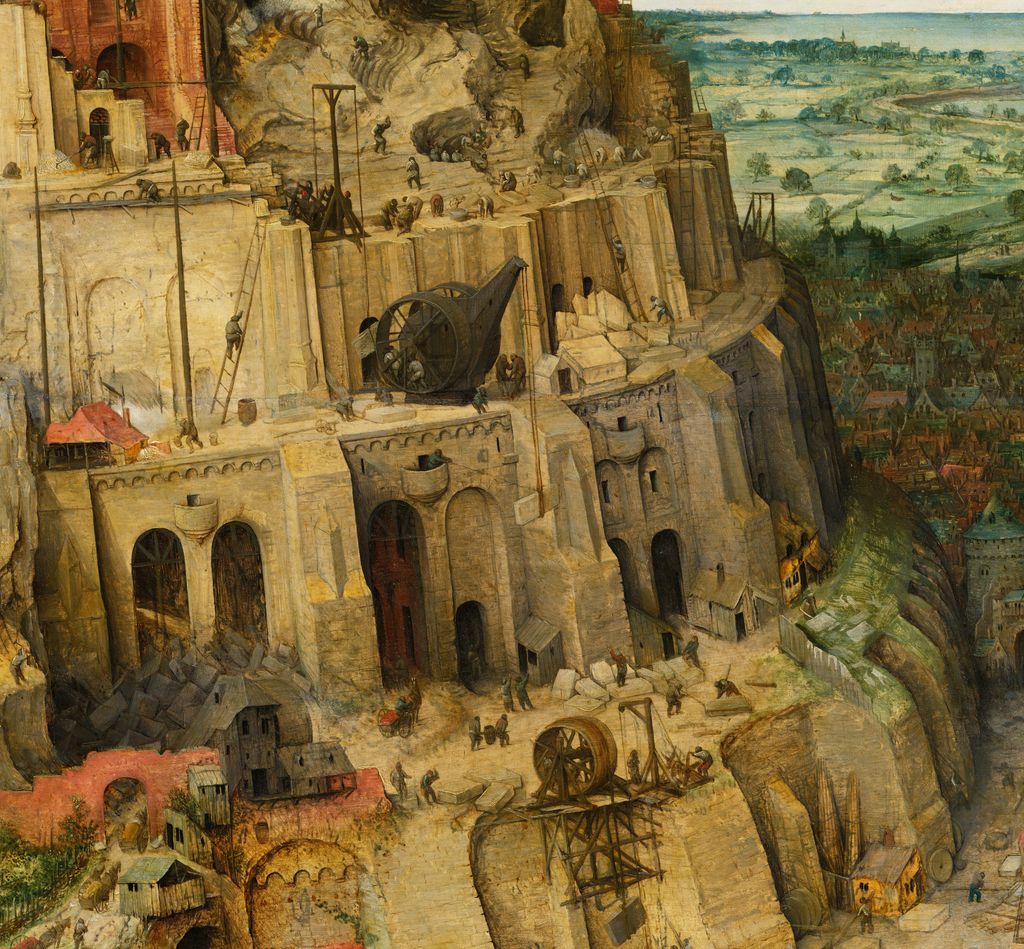
Quarry face, cranes and great wheel
Exposed rock interrupts the architecture while ropes, lifting gear and a large treadwheel crowd the platforms around it.
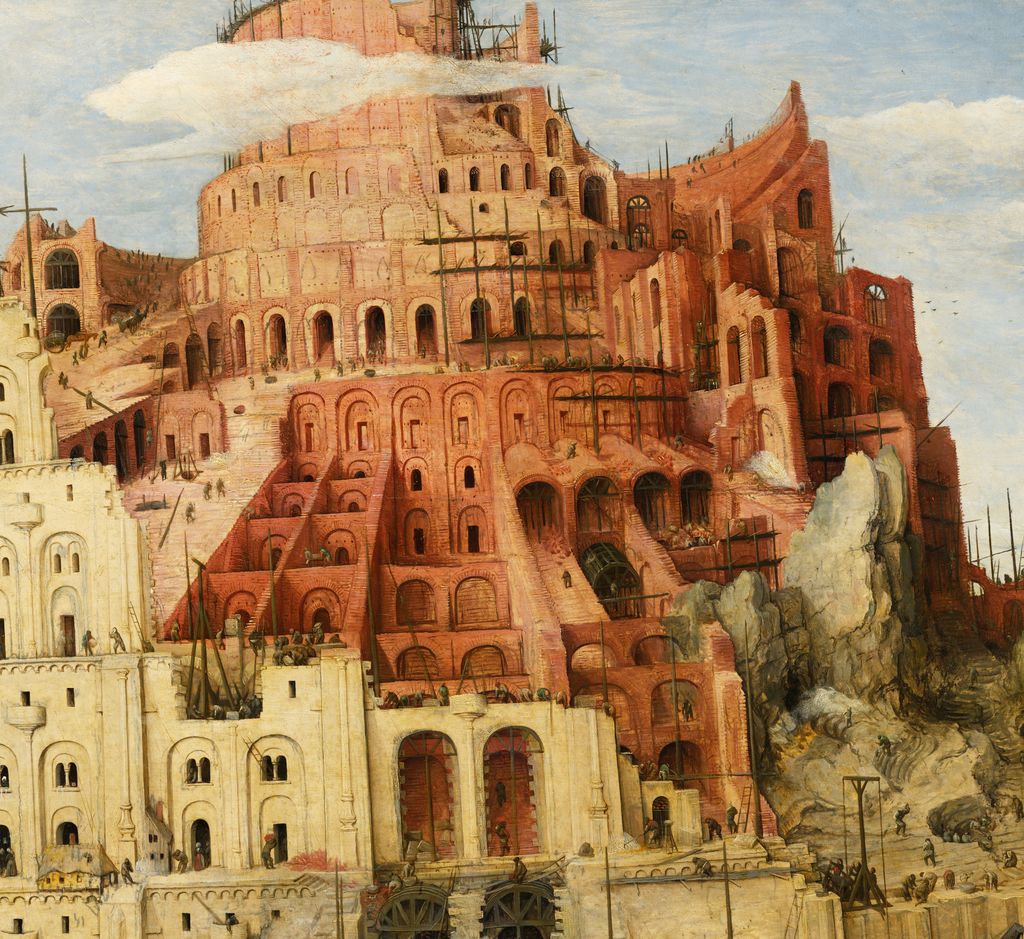
Unfinished upper spiral and scaffolding
The red upper courses curve unevenly around the core, with open arches, timber scaffolds and clouds emphasizing the incomplete ascent.
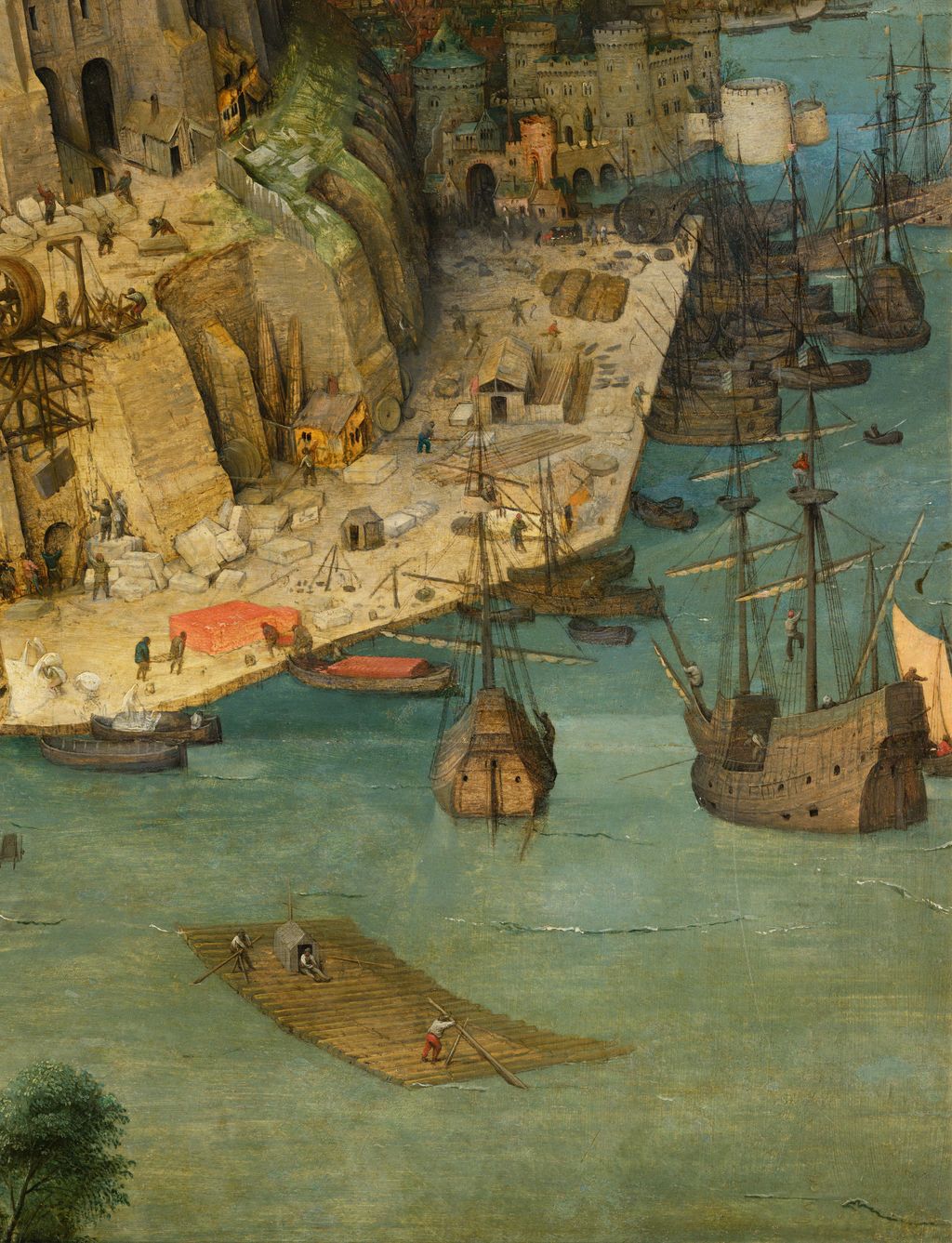
Harbour traffic at the tower's foot
Sailing ships, small boats and timber rafts press close to the quay, tying the immense building operation to movement across the water.
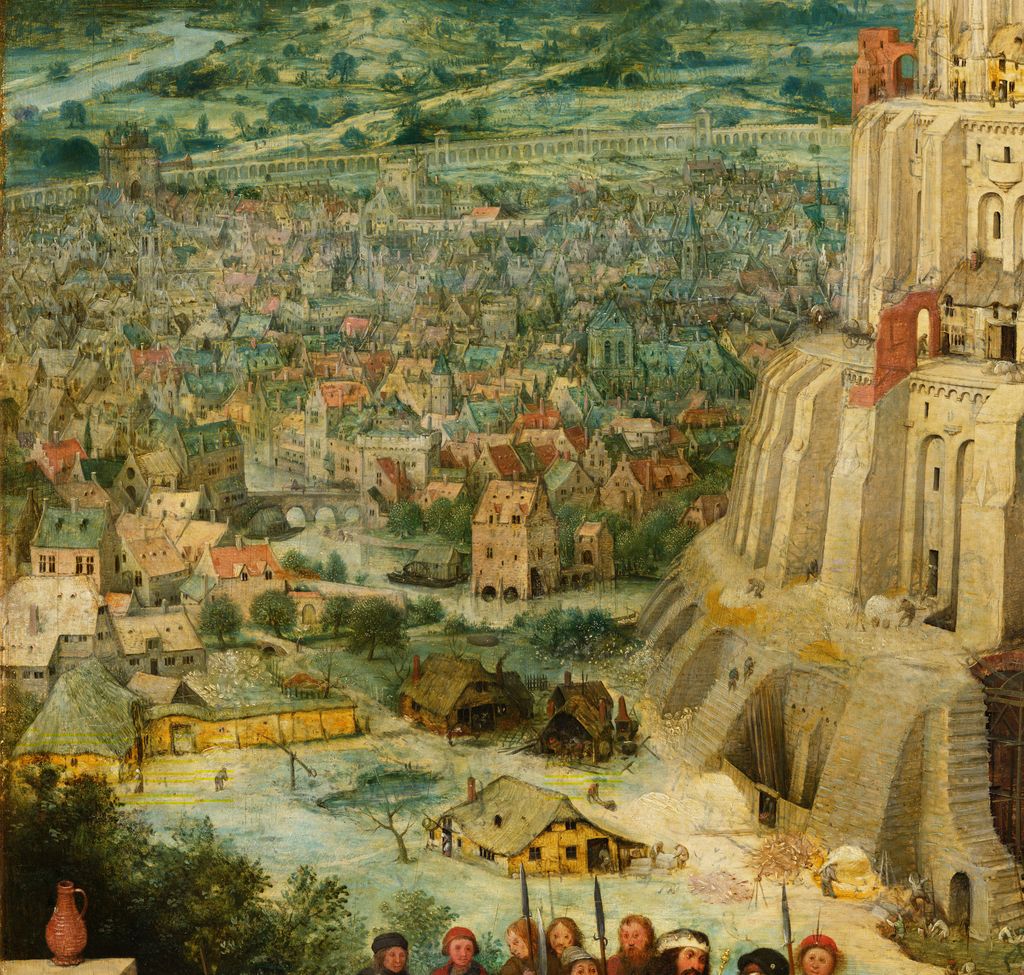
City spreading beyond the building site
A dense field of roofs, streets, fields and waterways recedes beside the tower, making its scale legible against an inhabited landscape.
What Bruegel Shows
At first sight, the painting is dominated by the tower itself. It rises from the left-center of the panel and curves upward in a broad, uneven spiral. Its base is colossal, embedded in the ground and surrounded by shore, road, and city. Its upper levels narrow toward a crown that still has not reached completion. The form seems both stable and unstable. It is massive enough to dwarf everything around it, yet it already looks damaged, improvised, and irregular. The viewer can sense the contradiction: the builders seek a perfect ascent, but the object they produce is full of mismatched systems.
The tower's exterior resembles a giant shell of stone arches, arcades, retaining walls, ramps, vaults, and ringed galleries. Some parts recall ancient Roman architecture, especially amphitheater-like tiers and arched masonry. Other parts suggest medieval or Romanesque construction. Bruegel is not reconstructing an ancient Near Eastern ziggurat. He is translating Babel into the architectural languages visible or imaginable to a sixteenth-century Netherlandish artist who had traveled south and who knew the prestige of Rome. The result is not archaeological accuracy. It is historical compression: antiquity, medieval building practice, and Bruegel's own commercial present interlock.
The lower left foreground introduces a royal encounter. A figure traditionally identified as Nimrod appears with attendants, while workers kneel or bow before him. This group gives the vast scene a political center, though not a simple one. Nimrod does not tower over the painting. He is small in relation to the building that supposedly expresses his ambition. His authority is visible, but the tower has already exceeded the scale of personal command. The ruler may commission, order, or inspect; the project itself has become a world. [1]
To the right and behind the tower spreads a harbor city. Houses crowd along the water. Ships enter and leave. The port is busy, disciplined, and prosperous. The city looks more Flemish than biblical: gables, quays, tiled roofs, and maritime trade bring the story into Bruegel's northern world. The city is not merely background. It provides scale. Against ordinary buildings, the tower becomes nearly unimaginable. The Kunsthistorisches Museum emphasizes this effect: the little port city, Flemish in character, makes the tower's immensity legible.
The sky is pale and wide, with clouds massing above the work. The landscape extends into distance, but it is not a calm escape from the tower. Land, water, and city all appear absorbed into the machinery of construction. Supplies arrive by ship. Roads climb upward. Workers stream through the structure. The whole environment has been reorganized around a single impossible enterprise.
Architecture And Craft
One of the painting's richest achievements is the way Bruegel turns architecture into a catalogue of making. The tower is not presented as a finished symbol. It is under construction everywhere. This lets Bruegel show craft as activity rather than as outcome. Viewers can trace how raw material becomes dressed stone, how blocks are moved, how walls rise, how cranes and hoists translate human and animal force into vertical lift.
The lower zones are especially dense with work. Figures climb ramps, carry baskets, handle poles, guide carts, tend animals, prepare mortar, and move between sheds, platforms, and scaffolds. Their smallness is part of the meaning, but Bruegel does not treat them as generic dots. He differentiates their tasks. The painting rewards patient looking because each passage reveals another trade or operation. The Kunsthistorisches Museum describes Bruegel's handling here as meticulous and encyclopedic in its attention to building techniques and crafts, and that phrase captures the work's double character: astonishingly exact in parts, overwhelming as a whole.
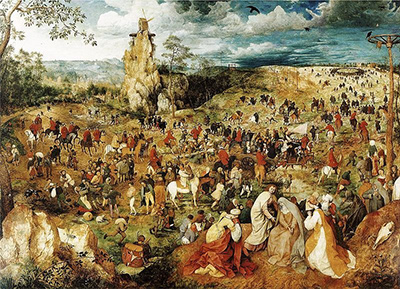
This fascination with craft connects the Vienna Tower to Bruegel's broader art. In Children's Games, he organizes a public world through many distinct actions. In Netherlandish Proverbs, he turns a city-like setting into a field of legible behaviors. In The Procession to Calvary, he scatters sacred narrative across a landscape filled with ordinary movement. The Tower of Babel belongs to this same imaginative family. Bruegel builds meaning by distributing attention. No single detail explains the whole; the whole emerges from the accumulation of observed acts.
The tower's fabric also shows Bruegel's interest in architectural history. Its stone envelope combines ancient and Romanesque elements. Arches march around the circumference. Barrel-like passages cut into the mass. Sections appear newly built, while others already look eroded or incomplete. This mixture is not accidental confusion by the painter. It is part of Babel's visual logic. A structure meant to unify the world is itself made from incompatible historical memories and construction languages. It borrows authority from Rome and from medieval building, but the borrowed forms do not resolve into coherence.
The architecture is therefore persuasive and impossible at the same time. Bruegel understands enough about building to make the tower feel technically plausible in many passages. Yet the total object cannot be made to sit comfortably in reality. Its lower rings are too vast, its upper zones too ambitious, its plan too irregular, its relation to the ground too strange. The more closely one looks, the more the painting moves between admiration and doubt.
Scale, Harbor City, And Human Labor
Scale is one of Bruegel's central tools. He does not simply paint a large tower; he builds a system of comparisons. The city is small beside the tower. Ships are smaller still. Workers become flecks on roads and platforms. Yet those flecks are the only reason the tower exists. The painting depends on a paradox: the builders are visually minor and materially essential.
The harbor matters because it makes Babel economic as well as architectural. This is a project fed by trade. Waterways bring materials. Ships collect around the base like moving warehouses. The port city suggests commerce, coordination, and wealth. Bruegel's viewers in Antwerp would have known what a great trading city could do: import goods, marshal capital, house specialists, and imagine itself as a hub of the world. The painting does not need to name Antwerp directly to make that resonance felt. Its Flemish-looking urban fabric places biblical Babel close to the mercantile north.
The human labor is not romanticized. Work appears strenuous, repetitive, and collective. People and animals are fitted into a system that requires constant motion. No one figure controls the entire undertaking. Even Nimrod, in the foreground, cannot visually command all that is happening. The project has too many parts. That is one reason the painting feels modern: it understands large projects as networks of labor, logistics, materials, authority, and habit.
The roadways and ramps are especially important. They convert the tower into a kind of circulation machine. Supplies must travel upward; workers must descend; materials must pass from ship to cart, from cart to staging area, from ground to crane, from crane to wall. Bruegel lets the eye travel those paths. Looking becomes a version of working through the system. The viewer follows one passage, then another, then loses the total arrangement in a maze of partial orders.
This is where the Babel story becomes visual rather than merely illustrative. Confusion is not shown only as a future punishment. It is already latent in the built form. The tower is full of channels of communication, but the eye cannot master them all. It is full of organized labor, but the total organism appears unstable. The painting suggests that Babel's failure begins before language breaks. It begins in the mismatch between human ambition and the scale of the system it tries to command.
Antwerp, Rome, And Empire
Bruegel's Tower of Babel has often invited historical interpretation. The painting was made in the Low Countries in 1563, in a period of extraordinary urban wealth, religious tension, imperial power, and political strain. Antwerp was one of Europe's great commercial centers. Rome, with its ruins and imperial memory, offered a language of grandeur and decay. The biblical subject itself pointed toward pride, empire, divine judgment, and the scattering of peoples. It is natural to bring these contexts to the painting, but they need to be handled with care. [2]
The tower's architecture strongly suggests Bruegel's knowledge of Roman forms. The ringed arcades can recall the Colosseum, while the immense masonry shell evokes ancient ruins magnified into a new construction. This matters because Rome could signify both achievement and collapse. It was the model of empire and the evidence that empires perish. By weaving antique forms into Babel, Bruegel gives the biblical story a historical echo: great civilizations leave behind structures that become warnings as well as wonders.
At the same time, the harbor city ties the scene to northern urban life. Bruegel's audience did not need a literal portrait of Antwerp to recognize the world of trade, ships, dense housing, and civic pride. The painting places the ancient story inside a recognizably commercial environment. That does not mean the work is a one-to-one allegory of Antwerp, the Habsburg empire, or any single political event. Its intelligence is broader and more durable. It stages the seductions of collective achievement: wealth, labor, planning, prestige, technical mastery, and the dream of becoming central to the world.
The royal figure sharpens this political dimension. He stands near the foreground with attendants, receiving the gestures of workers who bend before him. Authority is performed through posture, dress, and proximity. Yet the arrangement also diminishes him. The ruler is not placed at the summit; he is at the base, at the edge of a work too enormous to be personally grasped. Bruegel lets power appear real and insufficient. The tower is a monument to command, but it also exposes the limits of command.
This caution is one of Bruegel's great strengths. He rarely reduces a scene to a single message when a richer tension is available. His art is full of behavior, contradiction, and scale. In the Tower of Babel, empire can be present without turning the painting into a simple coded headline. Antwerp can be felt without becoming the only key. Rome can haunt the architecture without transforming the work into a travel note. Babel becomes a meeting place for many histories of ambition.
For more on Bruegel's broader career and northern setting, see the main Pieter Bruegel the Elder overview and the biography. His handling of crowds, distance, and moral complexity also belongs within the wider survey of Bruegel's paintings and his style and technique.
Watch Bruegel’s art
Explore Bruegel with TheHistoryOfArt and artwork discussions from Smarthistory.
Pieter BRUEGEL Explained in 10 Minutes (updated)
A TheHistoryOfArt film about Bruegel.
Watch on YouTubeThe Vienna Object
The inventory number is 1026. The date comes from the picture itself, on a cut stone in the foreground where Bruegel entered his name and the Roman numerals for 1563. The signature occupies the space that the picture gives to building materials and workmanship. It has a counterpart in the preparatory changes found by technical examination, since both reveal parts of the work that disappear when the tower is seen only as a distant silhouette [5].
The support is oak, the standard panel material for many Netherlandish paintings of the period. The KHM's technical study of its Bruegel holdings, carried out with non-invasive methods, has emphasized the importance of panel construction, underdrawing, pigments, and material history for understanding how Bruegel worked. For the Vienna paintings as a group, the museum describes the use of infrared photography, infrared reflectography, X-radiography, X-ray fluorescence analysis, and three-dimensional mapping. These methods help scholars examine what lies beneath or within the visible surface without claiming more than the evidence permits. [3]
For this painting, the museum record supplies the essential public facts: title, artist, date, medium, size, signature, collection, and early ownership. The work was recorded in 1566 with Nicolaas Jongelinck, one of Bruegel's most important patrons and owners. It probably passed into the possession of the city of Antwerp in the same year. Later it was associated with Rudolf II and then with the collection of Leopold Wilhelm. That path already says much about the painting's status. It moved through elite collecting environments where Bruegel's invention was understood as a major work, not as a minor devotional picture. [1]
Jongelinck is especially important in Bruegel's story. A wealthy Antwerp figure, he owned significant works by the artist, including major panels that helped shape Bruegel's reputation. The Vienna Tower fits that world of ambitious collecting. Its scale, density, and learned architectural play would have rewarded a viewer capable of lingering, comparing, discussing, and returning to the work. It is a painting designed for long looking.
The KHM record also notes that this monumental composition became the most famous Tower of Babel representation, widely copied and varied. That fame is understandable. Bruegel found a form for the subject that was at once memorable and endlessly reusable: the circular, rising, harbor-side tower, half ruin and half construction site, packed with little actions. Later artists could borrow the general silhouette or the crowded building logic, but the Vienna panel's power lies in the exact balance Bruegel achieved between spectacle and scrutiny. [1]
The Vienna and Rotterdam Towers
The KHM’s side-by-side exhibition account describes an X-ray result from the Rotterdam panel. Beneath the visible tower was a stage closer to the Vienna tower in structure. The evidence shows that the composition changed during painting. It is one reason the curators put the smaller work after the signed Vienna panel, although the image cannot supply an exact year. The palettes make the finished solutions easy to distinguish: pale masonry catches the light in Vienna, while brick-red and shadowed passages dominate the Rotterdam version [5] [4].
Bruegel's smaller Rotterdam Tower of Babel is essential for understanding the Vienna painting, but the comparison must begin with difference. Museum Boijmans Van Beuningen identifies the Rotterdam work as The Tower of Babel, Pieter Bruegel (I), circa 1568, oil on panel, about 74.6 by 59.9 centimetres. It entered the museum in 1958 with the collection of D.G. van Beuningen. Its format alone changes the experience. Rotterdam is much smaller and vertical; Vienna is larger and horizontal. Vienna opens the tower to city, sea, and ceremonial foreground. Rotterdam tightens the subject into a more concentrated object.
The Vienna tower is expansive. Its broad base sits beside a harbor that helps the viewer measure its astonishing size. The city and shipping activity create a world around the tower. The foreground encounter with Nimrod gives the scene a courtly and political overture. The landscape breathes around the main form, even as the tower dominates it.
The Rotterdam tower feels more compressed. Its vertical format brings the structure closer to the viewer's field of attention. It is often placed after 1563, and Boijmans dates it around 1568, and it has often been called the Little Tower of Babel to distinguish it from the Vienna panel. That nickname is useful, but it can also mislead if it makes the painting sound like a reduced copy. It is better understood as a related invention: Bruegel returning to Babel with a different scale, different tempo, and different pictorial pressure.
In Vienna, the tower is integrated into a lively port environment. In Rotterdam, the mass of the tower carries more of the drama by itself. The comparison reveals how much the Vienna painting depends on lateral spread: city to the right, ruler to the left, sea behind, roads and ramps crossing the structure. The eye moves around the whole social organism. The Rotterdam painting narrows that organism and heightens the sense of enclosure.
The two works also differ in dating and physical history. Vienna is securely dated 1563 by inscription. Rotterdam is not inscribed with a firm date in the same way; the Boijmans record gives circa 1568, and the museum has noted that many Bruegel specialists favor a late dating on stylistic grounds. Vienna's early history includes Nicolaas Jongelinck in 1566 and probably Antwerp civic ownership that year. Rotterdam's known history, as discussed by the museum, reaches back to Rudolf II and includes later European owners before the painting came to D.G. van Beuningen and then to the museum in 1958.
The relationship between the two works shows that Babel was not a passing idea for Bruegel. It was a subject capable of sustaining revision. The later painting does not cancel the earlier one, and the earlier one should not be used to explain away the later. Instead, they form a pair of meditations on scale and failure. Vienna asks how a whole society organizes itself around impossible ascent. Rotterdam asks what happens when that ascent becomes more inward, compact, and brooding.
Visitors often want to know which is the "real" Tower of Babel. The better answer is that both are real Bruegel paintings of the subject, with different ambitions. The Vienna version is the famous monumental panel of 1563. The Rotterdam version is the smaller later panel, distinct in format, size, date, and mood. Keeping them separate allows each painting to speak more clearly.
Copying And Fame
The Vienna Tower of Babel became a classic almost because it solved a pictorial problem so convincingly. Before Bruegel, artists had represented Babel in many ways, but he created a type that felt definitive: a vast circular tower under construction, set in a bustling world, combining architectural grandeur with swarming labor. The KHM notes that the composition became the most famous Tower representation and was often copied and varied. That afterlife is part of the painting's meaning.
Copying in the sixteenth and seventeenth centuries was not merely passive repetition. Famous compositions circulated through workshops, collectors, prints, painted versions, and memory. A successful invention could become a visual formula that other artists adapted. Bruegel's Babel offered exactly that kind of formula. Its silhouette was strong enough to be recognized at a glance, and its detail-rich surface invited endless variation.
Yet the fame of the composition can flatten the original if we see only the iconic form. The Vienna panel is more than "the round tower." Its authority comes from the precision of relationships: foreground ceremony against background labor, Flemish port against antique architecture, small workers against impossible masonry, technical knowledge against moral instability. Copies could repeat the shell, but the original's depth lies in the way every part contributes to the idea.
The painting also helped define Bruegel's reputation as an artist of worlds. He was not only a painter of peasants, landscapes, or moral scenes, though he made major works in all those categories. He was a builder of visual systems. His best paintings feel inhabited by patterns of life that continue beyond the frame. The Tower of Babel is among the clearest examples. Its activity seems to have begun before we arrived and to continue after we leave, even though the biblical story tells us it is doomed.
That combination of energy and doom explains the painting's lasting pull. Modern viewers recognize Babel in skyscrapers, bureaucracies, megaprojects, data systems, empires, financial networks, and cities that strain against their own infrastructure. Bruegel did not know those later forms, but he understood the underlying human pattern: the dream of total coordination, the beauty of collective intelligence, and the fragility of systems that imagine themselves limitless.
A Close-Looking Guide
Begin with the tower's base. Notice how it is both a foundation and a world in itself. The lower rings are so large that houses, gates, roads, and work areas seem absorbed into the structure. Bruegel makes the base feel ancient, almost geological, even though it is still being built. This is one of the painting's subtle instabilities: the tower looks unfinished and already ruinous.
Then look at the foreground ruler. Nimrod and his attendants occupy a small patch of stage-like ground. Workers kneel or bow. The encounter introduces hierarchy, but it does not dominate the composition. Ask how power is shown: through dress, gesture, escort, and the reaction of others. Then ask how it is limited: by the sheer scale of what rises behind him.
Move next to the harbor. The ships are not decorative extras. They explain how a project of this scale might function. Materials must arrive from elsewhere. Trade and construction are linked. The harbor city also makes the painting feel northern. Its buildings and waterfront bring Babel close to Bruegel's own world, allowing the ancient story to become contemporary without requiring a literal portrait of any one city.
Now follow the ramps. Bruegel's tower is designed around circulation. Roads loop upward, bridges cross gaps, and platforms create temporary zones of work. The eye can try to climb the tower, but it will not find a clean ascent. The way breaks, turns, disappears, and reappears. This wandering is part of the experience. Babel is a structure that promises order while producing disorientation.
Look at the different building materials. Some zones appear pale, others reddish, others gray or brown. Stone, brick, timber, and scaffolding each have their own visual character. The tower is not a smooth monument. It is patched together through phases of work. The variation suggests time: parts have been begun, altered, weathered, or abandoned while others remain fresh.
Pay attention to the arches. They are among the most Roman-looking elements in the composition, but they do not create a stable classical order. They repeat, stack, bend, and fragment. The architecture borrows the authority of antiquity while showing the strain of impossible expansion. The tower resembles a ruin before it is complete.
Look for the tiny craft scenes. One of Bruegel's pleasures is to make the viewer work. The painting is full of small discoveries: tools, carts, animals, carrying figures, rooflines, ladders, scaffold poles, and stone blocks. These details are not trivia. They turn the moral subject into lived labor. Babel is built by bodies, not abstractions.
Finally, step back. From a distance, the tower becomes a single immense form, almost a spiral mountain. From close range, it breaks into hundreds of activities. The painting lives between those two distances. Seen as a whole, it is a grand warning. Seen detail by detail, it is an admiring record of skill. Bruegel refuses to let either view cancel the other.
Why It Remains Important
The Vienna Tower of Babel remains important because it gives a biblical subject the density of social reality. Bruegel does not merely illustrate a familiar story. He rebuilds it as a system of labor, architecture, economy, authority, and perception. The painting can be read morally, historically, technically, and visually, and each reading strengthens the others.
It is also a key work for understanding Bruegel's mature art. His greatness lies partly in his ability to organize multiplicity. He can place dozens or hundreds of figures into a scene without reducing them to clutter. He can make a composition legible from across a room and still reward close examination. He can create comedy, warning, observation, and grandeur inside the same visual field. The Tower of Babel shows those powers at monumental scale.
The painting's caution about overreach has never lost relevance, but its warning is more interesting than simple anti-ambition. Bruegel clearly respects human making. The tower is absurd, but the workers are skilled. The project is doomed, but the craft is real. The city may be proud, but it is also productive, disciplined, and alive. This complexity keeps the work from becoming a flat sermon.
The comparison with the Rotterdam Little Tower of Babel deepens that importance. Bruegel did not treat Babel as a single finished answer. He returned to it later in a smaller, more concentrated form. The two paintings together show an artist testing how format, scale, and setting change meaning. The Vienna version remains the grand public statement: the tower as world, port, empire, workshop, ruin, and warning.
For viewers today, the painting offers an unusually powerful way to think about systems. Human beings still build beyond individual comprehension. We create projects that depend on coordination, shared language, technical specialization, and confidence in future completion. Bruegel's Babel asks what happens when the system becomes more legible than the purpose, when the machinery of making continues even as the meaning begins to fail.
That is why the Vienna Tower of Babel is more than a famous Bruegel painting. It is one of the strongest early modern pictures of collective ambition. Its genius lies in the fact that it does not ask us merely to condemn the tower. It asks us to look at it closely, admire its intelligence, sense its beauty, follow its workers, understand its pride, and recognize its fracture.
Discussion
What feels most revealing about Pieter Bruegel the Elder: the village detail, the landscape setting, the moral wit, or the way everyday life becomes a complete world?
Reader Insights
Begin with one small action in a Bruegel scene, then follow how it connects to the surrounding figures, setting and rhythm of the whole image.
Connect the work to Northern Renaissance visual culture, printmaking, proverb traditions and Bruegel's interest in rural and urban life.
Which detail changes the interpretation most once you know the subject, date, proverb source or present collection?
Join the Conversation
Have a thought or observation about Pieter Bruegel the Elder? Share it below. Thoughtful responses may be added to this section as the Bruegel pages develop.
Frequently Asked Questions
The Tower of Babel story is brief, but its afterlife in art is enormous. In Genesis, humanity gathers on a plain and decides to build a city and a tower "with its top in the heavens." The project is described as collective, urban, technological, and proud. [6]
The lower left foreground introduces a royal encounter. A figure traditionally identified as Nimrod appears with attendants, while workers kneel or bow before him. [1]
Bruegel's Tower of Babel has often invited historical interpretation. The painting was made in the Low Countries in 1563, in a period of extraordinary urban wealth, religious tension, imperial power, and political strain. [2]
The inventory number is 1026. The date comes from the picture itself, on a cut stone in the foreground where Bruegel entered his name and the Roman numerals for 1563. [5]
References
- Kunsthistorisches Museum Wien, The Tower of Babel, View source.
- Kunsthistorisches Museum Wien, Pieter Bruegel the Elder, View source.
- Kunsthistorisches Museum Wien, Researching Bruegel, View source.
- Museum Boijmans Van Beuningen, The Tower of Babel, View source.
- Kunsthistorisches Museum Vienna, Der Turmbau zu Babel, 2018 exhibition comparison, View source.
- United States Conference of Catholic Bishops, Genesis 11, New American Bible, View source.






