



 by Tom Gurney
Tom Gurney BSc (Hons) is an art history expert with over 20 years experience
Published on June 19, 2020 / Updated on August 16, 2026
Email: tomgurney1@gmail.com / Phone: +44 7429 011000
Pieter Bruegel Children's Games: Introduction
Pieter Bruegel the Elder's Children's Games is one of the most astonishing crowd paintings of the sixteenth century. Painted in 1560 and now in the Kunsthistorisches Museum in Vienna, it shows a town square, streets, doorways, buildings, a stream and distant edges of countryside taken over by children at play. KHM's current object record gives the scale of the event in numbers: more than 230 children and 83 games, all organized within a bird's-eye view that makes the crowded surface readable [1].
The painting is easy to enjoy and hard to exhaust. At first it looks like a lively record of childhood: running, climbing, rolling hoops, playing blind man's buff, staging ceremonies, pretending to keep shop and inventing little contests. Yet the longer one looks, the more unusual the picture becomes. Adults have almost vanished. The whole civic world appears to belong to children, and their games begin to resemble adult behavior in miniature: trade, marriage, procession, display, rivalry, aggression, rule-following and imitation.
That double quality is why Children's Games matters within Bruegel's art. It is not only a charming image of play. It is a large, deliberate, signed and dated panel that belongs beside Netherlandish Proverbs and The Fight Between Carnival and Lent as one of Bruegel's early encyclopaedic crowd pictures. It teaches viewers how to look: first at the whole field, then at chosen details, then back again to the larger pattern of human behavior.
At a Glance
- ArtistPieter Bruegel the Elder
- TitleChildren's Games
- Date1560
- Medium/supportpainting on oak wood
- Dimensionsabout 116.4 x 160.3 cm
- Signaturesigned and dated at the lower right on a beam: BRVEGEL 1560
- CollectionKunsthistorisches Museum Wien, Gemaldegalerie
- Current displayon view in the Gemaldegalerie, Room X
- Main subjectmore than 230 children playing 83 games in and around a town square
- Best first questionwhy does a scene of play feel so carefully ordered, and sometimes so adult?
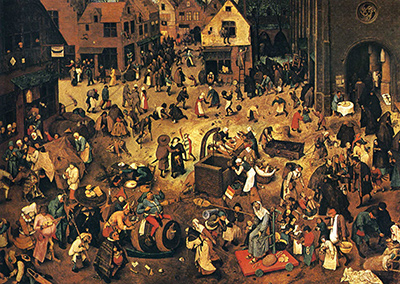
This work across Bruegel’s career
Tower of Babel
1563The Harvesters
1565Peasant Wedding
1568Children's Games
1560Triumph of Death
1562–1563Contents
- Introduction
- Object Facts And Why The Painting Is Unusual
- What Bruegel Shows
- Composition And Bird's-Eye Organization
- Play, Imitation And Social Learning
- How To Read The Games Without Inventing A Full List
- Relation To Proverbs, Carnival And Bruegel's Encyclopaedic Mode
- Why The Painting Remains Useful For Education
- Why It Still Feels Modern
- Annotated Details
Object Facts And Why The Painting Is Unusual
The KHM’s 2018 catalogue places the signature and date on a beam at the lower right and records the painting as inventory 1017. It gives the oak panel’s dimensions as 116.4 by 160.3 centimetres [7].
KHM identifies Children's Games as a painting by Pieter Bruegel the Elder, dated 1560, made on oak wood and held in the Gemaldegalerie under inventory number 1017. The museum record notes that the panel is signed at the lower right on a beam, with Bruegel's name and the date. It is on view in Vienna, in the same collection that holds the world's richest group of Bruegel paintings [1].
The basic facts already make the painting important. It is a secure work by Bruegel, not a later family repetition or a copy after a lost original. It is large enough to operate as a major panel, not a small curiosity. Its date places it early in Bruegel's mature painted career, close to The Fight Between Carnival and Lent of 1559 and Netherlandish Proverbs of 1559. Those works are often grouped because they fill a public setting with many separate actions, all seen from a raised viewpoint [2].
What makes Children's Games especially strange is its removal of ordinary adult control. The painted world includes streets, houses, a square, shop-like thresholds and ceremonial spaces, but children occupy nearly all of them. The usual hierarchy between adult city and child play has been reversed. Instead of a few children tucked into the corner of a larger adult scene, Bruegel makes childhood the organizing principle of the whole environment.
KHM calls the composition without precedent or parallel in the fine arts and describes it as a painted encyclopaedia, while also cautioning against a simple moralizing reading [1]. That caution is important. The painting can certainly invite moral reflection, but it does not work well as a single sermon against childishness. It is more generous and more unsettling than that. It records play, studies behavior, encourages searching, and leaves the viewer to ask how children learn the world they will later inhabit.
Annotated Details from Children's Games
The numbered details move from the pond and arcaded courtyard into the broad street, then across the tightly packed groups and games in the foreground.
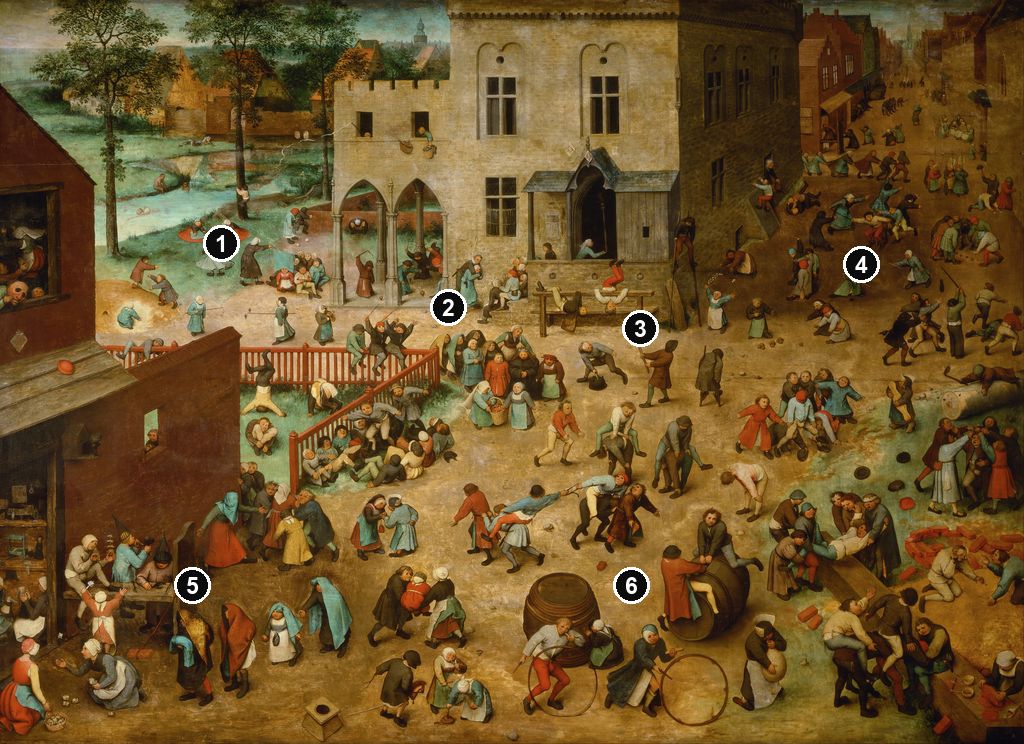
Details from CHILDREN'S GAMES
Close looking reveals how Bruegel fills distinct architectural and landscape spaces with small circles, lines and knots of bodies, allowing many kinds of play to unfold at once.
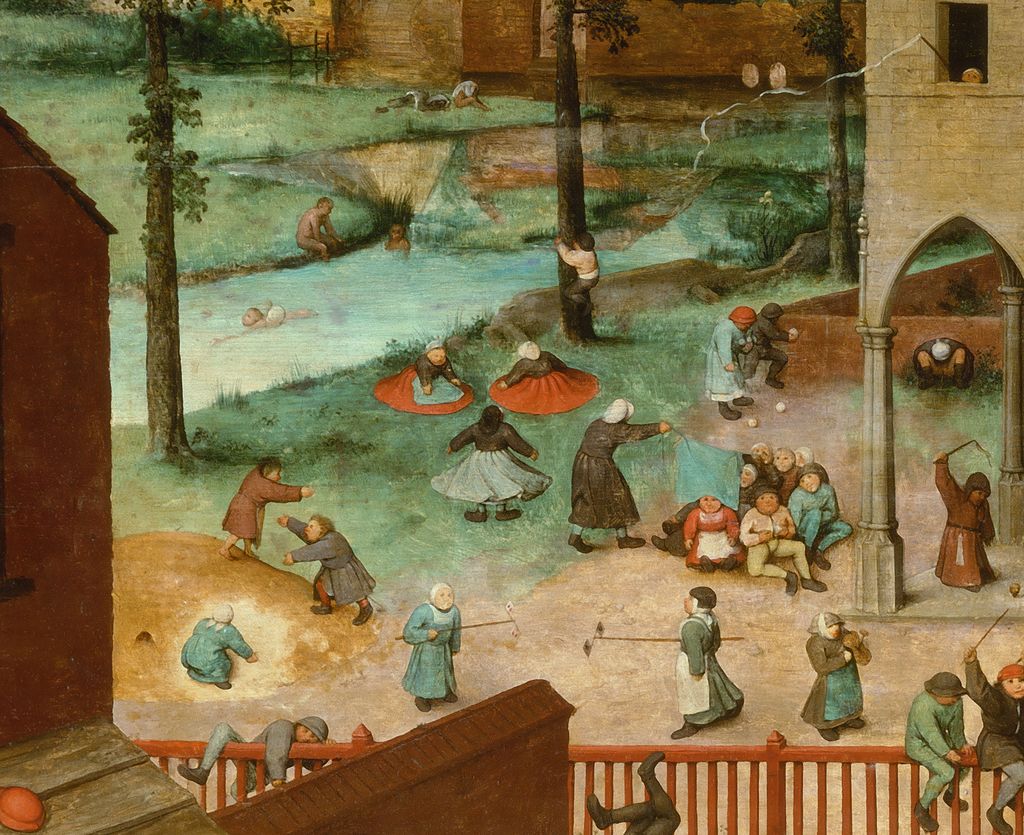
Pond and spinning games
The pale water opens a quiet pocket at the upper left, where swimmers, turning skirts and scattered figures create small rings of movement.
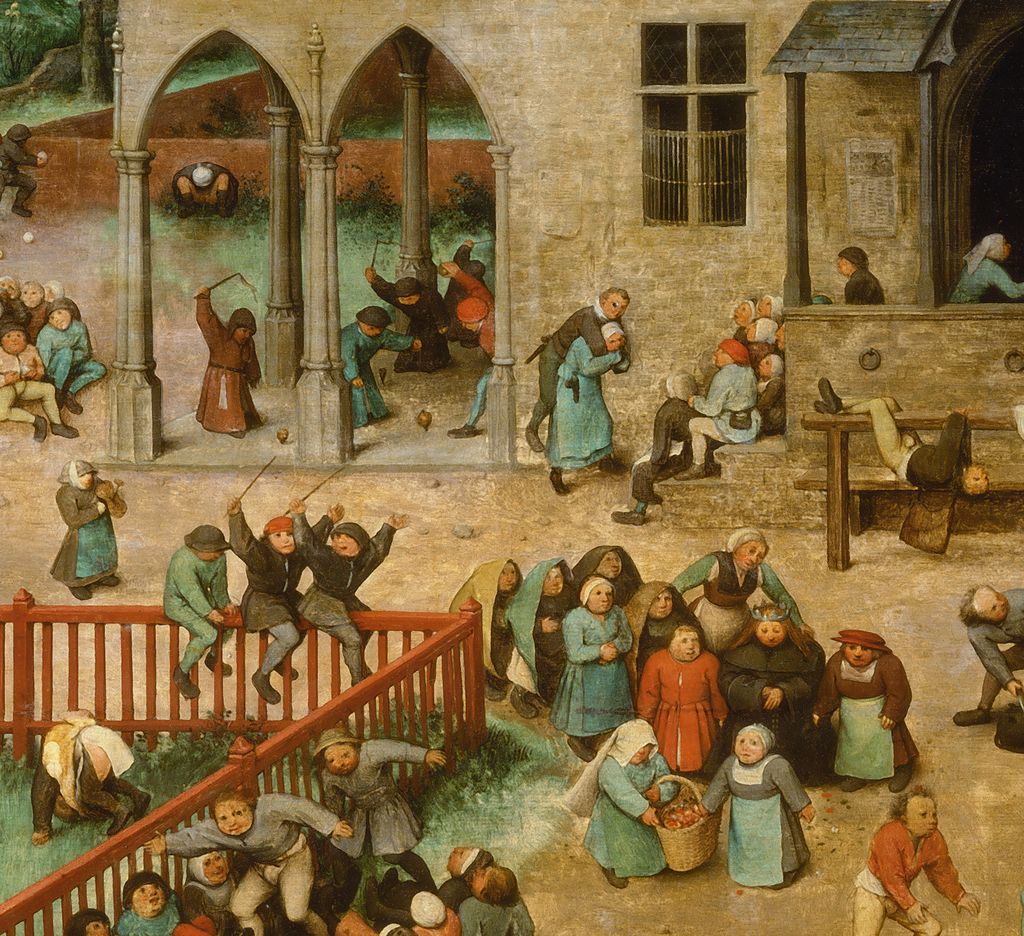
Games beneath the arcades
Arches, railings and steps divide the centre into compact stages, with seated, crouching and standing children arranged in overlapping clusters.
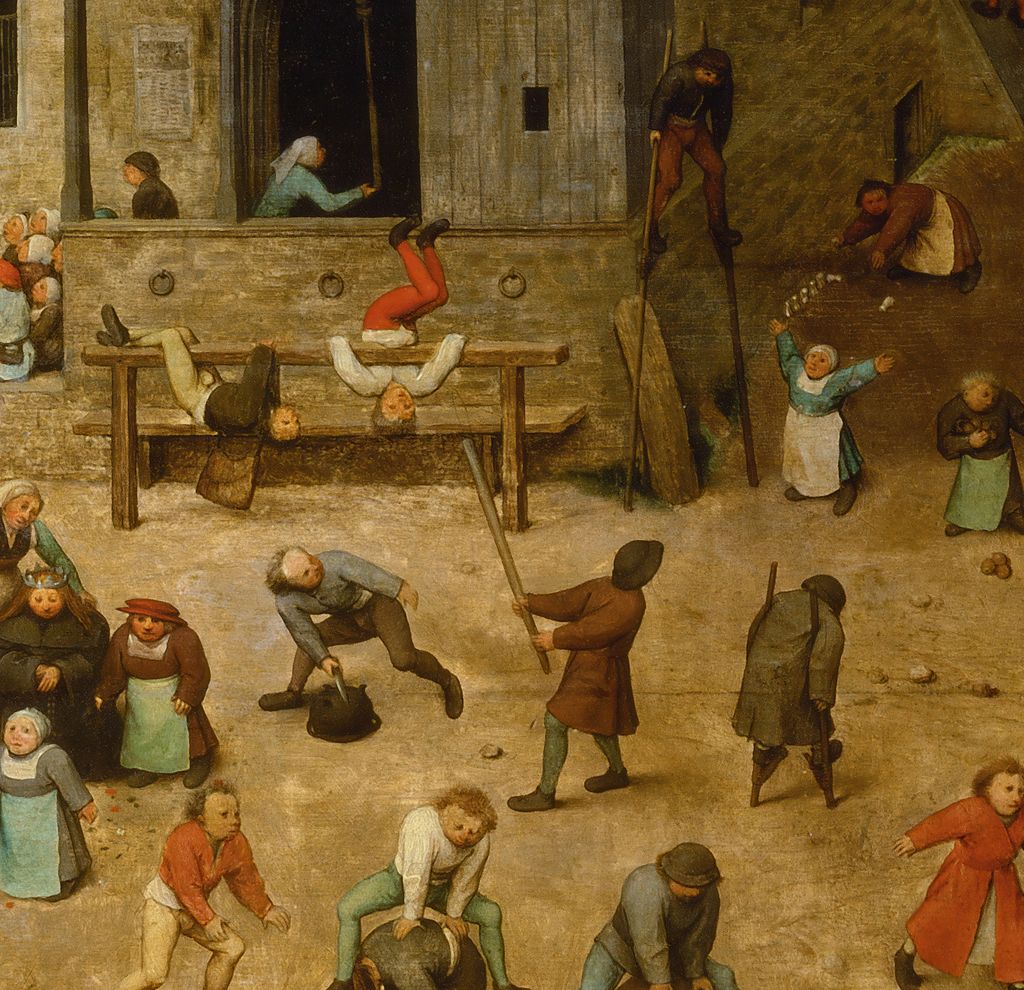
Handstands and balancing by the bench
Upside-down legs, bent backs and outstretched arms punctuate the open paving beside the bench, turning the figures into a sequence of changing silhouettes.
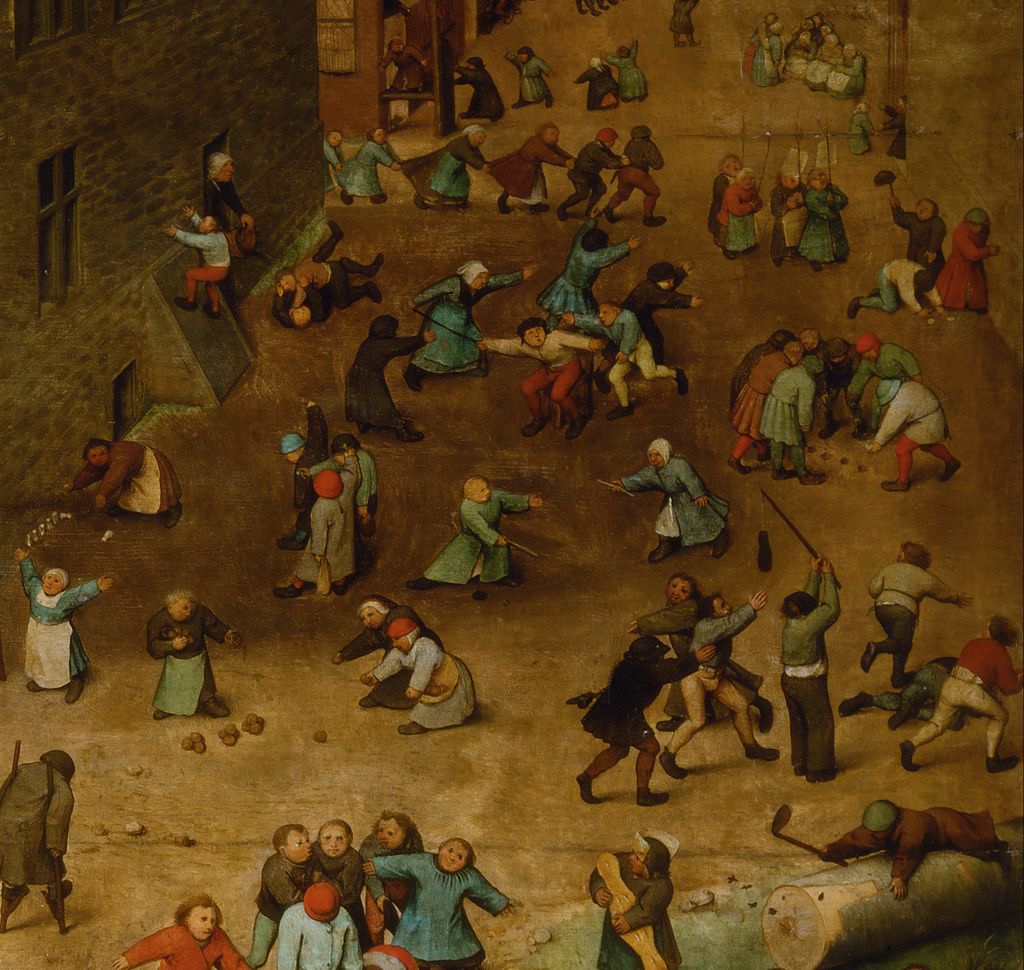
Processions and rough play in the street
The narrowing street gathers lines, circles and grappling groups into a dense stream that recedes between the buildings.
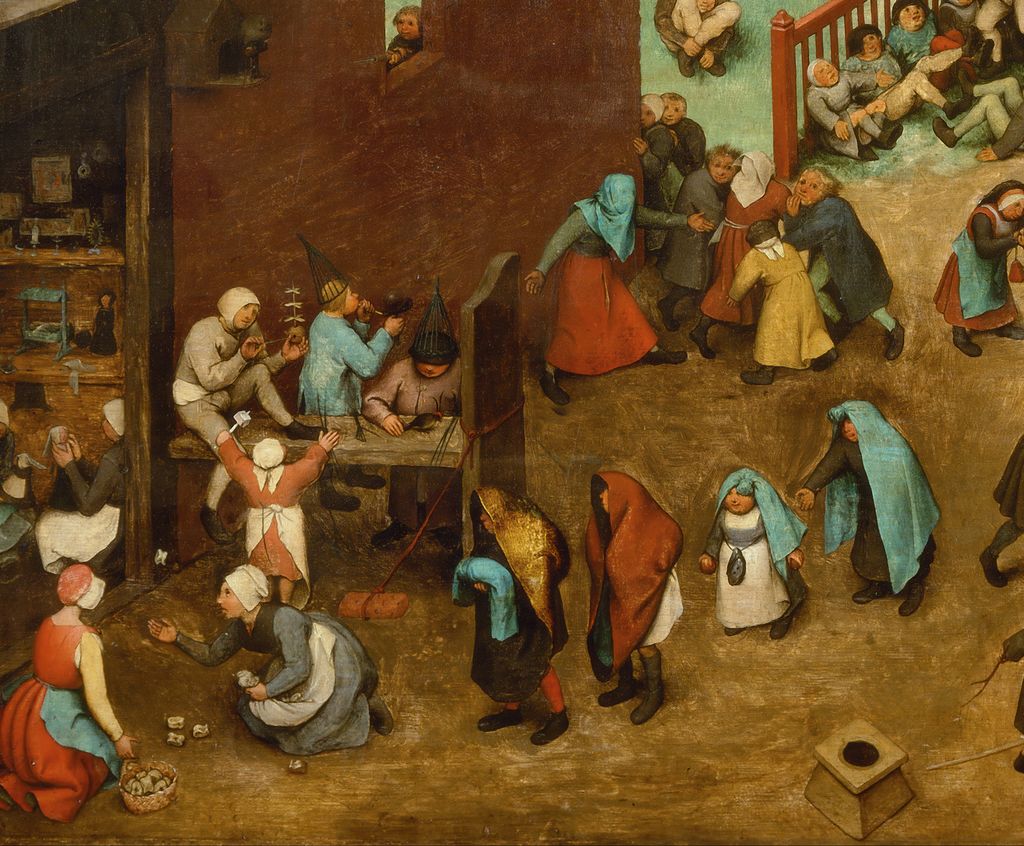
Mock wedding and foreground groups
A small procession threads past the dark building while neighbouring figures kneel, bend and gather around quieter games on the ground.
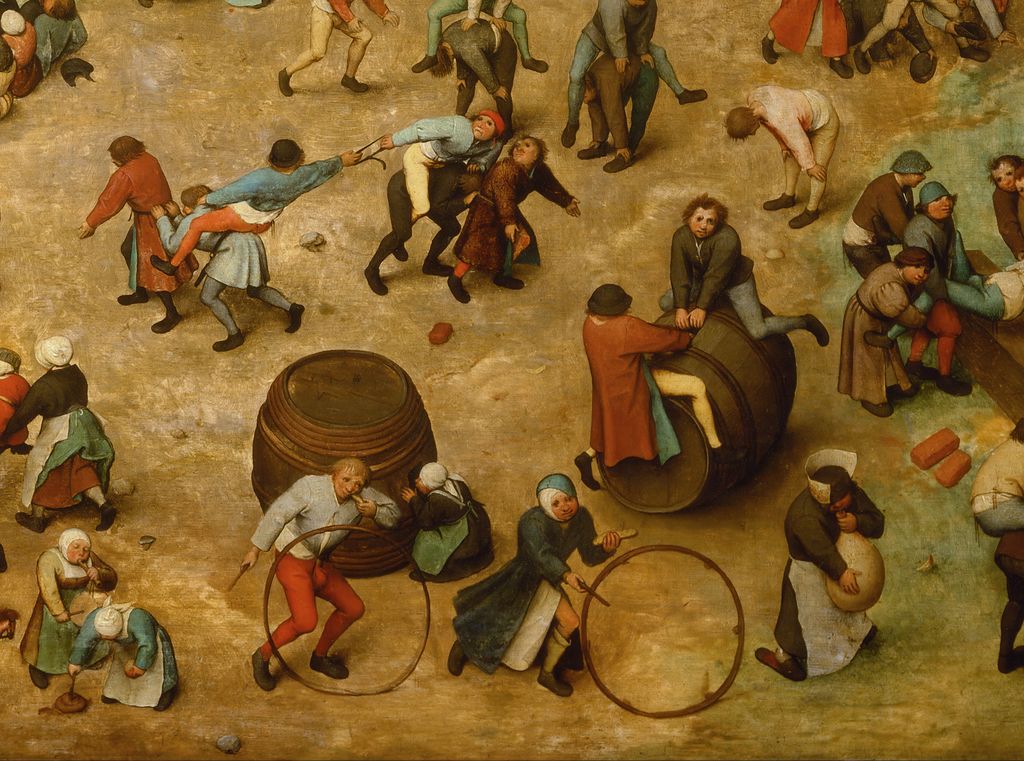
Barrels, hoops and team games
Large circular forms anchor the foreground as children run, pull and balance around them, echoing the smaller loops of arms and bodies nearby.
What Bruegel Shows
The scene is a broad urban space opening into streets, buildings and the edge of the countryside. The viewer looks down from above, as if standing high over the square rather than at street level. This elevated viewpoint allows Bruegel to distribute small figures across the whole panel without losing the main structure. The children gather in groups, but they do not merge into one shapeless crowd. Each pocket of action has its own rhythm.
Some games are still recognizable. The 2018 KHM exhibition material names blind man's buff as one activity still played today [2]. Other children roll hoops, ride hobbyhorses, balance, climb, wrestle, leap, tumble, form little processions or play with dolls and toys. Educational readings often use the painting to compare familiar and unfamiliar forms of play across time, while noting that Bruegel's image is too complex to reduce to a modern playground list [5].
The most memorable examples are often the ones in which children imitate adult roles. KHM's exhibition text points to children playing bride and groom, christening a child and pretending to be shopkeepers [2]. These are not random details. They show play as rehearsal. Children copy gestures, ceremonies, trades and social identities before they fully understand them. Bruegel makes that imitation funny, but he also makes it serious.
The mood is not uniform. Some children appear absorbed and peaceful. Others are rough, competitive or aggressive. Bruegel gives the square a range of bodily energies: crouching, pulling, pushing, balancing, striking, watching, carrying, peering, hiding, hanging, skipping and collapsing into awkward movement. The figures are small, but many are sharply characterized through posture. A child bending over a toy, a group pushing together, or a blindfolded figure reaching into empty space can carry more life than a larger formal portrait.
This range keeps the painting from becoming sentimental. Bruegel does not idealize childhood as innocence alone. He shows play as pleasure, training, habit, contest and misrule. Games create rules, but they also create conflict. They teach cooperation, but they also expose mimicry and cruelty. The square is full of delight, yet it is also a little unnerving because the children's world looks so complete without adult intervention.
Composition And Bird's-Eye Organization
Bruegel's main compositional problem was legibility. How can more than 230 figures and 83 games fit into a single panel without collapsing into visual noise? KHM's answer is the bird's-eye viewpoint: from above, the viewer can see over bodies, through the square and along the streets [1]. The high horizon and raised angle make the surface available to slow looking.
The composition is built as a field rather than as a single central drama. There is no one hero, no central child who explains the whole, and no one game that dominates the rest. Instead, the eye moves from group to group. A foreground activity catches attention; then a line of bodies leads toward the middle; then the street at upper right opens a deeper view; then a doorway or corner reveals another small incident. Looking becomes a form of wandering.
The 2018 KHM discussion links this kind of picture to the German term Wimmelbild, a busy picture filled with countless figures. It groups Children's Games with The Fight Between Carnival and Lent and The Proverbs, noting that all three share an elevated viewpoint and invite discovery across a crowded scene [2]. In each case, Bruegel gives the viewer a social map rather than a single event.
The right side of the composition is especially important because the receding street creates order. KHM's exhibition essay notes the perspective of the row of houses at the upper right and connects it with architectural ideas associated with Sebastiano Serlio, whose treatises were published in the sixteenth century by Pieter Coecke van Aelst, Bruegel's father-in-law [2]. Whether or not a viewer knows that background, the visual effect is clear: the houses pull the eye into depth and keep the crowded square from flattening completely.
At the same time, the picture never becomes a calm exercise in perspective. The square is full of interruptions. Children block routes, spill into thresholds, claim architectural edges and make the city their own. The ordered space of adult civic life becomes a play surface. Steps, barrels, fences, walls, beams and open ground are all converted into equipment for games.
This is one of Bruegel's great skills. He can make a composition highly controlled while making its subject look spontaneous. The painting feels as if the children have swarmed into the city, but their distribution is not accidental. Bruegel arranges density, open ground, architecture and motion so that the viewer can repeatedly enter the scene without losing orientation.
Watch Bruegel’s art
Explore Bruegel with TheHistoryOfArt and artwork discussions from Smarthistory.
Pieter BRUEGEL Explained in 10 Minutes (updated)
A TheHistoryOfArt film about Bruegel.
Watch on YouTubePlay, Imitation And Social Learning
Amy Orrock connects the painting to the arguments of humanist educators who took play seriously. Writers such as Juan Luis Vives discussed how children should play, whom they should play with and what adults could learn from watching them. Antwerp readers could encounter Vives and Erasmus in print. Orrock uses that material to put the activities on the panel in a world where children’s recreation might involve a choice about fairness, company and moderation. The relationship is historically suggestive. A scene with children playing a game cannot by itself establish Bruegel’s reading or point to a particular manual [6].
Knucklebones make the difference between identifying a game and explaining it particularly clear. An account of tossing the bones and trying to catch them on the back of the hand tells you what one set of rules was. Vives’s judgement of this pastime and the harsher judgement he reserved for dice tell you what an educator hoped young players would avoid. The painting returns attention to concrete actions and gestures. The figures can be counted, located and compared even where their conduct does not settle what it ought to mean [6].
The painting is most powerful when play becomes imitation. Children are not only amusing themselves; they are copying social forms. A mock wedding imitates adult ceremony. A christening game imitates religious and family ritual. Shopkeeping imitates trade. Processional games imitate public order. Doll play, costume, masks and role-playing all show children testing identities they have seen around them.
That imitation can be read in several ways. One reading is sympathetic: play is how children learn. They practice movement, speech, cooperation, exchange, rivalry and imagination. The painting then becomes a rich record of social learning, showing how adult society passes into childhood through observation and repetition.
Another reading is more moral. If children copy adults, then their games may expose adult folly. KHM's 2018 text suggests this mirror effect when it asks whether a child looking through an adult mask is imitating the viewer, and it raises the possibility that Bruegel may have been thinking of Sebastian Brant's Ship of Fools [2]. That is suggestive, but it should not force the whole painting into one moral key.
The best reading keeps both possibilities open. Bruegel shows children learning the world, but the world they learn is mixed. It contains ceremony, commerce, roughness, competition, pleasure, vanity and habit. Children imitate adults because adults provide the available models. If some games look foolish, the foolishness may not belong to children alone.
This is where the painting becomes more than a subject for childhood history. It is also a study of culture. Social habits are not abstract rules handed down in neat form. They are performed by bodies. Children learn them by copying. The town square becomes a school without teachers, where gestures circulate from one generation to the next.
How To Read The Games Without Inventing A Full List
It is tempting to turn Children's Games into a checklist. The painting practically asks viewers to identify activities, compare them with modern games and search for every little action. KHM even notes that the minuteness of the scenes requires slow and selective study if a viewer wants to decipher the games [1]. That slow study is part of the pleasure.
But a full inventory should be treated carefully. KHM's current object record gives 83 games [1]. Other discussions may count or group activities differently, partly because a single group of children can contain several actions and partly because some games are no longer familiar. The 2018 KHM essay notes that some forgotten games were identified only after extensive research [2]. That is a warning against casual certainty.
A useful close reading can work with selected examples instead. Start with the recognizable games: blind man's buff, hoops, hobbyhorses, climbing, balancing and make-believe. Then notice the adult-like play: bride and groom, christening, shopkeeping, procession and masked behavior. Then look for the rougher passages, where play shades into pushing, pulling or humiliation. The point is not to name everything. The point is to see how many kinds of behavior Bruegel allows play to contain.
It also helps to read the painting in zones. The foreground often gives the viewer the most immediate bodily activity. The central square shows many groups at once. The right-hand street pulls the eye into perspective and civic space. Doorways and architectural edges show play spilling into and out of buildings. The distant passages remind us that the scene is not a sealed playground but a whole town environment.
This method respects the painting's detail without pretending that every identification is equally secure. Bruegel rewards curiosity, but he also rewards restraint. A good reader can say, "this looks like a game of imitation," or "this group resembles a procession," while still acknowledging that older games may not map neatly onto modern names.
Relation To Proverbs, Carnival And Bruegel's Encyclopaedic Mode
Children's Games belongs to a remarkable sequence in Bruegel's early painting. The Fight Between Carnival and Lent is dated 1559. Netherlandish Proverbs is also dated 1559. Children's Games follows in 1560. The 2018 KHM material groups these three as Wimmelbilder, busy paintings teeming with figures and details [2].
The connection does not mean the paintings have identical meanings. Netherlandish Proverbs turns sayings into human actions. The Fight Between Carnival and Lent organizes festive and religious practices around a symbolic conflict between Carnival and Lent. Children's Games organizes social behavior through play. Each painting has its own subject, but all three use the same broad method: a high viewpoint, a public setting, many small incidents and a viewer who must search actively.
This method is encyclopaedic in the visual sense. Bruegel gathers many examples of a human field: proverbs, ritual practices or games. Yet he does not arrange them like isolated entries in a book. He places them inside a world. Buildings, streets, water, thresholds and open ground connect the activities. The result is not a diagram but a social environment.
For that reason, Bruegel's proverbs and iconography provide a useful companion to this page. In Bruegel, a visible action can be literal and meaningful at the same time. A child can simply be playing, and that play can also reveal imitation, discipline, competition or folly. A public ritual can be festive and morally charged. A proverb can be comic and bleak.
The Fight Between Carnival and Lent is especially close because it also takes place in a town square. KHM's 2018 account stresses that Bruegel shows many events simultaneously in the same public space [4]. Children's Games uses a similar public stage, but replaces seasonal conflict with childhood activity. In both works, the town square becomes a theatre of social behavior.
The comparison with Netherlandish Proverbs sharpens the question of moral reading. Proverbs often come with judgments already attached. Games do not. They are open-ended. A game can be innocent, foolish, violent, creative or instructive depending on how it is played and how it is viewed. This makes Children's Games harder to reduce. It sits between delight and diagnosis.
Why The Painting Remains Useful For Education
Children's Games remains one of Bruegel's most useful paintings for teaching because it immediately invites looking. Students do not need advanced art-historical vocabulary to begin. They can notice that the picture is full of children, that the viewpoint is high, that the town has been taken over by play, and that many activities resemble things still done today. From there, the painting opens into deeper questions.
One set of questions concerns historical childhood. What games have survived? Which look unfamiliar? Which require toys, which require only bodies, and which require shared rules? World History Commons presents the painting as a primary visual resource for thinking about children's play in earlier Europe, while also pointing beyond it to book illumination, poetry, toys and material culture [5]. The painting is not the whole history of childhood, but it is a vivid entry point.
Another set of questions concerns composition. How does Bruegel keep such a crowded scene readable? Why does the high viewpoint matter? What routes does the eye follow? Which areas feel dense, and which give the viewer breathing space? These questions help readers understand Bruegel as a maker of visual order, not just a collector of amusing details.
A third set concerns ethics and interpretation. Is the painting affectionate, critical, comic, documentary, moral or all of these? KHM's warning against a simple moralizing undertone is useful here [1]. It gives readers permission to see complexity. The painting can show joy in play and unease about imitation. It can preserve the history of games and ask what those games reveal about adult society.
The work is also useful because it models slow looking. It cannot be consumed instantly. The viewer has to return, compare, revise and admit uncertainty. That is one reason KHM's Bruegel research project matters beyond conservation. The museum describes its non-invasive study of Bruegel's Vienna panel paintings and the high-resolution Inside Bruegel resource as a way for viewers to look closely at the artist's compositions [3]. Children's Games is almost a training ground for that kind of attention.
Why It Still Feels Modern
The painting still feels modern because it understands public life as a network of repeated behaviors. Children imitate adults. Groups form around rules. Games become temporary societies. The square is full of cooperation, competition, performance, spectatorship and small conflicts. Bruegel seems to understand that culture is learned through use, not only through instruction.
It also feels modern because it refuses a simple division between innocence and folly. Childhood in the painting is energetic and inventive, but it is not pure. Adult life, glimpsed through imitation, is orderly and ceremonial, but it is not necessarily wise. The viewer stands between the two. Are we watching children play at being adults, or adults revealed as people still playing roles?
That question gives the panel its lasting charge. Bruegel does not need to tell us what to think. He creates a square in which human behavior repeats at different scales. A child's mock ceremony can resemble a real ceremony. A game can become a little economy. A contest can become a rehearsal for status. A mask can turn the act of looking back on the viewer.
For anyone moving through Bruegel's paintings, Children's Games is therefore essential. It shows the artist's crowd intelligence before the monumental landscapes of the mid-1560s and before the late peasant scenes. It belongs to the same imaginative world as his proverb and festival paintings, but it has a tone of its own: lively, comic, observational and quietly unsettling.
The best way to finish with the painting is to return to its numbers without letting them flatten the experience. More than 230 children. 83 games. One signed and dated oak panel. Those facts are extraordinary, but Bruegel's achievement is not arithmetic. It is the transformation of many tiny actions into a coherent image of social life. Children's Games remains powerful because every child seems busy inside a game, while the viewer slowly realizes that the largest game may be society itself.
Discussion
What feels most revealing about Pieter Bruegel the Elder: the village detail, the landscape setting, the moral wit, or the way everyday life becomes a complete world?
Reader Insights
Begin with one small action in a Bruegel scene, then follow how it connects to the surrounding figures, setting and rhythm of the whole image.
Connect the work to Northern Renaissance visual culture, printmaking, proverb traditions and Bruegel's interest in rural and urban life.
Which detail changes the interpretation most once you know the subject, date, proverb source or present collection?
Join the Conversation
Have a thought or observation about Pieter Bruegel the Elder? Share it below. Thoughtful responses may be added to this section as the Bruegel pages develop.
Frequently Asked Questions
Pieter Bruegel the Elder's Children's Games is one of the most astonishing crowd paintings of the sixteenth century. Painted in 1560 and now in the Kunsthistorisches Museum in Vienna, it shows a town square, streets, doorways, buildings, a stream and distant edges of countryside taken over by children at play. [1]
The KHM’s 2018 catalogue places the signature and date on a beam at the lower right and records the painting as inventory 1017. It gives the oak panel’s dimensions as 116.4 by 160.3 centimetres . [7]
Bruegel's main compositional problem was legibility. How can more than 230 figures and 83 games fit into a single panel without collapsing into visual noise? [1]
References
- Kunsthistorisches Museum Wien, Children's Games, View source.
- Kunsthistorisches Museum Wien, Of Wimmelbilder (busy pictures) and children's games, View source.
- Kunsthistorisches Museum Wien, Researching Bruegel, View source.
- Kunsthistorisches Museum Wien, Carnival vs. Lent, View source.
- World History Commons, Pieter Bruegel the Elder's "Children's Games", View source.
- Amy Orrock, Homo ludens: Pieter Bruegel’s Children’s Games and the Humanist Educators, Journal of Historians of Netherlandish Art 4, no. 2, 2012, View source.
- Kunsthistorisches Museum Vienna, Von Wimmelbildern und Kinderspielen, 2018 exhibition, inv. 1017, View source.






