


 Buy Art Prints Now
from Amazon
* As an Amazon Associate I earn from qualifying purchases.
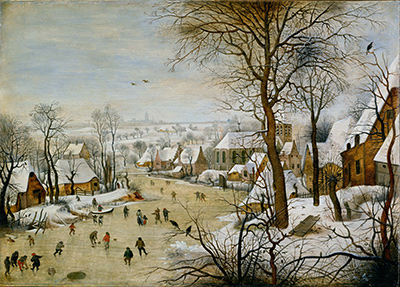
Version of Bruegel’s composition. The annotated details below show the 1565 Brussels panel.
 by Tom Gurney
Tom Gurney BSc (Hons) is an art history expert with over 20 years experience
Published on June 19, 2020 / Updated on August 16, 2026
Email: tomgurney1@gmail.com / Phone: +44 7429 011000
Pieter Bruegel Winter Landscape with a Bird Trap: Introduction
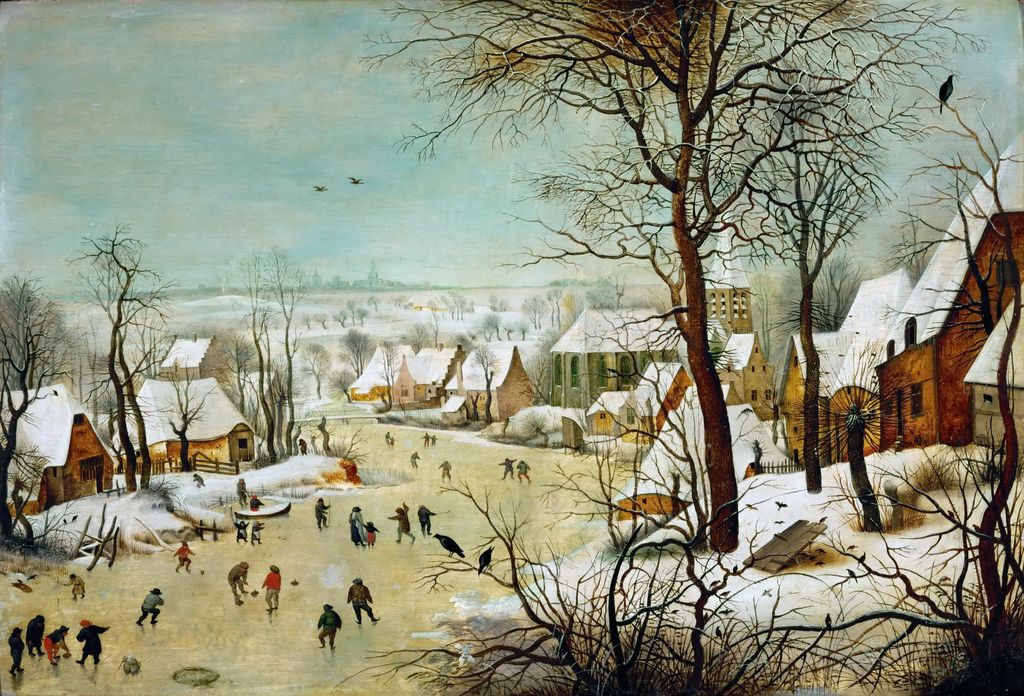
Pieter Bruegel the Elder's Winter Landscape with a Bird Trap is a small winter panel with a very large afterlife. The Royal Museums of Fine Arts of Belgium in Brussels identifies its Winterlandschap met schaatsers en vogelknip as a work by Pieter I Bruegel, dated 1565, painted in oil on oak, signed and dated at lower right [1]. That Brussels painting is the object basis here.
The caution is important because this famous composition exists in many later versions. The Kunsthistorisches Museum in Vienna records its own Winterlandscape with Bird-Trap as a 1601 work from the circle of Pieter Bruegel the Elder, and notes that around 100 copies testify to the extraordinary popularity of the design [2]. A familiar image, in other words, is not always the same object. The Brussels panel is treated by RMFAB as Bruegel's 1565 work; the Vienna panel is a later copy-context example. That distinction shapes how the painting should be read.
The picture itself seems disarmingly simple: a frozen village, skaters on ice, bare trees, cottages, birds, and a trap waiting at the right. Yet its quietness is deceptive. Like Hunters in the Snow, it shows Bruegel turning winter into a complete social and visual condition. Unlike the large seasonal panel in Vienna, this work concentrates winter into an intimate scene where play, danger, habit, and possible moral suggestion occupy the same frozen ground.
At a Glance
- ArtistPieter Bruegel the Elder
- TitleWinter Landscape with Skaters and Bird Trap; also known as Winter Landscape with a Bird Trap
- Date1565
- Medium/supportoil on oak
- Dimensions37 x 55.5 cm
- Signature/datesigned and dated at lower right, recorded by RMFAB as BRVEGEL / M.D.LXV
- CollectionRoyal Museums of Fine Arts of Belgium, Brussels
- Inventory8724
- Related comparisonKHM's 1601 Winterlandscape with Bird-Trap, catalogued in circle/copy terms
- Key cautionnot every version of this composition is by Bruegel the Elder
This work across Bruegel’s career
Tower of Babel
1563The Harvesters
1565Peasant Wedding
1568Children's Games
1560Triumph of Death
1562–1563Winter Landscape with a Bird Trap
This artworkContents
- Introduction
- Object Facts And RMFAB Context
- What The Winter Scene Shows
- Skaters, Ice, Village And Bird Trap
- Possible Moral And Proverbial Resonance
- Copy Tradition And Why Labels Matter
- Relation To Hunters In The Snow And The Seasons
- Why The Painting Matters
- Annotated Details
Object Facts And RMFAB Context
RMFAB's record gives the Dutch title Winterlandschap met schaatsers en vogelknip, names Pieter I Bruegel as artist, and dates the panel to 1565 [1]. The museum lists the technique as oil on oak, gives the dimensions as 37 by 55.5 cm, and records a lower-right signature and date [1]. The Brussels painting entered the museum through the Delporte bequest in 1977 [1].
Those facts make the Brussels panel a compact but secure point of reference within Bruegel's mature painting years. It belongs to the same date as the surviving Seasons panels, including Hunters in the Snow, The Gloomy Day, The Harvesters, Haymaking, and The Return of the Herd [4]. It is not itself one of those large dining-room panels, but it shares their intense attention to season, communal activity, weather, and the way people inhabit a landscape.
The scale matters. At 37 by 55.5 cm, the Brussels work is far smaller than Hunters in the Snow, which KHM records as a large oak panel of more than 116 by 162 cm [3]. Bruegel does not need monumental size to make winter convincing. Here the composition is compressed: the village, ice, trees, birds, and trap are held in a shallow, almost domestic field of vision. The small format helps explain why the image could travel so easily through copies. It is memorable, repeatable, and visually complete.
Annotated Details from Winter Landscape with a Bird Trap
Follow the skaters and birds across the Brussels panel, then look for the propped board on the snowy right bank.
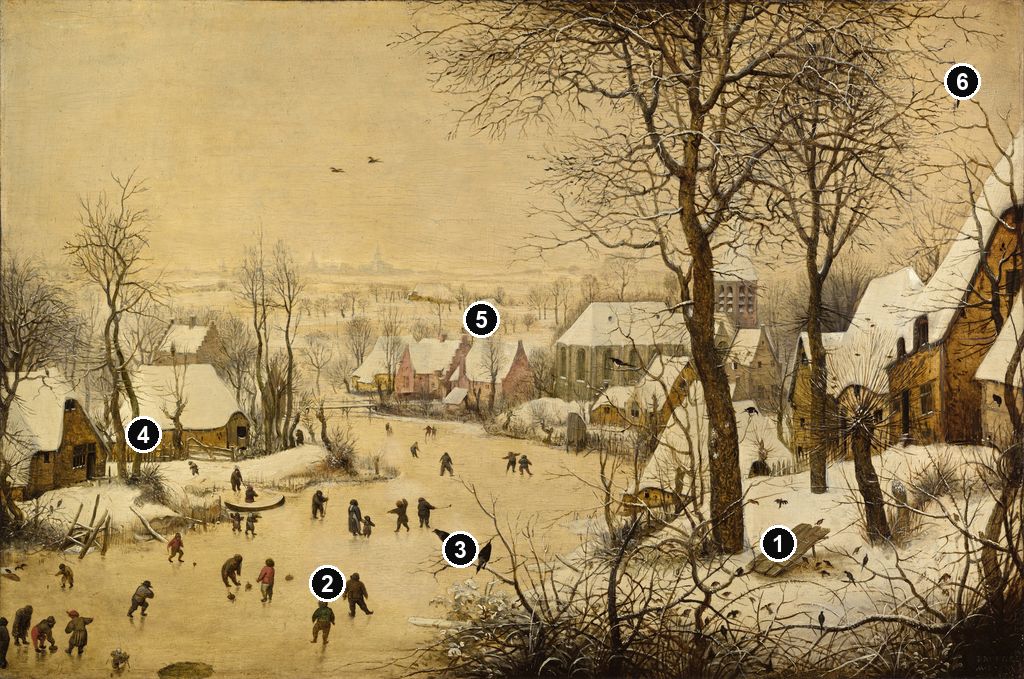
Details from WINTER LANDSCAPE WITH A BIRD TRAP
Six details connect the frozen water, the village and the bird trap.
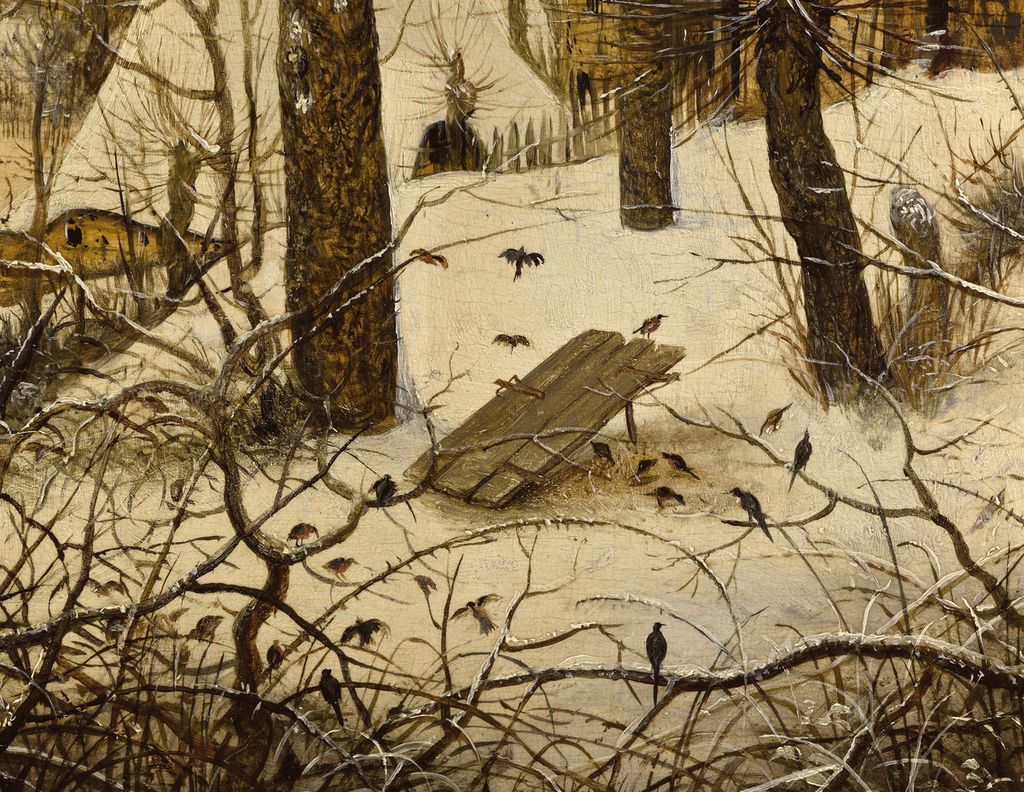
The propped bird trap
A flat board propped on a stick forms the trap on the right bank.
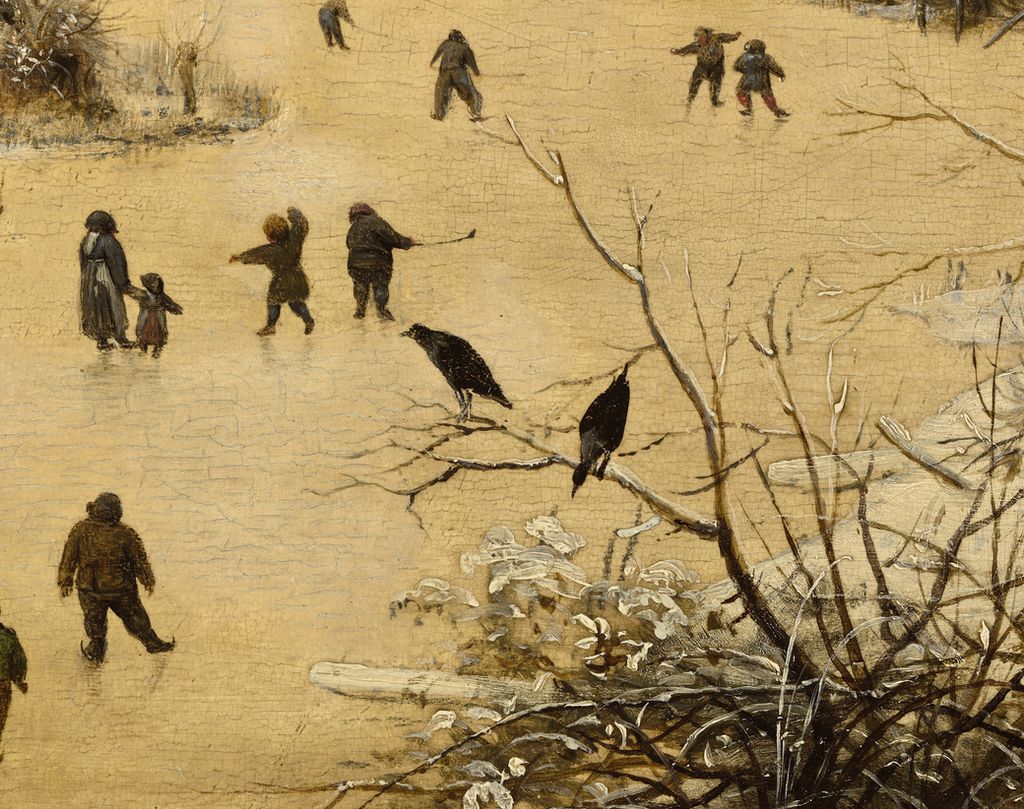
Skaters on the ice
Figures move across the ice in different directions, with one skater nearly at the lower edge of the panel.
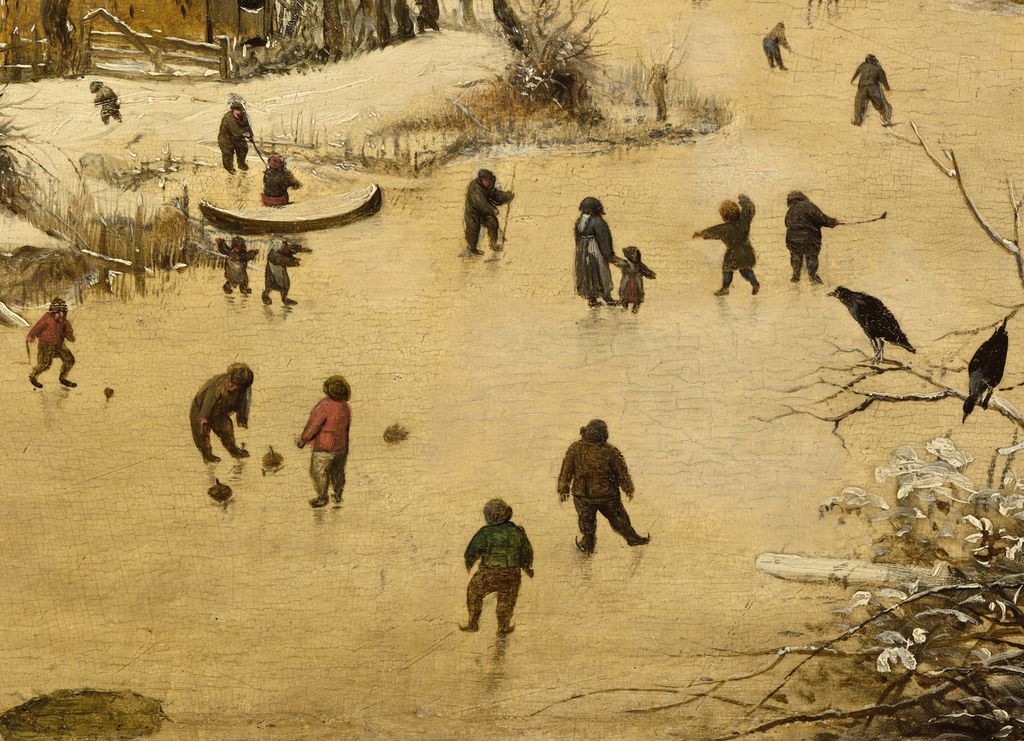
Birds near the ice
Two dark birds at the tips of branches stand out against the pale surface behind them.
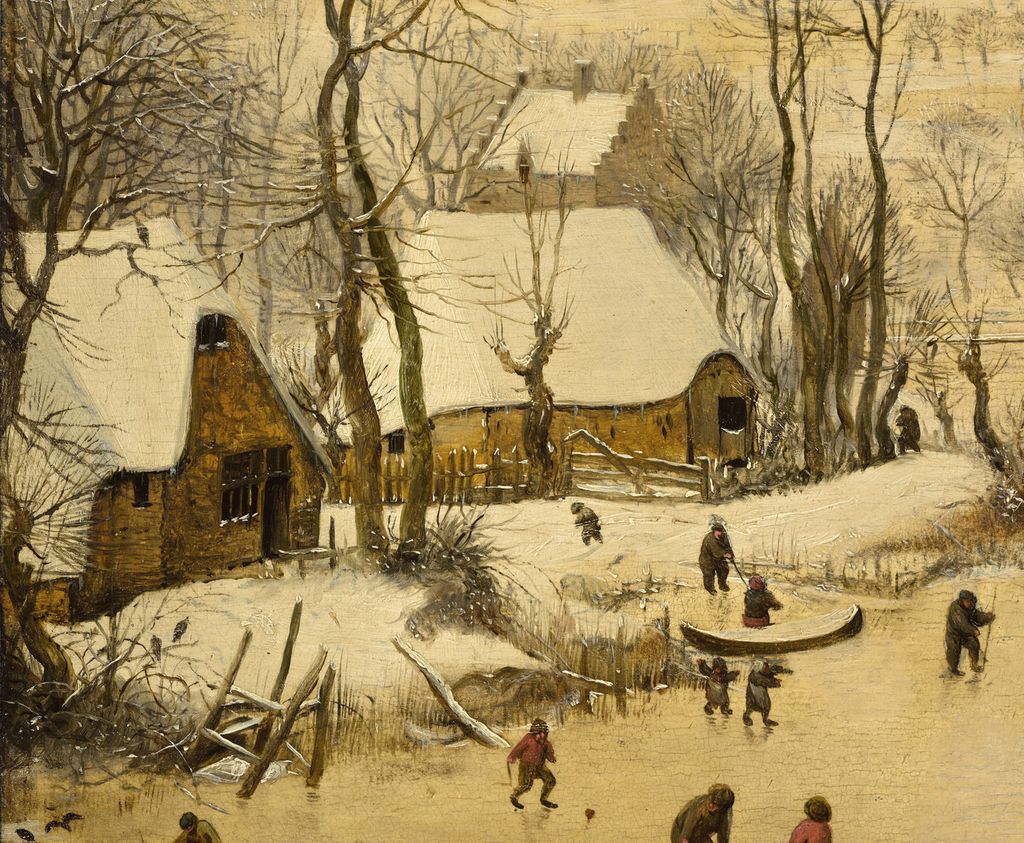
The left bank cottages
Snow-covered roofs and bare trees follow the curve of the frozen water.
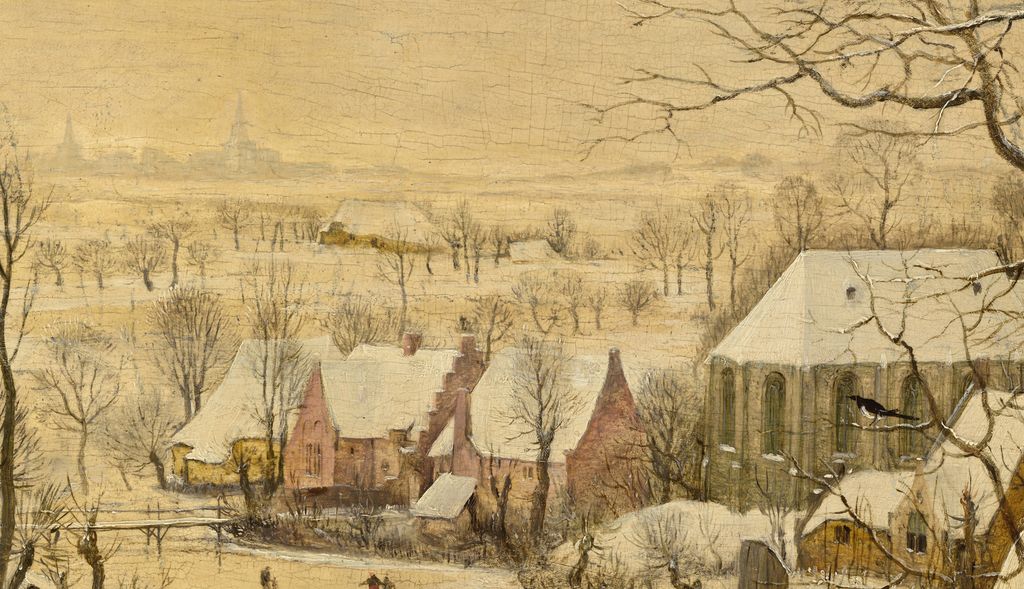
The village in the distance
Pale buildings and a church tower recede behind the nearer houses.
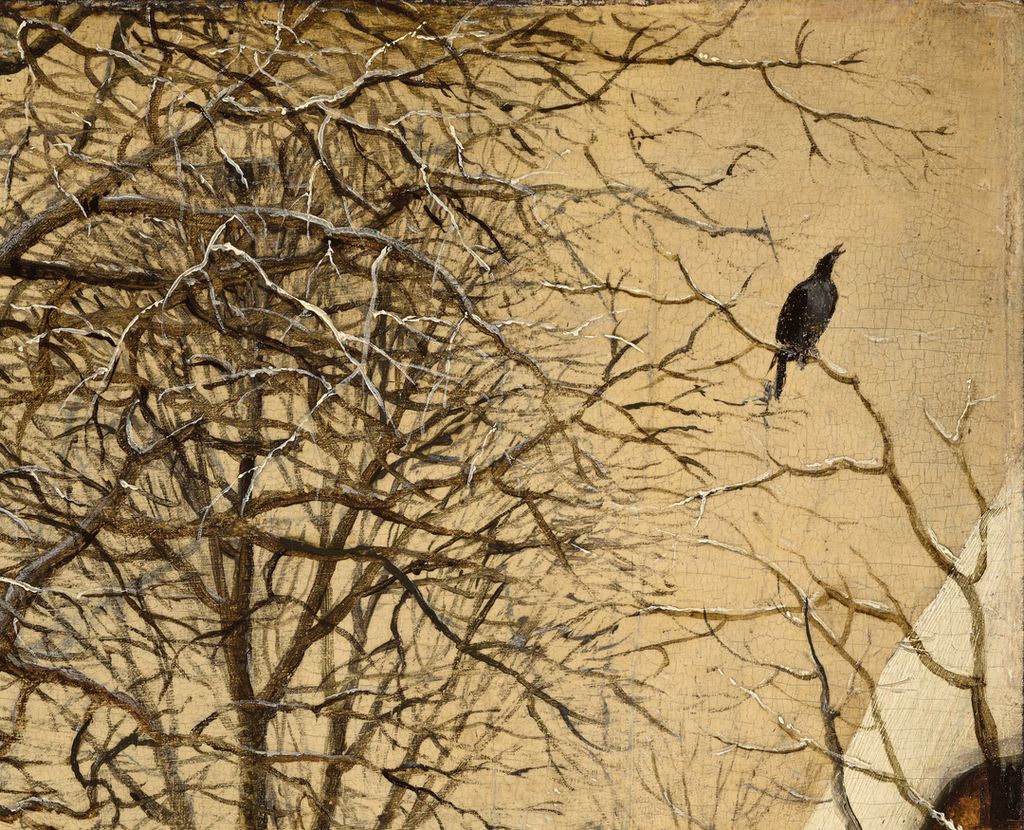
A bird in the high branches
A dark bird at the upper right is silhouetted against the winter sky.
Pieter Bruegel the Elder, Winter Landscape with a Bird Trap, 1565. Royal Museums of Fine Arts of Belgium, inv. 8724. Reproduction via Wikimedia Commons.
What The Winter Scene Shows
The painting presents a snow-covered village seen from a slightly elevated position. Cottages and leafless trees frame the frozen water. Figures skate and move across the ice, some upright and balanced, others implied as vulnerable simply by being on a slippery surface. Birds gather near the houses and trees. At the right, a bird trap waits: a simple device propped open, ready to fall.
Nothing in the scene announces itself as a grand event. The winter day is ordinary. That ordinariness is one of Bruegel's strengths. He often makes large meaning from distributed small action: children playing, peasants gathering, workers harvesting, villagers moving through snow, crowds filling a square. In this painting, winter is not an empty landscape with people added for scale. It is a social environment. The frozen surface becomes a temporary commons where village life continues under changed conditions.
The eye moves between pleasure and threat. The skaters make the picture lively; the bird trap gives it a quiet edge. The children, adults, houses, bare branches, birds, and ice all seem part of the same winter order. Bruegel does not isolate danger as a single dramatic episode. He lets it sit near play, almost unnoticed.
Skaters, Ice, Village And Bird Trap
The skaters are central to the painting's charm. They animate the frozen water and turn cold into motion. Their presence also links the panel with Bruegel's broader winter imagery, especially Hunters in the Snow, where KHM notes that skaters on frozen ponds helped make the work so beloved [3]. In both pictures, skating is not a decorative aside. It shows how a community adapts to winter.
The ice is both support and risk. It lets people gather, cross, play, and perform small acts of balance. At the same time, it is unstable by nature. The trap at the right sharpens that ambiguity. Birds are drawn toward bait or shelter, while humans glide nearby on a surface that can also betray them. The two motifs do not need to be reduced to a single coded message. Their power lies in proximity: life continues, play continues, and danger waits inside the everyday.
The village setting keeps the painting grounded. This is not a remote wilderness. It is a place of houses, roofs, paths, trees, and neighbors. Bruegel's winter is communal rather than solitary. The trap belongs to ordinary rural practice, while the skaters belong to ordinary seasonal pleasure. The painting matters because it holds those things together without forcing them into a neat moral diagram.
Possible Moral And Proverbial Resonance
The bird trap has often encouraged symbolic readings. KHM notes that the bird trap and skaters have been given proverbial or moralizing meanings, such as vigilance and the slippery course of life, while also stating that there is no convincing proof for those readings [2]. That caution should guide the interpretation.
It is reasonable to say that the painting invites moral resonance. Bruegel's viewers knew proverbs, moral exempla, and images in which everyday behavior could carry broader meaning. A trap near unsuspecting birds can suggest danger; skaters on ice can suggest precarious human movement. But the painting does not require a single solved allegory. Its effect is subtler than that.
The best reading keeps both levels open. On one level, this is a winter village with skaters and a bird trap. On another, the trap and ice may ask viewers to notice how pleasure, habit, and vulnerability overlap. The scene becomes more interesting when the possible moral meaning stays attached to the ordinary world instead of replacing it.
Copy Tradition And Why Labels Matter
One version at Museum Mayer van den Bergh makes the stakes of those labels clear. It includes tiny figures of Mary and Joseph with the donkey at the bridge, adding the Flight into Egypt to the snowy landscape. The museum discusses that addition as a rare variation and suggests it may reflect a client’s request. Look for it in a photograph of the Antwerp picture, where a detail easily missed at first glance changes how the rest of the landscape can be read. The Brussels panel discussed here is a separate object [5] [1].
The museum reports more than a hundred copies of the design and refers to a catalogue total of 127. That figure describes the recorded composition across numerous objects. It does not give the number of autograph paintings by either Bruegel. Comparison is especially useful when it follows small points from work to work, such as the shape of the trap, the traffic on the ice or the passage at the bridge. The repeated broad outline and the changing detail together show how a successful workshop pattern could be both recognisable and adaptable [5].
The composition's popularity is one of the most important facts about it. KHM states that around 100 copies demonstrate the extraordinary appeal of the design after Pieter Bruegel the Elder [2]. Its own 1601 version is not presented as the Brussels autograph work. KHM records it in circle terms, with a prior attribution to Pieter Brueghel the Younger treated cautiously, and describes it as one of the oldest and finest examples in the copy tradition [2].
That is exactly where readers need careful language. A version of Winter Landscape with a Bird Trap may reproduce Bruegel's design closely and still not be by Bruegel the Elder. It may belong to the Brueghel family, to a circle, to a follower, or to another copyist. It may also be historically important precisely because it shows how much demand existed for the image.
For Bruegel, copies are not a minor footnote. His surviving painted oeuvre is small, while his inventions circulated widely through family and workshop practice. The guide to workshop copies and attribution explains why titles, artist lines, dates, and words such as "circle" or "copy after" matter so much. In this case, the practical rule is simple: the Brussels RMFAB panel is the 1565 work identified as Pieter I Bruegel; the Vienna KHM painting is a 1601 copy-context object. The shared composition should not collapse those labels.
Relation To Hunters In The Snow And The Seasons
The natural comparison is Hunters in the Snow. Both winter paintings are tied to 1565, both use small human figures against a cold environment, and both show winter as a condition people inhabit rather than merely observe. KHM also notes the possibility that the unusually severe winter of 1564-65 may have encouraged Bruegel's attention to winter landscape, though that idea should remain a cautious historical possibility rather than a proven cause [2].
The differences are just as revealing. Hunters in the Snow belongs to Bruegel's large Seasons cycle, a group originally made for the Antwerp merchant and collector Niclaes Jongelinck and probably displayed in a country-house dining room [4]. It gives winter panoramic depth: hunters, dogs, village, frozen ponds, mountains, and a whole atmosphere of cold. The bird-trap painting is smaller and more concentrated. It narrows winter to village ice, nearby houses, birds, and a single waiting device.
Placed within Bruegel's landscapes and seasons, the panel shows another side of the same gift. Bruegel could make landscape expansive, as in the large Seasons panels, but he could also make a small winter scene feel complete. The Brussels painting belongs naturally in any survey of his paintings because it shows how a modest format could hold weather, social observation, and moral possibility in balance.
Why The Painting Matters
Winter Landscape with a Bird Trap matters first because it is a beautiful and concise winter image by one of the defining painters of the sixteenth-century Low Countries. It has snow, ice, skaters, cottages, birds, bare trees, and atmosphere, but it does not depend on spectacle. Its intelligence is quiet. Bruegel makes the viewer notice how ordinary life continues inside cold, and how danger can sit beside pleasure without announcing itself.
It matters secondly because of its copy tradition. Few Bruegel compositions demonstrate the difference between image and object so clearly. The same design could circulate in many painted versions, but each version carries its own attribution, date, material history, and evidentiary value. The painting is therefore both a winter scene and a lesson in how to look at Bruegel labels.
Most of all, it matters because it condenses Bruegel's larger art into a small field. The scene is approachable, even charming, yet it remains unsettled. Skaters move across ice; birds gather near a trap; a village endures winter; the viewer senses both play and warning. That balance is pure Bruegel: exact, humane, and cautious about giving the world only one meaning.
Discussion
What feels most revealing about Pieter Bruegel the Elder: the village detail, the landscape setting, the moral wit, or the way everyday life becomes a complete world?
Reader Insights
Begin with one small action in a Bruegel scene, then follow how it connects to the surrounding figures, setting and rhythm of the whole image.
Connect the work to Northern Renaissance visual culture, printmaking, proverb traditions and Bruegel's interest in rural and urban life.
Which detail changes the interpretation most once you know the subject, date, proverb source or present collection?
Join the Conversation
Have a thought or observation about Pieter Bruegel the Elder? Share it below. Thoughtful responses may be added to this section as the Bruegel pages develop.
Frequently Asked Questions
Pieter Bruegel the Elder's Winter Landscape with a Bird Trap is a small winter panel with a very large afterlife. The Royal Museums of Fine Arts of Belgium in Brussels identifies its Winterlandschap met schaatsers en vogelknip as a work by Pieter I Bruegel, dated 1565, painted in oil on oak, signed and dated at lower right . [1]
The skaters are central to the painting's charm. They animate the frozen water and turn cold into motion. [3]
The bird trap has often encouraged symbolic readings. KHM notes that the bird trap and skaters have been given proverbial or moralizing meanings, such as vigilance and the slippery course of life, while also stating that there is no convincing proof for those readings . [2]
References
- Royal Museums of Fine Arts of Belgium, Winterlandschap met schaatsers en vogelknip, View source.
- Kunsthistorisches Museum Wien, Winterlandscape with Bird-Trap, View source.
- Kunsthistorisches Museum Wien, Hunters in the Snow (Winter), View source.
- Kunsthistorisches Museum Wien, Six Seasons for a Dining Room, View source.
- Museum Mayer van den Bergh, Winter Landscape with a Bird Trap, View source.









