



 by Tom Gurney
Tom Gurney BSc (Hons) is an art history expert with over 20 years experience
Published on June 19, 2020 / Updated on August 16, 2026
Email: tomgurney1@gmail.com / Phone: +44 7429 011000
Hunters in the Snow by Pieter Bruegel the Elder: Introduction
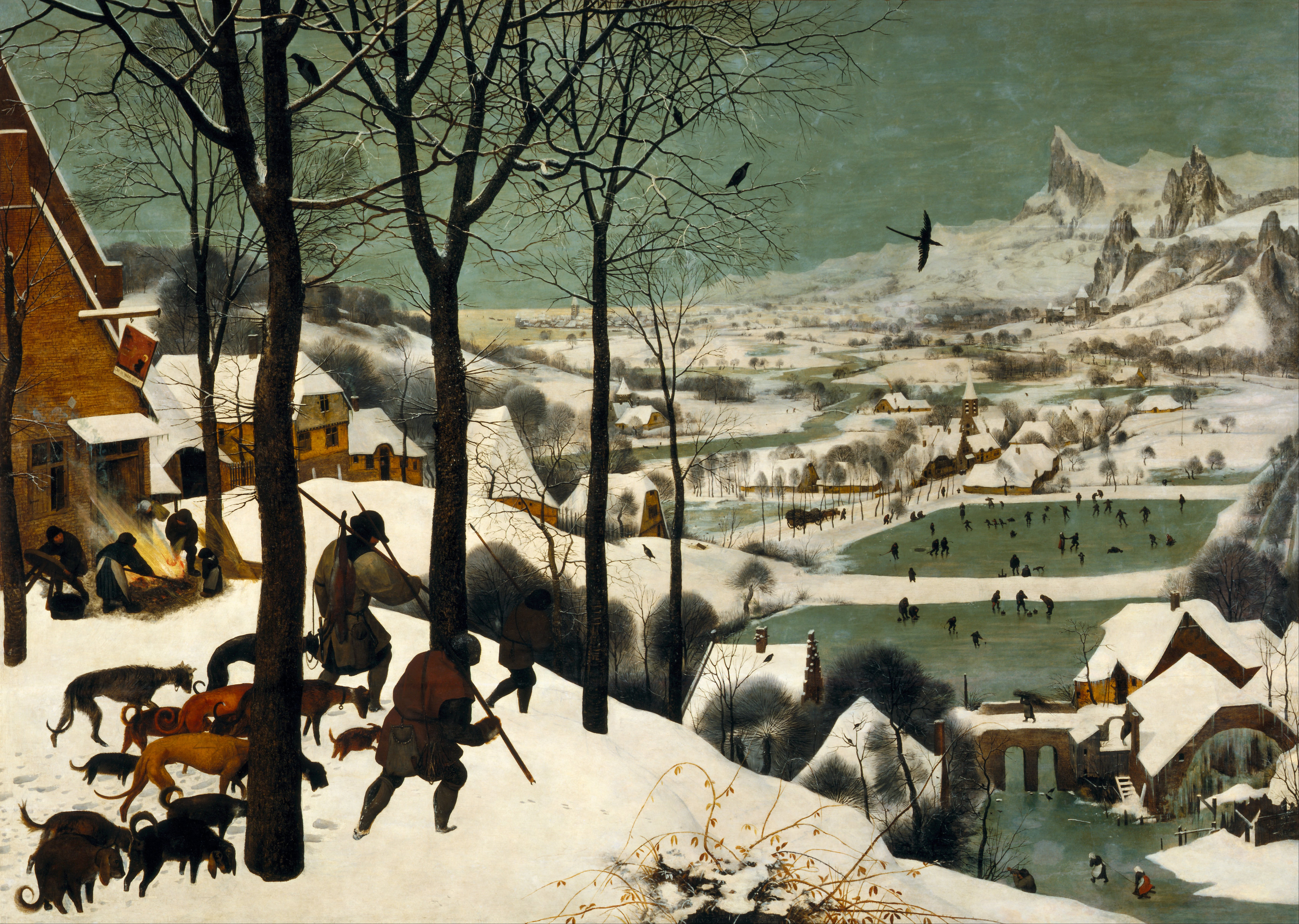
Pieter Bruegel the Elder's Hunters in the Snow, also known as Hunters in the Snow (Winter), is one of the clearest images of winter ever made. Three hunters return from the woods with a thin pack of dogs and a single fox. Below them, a village drops into a frozen valley. People skate, play games, walk across ice, tend fires, carry wood and keep going. The sky is pale, the snow is hard, the trees cut black lines across the air, and the mountains seem to close the world in.
Painted in 1565, the panel belongs to Bruegel's great cycle of the Seasons, a group originally made for the Antwerp merchant and collector Niclaes Jongelinck. The cycle was designed for a country-house dining room, probably as a frieze-like sequence around the room, so that the year unfolded around the viewer [2] [7]. Hunters in the Snow represented winter, most often understood as December and January. It is now in the Kunsthistorisches Museum Vienna, where it is on view in the Picture Gallery's Room X among the museum's exceptional Bruegel holdings [1] [5].
The painting's fame depends on a paradox. It is full of incident, yet it does not feel anecdotal. The eye can roam from the hunters and hounds to the pig-singeing at the inn, from the frozen ponds to the distant roofs, from a millwheel caught by ice to a far ridge of mountains. But the picture is not important because of a checklist of details. Its power lies in the total weather of the image. Bruegel makes cold into structure, color, movement and social atmosphere.
This is why Hunters in the Snow is central to understanding Pieter Bruegel the Elder as more than a painter of peasant scenes. It belongs to his mature landscape art, his feeling for seasonal labor and leisure, his high viewpoints, his disciplined construction, and his ability to make ordinary human action feel part of a larger order. It is a landmark of Bruegel's landscapes and seasons, but it also belongs beside his most famous paintings as a work whose simplicity of subject hides extraordinary invention.
At a Glance
- ArtistPieter Bruegel the Elder
- TitleHunters in the Snow (Winter)
- Date1565
- Medium/supportOil on oak panel; KHM records oak wood
- DimensionsAbout 116.5 x 162 cm; KHM object record gives 116.5 x 162 x 2.4 cm
- SignatureInscribed bottom center: BRVEGEL. M.D.LXV
- Present collectionKunsthistorisches Museum Vienna, Picture Gallery
- DisplayGemaldegalerie Room X, according to the KHM object record
- InventoryGemaldegalerie, inv. no. 1838
- Original settingPart of the six-panel Seasons cycle for Niclaes Jongelinck's country house near Antwerp
- Related Bruegel pagesBiography, Paintings, Landscapes and Seasons, Style and Technique
This work across Bruegel’s career
Tower of Babel
1563The Harvesters
1565Peasant Wedding
1568Children's Games
1560Triumph of Death
1562–1563Contents
- Introduction
- A Winter Panel In The Seasons Cycle
- The Hunters And Their Dogs
- The Inn, The Fire And The Pig
- The Village And Frozen Ponds
- The Sensation Of Cold
- High Viewpoint And Deep Landscape
- Composition And The Foremost Hunter
- Jongelinck's Dining Room And Country-House Culture
- Relation To Other Bruegel Winter Paintings
- Annotated Details
A Winter Panel In The Seasons Cycle
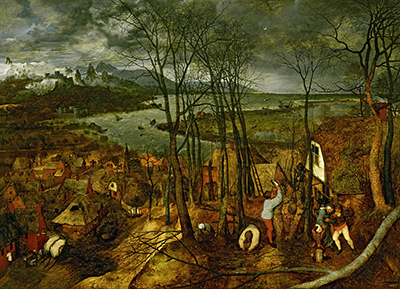
Look first at the distance between the hunters on the bank and the people on the ice. The distance lets Bruegel represent two kinds of movement in conditions that would otherwise be hard to compare in a single view. The men and dogs pick their way over snow on a steep slope. Beyond them, skaters and players spread out across a level surface with room to turn and glide. In KHM’s exhibition on the seasons, those changes of ground matter as much as the calendar. Compare the water here with the stream and the exposed shore in The Gloomy Day. The transformation from frozen communal ground to moving water lets the painter tell the time of year through the ways people travel across a landscape [7] [8].
Hunters in the Snow was not made as a single isolated view of winter. It was part of a cycle of six large panel paintings representing the seasons, made for Jongelinck's country house, called t'goed ter Beke, near Antwerp [2]. The surviving group gives one of the most ambitious answers in European art to a deceptively simple problem: how can a painter turn the year into a visual experience?
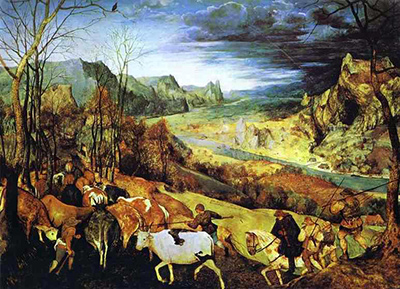
Today many viewers expect four seasons. In the sixteenth-century Low Countries, however, the year could be divided into six periods: early spring, spring, early summer, late summer, autumn and winter [2] [7]. Five of Bruegel's six panels survive. The Gloomy Day represents early spring and is in Vienna. Haymaking represents early summer and is in Prague. The Harvesters represents late summer and is in New York. The Return of the Herd represents autumn and is in Vienna. Hunters in the Snow represents winter and is also in Vienna [2] [7].
The missing panel, usually associated with spring or late spring, matters because it reminds us that the cycle is not complete. Even so, the surviving panels retain the force of a whole conception. Each painting has its own weather, color range, human activities and landscape rhythm. Seen together, they turn the calendar into a wide world in motion.
The comparison with The Harvesters is especially useful. The Met describes that panel as a late-summer scene of harvest labor, rest, food and abundance. Its workers cut wheat, gather apples and take shade beneath a tree [6]. In Hunters in the Snow, the equivalent world has been stripped and cooled. Food is no longer a golden field; it is a single fox and the preparation of a pig over fire. The land is no longer hazy and generous; it is frozen and resistant.
The comparison with The Gloomy Day and The Return of the Herd is just as important. Those Vienna panels make weather active. In The Gloomy Day, early spring is unsettled, wet and stormy. In The Return of the Herd, autumn is dramatic, with cattle descending while the weather turns severe. Hunters in the Snow takes that weather logic to its most complete form. It is not only an outdoor scene in winter. It is a landscape whose every part has been reorganized by cold.
The cycle also changes the status of landscape. Earlier European painting often used landscape as a setting behind religious or mythological events. Bruegel gives landscape a new independence. The Met's discussion of The Harvesters describes Bruegel as working at the front edge of independent, secular landscape, where the old narrative pretext falls away and the rhythms of life in the land take center place [6]. Hunters in the Snow makes that shift unmistakable. There is no single sacred story in the foreground. The subject is the season itself.
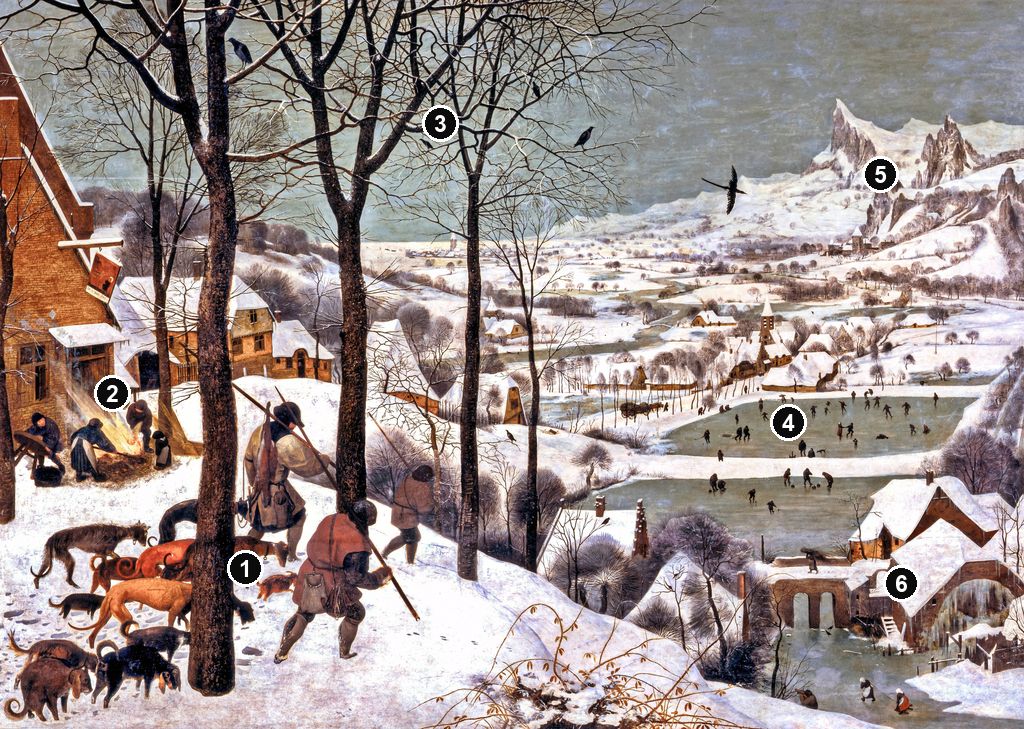
Annotated Details from Hunters in the Snow
The numbered details move from the weary hunting party and activity beside the inn through the bare winter canopy to the village, mountains and watermill below.
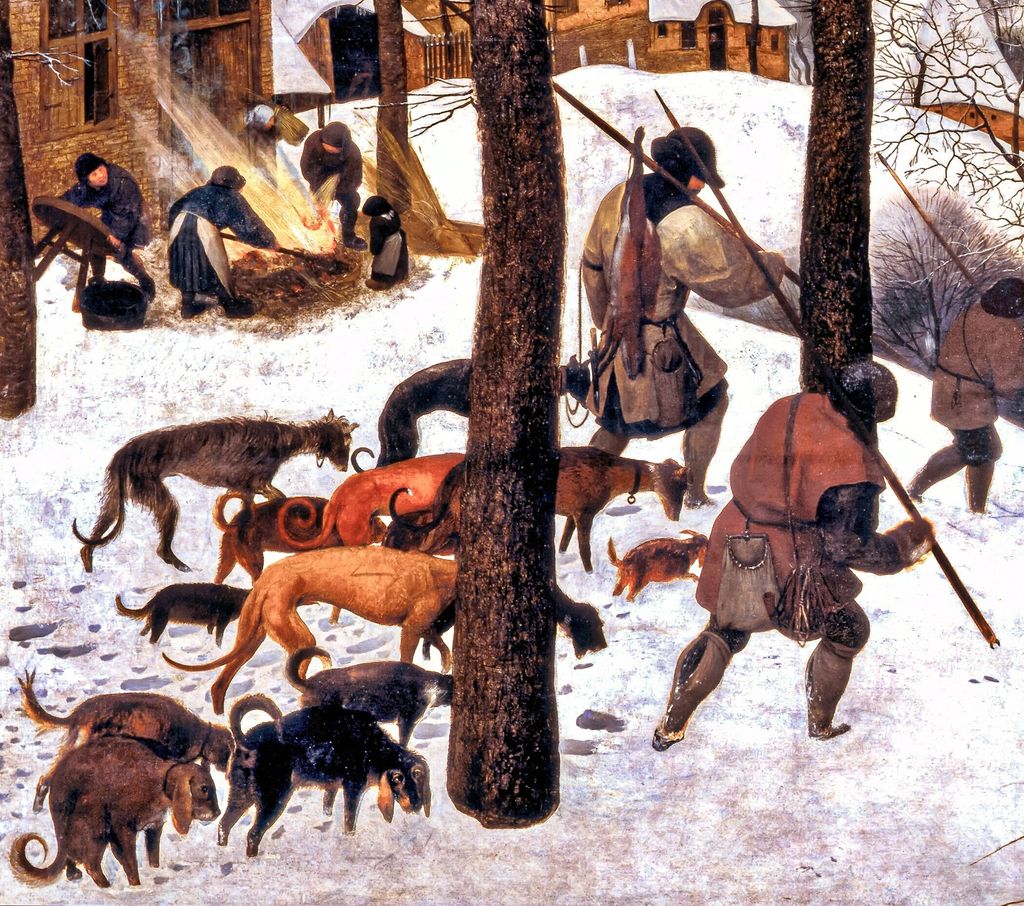
Details from HUNTERS IN THE SNOW
Close looking reveals how Bruegel sets the slow return of the hunters against many smaller movements across the wintry valley.
Hunters and hounds returning
The hunters lean into the descent while the clustered hounds spread across the snow, making their return feel slow and heavy.
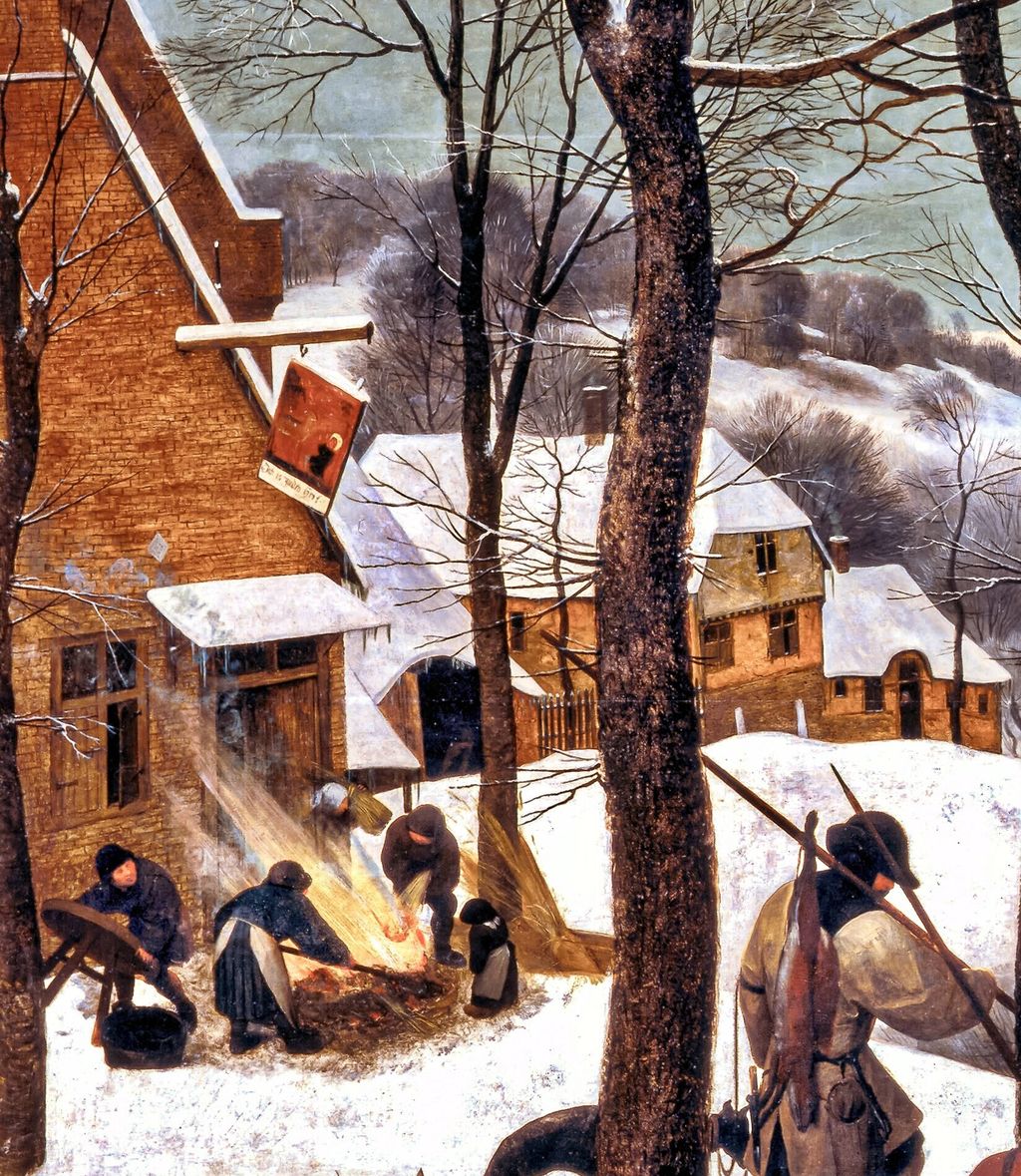
Inn sign and winter fire
A tilted sign and the orange flare of a fire interrupt the snowbound buildings, concentrating warmth and activity at the left edge.
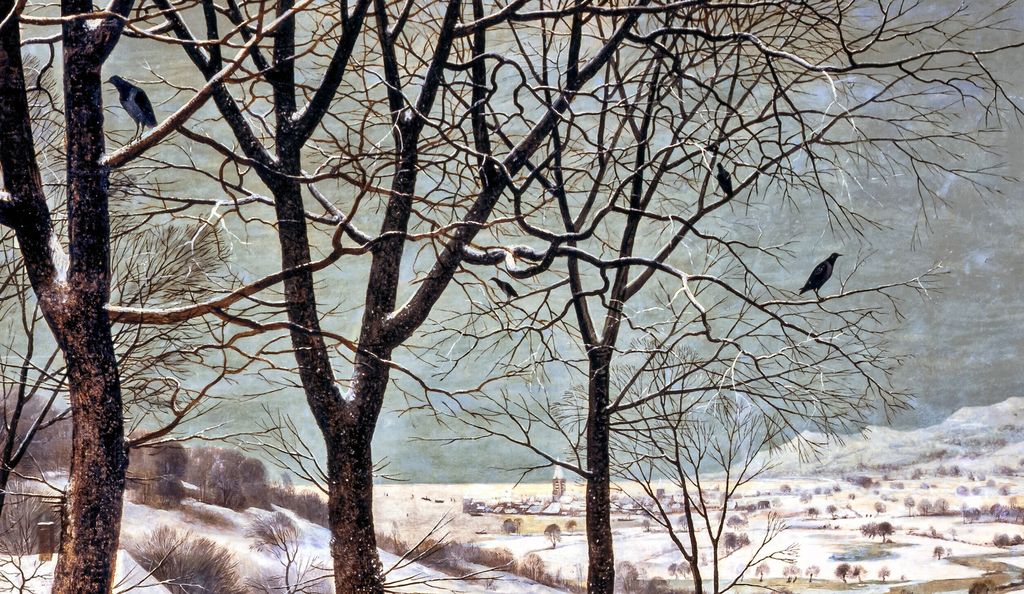
Bare branches and black birds
Dark trunks and fine branches form a restless screen across the pale sky, punctuated by perched and flying birds.
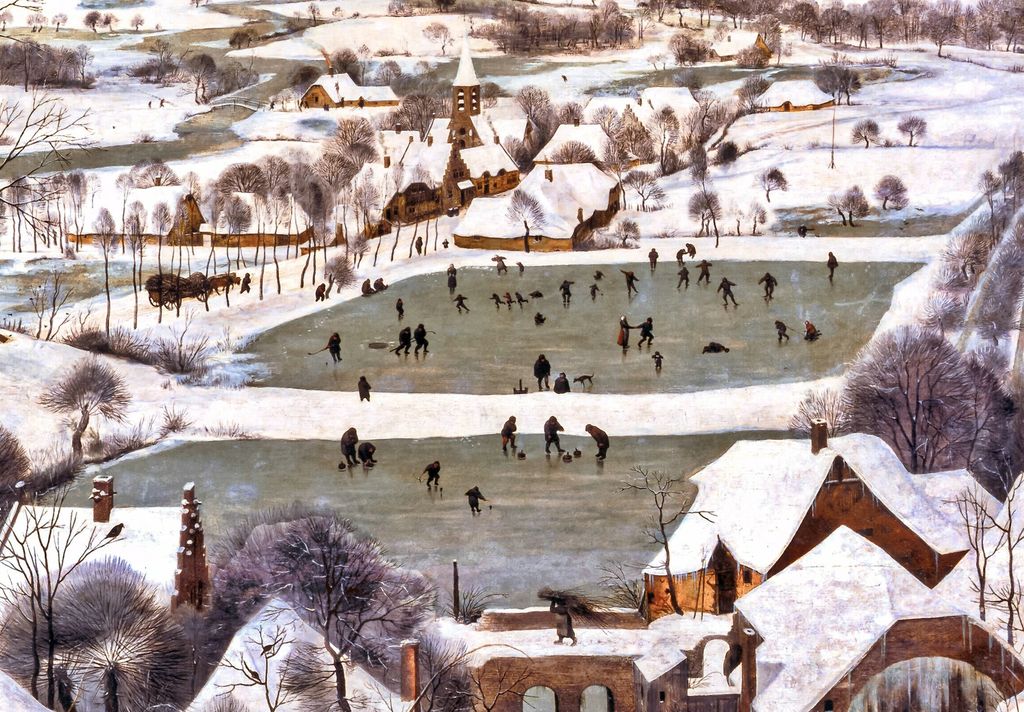
Village and skaters on the ice
Tiny figures scatter across the frozen ponds in varied poses, turning the valley into a field of games, travel and everyday work.
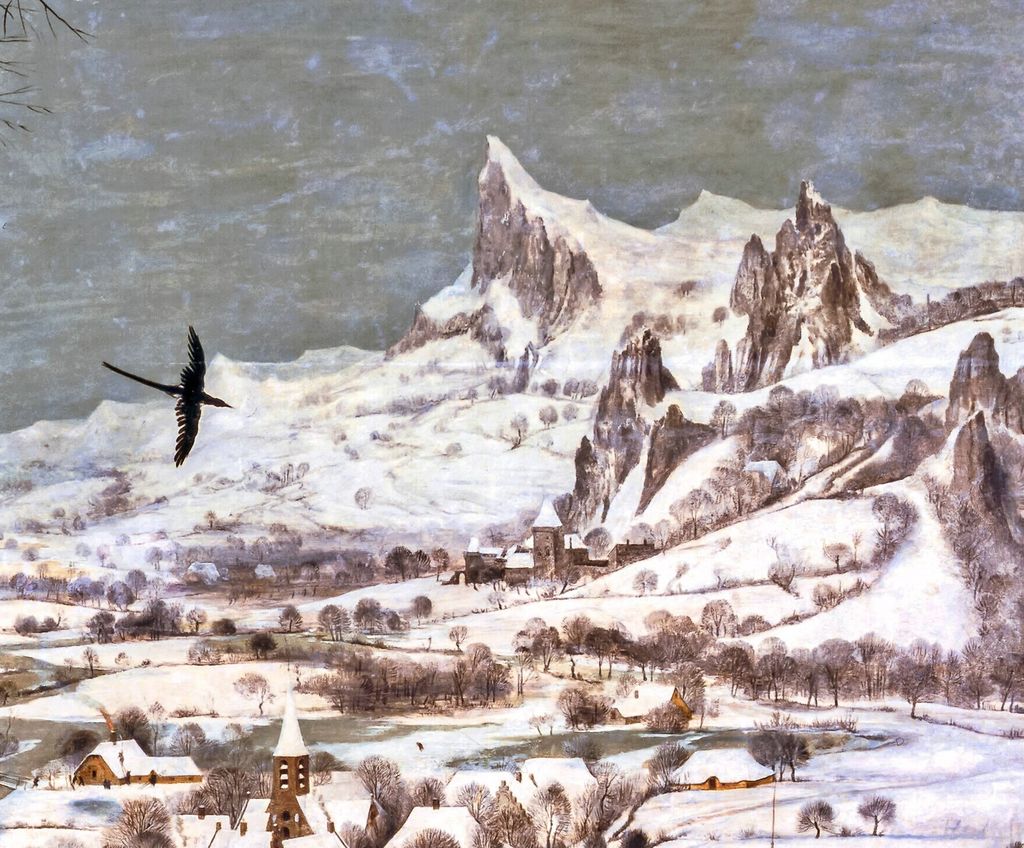
Distant mountains and frozen valley
Jagged peaks rise beyond the low village, extending the scene from the nearby hillside into a vast, cold distance.
Bridge and watermill at the edge
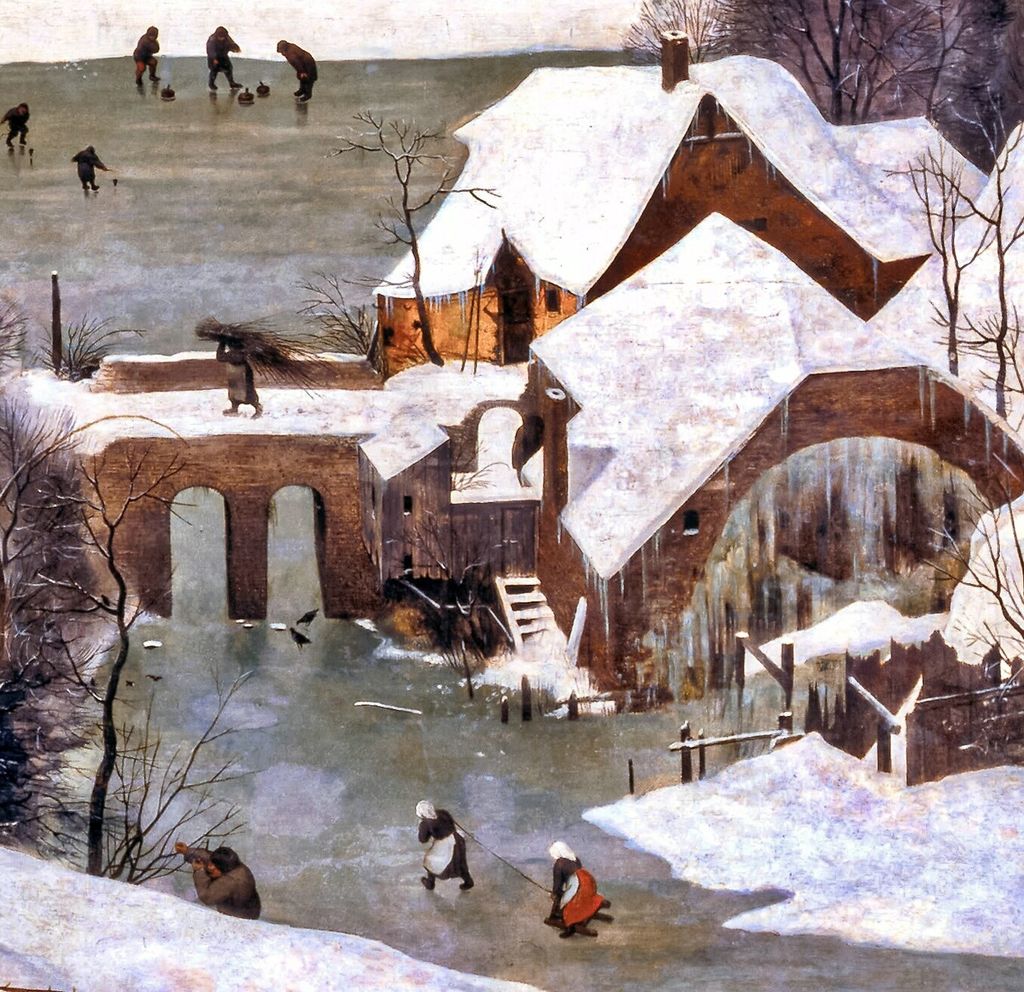
A low bridge, steep roofs and the dark wheel gather around the partly frozen water, creating a compact scene at the valley's edge.
The Hunters And Their Dogs
The first figures we meet are the hunters. They enter from the left foreground, backs turned, walking away from the viewer down the slope. Their bodies are dark against the snow. Their shoulders are hunched. Their spears lean. The dogs crowd around them, thin, tired, noses lowered and tails drawn in. The group is neither heroic nor triumphant.
KHM's object record identifies the essential action: the hunters return toward the lower village with exhausted dogs, and only one fox hangs from a spear [1]. That single animal is one of Bruegel's most economical narrative details. A hunt has taken place, but it has not produced abundance. The men have been out in a hard landscape and are coming back with almost nothing.
The title can mislead if it makes the hunters seem like the painting's full subject. They are important because they guide us into the landscape. They are the first movement, the nearest figures, the human measure against the great cold. But they are not the whole story. Bruegel turns their return into an entrance ramp for the eye. The line of their bodies, the slope beneath their feet and the leaning trees all pull the viewer down toward the valley.
The dogs are as eloquent as the men. The Times of Nature presentation notes that Bruegel knew how to depict animals with unusual feeling, and that the animals in the winter panel seem miserable in the cold, with bristling fur and drawn-in tails [7]. That observation helps explain why the painting does not sentimentalize rural life. The dogs register the season physically. They are winter translated into bodies.
One of the subtle effects of the foreground is that the hunters do not look back at us. We enter the painting by following them, not by meeting their gaze. The scene does not pause to perform itself. The men are absorbed in returning. This makes the painting feel less like a staged illustration and more like a world already underway.
The poor result of the hunt also complicates any idea that the picture is simply cheerful. The valley below is lively with skating and games, but the foreground is heavy. The men are cold, the dogs are tired and the catch is meager. Bruegel does not need to moralize. He lets the viewer feel the contrast between work and play, want and pleasure, fatigue and communal life.
The Inn, The Fire And The Pig
At the far left, near the hunters, villagers prepare to singe a pig over an open fire. KHM points to this action as one of the painting's key foreground details [1]. It matters because it places winter not only in weather but in seasonal practice. The scene belongs to the rhythms of food, labor and survival.
The fire is small in the wide painting, but it has great force. It is one of the few warm notes in a cold world. It does not thaw the landscape. It does not change the season. It simply marks human effort within it. Bruegel makes warmth real by making it limited.
The inn sign above the group is damaged and difficult to read, but the motif of hospitality, food and fire is clear. Near the hunters, this preparation of meat sets one kind of winter work beside another. The men return from the hunt with poor results; nearby villagers handle the practical work of preparing a pig. The painting does not isolate aristocratic sport from peasant labor. It places forms of winter activity side by side, all under the same cold sky.
This is one of Bruegel's gifts: he can let a detail be literal and symbolic without forcing it to become a puzzle. A fire used for singeing a pig is exactly that. It is also a visual counterpoint to snow, ice and exhausted bodies. It is a sign of food in a landscape where food is hard won. It is a social gathering at the edge of a scene that otherwise seems to open into vastness.
The left foreground also helps control the painting's depth. The dark trees, the hunters, the dogs, the inn and the fire create a dense threshold. Beyond that threshold, the world widens dramatically. Bruegel sets closeness against distance, human friction against open space. The viewer moves from crowded immediacy into a valley that seems almost endless.
The Village And Frozen Ponds
Below the hunters, the village lies deep in the valley. Roofs are capped with snow. Roads and footpaths thread through the settlement. People cross open spaces and gather on the ice. The frozen ponds are among the reasons the painting has become so beloved. KHM specifically notes the skaters as details that have contributed to the work's enormous popularity [1].
The skating scenes are tiny, but they are not decorative filler. They show a community adapting to the season. People skate, play stick games, pull one another, stand in groups and move across the ice as though the frozen surface has become a public square. Winter restricts movement in one sense, but it opens a different kind of space.
This is where Bruegel's view of human life becomes most subtle. The foreground hunters are tired, but the people below are not simply suffering. They are playing, traveling, working and socializing. Nature is powerful, but humanity is not erased. The season defines the terms; people continue within those terms.
The Times of Nature chapter frames this balance well, observing that Bruegel shifts attention toward nature itself while humans take a subordinate role and continue recognizable activities [7]. That is exactly what happens here. No figure dominates the picture. Human beings are small inside the landscape, but they are not meaningless. Their activities make the frozen valley legible as a lived world.
The scale is essential. If the skaters were larger, they would become genre figures. If they were absent, the painting might become a pure landscape of cold. Instead, they are small enough to be part of the larger weather and clear enough to carry human joy. The result is not a simple celebration of winter sport. It is a picture of people making life inside difficult conditions.
This is one reason Hunters in the Snow pairs naturally with Winter Landscape with a Bird Trap. Both images involve winter, ice, small figures and communal activity. But Hunters in the Snow is broader, deeper and more atmospheric. The bird-trap composition is concentrated around village ice and moral possibility. Hunters in the Snow turns winter into an entire world.
The Sensation Of Cold
The most famous quality of Hunters in the Snow is cold. Not the idea of cold, but the bodily sensation of it. Bruegel builds that sensation through color, surface, posture, distance and rhythm. The snow is not soft and decorative. It feels packed, walked on, crusted and resistant. The ponds are not merely reflective; they are hard, communal surfaces. The air seems thin.
KHM describes Bruegel's achievement as an overall evocation of continuing cold and calls the painting the first and most prominent winter landscape in European painting [1]. That claim is not only about subject matter. Winter scenes existed before Bruegel, especially in calendar imagery and book painting. What is new here is the scale and unity of the experience. Winter is not a vignette. It is the whole pictorial climate.
The palette is restrained: whites, blue-greens, browns, blacks and muted grays. Bruegel avoids the easy charm of glittering snow. His whites are cold because they are not pure. They are crossed by tracks, shadows, frozen surfaces and dirty edges. The dark trees bite into the snow. The hunters are almost silhouettes. The dogs are dark, bony accents against the ground.
The distant mountains intensify this temperature. They are not Flemish topography in a literal sense. Bruegel combines Alpine memory and imagination with village forms closer to the Low Countries, creating what the Met calls a "fantasy of visibility" in relation to The Harvesters: an invented structure mapped with real details from everyday life [6]. In Hunters in the Snow, that invented geography makes winter feel larger than any one place.
The cold also comes from soundlessness. The painting is full of activity, but it seems quiet. Snow absorbs noise. Distance diminishes voices. The skaters may be laughing, the fire may crackle, dogs may pant, but Bruegel's arrangement makes the whole scene feel hushed. The viewer senses a world where action continues under a layer of frozen stillness.
This is why the painting can feel both familiar and strange. Anyone who has known winter recognizes the lowered heads, the long visibility, the sharp branches, the social life of frozen ground. Yet Bruegel's world is more complete than memory. He has distilled winter into a visual order so convincing that it feels less like a day in 1565 than like the season itself.
Watch Bruegel’s art
Explore Bruegel with TheHistoryOfArt and artwork discussions from Smarthistory.
Pieter BRUEGEL Explained in 10 Minutes (updated)
A TheHistoryOfArt film about Bruegel.
Watch on YouTubeHigh Viewpoint And Deep Landscape
Bruegel's viewpoint is high, but not detached. We stand on a slope with the hunters, looking down into the valley and then outward to distant mountains. This elevated position is crucial to the Seasons cycle. The KHM Bruegel 2018 discussion notes that Bruegel leads viewers into these compositions from an elevated viewpoint, directing the gaze toward wide landscape below [3].
The height gives the painting its extraordinary breadth. The viewer can see foreground, middle ground and distance at once. We look across roofs, ponds, roads, fields, trees, slopes, towers and mountains. The landscape seems to unfold like a map, but it is not flat. Bruegel controls depth through overlapping forms, diagonals and shifts of scale.
The dark trees at left are especially important. Their trunks and branches create a near screen, cutting vertically across the horizontal sweep. They anchor the foreground and make the distant valley feel even deeper. Without them, the picture might open too quickly. With them, the viewer must pass through a cold threshold before entering the world beyond.
The slope works like a visual chute. The hunters move downward; the eye follows. The line of trees and the angle of the ground direct attention into the village, then beyond it to the ice and mountains. Bruegel's landscape is expansive, but it is not loose. Every large movement has a compositional job.
The high viewpoint also changes the relationship between people and nature. Human figures are not grand protagonists. They are part of a wider pattern. This does not make Bruegel indifferent to them. On the contrary, their smallness lets him show more of their world: not one dramatic event, but a whole system of winter activities.
That system is one reason the painting belongs on the style and technique side of Bruegel's art as well as on the subject side. The emotion of the picture depends on construction. Bruegel's feeling for cold is inseparable from how he organizes looking.
Composition And The Foremost Hunter
Modern technical examination has made Bruegel's construction even more fascinating. Beginning in 2012, the Kunsthistorisches Museum undertook a major examination of its twelve Bruegel panel paintings, using non-invasive methods including infrared photography, infrared reflectography, X-radiography, X-ray fluorescence analysis and 3D mapping [4]. The interactive Inside Bruegel project then made high-resolution technical material available for close study [4] [5].
One finding is especially important for Hunters in the Snow: the foremost hunter was added late. The KHM research article explains that the figure was not part of Bruegel's initial concept. He was painted over already executed snow-covered ground and a tree trunk, at a stage when the painting was far advanced. The figure functions as a repoussoir, leading the viewer into the composition [4].
That discovery is remarkable because the hunter now feels inevitable. He seems to belong to the painting's first idea. Yet technical evidence shows Bruegel adjusted the composition in a decisive way. He strengthened the foreground, increased the human threshold and sharpened the viewer's entry into the landscape.
The word repoussoir refers to a foreground element that helps push or draw the eye into depth. In this case the hunter does more than fill space. His back, shoulders, legs and spear create a dark shape against the snow. He gives the viewer a body to follow. He joins the near slope to the far valley. He turns looking into movement.
The late addition also reminds us that Bruegel's apparent naturalness is constructed. The painting may feel like a world glimpsed whole, but it was built through choices, revisions and compositional testing. Bruegel's art is not a passive record of peasant life or landscape. It is a deliberately organized field of observation, memory and invention.
Inside Bruegel matters for another reason. It matches the painting's own invitation to look closely. Bruegel gives the viewer an image that works from across a room and rewards intense study. Technical photography extends that double experience. One can admire the total winter effect, then move closer into brushwork, underdrawing, changes and minute figures.
Jongelinck's Dining Room And Country-House Culture
The original setting of Hunters in the Snow changes how we imagine its audience. The Seasons were made for Niclaes Jongelinck's country house near Antwerp, probably for the dining room [2] [7]. This was not a church cycle, not a civic hall project, and not a private devotional image. It belonged to the culture of wealthy urban patrons who built or owned country houses outside the city.
The Times of Nature chapter describes sixteenth-century country houses as places of recreation, status, education, art and literature in nature [7]. The Seasons fit that setting beautifully. Around a dining room, the panels could have turned the estate into a model of the world: the year, the planets, human work, seasonal change and the rhythms of nature surrounding the guests.
That context gives the painting a social edge. Jongelinck's guests were prosperous, educated people looking at images of peasants, hunters, workers and villagers. The Bruegel 2018 discussion of Hunters in the Snow notes that the cycle offered such viewers a view from an elite setting into the everyday world of peasants [3]. But Bruegel does not treat those people merely as comic objects. They are small, but they are dignified by belonging to the order of the season.
The dining-room setting also explains the painting's two speeds. From across the room, the panel would read as winter: pale snow, dark trees, a descending slope, frozen ponds, distant mountains. Up close, it becomes a world of details. Bruegel seems to have known that many details would be difficult to see in such a room. The larger seasonal mood had to carry the first encounter [3].
The provenance recorded by KHM traces the painting from Jongelinck to the city of Antwerp's 1594 gift to Archduke Ernst, then through the estate of Archduke Ernst, Rudolf II and the collection of Leopold Wilhelm [1]. That history matters because it shows how a country-house cycle entered Habsburg collecting and eventually became a museum treasure in Vienna.
The survival of the panels in different cities also shapes modern viewing. Three of the five surviving panels are in Vienna, one is in Prague, and one is in New York [2] [7]. No single museum now gives the complete original experience, and the spring panel is lost. Hunters in the Snow therefore carries both the memory of a cycle and the fame of an individual masterpiece.
Relation To Other Bruegel Winter Paintings
Hunters in the Snow is often compared with Bruegel's other winter imagery, especially Winter Landscape with a Bird Trap and The Census at Bethlehem. These works share snow, village life, small figures and the transformation of familiar activities by winter.
The differences are just as revealing. Winter Landscape with a Bird Trap is more compact and proverbial in feeling. A trap waits at the right while figures skate nearby. The winter surface becomes a field of play and danger. The Census at Bethlehem brings biblical narrative into a snow-covered Flemish village, making sacred history seem to enter everyday life. Hunters in the Snow, by contrast, has no single biblical event and no obvious moral emblem at the center. Its subject is the season as a total condition.
KHM's Best of Bruegel material notes that Winter Landscape with Bird-Trap became extraordinarily popular through many copies and that Bruegel's winter landscapes may be connected to the harsh winter of 1564-65 [5]. Whether or not that weather event was a direct catalyst, Hunters in the Snow feels rooted in a world where winter is not picturesque but governing.
Within the Seasons cycle, the most useful counterpart remains The Harvesters. Late summer and winter are opposites in color, appetite and social mood. The Harvesters gives shade, wheat, bread, fruit and rest. Hunters in the Snow gives snow, ice, meager game and tired dogs. Yet both paintings use high viewpoint, broad landscape and small-scale human activity to show the relation between people and nature.
The Gloomy Day and The Return of the Herd add intermediate weather. Early spring is stormy and raw; autumn is unstable and dramatic. Seen with them, Hunters in the Snow becomes the cycle's cold endpoint. The year has narrowed into ice, yet life has not stopped.
Why The Painting Is Famous
Hunters in the Snow is famous because it is immediately legible and endlessly explorable. A viewer can understand it in seconds: hunters, dogs, snow, village, ice, mountains. But the painting never runs out. The eye keeps finding small actions, paths, figures, roofs, birds, tracks, fires and frozen surfaces. Bruegel gives instant atmosphere and slow reward in the same image.
Its fame also rests on emotional balance. The painting is beautiful, but not pretty. It is not a winter postcard. The hunters are weary, the dogs are thin, the trees are severe and the cold feels permanent. Yet the valley is alive with play and movement. The picture holds hardship and pleasure together without resolving them into a lesson.
The work's place in European landscape painting is equally important. KHM emphasizes its status as a first and especially prominent winter landscape in European painting [1]. The Met's account of the Seasons context helps explain why: Bruegel moves landscape out of the background and makes the seasonal world itself the subject [6]. That shift makes Hunters in the Snow a landmark, not merely a famous image.
The painting also feels modern because it refuses a single center. Viewers are used to pictures that tell them where to look. Bruegel gives a world. The hunters matter, but so do the skaters, the fire, the roofs, the mountains, the birds, the mill, the tracks and the air. This distributed attention makes the image feel closer to experience. Life is happening everywhere at once.
At the same time, the painting is not chaotic. Its composition is controlled with extraordinary intelligence. The trees, slope and foreground figures guide the eye. The valley opens in stages. The pale sky and snow unify the surface. The dark accents keep the cold from becoming blank. Bruegel's achievement is to make abundance feel ordered and order feel alive.
For readers coming to Bruegel through his peasant imagery, Hunters in the Snow shows the seriousness behind the reputation. He can be humorous, observant and earthy, but he is also a major landscape inventor. He makes humans part of nature without making them insignificant. He builds a world from details without losing the whole.
That is why the painting remains one of the strongest introductions to Bruegel. It connects biography, patronage, landscape, technique, seasonal thought and visual pleasure. It belongs to the paintings page, to the landscapes and seasons page and to any account of Bruegel's mature style and technique. But it also stands on its own as an image of winter so complete that it seems less painted than remembered.
How To Look At Hunters In The Snow
Begin with the foreground. Notice that the hunters are returning, not setting out. Their backs turn the viewer toward the valley. Look at the dogs and the single fox. The emotional temperature of the painting begins here, in fatigue and scarcity.
Then move left to the fire. The pig-singeing scene is a small warm counterpoint to the snow. It grounds winter in food preparation and communal labor. Bruegel's seasonal world is never only weather; it is weather lived through work.
Next follow the slope downward. Let the hunters lead your eye into the village and across the ponds. The skaters are not random decoration. They show the transformation of frozen water into a social surface. What would be obstacle in one season becomes gathering place in another.
After that, step back and look at the whole structure. The trees at left form a dark screen. The snow and sky create a pale unity. The distant mountains make the Flemish village world feel vast and invented. The painting is not a literal topographical record. It is a constructed winter.
Finally, return to the foreground hunter with the knowledge supplied by technical examination. He was added late over already painted snow and tree trunk [4]. That fact does not weaken the illusion. It makes the painting more impressive. Bruegel saw that the composition needed a stronger entrance and gave it one.
The reward of Hunters in the Snow is that every level works. The painting is a room-sized seasonal statement, a landscape experiment, a social scene, a technical construction and a treasury of small actions. It asks the viewer to feel the cold first, then to discover how carefully that feeling has been made.
Discussion
What feels most revealing about Pieter Bruegel the Elder: the village detail, the landscape setting, the moral wit, or the way everyday life becomes a complete world?
Reader Insights
Begin with one small action in a Bruegel scene, then follow how it connects to the surrounding figures, setting and rhythm of the whole image.
Connect the work to Northern Renaissance visual culture, printmaking, proverb traditions and Bruegel's interest in rural and urban life.
Which detail changes the interpretation most once you know the subject, date, proverb source or present collection?
Join the Conversation
Have a thought or observation about Pieter Bruegel the Elder? Share it below. Thoughtful responses may be added to this section as the Bruegel pages develop.
Frequently Asked Questions
Painted in 1565, the panel belongs to Bruegel's great cycle of the Seasons, a group originally made for the Antwerp merchant and collector Niclaes Jongelinck. The cycle was designed for a country-house dining room, probably as a frieze-like sequence around the room, so that the year unfolded around the viewer . [2][7][1][5]
KHM's object record identifies the essential action: the hunters return toward the lower village with exhausted dogs, and only one fox hangs from a spear . That single animal is one of Bruegel's most economical narrative details. [1]
At the far left, near the hunters, villagers prepare to singe a pig over an open fire. KHM points to this action as one of the painting's key foreground details . [1]
References
- Kunsthistorisches Museum Vienna, Hunters in the Snow (Winter), View source.
- Kunsthistorisches Museum, Bruegel 2018, Six Seasons for a Dining Room, View source.
- Kunsthistorisches Museum, Bruegel 2018, The Hunters in the Snow, View source.
- Kunsthistorisches Museum, Bruegel 2018, Researching Bruegel, View source.
- Kunsthistorisches Museum Vienna, The Best of Bruegel - Only in Vienna, View source.
- The Metropolitan Museum of Art, The Harvesters, View source.
- Kunsthistorisches Museum, Chapter II: The seasons a la Bruegel, View source.
- Kunsthistorisches Museum Vienna, Pieter Bruegel d. Ä., Die Jahreszeiten, View source.






