


 by Tom Gurney
Tom Gurney BSc (Hons) is an art history expert with over 20 years experience
Published on June 19, 2020 / Updated on October 14, 2023
Email: tomgurney1@gmail.com / Phone: +44 7429 011000
The Return of the Herd: Introduction
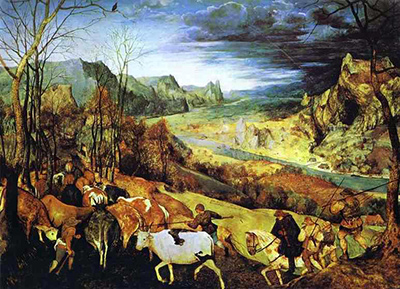
Pieter Bruegel the Elder’s The Return of the Herd is the autumn painting from his series of seasonal landscapes dated 1565. The Kunsthistorisches Museum in Vienna displays it alongside the surviving panels for early spring and winter. At the foot of the picture cattle and people move across a hillside. Farther off, a winding river sets the course of a broad valley, and dark clouds collect above the right-hand hills. The cattle give the view a direction near the ground. The storm makes that journey feel as though it has to be made within a limited span of time [1] [2].
This work across Bruegel’s career
Tower of Babel
1563The Harvesters
1565Peasant Wedding
1568Children's Games
1560Triumph of Death
1562–1563Return of the Herd
This artworkContents
- Introduction
- Following the Animals
- A Route Above the Valley
- Rain and the Last Light
- Autumn in the Painted Year
- Annotated Details
Following the Animals
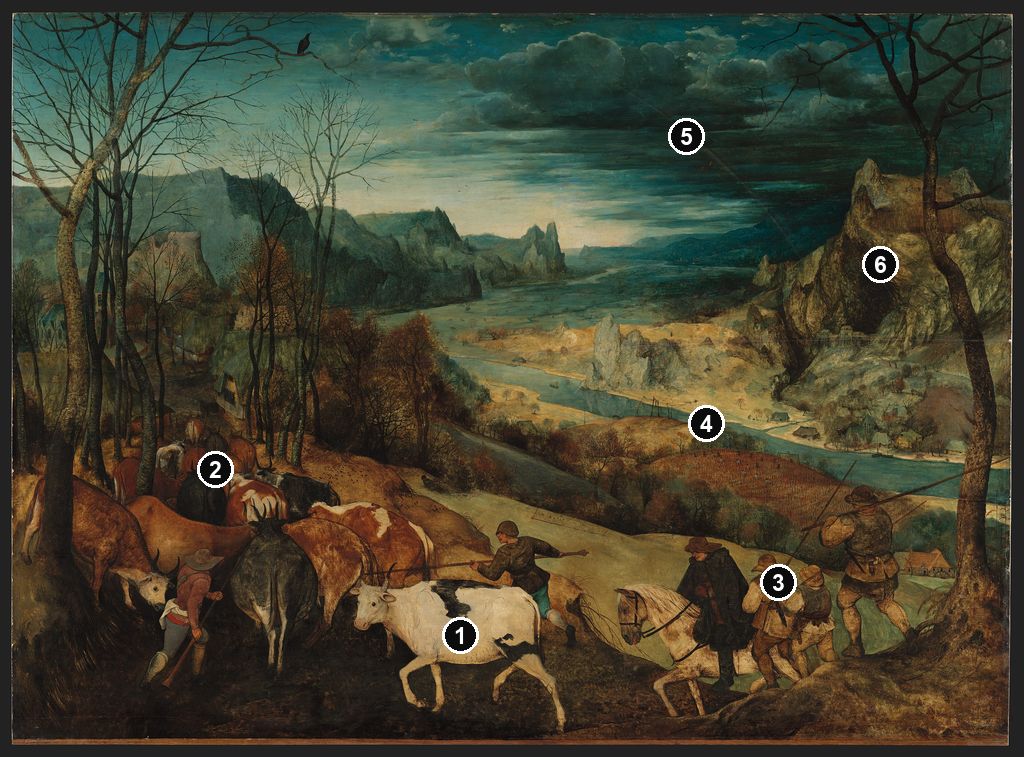
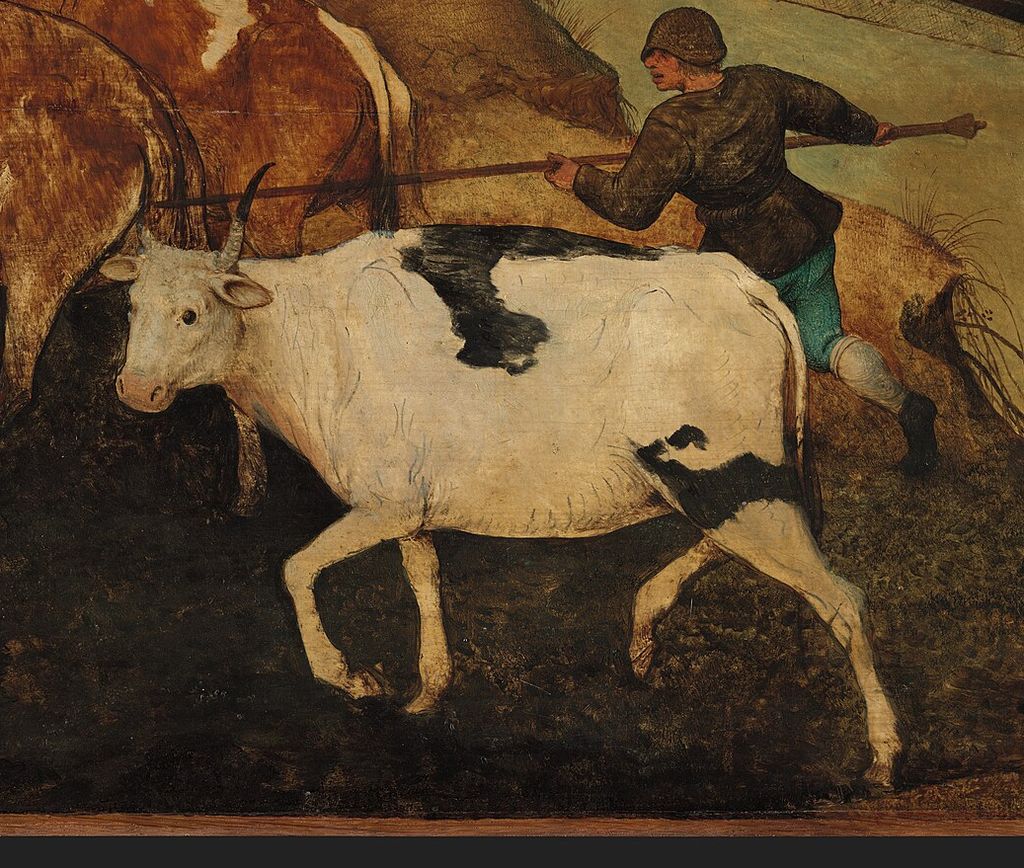
Look for the white animal toward the lower centre. The colour of its flank helps the eye follow the outline from its neck to its nearest leg. Its head faces left, in the direction of the cattle farther ahead. Compare it with the brown and black animals just to the left. Their outlines overlap more readily, and the contrast between an animal and the ground often depends on a small strip of light. Once you find that strip, you can compare the angle of its back with its neighbours’ and see how several bodies contribute to the line of the herd.
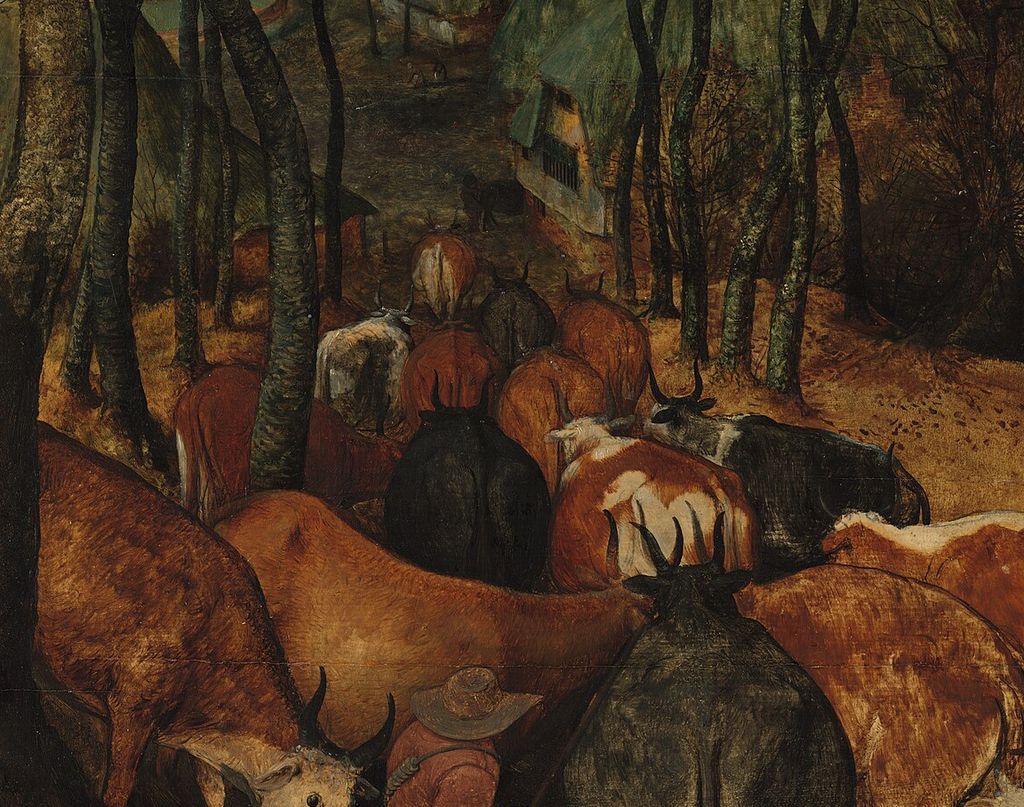
The cattle do not all face the viewer from the same position. Some show a flank and some are seen from behind. Farther left, a number of them are pressed together and partly hidden, curving away among the trees. This is how Bruegel lets you see the movement continue beyond the most legible animals. The turn also gives the foreground a shape of its own. The eye can follow the white flank across the bottom of the panel and then move into a dark area where the way forward is more tightly enclosed.
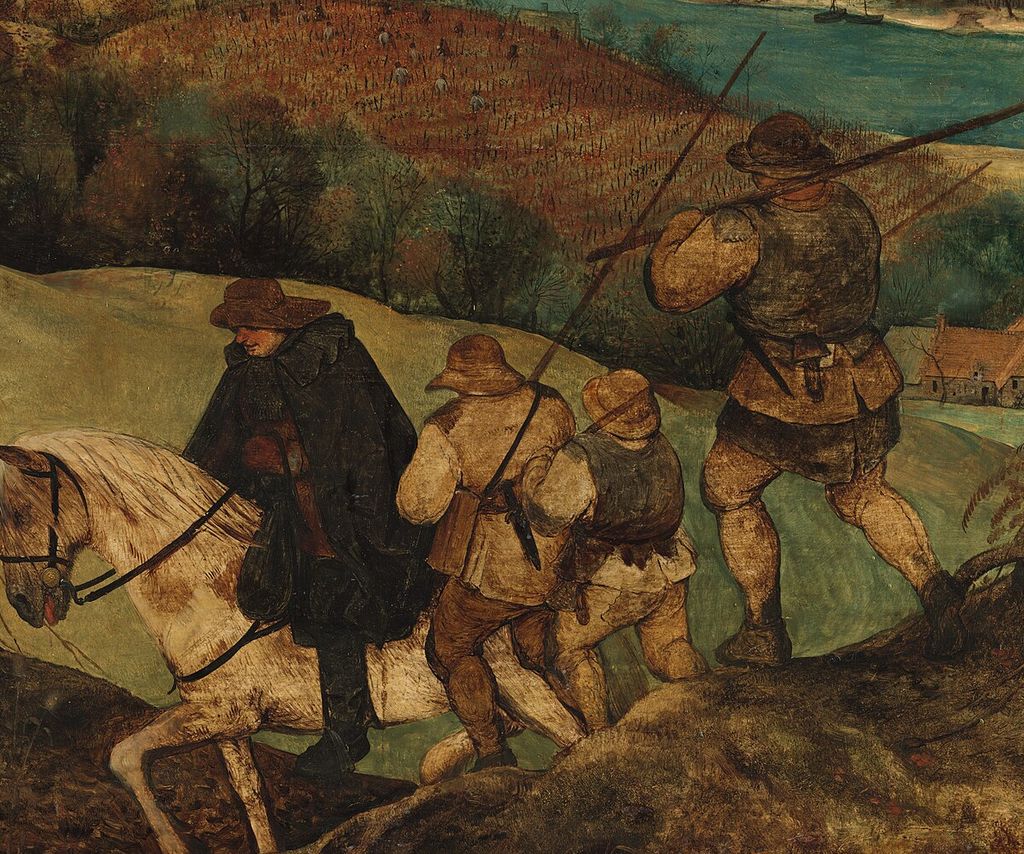
The people are easiest to see when you trace the rear of the group from the right. Some occupy separate pieces of ground and some emerge next to an animal. Their interval from the leading cattle gives a sense of the length of the task. Herding requires attention along a route. One person can be seen near the open ground, while animals farther ahead are already passing out of view. The changing spacing of people and cattle gives the picture a rhythm that depends on the ground underfoot [2].
Annotated Details from The Return of the Herd
Follow the cattle into the trees, then look across the river to the storm above the opposite ridge.
Details from THE RETURN OF THE HERD
The details show where the ground directs the animals and where the changing light opens out the valley.
White cow in the foreground
Follow the pale flank from the lowered head to the rear leg. It gives the eye a clear direction among the overlapping cattle.
Herd disappearing among trees
The bodies overlap as the animals move into the trees. Gaps between trunks let you see how the line continues.
Herders at the rear
The horse and the people on foot occupy separate pieces of ground. Together they bring up the rear of the animals.
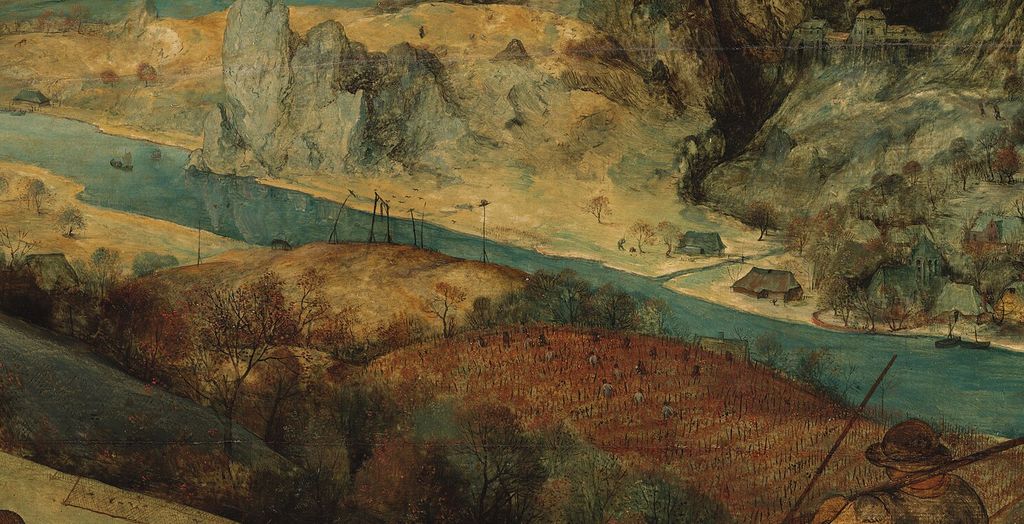
River turning through the valley
The line of water passes in front of distant rock and slopes. Follow it back towards the open land and the light.
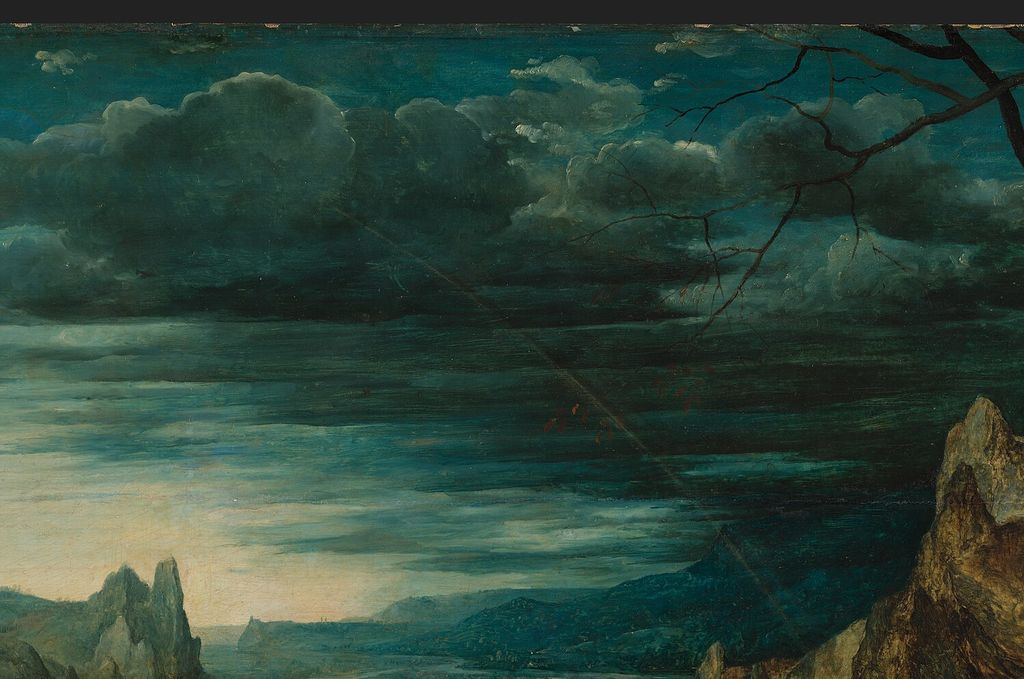
Storm over the ridge
Dark clouds extend across the upper right. Pale sky toward the centre still lets light reach sections of the valley.
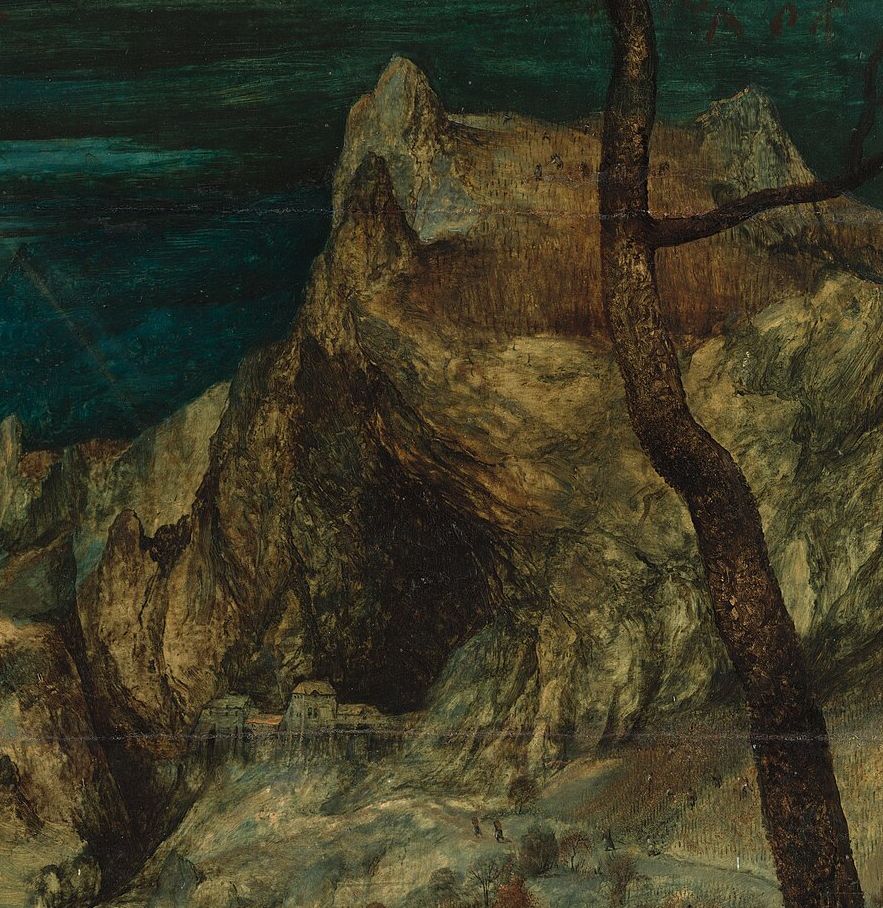
Rock face in the light
The illuminated rock helps separate the nearer ridge from the darker land and sky behind it.
A Route Above the Valley
The nearer slope is steep enough to interrupt the view of lower ground. At its far edge, dark vegetation and brighter slopes mark off a valley that opens to the right. The river is a useful line to follow. It bends away from the foreground and takes the eye between hills with distinctly different profiles. The nearby cattle demand our attention in a compact band. The winding water takes that attention farther from the immediate task.
Bruegel separates these two routes with colour. Browns and orange foliage are particularly visible near the trees and along the ridges that lead toward the valley. The water has a cooler colour, and the farther hills are generally easier to distinguish by their collective outline than by their details. These changes help locate the animals in a wide terrain. A dark branch, a reddish hillside and a grey-green strip by the river belong to different distances even when the painting places them close together on the panel.
The trees also show how much of a view a painter can open up with narrow forms. On the left their trunks rise in front of farther slopes, but the spaces between branches keep the mountains visible. The smaller bare branches offer little shelter from the weather. They make a kind of measure of the landscape, because the eye can follow a twig into the light and see how far away the brighter ground begins. The trees are close to the cattle, while the rocky formations on the other side of the valley rise outside the reach of anyone on the path [2].
Rain and the Last Light
The clouds gather most heavily over the right side. Look along the lower edge of the darker mass and notice where light is still reaching the valley below. This difference gives the terrain more depth than a uniformly dark sky would allow. You can see where one hill projects into the light and where the next joins darker land. Even within a single ridge, there are patches bright enough to pick out exposed rock.
The weather also helps make time visible. Bruegel shows that part of the land is still bright and another part is already under dark cloud. A familiar task such as guiding animals takes on a different pace in that setting. The weather gives a reason to follow the figures all the way left, towards the near trees, after having watched the open valley. The threatened storm occupies a wide space, while the next few steps of the herd can be read in the raised leg of a single animal [2].
Autumn in the Painted Year
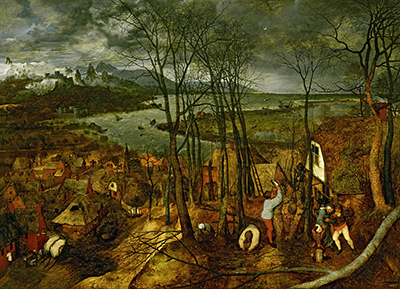
The Kunsthistorisches Museum associates the panel with October and November, one of six divisions used in the series. The cycle belonged to Nicolaas Jongelinck, and in 1594 Antwerp presented the paintings to Archduke Ernest of Austria. Five are known today. Vienna has The Return of the Herd, The Gloomy Day and Hunters in the Snow. The two summer scenes are in Prague and New York [1].
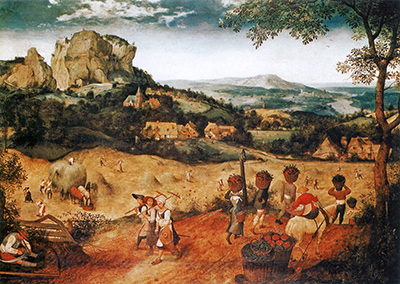
The sequence changes the use of the ground from one panel to the next. In Haymaking, a broad field provides enough room for people to work at intervals. In the autumn panel, the activity closest to the viewer is confined to a route along the slope. The wide ground is still there to look at, but the cattle are going one way and much of the view opens in another direction. Following that divergence gives the two scenes a distinct sense of the season [1].
In the winter painting, dark dogs and people cross white ground before the landscape opens to the ponds below. In the autumn picture, the most conspicuous animal is light and much of the surrounding ground is dark. It makes sense to look for the near animals first in both pictures, then judge how the colours of the foreground change the way the distance is seen. The winter panel gives its pockets of human movement room across ice. The autumn panel draws its people and animals into a line below the storm [1] [2].
Return at the end to the place where the cattle begin to disappear. There is room in the painting for a whole river valley and very little room between some of those animals. Bruegel keeps both scales legible. You can see where the people need to go and still look across the entire sweep of land over which the weather is changing.
Discussion
Which detail in this work most changes how you read it?
Frequently Asked Questions
The people are easiest to see when you trace the rear of the group from the right. Some occupy separate pieces of ground and some emerge next to an animal. [2]
The trees also show how much of a view a painter can open up with narrow forms. On the left their trunks rise in front of farther slopes, but the spaces between branches keep the mountains visible. [2]
The weather also helps make time visible. Bruegel shows that part of the land is still bright and another part is already under dark cloud. [2]
References
- Kunsthistorisches Museum, The seasons à la Bruegel, View source.
- Kunsthistorisches Museum, Exhibitions 2025 KHM-Museumsverband, The Return of the Herd (Autumn), View source.







