


 by Tom Gurney
Tom Gurney BSc (Hons) is an art history expert with over 20 years experience
Published on June 19, 2020 / Updated on October 14, 2023
Email: tomgurney1@gmail.com / Phone: +44 7429 011000
The Gloomy Day by Pieter Bruegel the Elder: Introduction
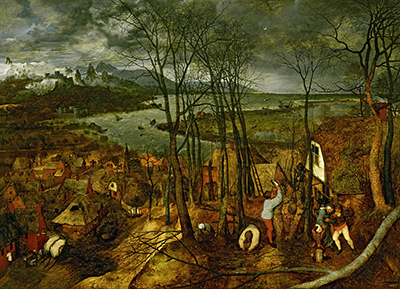
The weather has nearly taken possession of the valley in Pieter Bruegel the Elder’s The Gloomy Day. Bunched clouds hang over the mountains, and the light that reaches the foreground falls unevenly on bare ground and the branches of trees. Small figures work on the hillside. Beyond them the water widens into a space full of disturbances, where boats are harder to make out than the houses of the village. The painting makes it possible to feel the same weather from near the ground and from far above it.
The Kunsthistorisches Museum in Vienna calls the painting Düsterer Tag (Vorfrühling), or The Gloomy Day (Early Spring). It is dated 1565 and belongs to Bruegel’s painted cycle of the seasons. Early spring here includes the difficult conditions at the end of winter. Timber is still needed, trees are bare, and the figures’ activities indicate a season that has begun to change even while the land remains inhospitable [1] [2].
This work across Bruegel’s career
Tower of Babel
1563The Harvesters
1565Peasant Wedding
1568Children's Games
1560Triumph of Death
1562–1563Gloomy Day (Early Spring)
This artworkContents
- Introduction
- Work on the bank
- Carnival on a dark day
- A valley exposed to wind and water
- What changes across the seasons
- Annotated Details
Work on the bank
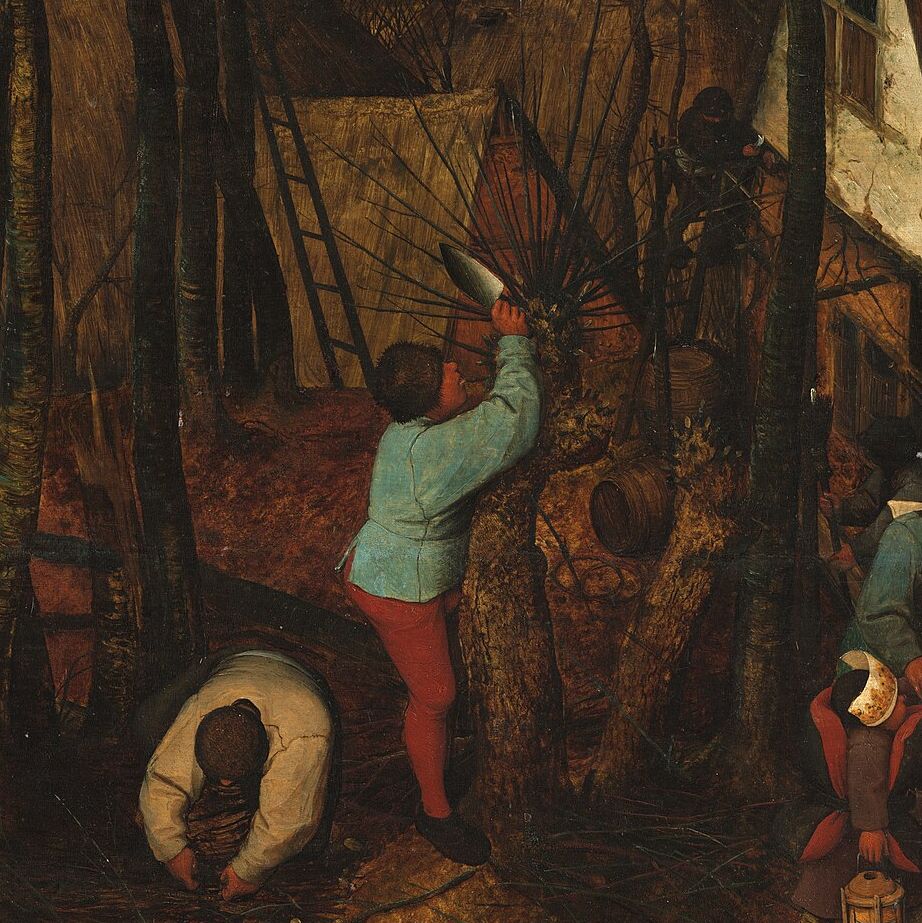
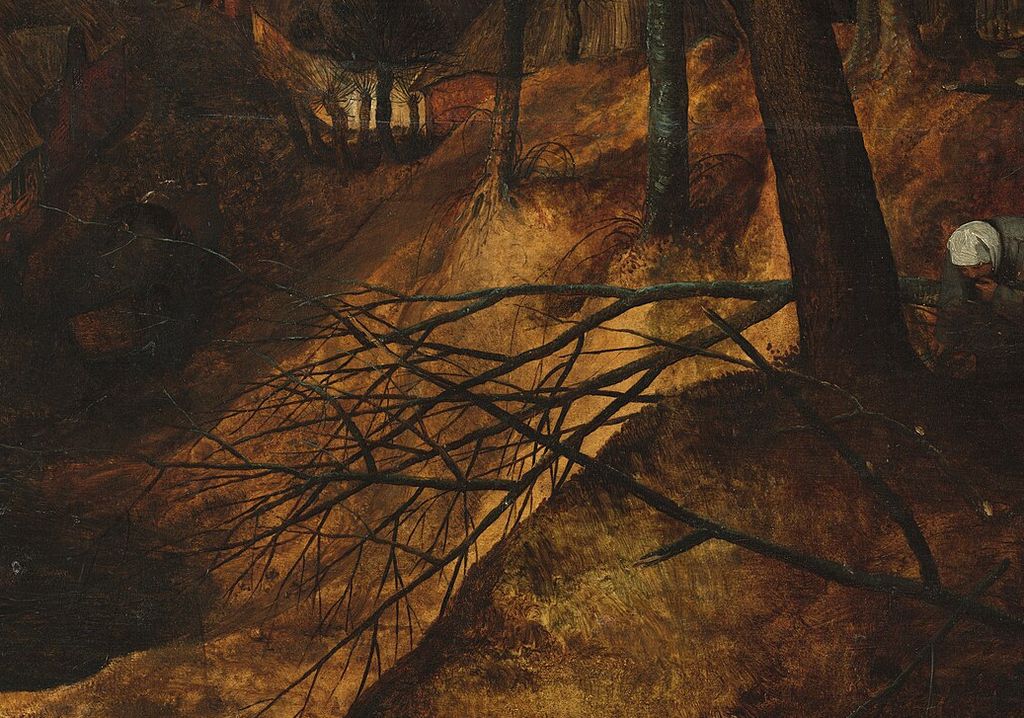
Begin with the large group of trees. Above their roots and fallen branches, the trunks separate into dark verticals. Some are thin enough that the eye can still follow the village beyond them. At their feet people bend, lift and reach, making small areas of activity where the ground allows it. The foreground slopes away between the viewer and the roofs. That incline explains why the workers have room to move in some places and seem squeezed together in others.
The KHM identifies wood gathering and cutting willow shoots among the seasonal activities. One figure raises a tool close to a trunk, while cut branches and stripped growth interrupt the ground below. More branches stand out against the water and sky. Their line is a record of the season: without a screen of leaves, parts of the hillside and the spread of the village remain visible through the trees [1].
The exposed ground also keeps the figures from becoming silhouettes alone. A white sleeve or a bright cap holds the attention for a moment, and then the eye sees a bent back or reaches for a raised arm. Their work belongs to a local slope with awkward footing, tangled growth and little shelter. Farther out, weather washes over whole roofs and hills. The distinction between the land a person can handle and the extent of the landscape is part of the painting’s force.
Annotated Details from The Gloomy Day
Start with the work and festivities at the front, then follow the slope down to the water and distant light.
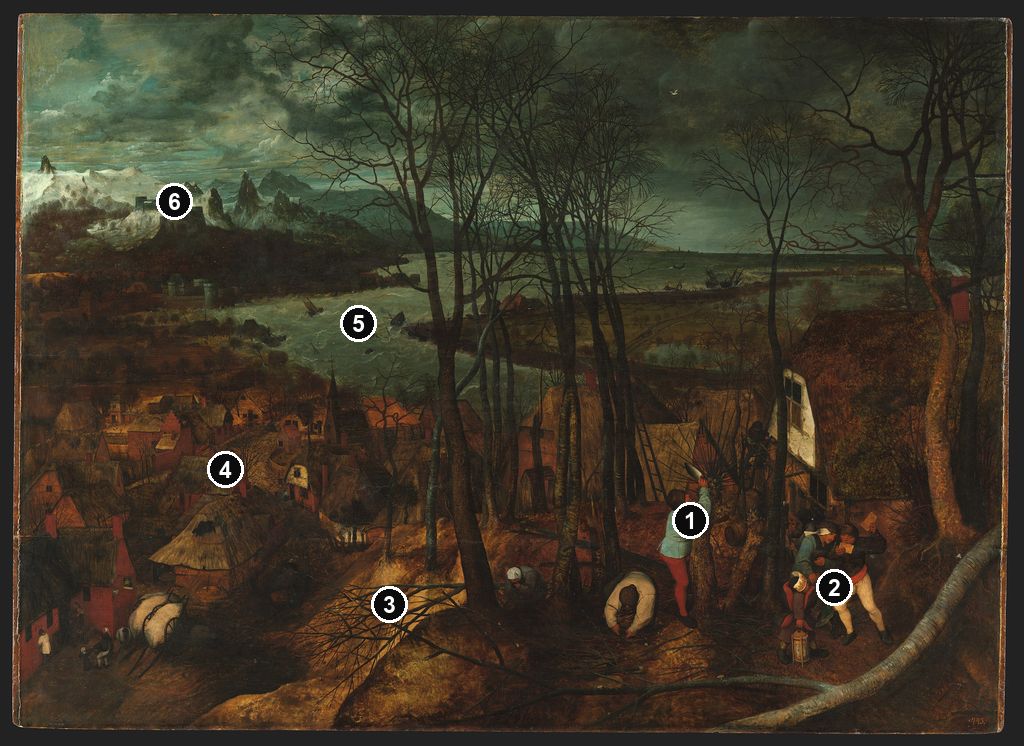
Details from THE GLOOMY DAY
The details show how Bruegel links the tasks of early spring with a change in the weather.
Willow cutting
A raised tool, bent back and pale sleeve make the work near the trees visible against the dark slope.
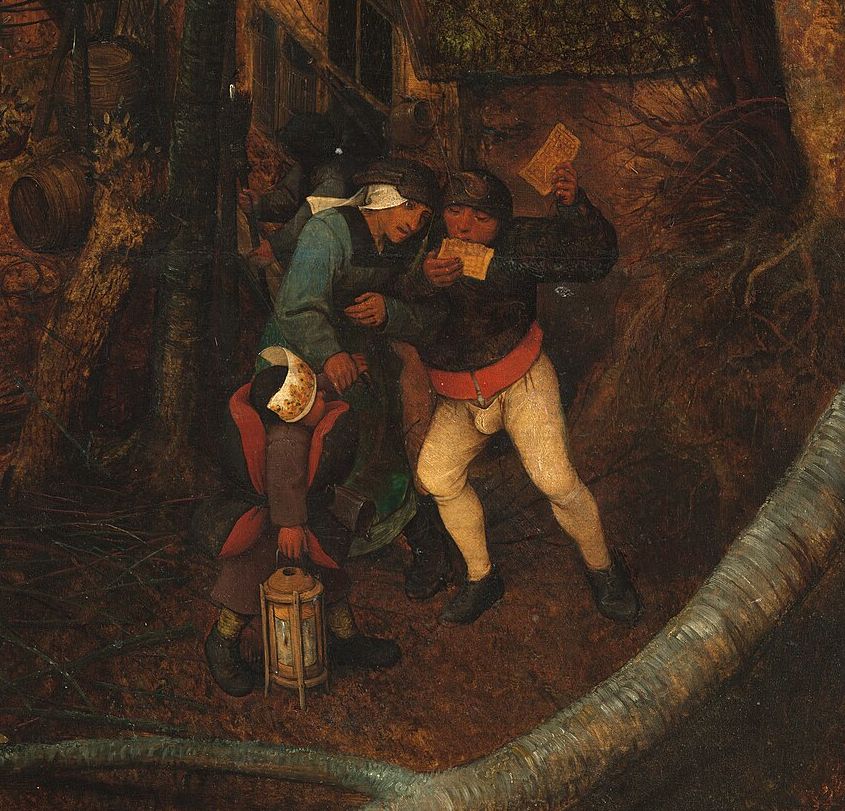
Carnival in the foreground
The group near the right edge takes part in early spring customs. Look for the paper crown and light-coloured clothing against the bank.
Cut branches
A heap of branches crosses the slope. Its dark lines bring the effects of the work into view, close enough to pick out individual twigs.
Roofs down the bank
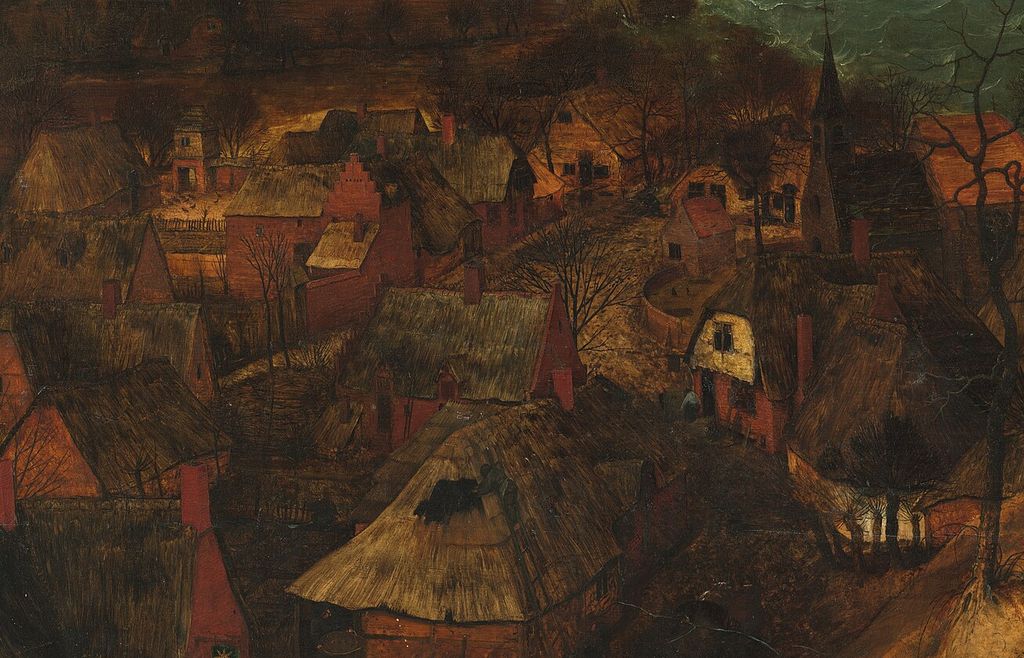
Small breaks between overlapping roofs lead the eye down through the settlement. Look for the edges of the buildings catching the light.
Vessels in rough water
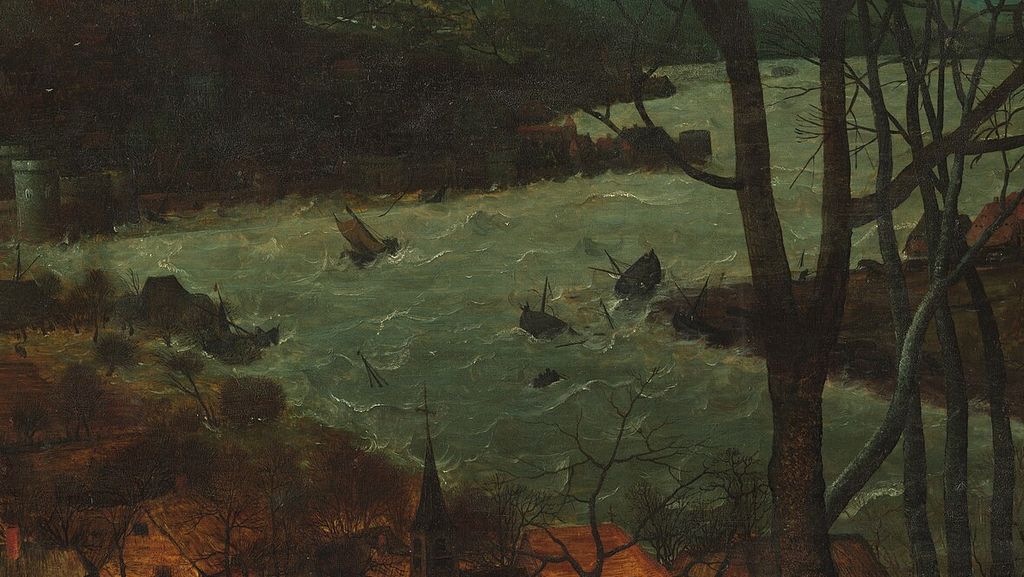
Several dark hulls show up against pale water beyond the roofs. The boats help establish the breadth of the valley and the force of the weather.
Light on the mountains
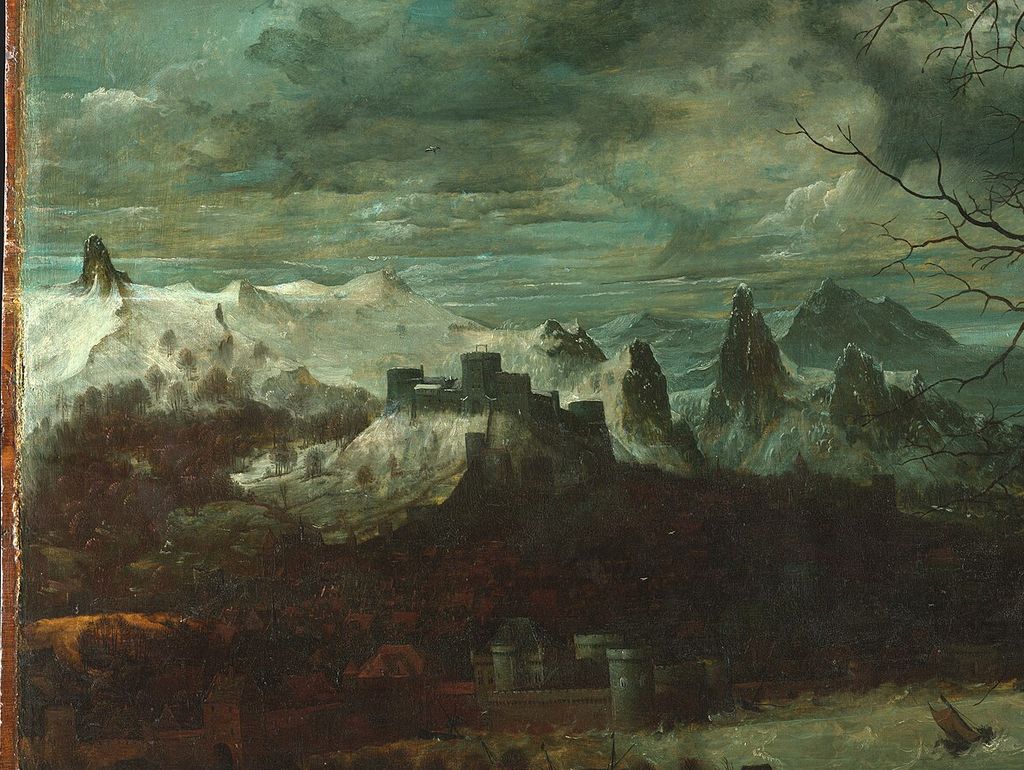
A patch of light separates the distant pale slopes from the dark middle distance. The branches above them belong to trees close to the viewer.
Carnival on a dark day
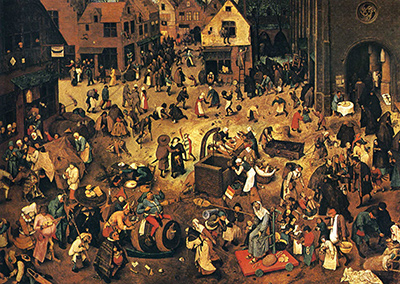
The small figures toward the right are another way to locate the season. The KHM draws attention to a paper crown, a lantern and waffles, as well as a masquerade involving a kettle worn over the head and a broom with candles. The same exhibition account compares these details with customs pictured in The Fight Between Carnival and Lent. There the opposing observances fill a town square. Here they take up a small part of a foreground whose most imposing elements are the trees, sky and falling ground [1].
Those little incidents change the mood without clearing the weather. A child’s crown and a patch of light clothing can be seen against dark wood. The view keeps them close to the people engaged in practical tasks. Seasonal customs make time legible in much the same way as the cut branches. A viewer need not see crops in a field or a named month on a calendar to recognise that the activity belongs to a particular point in the year.
The KHM’s reading places the picture at the beginning of the cycle and relates it to the calendar in which the year could begin in March. The language of early spring helps because the weather by itself could suggest winter. Identifying the work and festivities in the foreground gives that dark weather a more precise setting. Bruegel asks the eye to put the large and small evidence together [1] [2].
A valley exposed to wind and water
The village is most easily reached by following the roofs down and towards the left. Pale edges and little stretches of brighter ground lead the eye there through a region of muted browns. Some houses are hidden behind one another, while others lie at just enough distance to separate from the hillside. This use of intervals makes the settlement feel inhabited. It also creates a middle distance between people cutting wood and vessels exposed to weather on the water.
Bruegel keeps the strip of water broad enough to carry local effects. Seen through branches, the surface near the settlement leads to rougher passages and to the small pale shapes of boats. Look from those shapes to the mountains. Their distance is conveyed partly by smaller scale and partly by which differences of light remain visible. A light patch on a distant slope can matter as much as a black branch near the viewer. Both let the eye track the weather across a large space.
The diagonal of the near ground pulls against the sweep of the valley. These are two different paths through the painting. The first takes the eye down through the place where the people are working. The second conveys the greater breadth of the land and water behind them. A viewer can imagine moving down the foreground bank. The distant view is available in such full breadth only because Bruegel has constructed the landscape to reveal it.
What changes across the seasons
All five surviving panels allow a large landscape and a set of human actions to be read together. The readiness of the foreground for travel differs sharply from one panel to the next. In Hunters in the Snow the hunters pick their way down a bank, while people have a broad, level surface on the ice below. In The Gloomy Day, the plate of white land and ice gives way to muddy ground, cut growth and open water. These surfaces determine which paths people can use. They also affect how the eye follows the action [2] [3].
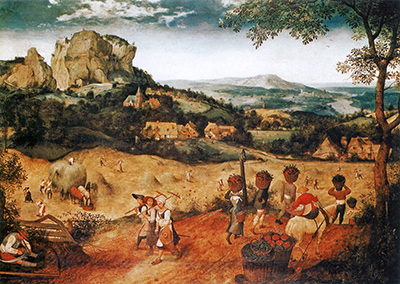
Haymaking provides another contrast. Its bright field lets the eye distinguish scattered people at work, while the dark trees in The Gloomy Day break the view into passages. Both pictures place substantial figures near the front and leave much smaller ones at distance. Early summer offers a clearer range of travel across open ground, while early spring demands more adjustment to the bank and its obstacles [2].
The pictures’ original grouping invites comparison even though the cycle has been dispersed and one panel is missing. The famous winter scene can make viewers think of Bruegel’s year through snow. The Gloomy Day adds a different sort of cold, with more exposed ground, moving water and a stronger sense of wind. It does not turn the calendar into a succession of labels. The work of the people and the appearance of the terrain do the job together.
A final way to look is to choose one of the little figures at the right, then find a vessel on the water without losing sight of the slope between them. Young and old share a narrow patch of usable ground, while the whole valley shows what the weather can do. The Gloomy Day holds both scales in one view. That is what makes it a strong beginning for a painted year. The season announces itself through people responding to land that has begun to change.
Discussion
Which detail in this work most changes how you read it?
Frequently Asked Questions
The KHM identifies wood gathering and cutting willow shoots among the seasonal activities. One figure raises a tool close to a trunk, while cut branches and stripped growth interrupt the ground below. [1]
The small figures toward the right are another way to locate the season. The KHM draws attention to a paper crown, a lantern and waffles, as well as a masquerade involving a kettle worn over the head and a broom with candles. [1]
References
- Kunsthistorisches Museum Vienna, Pieter Bruegel d. Ä., Die Jahreszeiten, with a discussion of Düsterer Tag (Vorfrühling), View source.
- Kunsthistorisches Museum Vienna, Six Seasons for a Dining Room, View source.
- Kunsthistorisches Museum Vienna, Kapitel II: Bruegels Jahreszeiten, from Arcimboldo – Bassano – Bruegel: Die Zeiten der Natur, View source.







