



 by Tom Gurney
Tom Gurney BSc (Hons) is an art history expert with over 20 years experience
Published on June 19, 2020 / Updated on August 16, 2026
Email: tomgurney1@gmail.com / Phone: +44 7429 011000
Pieter Bruegel Netherlandish Proverbs: Introduction
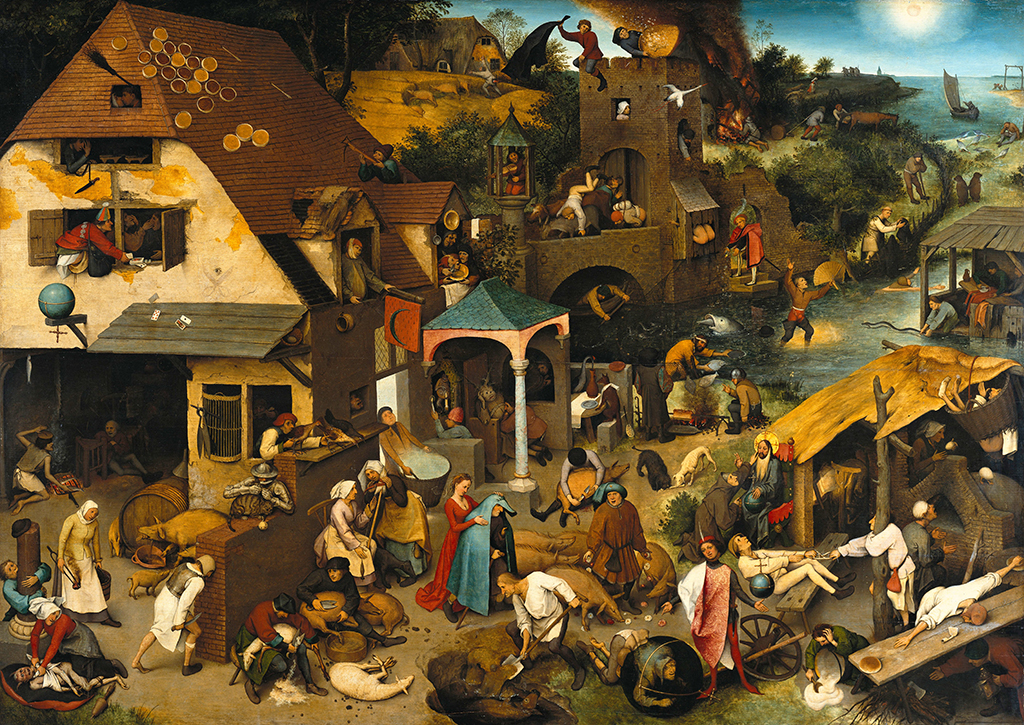
Pieter Bruegel the Elder's Netherlandish Proverbs is one of the great pictures of human foolishness. Painted in 1559 and now in the Gemäldegalerie, Berlin, it turns a village into a theatre of sayings: people bang their heads against walls, throw valuable things away, cloak one another in deception, look for advantage, waste effort, and act out familiar phrases as if language had become daily life [1].
The painting is often introduced as a catalogue of more than a hundred proverbs. That is useful as a starting point, but it can also mislead. Netherlandish Proverbs is not a flat word list on oak. It is a large, carefully organized village world in which sayings become visible behaviour. Bruegel asks viewers to read, compare, laugh, hesitate and return. The picture is comic because its actions are so absurd; it is serious because those actions belong to ordinary social life.
This page explains the Berlin painting as a flagship work of Bruegel's paintings and of his wider proverbs and iconography. It gives the object facts, sets the work within sixteenth-century proverb culture, offers selected examples without pretending to solve every detail, and shows why the painting is central to the art of Pieter Bruegel the Elder.
At a Glance
- ArtistPieter Bruegel the Elder
- Common English titleNetherlandish Proverbs
- German title in the DDB recordDie niederländischen Sprichwörter
- Date1559
- Medium and supportPainting on oak
- Dimensions117.2 × 163.8 cm
- CollectionGemäldegalerie, Staatliche Museen zu Berlin
- Inventory number1720
- Signature and dateThe DDB record notes a lower-right signature and dating
- Main subjectA village filled with proverbs, idioms, comic reversals and moral folly
- Best reading habitMove between selected details and the whole composition, while allowing some identifications to remain cautious
This work across Bruegel’s career
Tower of Babel
1563The Harvesters
1565Peasant Wedding
1568Children's Games
1560Triumph of Death
1562–1563Contents
- Introduction
- Object Facts And Title Notes
- What The Painting Shows
- Proverbs As Visual Behaviour
- The World Upside Down
- Selected Proverb Examples
- Composition: How Bruegel Organizes Abundance
- Relation To Children's Games And Carnival And Lent
- Prints And Proverb Culture
- Later Copies And Reception
- Annotated Details
Object Facts And Title Notes
The Gemäldegalerie records the oak panel at 117.2 by 163.8 centimetres, inventory 1720. The German title on that record is Die niederländischen Sprichwörter. It is a modern collection title for a picture whose actions have circulated under other names. That distinction matters when browsing old reproductions: words such as “Dutch,” “Flemish” or “The Blue Cloak” can be attached to the same Berlin painting or to later examples of the composition. The collection, date and inventory number tell us which panel is in view [11].
The Deutsche Digitale Bibliothek record, supplied through the Deutsches Dokumentationszentrum fur Kunstgeschichte - Bildarchiv Foto Marburg, identifies the work as Die niederländischen Sprichwörter, by Pieter Bruegel the Elder, in the Gemäldegalerie of the Staatliche Museen zu Berlin. It gives the inventory number as 1720, the support as oak, the dimensions as 117.2 × 163.8 cm, and the date as 1559 [1].
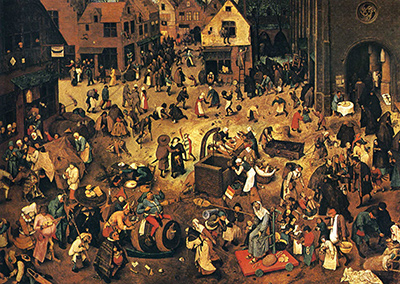
Those facts matter because they anchor a picture that can otherwise feel almost impossible to contain. The work is large enough to support many simultaneous incidents. It is not an illustrated proverb book, a small moral print, or a marginal curiosity. It is a major panel painting, close in size to other large Bruegel crowd works of the same period, and it belongs near The Fight Between Carnival and Lent and Children's Games as part of Bruegel's most ambitious experiments with many actions inside one pictorial world.
The title also needs care. Modern English readers usually know the painting as Netherlandish Proverbs, while German records often use Die niederländischen Sprichwörter. The word "Netherlandish" is better than simply "Dutch" for the sixteenth-century setting, because Bruegel worked in the Habsburg Netherlands rather than in the later modern nation-state sense of the Netherlands. Yet the proverbs themselves do not transfer neatly from one language to another. An English label may be a helpful modern equivalent rather than a word-for-word historical translation.
The DDB record is especially valuable because it includes many separate detail records connected to the Berlin painting [1]. That tells us something important about modern study of the work. Scholars, museums and educators have long wanted to isolate and name particular actions. The painting encourages that desire. But the detail records also make clear why caution is needed: identifying an individual proverb is not the same as explaining the whole painting.
Annotated Details from Netherlandish Proverbs
The numbered details move across Bruegel's crowded village, isolating small clusters that can disappear inside the painting's larger comic spectacle.
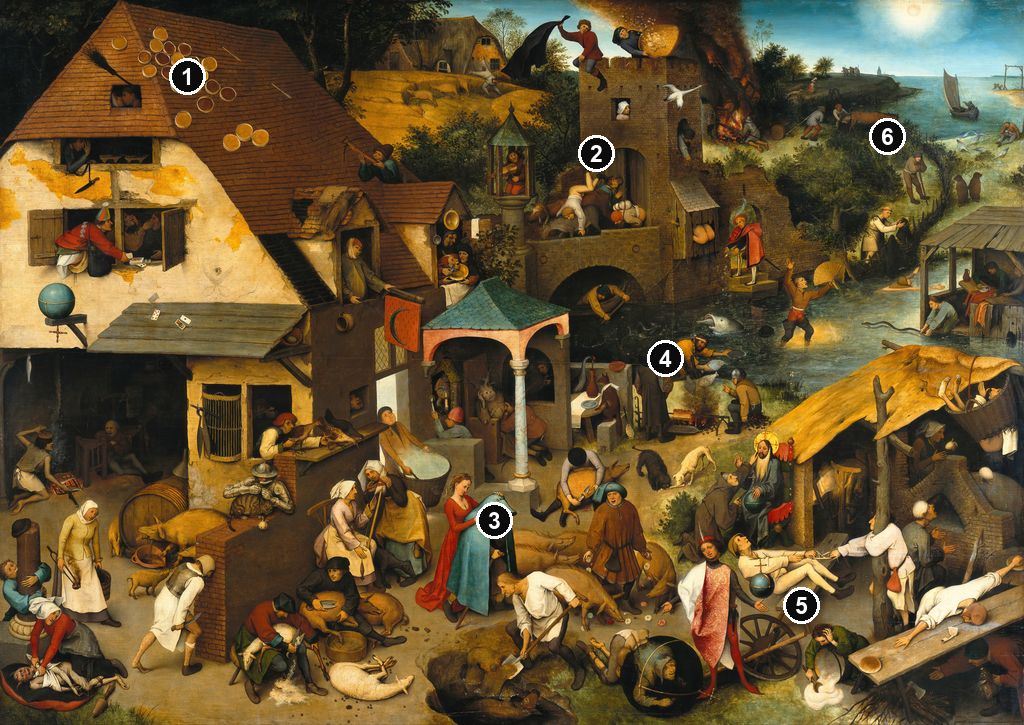
Details from NETHERLANDISH PROVERBS
Close looking reveals how architecture, tools, clothing, animals and gestures divide the village into dozens of miniature scenes.
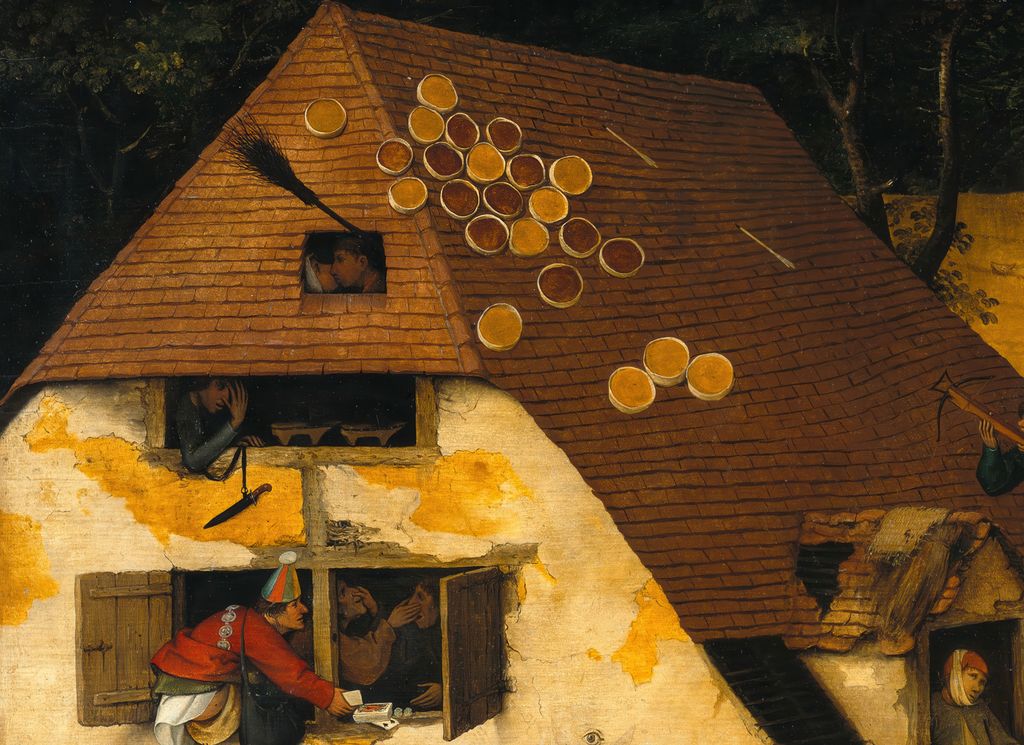
Pies across the tiled roof
Round pies form a loose diagonal across the orange tiles, turning the broad roof into a patterned field above the shadowed windows.
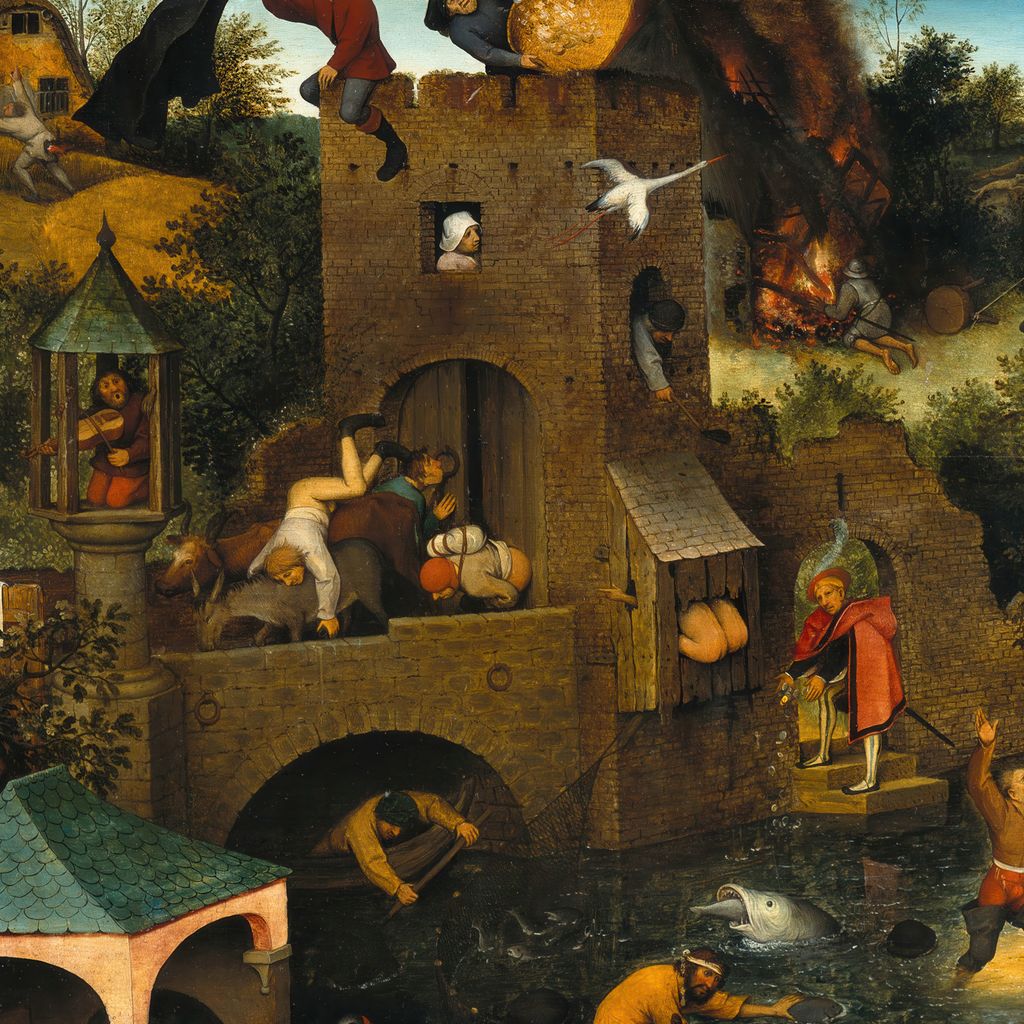
Burning tower and falling figures
Flames and smoke consume the building while pale bodies, dark openings and sharply angled limbs interrupt its heavy brick geometry.
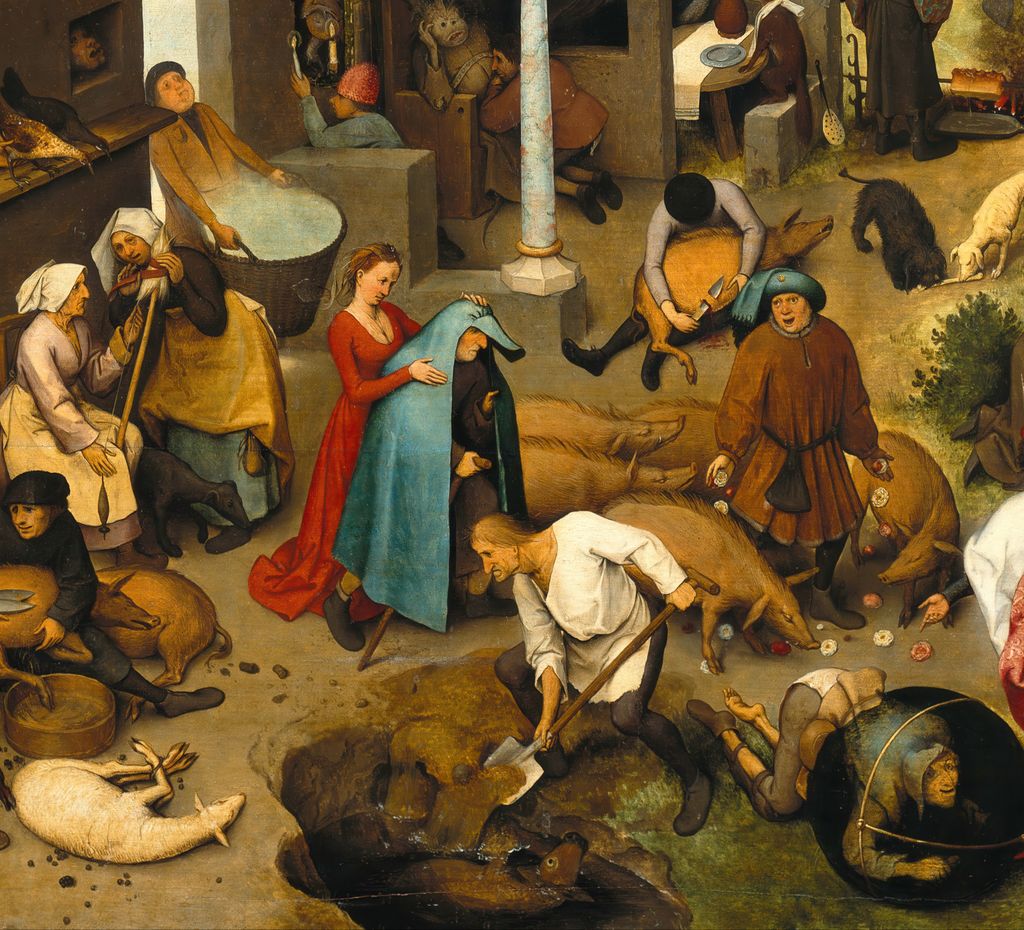
Blue cloak in the crowded courtyard
A bright blue garment anchors the group as bent backs, outstretched arms, animals and scattered objects crowd the dusty foreground.
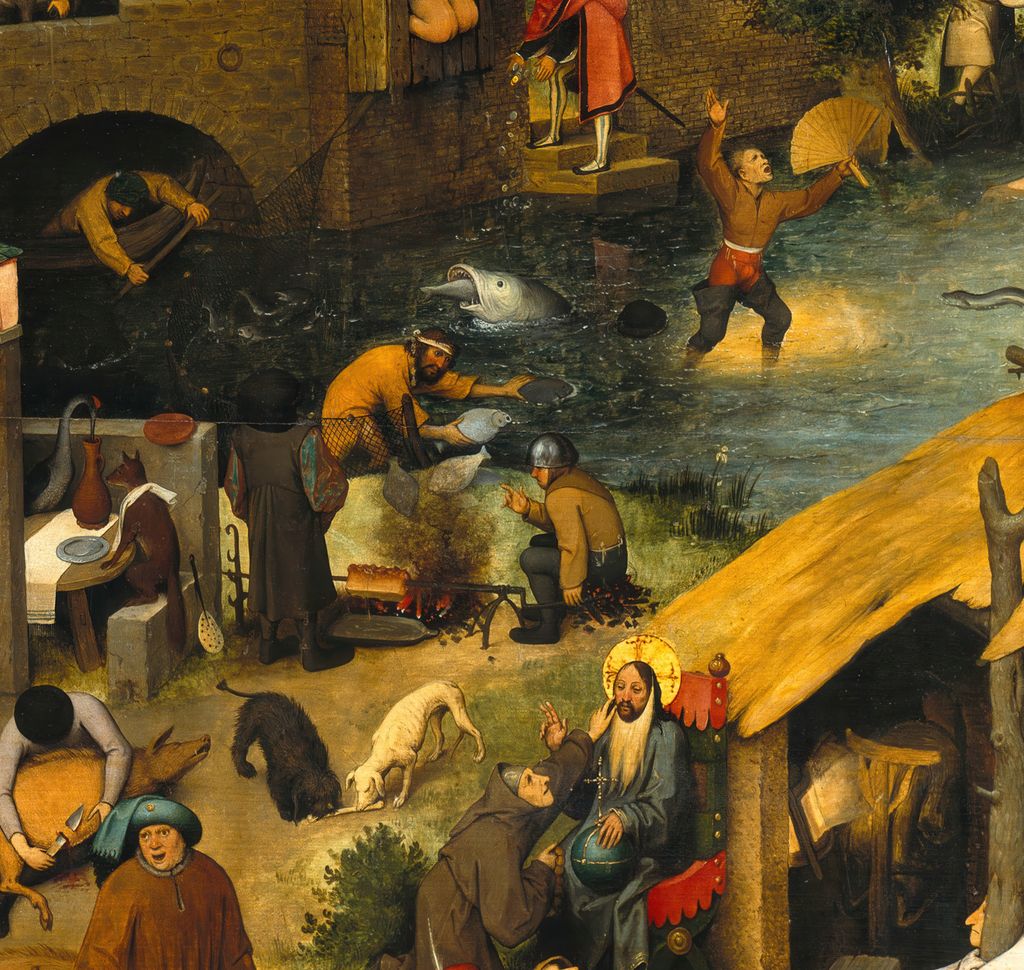
Activity along the riverbank
Figures crouch, carry, reach and balance beside the dark water, their repeated gestures drawing the eye from the bridge toward the bank.
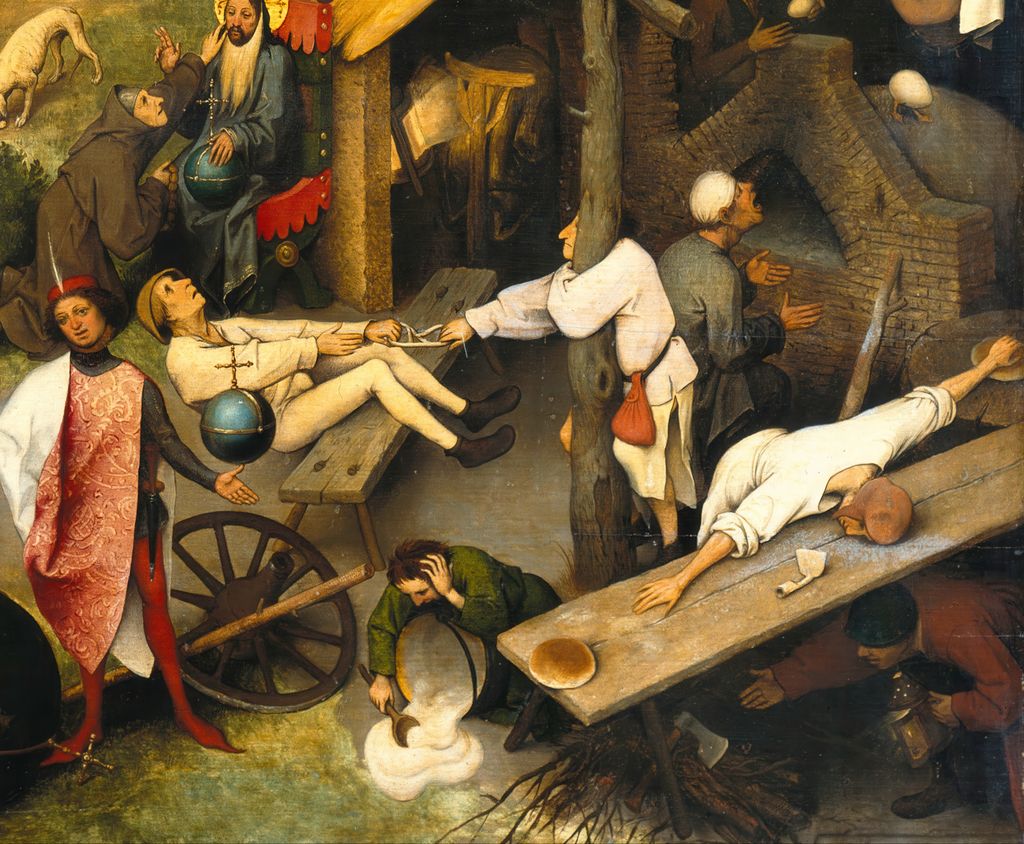
Bodies and objects in a tangle
Extended limbs, a tilted bench, a wheel and rounded vessels overlap so tightly that the scene reads as a knot of unstable diagonals.
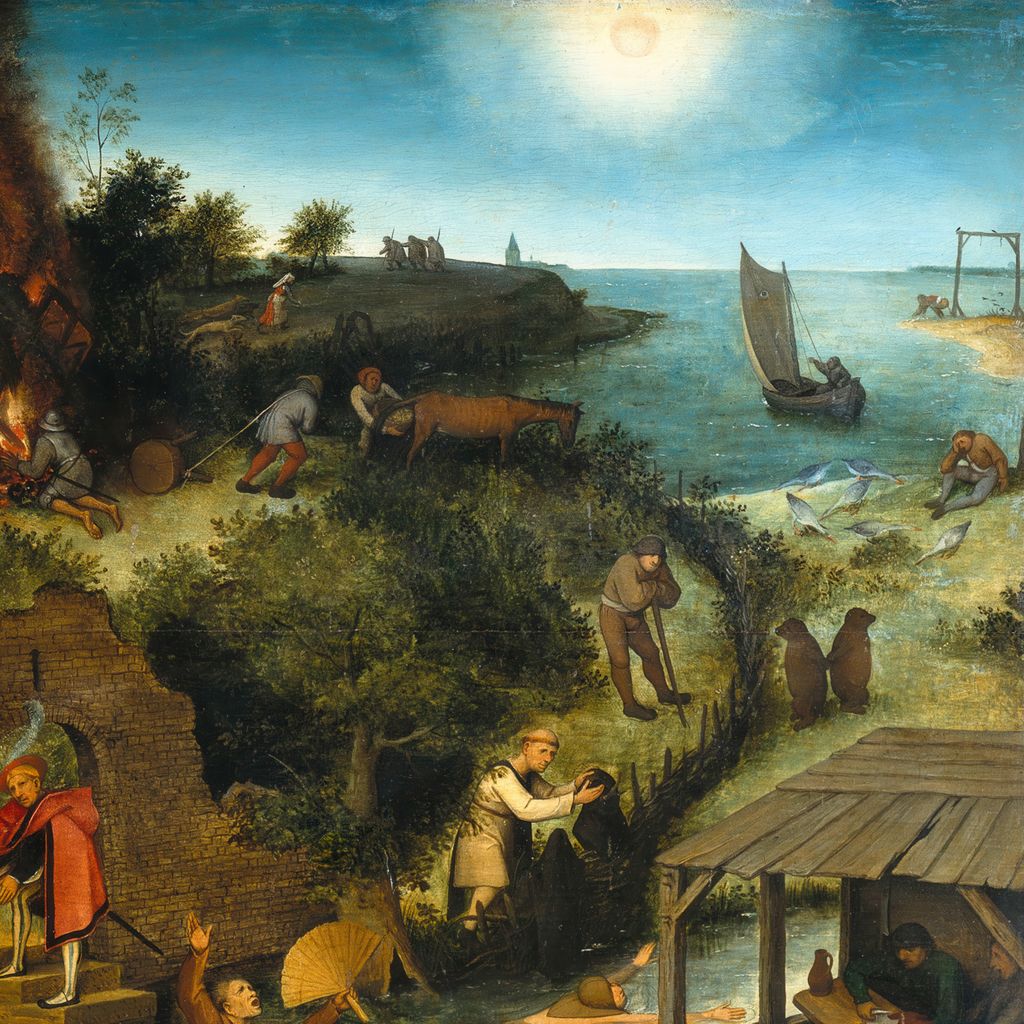
Boats and figures on the shoreline
Small figures and vessels punctuate the pale water, allowing the crowded foreground to open into a quieter strip of distant space.
What The Painting Shows
At first glance, Netherlandish Proverbs looks like a lively village scene near water. Houses gather around a central space. A red-roofed building holds several figures. Paths lead the eye from the foreground toward the middle distance. People move between interiors, doorways, roofs, courtyards, streets, water and open ground. There are tools, barrels, baskets, ladders, animals, food, cloth, boats and domestic objects. The surface is crowded, but not chaotic.
Then the ordinary village begins to slip. People are doing things that look wrong. A man seems to be beating his head against a wall. Another reaches toward a calf that has already escaped. Someone throws roses, or something valuable, before pigs. A woman places a blue cloak over a man. A figure sits between two stools. Another appears to try to fill in a well after the danger has already happened. The eye discovers action after action in which behaviour has become a saying.
Bruegel's method is literalization. A phrase that might normally live in speech is given a body, place and gesture. The result is funny because it is so direct. To "bang one's head against a wall" becomes an actual body meeting actual masonry. To "cast roses before swine," or in later English idiom to cast pearls before swine, becomes a visible waste of value. To "fall between two stools" becomes an unstable posture in space. The painting gives language weight.
Yet the work is more than a collection of jokes. Bruegel places the sayings in a shared environment. The figures do not stand in isolated boxes. They inhabit the same village, and their actions echo one another. Waste, delay, hypocrisy, self-deception, appetite, stubbornness, false trust and misplaced effort appear across the panel. The painting's subject is not one foolish person. It is a community of folly.
This is why the picture is so effective for students. It teaches slow looking. A viewer can begin with the large structure, then choose one area, then return to the whole with new alertness. Bruegel rewards curiosity without making the painting a simple game with one final answer.
Proverbs As Visual Behaviour
A proverb is already half visual. It compresses experience into a memorable picture: a world turned upside down, a fish swallowing a smaller fish, a door shut too late, a foolish head against a wall. Bruegel's achievement is to reverse the process. He takes the mental picture hidden inside the phrase and gives it a visible action.
That action is the key. The painting is not primarily about objects with secret meanings. It is about people doing things. A figure carries, covers, throws, climbs, waits, cheats, strains, eats, spills, kneels, leans, searches or falls. The proverb is not detached from the body. It is performed.
This matters because it protects the painting from being reduced to a crossword puzzle. It is tempting to ask only, "Which proverb is this?" That question has value, and many identifications are supported by long tradition. But the better question comes first: "What is this person doing, and how does that action relate to the wider village?" Bruegel's meanings usually begin in behaviour.
The painting also depends on recognition. A sixteenth-century Netherlandish viewer who knew the sayings would experience many details differently from a modern viewer reading modern English labels. Some proverbs survive in close equivalents. Others have shifted, disappeared or require explanation. Some identifications vary between languages and guides. That is not a failure of the painting. It is part of the history of proverb culture: sayings travel, mutate and gather local forms.
Smarthistory's educational account emphasizes this readerly challenge by presenting the painting through identifiable proverbs while also treating the image as a broader moral and comic field [2]. Columbia's online teaching material similarly uses the work as an interactive field of details rather than as a single central narrative [3]. Those modern tools are helpful, but they should not make the viewer forget the physical painting: one oak panel, one village, one brilliantly controlled surface.
The World Upside Down
The idea of the "world upside down" is central to the painting. It appears in the DDB subject classification attached to the work, and it fits the visual logic of the whole panel [1]. A world upside down is not merely a world in which objects are inverted. It is a moral and social order turned inside out.
Bruegel makes that inversion comic before he makes it solemn. The viewer smiles at ridiculous literal actions. Someone tries too late. Someone wastes what is precious. Someone fools another person while perhaps also fooling themselves. Someone pursues a pointless task with impressive commitment. The humour is sharp because the actions are recognizable. We may not perform these sayings literally, but the painting implies that we perform their meanings all the time.
The upside-down world is also architectural. Folly is not confined to one figure in the foreground. It occupies houses, roofs, yards, streets, water and distance. Some actions happen in public view; others occur in doorways or half-hidden spaces. The painting's world has no safe zone. Even the background belongs to the same inverted order.
This is one reason Bruegel differs from a simple moral illustrator. He does not give the viewer one emblem and one caption. He creates a condition. Folly becomes environmental. It spreads through space. It becomes almost the weather of the village.
At the same time, the painting is not despairing in a simple way. Its visual intelligence is joyful. The designs of bodies, roofs, colours, pathways and comic gestures are full of energy. Bruegel's world may be morally upside down, but the act of painting it is intensely ordered. That tension gives the work its force: a beautifully made picture of disorder.
Selected Proverb Examples
No short article should pretend to give a complete controlled list of every proverb in Netherlandish Proverbs. More than a hundred sayings are often associated with the painting, but the exact number depends on how one counts, translates and separates details. The examples below are selected because they show how Bruegel's method works. They should be read as a guide to looking, not as a closed inventory.
One of the clearest examples is the figure who appears to bang his head against a wall. The modern meaning is close to the familiar idea of wasting effort against an immovable obstacle. Bruegel makes the phrase almost painfully physical. The wall does not become a symbol floating above the scene; it remains a wall. The folly lies in the action.
Another often noted detail shows a person trying to deal with a problem too late, commonly glossed through the idea of filling the well after the calf has drowned or closing the gate after the horse has bolted. The exact English equivalent varies, but the moral pattern is clear: prevention has failed, and effort arrives after the damage. Bruegel turns bad timing into a visible episode.
The woman placing a blue cloak over a man is usually understood as a proverb of deception, often linked to marital betrayal. This is a useful example of translation caution. The literal action may not carry an obvious meaning for a modern English reader until the idiom is explained. The scene reminds us that Bruegel's painting is not just visual in a universal sense; it is rooted in Netherlandish speech and social humour.
The figure sitting between two stools is another case where the physical action and the modern meaning remain close. To fall or sit between two stools is to fail by choosing neither option securely. Bruegel makes indecision and misplaced calculation into a body without support. The joke works because it is both literal and abstract.
The motif of casting precious things before pigs points toward waste: giving value where it cannot be understood or used. Some English guides use the familiar biblical-adjacent wording "pearls before swine"; other renderings follow Netherlandish versions more closely. The important point is not the exact English phrase alone, but the visible mismatch between value and recipient.
The inverted globe or world motif, often associated with the world upside down, gives the painting a wider frame. It suggests that foolishness is not merely local. The entire order of things has been reversed. Yet Bruegel places that grand idea among small human actions, so cosmic disorder and village comedy meet.
Other details are often read through ideas such as being armed to the teeth, putting a spoke in someone's wheel, killing two flies with one blow, or leading another blindly. Some of these have close modern equivalents; others are more approximate. That range is exactly why the painting should be approached with humility. A detail can be well established as a proverb scene while its best English wording remains open to adjustment.
The selected examples also show how Bruegel balances accessibility and difficulty. Some proverbs are instantly readable even without a guide. Others require linguistic history. A modern viewer should enjoy both experiences: the quick recognition and the slower recovery of an unfamiliar idiom.
Watch Bruegel’s art
Explore Bruegel with TheHistoryOfArt and artwork discussions from Smarthistory.
Pieter BRUEGEL Explained in 10 Minutes (updated)
A TheHistoryOfArt film about Bruegel.
Watch on YouTubeComposition: How Bruegel Organizes Abundance
Mark Meadow approaches the work through the way proverbs organise knowledge. That is a useful change of pace after identifying examples one at a time. A viewer can see folly elsewhere in the scene before knowing the precise saying attached to a man at a wall or a couple in a doorway. Looking back and forth brings adjacent actions into comparison. An isolated list can make the picture seem like a set of independent entries, while the layout gives the sayings a common terrain. Read the list against the painting, following the paths and leaps across buildings that a reader cannot see on the page of a proverb book [13] [12].
The great danger in a painting like Netherlandish Proverbs is scatter. If every detail shouts for attention, the whole can collapse into noise. Bruegel avoids that by building a strong village structure. Architecture, ground, water and pathways divide the surface into zones, while the high viewpoint lets the viewer move across them without losing orientation.
The foreground gives immediate access. Here the figures are large enough to read as bodies before they become proverbs. The viewer notices posture, costume, tools and gestures. From there the eye moves inward, climbing through the central buildings and across the street-like spaces. Each zone offers a new set of actions, but the village holds them together.
The buildings are more than background. Walls, windows, roofs, thresholds and doorways create stages for behaviour. A proverb may happen against a wall, under a roof, at a doorway or in an open yard. The architecture gives the sayings social placement. Folly occurs at home, in public, in labour, in exchange and in neighbourly life.
Bruegel also uses colour to keep the eye moving. Reds, blues, whites and earth tones punctuate the surface. The famous blue cloak is not only an idiom; it is also a visual accent. Bright garments and objects help the viewer locate individual actions within the larger composition. The picture's readability depends on these small signals.
Scale is equally important. Figures become smaller as the eye moves into the distance, but they do not vanish into mere scenery. Even background figures can carry meaning. This is a typical Bruegel strength: distance does not simply create atmosphere; it extends the field of human activity. The world keeps going.
The composition is therefore encyclopaedic without being mechanical. Bruegel does not arrange the proverbs in a grid. He embeds them in a plausible environment. The viewer experiences the painting as a place before experiencing it as a collection of sayings. That is why the work remains so powerful even when one cannot identify every detail.
Relation To Children's Games And Carnival And Lent
Netherlandish Proverbs belongs to a remarkable group of Bruegel crowd pictures made around the turn of the 1560s. The Fight Between Carnival and Lent, also dated 1559, fills a town square with customs, food, charity, religious observance and comic opposition. The Kunsthistorisches Museum describes that painting as an encyclopaedia of Netherlandish customs and stresses Bruegel's unusual simultaneity of many actions in one place [7].
Children's Games, dated 1560 in the Kunsthistorisches Museum record, turns a broad square into a field of play. KHM identifies more than 230 children and 83 games, and its discussion of the work resists a single narrow moral reading [6]. Like Netherlandish Proverbs, the painting depends on multiplication. The viewer reads one action, then another, then the pattern created by many actions together.
These comparisons help define Bruegel's achievement. He was not merely piling details into pictures because abundance was entertaining. He was testing how many separate actions could be held inside one coherent world. In Carnival and Lent, the organizing frame is ritual season and social custom. In Children's Games, it is play. In Netherlandish Proverbs, it is language turned into behaviour.
The three paintings also share a particular kind of intelligence. They are not single-episode narratives. They do not ask the viewer to identify one hero and follow one plot. Instead, they invite scanning, comparison and moral pattern recognition. A person in one corner may clarify a person elsewhere. A repeated posture may become a theme. A comic action may become darker when seen beside ten other kinds of error.
This is why Bruegel is so central to the history of crowded composition. He proves that a picture can be full without being formless. His crowds are not decorative filling. They are thinking structures.
Prints And Proverb Culture
Bruegel's proverb painting also belongs near his prints. Many sixteenth-century viewers knew Bruegel through graphic designs issued by publishers rather than through rare paintings. KBR's account of The World of Bruegel in Black and White stresses the importance of Flanders as an international centre for prints around the middle of the sixteenth century, and identifies Bruegel and Hieronymus Cock as key figures in that world [4].
Print culture matters for Netherlandish Proverbs because it trained viewers to read dense moral images. A print could be held close, searched, compared with other impressions, read alongside inscriptions and discussed among collectors. Bruegel's painted proverb village offers a similar kind of pleasure on a larger scale. It rewards the viewer who scans slowly and returns to details.
The Metropolitan Museum of Art's essay on Bruegel notes his association with Cock's Antwerp publishing house after the artist's trip to Italy and says that between 1555 and 1563 he produced more than forty designs for engravings [5]. That period overlaps closely with the 1559 Berlin painting. It was a moment when Bruegel's imagination moved between graphic invention and large painted panels.
Proverbs were especially suited to that culture because they were compact, memorable and shareable. A proverb could move in speech; a print could move on paper; a painting could gather many such sayings into a single object for sustained looking. Bruegel understood the visual power of all three.
The relation to prints also helps explain the painting's balance between popular language and sophisticated design. Proverbs may sound like common wisdom, but Netherlandish Proverbs was not a naive folk artifact. It is an ambitious work by an artist active in urban, courtly and collecting networks. Its subject may be vernacular; its construction is highly learned.
Later Copies And Reception
The fame of Netherlandish Proverbs is partly visible in its afterlife. Bruegel's inventions were copied, adapted and circulated by later artists, including members of the Brueghel family. That broader copy culture is important across the artist's work, but it needs careful wording. A later version may preserve the design's popularity without carrying the same evidential status as Bruegel's 1559 Berlin painting.
For Netherlandish Proverbs, the Berlin panel remains the central work: Bruegel the Elder, dated 1559, on oak, in the Gemäldegalerie, inventory 1720 [1]. Later versions and related proverb pictures are best treated as evidence of reception, not as interchangeable substitutes. They show that the design was valued, legible and desirable, but they do not remove the need to distinguish original, copy, adaptation and later interpretation.
Reception also includes scholarship and teaching. Grosshans's Berlin-focused study, Meadow's work on rhetoric and proverb culture, and Gibson's writing on Bruegel all belong to the modern scholarly tradition that has kept the painting central to discussions of language, moral imagery and visual wit [8] [9] [10]. These studies are useful because they prevent the painting from being seen merely as a curiosity. They show that its humour is tied to serious questions about rhetoric, social knowledge and pictorial structure.
Modern educational resources have extended that reception in another direction. Smarthistory and Columbia present the painting as a work to be explored through details, identifications and guided looking [2] [3]. That is appropriate, because the painting seems almost built for interactive attention. But the strongest modern reading still returns to the whole panel. The painting is not only a database of proverbs. It is a vision of human life as proverb-ridden.
Cautions For Modern Viewers
The first caution is translation. A Netherlandish proverb from Bruegel's world may not have a perfect modern English equivalent. Sometimes an English idiom is close. Sometimes it is only a practical approximation. Sometimes the literal action survives more clearly than the phrase. Good labels help, but they should not be treated as final proof that every nuance has crossed languages intact.
The second caution is counting. Many sources say the painting contains more than a hundred proverbs. That is a reasonable general guide, but numbers vary depending on method. Does one count every separate figure? Every action? Every possible saying? What if one detail carries more than one proverb, or a proverb is split across a group? The safest approach is to say that the painting is commonly understood to contain more than a hundred proverb-like actions, while avoiding a false precision that the page cannot support.
The third caution is certainty. Some details are secure, widely accepted and easy to explain. Others are debated or vary between guides. This is normal for a painting built from historical language. Uncertainty does not weaken the work. It reminds us that Bruegel's painting is part of a living history of speech, viewing and scholarship.
The fourth caution is tone. Because many scenes are comic, it is easy to make Bruegel sound merely mocking. The painting is sharper than that. It includes ridicule, but it also includes pattern, sympathy, irony and self-recognition. The viewer is not placed outside the world of folly like a judge outside the courtroom. The picture's force comes from the uncomfortable sense that foolishness is shared.
The final caution is over-system. A painting like this invites charts, lists and annotations, but it should still be experienced as art. Bruegel's composition, colour, rhythm and spatial imagination matter as much as the identifications. The proverbs are the content, but painting is the form that makes them unforgettable.
How To Look At The Berlin Panel
A useful first step is to resist beginning with a list. Stand back, or imagine standing back, and let the village become visible before the sayings do. Notice the slope of the ground, the concentration of houses, the openings into interiors, the movement toward the water, and the way the red roof helps hold the middle of the composition. Bruegel's order is easier to feel at this distance. The painting is busy, but it has a clear geography.
Next, choose one zone and stay there for a moment. The foreground is a good entry point because the actions are physically legible. Look at posture before meaning. Is a figure bending, straining, covering, throwing, dragging, reaching or falling? What object makes the action possible? Is the action private, public, foolish, aggressive, resigned or theatrical? Only after that should the proverb label enter.
Then compare nearby actions. Bruegel often makes a detail stronger by placing it beside another detail that rhymes with it. Waste may sit near deception. Delay may sit near stubbornness. A household object may become comic in one place and morally pointed in another. The viewer starts to sense that the proverbs are not randomly scattered. They form neighbourhoods of behaviour.
After that, move upward and inward. The middle distance can be harder to read because the figures are smaller, but it is essential to the painting's force. If the foreground alone contained the folly, the viewer might treat it as a set of isolated jokes. By extending actions into the background, Bruegel suggests a whole social order. The village does not merely contain foolish people. It has been built as a proverb world.
Finally, return to the whole panel. This movement from whole to detail and back again is the best rhythm for the painting. A viewer who only hunts for identifications may miss the composition. A viewer who only admires the composition may miss the bite of the sayings. Bruegel asks for both kinds of attention at once.
This is also the safest way to teach the work. Begin with what can be seen: body, gesture, place, object, relation. Add the proverb identification as an interpretation grounded in visible evidence. Then acknowledge where translation or scholarly tradition affects the label. That method keeps the painting open without making it vague. It lets students enjoy discovery while also learning why historical images need careful reading.
Why The Painting Matters
Netherlandish Proverbs is central to Bruegel because it brings together several of his strongest gifts. It shows his command of crowd composition, his interest in popular speech, his comic severity, his ability to turn small actions into large patterns, and his talent for making a whole world out of details.
It also clarifies his difference from a simple genre painter. Bruegel does show ordinary people, ordinary objects and ordinary spaces. But he reorganizes them into a structure of thought. A village becomes an argument about human behaviour. A roof, a cloak, a pig, a wall or a stool becomes part of a moral language. The picture is everyday and intellectual at once.
The painting also helps explain why Bruegel matters to modern viewers. It teaches visual literacy. It asks us to notice, compare, doubt, translate, connect and revise. It rewards the beginner who recognizes one obvious proverb, and it rewards the specialist who sees how that proverb belongs to a wider rhetorical and pictorial tradition.
For students, the work is an ideal introduction to iconography because it shows both the pleasure and the danger of decoding. Identifying details is exciting, but it is only the beginning. The larger question is how Bruegel turns many identifications into a single social vision.
For museum visitors, the best approach is slow movement. Start with the whole village. Choose one figure. Ask what the body is doing. Look for nearby actions that rhyme with it. Then step back mentally and ask what kind of world contains all these behaviours at once. That rhythm of close looking and return is exactly what Bruegel's art demands.
In the end, Netherlandish Proverbs remains unforgettable because it makes language visible and makes folly communal. It is funny, severe, orderly, crowded and humane. It belongs with Bruegel's greatest paintings because it does what only he could do at this scale: turn the small wisdom of common speech into a complete painted world.
Discussion
What feels most revealing about Pieter Bruegel the Elder: the village detail, the landscape setting, the moral wit, or the way everyday life becomes a complete world?
Reader Insights
Begin with one small action in a Bruegel scene, then follow how it connects to the surrounding figures, setting and rhythm of the whole image.
Connect the work to Northern Renaissance visual culture, printmaking, proverb traditions and Bruegel's interest in rural and urban life.
Which detail changes the interpretation most once you know the subject, date, proverb source or present collection?
Join the Conversation
Have a thought or observation about Pieter Bruegel the Elder? Share it below. Thoughtful responses may be added to this section as the Bruegel pages develop.
Frequently Asked Questions
Pieter Bruegel the Elder's Netherlandish Proverbs is one of the great pictures of human foolishness. Painted in 1559 and now in the Gemäldegalerie, Berlin, it turns a village into a theatre of sayings: people bang their heads against walls, throw valuable things away, cloak one another in deception, look for advantage, waste effort, and act out familiar phrases as if language had become daily life . [1]
The Gemäldegalerie records the oak panel at 117.2 by 163.8 centimetres, inventory 1720. The German title on that record is Die niederländischen Sprichwörter . [11]
Smarthistory's educational account emphasizes this readerly challenge by presenting the painting through identifiable proverbs while also treating the image as a broader moral and comic field . Columbia's online teaching material similarly uses the work as an interactive field of details rather than as a single central narrative . [2][3]
The idea of the "world upside down" is central to the painting. It appears in the DDB subject classification attached to the work, and it fits the visual logic of the whole panel . [1]
References
- Deutsche Digitale Bibliothek / Deutsches Dokumentationszentrum fur Kunstgeschichte - Bildarchiv Foto Marburg, Die niederländischen Sprichwörter, View source.
- Smarthistory, "Pieter Bruegel the Elder, The Dutch Proverbs.", View source.
- Columbia University, "Bruegel, Netherlandish Proverbs" educational resource, View source.
- KBR, "The World of Bruegel in Black and White.", View source.
- Jacob Wisse, "Pieter Bruegel the Elder (ca. 1525-1569)," Heilbrunn Timeline of Art History, The Metropolitan Museum of Art, View source.
- Kunsthistorisches Museum Wien, "Children's Games.", View source.
- Kunsthistorisches Museum Wien, "The Fight between Carnival and Lent.", View source.
- Rainald Grosshans, Pieter Bruegel d. A.: Die niederländischen Sprichwörter, Staatliche Museen zu Berlin / Prestel, 2003, View source.
- Mark A. Meadow, Pieter Bruegel the Elder's Netherlandish Proverbs and the Practice of Rhetoric, Waanders, 2002, View source.
- Walter S. Gibson, Bruegel, Thames and Hudson, 1977, View source.
- Staatliche Museen zu Berlin, Gemäldegalerie, Die niederländischen Sprichwörter, inventory 1720, View source.
- Staatliche Museen zu Berlin, Gemäldegalerie, The Proverbs, Google Arts & Culture, View source.
- Mark A. Meadow, On the Structure of Knowledge in Bruegel’s Netherlandish Proverbs, View source.






