


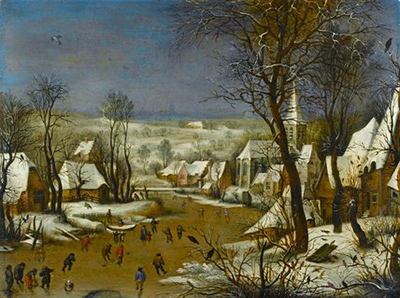
 by Tom Gurney
Tom Gurney BSc (Hons) is an art history expert with over 20 years experience
Published on June 19, 2020 / Updated on August 16, 2026
Email: tomgurney1@gmail.com / Phone: +44 7429 011000
Pieter Bruegel the Elder Biography: Introduction
Pieter Bruegel the Elder is one of the defining artists of sixteenth-century northern Europe, yet the outline of his life is much thinner than the reach of his art. He left no memoir, no body of letters and no settled archive that explains what he thought as he painted villagers skating, children playing, farmers harvesting, towers rising, armies moving and hunters returning through snow. The surviving record is a patchwork: guild registration, early printed biography, inscriptions, later ownership, technical evidence, and the testimony of works that moved through Antwerp, Brussels, Vienna, Prague, New York and many other collections.
That uneven evidence matters. Bruegel is often introduced through ready-made labels: peasant painter, moralist, satirist, follower of Bosch, observer of common life, inventor of panoramic landscape. Each phrase contains something useful, but each can become misleading when it pretends to know more than the record allows. A careful biography has to hold two truths together. Bruegel's documentary life is brief and uncertain; his artistic life is extraordinarily rich.
This page follows the available evidence from his probable birth in the 1520s to his death in Brussels in 1569, while also pointing to the larger subjects that shape the Pieter Bruegel the Elder guide: his paintings, prints, drawings, working methods, patrons, family and later reputation.
At a Glance
- Full namePieter Bruegel the Elder, often distinguished from his sons Pieter Brueghel the Younger and Jan Brueghel the Elder.
- Datesprobably born around 1525/30; died in Brussels in 1569 [2] [8].
- Birthplaceuncertain. Early tradition points near Breda and a place called Bruegel; modern summaries often allow either Breugel or Antwerp [2] [1].
- Trainingtraditionally connected with Pieter Coecke van Aelst and Mayken Verhulst, though the evidence should be treated cautiously [1] [2].
- Early careerrecorded as a master in the Antwerp painters' guild in 1551–52, then travelled to Italy and through the Alps in the early 1550s [2] [8].
- Print careerworked closely with the Antwerp publisher Hieronymus Cock, whose house helped spread Bruegel's designs across Europe [10] [8].
- Mature painting careerbest known today for major panels including The Harvesters, Hunters in the Snow, The Tower of Babel, Netherlandish Proverbs, Children's Games and The Peasant Wedding.
- Patronageworked for sophisticated urban patrons, including the Antwerp merchant and collector Niclaes Jonghelinck, rather than for a village audience alone [7] [6].
- Familymarried Mayken Coecke in Brussels in 1563; his sons were young when he died and later became major painters in their own right [2] [1].
- Surviving workroughly forty paintings, sixty drawings and eighty prints are attributed to him today, with major reassessment in modern scholarship [3] [9].
Bruegel in context
Northern Renaissance
Sixteenth-century setting[12][8][1][2]Antwerp print culture
1550s–1560s[13][14][9]Brueghel family and copies
After 1569[2][2][1]Antwerp guild
1551–1552[2]Italy and the Alps
Early 1550s[2][8]Brussels and family
Marriage in 1563[2][2][1]Triumph of Death
1562–1563[1]Four stages of Bruegel’s career
Contents
- Introduction
- Evidence Limits
- Early Life And Training Tradition
- Italy And The Alps
- Antwerp And The Print Market
- Brussels And Patrons
- Late Paintings
- Family And The Brueghel Dynasty
- Death And Early Reception
- Modern Rediscovery And Technical Research
Evidence Limits
Bruegel's biography begins with a warning: the most famous facts are often the least secure. The early seventeenth-century writer Karel van Mander, whose account appeared decades after Bruegel's death, remains an important early witness, but his anecdotes cannot be treated as direct documentary proof. Van Mander preserves traditions about Bruegel's origins, travel, training and social habits, yet modern biography has to separate his early reception value from confirmed record [2].
The birth year is inferred rather than documented. Bruegel is recorded as a master in the Antwerp Guild of Saint Luke in its 1551–52 year. Because guild masters were usually in their early twenties, the Kunsthistorisches Museum's Bruegel 2018 biography suggests a birth between 1526 and 1530, perhaps around 1527/28 [2]. Other museum summaries give the broader form, around 1525/30 [3] [8]. That range is more honest than a single confident date.
His birthplace is equally uncertain. Van Mander associated him with a place called Bruegel near Breda. Modern institutional summaries usually keep the matter open, giving Breugel, Breda or Antwerp as possibilities rather than fixing the point beyond doubt [2] [1] [7]. Even his surname encourages confusion. The artist is normally called Bruegel without an "h"; his sons and many later family members are usually spelled Brueghel with an "h" [2]. Older texts and catalogues sometimes vary the spelling.
The same caution applies to statements about belief, politics and intention. Bruegel worked during decades marked by religious conflict, Habsburg rule, civic tension, print expansion and humanist learning in the Low Countries. Those contexts matter, but they do not allow us to read every panel as a coded confession or a direct political statement. His images are intelligent, unsettling, comic and morally alert. They are not simple transcripts of his private opinions.
This careful approach does not make Bruegel smaller. It makes him more interesting. The gaps around his early life direct attention toward the things that can be studied closely: dated works, print inscriptions, patronage contexts, technical imaging, family reception and the way his images moved between elite households, publishers, collectors and viewers.
Early Life And Training Tradition
If Bruegel was born around 1525/30, he grew up in the years after the great generation of early Netherlandish painting had already reshaped northern art. The legacy of artists such as Jan van Eyck still mattered through precision, surface, devotional detail and the prestige of Netherlandish craft. At the same time, Antwerp was becoming one of Europe's major commercial and artistic centers. By the middle of the sixteenth century, it was a city of painters, publishers, merchants, humanists, mapmakers, printers and international trade.
The Antwerp guild register supplies the earliest firm date in Bruegel’s career. Museum Mayer van den Bergh gives 1551, while the Met uses the guild year 1551–52 [12] [8]. That registration marks him as a professional master, but it does not describe his apprenticeship. Later tradition connects him with Pieter Coecke van Aelst, an artist, designer and intellectual figure active in Antwerp and Brussels, and with Coecke's family circle. KHM's artist summary records the training tradition and notes the importance of Coecke's wife, Mayken Verhulst, herself known as a painter and miniaturist [1] [2].
The connection matters, but the wording should stay careful. It is safer to say that Bruegel's training is traditionally linked to Coecke van Aelst than to build a detailed teacher-pupil story that the surviving documents cannot fully support. What the tradition does suggest is the kind of world in which Bruegel matured: a world of learned image-making, designs for multiple media, courtly and urban patronage, and the circulation of ideas through prints, tapestries, books and paintings.
Bruegel's later art does not look like a simple continuation of Coecke's. It absorbs many currents and makes something stranger. His scenes are densely organized without feeling mechanical. He can fill a panel with figures and still make a landscape feel vast. He can take a biblical subject and make the nominal event almost disappear into weather, work, architecture or crowd behavior. He can use peasant festivity without reducing it to crude comedy. Those achievements belong to the mature artist, but they make sense in a broad Netherlandish environment where painters and designers were already skilled at combining local observation, inherited iconography and international ambition.
The young Bruegel also entered a northern artistic culture deeply aware of Hieronymus Bosch. Bosch had died before Bruegel was born, but his imagery of folly, demons, moral inversion and fantastical invention remained powerful. Bruegel's later prints and paintings sometimes invited comparison so strongly that the Met notes the sixteenth-century habit of seeing him as a kind of successor to Bosch [9] [8]. Yet the relationship should not be flattened into imitation. Bruegel could work with Boschian material, but he also transformed landscape, proverb, peasant imagery and everyday spectacle into new forms of pictorial intelligence.
Italy And The Alps
Soon after becoming a master in Antwerp, Bruegel travelled south. The exact route cannot be reconstructed from travel papers, but drawings and prints support an itinerary through France and Italy. The KHM Bruegel 2018 biography names Lyon, Rome, Naples, Reggio di Calabria and Messina as places that can be connected to the journey through surviving graphic evidence [2]. The Met likewise places the Italian trip before his long association with Hieronymus Cock [8].
For many Renaissance artists, Italy meant antiquity, Rome, the studied body, proportion and the prestige of classical form. For Bruegel, the afterlife of the trip is especially visible in landscape. The Alps seem to have mattered with unusual force. Mountain views, deep valleys, roads, rivers, crags and distant settlements appear in his graphic work and later paintings not merely as backdrops, but as structures of thought. The Met's publication on Bruegel's drawings and prints emphasizes his naturalistic rendering of landscapes and the way Alpine experiences fed a new kind of independent landscape image [9].
This does not mean Bruegel painted literal travel views in a modern documentary sense. His landscapes are often assembled, heightened and reimagined. The point is not topographic reporting alone; it is the creation of worlds large enough for human activity to seem both vivid and small. In the landscapes and seasons that culminate in 1565, tiny figures cut wheat, hunt, skate, herd animals and gather wood while the land opens beyond them. Human labor is precise; the world is larger still.
The Italian journey also sharpened Bruegel's ability to work between north and south. He had seen Rome and the south of Italy, but he did not become an Italianate painter in the most obvious sense. He returned to the Low Countries with a widened visual vocabulary and used it to deepen northern subjects. That tension is one reason his art still feels so independent. He could borrow the scale of world landscape and the ambition of Renaissance design while keeping his attention fixed on roads, villages, weather, tools, bodies, gestures and ordinary labor.
The journey also supplied material for prints. Some of the so-called Large Landscapes were issued through the print trade in the mid-1550s, and their mix of panoramic invention, travel memory and commercial reproduction helped establish Bruegel as an artist whose designs could travel far beyond the location of a single panel [10] [9].
Antwerp And The Print Market
The design and the finished print of Big Fish Eat Little Fish tell different stories about whose name sold an image. Bruegel signed the 1556 drawing, now in the Albertina, and its outlines were indented for transfer. In 1557 Pieter van der Heyden engraved the design in reverse for Hieronymus Cock. The caption names Hieronymus Bosch as the inventor. Bosch had been dead for four decades. Today the drawing and print can be compared almost incident by incident, from the great fish spilling its catch to the figures in the boat. The signed sheet establishes Bruegel’s role even where the published image assigns it elsewhere [13] [14] [9].
The Antwerp years are essential to Bruegel's biography because they explain how he became famous before the paintings now most loved by museum visitors were widely known. KBR's exhibition on Bruegel in black and white makes the point directly: in the sixteenth century, Bruegel's graphic work brought him broad fame [10]. Paintings were rare, costly and often bound to private ownership. Prints could be multiplied, sold, exchanged, copied and collected.
Around the middle of the sixteenth century, Flanders emerged as an international center for the production and trade of prints, and Bruegel's collaboration with the publisher Hieronymus Cock was central to that world [10]. Cock's Antwerp publishing house, At the Four Winds, issued prints on many subjects. Bruegel supplied designs; specialist engravers such as Pieter van der Heyden or Frans Huys often translated those designs into copperplate. The distinction matters. A print may be after Bruegel, designed by Bruegel, engraved by another hand and published by Cock. The prints page follows that process in greater depth.
The print market rewarded invention that could be recognized quickly and examined slowly. Bruegel was well suited to it. His designs move between moral allegory, landscape, biblical narrative, proverb, satire, monsters and everyday human behavior. The Met essay notes that between 1555 and 1563 he made more than forty designs for engravings, responding in part to strong demand for images in the Boschian manner [8]. KBR's catalogue record for Bruegel in black and white emphasizes the design-to-engraving process, multiple states and editions, and the way his graphic work shaped his public image for centuries [11].
Prints also complicate the idea of Bruegel as only a painter of peasants. Before the great panels of the 1560s, he had already developed a European presence through portable black-and-white images. Viewers encountered him through monsters, ships, landscapes, virtues, sins, proverbs and comic reversals. These works circulated in a culture also shaped by the northern graphic achievements of Albrecht Durer, whose prints had shown how images could travel through paper, collectors and books with extraordinary force.
The Antwerp print world also trained viewers to look actively. Prints reward close inspection: inscriptions, tiny figures, repeated motifs, reversals, jokes, moral cues and technical states. Bruegel's later paintings preserve that habit of looking. Netherlandish Proverbs and Children's Games are not prints, but they ask for a print-trained eye: one that scans, compares, returns, recognizes and questions.
Watch Bruegel’s art
Explore Bruegel with TheHistoryOfArt and artwork discussions from Smarthistory.
Pieter BRUEGEL Explained in 10 Minutes (updated)
A TheHistoryOfArt film about Bruegel.
Watch on YouTubeBrussels And Patrons
A date on a painting does not always tell us where it was made. In Dulle Griet, the removal of old overpaint and the technical examination revealed a date of 1563. The Antwerp marriage banns for Bruegel and Mayken Coecke were recorded on 25 July of that year, while the marriage probably took place in Brussels in August. The conservators point out that the work could have been begun in one city and finished in the other. Both the inscription and the banns sharpen the chronology while leaving that question open [15].
In 1563 Bruegel married Mayken Coecke, daughter of Pieter Coecke van Aelst, and moved to Brussels [2] [1]. This shift is more than a domestic milestone. Brussels placed him close to courtly, administrative and elite circles in the Habsburg Netherlands, while Antwerp remained important through patrons, publishers and collectors. The last six years of his life were short but astonishingly productive.
The move also reminds us that Bruegel's audience was not the peasant world he so famously pictured. The Met essay stresses that he was patronized chiefly by scholars, wealthy businessmen and connoisseurs, and that he was connected with prominent humanists including Abraham Ortelius and Christoph Plantin [8]. The seasonal cycle made for Niclaes Jonghelinck gives the clearest case. Bruegel painted the six-panel Seasons for the country house of this Antwerp merchant and collector, probably for a dining room setting [6] [7].
That context changes the way we read the images. A work such as The Harvesters shows agricultural labor, rest, food and summer abundance, but it was made for an urban collector's country house [7]. The Hunters in the Snow presents winter activity and vast landscape, yet it belonged to the same cycle of sophisticated display [6]. Bruegel's peasant subjects are therefore not simple windows onto village life. They are designed images made for viewers who could enjoy observation, humor, social distance, moral reflection and pictorial mastery all at once.
Niclaes Jonghelinck is especially important because he owned a substantial group of Bruegel's works. The Met notes that Jonghelinck owned at least sixteen works by the artist, including the Seasons [8]. The KHM Bruegel 2018 account describes the panels as originally six large paintings, probably displayed in a dining room at Jonghelinck's country house near Antwerp [6]. Five survive today: The Gloomy Day, Haymaking, The Harvesters, The Return of the Herd and Hunters in the Snow; the spring panel is lost [6].
The later path of those paintings also shows how quickly Bruegel's works entered high-level collecting. The Seasons passed from Jonghelinck's setting into the Habsburg collection after the city of Antwerp presented them to Archduke Ernest in the late sixteenth century [6]. This movement from merchant display to princely collection helped preserve several of the paintings now central to Bruegel's fame.
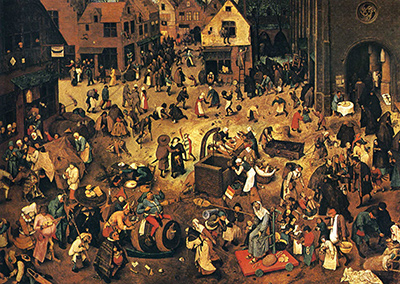
The Brussels years also saw works that resist easy category. The Tower of Babel turns a biblical story into a colossal study of architecture, labor, ambition and collapse. The Peasant Wedding brings viewers into a crowded interior without allowing the scene to become a simple anecdote. The Battle Between Carnival and Lent and related works build moral and social complexity through crowds rather than a single heroic center.
Late Paintings
Bruegel's fame today rests largely on the paintings of the 1560s, even though the print market had carried his name earlier. This late concentration is one of the remarkable facts of his career. About forty paintings are attributed to him today, and many of the most important were made in the final decade of his life [3]. The Kunsthistorisches Museum in Vienna holds the largest group, with twelve works in its collection, and the 2018 Vienna exhibition displayed an exceptional gathering of paintings, drawings and prints [4] [3].
The late paintings show Bruegel stretching inherited genres until they become new. In Netherlandish Proverbs, proverb imagery becomes a whole village of misread signs, inverted values and comic violence. In Children's Games, play becomes a dense social field, neither sentimental nor purely moralizing. In The Tower of Babel, a biblical warning becomes a monumental construction site filled with engineering, hierarchy, craft and futility. In Hunters in the Snow, landscape, weather and human movement become inseparable.
The style and technique questions are just as important as the subjects. Bruegel organized crowded scenes with extraordinary control. He could make dozens or hundreds of figures legible without reducing them to pattern. He used elevated viewpoints to hold vast spaces together, but he also planted tiny incidents that slow the eye. His paintings often place major meaning in the relation between parts: a group in the foreground and a distant town, a biblical episode and a broad landscape, a proverb and the larger foolishness of a community.
Technical research has deepened this understanding. The KHM's research project on its twelve Bruegel panel paintings used infrared photography, infrared reflectography, X-radiography, X-ray fluorescence and 3D mapping to study panel construction, materials, underdrawing and changes made during painting [5]. The findings show Bruegel not as an effortless recorder of pre-existing scenes but as a painter who revised, adjusted and built his images through decisions that can still be traced beneath the surface.
One late myth deserves particular caution: the idea that Bruegel's peasant pictures simply prove he was himself of peasant origin or that he painted rural people only from within their world. The Met calls that reputation misleading and emphasizes both his direct observation and sophisticated design [8]. The nickname "Peasant Bruegel" belongs to reception history, not to a complete account of the man. The peasant imagery needs to be read with patrons, humor, sympathy, distance and design all in view.
Family And The Brueghel Dynasty
Bruegel married Mayken Coecke in Brussels in 1563 [2]. Their sons were still children when he died: Pieter Brueghel the Younger was born in 1564, and Jan Brueghel the Elder in 1568 [2] [1]. Both became painters, and together they extended the family name into one of the most important artistic dynasties of the southern Netherlands.
The family story can create confusion because the names are so similar. Pieter Bruegel the Elder is the artist of the original sixteenth-century paintings and designs discussed here. Pieter Brueghel the Younger, his elder son, became closely associated with copies and versions after his father's works, helping satisfy demand for images that were already famous. Jan Brueghel the Elder developed a different career, admired for refined small-scale painting, flowers, landscapes, allegories and collaborations. The distinction is essential for readers navigating workshop copies and attribution.
The spelling difference is useful but not absolute in older material. Modern English usage normally writes the father as Bruegel and the sons as Brueghel. The KHM Bruegel 2018 biography notes the difference and the wider family variation [2]. A painting, print or catalogue entry with the name Brueghel may therefore belong to the family tradition rather than to the hand of Pieter Bruegel the Elder.
The sons' later careers also shaped the father's reputation. Copies, versions and prints kept compositions visible when autograph paintings were in private or princely collections. This helped Bruegel become familiar across Europe, but it also introduced attribution problems that still matter. Some works long associated with the father are now treated as copies, works after lost originals, uncertain attributions or family workshop productions. That is not a minor technicality. It changes what can safely be said about Bruegel's own hand, and it explains why modern museum records and technical studies are central to any serious biography.
Death And Early Reception
The tribute in Abraham Ortelius’s friendship album is a humanist’s judgement of a painter he knew. Its comparison with the ancient artist Apelles draws on Pliny and praises Bruegel’s ability to make a viewer imagine more than paint can show. That praise belongs to Ortelius. A different voice appears below Bruegel’s printed portrait of 1572, in verses written by Dominicus Lampsonius. The tangible settings of the two texts, a page in a friendship album and a portrait made for publication, help explain how praise of Bruegel reached different readers after his death [16] [17].
Bruegel died in Brussels in 1569 [1] [2] [8]. If he was born around 1525/30, he was probably in his early forties. The shortness of his life intensifies the concentration of the late paintings. Within little more than a decade, he moved from guild master and print designer to creator of some of the most ambitious panels in northern European art.
Early reception preserved admiration but also shaped legends. Van Mander's 1604 account is important because it shows that Bruegel's life and character had already become a subject of curiosity [2]. Abraham Ortelius, the Antwerp cartographer and humanist, also belongs to the early reception tradition, but quotations attributed to him need exact scholarly handling before they are repeated as public evidence. It is enough here to say that Bruegel was remembered within learned Antwerp circles as well as through the images themselves [8].
His posthumous reputation travelled through several channels. Paintings entered elite collections, especially Habsburg holdings. Prints after his designs continued to circulate. Family copies and later versions spread his compositions. Collectors, writers and artists responded to the density, humor and strangeness of the images. Over time, different Bruegels emerged: the peasant painter, the satirist, the Boschian fantasist, the landscape innovator, the observer of human folly, the maker of crowd scenes.
None of these afterlives is wholly wrong, but none is complete. Bruegel's art has remained alive partly because it resists one master key. Viewers can approach him through proverb, landscape, religious narrative, social comedy, print culture, family workshop history or technical making. His biography is therefore less a chain of private episodes than a set of contexts that clarify how the work became possible.
Modern Rediscovery And Technical Research
Modern Bruegel scholarship has changed the artist in two major ways. First, it has restored the importance of drawings and prints. Second, it has made attribution and technique more precise. The Met's 2001 publication, edited by Nadine M. Orenstein, accompanied a major exhibition devoted to Bruegel's drawings and prints and emphasized that his graphic work had been reassessed, with some drawings once accepted as autograph reassigned and other sheets added to the canon [9]. That kind of research makes the drawings page central rather than secondary.
KBR's Bruegel in black and white project made a similar public argument for the prints. Its exhibition gathered the library's complete collection of Bruegel prints and foregrounded the sixteenth-century print center of Flanders, the role of Hieronymus Cock, the process from preparatory drawing to printed image, and the importance of editions and states [10]. The accompanying catalogue, by Maarten Bassens, Joris Van Grieken, Dominique Allart and other contributors, treats Bruegel's engraved oeuvre as a major body of work with its own history of creation, interpretation and appreciation [11].
The KHM's technical project changed the paintings from within. Beginning in 2012 with Getty-supported research, conservators and scholars examined the museum's twelve Bruegel panel paintings using non-invasive methods [5]. The project studied supports, grounds, pigments, underdrawing, compositional changes, provenance and technique. The Inside Bruegel platform, launched in 2018, then made high-resolution technical imagery accessible to specialists and interested viewers [5].
This research matters for biography because it brings the artist back from legend to working practice. We can see that a figure was added after a painted ground was already advanced, that underdrawing shaped a composition, that panels and pigments have histories, that copies preserve or distort lost information. Bruegel's life may be sparsely documented, but his decisions survive in material form.
Technical study also encourages humility. The more closely experts look, the less useful broad certainty becomes. Attribution changes. Workshop relationships become clearer or more complicated. A famous image may turn out to be a copy after a lost original. A painting long read as a direct statement of belief may be better understood through patronage, print culture, proverb tradition, viewer expectation and material revision. The modern Bruegel is not less powerful than the old one. He is more precise.
Why The Biography Still Matters
A biography of Bruegel matters because his art is too easily separated from the conditions that made it possible. Without the Antwerp print market, his early fame looks mysterious. Without the Italian and Alpine journey, the landscapes lose part of their ambition. Without Brussels and elite patrons, the peasant scenes can be mistaken for simple folk realism. Without the family dynasty, copies and attributions become hard to untangle. Without modern technical research, the paintings appear more effortless and less experimental than they really are.
The biography also helps readers move through the works without forcing them into one explanation. Bruegel's paintings include biblical subjects, seasonal cycles, peasant festivities, moral allegories, landscapes and crowd scenes. His prints show how inventions could travel in black and white. His drawings preserve the movement between observation, design and reproduction. His major works, from The Harvesters to The Peasant Wedding, become richer when seen as part of a short, intense career shaped by cities, publishers, patrons, travel and family.
Comparison helps too, if it is used carefully. Bruegel learned from the northern tradition that includes Jan van Eyck and from the graphic possibilities opened by artists such as Albrecht Durer. He inherited and transformed the moral imagination associated with Hieronymus Bosch. But he is not merely a bridge between others. His art makes a world in which human beings are busy, foolish, comic, vulnerable, inventive and small beneath vast skies.
The surviving documents cannot tell us exactly what Bruegel believed as he painted. They cannot give a secure birthplace, a full apprenticeship record or a private diary of intentions. What they can give is a responsible frame: a professional artist active in Antwerp and Brussels, linked to print publishing and elite collecting, sharpened by travel, alert to older Netherlandish and Boschian traditions, and capable of transforming inherited forms into images that still make viewers look longer than they expected.
That may be the best reason to begin with biography. Bruegel's life is not a solved puzzle behind the pictures. It is a set of evidence, absences and contexts that teaches us how to look at the pictures with more patience.
Discussion
What feels most revealing about Pieter Bruegel the Elder: the village detail, the landscape setting, the moral wit, or the way everyday life becomes a complete world?
Reader Insights
Begin with one small action in a Bruegel scene, then follow how it connects to the surrounding figures, setting and rhythm of the whole image.
Connect the work to Northern Renaissance visual culture, printmaking, proverb traditions and Bruegel's interest in rural and urban life.
Which detail changes the interpretation most once you know the subject, date, proverb source or present collection?
Join the Conversation
Have a thought or observation about Pieter Bruegel the Elder? Share it below. Thoughtful responses may be added to this section as the Bruegel pages develop.
Frequently Asked Questions
Bruegel's biography begins with a warning: the most famous facts are often the least secure. The early seventeenth-century writer Karel van Mander, whose account appeared decades after Bruegel's death, remains an important early witness, but his anecdotes cannot be treated as direct documentary proof. [2]
References
- Kunsthistorisches Museum Vienna, "Pieter Bruegel the Elder.", View source.
- Kunsthistorisches Museum Vienna / Bruegel 2018, "Who is Pieter?", View source.
- Kunsthistorisches Museum Vienna / Bruegel 2018, "Once in a Lifetime.", View source.
- Kunsthistorisches Museum Vienna, "The Best of Bruegel: Only in Vienna.", View source.
- Kunsthistorisches Museum Vienna / Bruegel 2018, "Researching Bruegel.", View source.
- Kunsthistorisches Museum Vienna / Bruegel 2018, "Six Seasons for a Dining Room.", View source.
- The Metropolitan Museum of Art, "Pieter Bruegel the Elder, The Harvesters.", View source.
- Jacob Wisse, "Pieter Bruegel the Elder (ca. 1525-1569)," Heilbrunn Timeline of Art History, The Metropolitan Museum of Art, View source.
- Nadine M. Orenstein, ed., "Pieter Bruegel the Elder: Drawings and Prints," The Metropolitan Museum of Art, 2001, View source.
- KBR, "The World of Bruegel in Black and White.", View source.
- KBR General Catalogue, "Bruegel en noir et blanc / Bruegel in Black and White," KBR and Hannibal, 2019, View source.
- Museum Mayer van den Bergh, Bruegel en Antwerpen? De feiten, View source.
- Albertina, Die großen Fische fressen die kleinen, 1556, inv. 7875, View source.
- Metropolitan Museum of Art, Big Fish Eat Little Fish, engraved by Pieter van der Heyden, 1557, View source.
- Museum Mayer van den Bergh, Restoration Dulle Griet reveals unseen wealth of colour and fresh discoveries, View source.
- Cambridge University Library, The Album amicorum of Abraham Ortelius, Pembroke College MS LC.2.113, fol. 12v, View source.
- Rijksmuseum, Portret van Pieter Bruegel I, 1572, View source.







