


 by Tom Gurney
Tom Gurney BSc (Hons) is an art history expert with over 20 years experience
Published on June 19, 2020 / Updated on August 16, 2026
Email: tomgurney1@gmail.com / Phone: +44 7429 011000
Pieter Bruegel the Elder Paintings: Introduction
Pieter Bruegel the Elder's paintings survive in small number but enormous range. About forty paintings by him have come down to us, and that scarcity is part of what makes each accepted work matter so much [1] [6]. In those few pictures, Bruegel remade the possibilities of Northern Renaissance painting: landscape became a system of weather and labor, crowds became moral structures, proverbs became bodies, biblical events entered Netherlandish villages, and peasant life became one of the most searching subjects in European art.
This overview is a guide to the painted oeuvre rather than a full catalogue. It gathers the main subjects, museums, cautions and starting points for readers moving through Pieter Bruegel the Elder and the major artwork pages. For life and career, begin with the Pieter Bruegel biography. For the way the paintings are built, see style and technique. For major interpretive themes, continue to landscapes and seasons, proverbs and iconography, peasant imagery and workshop copies and attribution.
At a Glance
- Surviving paintingsAbout forty are generally cited as surviving works by Pieter Bruegel the Elder [1] [6]
- Largest holdingKunsthistorisches Museum Vienna, with twelve paintings by Bruegel [1] [3]
- Major concentrationThe 1560s, especially after Bruegel's move to Brussels in 1563 [2]
- Key patronNiclaes Jongelinck, associated with the six-part seasons cycle [4]
- Main painted fieldsLandscapes, seasons, crowds, proverbs, peasant subjects, biblical subjects, moral catastrophe and architectural ambition
- Key works to startThe Harvesters, Hunters in the Snow, The Tower of Babel, Children's Games, Netherlandish Proverbs, Peasant Wedding and The Triumph of Death
- Main cautionBruegel's name is attached to originals, copies, workshop-related works, family repetitions and paintings with debated attribution
Contents
- Introduction
- Surviving Paintings And Rarity
- Major Collections
- The 1560s Concentration
- Landscapes And Seasons
- Proverb And Crowd Paintings
- Peasant And Biblical Images
- Technique And Panels
- Attribution And Copies
- Where To Start








Surviving Paintings And Rarity
Bruegel is one of the most famous painters in European art, yet the painted body of work attached to his own hand is unusually compact. Both the Kunsthistorisches Museum in Vienna and the Royal Museums of Fine Arts of Belgium describe the surviving paintings as numbering about forty [1] [6]. That figure should shape how the paintings are approached. Bruegel's reputation rests not on hundreds of canvases but on a small group of highly concentrated works, many of them dated within a brief final decade.
The scarcity is sharpened by the fact that Bruegel was also a major designer of prints and drawings. His fame in the sixteenth century moved through graphic art as well as through paintings. The painted works were rarer objects, usually made for collectors, patrons and elite settings. They therefore carry several histories at once: the history of Bruegel's invention, the history of private ownership, the history of later collecting, and the history of copying after his death.
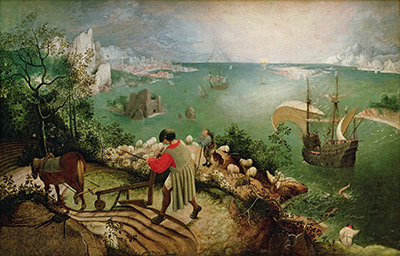
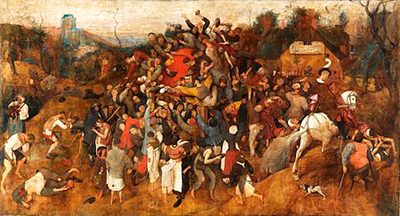
This is why a paintings overview has to balance excitement with caution. The Harvesters and Hunters in the Snow are secure anchors in the 1565 seasons cycle. The Triumph of Death is recorded by the Prado as a 1562-63 oil on panel [7]. The Prado's Wine of Saint Martin's Day is a rarer case: a large glue-size work on twill canvas, dated 1566-67, that entered the museum after rediscovery and study [8]. Other famous Bruegel subjects, such as Landscape with the Fall of Icarus, require more careful wording because attribution and version questions are part of their modern identity.
The small number of surviving paintings also means that lost works matter. Bruegel's 1565 seasons cycle originally consisted of six large panels, but only five survive [4]. The lost spring panel reminds viewers that the known oeuvre is not identical with everything Bruegel made. Survival has shaped the artist we now see.
Major Collections
Vienna is the central place for Bruegel's paintings. The Kunsthistorisches Museum holds twelve works by him and describes that group as the world's largest and most important collection of paintings by Pieter Bruegel the Elder [1]. This concentration includes many of the works through which visitors first learn the artist: The Tower of Babel, Hunters in the Snow, Children's Games and Peasant Wedding. The museum's 2018-19 Bruegel exhibition displayed 29 paintings, roughly three-quarters of the surviving painted oeuvre, which shows how exceptional such a gathering was [1].
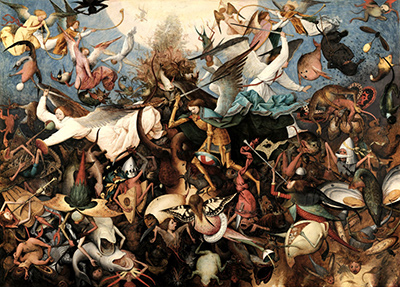
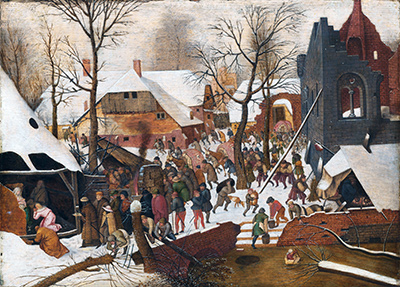
Brussels is another essential center. The Royal Museums of Fine Arts of Belgium describe their Bruegel holdings as the second-largest painting collection after Vienna [6]. Their group includes Fall of the Rebel Angels, Census at Bethlehem, Winter Landscape with a Bird Trap and works or questions associated with Icarus [6]. Brussels matters not only because of quantity but because several works there sit close to important questions of demonology, winter imagery, biblical modernizing and attribution.
New York, Madrid and Rotterdam also hold key paintings. The Metropolitan Museum of Art owns The Harvesters, a 1565 oil on oak panel from the seasons cycle and one of the clearest entrances into Bruegel's landscape art [5]. The Prado owns The Triumph of Death and Wine of Saint Martin's Day, two very different works that show the dark catastrophic and large festive sides of the artist [7] [8]. Museum Boijmans Van Beuningen owns the smaller Little Tower of Babel, listed as a circa 1568 oil on panel measuring 74.6 by 59.9 centimeters [9].
These holdings are not interchangeable. A visitor who sees Vienna receives an unusually broad Bruegel experience in one place. A reader comparing Vienna, Brussels, New York, Madrid and Rotterdam begins to see how dispersed the oeuvre is, and how much modern Bruegel study depends on museums preserving, researching and describing individual objects with precision.
The 1560s Concentration
Bruegel's painted achievement is heavily concentrated in the 1560s. The Kunsthistorisches Museum describes his early career as rooted in drawing and print design, with paintings becoming increasingly important after his return from Italy and his work in Antwerp [2]. In 1563 he moved to Brussels and married Mayken Coecke, the daughter of Pieter Coecke van Aelst and Mayken Verhulst, figures associated with his artistic formation [2]. The years that followed include some of the most famous paintings in the Bruegel canon.
This late concentration matters because Bruegel died in 1569, at about forty years old [2]. The familiar paintings are therefore not the product of a long old age. They belong to a short, intense career in which graphic invention, landscape memory, Antwerp print culture, Brussels patronage and learned social observation came together.
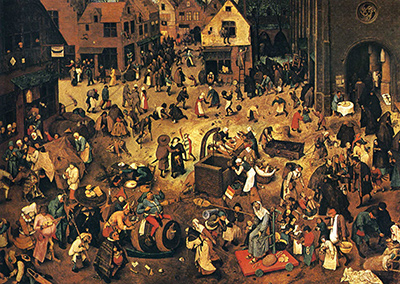
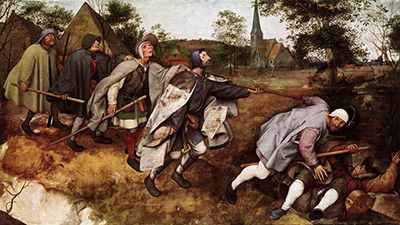
The decade begins with crowded moral and social pictures such as The Fight Between Carnival and Lent, Netherlandish Proverbs and Children's Games. It includes moral catastrophe in The Triumph of Death, ambitious biblical and architectural invention in The Tower of Babel, and the extraordinary landscape cycle of 1565. It ends with late peasant and biblical works, including Peasant Wedding and The Blind Leading the Blind.
The point is not that every painting says the same thing. It is that the 1560s show Bruegel testing how many kinds of experience a painting could hold. A town square can become a moral map. A field can become a seasonal world. A peasant feast can become a study of ceremony, hunger and social looking. A biblical event can happen in a Flemish village. A tower can become a political and theological machine. That range, achieved in so few years, is one reason Bruegel's paintings feel inexhaustible.
Landscapes And Seasons
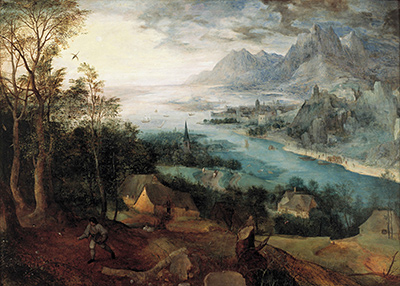
Bruegel's landscapes are among his greatest inventions. They are not passive backgrounds behind human stories. They organize the action, set the emotional weather and show human beings inside systems larger than themselves. The landscapes and seasons page follows this subject in depth, but the paintings overview begins with the 1565 seasons cycle.
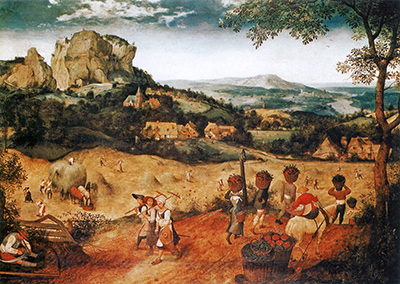
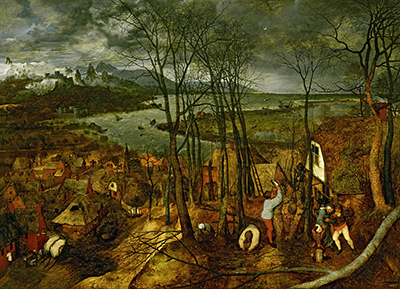
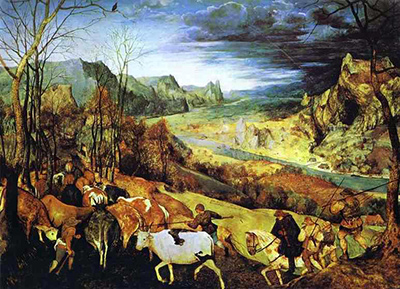
The cycle was made for the country house of the Antwerp merchant and collector Niclaes Jongelinck, probably for a dining room [4]. It originally consisted of six large panel paintings, corresponding to a six-part division of the year in the sixteenth-century Low Countries. Five survive: The Gloomy Day, Haymaking, The Harvesters, The Return of the Herd and Hunters in the Snow. Spring is lost [4].
The surviving panels show Bruegel's ability to make season visible through work, air, appetite and movement. The Met describes The Harvesters as late summer, with laborers cutting wheat, gathering apples and resting in the shade; it identifies the work as oil on oak and Public Domain in the museum collection [5]. Hunters in the Snow turns winter into a whole visual climate: tired hunters, thin dogs, dark trees, white hills, skaters below and distant mountains all contribute to the feeling of cold.
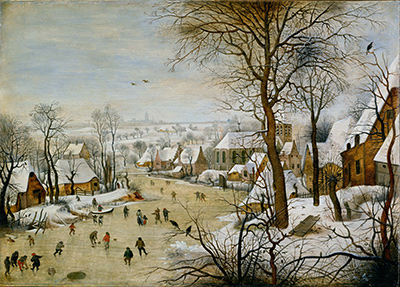
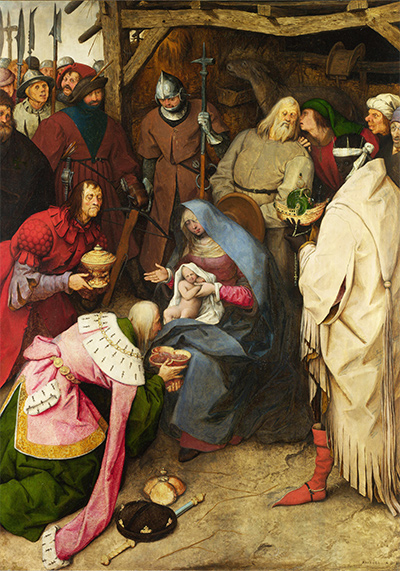
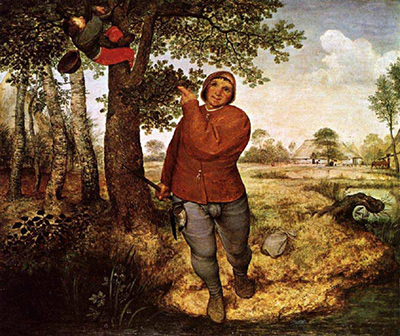
Other winter paintings expand this landscape imagination. Census at Bethlehem places a biblical subject within a snowy Netherlandish village, making sacred history pass through ordinary winter life. Winter Landscape with a Bird Trap is essential for thinking about winter, skating, danger and repetition, but it also needs object-by-object caution because the composition became highly popular in copies and versions.
Bruegel's landscapes ask viewers to move across the surface. The eye travels down roads, over frozen ponds, through fields and across distant horizons. Human beings are small, but not trivial. Their smallness is the point: work, play, hunger, travel and survival all take place inside a world that exceeds them.
Watch Bruegel’s art
Explore Bruegel with TheHistoryOfArt and artwork discussions from Smarthistory.
Pieter BRUEGEL Explained in 10 Minutes (updated)
A TheHistoryOfArt film about Bruegel.
Watch on YouTubeProverb And Crowd Paintings
Bruegel's crowd paintings are not just busy. They are structured fields of attention. A viewer can read them from far away as strong designs, then move closer and discover dozens of incidents that change the meaning of the whole. This distributed way of making meaning is central to proverbs and iconography.
Netherlandish Proverbs is the clearest example. Instead of presenting one moral emblem, Bruegel fills a village with sayings turned into behavior. Folly becomes architectural, bodily and social. The painting asks the viewer to decode actions, but it also makes a larger argument: foolishness is not isolated in one person. It spreads across the world.
Children's Games works in a related but distinct way. The KHM describes a town square seen from above, filled with more than 230 children and many different games [1]. The picture is delightful, but it is also strange. The children are serious about play, and the repetition of their actions begins to resemble adult social ritual. Bruegel makes childhood lively without making it simple.
The Fight Between Carnival and Lent places collective behavior inside a seasonal and moral contest. Carnival and Lent become opposing social energies, surrounded by food, poverty, performance, ritual and spectatorship. The painting is funny at the level of detail, but its power comes from the way the entire square becomes a contested world.
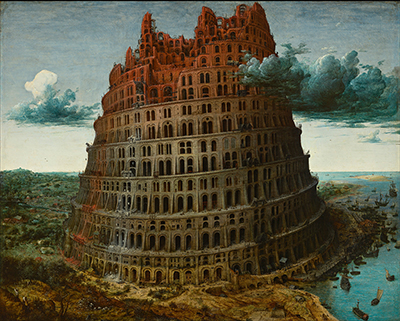
The Tower of Babel belongs here too, even though it is not a proverb painting in the same sense. It is a crowd image organized around architecture. Builders, rulers, workers, tools, scaffolds and masonry all participate in a monumental project that seems both brilliant and unstable. The smaller Rotterdam version, Little Tower of Babel, compresses that theme into a different scale; Boijmans records it as a circa 1568 oil on panel [9].
Peasant And Biblical Images
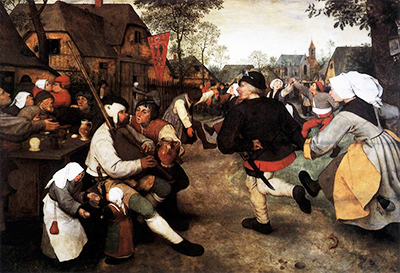
Bruegel's peasant subjects have often shaped his popular image, but they should not be treated as simple scenes of rustic charm. They are highly organized paintings made for viewers outside the peasant world they depict. The page on peasant imagery is the best place to follow that tension: observation, comedy, social distance, appetite and dignity all operate together.
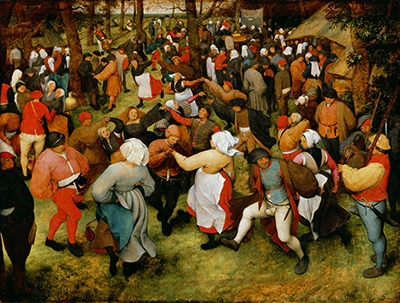
Peasant Wedding is a key late painting. The scene appears immediate, with food carried in on a door, guests gathered in a barn and the bride seated before a green cloth, but its apparent informality is carefully composed [1]. Bruegel gives the event bodily weight. Food is heavy, servers lean, guests crowd, and the ceremony becomes a study of rural society seen from near and far at once.
The Harvesters is also a peasant image, though it belongs first to the seasons cycle. The Met notes its sympathetic yet idealized view of rural workers [5]. That balance is crucial. Bruegel observes labor and rest with unusual force, but the painting is not neutral field reporting. It was made for a wealthy urban patron and transforms agricultural work into a broad, harmonious seasonal vision.
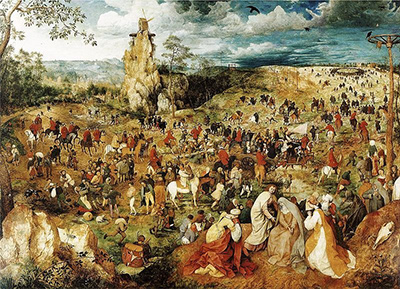
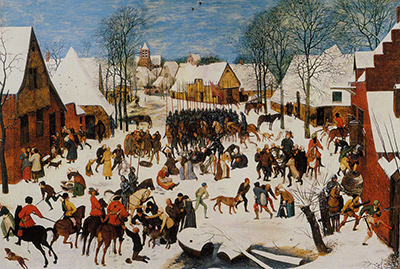
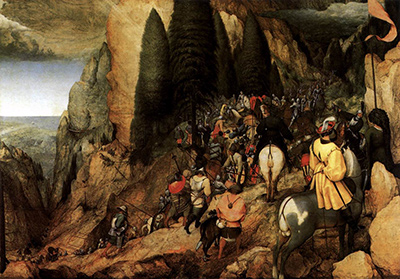
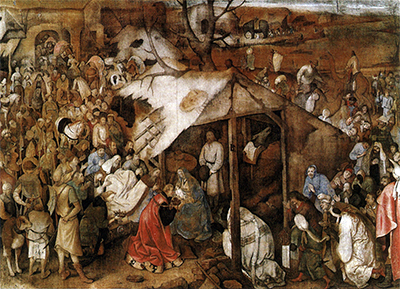
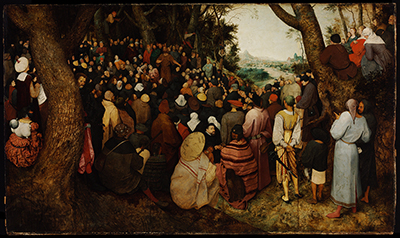
Biblical paintings show a similar transformation of subject. Bruegel often moves sacred history into the visible world of the sixteenth-century Low Countries. Census at Bethlehem turns a biblical episode into village administration under snow. Massacre of the Innocents brings violence into a Netherlandish winter setting and exists amid important version and copy distinctions. The Procession to Calvary places Christ's route to execution inside a vast crowd and landscape, making the central sacred event almost swallowed by human movement.
The Blind Leading the Blind stands near proverb, biblical warning and late figure painting at once. Its subject is sharply legible, but its emotional force comes from rhythm: bodies tipping in sequence, a path turning disastrous, and an image of error becoming physical.
Technique And Panels
Bruegel's paintings reward close looking because they are physically and compositionally exact. The KHM's research project began in 2012 with support from the Getty Foundation and examined the museum's twelve Bruegel panel paintings through non-invasive methods including infrared photography, infrared reflectography, X-ray imaging, X-ray fluorescence and 3D mapping [3]. These tools help reveal panel construction, underdrawing, pigments, changes and the way Bruegel adjusted compositions while working.
This research matters for general viewers because Bruegel's pictures can seem effortless. They are full of movement, weather, crowds and tiny actions, but their readability depends on discipline. Paths guide the eye. Figure groups are placed with care. Large tonal areas keep busy scenes from becoming chaos. In the seasons cycle, landscape space is both believable and organized. In proverb and crowd paintings, the surface is crowded but not random.
Panel painting is central to this story. The KHM research focused on twelve panel paintings, and many major Bruegel works are oils on oak [3] [5]. A panel is a made object before it is an image: wood, joins, ground, drawing and paint layers all condition how the picture survives and how it can be studied. The Prado's Wine of Saint Martin's Day is an important exception to the usual panel pattern, recorded as glue-size on twill canvas [8].
Close study also helps viewers understand Bruegel's revisions. The KHM notes that technical imaging revealed changes made when some paintings were already far advanced [3]. That kind of evidence makes the paintings feel more alive as acts of making. Bruegel did not simply fill a predetermined outline with detail. He built, tested and adjusted complex worlds.
Attribution And Copies
The panels in Vienna and Rotterdam demonstrate how much a collection label can condense. Vienna’s accession 1026 is a large oak panel with a dated signature on a stone in the foreground. Rotterdam 2443 is smaller and undated. The KHM exhibition’s comparison discusses early changes revealed by X-ray in the smaller panel, and Boijmans gives an approximate date around 1568. The two works share the name The Tower of Babel, so a date or attribution encountered without its collection can easily be attached to the wrong image. Read the number and institution first, then compare the materials, scale and painted evidence [10] [9].
The same principle helps when moving between museums. The Royal Collection’s Massacre of the Innocents retains much of an early overpaint, which can make scenes of looting more apparent than the events described in the Gospel. Another version may show more of the biblical action and still belong to another painter. The museum history of each piece matters as much as whether a familiar composition appears in the catalogue [11].
Attribution is part of looking at Bruegel responsibly. His sons Pieter Brueghel the Younger and Jan Brueghel the Elder became painters after his death, and the family name remained powerful [2]. Pieter Brueghel the Younger in particular is closely associated with copies and repetitions after his father's compositions. Some later works are historically valuable because they show demand for Bruegel's inventions, but they are not the same thing as paintings by Pieter Bruegel the Elder himself.
The page on workshop copies and attribution is therefore essential. A title associated with Bruegel can point to several different realities: an accepted autograph work, a copy after a lost original, a family workshop version, a later repetition, or a painting whose status remains debated. The distinction affects date, technique, interpretation and even the way a viewer should describe what is being seen.
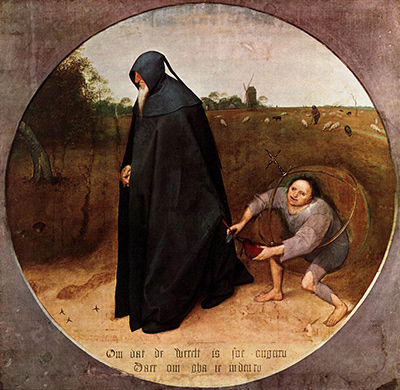
Landscape with the Fall of Icarus is one of the most important cautionary cases. It is famous as a Bruegel image, but the Brussels painting has long required careful attribution language. Winter Landscape with a Bird Trap also needs attention because the composition became Bruegel's most-copied winter subject in later tradition [6]. Massacre of the Innocents likewise appears across important versions and copies, so object records should not be collapsed into one simple statement.
The Prado's Wine of Saint Martin's Day shows the other side of the problem: a work may move from obscurity into the accepted painted oeuvre after technical and scholarly study. The Prado records the painting as practically unknown before modern study, with attribution confirmed after examination and restoration, leading to acquisition [8]. That history is a reminder that Bruegel's painted oeuvre is small, but the study of it remains active.
Where To Start
Start with The Harvesters and Hunters in the Snow if you want Bruegel's landscape art at full strength. Together they show heat and cold, labor and return, abundance and fatigue, human activity and the scale of the natural world.
Then move to The Tower of Babel and Little Tower of Babel for architecture, ambition and collective work. The pair also shows why scale and version matter: related subjects can operate differently when size, setting and object history change.
For Bruegel's crowd intelligence, compare Netherlandish Proverbs, Children's Games and The Fight Between Carnival and Lent. These paintings train the eye to search a whole surface, not just a center.
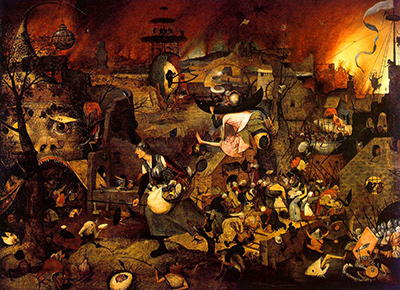
For rural ceremony and biblical life in Netherlandish settings, continue to Peasant Wedding, Census at Bethlehem, The Procession to Calvary and Massacre of the Innocents. For darkness and moral catastrophe, go to The Triumph of Death, then set it beside Fall of the Rebel Angels and Wine of Saint Martin's Day to see how wide Bruegel's painted imagination can become.
Finally, keep the support pages nearby. The biography explains the career. Style and technique explains how the paintings are built. Landscapes and seasons follows the cycle and winter scenes. Proverbs and iconography helps decode the moral and comic language. Peasant imagery handles rural subjects with the needed social care. Workshop copies and attribution keeps the Bruegel name from becoming too simple.
Discussion
What feels most revealing about Pieter Bruegel the Elder: the village detail, the landscape setting, the moral wit, or the way everyday life becomes a complete world?
Reader Insights
Begin with one small action in a Bruegel scene, then follow how it connects to the surrounding figures, setting and rhythm of the whole image.
Connect the work to Northern Renaissance visual culture, printmaking, proverb traditions and Bruegel's interest in rural and urban life.
Which detail changes the interpretation most once you know the subject, date, proverb source or present collection?
Join the Conversation
Have a thought or observation about Pieter Bruegel the Elder? Share it below. Thoughtful responses may be added to this section as the Bruegel pages develop.
Frequently Asked Questions
References
- Kunsthistorisches Museum, The Best of Bruegel - Only in Vienna, View source.
- Kunsthistorisches Museum, Pieter Bruegel the Elder, View source.
- Kunsthistorisches Museum, Researching Bruegel, View source.
- Kunsthistorisches Museum, Six Seasons for a Dining Room, View source.
- The Metropolitan Museum of Art, The Harvesters, View source.
- Royal Museums of Fine Arts of Belgium, Bruegel: The Originals, View source.
- Museo Nacional del Prado, The Triumph of Death, View source.
- Museo Nacional del Prado, The Wine of Saint Martin's Day, View source.
- Museum Boijmans Van Beuningen, The Tower of Babel, View source.
- Kunsthistorisches Museum Vienna, Der Turmbau zu Babel, 2018 exhibition comparison, View source.
- Royal Collection Trust, Massacre of the Innocents, RCIN 405787, View source.