


 by Tom Gurney
Tom Gurney BSc (Hons) is an art history expert with over 20 years experience
Published on June 19, 2020 / Updated on October 14, 2023
Email: tomgurney1@gmail.com / Phone: +44 7429 011000
Landscape with the Flight into Egypt: Introduction
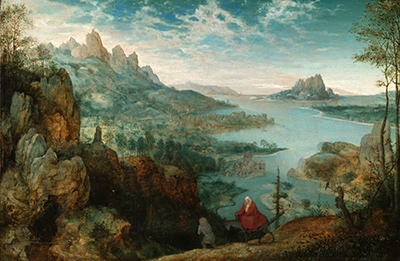
Pieter Bruegel the Elder’s Landscape with the Flight into Egypt is a signed and dated oil painting of 1563 in the Courtauld Gallery, London. Mary rides a donkey along a path near the bottom of the panel, with Joseph on foot ahead of her. Beyond them, a river turns among rocky outcrops, fields, trees and settlements. Much of the painting can be seen before its subject is discovered. Once the family is in view, the broad landscape gives a scale to the distance they have to travel [1] [2].
This work across Bruegel’s career
Tower of Babel
1563The Harvesters
1565Peasant Wedding
1568Children's Games
1560Triumph of Death
1562–1563Landscape with the Flight into Egypt
This artworkContents
- Introduction
- The Travellers on the Near Path
- Crossing the Rocks and Looking Down
- The River and the Distant Settlements
- The Courtauld Panel and the Printed Flight
- Annotated Details
The Travellers on the Near Path
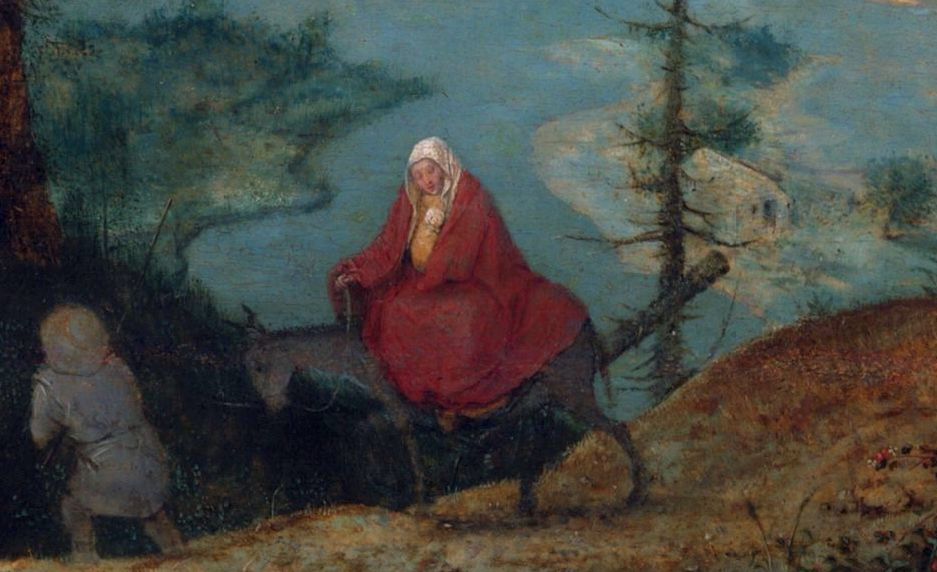
Begin with the red of Mary’s garment. It sits near the lower middle of the picture, sharply distinct from the cooler water and the dark vegetation behind the donkey. A small pale shape at her chest marks the child she carries. The red area is much more easily found than the child, and it gives the viewer a place to look for details that might otherwise be hard to distinguish. Bruegel could give the family a conspicuous point of colour while keeping them small in relation to the land.
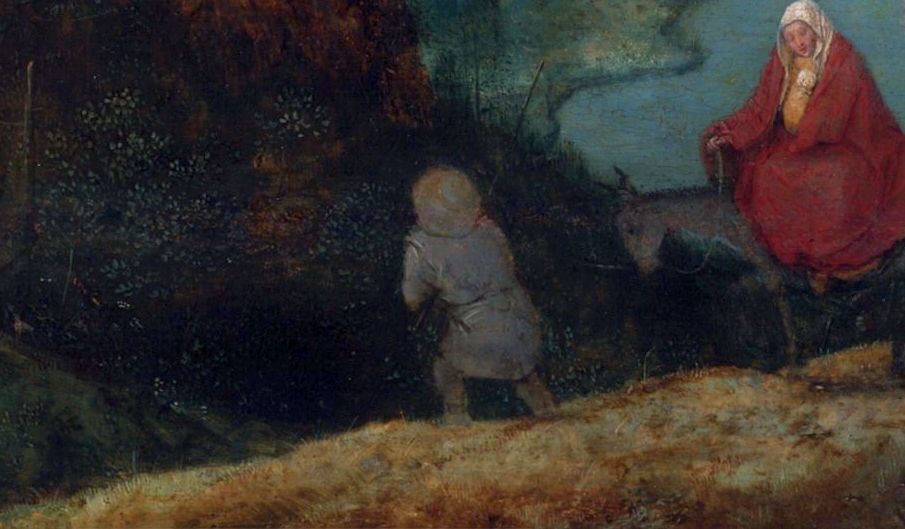
Joseph walks just ahead, in clothes much closer in tone to the surrounding rock and earth. His position against the dark ground makes him less immediately visible. Follow the route down and towards the left to see how the two figures are connected. The path turns, disappears among dark forms and can be picked up again farther along the foreground. It has intervals where bodies and feet appear clearly and others where a traveller might pass out of view. That pattern makes the terrain part of what the family must negotiate.
Matthew’s Gospel recounts Joseph being warned in a dream to take the child and his mother to Egypt because Herod is seeking the child. Joseph sets out with them. Bruegel chooses the journey as the moment to paint. The rocks, slopes and crossings help to give the flight a physical character beyond what the biblical passage needs to describe. The family is recognisable in the action of going somewhere, while the landscape puts much more ground in front of them than they can cross within our view [3] [1].
Annotated Details from Landscape with the Flight into Egypt
Find the Holy Family along the lower edge before looking out over the river valley.
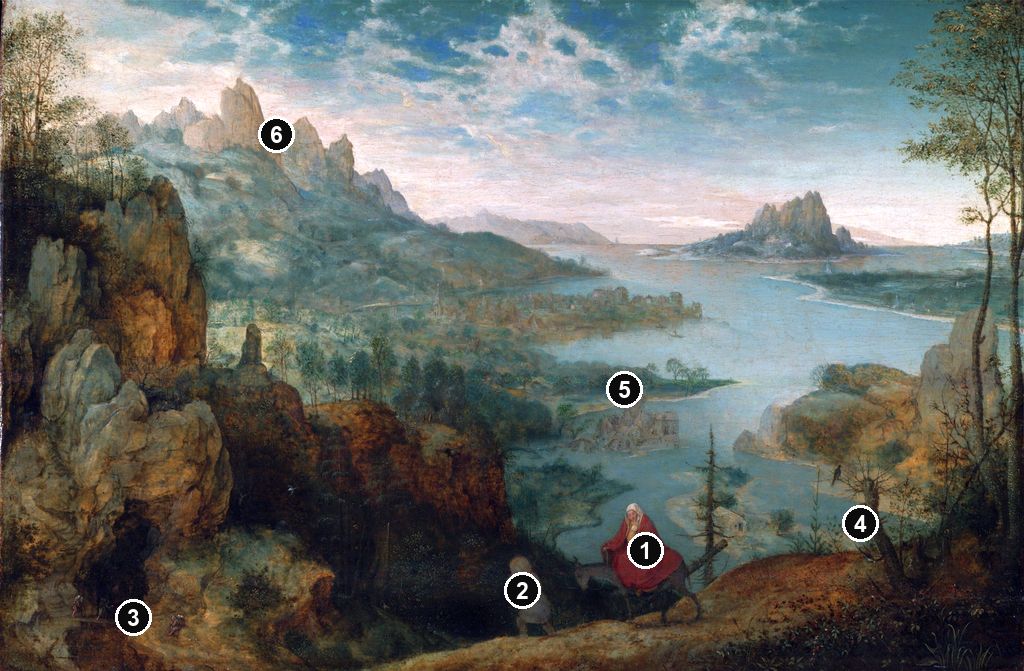
Details from LANDSCAPE WITH THE FLIGHT INTO EGYPT
Six details trace the figures, the difficult foreground and the country ahead.
Mary and the child
Mary’s red garment picks out the rider and helps locate the child she carries.
Joseph on the path
Joseph walks ahead where the path passes into darker ground.
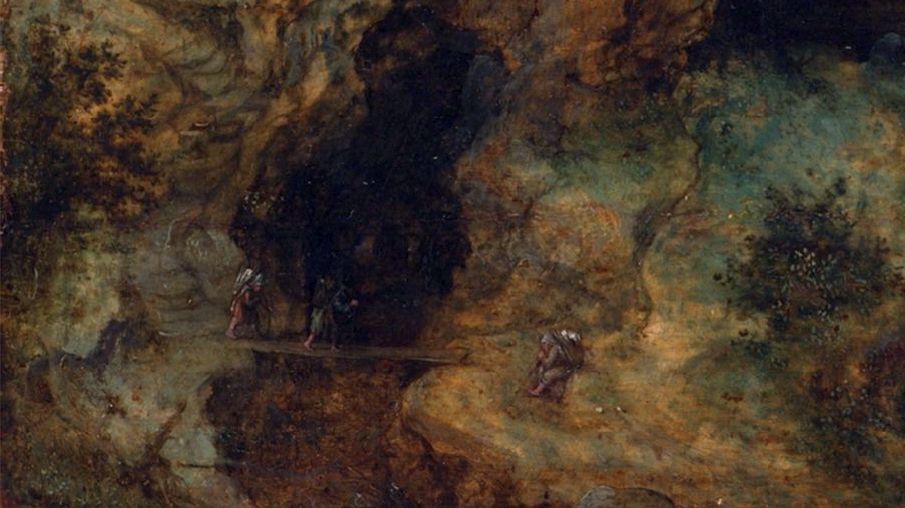
The small bridge
The Courtauld identifies three men crossing the precipice at the left.
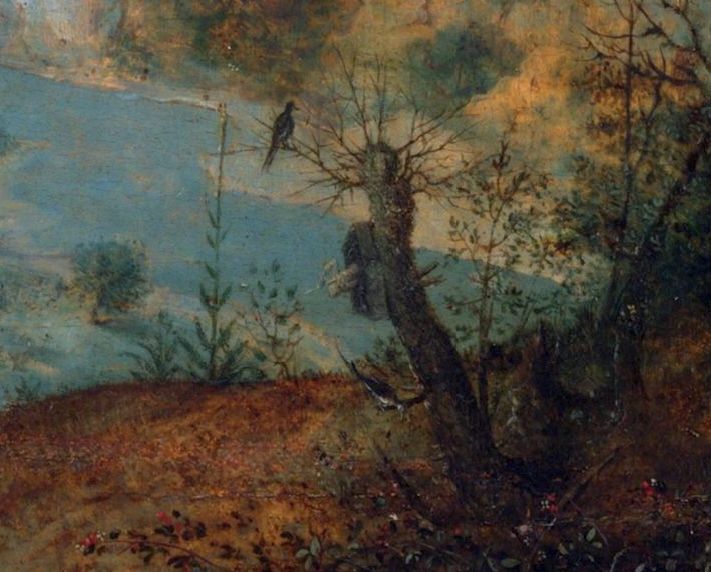
The shrine at the right
The Courtauld identifies a small idol falling from a shrine on this dead trunk.
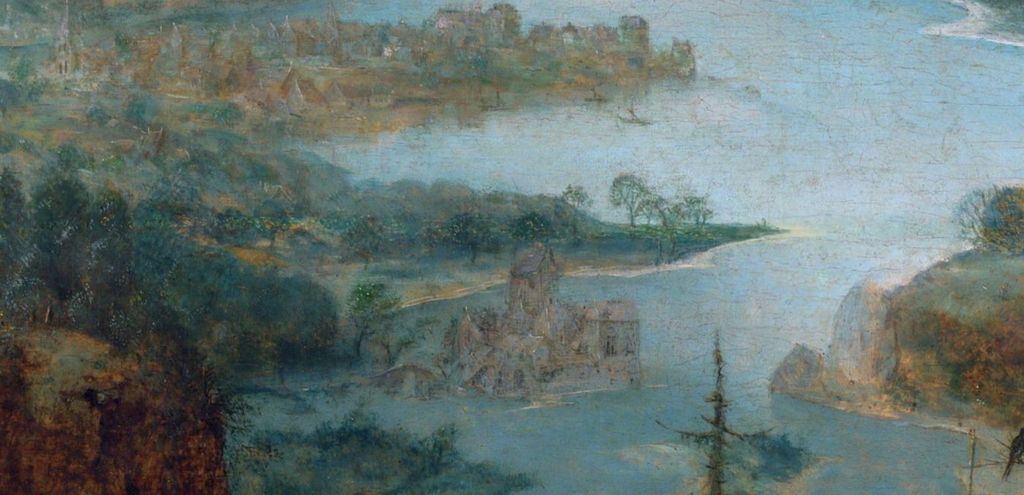
The river and settlements
Buildings nestle near the water, and the pale river links parts of the valley.
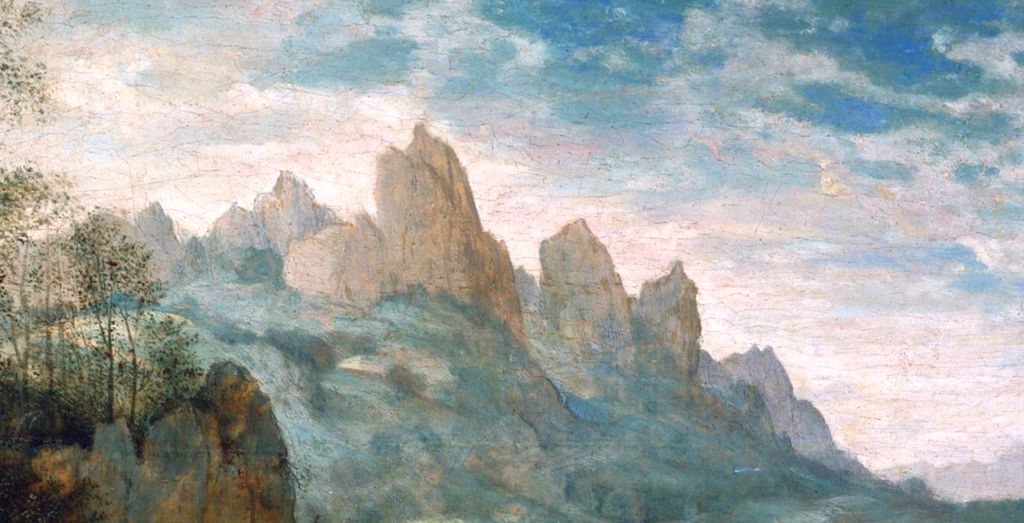
The mountain peaks
Cooler tones carry the eye away from the darker rock at the front.
Pieter Bruegel the Elder, Landscape with the Flight into Egypt, 1563, oil on panel. The Courtauld, London, Princes Gate Bequest, P.1978.PG.47. Courtauld reproduction via Wikimedia Commons.
Crossing the Rocks and Looking Down
The Courtauld points out three men at the left crossing a precipice on a small bridge. Find them below the tall mass of rock, in one of the least brightly coloured areas of the foreground. A crossing has to fit between the rock walls rather than follow the wider line of the valley. Its small scale gives a way to judge the drop beneath the ledge. Finding the men after finding the family makes their journey seem more difficult even though they occupy separate parts of the picture [1] [2].
The large rock above them also directs the way the landscape is seen. Its nearer face has warm and dark passages. Farther up the valley the rock rises in a series of pointed forms that become lighter and cooler as they recede. The foreground outcrop is close enough to interrupt much of the view at the left, while the distant peaks give it an upper edge. Looking from one to the other joins two scales of terrain without losing the narrow route close to the viewer.
At the right, a thin trunk helps frame the river. The Courtauld identifies a small idol falling from a shrine on a dead tree trunk in that part of the picture and describes it as a sign of the end of pagan worship. It is a much smaller detail than the figures with whom the title identifies the scene. The biblical passage describes the departure, while the falling figure belongs to a further tradition about the journey. Looking closely at the tree makes a new layer of the story visible without changing the family’s small place in the landscape [2] [3].
The River and the Distant Settlements
The river basin becomes particularly clear once the dark trees at the front have been established. A pale blue sweep passes through the middle and turns around land that projects into it. Buildings sit close to the water at more than one distance. The near settlement can be examined as a group of roofs and walls, while those farther away form a lower, less distinct strip. Bruegel gives the water enough width to connect these places while making the land between them look difficult to traverse on foot.
In the distance, a rocky mass at the right stands away from the larger slope at the left. Between them, stretches of water and land approach the light on the horizon. Above the whole valley, the sky holds cooler blue and pale cloud with several degrees of brightness. It is possible to look out so far that the travellers are momentarily forgotten. Coming back to the folds of Mary’s garment then restores the difference between the small group we can follow and the country spread out ahead of them.
The Courtauld Panel and the Printed Flight
The Courtauld records a panel measuring 37.1 by 55.6 centimetres and gives it the accession P.1978.PG.47. Its provenance notes a probable connection with Cardinal Antoine Perrenot de Granvelle, including a possible reference in the inventory of his heirs, and records it in Peter Paul Rubens’s estate inventory in 1640. The Courtauld’s account allows for a commission from Granvelle. The documented passage through collections answers a different question from who first asked the painter to make it [1] [2].
The Courtauld’s record traces the painting to Antoine Seilern, who bought it at auction in 1939. It came to the gallery in 1978 with the Princes Gate Bequest. These later records let the same small landscape be followed from private ownership into a public collection [1].
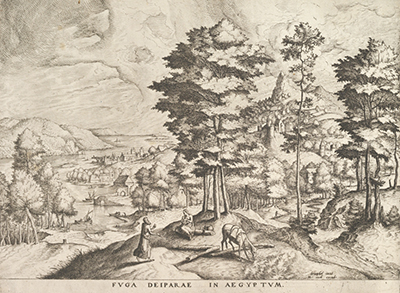
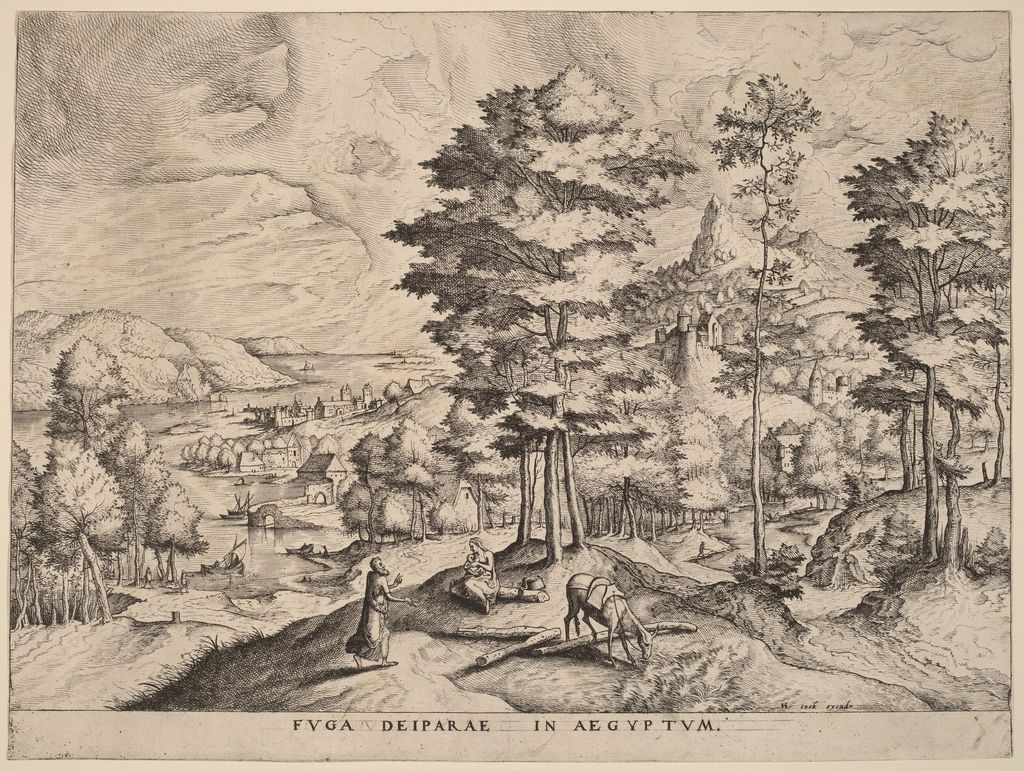
The comparison below shows The Flight into Egypt from the Large Landscapes, in the National Gallery of Art’s impression 1964.8.6. In the print Mary sits on the ground and the donkey grazes. The Courtauld figures are travelling along a different route in a different composition. The print is the work of Johannes and Lucas van Doetecum, published by Hieronymus Cock. The National Gallery of Art catalogues the design as after Bruegel, while the 2001 exhibition catalogue questions that attribution. These separate records matter because a matching biblical title can refer to very different objects [4] [5].
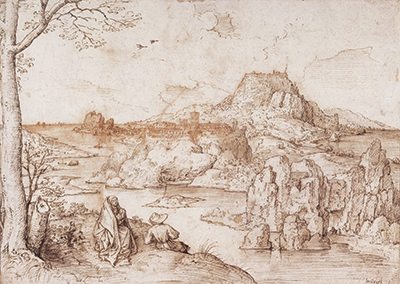
The separate Berlin drawing of the Rest on the Flight into Egypt also illustrates a pause. Its tree and foreground give the figures somewhere to sit and let the eye travel out into the valley. In the Courtauld picture the nearest marks of the journey are the placement of Joseph a little ahead and the diagonal of the bank below the donkey. Return to that bank after comparing the rest scenes. It gives the family a short route across the painting and makes it possible to imagine the much longer one beyond it [5] [1].
Discussion
Which detail in this work most changes how you read it?
Frequently Asked Questions
The Courtauld records a panel measuring 37.1 by 55.6 centimetres and gives it the accession P.1978.PG.47. Its provenance notes a probable connection with Cardinal Antoine Perrenot de Granvelle, including a possible reference in the inventory of his heirs, and records it in Peter Paul Rubens’s estate inventory in 1640. [1][2]
References
- Courtauld Gallery, Landscape with the Flight into Egypt, P.1978.PG.47, View source.
- The Courtauld, Landscape with the Flight into Egypt, collection interpretation, View source.
- United States Conference of Catholic Bishops, Matthew 2:13–15, View source.
- National Gallery of Art, The Flight into Egypt, 1964.8.6, View source.
- Nadine M. Orenstein, ed., Pieter Bruegel the Elder, Drawings and Prints, 2001, nos. 20 and 33, View source.







