



 by Tom Gurney
Tom Gurney BSc (Hons) is an art history expert with over 20 years experience
Published on June 19, 2020 / Updated on August 16, 2026
Email: tomgurney1@gmail.com / Phone: +44 7429 011000
The Harvesters by Pieter Bruegel the Elder: Introduction
Pieter Bruegel the Elder's The Harvesters is one of the great paintings of late summer. Wheat fills the foreground like a golden wall, workers cut and bind the crop, people rest beneath a tree, and the eye travels outward to orchards, paths, houses, water, hills and sky. The scene looks natural because Bruegel makes it feel inhabited at every scale. Yet it is also carefully built: a large panel painting made in 1565 for an urban patron, part of a cycle that turned the rural year into a sequence of monumental landscapes.
The Metropolitan Museum of Art identifies The Harvesters as a 1565 oil on oak by Pieter Bruegel the Elder, now in New York as object 19.164 [1]. The Met describes the season as July or August, when harvesting is underway: workers scythe wheat, gather apples and rest in the shade [1]. The Kunsthistorisches Museum Vienna places the painting within Bruegel's six-part Seasons cycle, made for the country house of the Antwerp merchant and collector Niclaes Jongelinck, probably for a dining room [3].
That setting matters. The Harvesters is not a neutral report from the fields. It is a painted world in which labor, appetite, rest and distance have been organized for looking. Bruegel gives rural workers unusual dignity and presence, but he also softens the harshness of agricultural work. The result is not simple realism or simple nostalgia. It is a sophisticated landscape painting in which the abundance of the season, the rhythms of work and the pleasures of viewing all meet.
At a Glance
- ArtistPieter Bruegel the Elder.
- Date1565.
- Mediumoil on oak.
- Dimensions119 × 162 cm overall. The original painted surface measures 116.5 × 159.5 cm [1].
- CollectionThe Metropolitan Museum of Art, New York.
- Credit lineRogers Fund, 1919.
- Object number19.164.
- Current displayGallery 638 at The Met Fifth Avenue.
- Seasonlate summer, usually read as July or August.
- Cycleone surviving panel from Bruegel's six-part Seasons series.
- Image statusthe Met marks the object image Public Domain and provides Open Access collection resources [1].
This work across Bruegel’s career
Tower of Babel
1563The Harvesters
1565Peasant Wedding
1568Children's Games
1560Triumph of Death
1562–1563Contents
- Introduction
- What The Painting Shows
- The Place In The Seasons
- Harvest, Rest And Food
- Landscape And Distance
- Patronage And Idealization
- Bruegel And Secular Landscape
- Relations Within The Cycle
- Why The Harvesters Remains Important
- Annotated Details
What The Painting Shows
The foreground is dominated by grain. Bruegel makes the wheat tall, dense and almost architectural, so that the workers appear partly absorbed into the crop they are cutting. At the left, harvesters swing scythes through the field. One man drinks from a jug. Another bends under the work. A woman in a broad triangular hat stoops to gather the cut wheat, her shape echoing the angled bundles around her. The Met notes this visual merging of worker and landscape, a small but powerful example of Bruegel's compositional wit [1].
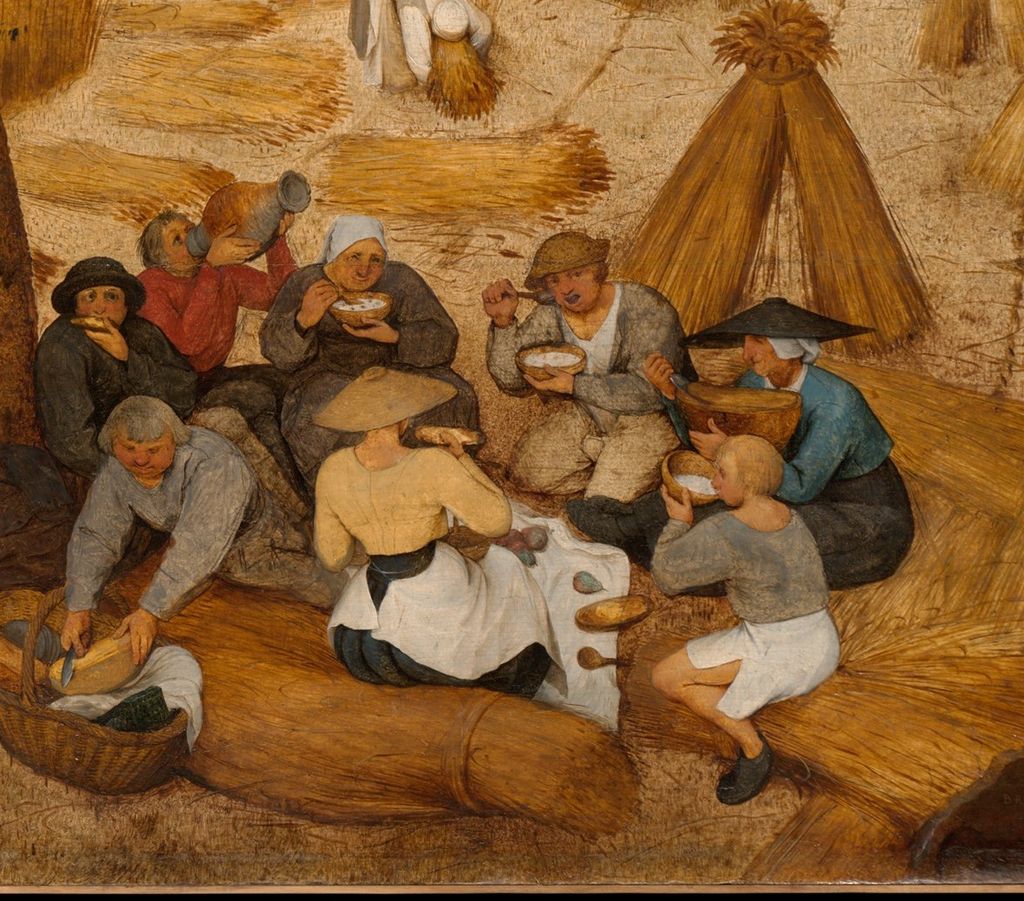
Under the pear tree at the center, the mood changes. The harvest continues, but the nearest group has stopped for a meal. Some figures sit or lie in the shade. One sprawls with his legs extended, overcome by heat and fullness. Another cuts or handles food. Others eat from bowls. The tree trunk and the circle of resting bodies create a second center inside the larger field, a human pause within the seasonal machine.
To the right, workers continue to move through the landscape. A path leads the eye past a cart, through a village and toward distant water. People climb a tree to gather fruit. Small figures walk, carry, bend, talk and vanish into the terrain. The painting rewards looking because Bruegel refuses to keep importance only in the foreground. The distant world is not background filler; it is the continuation of the same seasonal life.
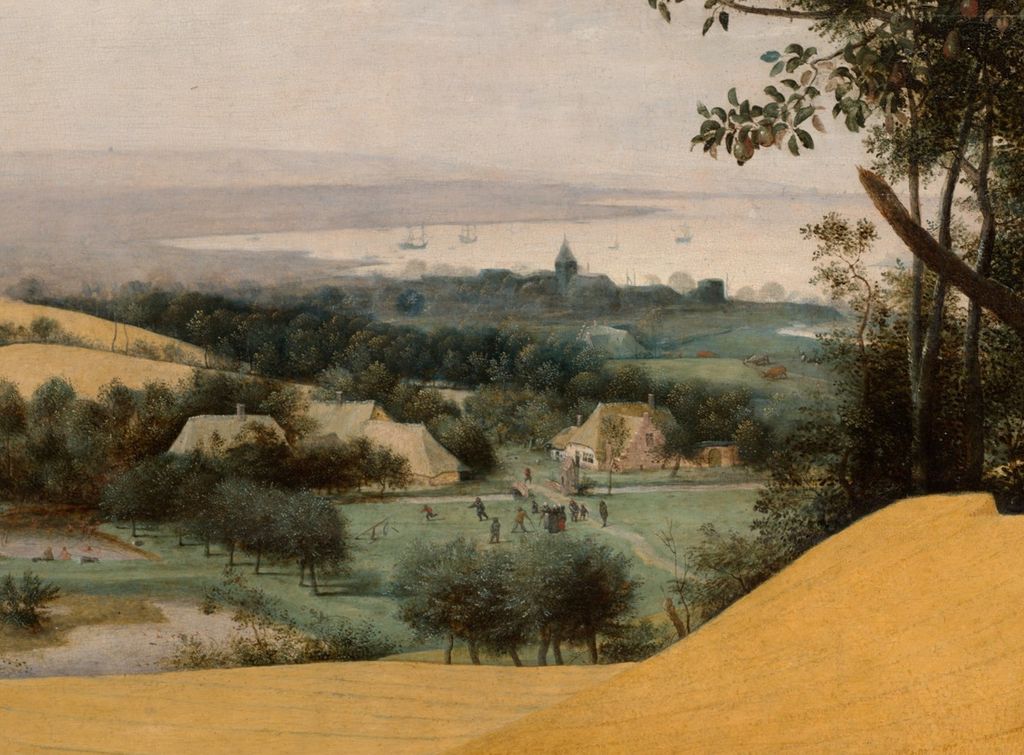
The horizon opens into a wide blue-green distance. There are fields, houses, a church tower, water, boats and far hills. The viewer stands above the land, able to see more than any person within the painting could see at once. That elevated viewpoint is one reason the picture feels so expansive. Bruegel does not simply place peasants in a landscape. He lets landscape become the structure that holds work, food, settlement, travel and weather together.
Annotated Details from The Harvesters
Start with the cut edge of the wheat, then follow the changes in distance and posture from the field to the meal and the far shore.
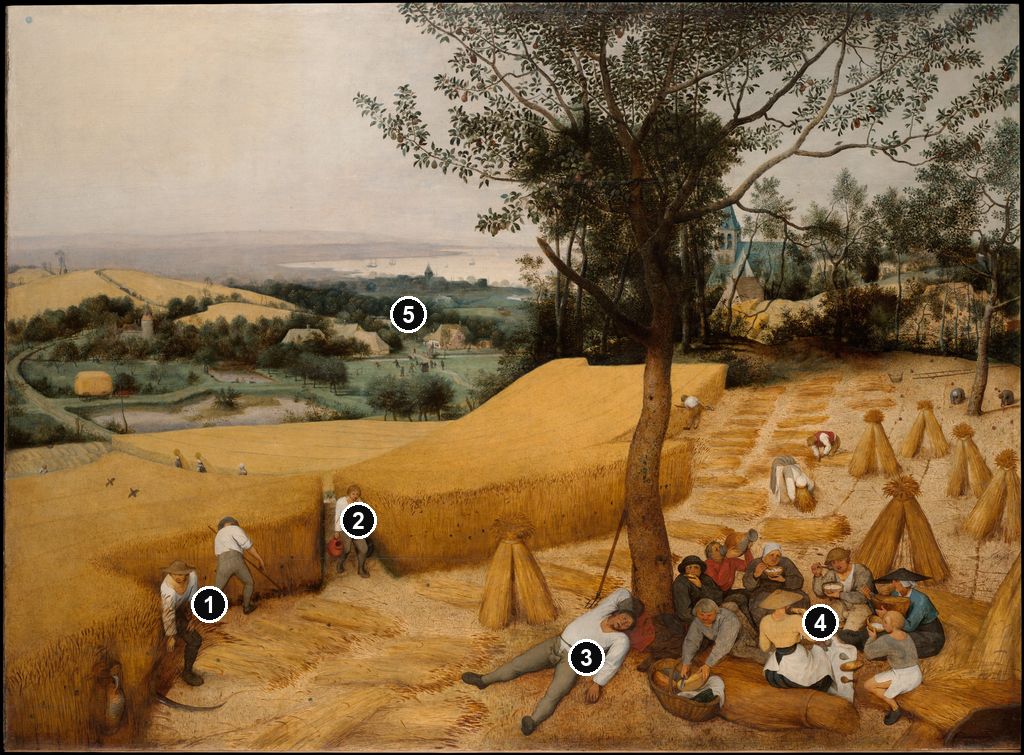
Details from THE HARVESTERS
Each detail isolates a part of the scene. Use the numbered image to find it again within the whole painting.
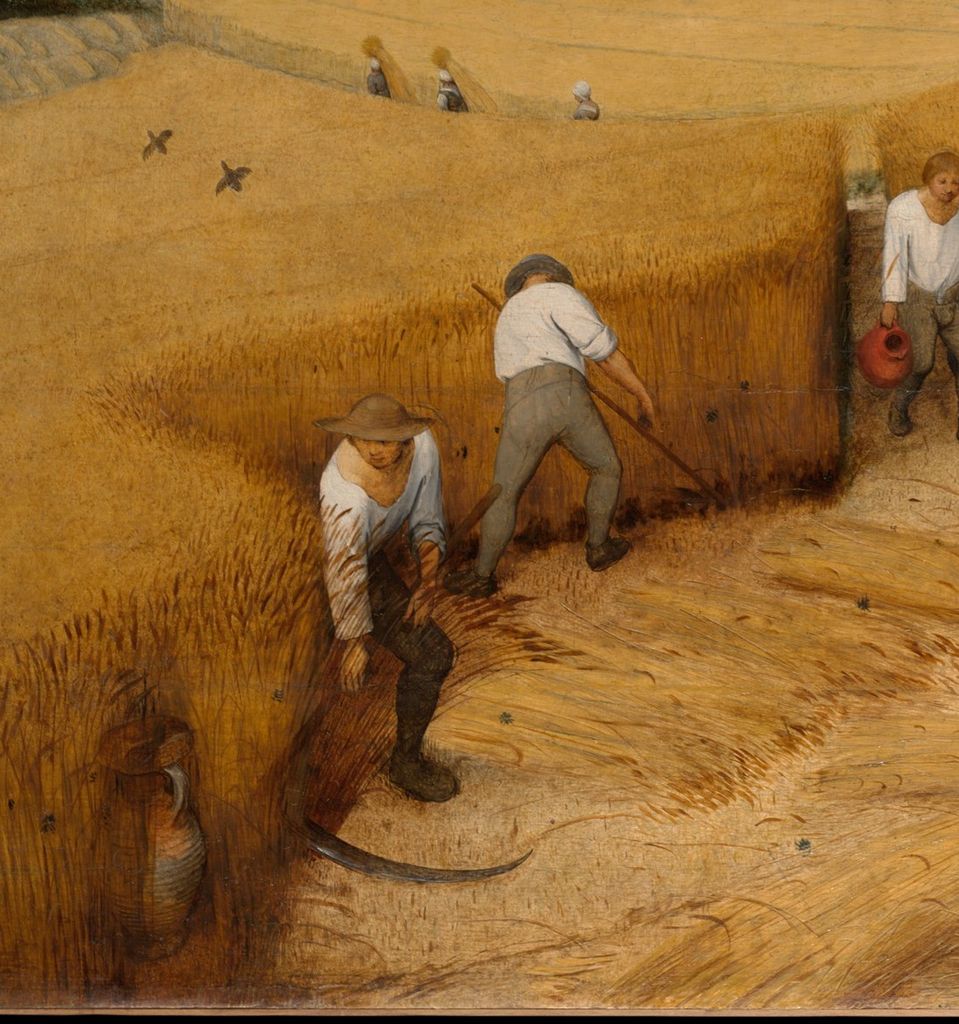
Cutting the wheat
One harvester leans over the standing wheat, close to the lower edge. Another swings a scythe along the cut edge. The exposed ground makes it possible to see where the work has reached.
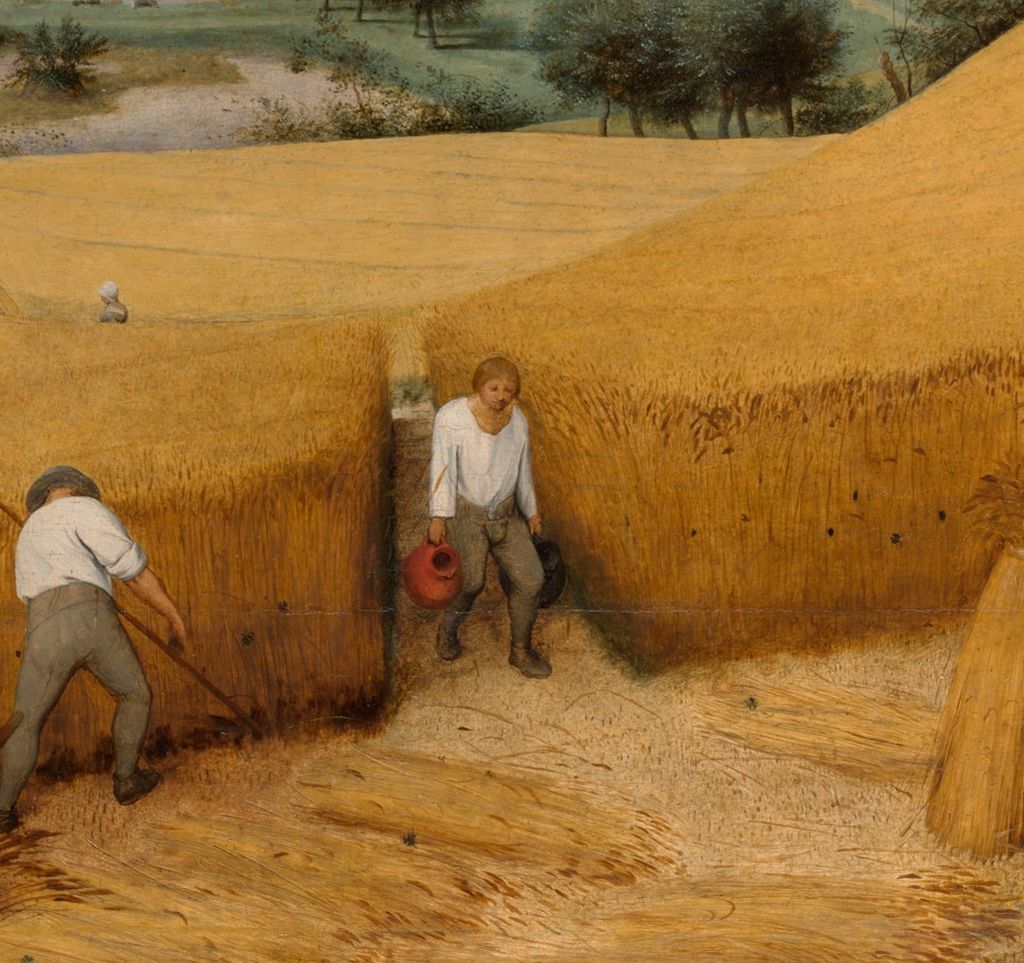
A path in the wheat
An opening separates two walls of standing wheat. The man at its entrance helps establish the height of the crop and gives the eye a way to follow the path into the field.
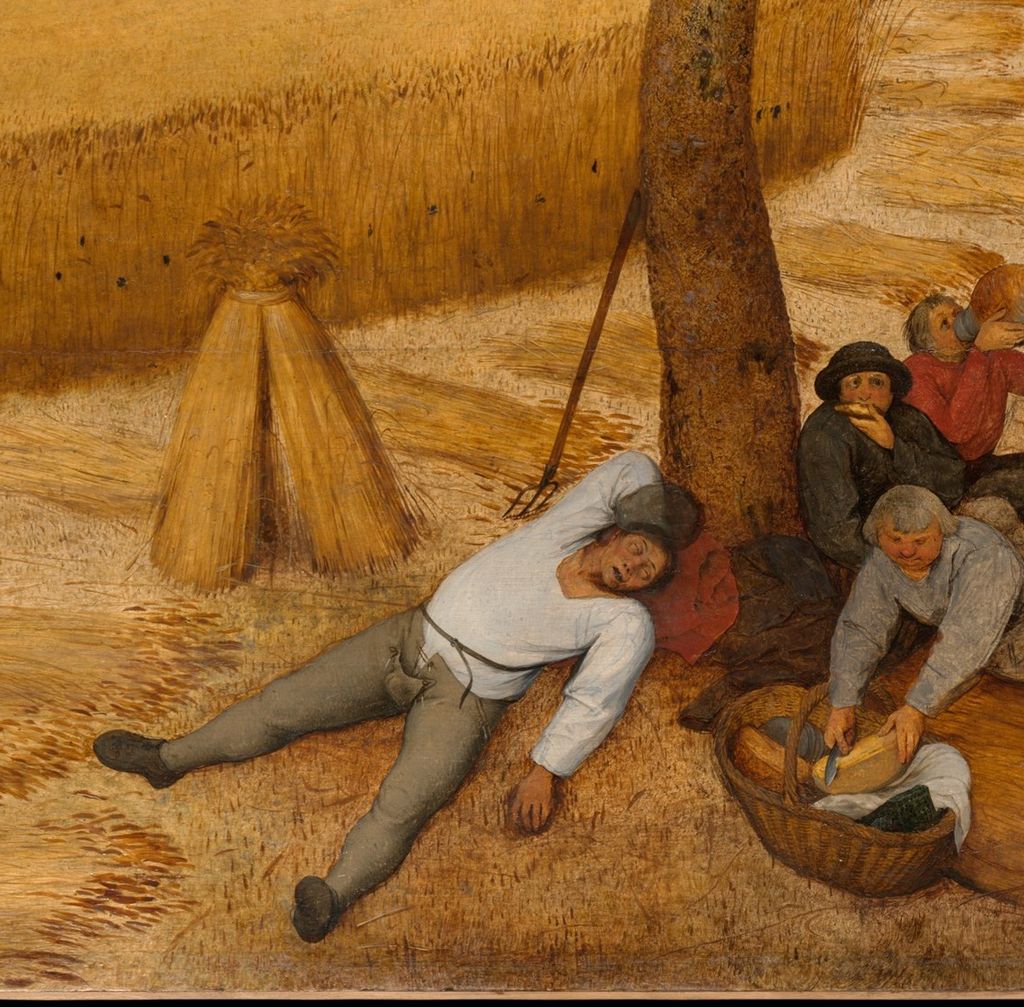
Shade under the pear tree
A worker has stretched out beneath the tree, with no seat or table to meet the eye. His diagonal posture leads across the stubble to the people eating in the same patch of shade.
The meal
The tree trunk marks the edge of the group. Within it, hands lift bowls and bread and reach toward food. Look for the changes of posture around the small space occupied by the meal.
From the village to the water
Buildings, hedges and trees interrupt the descent toward distant water. The smallest boats are picked out against the pale distance, far from the strong gold and brown of the field at the bottom.
The Place In The Seasons
The Harvesters belonged to a cycle that originally consisted of six large panel paintings. KHM's Six Seasons for a Dining Room explains that viewers today often imagine the year in four seasons, but in the sixteenth-century Low Countries the year could be divided into six periods: early spring, spring, early summer, late summer, autumn and winter [3]. Bruegel's late-summer painting therefore sits within a more finely divided agricultural calendar than the modern four-season scheme.
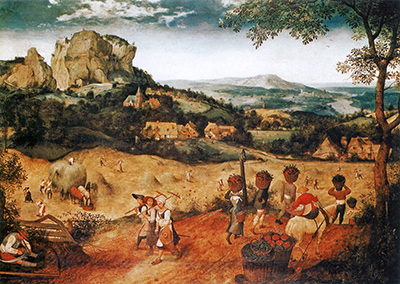
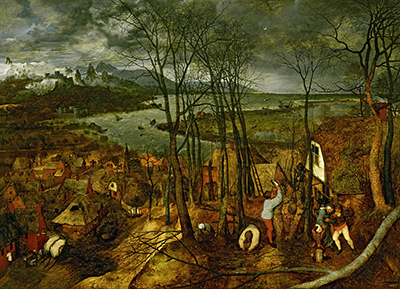
Only five of the six panels survive. KHM identifies the surviving works as The Gloomy Day for early spring, Haymaking for early summer, The Harvesters for late summer, The Return of the Herd for autumn and The Hunters in the Snow for winter [3]. The spring panel is lost [3]. Compare it with The Gloomy Day, Hay Harvest, The Return of the Herd and Hunters in the Snow, as well as the broader guide to Bruegel's landscapes and seasons.
The five surviving panels gain a different sense of scale when considered as a series. KHM suggests that the panels may once have functioned like a frieze on the walls of Jongelinck's dining room, creating a grand world landscape around the viewer [3]. That possibility changes the way The Harvesters should be imagined. It was not only a single painting for silent museum viewing. It was part of a room, a sequence and a social experience. Guests eating indoors may have looked at painted laborers eating outdoors, while a wealthy household contemplated the seasonal order that made abundance possible.
The later history of the cycle also gives it political and collecting weight. KHM traces the panels from Jongelinck's country house to the Habsburg collection after the city of Antwerp presented the Seasons to Archduke Ernest during his time as regent of the Spanish Netherlands [3]. The Harvesters, now in New York, is therefore both an intensely local-looking scene and part of an international museum history.
Harvest, Rest And Food
Food is everywhere in The Harvesters, but Bruegel does not present it as a still life. It appears as a condition of life: grain in the field, fruit in the orchard, bread under the tree, bowls of porridge, cheese and drink. The Met's audio discussion emphasizes the foreground meal of bread, cheese and porridge, treating it as central to the painting's sense of abundance [2]. Bread is especially important because the wheat around the figures is on its way to becoming the staple food that sustains them.
This makes the painting's timing precise. The wheat has not yet become bread, but bread is already being eaten. The field and the meal belong to the same cycle. Laborers cut the crop that will feed households; at the same time, they pause to consume the food that allows them to keep working. Bruegel sets up a visual loop between effort and nourishment.
The resting group is often the first human focus of the painting because it feels so immediate. The people are not heroic in a classical sense, but they have weight, appetite and comfort. The sprawling man under the tree is especially memorable. He is not posed elegantly. He looks heavy with heat, food and bodily fatigue. His presence prevents the scene from becoming purely decorative.
At the same time, the Met rightly cautions that Bruegel shows peasant laborers in a sympathetic yet idealized light [1]. The wheat is abundant, the meal is ample, and the hardest aspects of rural work are softened. The field does not feel desperate. Hunger, injury, debt, bad weather and social vulnerability are not the painting's subject. Bruegel creates an image of harmony between people, work and land, which would have suited the expectations of a wealthy urban patron viewing the countryside from a position of comfort [1].
That idealization does not make the painting shallow. It makes it historically specific. The Harvesters is powerful because it holds a double vision. It respects rural workers enough to make them central, large and memorable. It also frames their labor within an elite image of seasonal order. The viewer has to hold both truths at once.
Watch Bruegel’s art
Explore Bruegel with TheHistoryOfArt and artwork discussions from Smarthistory.
Pieter BRUEGEL Explained in 10 Minutes (updated)
A TheHistoryOfArt film about Bruegel.
Watch on YouTubeLandscape And Distance
The measurements in New York’s catalogue record changes to the panel. Bruegel’s painted surface measures 116.5 by 159.5 centimetres. Strips added at the top, bottom and right bring its present size to 119 by 162 centimetres. Those additions are why two apparently precise measurements of the same panel can differ. The Met’s photography and audio also make it possible to test how this wide field of view works. The high viewpoint gives us access to both the shade under the tree and the distant water beyond the fields. A person standing beside the resting workers could hardly see every corner so clearly. The view is constructed, while the small tasks that fill it make the countryside feel observed [1] [2].
Bruegel's landscape is one of the painting's great achievements. The foreground wheat is close enough to touch, but the eye can travel far beyond it. Paths lead from the field to the village, from the village toward water, from water to hills, and from hills into a hazy horizon. The picture offers an almost impossible range of visibility.
The Met audio commentary, with curator Adam Eaker, is helpful on this point. It stresses that the painting should not be treated as a literal Flemish view. Bruegel creates a constructed landscape: a fantasy of visibility mapped with details that feel drawn from everyday life [2]. This is essential to understanding the painting. The truth of The Harvesters does not come from topographical accuracy. It comes from the way invented space makes seasonal life legible.
The high viewpoint lets Bruegel connect many zones of activity. Close by, figures cut wheat and eat. Farther off, fruit is gathered. Beyond that, villagers move through paths and houses. Farther still, water and boats suggest trade, travel or a larger world beyond the harvest. The painting's geography becomes a moral and social map, showing the countryside as a network of work, consumption, settlement and movement.
The distance also changes the mood. If the picture stayed only with the scythes and wheat, it might feel hot, heavy and enclosed. The far view gives the scene air. It lets the viewer breathe, and it turns a single field into a whole world. Bruegel's late-summer heat is not claustrophobic. It is hazy, slow and expansive.
This is one of the reasons the painting is central to Bruegel's style and technique. He combines close observation with structural invention. The tiny incidents feel particular, but the whole space is orchestrated. KHM's research project on Bruegel's panel paintings emphasizes how modern non-invasive methods, including infrared and x-ray-based techniques, have deepened understanding of his construction, handling and revisions in works from the KHM collection [5]. Even without assigning those findings specifically to The Harvesters, that wider technical context supports a simple point: Bruegel's apparent naturalness is the product of intricate planning and painterly control.
Patronage And Idealization
The Antwerp merchant and collector Nicolaes Jonghelinck owned the series. KHM identifies the country house as Jongelinck's estate near Antwerp, and the paintings probably decorated its dining room [3]. The Met likewise connects The Harvesters with a six-part cycle commissioned by an Antwerp merchant for a country home's dining room [1].
That context shapes the painting's meaning. A dining room is a place of eating, conversation and hospitality. A season of harvest is a season of provision. The panel's resting laborers, bread, cheese, porridge, fruit and grain would have resonated strongly in a room where food was served. The picture could delight viewers with rural abundance while reminding them, indirectly, of the labor and seasonal timing behind elite comfort.
Jongelinck also belongs to the wider story of Bruegel's late career. KHM's artist material places this patronage within the Brussels-period context in which several of Bruegel's major paintings were made for sophisticated collectors [4].
Bruegel avoids crude mockery. His peasants are not simply comic types. Their bodies are solid, their work is necessary, and their rest is earned. The painting gives them a degree of centrality rare in earlier European art. It does not need a saint, mythological hero or biblical event to justify the landscape. Rural labor is enough to anchor the image.
Yet the patron's viewpoint remains embedded in the work. The countryside is made coherent, fertile and enjoyable to survey. The viewer sees more than the workers can see. The hardships of rural existence are subdued. Bruegel's art is not propaganda, but it is not socially innocent either. It stages rural life as something that can be admired, consumed and contemplated from outside.
That tension is one of the reasons The Harvesters still feels modern. It does not let the viewer settle into a single attitude. The painting invites pleasure in light, space and abundance, then quietly asks whose pleasure is being served. It honors work, but it also turns work into a view.
Bruegel And Secular Landscape
The Harvesters belongs to a major shift in European painting: the emergence of landscape as an independent subject. Earlier landscapes often appeared as settings for religious narratives, mythological stories or portraits. In Bruegel's Seasons, the landscape itself becomes the main event. People remain crucial, but they do not act out a sacred story. They perform the ordinary rituals of the agricultural calendar.
This does not mean the painting lacks meaning. On the contrary, its meaning comes from ordinary life made monumental. The wheat field, the resting meal, the distant village and the wide world beyond become worthy of sustained attention. Bruegel's art insists that seasonal labor can carry the weight once reserved for grand narrative.
The Met audio commentary connects The Harvesters to the rise of secular or independent landscape [2]. That is a useful frame because it explains why the painting feels both familiar and revolutionary. The subject is ordinary; the scale and ambition are not. Bruegel makes harvest time as visually complex as a biblical history scene.
The artist's broader career strengthens this reading. His biography moves through Antwerp print culture, travel, patronage and the late Brussels period, while his paintings include crowded proverb pictures, peasant scenes, biblical subjects and panoramic landscapes. The Harvesters draws several of those strengths together: observational comedy, social structure, landscape invention and a sharp eye for human behavior.
Relations Within The Cycle
Vienna’s recent exhibition on the seasons pairs village and agricultural work with changes in light and weather across the group. The sharp gold of the wheat looks different beside The Gloomy Day, which gives the sky and wind much more of the picture. The comparison is clearest when the panels are identified by subject and collection. It also leaves room for differing assignments of particular months in a cycle of six compositions [6].
The surviving Seasons panels become more powerful when seen as a group. The Gloomy Day gives the year a stormy early-spring atmosphere, with unstable weather and bare branches. Hay Harvest, corresponding to KHM's Haymaking, belongs to early summer, when grass is cut, gathered and carried. The Harvesters intensifies the cycle into late summer abundance, with wheat, fruit and heavy rest.
The Return of the Herd shifts the mood toward autumn. The movement of animals and people becomes more urgent, and the land begins to turn. Hunters in the Snow closes the surviving sequence in winter, with weary hunters entering a village landscape of snow, ice, smoke and cold. Across the group, Bruegel changes not only subject matter but atmosphere: moisture, heat, harvest, autumnal pressure and winter stillness.
The Harvesters is the warmest and most expansive of the surviving cycle. It does not have the icy drama of Hunters in the Snow or the unsettled weather of The Gloomy Day. Its drama lies in fullness. The wheat is high, the meal is substantial, the orchard is active, and the distance opens generously. Late summer becomes the season when the world seems most available to the eye.
The lost spring panel leaves the cycle incomplete, but not unintelligible. The surviving works still show Bruegel's ambition: to imagine the year as a sequence of environments, labors and moods. The Harvesters is indispensable to that ambition because it gives the sequence its image of ripeness.
Why The Harvesters Remains Important
The Harvesters remains important because it changed what a landscape could do. It is not merely a setting. It is a social world, a calendar, a patronal object, a study of work and rest, and a feat of spatial imagination. Bruegel gives ordinary rural life the scale of a major painting without turning it into simple celebration.
The painting also remains important because it keeps looking generous while becoming more complex the longer one looks. At first, it is a golden harvest scene. Then it becomes a study of bodies under heat, food as reward, labor as rhythm, landscape as invention and patronage as pressure. Its beauty is immediate, but its intelligence is slow.
For viewers coming to Bruegel through a single work, The Harvesters is one of the best starting points. It connects to the artist's seasonal landscapes, his attention to peasant life, his late panel painting, his Antwerp patrons and his role in the rise of independent landscape. It also links outward across the Bruegel collection: to the winter world of Hunters in the Snow, the unsettled early spring of The Gloomy Day, the labor of Hay Harvest, the autumnal motion of The Return of the Herd, and the wider story of Bruegel's landscapes and seasons.
Most of all, the painting endures because Bruegel understands the rhythm of looking. He gives the viewer a place to begin, under the tree with bread and shade, then releases the eye into a landscape that seems to contain more life than any single glance can hold. The Harvesters is a painting of late summer, but it is also a painting about abundance itself: abundance of food, labor, distance, incident and visual thought.
Discussion
What feels most revealing about Pieter Bruegel the Elder: the village detail, the landscape setting, the moral wit, or the way everyday life becomes a complete world?
Reader Insights
Begin with one small action in a Bruegel scene, then follow how it connects to the surrounding figures, setting and rhythm of the whole image.
Connect the work to Northern Renaissance visual culture, printmaking, proverb traditions and Bruegel's interest in rural and urban life.
Which detail changes the interpretation most once you know the subject, date, proverb source or present collection?
Join the Conversation
Have a thought or observation about Pieter Bruegel the Elder? Share it below. Thoughtful responses may be added to this section as the Bruegel pages develop.
Frequently Asked Questions
The foreground is dominated by grain. Bruegel makes the wheat tall, dense and almost architectural, so that the workers appear partly absorbed into the crop they are cutting. [1]
The Harvesters belonged to a cycle that originally consisted of six large panel paintings. KHM's Six Seasons for a Dining Room explains that viewers today often imagine the year in four seasons, but in the sixteenth-century Low Countries the year could be divided into six periods: early spring, spring, early summer, late summer, autumn and winter . [3]
Food is everywhere in The Harvesters , but Bruegel does not present it as a still life. It appears as a condition of life: grain in the field, fruit in the orchard, bread under the tree, bowls of porridge, cheese and drink. [2]
References
- The Metropolitan Museum of Art, The Harvesters, Pieter Bruegel the Elder, 1565, object 19.164, View source.
- The Metropolitan Museum of Art, audio transcript on the object page, 5179. The Harvesters.
- Kunsthistorisches Museum Vienna, Six Seasons for a Dining Room, View source.
- Kunsthistorisches Museum Vienna, Pieter Bruegel the Elder, View source.
- Kunsthistorisches Museum Vienna, Researching Bruegel, View source.
- Kunsthistorisches Museum, Kapitel II: Bruegels Jahreszeiten, from Arcimboldo – Bassano – Bruegel: Die Zeiten der Natur, View source.






