


 by Tom Gurney
Tom Gurney BSc (Hons) is an art history expert with over 20 years experience
Published on June 19, 2020 / Updated on October 14, 2023
Email: tomgurney1@gmail.com / Phone: +44 7429 011000
Haymaking by Pieter Bruegel the Elder: Introduction
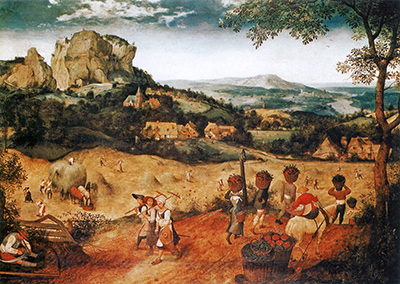
A woman carrying a rake looks back across the path in Haymaking. Beyond her, people are still at work in a broad field, and the light catches a line of buildings at the foot of a rocky outcrop. Those few steps along the path give the eye a route into an unusually large landscape. Where the workers are small in the field, the figures passing near us are big enough for us to gauge the weight of what they carry and the space they need to pass.
Pieter Bruegel the Elder painted this oak panel in 1565. It measures 114 by 158 centimetres and belongs to the Lobkowicz Collections in Prague. The Kunsthistorisches Museum identifies it as early summer in the annual cycle that Bruegel made for the Antwerp collector Niclaes Jonghelinck. It is often called The Hay Harvest, a title that draws attention to the work in the field. Other tasks fill the picture too. Paths, baskets and the movement of people and loads give this scene a subject beyond the single act of cutting hay [1] [2].
This work across Bruegel’s career
Tower of Babel
1563The Harvesters
1565Peasant Wedding
1568Children's Games
1560Triumph of Death
1562–1563Hay Harvest
This artworkContents
- Introduction
- The path along the foreground
- From the field to the distant water
- Hay and grain in two summer panels
- A painting from a dispersed cycle
- Annotated Details
The path along the foreground
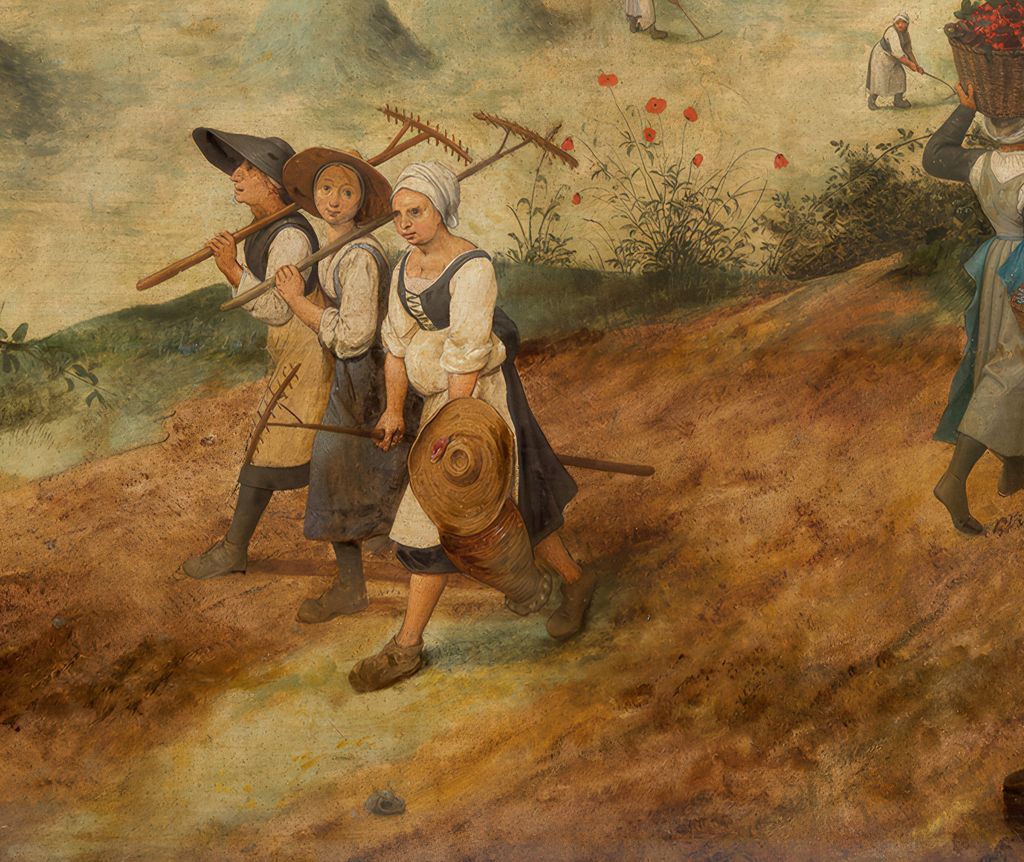
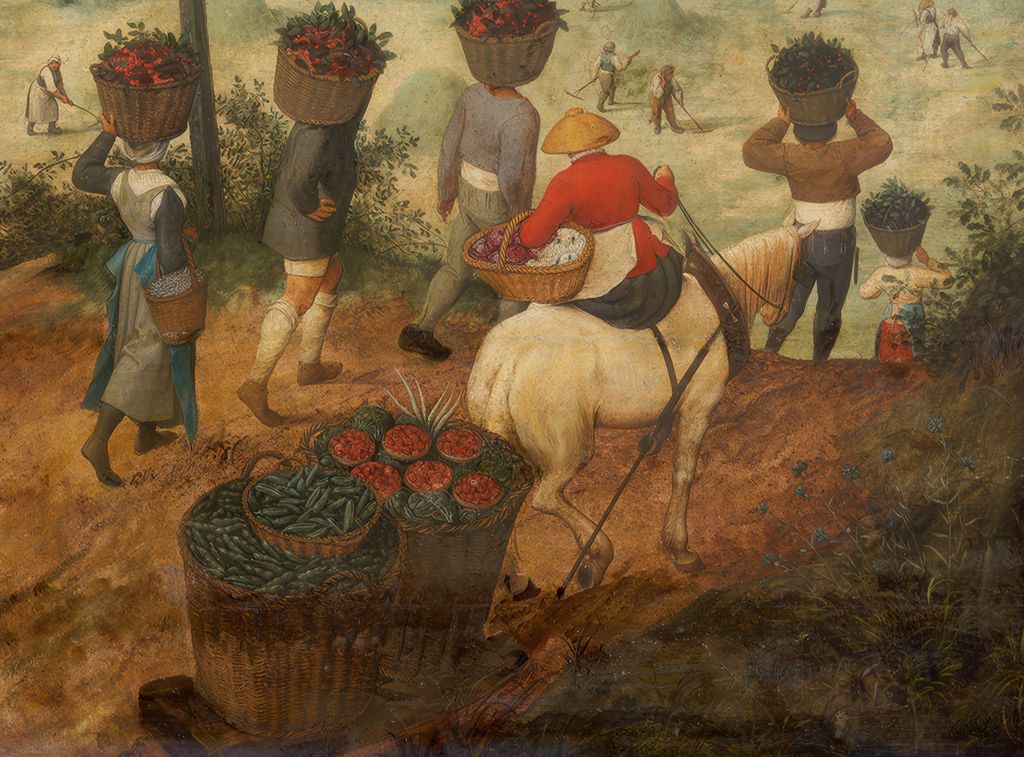
The first part of the painting to look at is the open ground between two groups. Several women carry long-handled tools in the foreground. Farther right, the activity gathers around baskets, loads and people moving along the road. One group can cross the field of view while another works almost in place. Clear space between the groups allows the eye to see the direction of travel before looking at the smaller figures within them.
The tools help. They extend beyond the outlines of the people carrying them. Some of their shafts rise into the pale colour of the field behind, where they are easy to see. They also give differences of direction a visual form. A figure can turn her head while carrying something that continues to point the other way. That brief suspension of movement gives the foreground a lived rhythm. The workers have somewhere to go, and they remain aware of the people at their sides or behind them.
Across the path, there are quieter and heavier gestures. Some people bend to their loads. Other figures are painted so small that all we can see at first is a colour, a tilt or the space between one body and the next. Bruegel can make the foreground feel populated without devoting equal attention to each person. The differences of scale help us read a road as a place of passing, carrying and meeting, rather than a flat band across the bottom of the landscape.
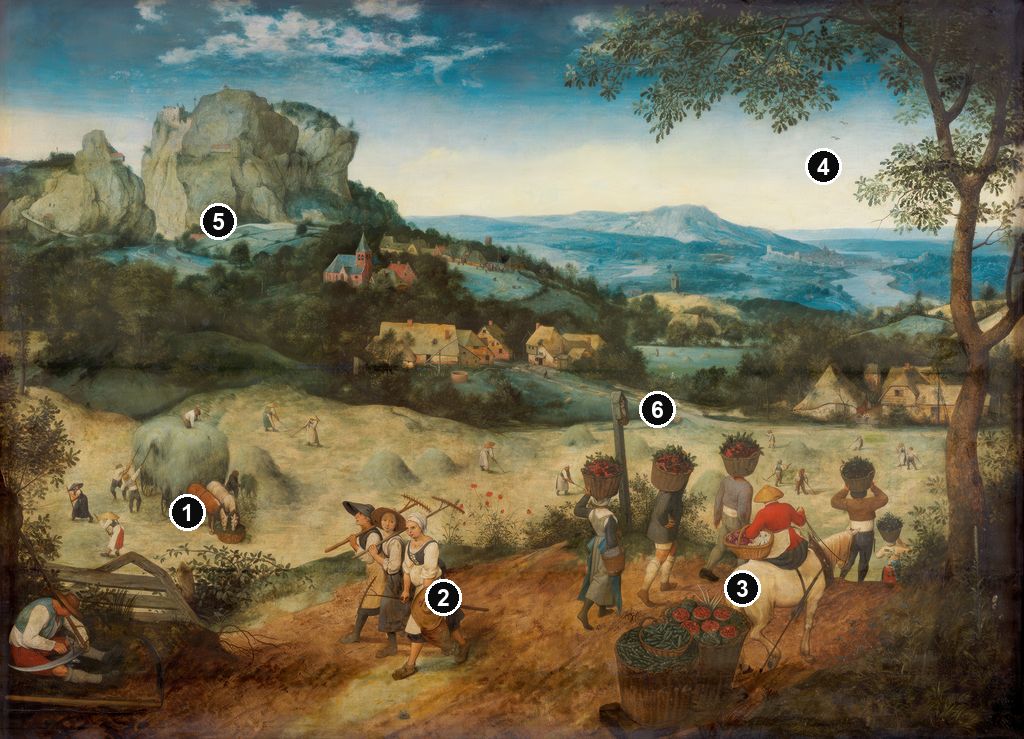
Annotated Details from Hay Harvest
The numbered details move between labour, travel, produce and landscape, showing how Bruegel links the foreground road to the distant valley.
Details from HAY HARVEST
Close looking reveals how figures, tools, animals, crops and paths organise the immense summer landscape.
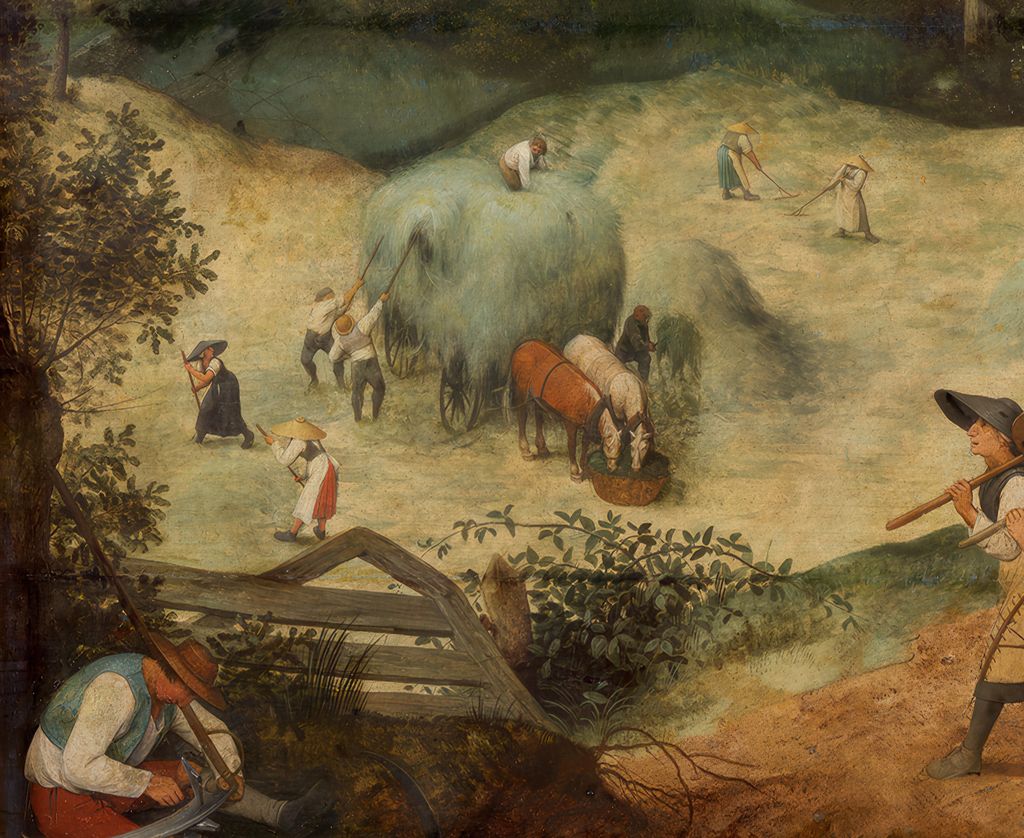
Haymakers and resting horses
Workers gather around a towering haystack while two horses lower their heads, compressing labour, rest and stored harvest into one busy corner.
Travellers on the rutted road
Three figures advance along the ochre track, their staffs, hats and overlapping steps forming a compact diagonal against the open ground.
Fruit baskets and market riders
Red fruit, green vegetables and tall baskets brighten the road as walkers and riders balance the weight of the season's produce.
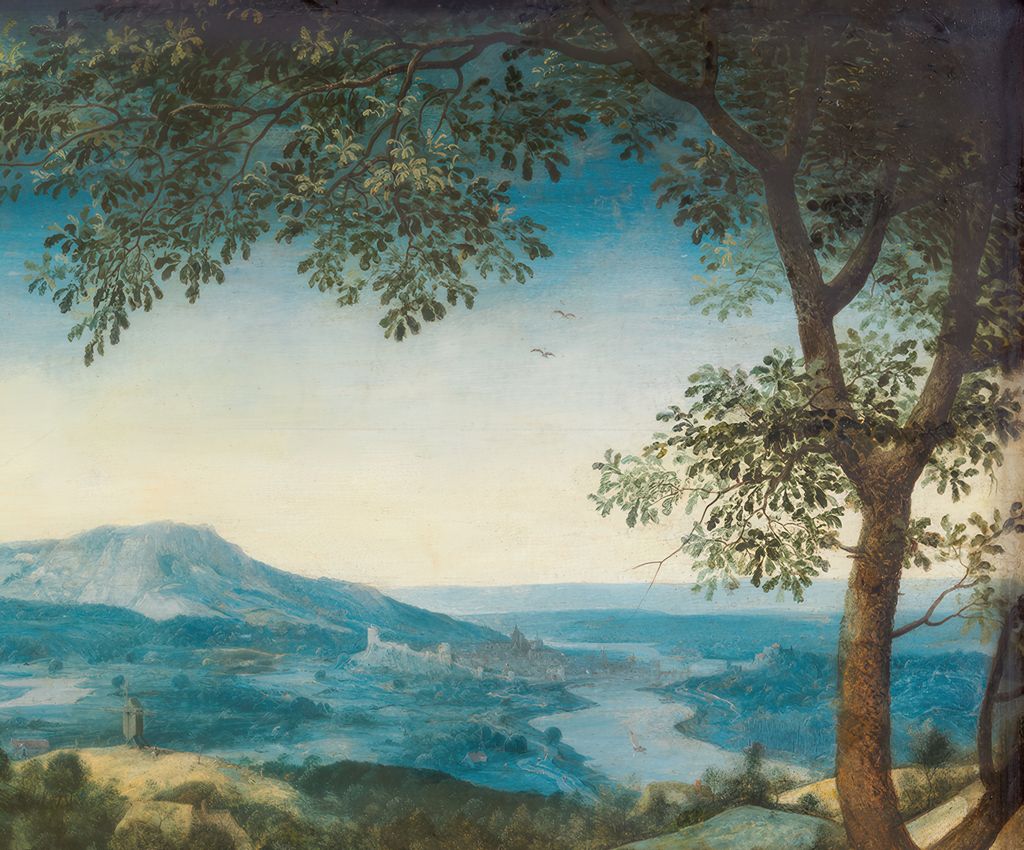
Tree-framed river valley
The dark trunk and hanging canopy frame pale water, distant mountains and tiny settlements, turning the upper corner into a landscape within the landscape.
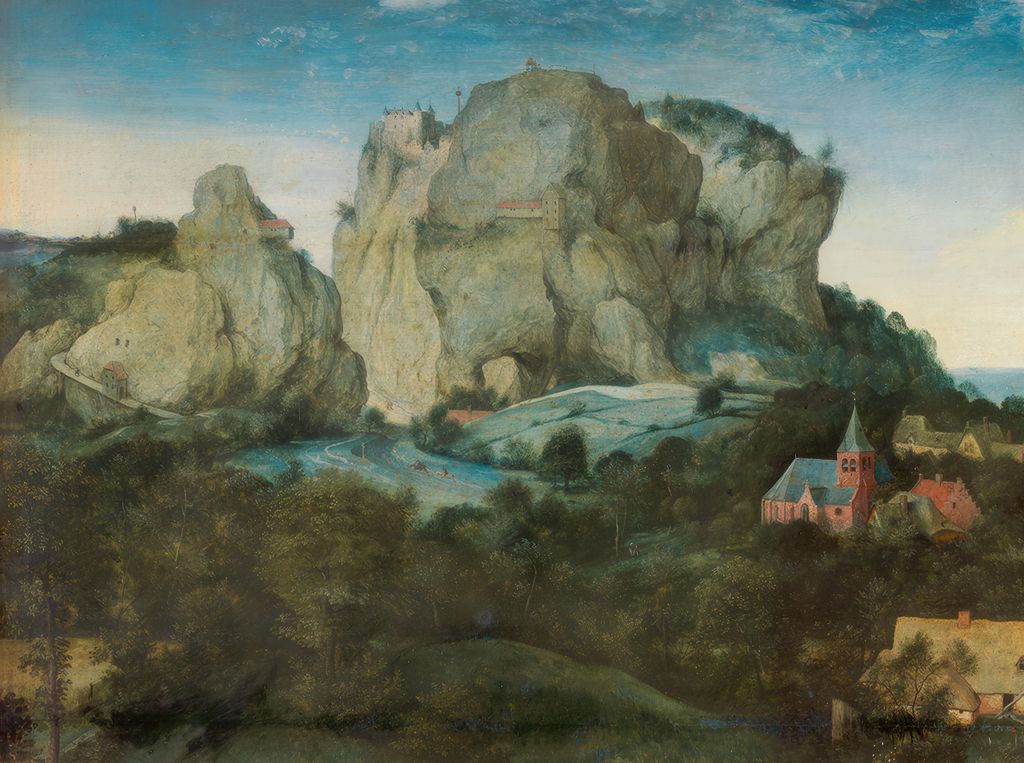
Rocky castle and hillside village
Fortifications cling to the pale crags while a church and red-roofed houses step down the wooded slope below.
Workers across the pale field
Widely spaced workers punctuate the broad field, their small bent bodies and repeated tools carrying the harvest rhythm toward the distant water.
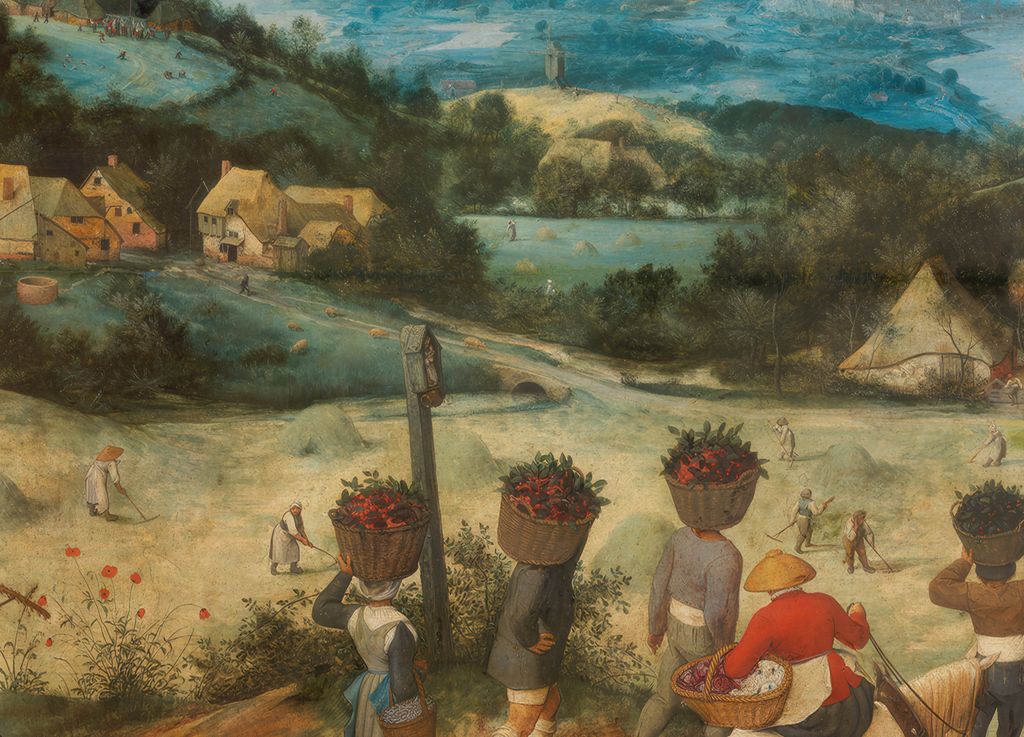
From the field to the distant water
The pale field occupies much of the middle ground. Workers are spaced far enough apart that a viewer can distinguish one person from the next without knowing every tool or task. A great mound of hay at the left interrupts that pattern. Look from the mound to the people who surround it, then back to the foreground. The amount they have gathered becomes a measure of labour, while their distance from the road shows how much ground the picture has opened up.
Beyond, dark foliage and the buildings of the settlement divide near fields from the far country. The pale rock at the left rises steeply above the roofs. At the other edge, the trunk of a tree climbs out of the picture. Between them there is an opening of a different scale, where the eye reaches towards water and the low hills beyond it. Bruegel uses contrasting verticals to frame a long view that neither of them can contain on its own.
The cliffs, settlement and water make the field part of an imagined region. The paths still feel practical. Their turns make sense for travellers and for the movement of goods, even though the landscape does not need to be identified with an exact place. This relationship between familiar work and constructed distance connects Haymaking with Bruegel’s landscape drawings and prints. A viewer can recognise the work of walking and carrying while also seeing a view broader than any single person in the painting commands [1] [3].
Hay and grain in two summer panels
It helps to put Haymaking beside The Harvesters in New York. The foreground wheat in the later summer picture rises close to the people cutting it. Paths become openings through an almost solid mass of grain. The pear tree casts shade over a group that has stopped for a meal. We can imagine reaching that group from one side of the field, but the standing wheat conceals portions of the path.
The early-summer panel offers a different range of movement. It leaves an open foreground path for people on their way across the scene. Bodies get smaller in the distance, but less of their work is hidden by upright crops. The sunlit middle ground connects episodes which might otherwise have seemed to belong to separate landscapes. The seasonal contrast has as much to do with what the viewer can see as with the change in agricultural activity [1] [4].
The two works also give colour different jobs. In the New York painting, the golden crop reaches almost to the viewer and makes the resting figures feel close. In Haymaking, the warmer tones run across the field and lead the eye towards the roofs. Darker areas between those roofs and the first figures produce several steps into the distance. Read one painting at the pace of the people gathered under a tree, then read the other at the pace of the people crossing the road. The comparison turns two large panels into two different experiences of summer.
A painting from a dispersed cycle
The 1565 cycle originally consisted of six pictures. Five survive. The KHM connects them with Jonghelinck’s Antwerp country house and has suggested that they may have worked together around a room. That possibility gives the painting a scale beyond the panel’s own width. Seen as one part of a sequence, the distance visible here would have been one of several larger views of a changing year. The precise original arrangement is a historical question. The surviving pictures themselves let us compare changes in terrain, light and activity directly [1].
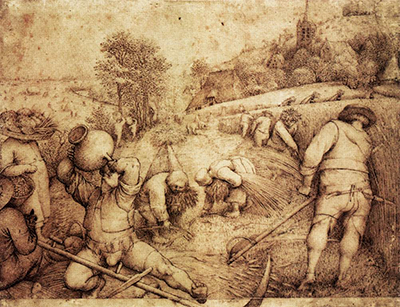
The Prague picture is distinct from Bruegel’s designs for published seasonal prints. The two projects share a subject, work done at particular points in the year. They use it differently. The design for the seasonal print Summer concentrates on another set of bodies and movements, while Haymaking reserves large spaces for the routes and distances between people. The useful comparison begins with medium and composition rather than the word summer [1] [3].
The people on the path offer a way back into the picture when the view seems too broad. Find them first. Then follow the road, the pile of hay, the roofs and the distant water. The height of the rock and the length of the view become clearer when measured against the steps of the people passing through it. That is one reason the panel stands apart within Bruegel’s seasons. Early summer is a particular kind of access to the land, with open ground ahead and work going on at several distances at once.
Discussion
Which detail in this work most changes how you read it?
Frequently Asked Questions
The 1565 cycle originally consisted of six pictures. Five survive. [1]
References
- Kunsthistorisches Museum Vienna, Six Seasons for a Dining Room, with the catalogue entry for Haymaking, View source.
- House of Lobkowicz, Collection Highlights, View source.
- Nadine M. Orenstein, ed., Pieter Bruegel the Elder: Drawings and Prints, The Metropolitan Museum of Art and Yale University Press, 2001, View source.
- Metropolitan Museum of Art, The Harvesters, accession 19.164, View source.







