


 by Tom Gurney
Tom Gurney BSc (Hons) is an art history expert with over 20 years experience
Published on June 19, 2020 / Updated on October 14, 2023
Email: tomgurney1@gmail.com / Phone: +44 7429 011000
Summer: Introduction
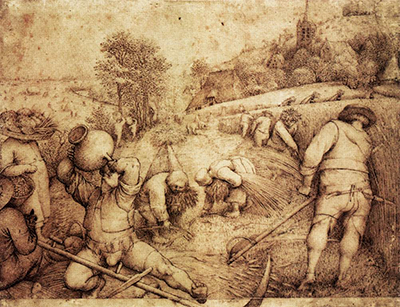
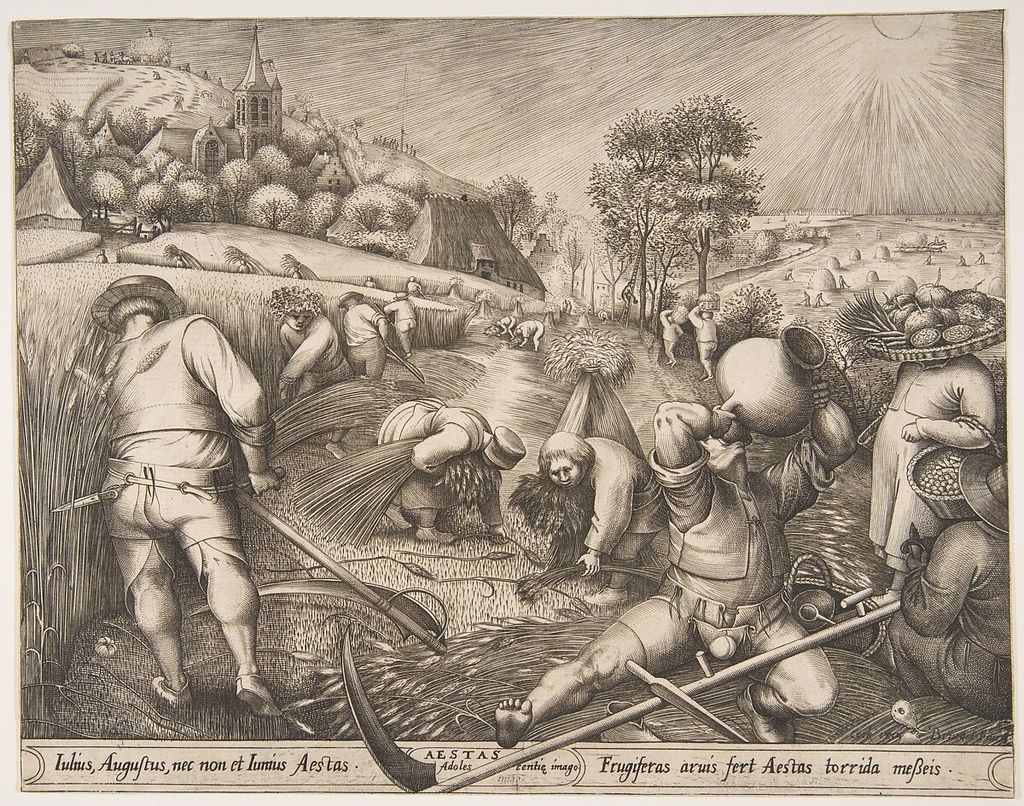
Pieter Bruegel the Elder’s Summer is a pen-and-brown-ink drawing dated 1568 in the Hamburger Kunsthalle. Pieter van der Heyden engraved the design for Hieronymus Cock’s publication of the four seasons in 1570. The image above shows Bruegel’s drawing, with the large worker at the right and the man drinking at the left. The print reverses them. Between those figures, people cut grain, gather it and carry away the crop. A village and more fields are still visible beyond the workers [1] [2].
This work across Bruegel’s career
Tower of Babel
1563The Harvesters
1565Peasant Wedding
1568Children's Games
1560Triumph of Death
1562–1563Summer
This artworkContents
- Introduction
- The Scythe and the Cut Grain
- A Drink at the Edge
- From Drawing to Published Print
- Comparing the Painted Harvests
- Annotated Details
The Scythe and the Cut Grain
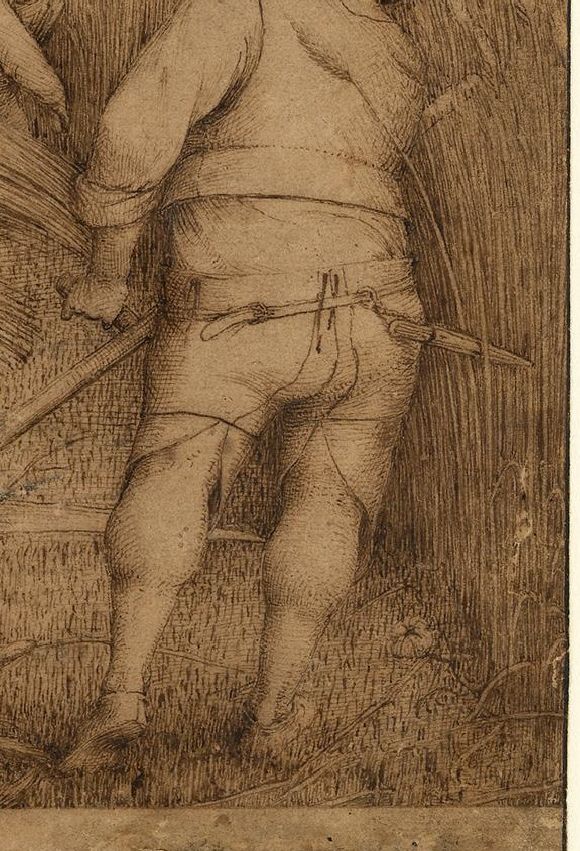
Begin at the right edge of the drawing. A large figure turns his back to the viewer, with his feet apart and his hands set on the tool. Follow the shaft down towards the curved blade. The diagonal takes the eye from the man’s body to the ground where the grain is being cut. Nearby, standing stalks make a dense pattern against which the shorter marks near his feet become easier to recognise. The crop is legible in two different conditions, and the worker’s position marks the boundary between them.
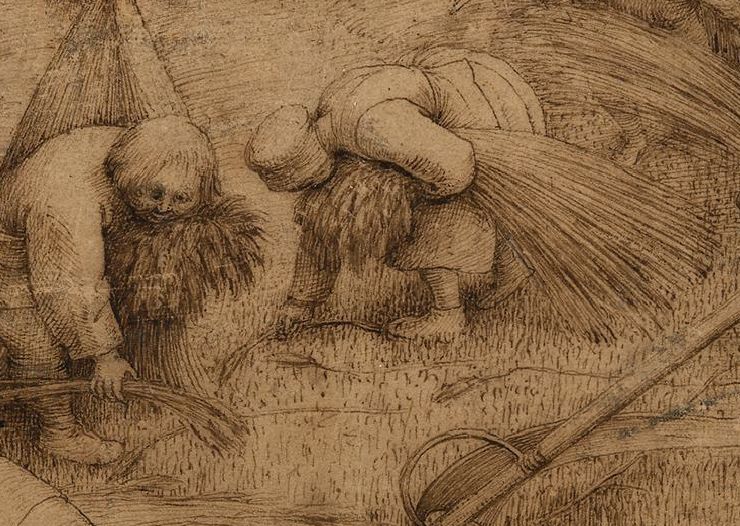
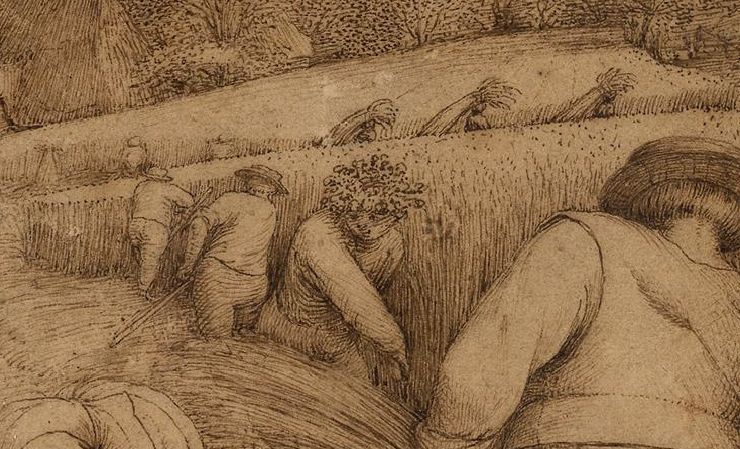
Behind him, people bend to work close to the earth. One mass of cut grain curves across a worker’s back and arm. Elsewhere the plants appear as handfuls or as the irregular floor of a field. Bruegel makes a season out of these changes of scale. It is possible to picture the crop leaving the ground in the sweep of a tool and later taking up space in the hands of someone who gathers it. The most prominent bodies are close enough for us to follow a particular movement. The smaller bodies show how much work can fill one hillside [1] [2].
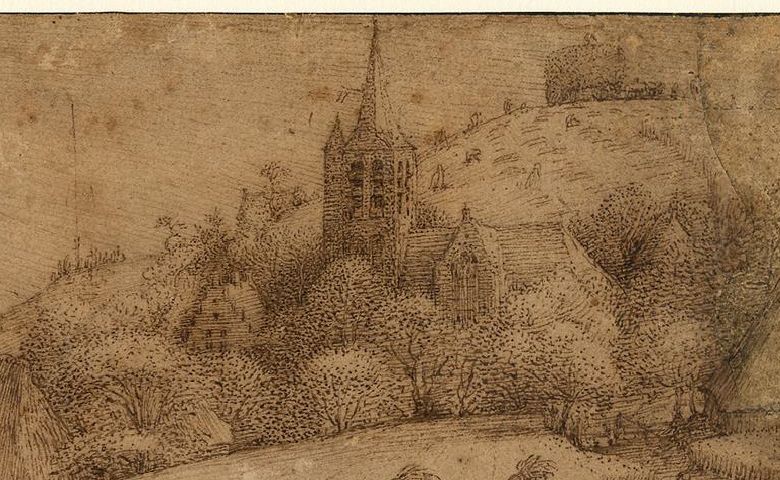
Farther back, the open land is broken up by trees and buildings. Workers can be seen at intervals through the middle and distant parts of the drawing. The Metropolitan Museum’s 2001 catalogue identifies fruit picking and work with hay alongside the grain harvest. The different tasks belong to seasonal associations with June, July and August. Bruegel allows them to occupy a continuous landscape. A viewer can move from one to another by following the field, then look back to see what the largest figures have already suggested about the work throughout the view [1].
Annotated Details from Summer
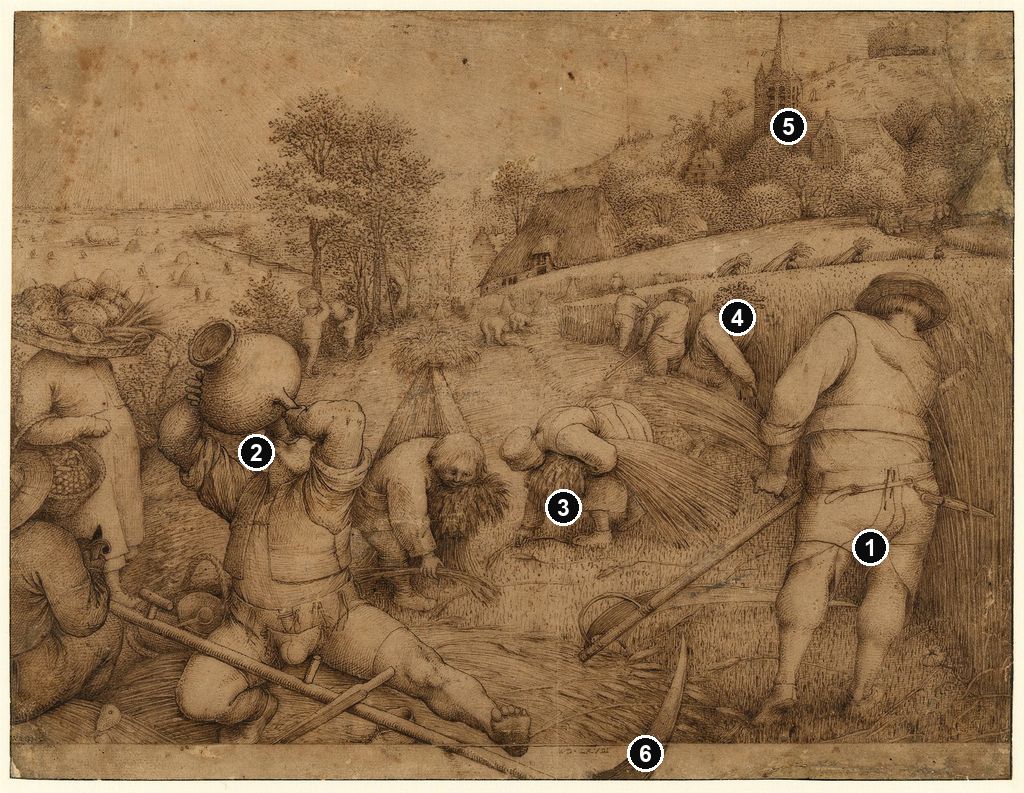
Look from the mower to the worker drinking, then follow the harvest uphill.
Details from SUMMER
Six details trace the work and rest across the field.
The mower at the right
The nearest mower faces the standing grain.
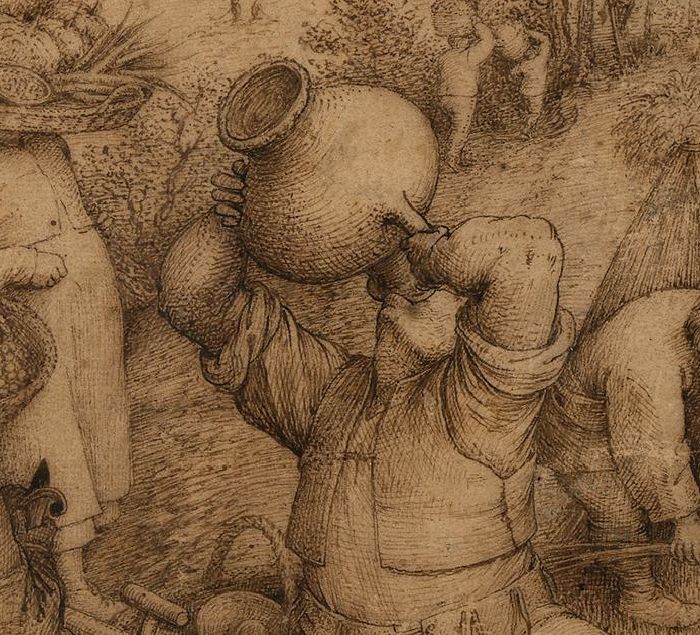
The drinker and his jug
A resting worker tilts a large jug above his head.
Gathering the cut grain
Bent figures collect stalks between the drinker and the mower.
Reapers farther up the field
Smaller figures bend along the edges of the standing crop.
The village on the hill
A church tower rises among the roofs and trees.
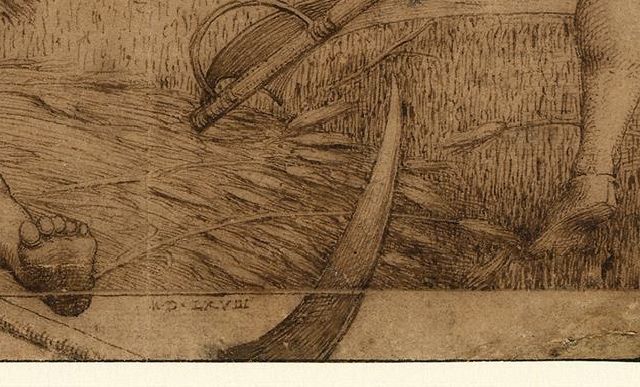
Across the lower border
The scythe blade crosses the line at the bottom of the design.
Pieter Bruegel the Elder, Summer, 1568. Hamburger Kunsthalle, 21758. Reproduction via Wikimedia Commons.
A Drink at the Edge
At the front a seated or kneeling man raises a large jug to his mouth. The jug almost covers his face, and his arm reaches farther above his head than the arms required for most of the work behind him. A spread of legs on the ground makes his posture easier to distinguish from the people bending over the harvest. His body becomes one of the largest shapes in the design, even though his action is a pause in the agricultural work [1].
The jug also gives the eye an object different from the thousands of narrow marks used for straw and grain. Its rounded shape is smooth enough to be picked out quickly. Nearby, the curved rims of containers and the weight of a load being carried offer other ways to compare the shapes that objects make when someone handles them. Just beyond this foreground are people who need to bend or reach in order to do their jobs. The drinker gives the viewer a reason to think about the same field in terms of heat and effort [1] [2].
At the foot of the design, the foreground stretches all the way to the edge. The 2001 catalogue draws attention to the scythe and the drinker’s bare foot crossing the boundary of the composition. That makes an impression of space even where there is very little of it to spare. Parts of the field continue beyond what a viewer can see. The worker and the drinker sometimes seem too large for the limits of the image, while the distant figures have enough room to appear as small marks among fields and paths [1].
From Drawing to Published Print
The Hamburg sheet measures 22 by 28.6 centimetres and is recorded as accession 21758. The ink date survives at lower centre, and part of the signature at lower left. Its contours were indented for transfer. The drawing therefore carries information about how the design was prepared for another working surface as well as the visible description of a field. The catalogue also notes that the placement of the workers’ hands anticipates reversal. In the engraving the position and direction of a gesture therefore make a useful point of comparison [1].
The print adds a title and other wording at the bottom. Its title is Aestas, Latin for summer. One line groups July, August and June together. Another presents summer as an image of youth, and a further verse connects the heat of summer with abundant harvests. The print lets a reader enter by way of those statements and then check where the imagery takes them. The heat is visible to the reader in the lighting, the work and the raised jug. The relation to youth broadens the meaning of the scene beyond the work of a particular month [2] [3].
Cock’s series contained four prints. Bruegel designed spring and summer, and Hans Bol supplied the designs for autumn and winter. This division of work gives the seasonal print cycle a different identity from Bruegel’s paintings for Nicolaas Jongelinck. The publisher and engraver link the sheets as a set even where the designer changes. Looking at the printed margin and the maker credit is a way to establish which series and which object you are reading [4] [1] [5].
The Met’s current label reads the harvest as an ideal of plentiful and productive work. Its 2001 exhibition catalogue gives more weight to the drinker’s exuberance and to the way a figure or tool presses beyond the border. Both interpretations begin with things visible in the image. A reader can test them by looking from the tasks continuing behind the mower to the space taken up by the foreground bodies. The crop is abundant and the people can still do surprising things with the space around it [2] [1].
Comparing the Painted Harvests
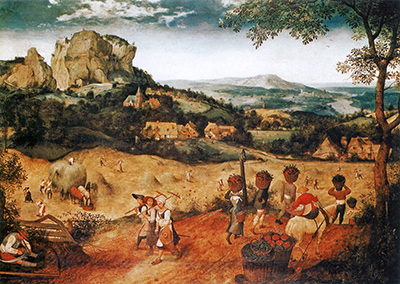
The painted Harvesters has workers, a pause for food and a much wider view from an elevated position. In Summer, the large mower and the raised jug take up substantial portions of a compact design. In the painting, people resting under a tree remain part of a landscape that opens far beyond them. The two works give the viewer different distances from which to understand a pause in harvesting. The design concentrates it near a field’s edge, while the painting sets it beside routes that carry the eye into the distance [1] [5].
The painted Haymaking offers another comparison. The broad ground and distinct routes across it help separate the work of different groups. The drawing shows bodies close together at the front, in a field where grain passes through successive stages and other seasonal tasks remain visible beyond. Return to the curved blade, the hands in the cut crop and the jug. Those details establish the physical demands of the season before the Latin title asks a reader to think of summer as part of the course of a life [1] [5].
Discussion
Which detail in this work most changes how you read it?
Frequently Asked Questions
At the front a seated or kneeling man raises a large jug to his mouth. The jug almost covers his face, and his arm reaches farther above his head than the arms required for most of the work behind him. [1]
The Hamburg sheet measures 22 by 28.6 centimetres and is recorded as accession 21758. The ink date survives at lower centre, and part of the signature at lower left. [1]
References
- Nadine M. Orenstein, ed., Pieter Bruegel the Elder, Drawings and Prints, The Metropolitan Museum of Art, 2001, nos. 109–110, View source.
- The Metropolitan Museum of Art, Summer (Aestas), engraving by Pieter van der Heyden, 26.72.23, View source.
- National Gallery of Art, Summer, engraving by Pieter van der Heyden, object record and inscription, View source.
- Maarten Bassens and Joris Van Grieken, Bruegel, The Complete Graphic Works, 2019, View source.
- Kunsthistorisches Museum, The seasons à la Bruegel, View source.








