


 by Tom Gurney
Tom Gurney BSc (Hons) is an art history expert with over 20 years experience
Published on June 19, 2020 / Updated on August 16, 2026
Email: tomgurney1@gmail.com / Phone: +44 7429 011000
Pieter Bruegel Landscape with the Fall of Icarus: Introduction
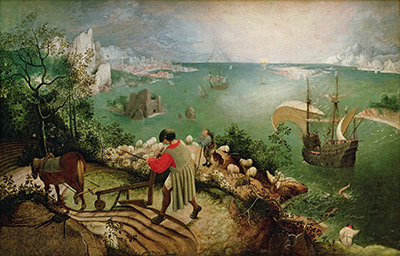
Landscape with the Fall of Icarus is one of the most famous images associated with Pieter Bruegel the Elder, but the Brussels painting should not be presented as a secure autograph work by him. The Royal Museums of Fine Arts of Belgium currently list De val van Icarus under "Pieter I Bruegel (?)", with a question mark in the attribution line, and the museum announced in April 2026 that new technical research was underway to clarify the work's status within Bruegel's oeuvre [1] [2].
That caution does not make the painting less fascinating. In some ways it makes the picture more useful for readers, because it brings together nearly every issue that matters in Bruegel study: landscape, storytelling, everyday labor, copied designs, physical condition, restoration history and the difference between a famous composition and a securely attributed object. The image is unforgettable because Icarus, the mythological figure named in the title, is almost hidden. A ploughman dominates the foreground, a shepherd looks up, ships cross the sea, and at the lower right a pair of legs disappears into the water. Disaster has happened, but ordinary life continues.
For the wider setting, this page is best read alongside the Bruegel paintings overview, the guide to landscapes and seasons, and the explanation of workshop copies and attribution. For difficult cases across the artist's orbit, see disputed attributions.
At a Glance
- Artist / attributiontraditionally associated with Pieter Bruegel the Elder; the Brussels museum record uses "Pieter I Bruegel (?)"
- Common English titleLandscape with the Fall of Icarus
- Museum titleDe val van Icarus
- Mediumoil on canvas
- Dimensions73.5 x 112 cm
- CollectionRoyal Museums of Fine Arts of Belgium, Brussels
- Inventory number4030
- Provenance notebought from The Sackville Gallery, London, in 1912
- Main cautionattribution, date, technique and restoration history are under renewed technical study
- Research statusRMFAB announced on April 9, 2026 that non-invasive analyses and scientific imaging were underway with the Royal Institute for Cultural Heritage; results are expected for a Bruegel exhibition in autumn 2028
This work across Bruegel’s career
Tower of Babel
1563The Harvesters
1565Peasant Wedding
1568Children's Games
1560Triumph of Death
1562–1563Landscape with the Fall of Icarus
This artworkContents
- Introduction
- Attribution Note
- Object Facts And Current Research Status
- What The Painting Shows
- The Myth Behind The Image
- Why Icarus Is Nearly Hidden
- Landscape, Labor And The Sea
- A Bruegelian Idea, But A Questioned Object
- Technique, Restoration And Condition Questions
- How To Discuss The Painting Responsibly
- Annotated Details
Attribution Note
The safest way to describe the work is as the Brussels painting associated with Bruegel, or as a Bruegel-related Fall of Icarus. It is reasonable to explain why the composition has long been connected with Bruegel, but it is not responsible to call the Brussels canvas a settled painting by Pieter Bruegel the Elder.
The museum's own record is the simplest reason for caution. It gives the artist line as "Pieter I Bruegel (?)" and records the work as inventory number 4030 [1]. The question mark is not decoration. It tells the reader that the attribution is not being stated with the same confidence as securely accepted Bruegel paintings such as the Brussels Census at Bethlehem or Fall of the Rebel Angels.
The museum's April 2026 notice makes the point even clearer. RMFAB states that The Fall of Icarus has raised questions about attribution, dating, painting technique and the extent of restoration. The museum also says that new technical research is being undertaken to clarify the work's place in Bruegel's oeuvre, in collaboration with the Royal Institute for Cultural Heritage, using non-invasive analyses and scientific imaging [2].
That means the current public position is a careful one: famous, Bruegel-related, historically important, but not settled as autograph. The results of the new study had not been announced in the April 2026 notice; the museum said they would be unveiled at an autumn 2028 Bruegel exhibition [2]. Until those results are known, the responsible wording is cautious.
Annotated Details from Landscape with the Fall of Icarus
The numbered details show how ordinary work and travel continue around Icarus's almost invisible fall, before the scene opens into sea, harbour and sunset.
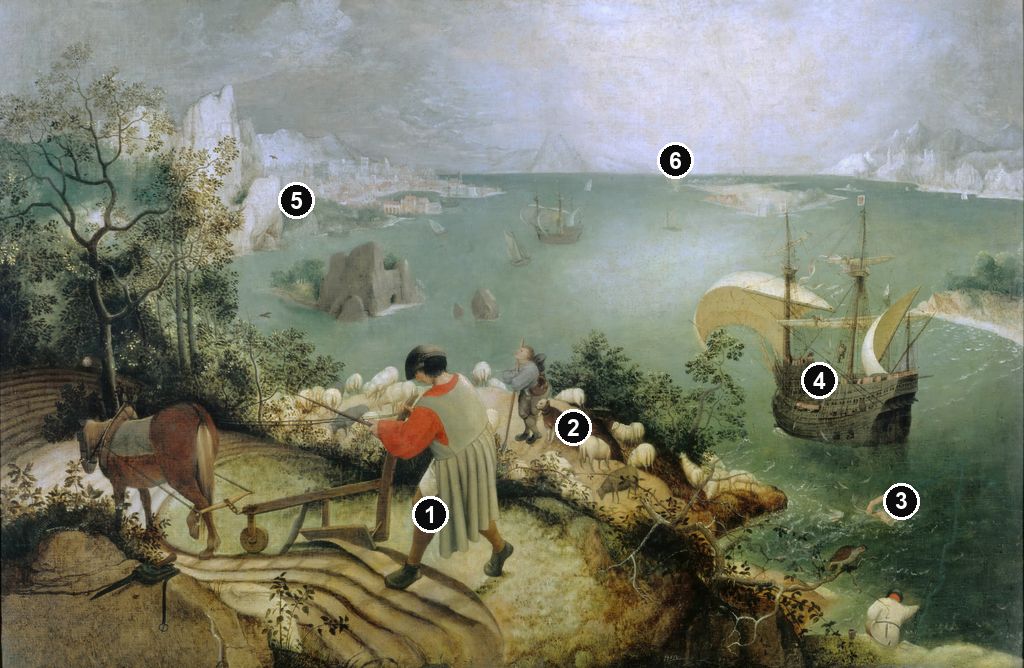
Details from LANDSCAPE WITH THE FALL OF ICARUS
Close looking reveals how a tiny disaster is absorbed into the painting's larger rhythms of labour, travel and distance.
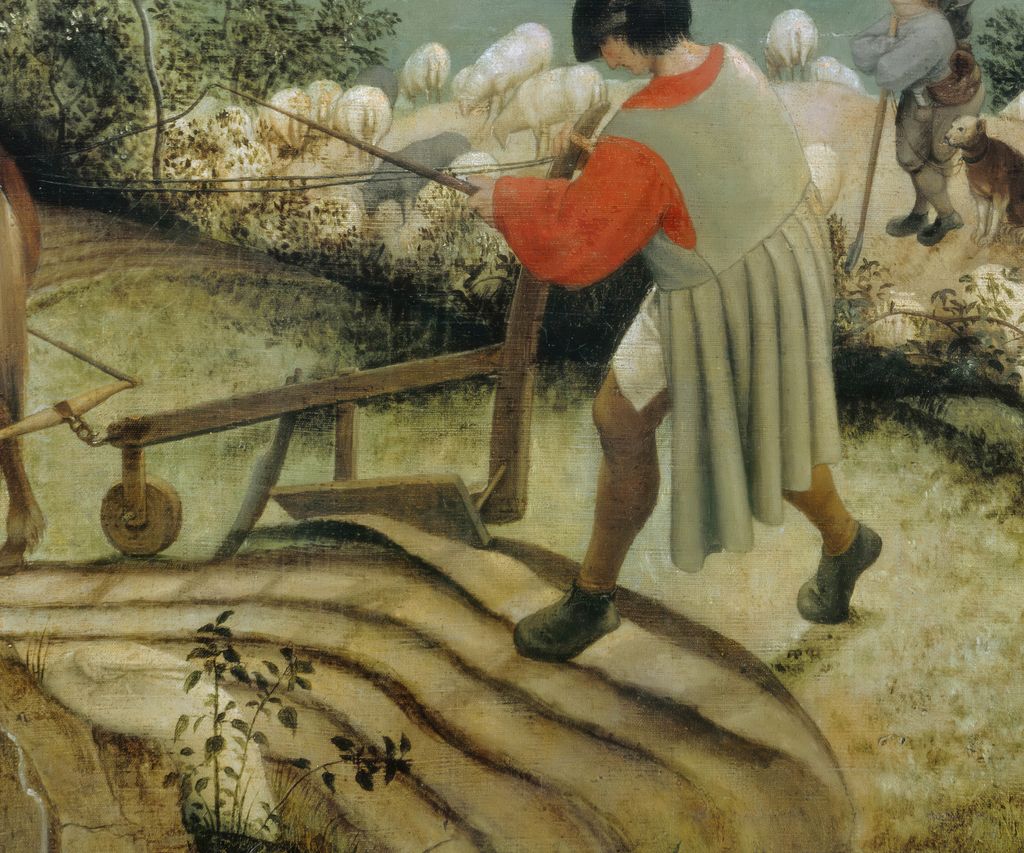
Ploughman and horse
The ploughman leans into his furrow behind the broad flank of his horse, making steady work the dominant action in the foreground.
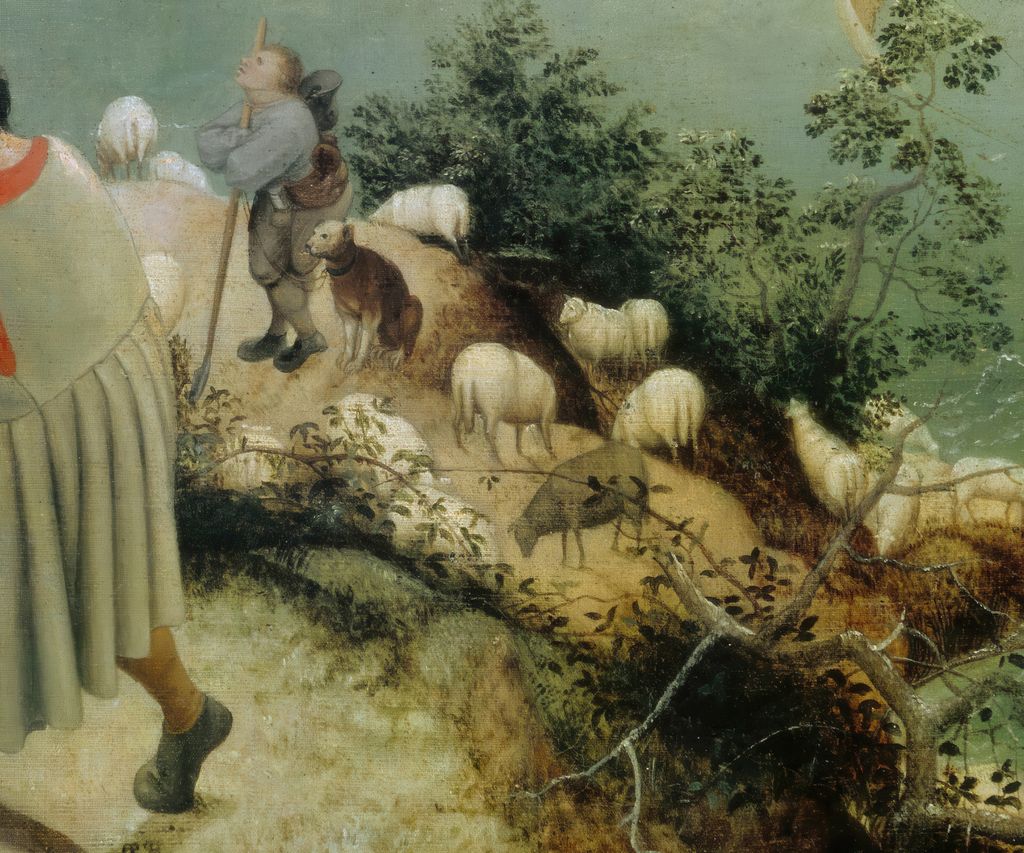
Shepherd and flock
A shepherd tilts his face toward the sky while his dog and sheep cluster along the descending edge, all turned away from the splash below.
Icarus beside the fisherman
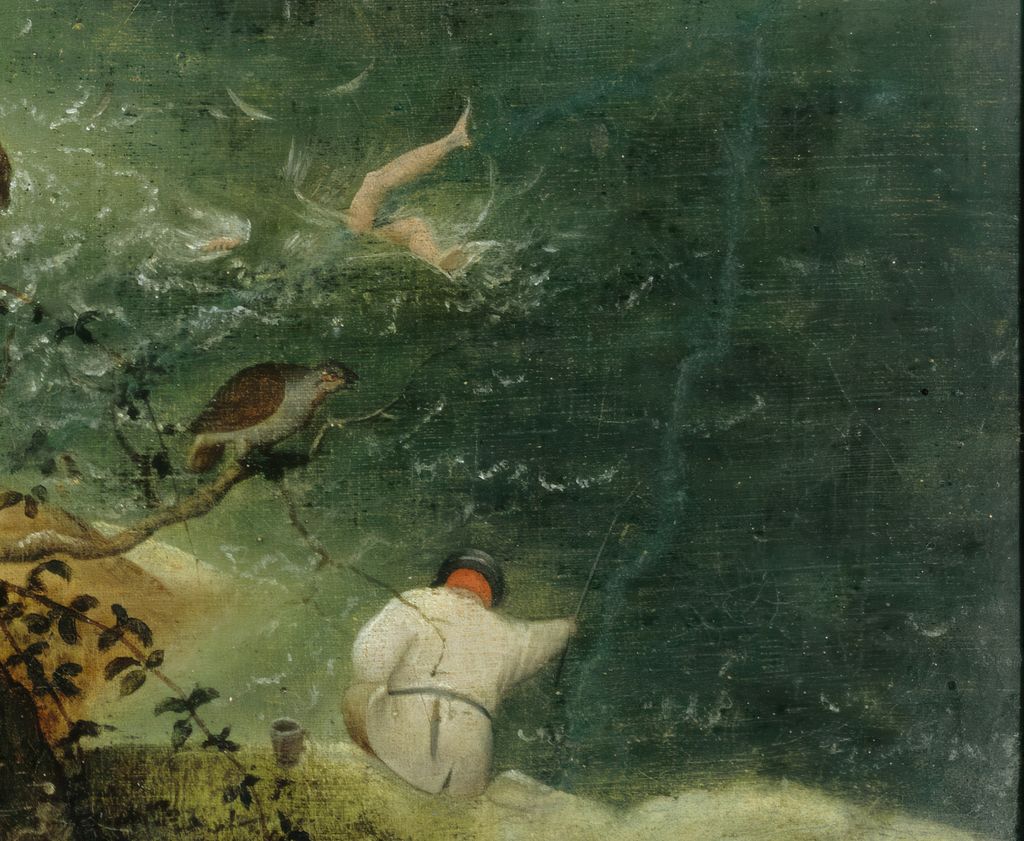
Only two pale legs and a small burst of foam mark Icarus's fall, while the nearby fisherman remains bent over the water.
Merchant ship
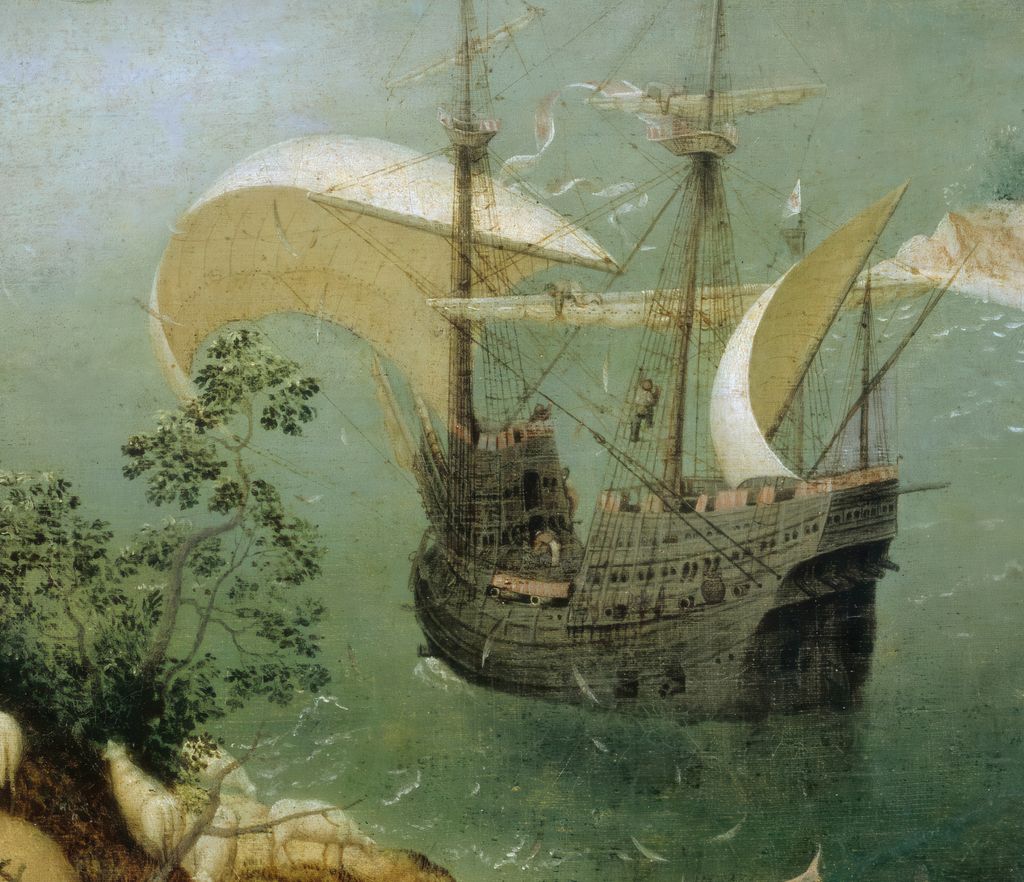
The richly rigged vessel catches the wind at close range, its swelling sails and dark hull passing the unnoticed figure in the water.
Harbour and cliffs
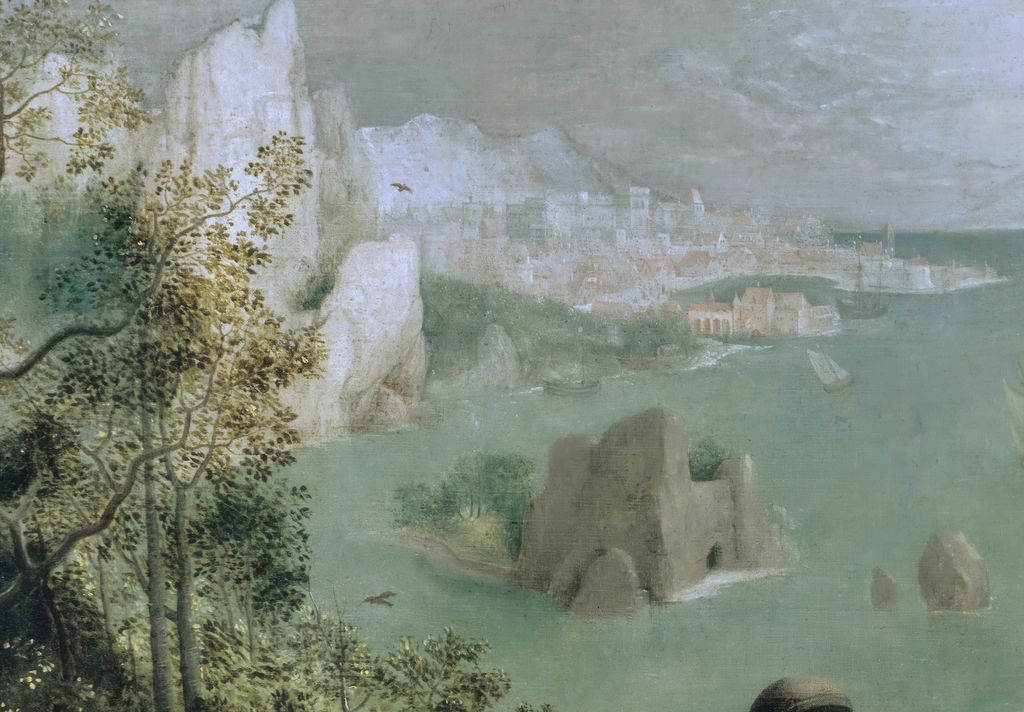
Pale cliffs, clustered roofs and small anchored boats recede through the haze, extending the working world far beyond the foreground figures.
Setting sun and distant coast
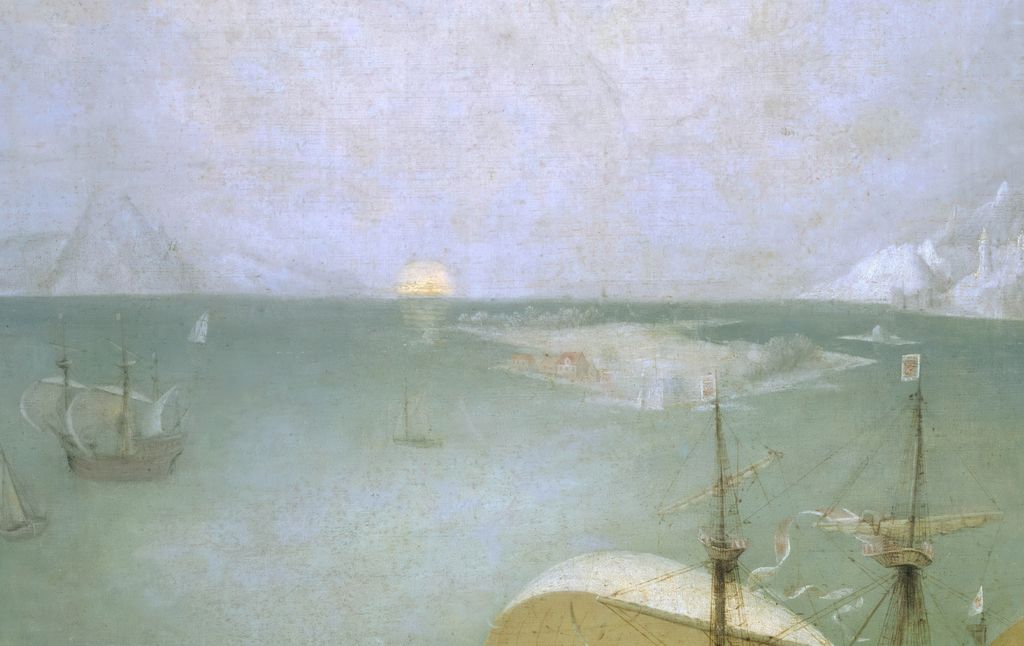
The small sun sits on the horizon between distant shores, drawing the eye through bands of pale sky, green water and misty land.
Object Facts And Current Research Status
RMFAB's collection record gives the title in Dutch as De val van Icarus, lists the medium as oil on canvas, gives the dimensions as 73.5 by 112 cm, and states that the painting was bought from The Sackville Gallery in London in 1912 [1]. Those facts establish the Brussels object: a canvas in the Royal Museums of Fine Arts of Belgium, historically attached to Bruegel's name but now publicly marked with an attribution question.
The April 9, 2026 research notice should shape how the painting is discussed. RMFAB described the painting as admired by the public but surrounded by questions. The museum identified four linked issues: who painted it, when it was made, how it was painted, and how much of what viewers see has been affected by restoration [2].
The research described in that notice is material rather than speculative. Non-invasive analysis and scientific imaging can examine paint structure, surface condition, hidden drawing, changes, damage and later intervention without taking large samples from the object. Such methods do not by themselves deliver a simple yes-or-no answer about authorship, but they can provide evidence that helps specialists compare the canvas with accepted Bruegel works, known copies and workshop-related pictures.
The notice also matters because it places the painting in an active research moment. RMFAB said the famous painting was expected to return to the museum around October 2026, while the results of the research would be presented at an exhibition on Pieter Bruegel the Elder in autumn 2028 [2]. That timetable means any present discussion should avoid implying that the 2028 findings are already known.
What The Painting Shows
The composition is built around a strange imbalance. The title points toward Icarus, but the eye first meets a ploughman. He fills the left foreground, walking behind his horse, cutting a furrow across a steep field above the sea. His red garment and strong placement make him far more visible than the mythological tragedy.
Behind him, a shepherd stands with his flock. He looks upward, not toward the water where Icarus is drowning. Lower down at the right, a fisherman works near the shore. Farther out, ships move across a broad expanse of water. A large vessel passes close to the spot where Icarus has fallen, its sails and rigging more commanding than the body in the sea.
Icarus himself is reduced to two legs and a splash near the lower right edge. There is no heroic body plunging through the sky, no dramatic burst of wings at the center, no theatrical group of witnesses rushing to help. The most important event has been made visually small. A viewer can miss it on a first look, which is precisely why the picture has become so memorable.
This structure makes the painting feel like a landscape first and a mythological scene second. The field, coast, harbor, islands and ships create the main visual world. The human figures occupy that world according to their own tasks: ploughing, shepherding, fishing, sailing. Icarus enters the scene almost as an interruption that the scene refuses to reorganize around.
The Myth Behind The Image
The story comes from the myth of Daedalus and Icarus, most famously told in Ovid's Metamorphoses. Daedalus, trapped on Crete, builds wings from feathers and wax so that he and his son can escape by air. He warns Icarus to keep a middle course, avoiding both the damp sea and the heat of the sun. Icarus flies too high, the wax softens, the wings fail, and he falls into the sea [5].
Ovid's version includes figures who are crucial for understanding the Bruegel-related composition. A fisherman, a shepherd and a ploughman see Daedalus and Icarus in flight and wonder at them [5]. In the Brussels painting, those figures remain, but their relation to the tragedy is transformed. The ploughman no longer looks amazed at the airborne figures. The fisherman does not become a rescuer. The shepherd's gaze does not guide us clearly to Icarus. The witnesses of the poem become workers absorbed into a world of routine.
That shift is the painting's great visual irony. Ovid's story is about a spectacular fall caused by overreaching flight. The Brussels composition turns that spectacular fall into a marginal incident within a larger landscape. The viewer knows the title and searches for Icarus; the people in the painting continue their business.
The result is not a denial of tragedy. It is a different kind of tragedy. The picture suggests that catastrophe can happen while the world remains bright, active and indifferent. A boy has fallen from the sky, but the plough still cuts the earth, the flock still grazes, the fisherman's line still meets the water, and ships still follow their course.
Why Icarus Is Nearly Hidden
Icarus's near-invisibility is the central experience of the painting. In many mythological images, the named hero anchors the composition. Here the title character is almost displaced by the systems around him: agriculture, maritime trade, animal care, distance, weather and light. The painting asks viewers to work backward from the title to the image, and then to notice how little the image seems to care about the title.
This is why the work is often discussed as an image of attention. The viewer may begin by asking, "Where is Icarus?" Once the legs are found, the question changes: "Why is he so small?" The answer lies in the composition's hierarchy. The painting gives scale, color and foreground force to the ploughman. It gives breadth and movement to the sea and ships. It gives only a narrow, almost absurd sign to Icarus.
That reversal creates a moral and perceptual puzzle. It may suggest the limits of human importance within the world. It may suggest the persistence of labor after private disaster. It may also suggest the danger of looking in the wrong place. The shepherd looks upward; the viewer looks around; the painting's title points downward to the corner.
The effect depends on restraint. If Icarus were large, central and theatrical, the painting would become a conventional disaster scene. By making him nearly hidden, the composition makes the viewer experience neglect. The fall is not only represented; it is almost overlooked.
Landscape, Labor And The Sea
The most powerful figure in the painting is the ploughman. His body, horse and plough create the picture's foreground engine. The diagonal of the field pulls the eye down toward the water, but the worker's repeated movement also suggests continuity. This furrow follows the last one and precedes the next. In that rhythm, myth becomes secondary to labor.
Bruegel's accepted paintings often give landscape and work this kind of structural authority. The seasonal pictures, including The Harvesters and Hunters in the Snow, do not treat peasants as isolated anecdotes. They place human action inside large systems of weather, terrain, food, distance and time. The Brussels Icarus composition belongs naturally in that landscape tradition, even though the attribution of the object itself remains questioned.
The sea is equally important. It is where Icarus dies, but it is also a route for ships and trade. The large vessel near the right side does not stop for the drowning figure. Its scale makes Icarus seem smaller still. The water becomes a place of both mythic death and ordinary movement. That double role gives the painting much of its severity.
The shepherd and fisherman extend the theme. Each is connected to a form of work and attention. The shepherd watches the sky or distance; the fisherman looks down toward the water; the ploughman looks toward the earth. Together they form a sequence of gazes that do not gather around Icarus. The painting converts Ovid's astonished witnesses into figures whose attention misses, shifts away from or absorbs the fall.
A Bruegelian Idea, But A Questioned Object
The painting feels Bruegelian because its pictorial intelligence resembles problems Bruegel handled with extraordinary skill: a high viewpoint, an expansive landscape, small figures arranged in meaningful tension, and a subject whose moral force comes through visual organization rather than a single dramatic gesture. It also belongs to a broader Bruegel world in which ordinary activity can carry philosophical weight.
Yet "Bruegelian" is not the same as "painted by Pieter Bruegel the Elder." This distinction is essential. A composition can descend from Bruegel, preserve a lost Bruegel idea, or imitate Bruegel's manner without being an autograph work. The history of the Bruegel and Brueghel family makes this especially important. Pieter Brueghel the Younger and his studio produced many versions and copies after the elder artist's compositions, and later artists and followers helped circulate Bruegelian designs in different forms [4].
The Brussels Icarus has often been discussed in precisely this space between invention and execution. A 2013 peer-reviewed article by Dominique Allart and Christina Currie reported that scientific examination led them to conclude that the Brussels painting was not by Pieter Bruegel the Elder and was likely an old copy after a lost original by him [3]. That article also discussed a second version at the Van Buuren Museum in Brussels and emphasized how technical evidence, condition and underdrawing affected the attribution question [3].
That scholarly conclusion is important, but the current museum wording still requires care. RMFAB's 2026 notice did not announce a final new attribution. It announced further research to clarify the painting's status [2]. A balanced public account can therefore say that serious scholarship has argued for a copy after a lost Bruegel original, while also noting that the museum's current research process is ongoing.
Technique, Restoration And Condition Questions
The Van Buuren painting helps explain why the title alone cannot identify the evidence for either version. Daedalus is visible in its sky, and the sun sits higher than in the better-known museum canvas. The change in the sun’s position matters in a myth in which heat loosens wax and brings a flight to an end. Even so, a detail that fits Ovid more explicitly cannot establish which object came first. Both pictures preserve a broad landscape and a small catastrophe, and an artist copying or modifying the design could adjust how much of the myth is visible [6] [3].
The versions also call for different tests. The Van Buuren painting is on panel. The wood-ring evidence discussed by Dominique Allart supports a late-sixteenth-century date for that version. Allart and Christina Currie cite radiocarbon dating of the canvas and examination of a paint cross-section in their study of the Royal Museums picture. Neither test can name the person who held the brush. Their judgement that the Royal Museums work is an early copy combines those findings with the character of the underdrawing and paint surface. The museum’s question mark and that stronger scholarly judgement can be presented side by side, with each attached to its source [1] [3] [6].
Attribution is not decided by style alone. The Brussels Icarus raises questions about support, paint handling, underdrawing, restoration and condition. RMFAB's 2026 notice names painting technique and the extent of restoration among the problems now being investigated [2].
The 2013 Allart and Currie article gives a sense of why those issues matter. Its abstract reports that analysis of a paint cross-section and radiocarbon dating of the canvas supported the idea of an old copy, while infrared reflectography revealed an underdrawing the authors did not consider characteristic of Pieter Bruegel the Elder or Pieter Brueghel the Younger [3]. The same summary notes that worn and retouched paint, yellowed varnish and poor condition complicated attribution [3].
For a reader, the key point is that the visible surface is not a transparent window onto the moment of making. A painting's present appearance can include original paint, later repairs, losses, varnishes, retouching and changes produced by age. Scientific imaging helps separate some of those layers. It can reveal an underdrawing beneath paint, show how forms were built, identify damage and compare technical features with other works.
This does not reduce the painting to laboratory data. It makes the looking more precise. The visual brilliance of the composition remains, but the physical object asks different questions: who made this version, when, from what model, using what method, and how much has later intervention changed what we see? Those questions are not distractions from the art. They are part of the art's recent history.
How To Discuss The Painting Responsibly
A responsible description should keep two truths together. First, Landscape with the Fall of Icarus is one of the most powerful images connected with Bruegel's name. Second, the Brussels painting is attribution-sensitive and should not be called a secure autograph work by Pieter Bruegel the Elder.
Good wording includes "the Brussels painting associated with Bruegel," "the Bruegel-related Fall of Icarus," "the painting traditionally associated with Bruegel," or "the questioned Brussels Icarus." Those phrases preserve the familiar connection while warning readers that the object basis is complicated.
Avoid flattening the issue into a dramatic verdict. It is too simple to say either "Bruegel painted it" or "it has nothing to do with Bruegel." The composition may preserve a Bruegel invention even if the surviving Brussels canvas was painted by another hand. That possibility is one reason copies and versions matter so much in Bruegel study.
It is also important not to jump ahead of RMFAB's announced research. The 2026 notice says that results are expected in autumn 2028 [2]. Until then, claims about what the new analyses prove should be avoided. The best language is patient: the work is under renewed study, its attribution has been questioned, and its place in Bruegel's oeuvre remains a matter for evidence-led assessment.
Why The Painting Still Matters
The painting matters because its composition changed how generations have imagined the Icarus myth. Instead of showing a central falling body, it shows a world that has barely noticed the fall. That decision gives the image unusual modern force. It speaks to catastrophe, indifference, attention and scale without needing a crowded tragic stage.
It also matters as a landscape. The field, sea, distant coast and ships are not background scenery. They carry the meaning. The ploughman's labor, the shepherd's upward gaze, the fisherman's downward attention and the ship's onward movement create a world of divided awareness. Icarus is the title, but the landscape is the argument.
Finally, the painting matters because uncertainty itself is instructive. Many viewers first encounter Bruegel through famous images reproduced without much label information. This work teaches a better habit: look closely, enjoy the image, but read the attribution line. A questioned Bruegel-related painting can be visually profound, historically famous and intellectually important without being securely by Bruegel's hand.
That is not a loss. It is a more accurate way to admire the work. The Brussels Icarus remains compelling because it sits at the meeting point of myth, landscape, labor and evidence. Its mystery is not only the tiny pair of legs in the water. It is also the larger question of how a celebrated image survives, changes hands, changes labels and continues to ask for careful looking.
Discussion
What feels most revealing about Pieter Bruegel the Elder: the village detail, the landscape setting, the moral wit, or the way everyday life becomes a complete world?
Reader Insights
Begin with one small action in a Bruegel scene, then follow how it connects to the surrounding figures, setting and rhythm of the whole image.
Connect the work to Northern Renaissance visual culture, printmaking, proverb traditions and Bruegel's interest in rural and urban life.
Which detail changes the interpretation most once you know the subject, date, proverb source or present collection?
Join the Conversation
Have a thought or observation about Pieter Bruegel the Elder? Share it below. Thoughtful responses may be added to this section as the Bruegel pages develop.
Frequently Asked Questions
Landscape with the Fall of Icarus is one of the most famous images associated with Pieter Bruegel the Elder , but the Brussels painting should not be presented as a secure autograph work by him. The Royal Museums of Fine Arts of Belgium currently list De val van Icarus under "Pieter I Bruegel (?)", with a question mark in the attribution line, and the museum announced in April 2026 that new technical research was underway to clarify the work's status within Bruegel's oeuvre . [1][2]
The museum's own record is the simplest reason for caution. It gives the artist line as "Pieter I Bruegel (?)" and records the work as inventory number 4030 . [1]
RMFAB's collection record gives the title in Dutch as De val van Icarus , lists the medium as oil on canvas, gives the dimensions as 73.5 by 112 cm, and states that the painting was bought from The Sackville Gallery in London in 1912 . Those facts establish the Brussels object: a canvas in the Royal Museums of Fine Arts of Belgium, historically attached to Bruegel's name but now publicly marked with an attribution question. [1]
The story comes from the myth of Daedalus and Icarus, most famously told in Ovid's Metamorphoses . Daedalus, trapped on Crete, builds wings from feathers and wax so that he and his son can escape by air. [5]
References
- Royal Museums of Fine Arts of Belgium, Pieter I Bruegel (?) De val van Icarus, View source.
- Royal Museums of Fine Arts of Belgium, *New technical study of The Fall of Icarus*, published April 9, 2026.
- Dominique Allart and Christina Currie, *Trompeuses séductions. La Chute d'Icare des Musées royaux des Beaux-Arts de Belgique à Bruxelles*, CeROArt, 2013.
- KIK-IRPA, *The Brueg(H)el Phenomenon: Paintings by Pieter Bruegel the Elder and Pieter Brueghel the Younger with a Special Focus on Technique and Copying Practices*, 2012.
- Theoi Classical Texts Library, Ovid, Metamorphoses, Book 8, Daedalus and Icarus, View source.
- Dominique Allart, Échos d’un chef-d’œuvre perdu de Pierre Bruegel l’Ancien. Les deux versions de la Chute d’Icare conservées à Bruxelles, View source.







