



 by Tom Gurney
Tom Gurney BSc (Hons) is an art history expert with over 20 years experience
Published on June 19, 2020 / Updated on August 16, 2026
Email: tomgurney1@gmail.com / Phone: +44 7429 011000
Pieter Bruegel Peasant Wedding: Introduction
Pieter Bruegel the Elder's Peasant Wedding is one of the most famous images of rural celebration in European art. Painted in 1568 on oak and now on view in the Gemäldegalerie of the Kunsthistorisches Museum in Vienna, it places the viewer inside a crowded wedding feast where food, custom, appetite and social rank all press into the same barn-like room [1]. The picture looks immediate, almost as though Bruegel had caught one busy instant of village life. The Kunsthistorisches Museum, however, stresses that this apparent instant is carefully composed [1].
That tension is the key to the painting. Peasant Wedding is not a loose record of rustic charm, nor is it a simple joke at the expense of rural people. Bruegel gives the scene weight and order. The bride sits before a green cloth beneath a paper crown. Men carry bowls of porridge or gruel on an unhinged door. Guests crowd the long table. A lawyer, a Franciscan friar and the local lord appear at the right, marking the feast as a social world with ranks and witnesses as well as hunger and celebration [1]. The painting belongs with Bruegel's late peasant subjects, but it also belongs with the larger art of Pieter Bruegel the Elder: compositions that seem full of happenstance until their structure slowly becomes visible.
At a Glance
- ArtistPieter Bruegel the Elder
- TitlePeasant Wedding
- Datec. 1568
- Medium and supportPainting on oak wood
- CollectionKunsthistorisches Museum, Gemäldegalerie, Vienna
- Current displayOn view in the Gemäldegalerie, Room X
- InventoryGemäldegalerie, 1027
- Dimensions113 x 164 x 3.2 cm overall; KHM notes that the panel was cut at the bottom and later had 5 cm added back
- Main subjectA Flemish peasant wedding feast
- Key detailsBride before green hanging; paper crown; absent bridegroom; food carried on an unhinged door; lawyer, Franciscan and manor lord at the right
This work across Bruegel’s career
Tower of Babel
1563The Harvesters
1565Peasant Wedding
1568Children's Games
1560Triumph of Death
1562–1563Contents
- Introduction
- Object Facts And Late Career Setting
- What The Wedding Scene Shows
- The Bride At The Still Center
- Food, Service And The Door As Tray
- Wedding Custom And The Absent Bridegroom
- A Carefully Composed Snapshot
- Peasant Imagery, Humor And Dignity
- Elite Viewers And The Rural Feast
- Relation To Bruegel's Other Peasant Works
- Annotated Details
Object Facts And Late Career Setting
The Kunsthistorisches Museum identifies Peasant Wedding as a work by Pieter Bruegel the Elder, dated around 1568, made on oak wood and displayed in the museum's Picture Gallery [1]. That date places it near the end of Bruegel's short career. He died in Brussels in 1569, and KHM gives his life dates as about 1525/30 to 1569 [2]. The painting therefore belongs to the same late moment as some of Bruegel's most concentrated images of rural, biblical and moral life.
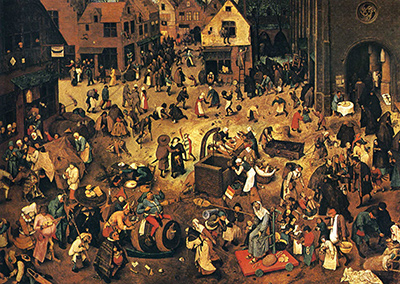
The late date matters because Peasant Wedding is not an early experiment by a painter trying to find his subject. By 1568 Bruegel had already made major panels such as Children's Games, The Fight Between Carnival and Lent, the 1565 seasonal landscapes and The Tower of Babel. His painted work had moved through proverb imagery, seasonal landscape, biblical history, festival scenes and densely peopled public spaces. Peasant Wedding draws on that experience. It compresses a social event into a tight interior, using the same gift for crowd management that makes his large outdoor pictures feel legible.
Vienna is especially important for understanding this painting because the Kunsthistorisches Museum holds the largest collection of Bruegel paintings in the world. The museum's 2018 exhibition noted that about forty paintings, sixty drawings and eighty prints can be attributed to Bruegel today, and that almost a third of his extant paintings are in Vienna [4]. Peasant Wedding is part of that concentration. It can be seen in the same institutional context as KHM's Hunters in the Snow, Children's Games, The Tower of Babel and The Fight Between Carnival and Lent, a group that makes Bruegel's range unusually vivid.
For the broader career, see the Pieter Bruegel biography and the overview of Bruegel's paintings. Those pages explain why his peasant subjects should not be isolated from his work as a designer of prints, maker of landscapes and painter of moral crowd scenes. The Met's account of Bruegel's career makes the same larger point: he is best known today for paintings of peasant life, but his sixteenth-century fame also depended heavily on drawings and prints [6].
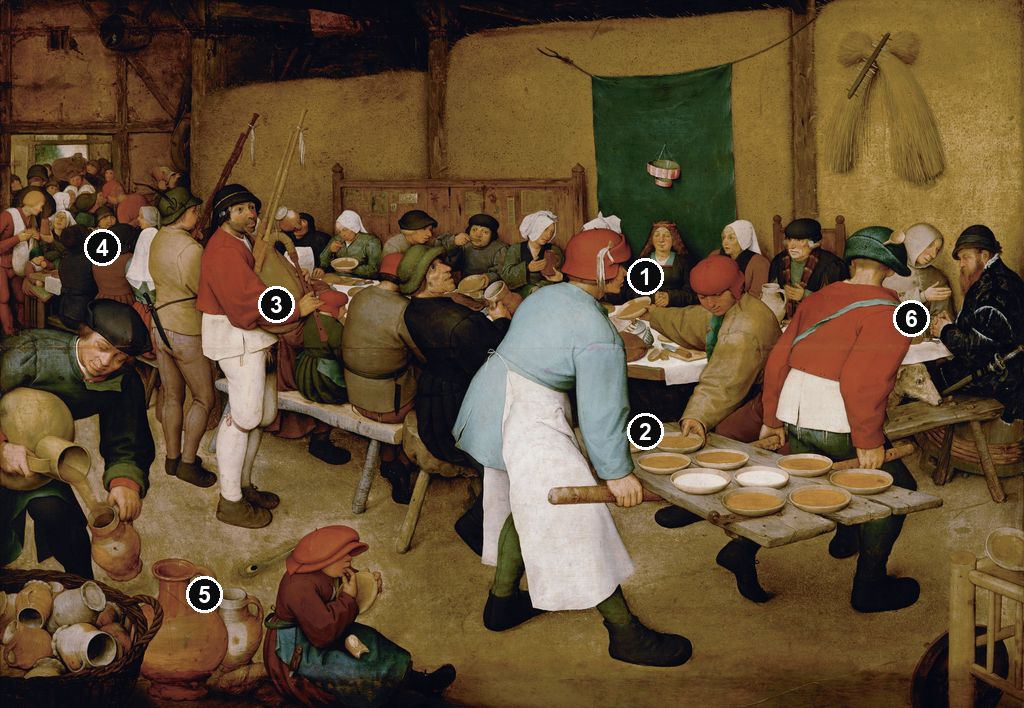
Annotated Details from The Peasant Wedding
The numbered details move from the bride and the busy food service to the musicians, doorway crowd, foreground vessels and attentive guests at the right edge.
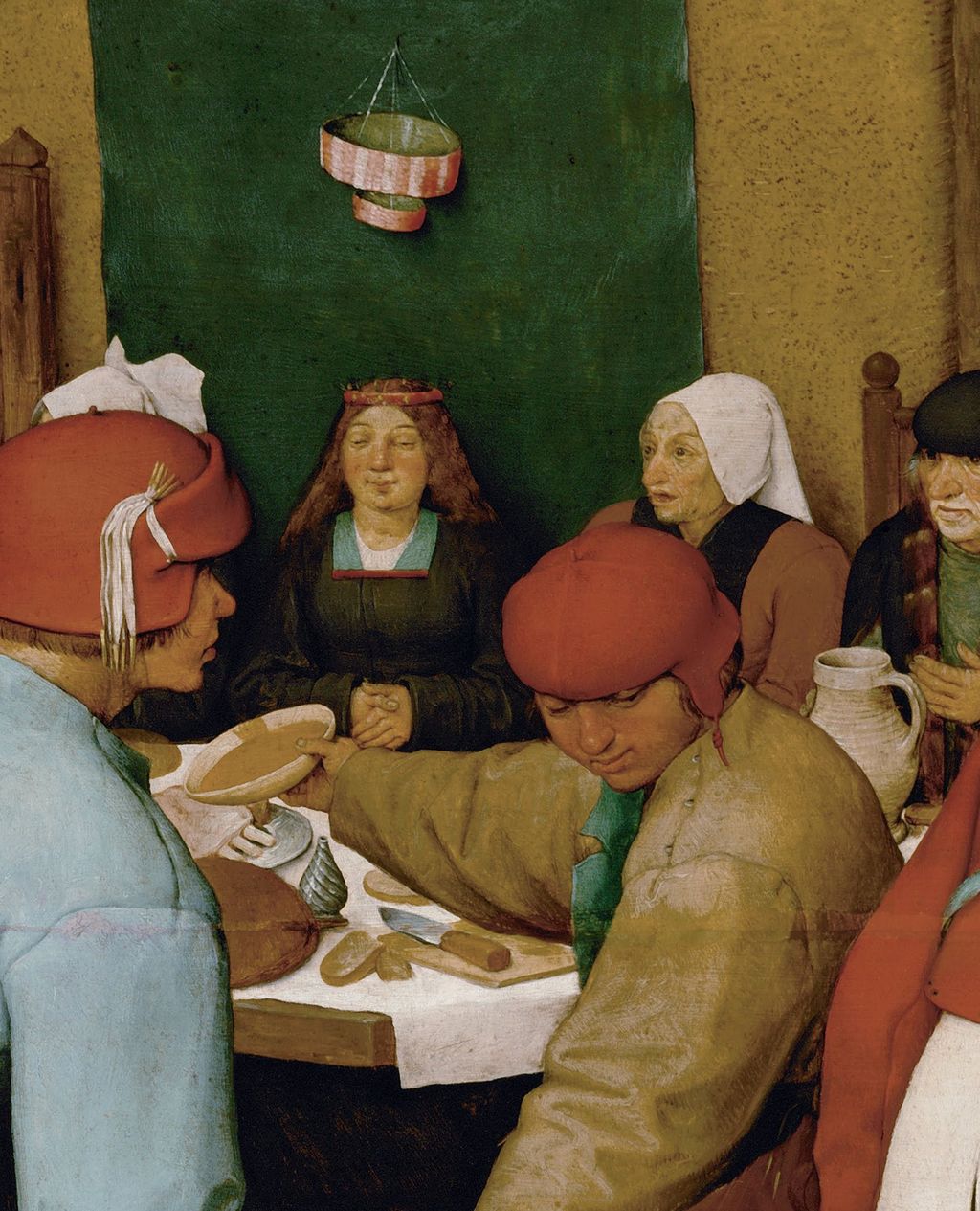
Details from THE PEASANT WEDDING
Close looking reveals how Bruegel builds the feast from overlapping gestures, vessels, clothing and faces across the crowded barn.
Bride beneath the green hanging
The bride sits almost still beneath the broad green cloth, her composed front-facing pose contrasting with the gestures and turned heads around her.
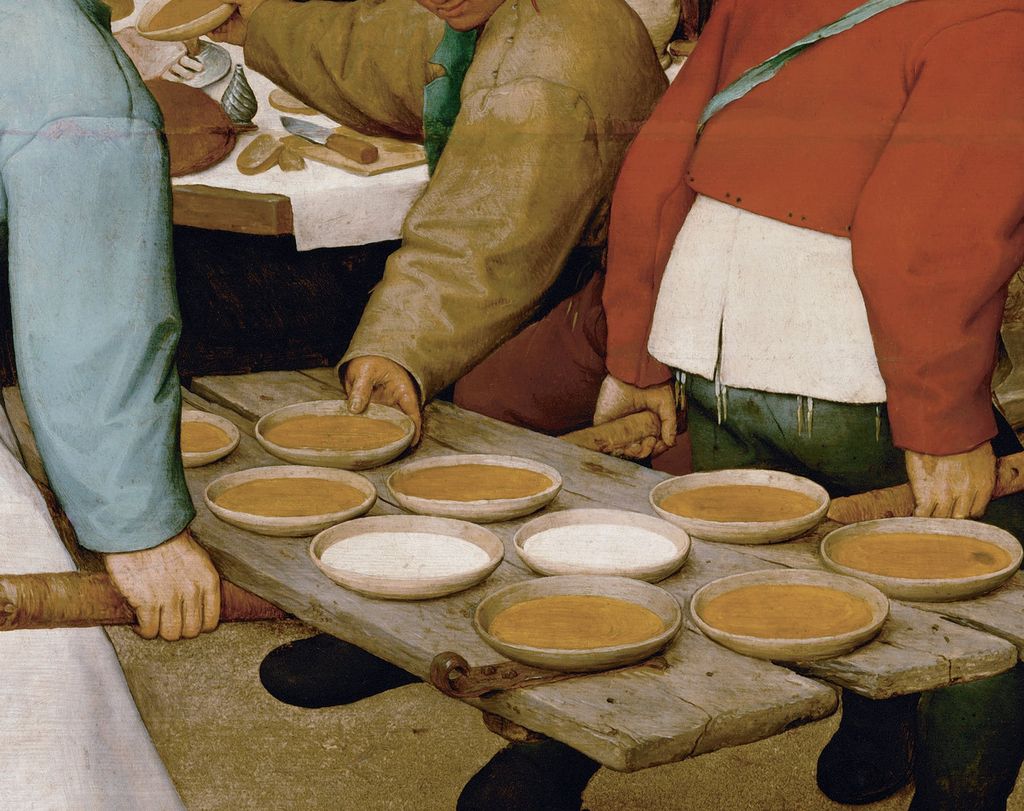
Food bearers and improvised tray
Two servers carry rows of shallow bowls on a broad wooden door, creating a strong diagonal passage through the seated guests.
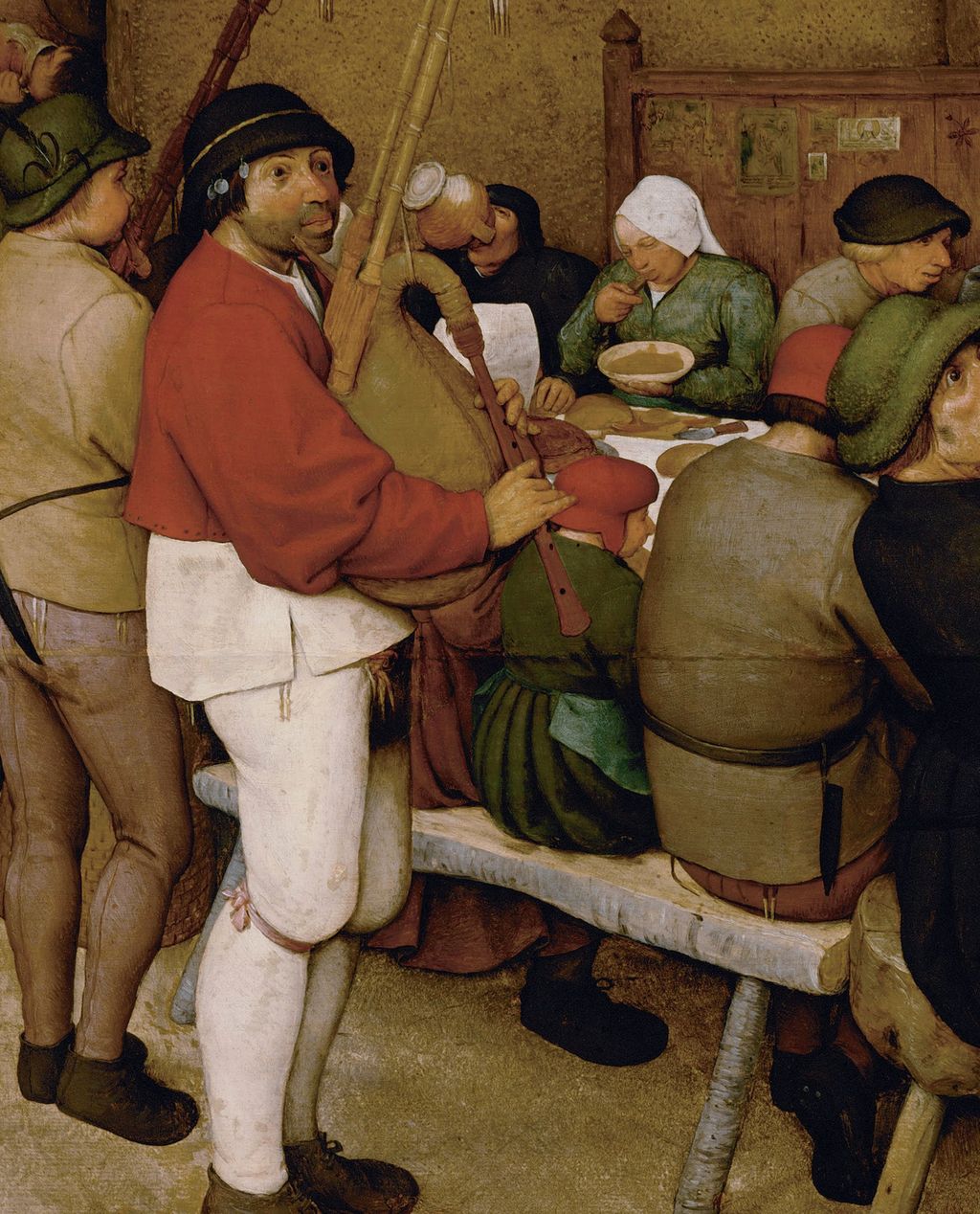
Bagpipers beside the table
The bagpipers' long pipes rise above the diners while the nearest musician looks outward, linking the music to the viewer's space.
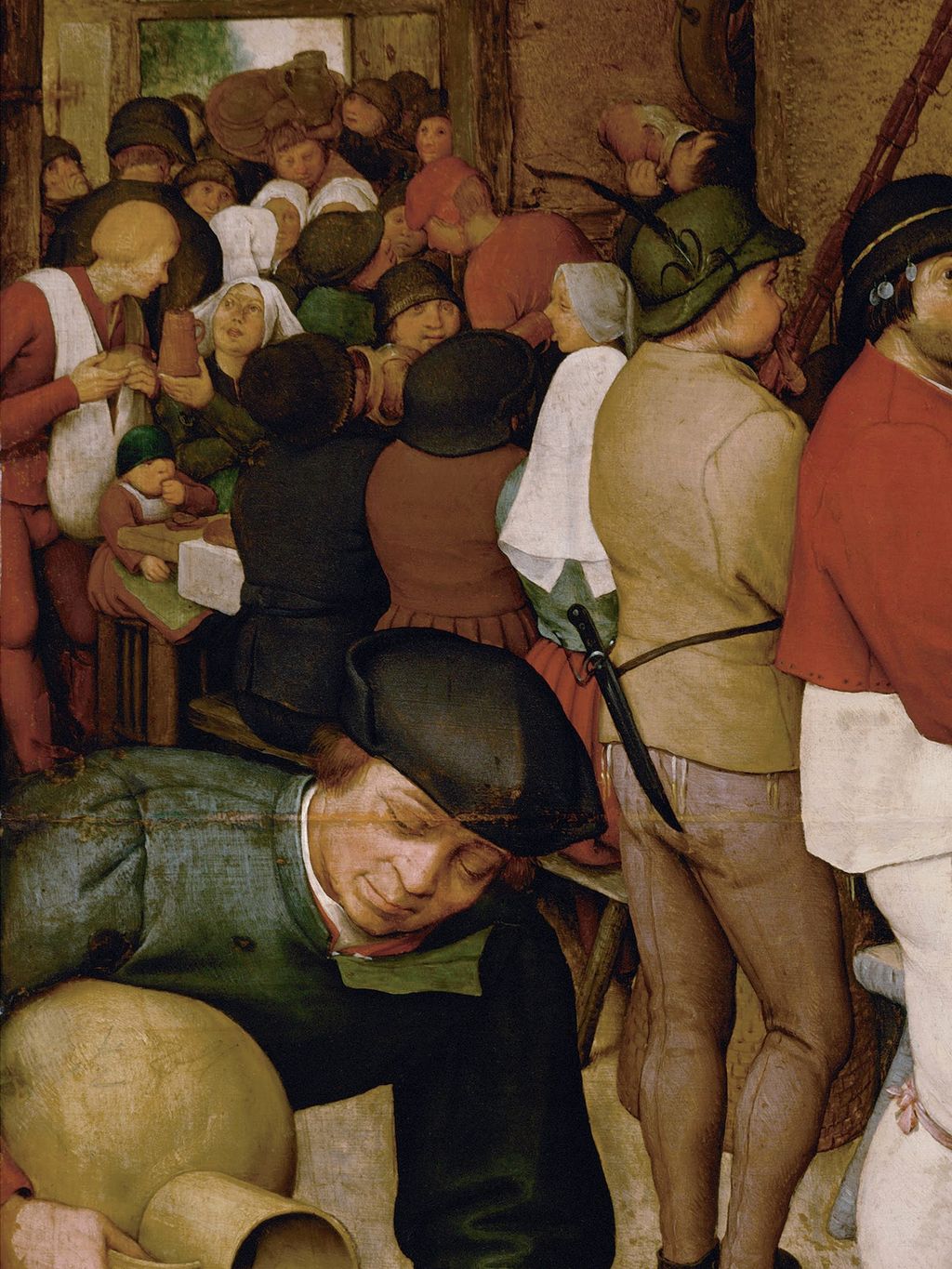
Doorway crowd and beer service
Faces press through the open doorway while a guest pours from a large jug, compressing arrival, service and conversation into one busy corner.
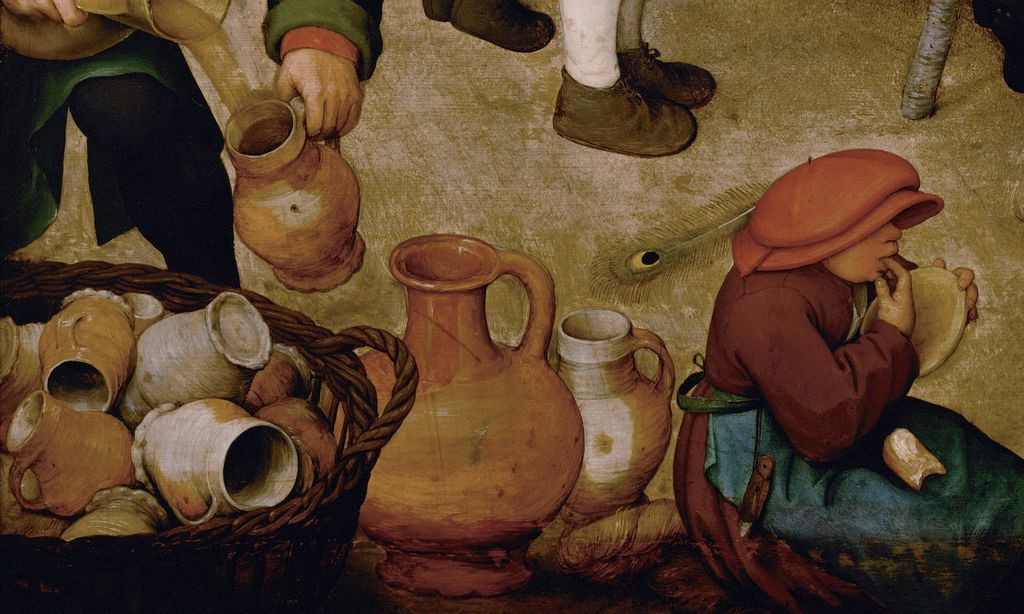
Child among jugs and baskets
A child eats in the foreground beside a dense still life of earthenware jugs and a tipped basket, bringing the feast down to an intimate scale.
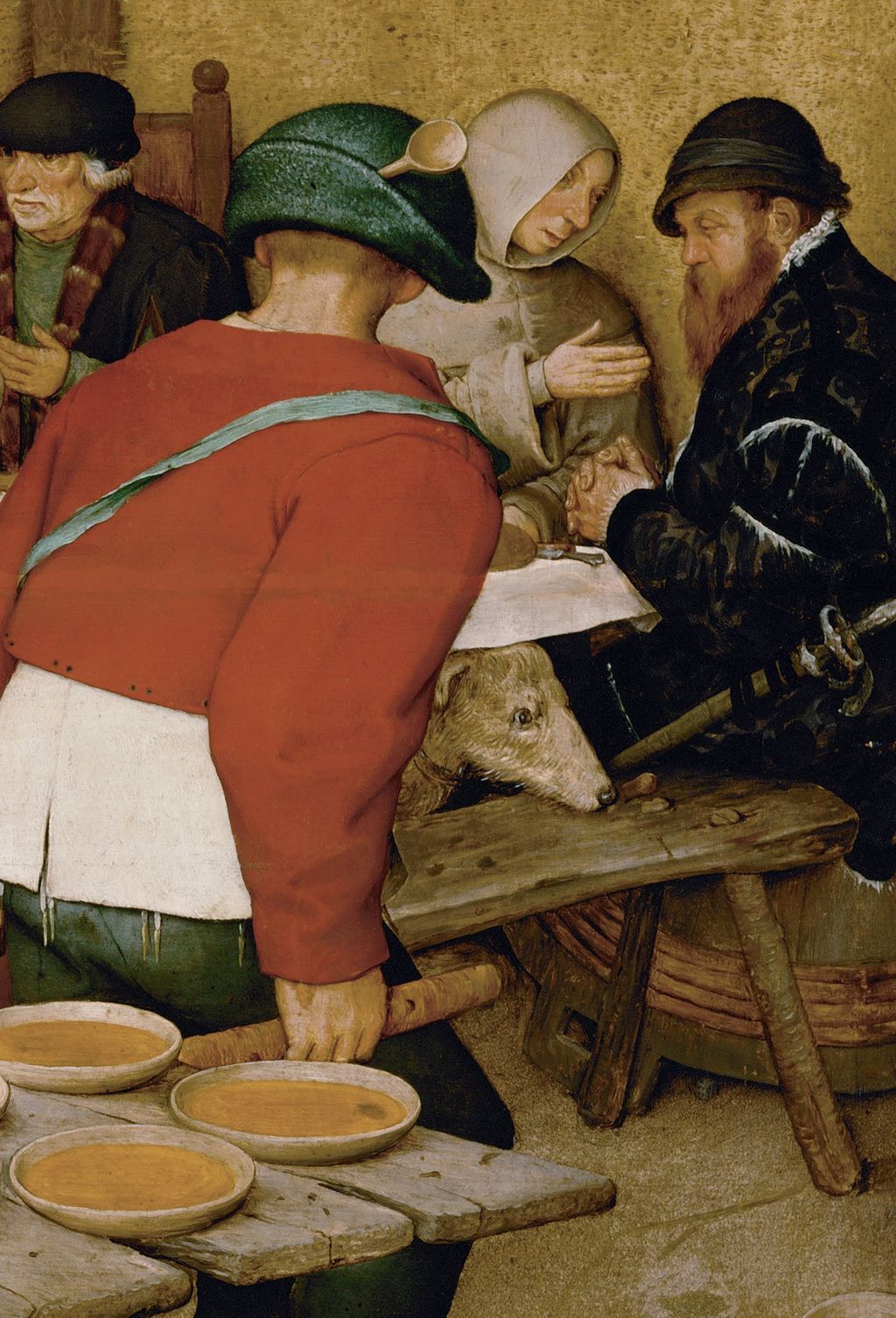
Distinguished guests and tethered calf
At the table's right edge, darker clothes and attentive gestures frame a small calf whose head appears unexpectedly beneath the seated figures.
What The Wedding Scene Shows
The setting is a feast in a rural interior. A long table runs across the back half of the picture. Behind it is a high wall of straw or bundled grain, turning the room into a working barn as well as a festive hall. The bride sits in front of a green hanging. Above her, KHM notes, hangs a paper crown [1]. She does not dominate by action. She is seated, still, and framed. Her importance comes from position, custom and the quiet way the composition gathers around her.
The most active movement comes from the serving line in the foreground. Two men carry a door that has been taken from its hinges and turned into a tray. On it are simple bowls of food. KHM identifies these as porridge dishes and emphasizes both their plainness and the striking posture of the carriers [1]. The detail is famous because it is both practical and theatrical. The door is an improvised tool, but within the painting it becomes a diagonal stage prop. It leads the eye from the lower right toward the centre, separating the viewer's space from the packed table beyond.
The guests react in different ways. Some eat, some look, some reach, some wait. A child near the foreground turns toward the food with one finger in a bowl or plate. A bagpiper at the left supplies music, though he too watches the arrival of the dishes. The men at the table do not form a neat line of portraits; they create a rhythm of caps, hands, heads, jugs and bowls. Bruegel's room is crowded, but it is not confused. Each body has a task or a pressure: sitting, carrying, pouring, playing, watching, leaning forward.
At the right, the feast meets the wider social order. KHM identifies a lawyer with a mortar-board, a Franciscan monk and the lord of the manor with his dog [1]. These figures are easy to miss if the viewer treats the picture only as a scene of food and music. Their presence changes the room. A peasant wedding is not sealed off from law, religion or landholding power. The event may be rural, but it is not socially simple.
The Bride At The Still Center
The bride is one of Bruegel's most unusual centres. In many wedding images, one might expect the bride and groom to anchor the story together. Here the bride sits alone before the green cloth. She has a visible crown, but she is not theatrically expressive. She does not reach for food, turn toward a speaker or command the room. She is almost the calmest person in the picture.
That stillness is part of Bruegel's design. The foreground servers create a strong diagonal. The table produces a horizontal band. The heads and caps of the guests form a crowded upper rhythm. Against that activity, the bride becomes a point of rest. She is not the largest figure, but she is the figure most clearly set apart. The green hanging and crown identify her; the surrounding press of bodies makes her quietness more noticeable.
Bruegel's handling of the bride also keeps the viewer from reading the picture as a simple comic scene. There is humor in the crowded room, in the urgent appetite around the food and in the awkwardness of service. Yet the bride's placement gives the ceremony dignity. She is visible because custom and composition make her visible, not because Bruegel turns her into an elegant courtly heroine. Her importance is embedded in the actual terms of the feast.
This balance is typical of Bruegel's best peasant imagery. He does not idealize rural people into graceful figures borrowed from courtly art, but he also does not reduce them to crude caricature. The painting's humor arises from bodies, hunger, crowding and the improvised realities of celebration. Its dignity comes from the seriousness with which those realities are organized.
Food, Service And The Door As Tray
The door carried in the foreground is one of the most memorable details in the painting. It is easy to describe and hard to exhaust. As an object, it suggests the practical resourcefulness of the feast: a large flat surface has been found, removed and turned into a serving tray. As a compositional device, it gives Bruegel a strong diagonal that brings food toward the viewer. As a social detail, it makes labor visible. The meal does not simply appear; it is carried, balanced, served and awaited.
KHM's description stresses the simplicity of the porridge dishes [1]. That simplicity is important. This is a wedding feast, but not a display of luxury. The bowls are plain; the food is ordinary; the handling is physical. The men carrying the door lean into the weight. Their gait matters because Bruegel makes service part of the event's drama. The celebration is not only in the eating; it is also in the work that makes eating possible.
Food often has a special force in Bruegel's art. In The Harvesters, the meal under the tree marks rest within seasonal labor. In The Land of Cockaigne, abundance becomes an image of excess and moral fantasy. In Peasant Wedding, food is closer to social ritual. The bowls move through the room as the wedding gathers everyone into a shared act of waiting, receiving and consuming.
The serving line also controls how close the viewer feels to the event. The men approach from the lower right, as though they are passing in front of us. The door nearly crosses into our space, but it also blocks us from entering too easily. We are close to the feast without becoming one of the guests. Bruegel makes the viewer a witness at the edge.
Wedding Custom And The Absent Bridegroom
One of the most persistent questions about the painting is simple: where is the bridegroom? KHM answers this directly, explaining the absence in relation to Flemish custom: the bridegroom was not present at the wedding feast [1]. That statement should be used carefully. It tells us how the museum understands the scene, and it prevents a misleading hunt for a hidden groom. It does not require a modern viewer to reconstruct every stage of sixteenth-century rural marriage practice from this single image.
The absent bridegroom changes the painting's emphasis. Instead of staging a couple, Bruegel stages a social event around the bride, the food and the assembled community. The wedding is not presented as private romance. It is public, bodily and communal. Its signs are the crown, the cloth, the meal, the table, the servers and the witnesses.
The paper crown above the bride is a small but crucial object. It marks festivity without luxury. It is temporary, ceremonial and modest. The green hanging behind her performs a similar function. It gives the bride a visual backdrop inside a rough space, turning the barn wall into a ceremonial setting. Bruegel is attentive to how ordinary materials can carry ritual meaning.
The presence of the lawyer, friar and lord at the right extends that ritual beyond the table. Weddings involve contract, sacrament, household and social order. Bruegel does not need to spell those categories out. He inserts figures who make them visible. The painting's realism therefore lies not only in observed costumes and gestures, but in the way different parts of society share the same room.
Watch Bruegel’s art
Explore Bruegel with TheHistoryOfArt and artwork discussions from Smarthistory.
Pieter BRUEGEL Explained in 10 Minutes (updated)
A TheHistoryOfArt film about Bruegel.
Watch on YouTubeA Carefully Composed Snapshot
KHM's phrase about the apparent snapshot being carefully composed is the best starting point for reading the picture [1]. The scene feels caught in motion, but it is built with unusual discipline. The foreground diagonal of the serving door, the horizontal table, the vertical supports of the barn and the framed bride all lock together. The result is a painting that looks casual before it reveals how ordered it is.
The composition works partly by contrast. The bride is still; the servers move. The table is crowded; the foreground has larger, more isolated figures. The room feels enclosed; the diagonal tray creates forward momentum. The social types at the right are compressed into conversation and observation; the child in the foreground offers a small note of appetite and immediacy. Bruegel does not need a single dramatic climax. He builds the scene from many small pressures.
This controlled density connects Peasant Wedding to other Bruegel works. Children's Games uses a high viewpoint and a wide urban space to make many small actions readable. The Fight Between Carnival and Lent organizes a town square full of customs, inversions and competing rhythms. Peasant Wedding is more compact, but the intelligence is related. Bruegel trusts the viewer to move through a world of details, then rewards close looking with structure.
The painting also shows why Bruegel's style and technique matter for interpretation. The KHM research project on Bruegel's Vienna panels used non-invasive methods including infrared photography, infrared reflectography, X-radiography, X-ray fluorescence and 3D mapping to study his panel construction, underdrawing, materials and changes [3]. That research context supports a larger point: Bruegel's paintings are made things, not transparent windows. Even when the subject looks informal, the image is the result of decisions about support, drawing, paint, sequence and revision.
Peasant Imagery, Humor And Dignity
Bruegel's reputation has long been tied to peasant subjects. The nickname "Peasant Bruegel" is part of that reception, but it can mislead if it turns the painter into a simple recorder of rural folklore. The Met notes that Bruegel's paintings of Flemish commoners contributed to that nickname and to a mistaken belief that he himself came from peasant birth. The same account stresses that these works show direct observation of village settings while remaining far from simple re-creations of daily life; they are strongly organized images made with sophisticated design [5].
That caution is especially useful for Peasant Wedding. Bruegel knows how to make rural festivity funny. The room is packed; bodies are heavy; appetite is visible; the service is awkward and efficient at once. Yet the humor is not the whole picture. KHM's description of the related Peasant Dance says that Bruegel's view of peasants is neither condescending nor merely humorous, and that a realism close to idealism dominates [7]. Although Peasant Dance is a separate work, the point helps frame the late rural scenes together.
The word "dignity" must be used carefully here. Bruegel does not ennoble the guests by making them polished or elegant. Their dignity comes from the painting's seriousness of attention. Hands grip bowls. Shoes plant on the floor. The servers bear weight. The bride sits beneath her crown. The guests occupy space as full bodies, not as decorative extras. Bruegel's people can be comic and substantial at the same time.
This is why Peasant Wedding remains central to Bruegel's peasant imagery. It sits between observation and construction, sympathy and social distance, humor and ceremony. It asks the viewer to look closely at ordinary bodies and ordinary food without pretending that the act of looking is neutral. The painting was made by an urban professional for viewers likely outside the peasant world it depicts. That distance is part of the work's meaning.
Elite Viewers And The Rural Feast
Claudia Goldstein’s study of the early modern dinner party places pictures of feasting alongside the dining rooms, vessels and furnishings through which elite households represented themselves. That approach changes the questions to ask of Bruegel’s painting. People accustomed to feeding guests might recognise how awkward it is to serve a crowded table, how far the plates have to travel and how little room there is for someone standing behind a bench. They might also be attentive to the differences between the materials of their own rooms and the barn painted here. The viewer’s knowledge of dining can become part of the joke and part of the picture’s appeal [8].
That setting also helps explain why the service deserves close attention. The figure near the end passes food along the diagonal that leads to the bride, whom Vienna’s catalogue identifies as the central figure. The line of dishes and hands makes plain how much work has to happen around her. Guessing which man is the bridegroom is a separate question. The painting already gives enough evidence to follow how the gathering operates, from the opening where people arrive to the space needed by the two men carrying dishes [9].
The presence of elite or semi-elite figures inside the painting mirrors the likely position of many of its early viewers. Bruegel's patrons and collectors were not rural laborers. The Met describes him as patronized mainly by scholars, wealthy businessmen and connoisseurs, and connected with prominent humanists in the Netherlands [5]. KHM's artist account also places him in the Antwerp print world and in contact with figures such as Hieronymus Cock, Abraham Ortelius and the Jonghelinck circle [2].
That context does not make Peasant Wedding cynical. It does make the painting more complex. A wealthy urban viewer could find comedy in the feast, admire Bruegel's descriptive skill, recognize social types, reflect on custom and take pleasure in the painter's control of crowd and space. The painting allows all of those responses without collapsing into any one of them.
The rural setting may also have offered urban viewers a world that felt both familiar and distant. Food, marriage, music and rank were not exotic subjects. Yet the barn interior, plain fare and heavy peasant bodies differ sharply from courtly or biblical grandeur. Bruegel's art often works in that gap. He brings ordinary life into the space of serious painting while refusing to make ordinariness simple.
The lawyer, friar and lord at the right are therefore not just picturesque details. They connect the wedding feast to institutions and to the viewer's awareness of social hierarchy. Their inclusion helps prevent an easy fantasy of rural life as sealed, timeless or innocent. The room is a community, but it is also a structured society.
Relation To Bruegel's Other Peasant Works
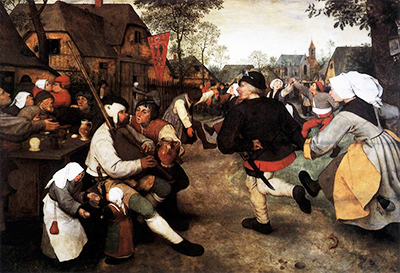
Peasant Wedding is best read alongside Bruegel's other late rural subjects rather than as an isolated emblem. Peasant Dance is the closest KHM companion. It is dated around 1568 and shows a country fair dance, again with robust figures, social observation and a strong sense of physical action [7]. Where Peasant Wedding is interior, compressed and focused on food service, Peasant Dance is outdoor, kinetic and organized around music, motion and festival behavior.
Wedding Dance offers another related point of comparison. It expands the wedding theme into open-air bodily movement, whereas Peasant Wedding turns the event inward toward table, meal and custom. The two subjects show how Bruegel and the Bruegel tradition could treat marriage as both ceremony and social performance.
The Land of Cockaigne is different again. Its rural and bodily imagery turns toward fantasy, idleness and excess. Set beside that world of impossible abundance, the food in Peasant Wedding seems strikingly plain. The bowls carried on the door are not a dream of endless plenty. They are modest dishes within a real ceremony. That difference helps separate Bruegel's modes: he can use peasant bodies for moral fantasy in one work and for communal ritual in another.
The wider paintings page helps keep these relationships in view. Bruegel's rural scenes are part of a painted oeuvre that also includes landscape, biblical narrative, proverb imagery and allegory. His peasant subjects do not define him completely, but they do reveal one of his great inventions: the ability to make everyday people and everyday customs bear the weight of serious composition.
Why The Painting Still Matters
Peasant Wedding still matters because it makes looking feel easy and then makes thinking unavoidable. A visitor can enter through the obvious pleasures: the crowded table, the bagpiper, the child, the door-tray, the bowls, the bride beneath her crown. The painting is immediately readable as a feast. But the longer one looks, the less simple it becomes.
The bride is central but quiet. The groom is absent by custom. The food is plain but ceremonially important. The room is rural but includes law, religion and landholding rank. The scene looks like a moment, yet it is tightly structured. Bruegel turns a wedding meal into a study of how a community gathers, eats, watches, serves and recognizes itself.
The painting also matters because it resists two common mistakes. It should not be reduced to folklore, as though Bruegel simply preserved quaint village customs for modern amusement. It should not be overburdened with unsupported claims about politics, class attitude or hidden allegory. KHM describes the painting as a realistic account of a Flemish peasant wedding and at the same time insists on its careful composition [1]. Those two points are enough to make the work powerful.
For readers new to Bruegel, Peasant Wedding is an ideal entry into his art. It links to the public Bruegel of popular memory, the painter of peasants, food and festivals. It also opens onto the deeper Bruegel: the maker of controlled crowds, social comedy, bodily presence and intricate pictorial order. From here, the path naturally leads back to Pieter Bruegel the Elder, across to his paintings, and outward into style and technique, peasant imagery, proverb pictures and the broader world of sixteenth-century Netherlandish art.
Discussion
What feels most revealing about Pieter Bruegel the Elder: the village detail, the landscape setting, the moral wit, or the way everyday life becomes a complete world?
Reader Insights
Begin with one small action in a Bruegel scene, then follow how it connects to the surrounding figures, setting and rhythm of the whole image.
Connect the work to Northern Renaissance visual culture, printmaking, proverb traditions and Bruegel's interest in rural and urban life.
Which detail changes the interpretation most once you know the subject, date, proverb source or present collection?
Join the Conversation
Have a thought or observation about Pieter Bruegel the Elder? Share it below. Thoughtful responses may be added to this section as the Bruegel pages develop.
Frequently Asked Questions
Pieter Bruegel the Elder's Peasant Wedding is one of the most famous images of rural celebration in European art. Painted in 1568 on oak and now on view in the Gemäldegalerie of the Kunsthistorisches Museum in Vienna, it places the viewer inside a crowded wedding feast where food, custom, appetite and social rank all press into the same barn-like room . [1][1]
The setting is a feast in a rural interior. A long table runs across the back half of the picture. [1]
KHM's description stresses the simplicity of the porridge dishes . That simplicity is important. [1]
References
- Kunsthistorisches Museum, "Peasant Wedding.", View source.
- Kunsthistorisches Museum, "Pieter Bruegel the Elder.", View source.
- Kunsthistorisches Museum / Bruegel 2018, "Researching Bruegel.", View source.
- Kunsthistorisches Museum / Bruegel 2018, "Once in a lifetime.", View source.
- Jacob Wisse, "Pieter Bruegel the Elder (ca. 1525-1569)," The Metropolitan Museum of Art, Heilbrunn Timeline of Art History, View source.
- Nadine M. Orenstein, ed., Pieter Bruegel the Elder: Drawings and Prints, The Metropolitan Museum of Art, 2001, View source.
- Kunsthistorisches Museum, "Peasant Dance.", View source.
- Claudia Goldstein, Pieter Bruegel and the Culture of the Early Modern Dinner Party, Ashgate, 2013, View source.
- Kunsthistorisches Museum Vienna, Peasant Wedding, inventory GG 1027, Google Arts & Culture, View source.






