


 by Tom Gurney
Tom Gurney BSc (Hons) is an art history expert with over 20 years experience
Published on June 19, 2020 / Updated on August 16, 2026
Email: tomgurney1@gmail.com / Phone: +44 7429 011000
Pieter Bruegel Fight Between Carnival and Lent: Introduction
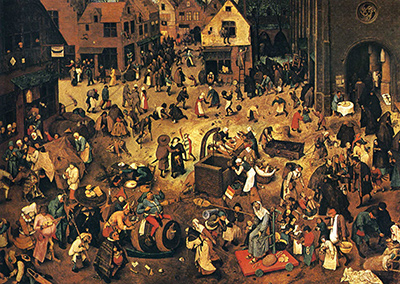
Pieter Bruegel the Elder's The Fight between Carnival and Lent turns a town square into a battle of appetites, rituals, charity, performance and social display. Painted in 1559, the work shows Carnival and Lent as comic opponents in a mock joust, but the confrontation is only the visible hinge of a much larger scene. Around them, the square fills with townspeople, beggars, churchgoers, cooks, players, drinkers, vendors and onlookers, each absorbed in a different action.
The Kunsthistorisches Museum Vienna identifies the painting as a signed and dated work by Bruegel on oak wood, now on view in its Picture Gallery. The museum describes it as an encyclopaedia of Netherlandish customs connected with Carnival and Lent, and stresses that Bruegel's great invention is the way he makes many episodes appear to happen in the same place at the same time [1]. That simultaneity gives the painting its life. The viewer does not receive one neat moral lesson. Instead, Bruegel creates a whole community in motion.
This is one of the essential early paintings for understanding Pieter Bruegel the Elder. It belongs beside Netherlandish Proverbs and Children's Games as a crowd picture that rewards slow looking. It also points toward Bruegel's wider interest in proverbs and iconography, festive behavior and peasant imagery, while refusing to become a simple record of rural custom or a single-sided religious statement.
At a Glance
- ArtistPieter Bruegel the Elder
- TitleThe Fight between Carnival and Lent
- Date1559
- Medium/supportPainting on oak wood
- DimensionsKHM gives the overall size as 118 x 163.7 x 3.3 cm
- SignatureSigned and dated BRVEGEL 1559
- CollectionKunsthistorisches Museum Vienna, Picture Gallery
- InventoryGemaldegalerie, inv. no. 1016
- DisplayKHM lists the painting as on view in the Picture Gallery
- Main subjectThe ritual opposition of Carnival and Lent, expanded into a broad town-square scene of contemporary custom
- Related Bruegel worksNetherlandish Proverbs, Children's Games and the wider Bruegel paintings group
This work across Bruegel’s career
Tower of Babel
1563The Harvesters
1565Peasant Wedding
1568Children's Games
1560Triumph of Death
1562–1563Fight Between Carnival and Lent
This artworkContents
- Introduction
- Object Facts And Early Bruegel Context
- Carnival Versus Lent: The Central Mock Combat
- The Square As An Encyclopedia Of Customs
- Simultaneity And The Elevated Viewpoint
- Underdrawing, Revision And Painted Detail
- Moral, Religious And Social Readings
- Relationship To Proverbs, Games And Peasant Imagery
- Why The Painting Remains Important
- Annotated Details
Object Facts And Early Bruegel Context
The Fight between Carnival and Lent belongs to the moment when Bruegel was establishing himself as one of the most inventive painters in the Low Countries. KHM's Bruegel 2018 biography places his birth probably between 1526 and 1530, records his admission to the Antwerp painters' guild in 1551, and notes the Italy journey that can be reconstructed from drawings and prints [6]. By 1559, the year of this panel, Bruegel had already worked in the orbit of Antwerp print culture and had begun turning vernacular moral subjects into ambitious painted worlds.
The Met's essay on Bruegel emphasizes his Antwerp association with the publisher Hieronymus Cock and notes that between 1555 and 1563 he produced more than forty designs for engravings. Those prints ranged across landscapes, parables and moral subjects, and they helped make Bruegel's inventions widely known [7]. That graphic background matters for The Fight between Carnival and Lent. The painting is not a print, but it asks for a similar kind of active viewing: scanning, comparing, recognizing small actions, and letting many incidents build a larger idea.
KHM describes the work as an early panel painting from 1559 and as one of Bruegel's great pictures of contemporary custom [1] [2]. Its scale is important. At roughly 118 by 164 cm, this is not a small anecdotal scene. It is a large panel in which a whole town square becomes a theatre of social life. Bruegel uses the surface to gather a crowded calendar of ritual practices, then organizes those practices around the comic collision of Carnival and Lent.
The painting also falls in the same concentrated period as Netherlandish Proverbs, usually dated to 1559, and immediately before Children's Games of 1560. Bruegel 2018 groups these three early crowd pictures together as works filled with countless figures and viewed from above [5]. Seen in that company, The Fight between Carnival and Lent is not an isolated festive oddity. It is part of Bruegel's broader experiment with how a painting can become a field of many readable actions.
Annotated Details from The Fight Between Carnival and Lent
Find Carnival and Lent in the foreground, then follow the crowds towards the inn and church.
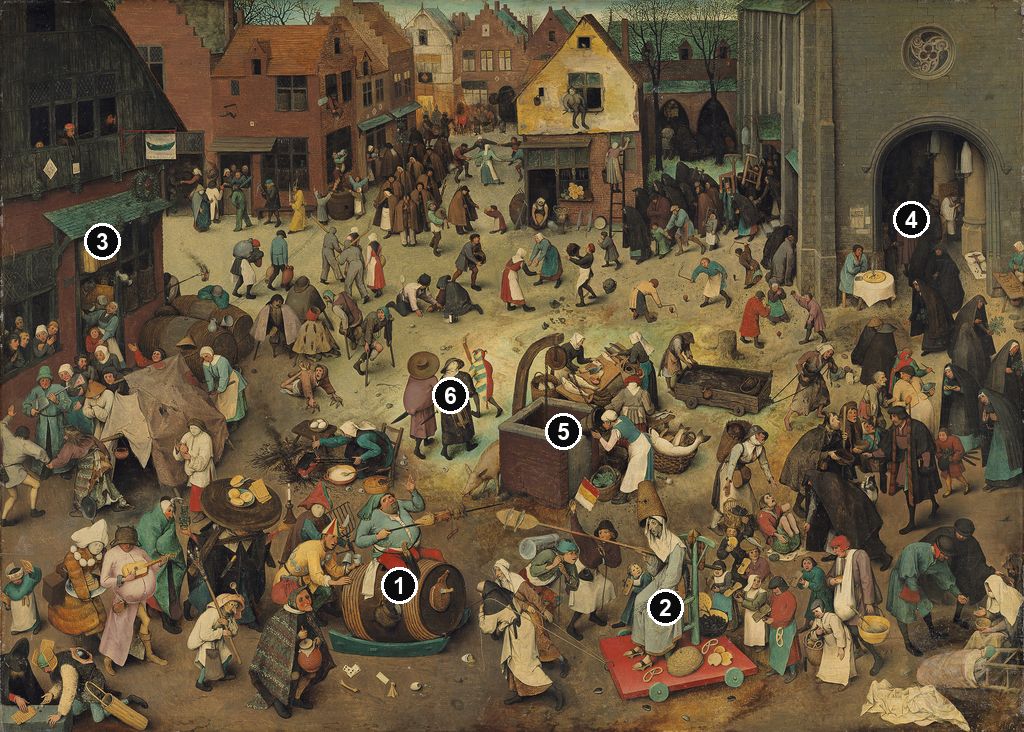
Details from THE FIGHT BETWEEN CARNIVAL AND LENT
Six details trace activities on both sides of the square.
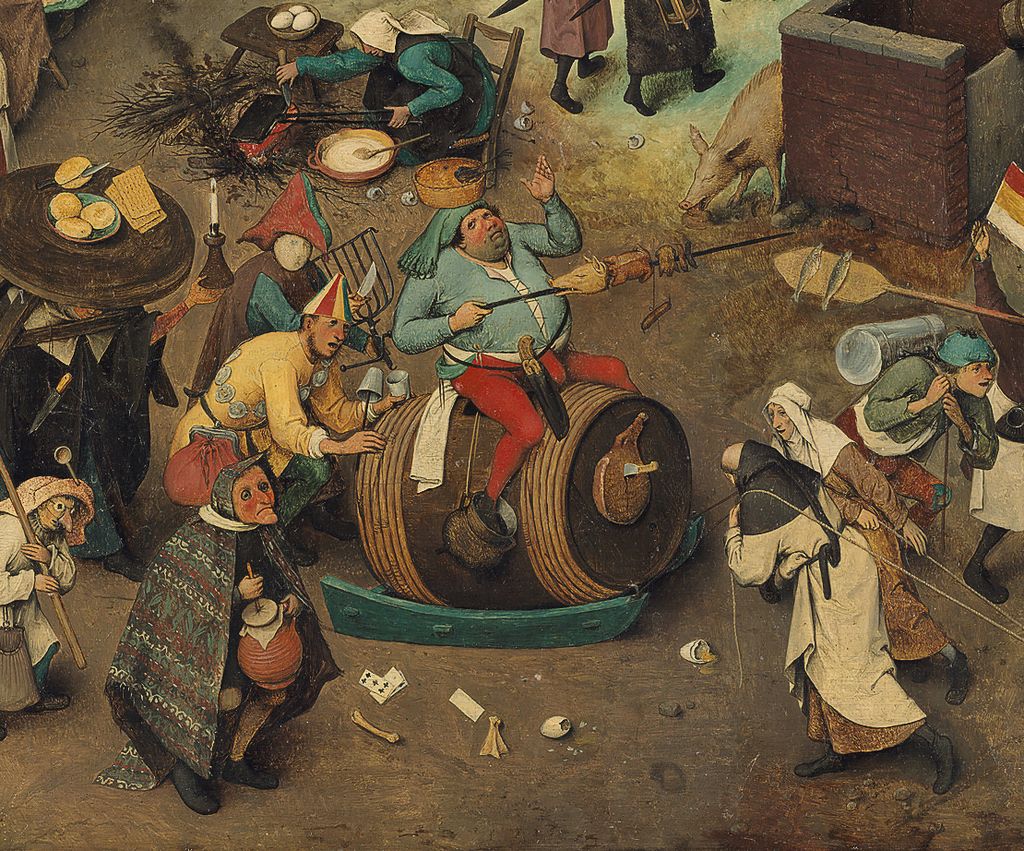
Carnival on the barrel
Carnival rides a barrel and carries a spit.
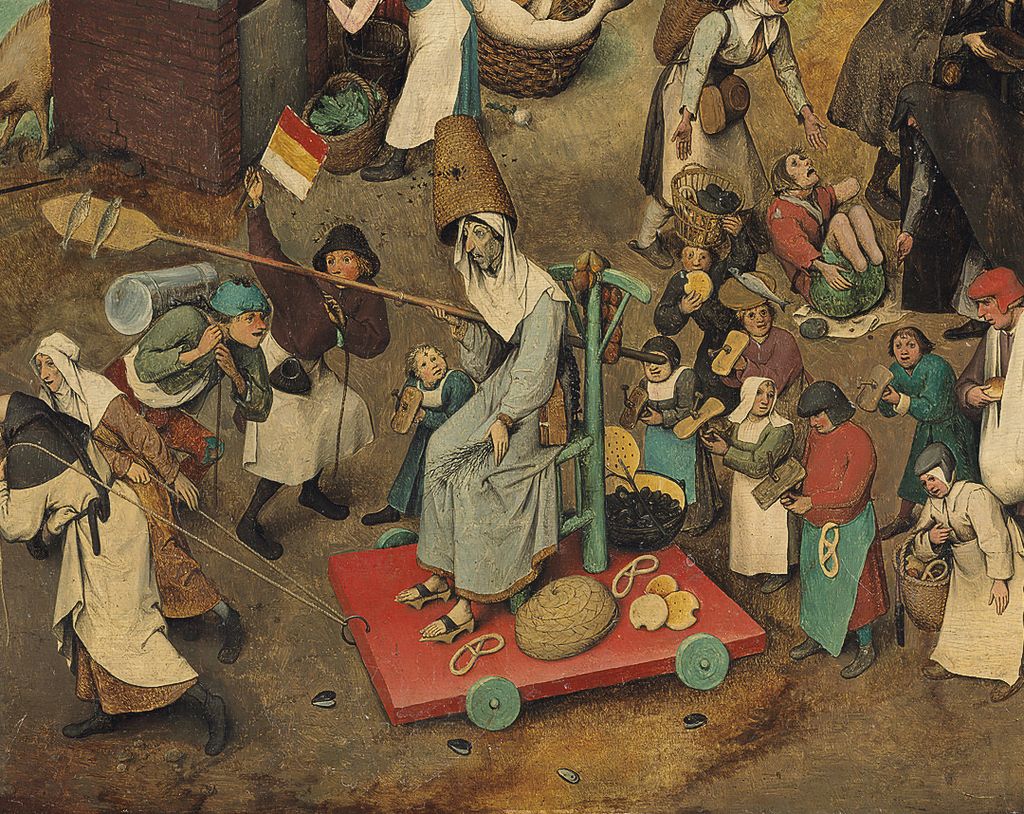
Lent on the cart
Lent holds a baker’s peel bearing fish.
The inn at the left
Figures watch from the inn and gather in the street below.
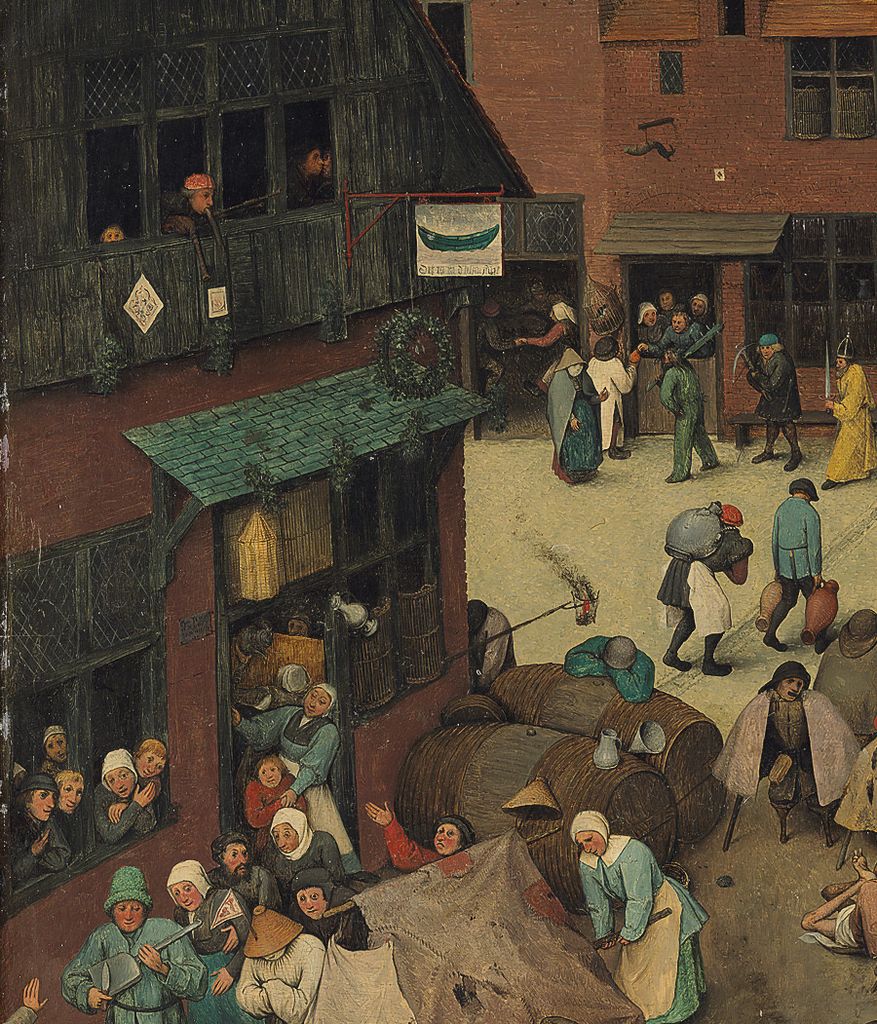
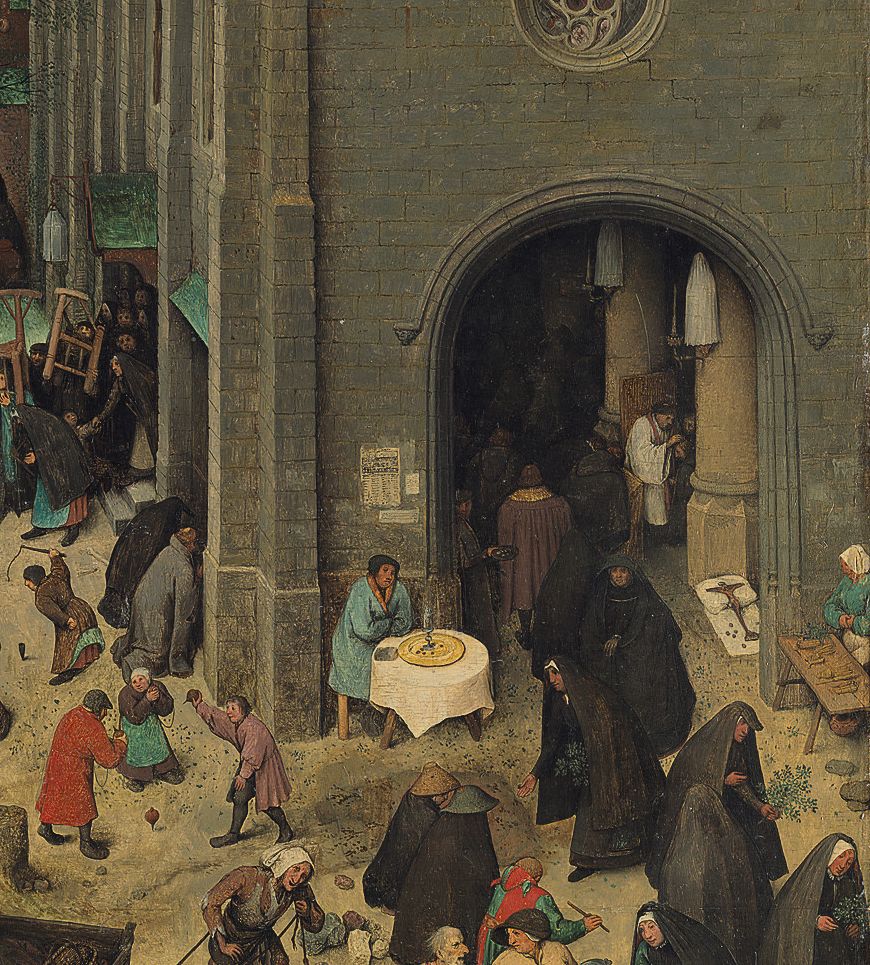
The church door
People pass in and out beneath the arched entrance.
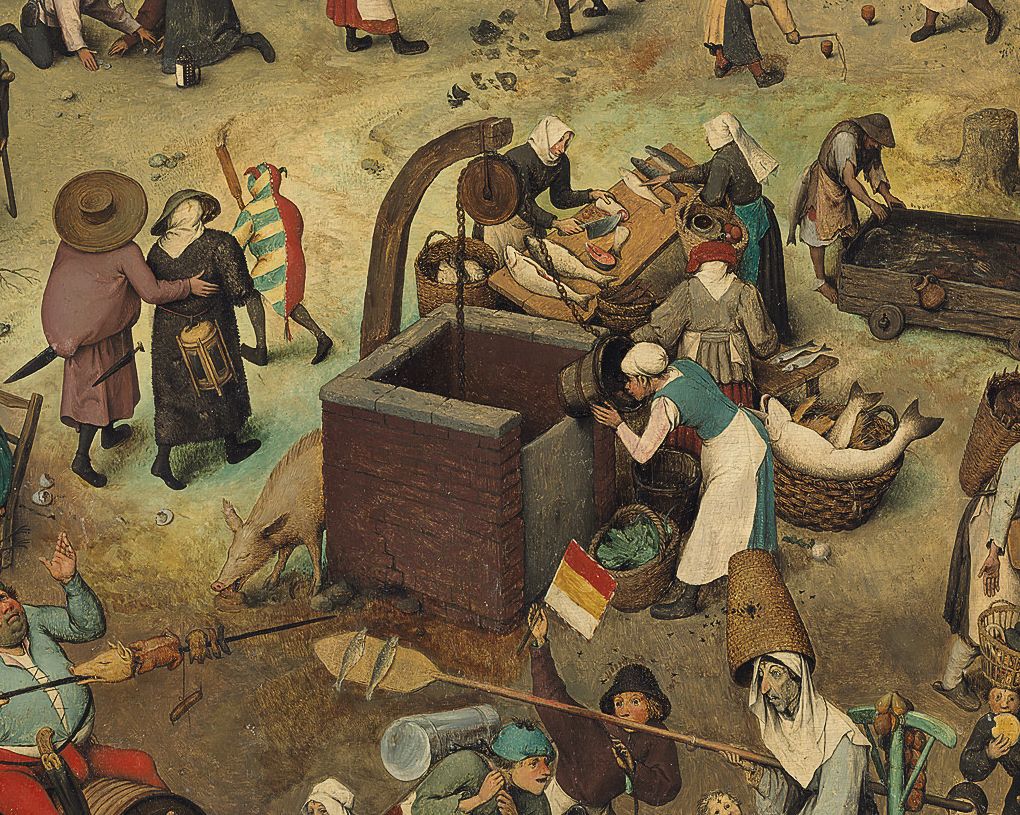
The well in the square
Activity around the well sits between the two sides.
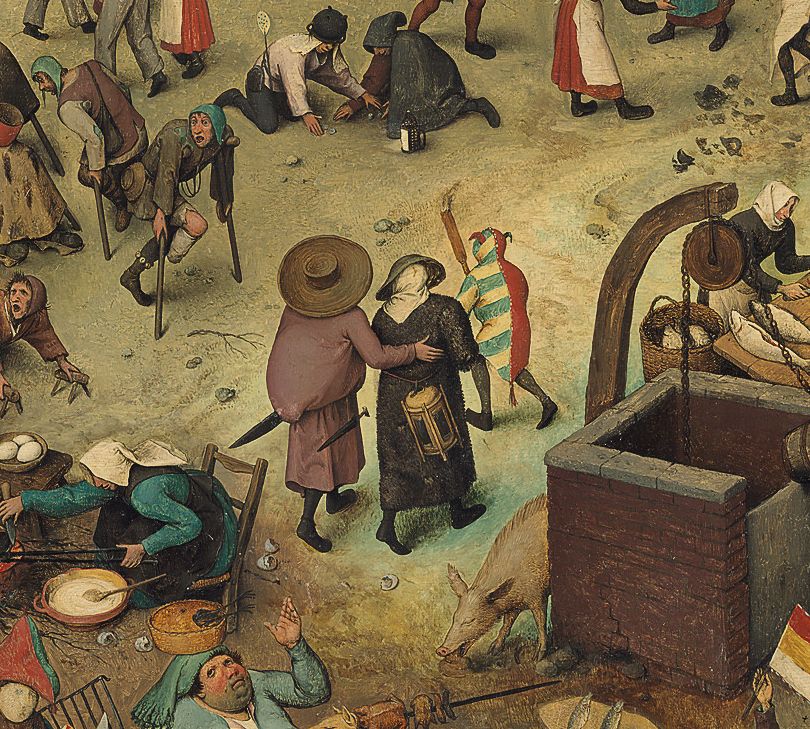
The pair seen from behind
Two figures walk away from the viewer near the middle of the square.
Pieter Bruegel the Elder, The Fight Between Carnival and Lent, 1559. Kunsthistorisches Museum, GG 1016. Reproduction via Wikimedia Commons.
Carnival Versus Lent: The Central Mock Combat
The clearest action is in the foreground. Carnival and Lent are personified as opponents about to meet in an absurd joust. KHM describes Carnival riding on a barrel and carrying a roasting spit as his weapon, while Lent is a lean figure who advances with a baker's peel bearing fish [1]. Bruegel 2018 sharpens the contrast: the left side is dominated by the inn and Prince Carnival, while the right side is anchored by the church and Lady Lent [2].
The opposition is comic, but it is not random. Carnival belongs to feasting, meat, drinking, disorder, masquerade and the last excess before the fasting season. Lent belongs to abstinence, fish, penitence, churchgoing and the discipline of the Christian calendar. Bruegel makes the contrast visible through bodies and tools. Carnival is heavy, seated on a barrel, armed with meat. Lent is spare, gray and supported by the signs of fasting.
The combat is staged rather than real. Bruegel 2018 calls attention to the fact that the figures are about to break a lance, but the weapons are not military weapons: a spit loaded with meat on one side, a bread peel with herrings on the other [2]. The painting turns religious time into comic theatre. The contest is not between two armies but between two ways of living, each with its own objects, followers and habits.
Yet the central pair does not settle the meaning of the painting. Carnival is funny, but not simply victorious. Lent is solemn, but not simply pure. Bruegel places both figures inside a wider social field where ritual can become display, charity can become performance, appetite can become foolishness, and penitence can become habit. The mock combat is therefore a gateway into the painting's larger question: what happens when a community's customs reveal its desires?
That question is why the painting should not be flattened into a direct attack on one side. Bruegel certainly uses satire. He also shows a world in which both sides are performed by human beings. Carnival and Lent are calendar forces, but the painting's energy comes from the people around them: the drinkers, beggars, churchgoers, children, vendors and spectators who turn ritual into daily behavior.
The Square As An Encyclopedia Of Customs
KHM's object record calls the painting an encyclopaedia of Netherlandish customs related to Carnival and Lent [1]. That description is useful because it explains the work's density without turning every detail into a separately solved emblem. Bruegel is not merely illustrating one custom. He is building a town square where many customs, gestures and social roles coexist.
The setting is crucial. Bruegel 2018 notes that all the action takes place between the inn and the church [2]. This architectural opposition makes the painting legible at a glance. On one side, food, drink and Carnival festivity gather around the inn. On the other, Lent, churchgoing and charity gather around the church. The square between them becomes a contested middle ground.
That middle ground is not empty space. It is the place where society performs itself. People move through the square, pause, watch, beg, eat, sell, process and play. Some actions are ritual; others are ordinary. Some look comic; others look uncomfortable. Bruegel's town square is therefore both a civic setting and a moral stage. The viewer sees a community under the pressure of a calendar change, but also under the pressure of appetite, poverty, status and religious routine.
Selected details can be read with confidence when the sources support them. Bruegel 2018 identifies the inn, Prince Carnival, the church, Lady Lent, the meat-loaded spit and the herrings on the bread peel [2]. It also draws attention to the church entrance, where the poor and the well-to-do are differently placed, and to beggars who compete for position near acts of charity [2]. These details are not incidental decoration. They show how ritual seasons shape public behavior.
At the same time, a responsible reading should avoid claiming to identify every custom in the picture. Bruegel's density tempts the viewer toward total inventory. The safer and more fruitful approach is to ask how the kinds of action relate: feasting and fasting, giving and receiving, masking and praying, watching and performing, poverty and display. The painting's intelligence lies in these relationships more than in any complete checklist.
Simultaneity And The Elevated Viewpoint
The most important formal idea in The Fight between Carnival and Lent is simultaneity. KHM states that while the details correspond to customs known from the time, the depiction of everything happening in one place at one time is Bruegel's invention [1]. That single point explains much of the painting's power.
Real Carnival and Lent customs unfolded over time. Bruegel compresses them into one shared square. He does not paint a single procession, a single meal, a single act of charity or a single churchgoing moment. He paints many temporal fragments as though the viewer could see them together. The result is not realism in the ordinary sense. It is a constructed vision of social time.
The elevated viewpoint makes this possible. Bruegel 2018 describes the painting as a crowded composition seen from above, with a raised viewpoint that allows the viewer to see many events occurring simultaneously on the main square [2]. The eye is not fixed at street level. It hovers high enough to compare groups and actions, yet close enough to recognize gestures, tools and expressions.
This high view does not make the scene cold or detached. It makes the painting democratic in attention. No single figure monopolizes the surface, not even Carnival and Lent. Instead, the viewer keeps shifting focus: foreground combat, side buildings, church entrance, food, masks, children, beggars, doors, windows, side streets. Bruegel lets small actions matter without letting any one detail swallow the whole.
The painting therefore trains the viewer in a specifically Bruegelian way of looking. One begins with the central opposition, then wanders outward. Each group seems to have its own rhythm, but the whole scene remains bound by the square. The composition behaves almost like a map of conduct. It shows not where people are merely located, but how they act in relation to public rituals and to one another.
This is why the picture remains so alive. A simpler allegory could have shown Carnival and Lent as two figures alone. Bruegel's version makes the allegory social. The battle is everywhere because the square is everywhere divided: between hunger and display, pleasure and restraint, charity and self-interest, devotion and spectacle.
Underdrawing, Revision And Painted Detail
Christina Currie compared infrared images of the Vienna painting with versions by Pieter Brueghel the Younger. The correspondences provide evidence that the Elder used pricked cartoons to transfer the design onto his panel. A preparatory drawing on paper could be perforated along its lines, then pounced to leave a trace on the surface below. Several copies preserve evidence of the same underlying design. An unusual version sold in London in 2012, Currie argues, even reflects a stage earlier than the final choices visible in the Vienna painting [8].
That distinction lets a later painting tell us something about the making of an earlier one. Where the Younger’s workshop followed a transferred line, it may have inherited an idea that the Elder himself revised. Look at the infrared image as a record of working decisions, then look back at the painted square. The strong sense of simultaneous action in the finished scene was assembled on the panel through preparation and change, as the figures and groups were brought into relation [8] [4].
Modern research has deepened the understanding of how Bruegel built this crowded world. Beginning in 2012, the Kunsthistorisches Museum undertook a major study of its Bruegel panel paintings, using non-invasive methods such as infrared photography, infrared reflectography, X-radiography, X-ray fluorescence analysis and 3D mapping [3]. The project was designed to investigate Bruegel's materials, panel construction, underdrawing, technique, revisions and later changes [3] [4].
For The Fight between Carnival and Lent, the technical evidence is especially revealing. KHM's research account explains that infrared reflectography shows careful underdrawing in the early works, with tiny details in this painting clearly delineated before painting. It specifically notes that fingers and skewered sausages can be recognized in the underdrawing, and that Bruegel often followed these delicate preparatory lines closely when painting the miniature details [4].
That finding changes how we think about the surface. The painting may look like a noisy crowd, but the crowd was not improvised loosely. Bruegel planned many small incidents with remarkable precision. The result is a paradox: the square feels spontaneous because so many actions happen at once, yet the technical evidence shows a disciplined underlying structure.
The same research also shows that Bruegel could adjust while working. KHM notes that the built setting around the main square was handled more freely, with Bruegel not always following the preparatory lines for the houses [4]. In other words, he used different degrees of control in different parts of the painting. The figures and tiny incidents could be planned with miniature care, while the architectural stage allowed more painterly movement.
One striking technical observation concerns Lady Lent's bread peel. KHM's research page explains that infrared imagery shows an earlier rhomboid form with a black cross; in the painted version the peel was narrowed, reshaped and given fish instead [4]. This is not a small curiosity. It shows Bruegel refining the visible language of the central combat. The fish make Lent's identity immediately legible within the ritual opposition.
Bruegel 2018 also notes that the painting contains overpainted areas and that some copies preserve figures later covered in the original [2]. That evidence reminds us that a painting's present surface has a history. Bruegel's composition, later interventions, copies and modern imaging all shape what viewers can know. The picture is still clear as an artwork, but its physical life adds depth to the reading.
Moral, Religious And Social Readings
The painting invites moral interpretation, but it needs careful handling. It is tempting to ask whether Bruegel is condemning Carnival, Lent, Catholic practice, popular festivity, public charity or the whole social order. The sources support a sharper but more balanced conclusion: Bruegel is deeply interested in the way customs expose human behavior.
Bruegel 2018 describes him here as an observer and social critic, and reads the painting as a mirror held up to contemporaries [2]. That is persuasive because the satire is distributed. Carnival excess is visible, but the Lenten side is not untouched by critique. The church entrance, beggars and acts of charity show how piety can become social theatre. The inn side, meanwhile, shows pleasure, appetite and comic disorder.
The painting's religious field is therefore not a simple two-party argument. Carnival and Lent both belong to the Christian calendar. Their opposition is ritualized, expected and communal. Bruegel shows that opposition being enacted by people of different conditions and motives. Some take part in festivity; some take part in discipline; some seek advantage; some display charity; some need charity; some watch.
This is where the painting's social bite becomes strongest. Bruegel 2018 draws attention to the poor leaving the church through a side entrance, the well-to-do using the main entrance, and beggars competing for advantageous positions [2]. The point is not merely that poverty exists. It is that poverty, charity and public status all become part of the ritual scene. The square is a place where need and reputation meet.
At the same time, Bruegel does not turn the poor into one simple moral category. The source discussion mentions sham cripples and strategic positions, but a modern reader should keep the language careful and tied to the source [2]. The painting belongs to a sixteenth-century visual culture that often represented disability, begging and deception through harsh satire. That context should not make the viewer indifferent to suffering; it should make the social reading more alert.
The safest way to understand the painting is as a study of communal performance under ritual pressure. Carnival and Lent are not only dates in the church year. They become public roles, costumes, objects, foods, gestures and social transactions. Bruegel's brilliance lies in showing that custom is never abstract. It is carried by bodies.
Relationship To Proverbs, Games And Peasant Imagery
The Fight between Carnival and Lent belongs with Bruegel's other early crowd pictures because all of them turn multiple actions into one pictorial system. Bruegel 2018 explicitly names The Battle between Carnival and Lent, The Proverbs and Children's Games as early crowded works seen from an elevated viewpoint and filled with countless figures [5].
The comparison with Netherlandish Proverbs is especially close. Both works are dated around 1559 and both use a broad setting to gather many actions. Yet they work differently. Netherlandish Proverbs turns sayings into visible behavior. The Fight between Carnival and Lent turns ritual seasons into social behavior. In one, the organizing force is proverbial speech; in the other, it is the calendar and the opposition between feast and fast.
The comparison with Children's Games is equally useful. Bruegel 2018 describes Children's Games as a bird's-eye view over a square crowded with children and many games, some still recognizable and others identified only through research [5]. Like The Fight between Carnival and Lent, it depends on an elevated viewpoint and a dense field of activity. But its mood is different. Children's Games studies play, imitation and social learning; The Fight between Carnival and Lent studies ritual opposition, appetite, piety and public behavior.
The connection to peasant imagery should also be precise. Bruegel is often remembered as a painter of peasants, festivals and ordinary people, but that label can mislead if it makes him seem like a simple recorder of village life. In this painting, the customs may be rooted in Netherlandish practice, but the composition is an invention. The square is staged, compressed and intellectually organized. Bruegel's peasants, townspeople and beggars are not ethnographic specimens. They are participants in a moral and social theatre.
That theatre also links the work to the broader Bruegel paintings overview. The same artist who made seasonal landscapes, biblical scenes in contemporary settings, proverb paintings and peasant feasts also made this ritual square. Across those subjects, his method often stays recognizable: high viewpoint, concentrated detail, social observation, moral ambiguity and a refusal to let one central figure explain everything.
Why The Painting Remains Important
The Fight between Carnival and Lent remains important because it shows Bruegel inventing a new kind of pictorial intelligence. The painting is funny, crowded and immediately accessible, but it is also rigorous. Its central joke is easy to grasp: Carnival and Lent charge at one another with food as weapons. Its deeper structure takes longer: the entire square becomes a meditation on how people inhabit customs.
The work also matters because it captures a society through simultaneous action rather than portraiture or narrative climax. Bruegel does not show one hero making a decisive choice. He shows a town making many small choices at once. That is why the painting feels modern in its complexity. It understands public life as overlapping behaviors, partial motives and competing performances.
It is equally important within Bruegel's career. The 1559 panel stands at the beginning of his great decade of painting. It shows him bringing the habits of graphic satire, proverb imagery and close observation into large-scale panel painting. It also anticipates the viewerly pleasure of his later crowd and landscape works: the sense that the painting is larger than any first glance.
For readers coming to Bruegel for the first time, the painting is one of the best introductions to his art. It teaches how to look: start with the large opposition, then follow the details; enjoy the comedy, but notice the social edge; recognize the customs, but do not reduce the scene to a list. Bruegel's square is a world of eating, fasting, giving, begging, performing, watching and moving through time.
That is the enduring achievement of The Fight between Carnival and Lent. It makes ritual visible as human behavior. It takes two calendar seasons and turns them into a whole society, noisy and disciplined, comic and uneasy, familiar and strange.

Discussion
What feels most revealing about Pieter Bruegel the Elder: the village detail, the landscape setting, the moral wit, or the way everyday life becomes a complete world?
Reader Insights
Begin with one small action in a Bruegel scene, then follow how it connects to the surrounding figures, setting and rhythm of the whole image.
Connect the work to Northern Renaissance visual culture, printmaking, proverb traditions and Bruegel's interest in rural and urban life.
Which detail changes the interpretation most once you know the subject, date, proverb source or present collection?
Join the Conversation
Have a thought or observation about Pieter Bruegel the Elder? Share it below. Thoughtful responses may be added to this section as the Bruegel pages develop.
Frequently Asked Questions
The Kunsthistorisches Museum Vienna identifies the painting as a signed and dated work by Bruegel on oak wood, now on view in its Picture Gallery. The museum describes it as an encyclopaedia of Netherlandish customs connected with Carnival and Lent, and stresses that Bruegel's great invention is the way he makes many episodes appear to happen in the same place at the same time . [1]
The Fight between Carnival and Lent belongs to the moment when Bruegel was establishing himself as one of the most inventive painters in the Low Countries. KHM's Bruegel 2018 biography places his birth probably between 1526 and 1530, records his admission to the Antwerp painters' guild in 1551, and notes the Italy journey that can be reconstructed from drawings and prints . [6]
KHM's object record calls the painting an encyclopaedia of Netherlandish customs related to Carnival and Lent . That description is useful because it explains the work's density without turning every detail into a separately solved emblem. [1]
References
- Kunsthistorisches Museum Wien, The Fight between Carnival and Lent, View source.
- Kunsthistorisches Museum Wien / Bruegel 2018, Carnival vs. Lent, View source.
- Kunsthistorisches Museum Wien / Bruegel 2018, Researching Bruegel, View source.
- Kunsthistorisches Museum Wien / Bruegel 2018, Revealing glimpses into the heart of panel paintings, View source.
- Kunsthistorisches Museum Wien / Bruegel 2018, Of Wimmelbilder (busy pictures) and children's games, View source.
- Kunsthistorisches Museum Wien / Bruegel 2018, Who is Pieter?, View source.
- Jacob Wisse, The Metropolitan Museum of Art, Pieter Bruegel the Elder (ca. 1525-1569), View source.
- Christina Currie, The Final Piece of the Puzzle: Bruegel’s Use of Cartoons in the Battle between Carnival and Lent and Reflections on his Preparatory Work for Painting, in The Bruegel Success Story, Peeters, 2021, View source.







