


 by Tom Gurney
Tom Gurney BSc (Hons) is an art history expert with over 20 years experience
Published on June 19, 2020 / Updated on October 14, 2023
Email: tomgurney1@gmail.com / Phone: +44 7429 011000
The Flight into Egypt: Introduction
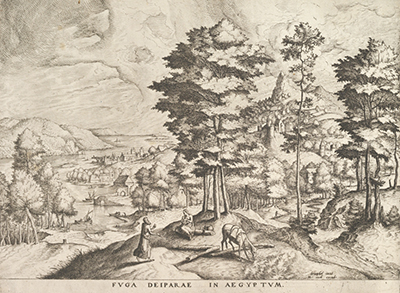
The Flight into Egypt, or Fuga Deiparae in Aegyptum, is an etching with engraving in the Large Landscapes. Johannes and Lucas van Doetecum made the plate and Hieronymus Cock published the print around 1555–56. Mary and the child sit beneath trees, Joseph approaches on foot, and the donkey grazes nearby. There is room around the group to see where the path descends and where a river runs past buildings in the distance. The National Gallery of Art catalogues the print after Pieter Bruegel the Elder, while the 2001 Metropolitan Museum exhibition catalogue questions who designed it [1] [2] [4].
This work across Bruegel’s career
Tower of Babel
1563The Harvesters
1565Peasant Wedding
1568Children's Games
1560Triumph of Death
1562–1563The Flight into Egypt
This artworkContents
- Introduction
- The Family Beneath the Trees
- Ways Into the Valley
- What the Impressions Tell Us
- The Flight in Painting and Drawing
- Annotated Details
The Family Beneath the Trees
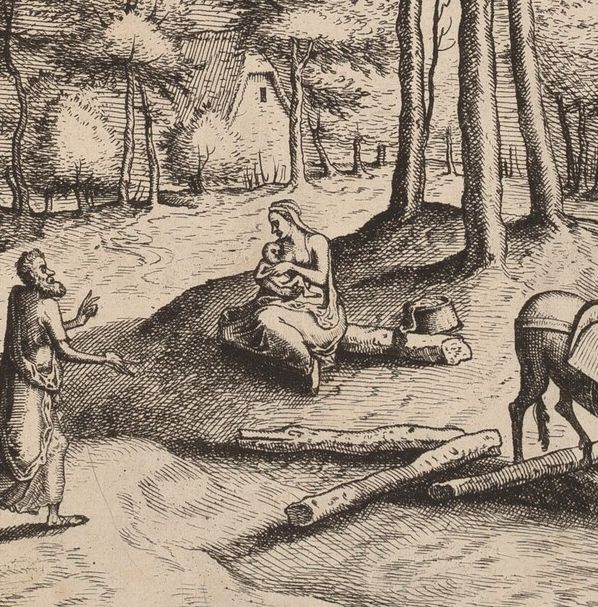
The main figures are in the lower middle. Mary is seated just in front of a cluster of trunks. The child’s head and body form a small light area against the shaded ground and the lines of her clothing. The roots and shadows give the seated figure a place on the slope, while the open path around her helps separate the child and adult from the trees. Seen from a little distance, the group almost disappears into the arrangement of earth and branches. Seen up close, it is the point where the different movements in the foreground meet.
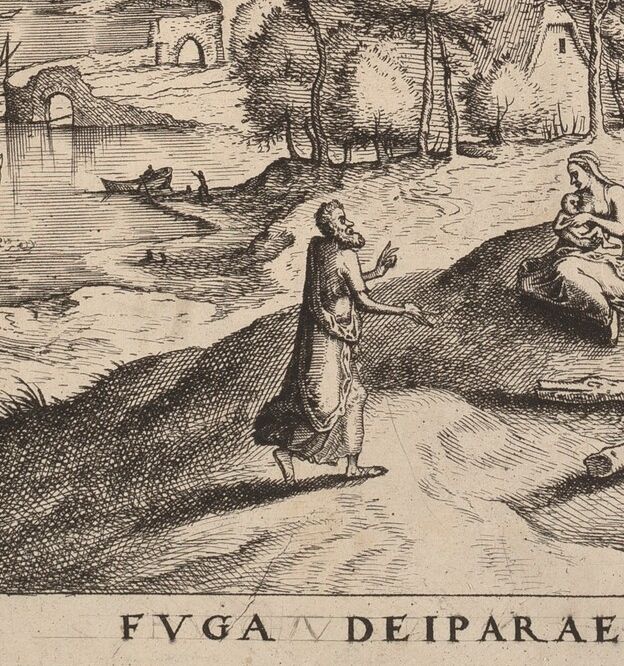
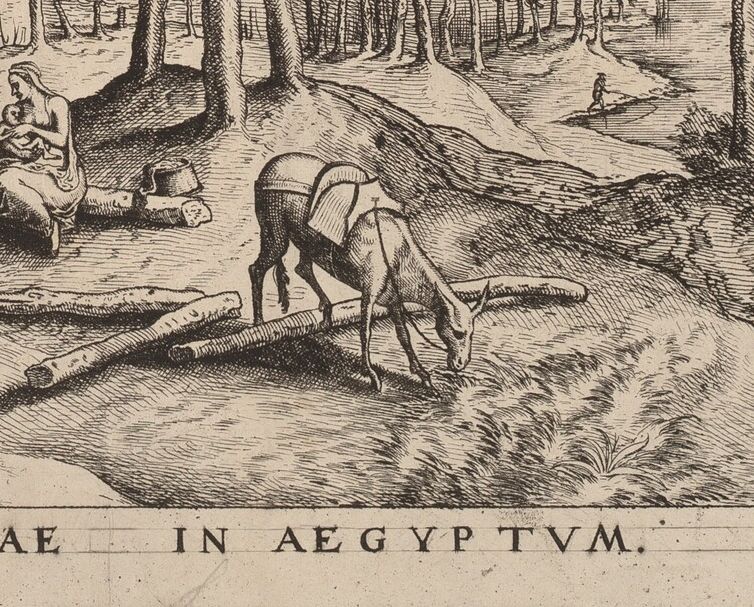
Joseph stands at the left of the group. The small interval between his feet and Mary’s side is crossed by the direction of his gesture. At the right, the donkey lowers its head to graze, setting a different line against the standing man and upright trees. Fallen wood lies in front of it. The animal and the length of wood make that part of the slope easy to locate again after looking farther out. The composition gives the family time to stop. Their position on a path also leaves open the possibility of travelling farther [4].
The title identifies the wider story. In Matthew’s Gospel, Joseph takes Mary and Jesus away after being warned in a dream that Herod is seeking the child. The print gives space to a rest during the journey. Its trees and water have considerable presence apart from the three travellers, while the lower margin names the episode and gives viewers a reason to find them [6] [1] [4].
Annotated Details from The Flight into Egypt
Find the resting group below the trees, then use the paths and river to look outward.
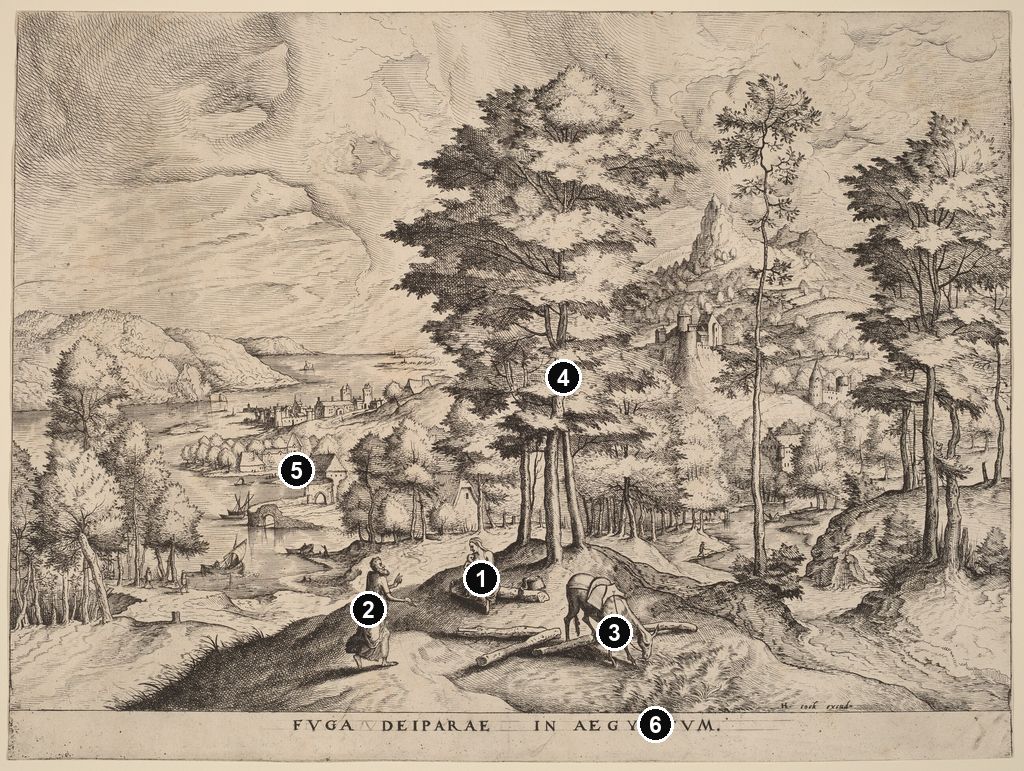
Details from THE FLIGHT INTO EGYPT
Six details trace the family, their surroundings and the first-state inscription.
Mary and the child
The seated figures rest just below the cluster of trunks.
Joseph on the path
The standing figure turns towards the seated group across a pale stretch of ground.
The grazing donkey
The donkey lowers its head beside a length of fallen wood.
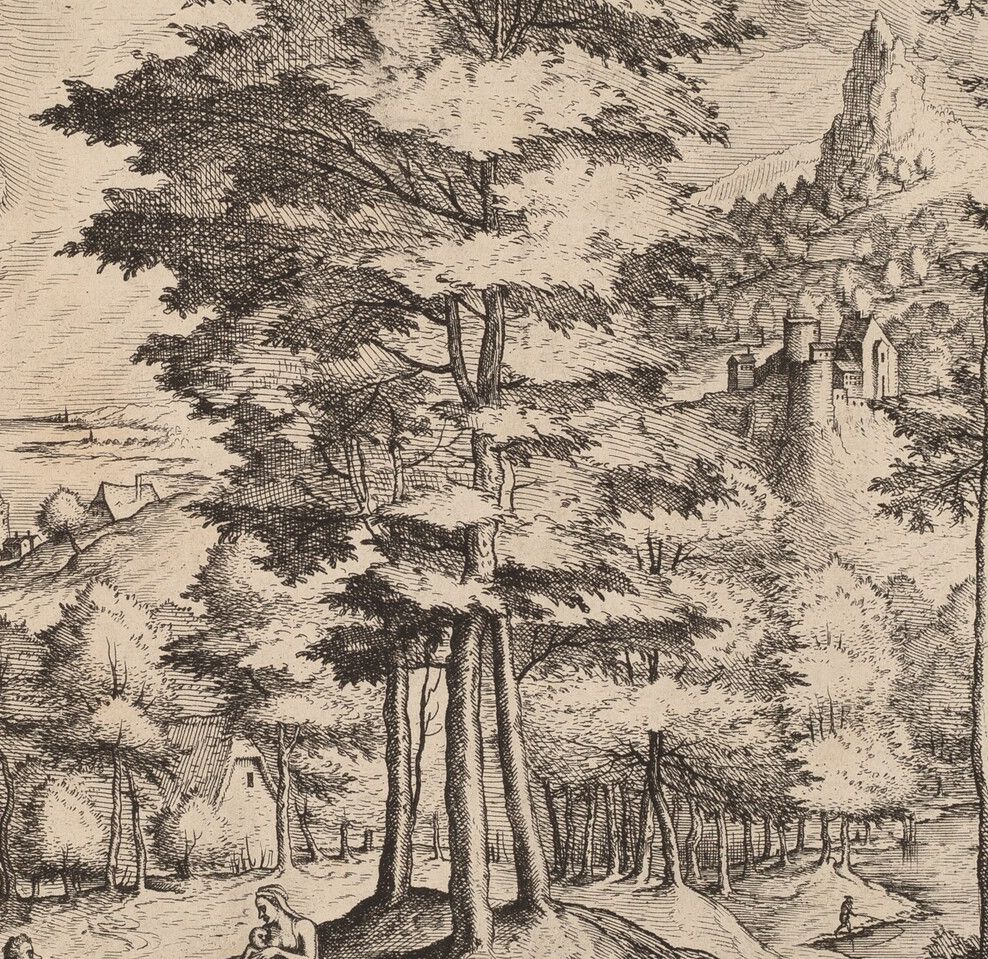
The tall trees
Narrow trunks lead to foliage broken into light and dark patches.
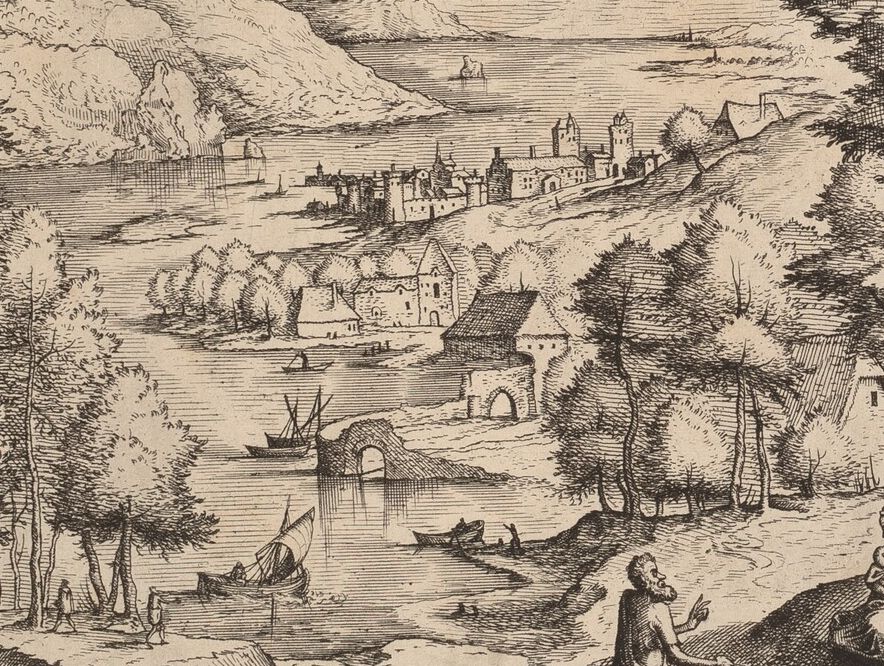
Buildings by the river
Roofs and boats give scale to the water below the slope.
Title and publisher’s credit
The Latin title and the publisher’s credit are present in this state. The space above Cock’s name is still open.

Johannes and Lucas van Doetecum, after Pieter Bruegel the Elder in the NGA catalogue, Fuga Deiparae in Aegyptum. Published by Hieronymus Cock. First state. Rosenwald Collection, National Gallery of Art, 1964.8.6. Public domain.
Ways Into the Valley
The trees above the family are relatively tall and narrow. Some of the lower branches extend over open ground, and the upper foliage separates into dark patches against the sky. A narrower trunk to the right rises in front of distant rock and buildings. It takes only a few dark strokes running vertically through that zone to keep the nearer trees apart from the more lightly drawn country. There is enough open space between the trunks for the eye to find routes beyond the family.
The valley slopes away at the left towards the river. Buildings and small boats help distinguish stretches of water from the adjacent pale ground. Look just above the seated group to see how dark shapes help separate the stages of the view. At the far right the land climbs again, and a path is visible between the outcrops and trees. The routes guide the eye towards separate parts of the picture, while the nearest group can still be found by locating the lowered head of the donkey.
Orenstein calls attention to the way the landscape is made from a succession of smaller features. In her account, the hill and river do not link the picture in the same way as the more continuous spaces in some of the other Large Landscapes. That difference can be tested by following the ground at the right, where separate tree groups and slopes interrupt the way into the distance, and then looking again at the more open country beside the river [4].
What the Impressions Tell Us
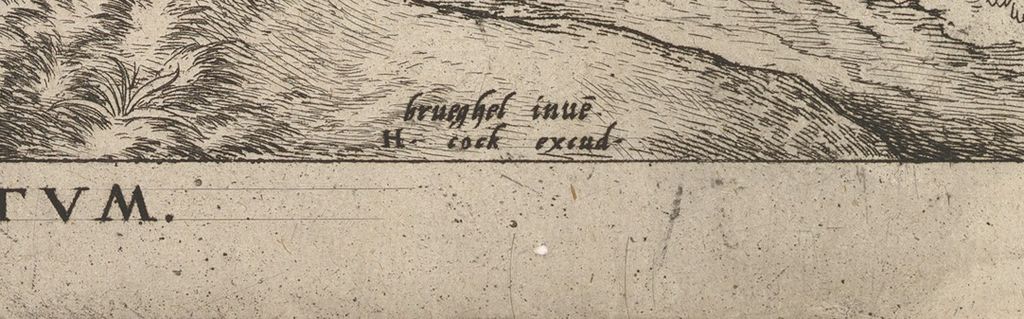
The Washington sheet, 1964.8.6, is an impression of the first state, the stage in which the plate carried Cock’s publication credit but had yet to receive Bruegel’s name. The Latin title is in the lower margin. A state records the plate at a particular stage of its working life. An impression is a particular sheet printed from that plate. The Metropolitan Museum has a later impression, 26.72.36, catalogued as the second state. The Städel also records the added inscription identifying Bruegel as the inventor of the design in its second-state sheet [1] [2] [3] [4].
The second-state detail below puts the two lines of credit close enough to see together. Bruegel’s name appears above Cock’s at the lower right, apart from the title across the lower margin. In the Washington image the place above Cock’s name remains open. The scene still depicts the family under the same trees. This is a change in how the plate identifies the work and its makers, visible at the edge of an otherwise familiar landscape [1] [2] [3].
The addition is evidence that Bruegel’s name was printed in association with the design. Orenstein considers other evidence when discussing who devised it. She compares the smaller, thinner figures and the proportions of the trees with the more firmly modelled trees and figures of other designs in the series. She proposes that one of the Van Doetecums may have designed the print. The museums identify the makers and publisher with greater certainty than the evidence permits for the designer. The discussion is a reason to keep the plate inscription and the attribution question visible together [1] [2] [4].
The Flight in Painting and Drawing
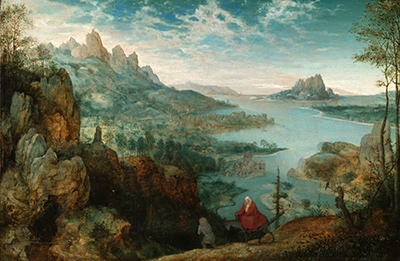
Bruegel’s signed 1563 Landscape with the Flight into Egypt, shown below, is a distinct Courtauld oil painting. In it, Mary rides a donkey along a slope and Joseph walks ahead of her. The saturated red of her garment helps a viewer locate them against dark vegetation and cooler water. In the print, etched and engraved lines bring the family into view where the dark trunks meet the brighter path. The family’s actions differ as well. The panel shows travel and the print gives the travellers a place to rest [5] [4].
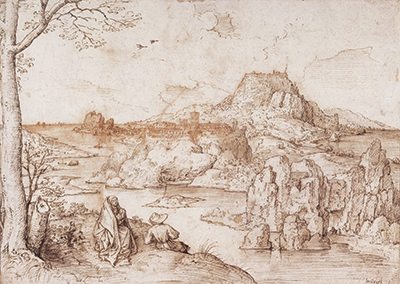
The Berlin Rest on the Flight into Egypt also depicts a pause. It is a separate drawing with a tree framing the scene at the left and a valley beyond. Looking across the three works helps explain why the subject alone cannot establish a direct relationship between the designs. Inspect the position of the family, the trees immediately around them and the opening to the distant country. Those are the features by which a drawing, painting and print can be distinguished even when similar English titles have been attached to them [4] [5].
Return to the figure under the central trees. The paths at either side and the presence of the grazing donkey show a journey momentarily interrupted. The margin gives the name of that journey, while the drawn lines on the slope make a space for a quieter part of it [1].
Discussion
Which detail in this work most changes how you read it?
Frequently Asked Questions
Joseph stands at the left of the group. The small interval between his feet and Mary’s side is crossed by the direction of his gesture. [4]
Orenstein calls attention to the way the landscape is made from a succession of smaller features. In her account, the hill and river do not link the picture in the same way as the more continuous spaces in some of the other Large Landscapes . [4]
References
- National Gallery of Art, Fuga Deiparae in Aegyptum, 1964.8.6, first state, View source.
- The Metropolitan Museum of Art, Flight into Egypt, 26.72.36, second state, View source.
- Städel Museum, The Flight into Egypt, 9210 D, second state, View source.
- Nadine M. Orenstein, ed., Pieter Bruegel the Elder, Drawings and Prints, Metropolitan Museum of Art, 2001, nos. 20 and 33, View source.
- Courtauld Gallery, Landscape with the Flight into Egypt, P.1978.PG.47, View source.
- United States Conference of Catholic Bishops, Matthew 2:13–15, View source.







