


 by Tom Gurney
Tom Gurney BSc (Hons) is an art history expert with over 20 years experience
Published on June 19, 2020 / Updated on October 14, 2023
Email: tomgurney1@gmail.com / Phone: +44 7429 011000
The Sermon of Saint John the Baptist: Introduction
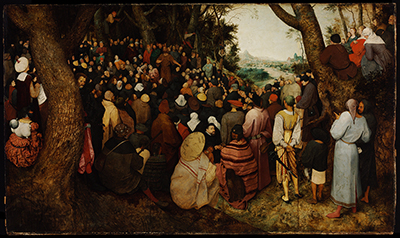
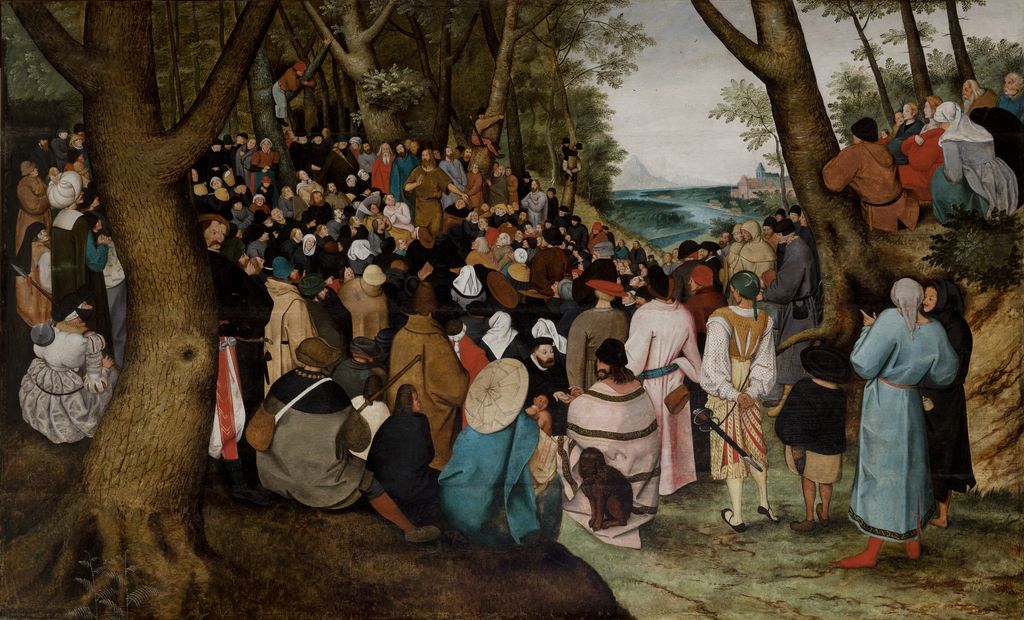
A crowd has gathered beneath tall trees in Pieter Bruegel the Elder’s The Sermon of Saint John the Baptist. Some people have climbed for a better view. Others sit with their backs to us, and a few direct their attention elsewhere. John is the brown-clad figure near the middle of the gathering, with Christ in pale blue a little to his right. The Museum of Fine Arts in Budapest holds the signed and dated 1566 panel as inventory 51.2829. The painting measures about 95 by 160.5 centimetres. At that scale it gives the crowd enough room to establish the setting before the preacher comes clearly into view [1] [2].
This work across Bruegel’s career
Tower of Babel
1563The Harvesters
1565Peasant Wedding
1568Children's Games
1560Triumph of Death
1562–1563The Sermon (Preaching) of Saint John the Baptist
This artworkContents
- Introduction
- Finding John and Christ
- Who Turns towards the Sermon
- The Clearing and the Year 1566
- The Budapest Panel and the Kraków Version
- Annotated Details
Finding John and Christ
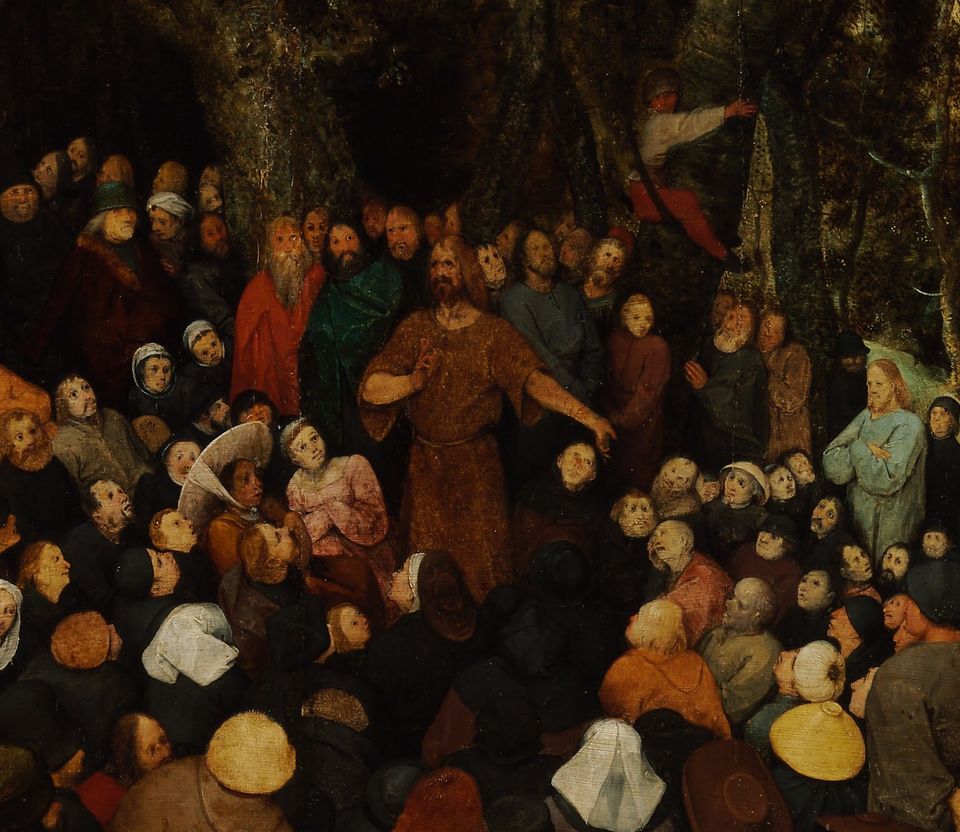
Begin where the figures turn towards a man standing above many of their heads. John extends his arms, and one hand directs the eye towards the people just to the right. His brown garment is close in colour to parts of the wooded background, which makes his outline less immediately conspicuous than the brighter clothing in front. The small gaps around his arms separate him from those standing near him. Once you see the gesture, the inclinations of several nearby heads begin to make sense as responses to it [1] [2].
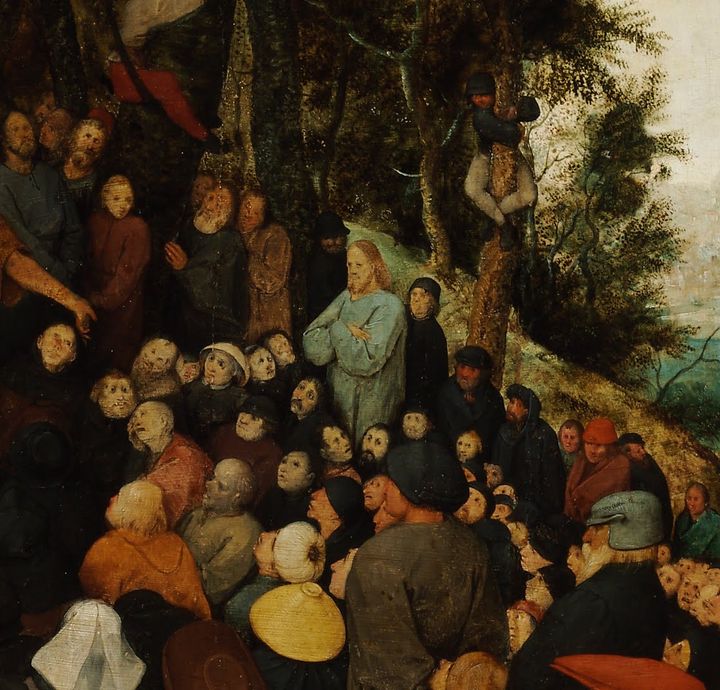
Christ stands near the opening into the landscape. His crossed arms form a smaller gesture than John’s, and the light blue of his garment helps distinguish him. In Matthew, John calls people to repent and announces one who is to come after him. The same chapter later brings Jesus to John for baptism. The picture gives the preacher room to speak while introducing Christ through position, colour and gesture. A viewer looking for the speaker can come upon the person he foretells by following the direction of his arm [3] [2].
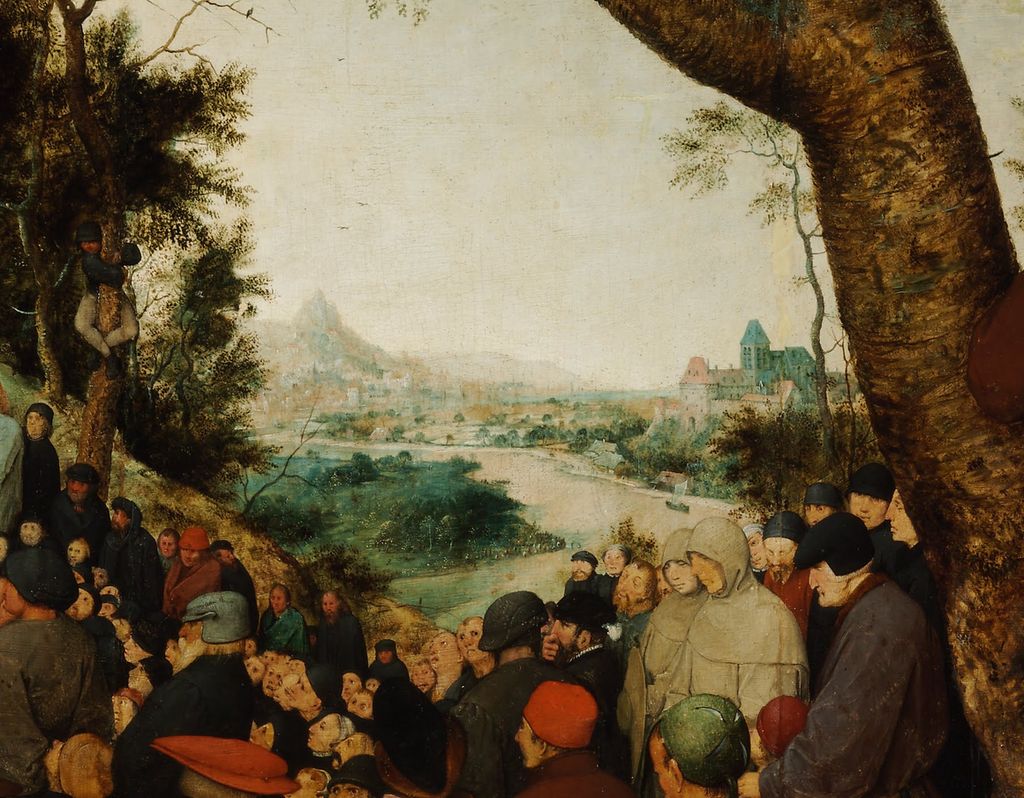
Two large trunks frame the gathering. People at the left can be seen on either side of the closer trunk, so the crowd seems to extend into ground that is hidden from us. Near the right trunk, people higher up look down at those assembled below. The trees therefore mark both the edges of the principal gathering and its continuation beyond the foreground. The paler valley between them opens a much longer view, giving the tightly packed heads a distinct limit before the landscape takes over.
Annotated Details from The Sermon of Saint John the Baptist
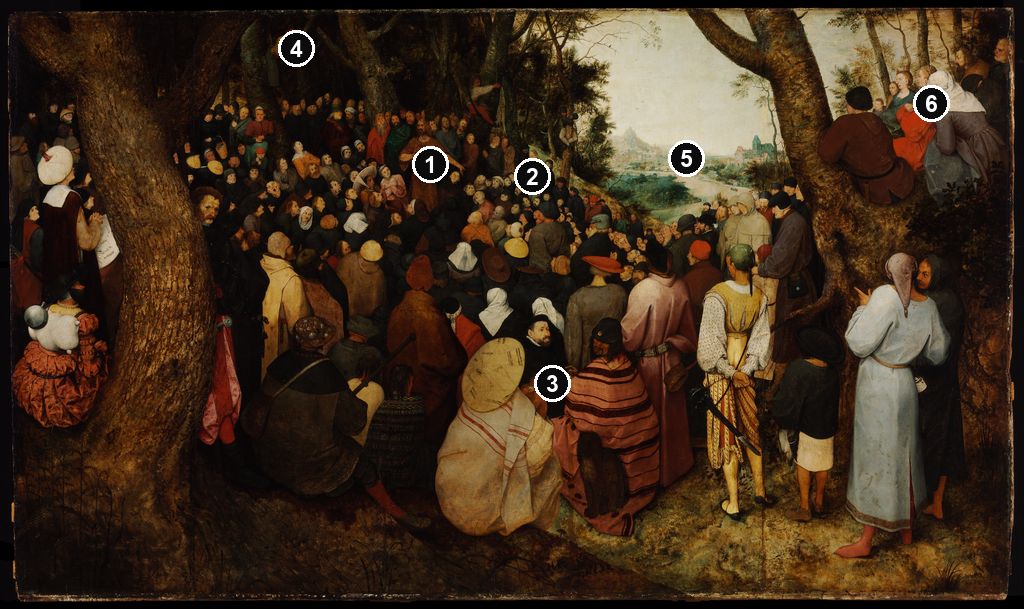
Find John in the clearing and follow the positions and gestures of the people around him.
Details from THE SERMON OF SAINT JOHN THE BAPTIST
Six details show how the painting distinguishes the preacher, Christ and the crowd.
John’s gesture
John extends his arms above many of the heads around him.
Christ in blue
Christ stands with crossed arms beside the opening in the crowd.
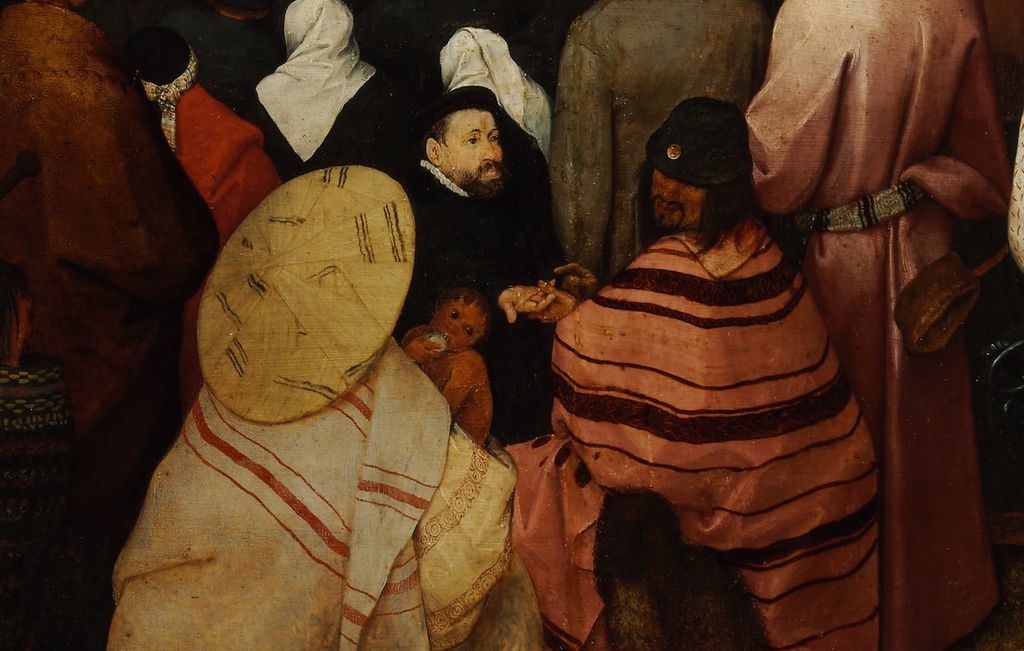
The palm reading
Two figures attend to an extended hand while the sermon continues.
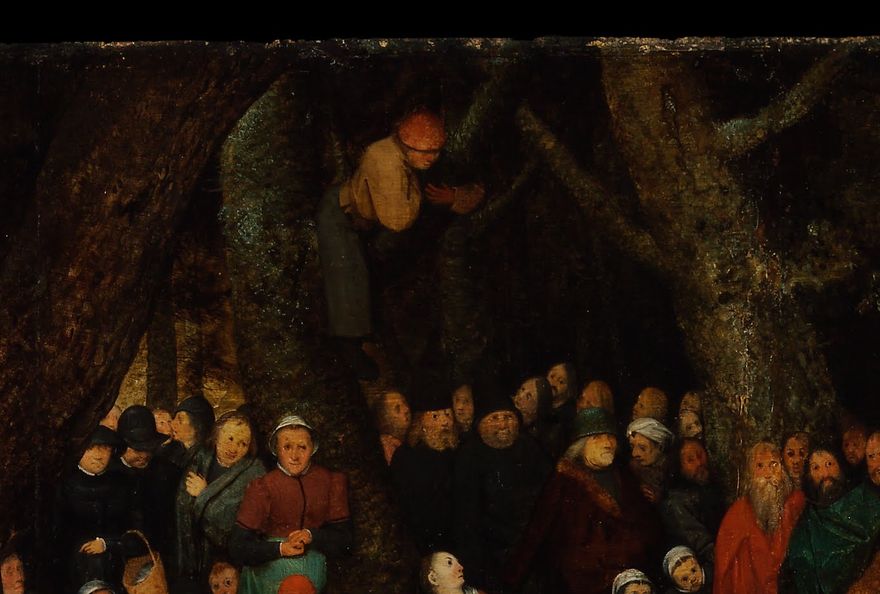
Listeners among the branches
A figure climbs to look down into the clearing.
The opening into the valley
A light view of water and buildings opens beyond the crowd.
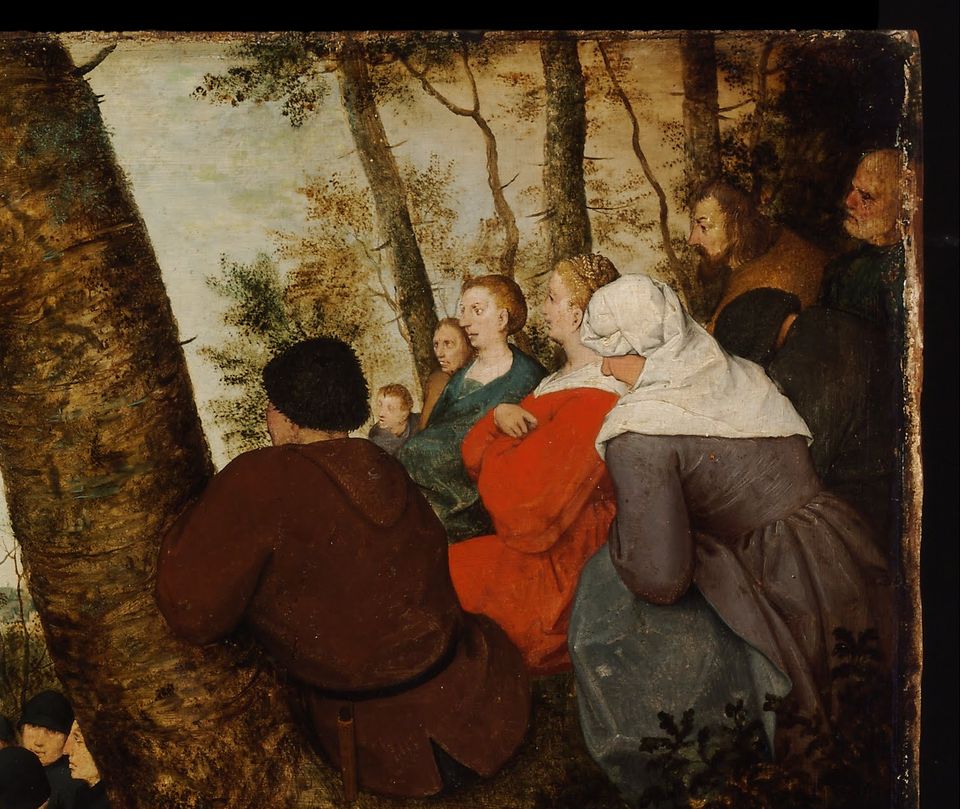
The group at the right
Listeners occupy a slope above the people gathered below.
Pieter Bruegel the Elder, The Sermon of Saint John the Baptist, 1566. Museum of Fine Arts, Budapest, 51.2829. Reproduction via Wikimedia Commons.
Who Turns towards the Sermon
Several figures near the bottom show little of their faces. A round hat, a pale wrap and the broad bands of a striped garment occupy space that could easily have been filled with more faces turned towards John. The painting puts these listeners between the viewer and the speaker. We look past their shoulders from within the clearing. At the front and along the sides, turns of the head occasionally provide a clearer profile. The crowd is legible as a gathering partly because each back and profile leaves a different amount of information for us to read.
One encounter at the front turns away from the sermon. The museum’s account identifies a person in a striped garment reading the hand of the man opposite. A nearby seated figure with a broad hat helps enclose their exchange. The hands are much smaller than the expanses of clothing around them. Finding them takes some of the same attention as finding John’s pointing arm. Once recognised, the foreground encounter helps distinguish the people who listen to the sermon from those whose interest is directed towards someone nearer at hand [2].
Higher up, a figure leans from among the branches. On the right, listeners occupy raised ground beside the large trunk. Their positions offer views unavailable to the people who stand below. Some of the foreground figures, conversely, are high enough on the panel to block our view of the smaller figures beyond. Bruegel balances the inconvenience of being among so many people with the possibility of looking down on them. The expressions and movements of the crowd can be inspected at a pace very different from the apparent progress of the sermon.
The Clearing and the Year 1566
The scene takes place outdoors, as John’s preaching does in the Gospel. Bruegel’s varied clothing and the forested setting also allow the viewer to see a gathering closer to his own time. The Budapest museum’s interpretive account connects the setting with the open-air Protestant sermons held in the Netherlands in 1566. It also draws attention to the varied people who have come together for the biblical announcement. The historical comparison helps explain what a contemporary viewer might have recognised in the setting. The painting leaves Bruegel’s own confessional commitments open [1] [2] [3].
The two readings bring different details into focus. The position of Christ relates John’s gesture to the Gospel account. The crowded banks and people in the branches bring out the practical conditions of gathering outdoors to hear a speaker. Both are present in the painting. Look out through the gap towards the river and a distant settlement and the clearing can seem comparatively secluded. Look back at the variety of clothes and faces and it becomes a place where people with different interests have arrived at the same time [1] [2].
The Budapest Panel and the Kraków Version
The Budapest museum records the signature and date in the lower right. The panel is the basis for the main reproduction here. The National Museum in Kraków owns a later version, MNK XII-A-619, which it attributes to Pieter Brueghel the Younger. A version can preserve many particulars of an earlier composition while belonging to a different painter and a different stage of the design’s circulation. The two inventory numbers identify the individual objects [1] [4].
In the Kraków painting reproduced below, the figures in the trees, the preacher and the opening to the landscape retain their places. The large garments near the bottom are easy points of comparison. In the Budapest photograph, the seated figure with the round hat has a light wrap. In the Kraków version the corresponding area has a much stronger blue-green colour. The pale garments at the right and the bands on the figure reading the hand offer further places to look. These comparisons make it possible to follow the survival of the grouping while looking closely at each painter’s handling of it [1] [4].
Discussion
Which detail in this work most changes how you read it?
Frequently Asked Questions
One encounter at the front turns away from the sermon. The museum’s account identifies a person in a striped garment reading the hand of the man opposite. [2]
References
- Museum of Fine Arts, Budapest, The Preaching of Saint John the Baptist, 51.2829, View source.
- Museum of Fine Arts, Budapest, When Saint John the Baptist Visited the Netherlands, Google Arts & Culture, View source.
- United States Conference of Catholic Bishops, Matthew 3, View source.
- National Museum in Kraków, Sermon of Saint John the Baptist, MNK XII-A-619, View source.









