


 by Tom Gurney
Tom Gurney BSc (Hons) is an art history expert with over 20 years experience
Published on June 19, 2020 / Updated on October 14, 2023
Email: tomgurney1@gmail.com / Phone: +44 7429 011000
The Wedding Dance: Introduction
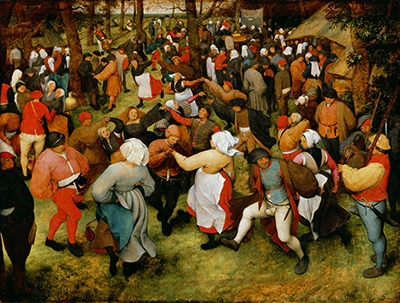
Pieter Bruegel the Elder’s The Wedding Dance is a signed and dated painting of 1566 in the Detroit Institute of Arts. On a wood panel nearly 1.6 metres wide, Bruegel gathers dancers, musicians and wedding guests in a clearing. A man in pale hose pushes one foot across the foreground, just beside a woman whose apron swings with her turn. The picture lets us see both the space a single step requires and the difficulty of finding it in a crowd [1].
This work across Bruegel’s career
Tower of Babel
1563The Harvesters
1565Peasant Wedding
1568Children's Games
1560Triumph of Death
1562–1563Wedding Dance
This artworkContents
- Introduction
- Feet, Hands and Partners
- Listening at the Edge of the Clearing
- What the Wood and Paint Reveal
- From a Wedding Feast to an Outdoor Dance
- Annotated Details
Feet, Hands and Partners
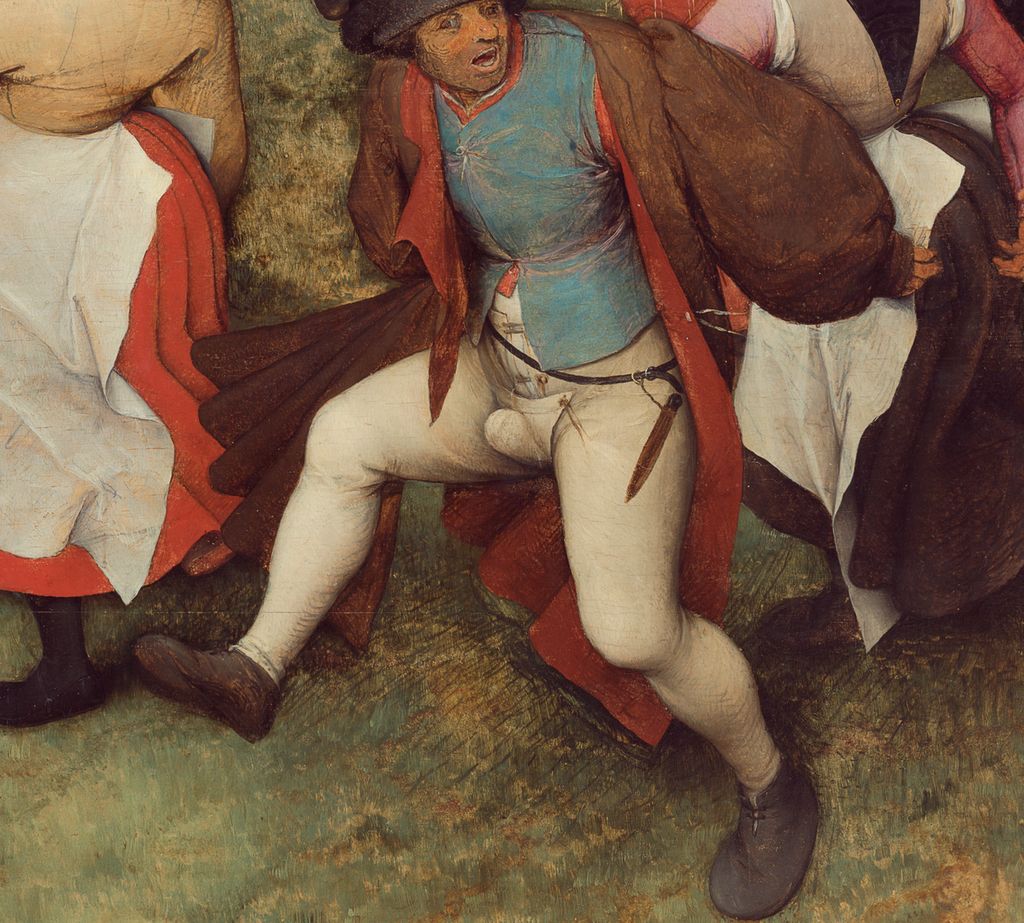
Start with the man in the blue top and pale hose near the lower right. One knee bends and the other leg reaches out across the grass. His spread arms and the fall of his coat show how much of his body is involved in keeping his balance. There is enough empty ground between his shoes and the bottom edge to make the step readable. Several rows farther back, feet disappear among hems, while heads and shoulders continue to show where the dancers are going.
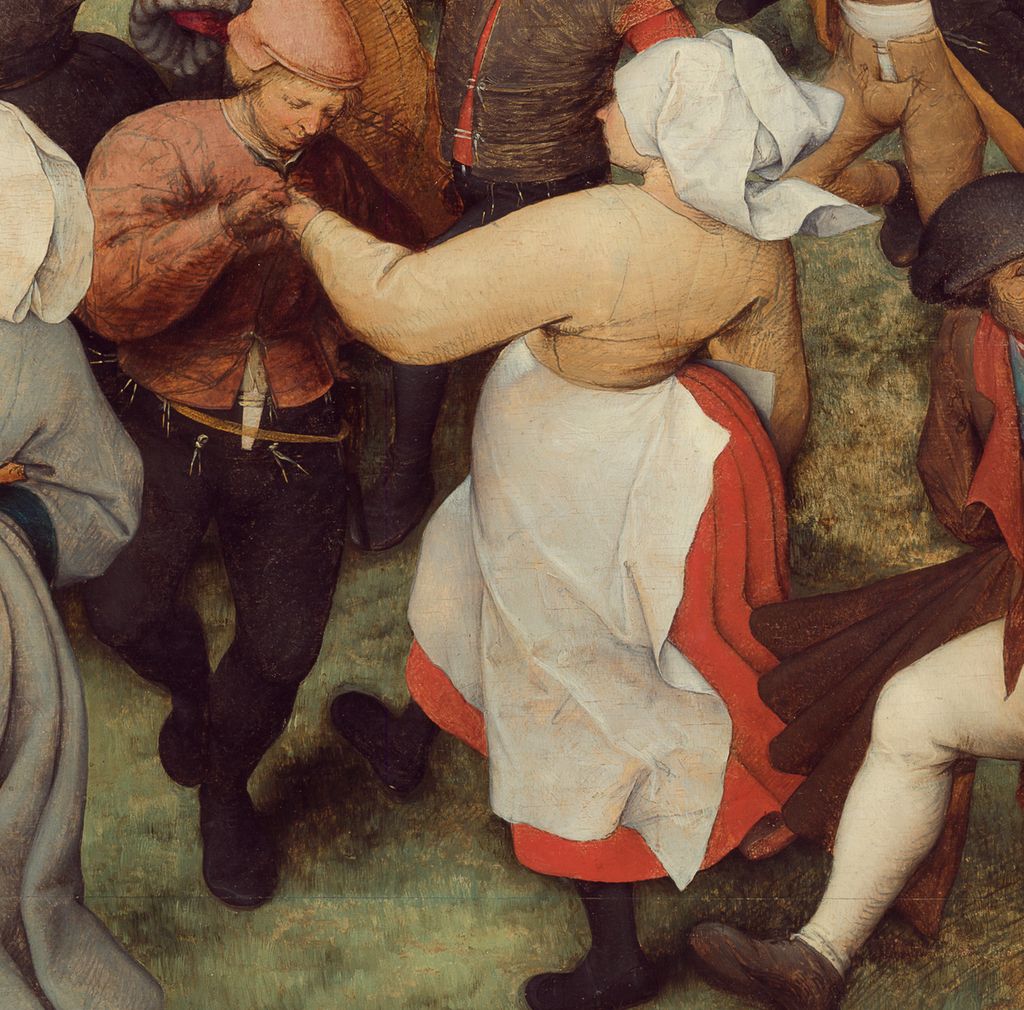
The figure in the white apron near the centre gives the same stretch of grass a different shape. Her arm reaches left to meet another dancer’s hand. The outer edge of her skirt moves out toward the right and its red cloth shows beneath the white. Follow those edges down to the feet and the amount of cloth in motion becomes clearer. Nearby, the woman in blue, seen from behind, turns along a different line. Bruegel can keep both turns legible because the two aprons and headdresses make distinct shapes against the people behind them.
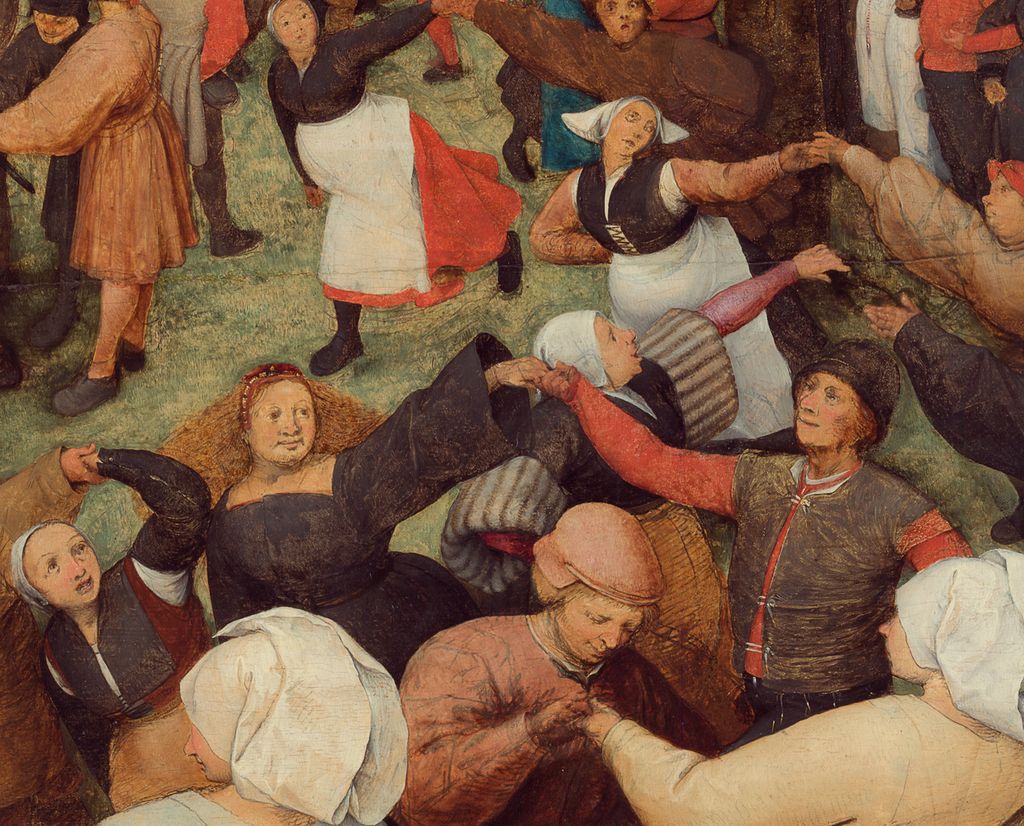
At lower left the man in a pink jacket and red hose keeps his arms near his waist. The eye can trace his stance from its wide upper outline down to the shoes close together on the ground. In the centre, at a little more distance, dancers raise their joined hands. The DIA draws attention to the deliberate exaggeration of limbs. Comparing the extended leg in front with the lifted arms in the middle shows how widely Bruegel varies the movement without making every person equally conspicuous [1].
Annotated Details from The Wedding Dance
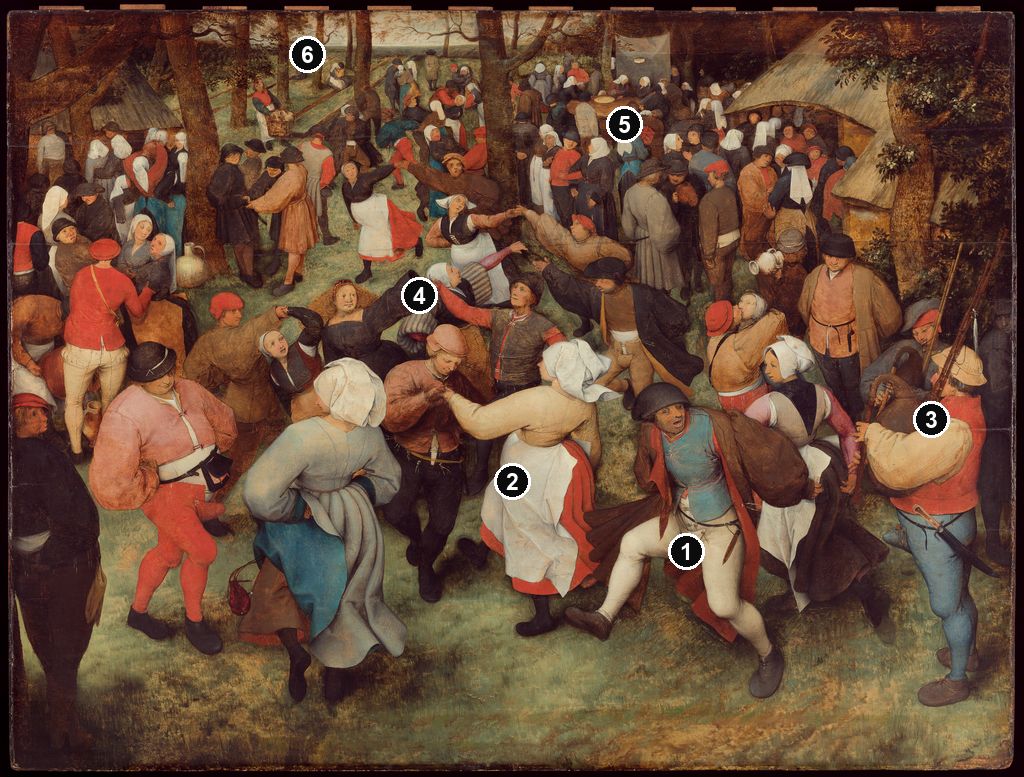
Trace the dancers’ movements across the grass, then look at the musicians and the gathering beyond.
Details from THE WEDDING DANCE
Six details show how Bruegel fills the clearing and where the later addition changed its upper edge.
The lunging dancer
The man in pale hose reaches across the grass. His bent knee and extended leg make the transfer of weight visible.
The swinging apron
The white apron sweeps across the red skirt as the dancer stretches an arm towards her partner.
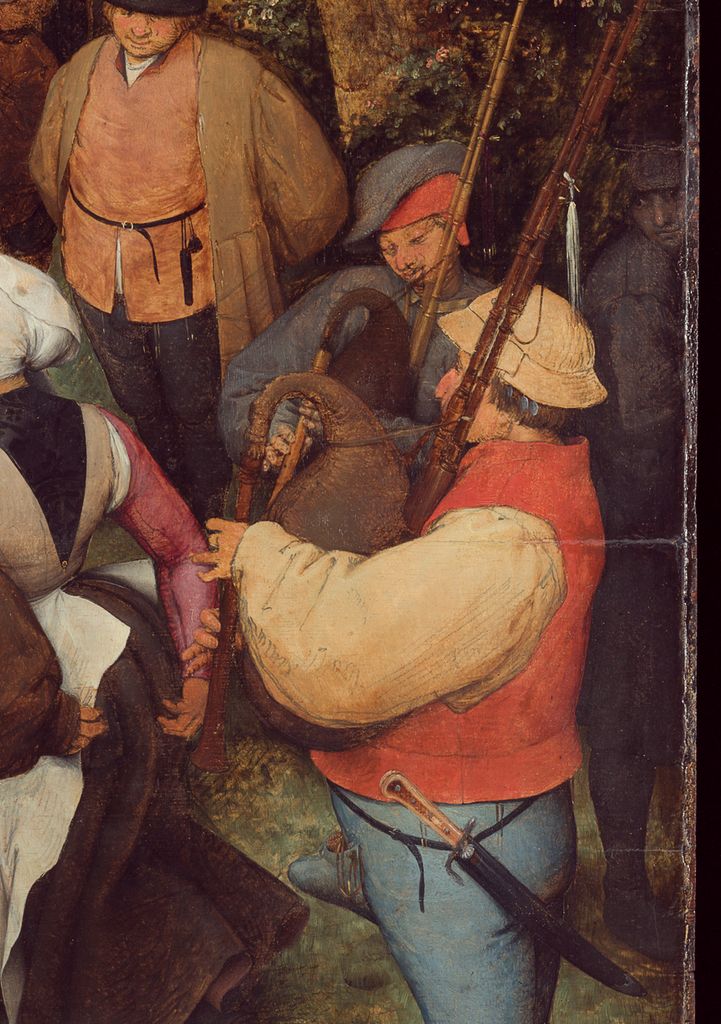
The bagpipers
The instruments overlap the musicians at the right edge. The slanting pipes stand out against the dark background.
Hands raised in the dance
A pair’s lifted arms make a low arch above people whose feet are partly obscured.
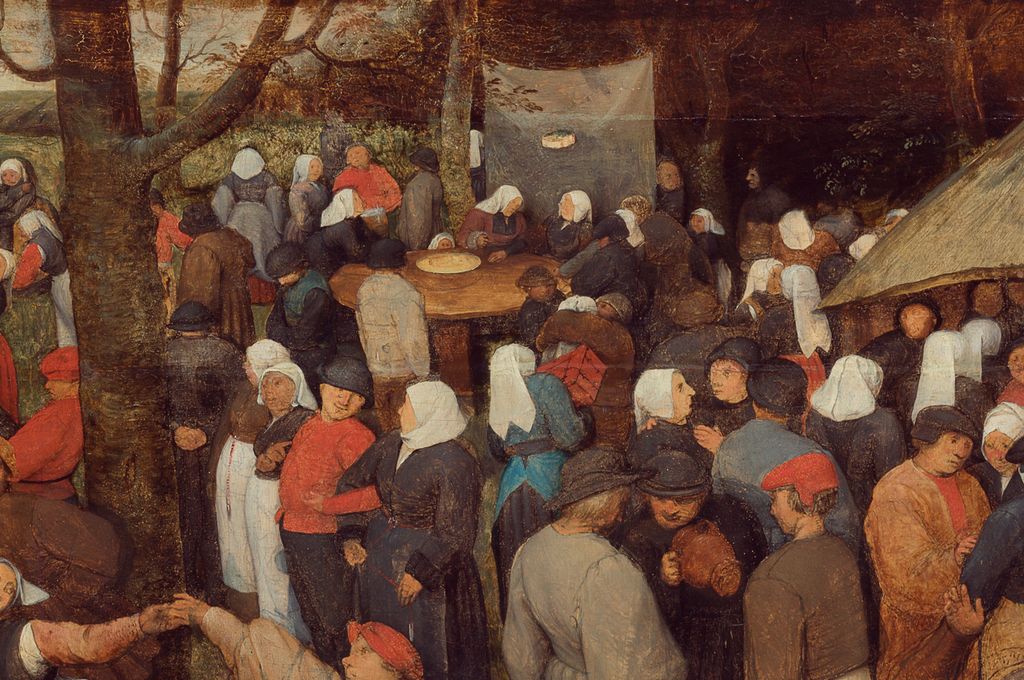
The wedding gathering
A table and a close group of guests occupy a patch of ground behind the dancing.
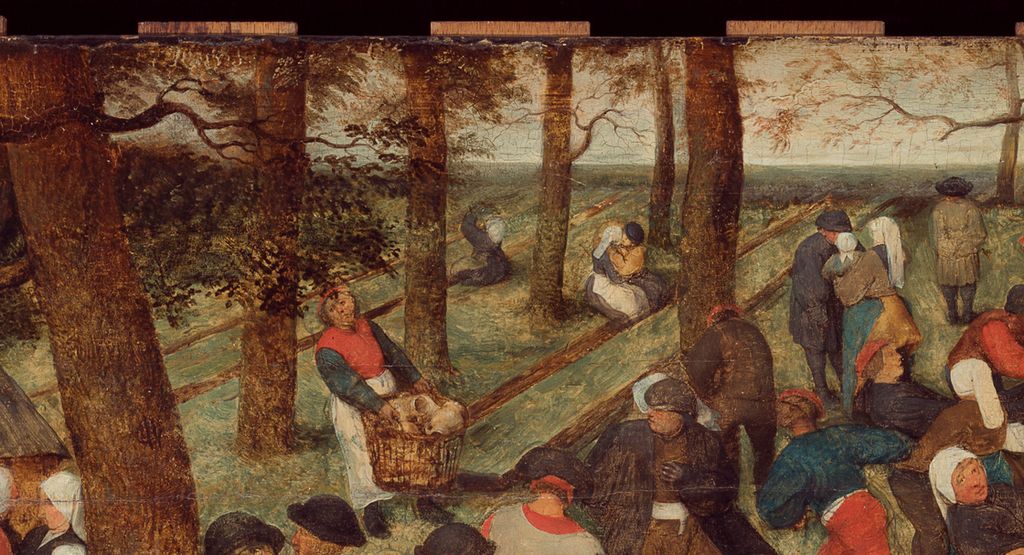
The horizon at the top
A gap between the trees opens towards the horizon. Detroit’s conservators identify the uppermost plank as a later addition.
Pieter Bruegel the Elder, The Wedding Dance, 1566, oil on wood panel. Detroit Institute of Arts, City of Detroit Purchase, 30.374.
Listening at the Edge of the Clearing
Two bagpipers stand among the guests at the right. Look for the long inclined pipes against the dark tree and the bag at the side of the player nearest the edge. His relatively steady stance gives a point of comparison for the weight shifting between the dancers’ feet. A second instrument overlaps him farther back. Bruegel puts the source of music within easy view of the nearest dancers, with the figures and trees cutting into the space around it.
Then look at the path that opens intermittently towards the rear. There are fewer gaps large enough to see an entire body and more faces framed by caps and white cloth. That narrowing matters at the scale of the real panel. Close up, you can inspect individual expressions. From farther away, the repeated whites make it possible to track the crowd deep into the clearing, even where you can no longer separate the people by their outlines.
At the back right, near the buildings, a gathering at a table gives the dancers another point of orientation. Some people are standing with their backs to the viewer, and others turn inward. Bruegel shows the wedding as an occasion that makes room for different activities at once. The largest bodies command the foreground, while the crowded rear helps explain why the people have gathered in the first place. The sloping roofs and tall trees contain both parts of the celebration.
What the Wood and Paint Reveal
The Detroit Institute of Arts records the signature and Roman-numeral date at the lower right. The museum acquired the panel in 1930. For its 2019–20 exhibition, its conservators and curators put the construction and treatment history alongside the visible picture. The work on display includes a fifth piece of wood along the top. The museum found multiple reasons to identify this strip as an addition, including the abrupt stop in Bruegel’s underdrawing below it and evidence from the paint [1] [2] [3] [4].
The change affects the way the clearing reads. Through gaps among the trunks, the upper strip now gives a glimpse of land running towards a horizon. The conservators concluded that Bruegel probably designed the picture without that horizon. The eye would have been kept nearer the crowd, trees and buildings. The present edge, with its small openings beyond the gathering, records a later stage in the painting’s history [2] [3].
Infrared imaging also made it possible to see a remarkably detailed drawing beneath much of the painted surface. The museum identifies the medium as black chalk, a natural stone used for drawing. Hatching and altered contours show Bruegel working through the placement of forms. There is an instructive difference between that evidence of adjustment and the sudden movement that seems to happen in front of us. The speed belongs to the represented steps and gestures. The changes under the paint show the time taken to arrange them [2].
The conservators also identified both vermilion and cochineal among the red materials in the painting. The broad red shapes you see from across a room therefore cannot be treated as evidence for a single pigment. Compare the red hose at lower left with the glimpses of red along the edge of the central apron. Their size, position and neighbours give them very different jobs in the composition [2].
From a Wedding Feast to an Outdoor Dance
Bruegel’s Peasant Wedding in Vienna gives the wedding feast its own setting. Dishes travel on an improvised tray through a crowded interior, and the long table organises the guests. In Detroit, the clearing allows dancers to swing around one another and lets music occupy the right edge. Comparing the two works helps explain how Bruegel makes the activity determine the space. One composition follows food through a room. The other follows steps across an opening between trees and buildings [5] [1].
Vienna’s Peasant Dance is also outdoors. There, figures dance in a village street, with the buildings and the line through the street establishing the direction of the view. In Detroit, several turns and handholds compete for the viewer’s attention, and the gathering continues beyond the dancers towards the table. The DIA relates the excessive gestures and conduct in its picture to contemporary moral attitudes toward unrestrained festivity. This interpretation can be read alongside the care Bruegel grants to the mechanics of moving, making music and looking on [6] [1].
Return to the patch of grass at the lower right. The man’s extended foot takes up room that a neighbour has to leave open, even though it passes very close to the swinging skirts. At the rear, there is barely a gap between one head and the next. Seeing the two areas together makes the crowded picture easier to read. Bruegel gives the dance its force partly by measuring out where each dancer can move.
Discussion
Which detail in this work most changes how you read it?
Frequently Asked Questions
Pieter Bruegel the Elder’s The Wedding Dance is a signed and dated painting of 1566 in the Detroit Institute of Arts. On a wood panel nearly 1.6 metres wide, Bruegel gathers dancers, musicians and wedding guests in a clearing. [1]
At lower left the man in a pink jacket and red hose keeps his arms near his waist. The eye can trace his stance from its wide upper outline down to the shoes close together on the ground. [1]
References
- Detroit Institute of Arts, The Wedding Dance, 30.374, View source.
- Detroit Institute of Arts, Bruegel’s The Wedding Dance Revealed, conservation findings, View source.
- Detroit Institute of Arts, Bruegel’s The Wedding Dance Revealed, technical illustrations and discussion, View source.
- Detroit Institute of Arts, Bruegel’s The Wedding Dance Revealed, 2019–20 exhibition, View source.
- Kunsthistorisches Museum, Peasant Wedding, View source.
- Kunsthistorisches Museum, Peasant Dance, View source.







