


 by Tom Gurney
Tom Gurney BSc (Hons) is an art history expert with over 20 years experience
Published on June 19, 2020 / Updated on October 14, 2023
Email: tomgurney1@gmail.com / Phone: +44 7429 011000
The Land of Cockaigne: Introduction
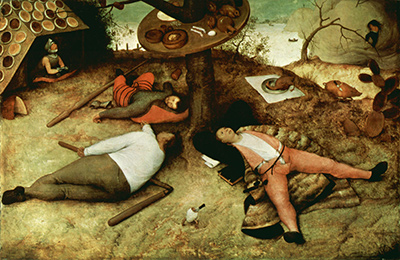
Pieter Bruegel the Elder painted The Land of Cockaigne in 1567 on an oak panel now in the Alte Pinakothek, Munich. Beneath a tree, three people recline around a circular table. The food on the table is only the beginning of what this country provides. A roof is tiled with tarts, a man emerges through a mound of buckwheat and a pig carries a knife. The country could supply nearly every meal without work. Bruegel uses that premise to show what people look like when there is scarcely a reason to get up [1] [2].
This work across Bruegel’s career
Tower of Babel
1563The Harvesters
1565Peasant Wedding
1568Children's Games
1560Triumph of Death
1562–1563Land of Cockaigne
This artworkContents
- Introduction
- Three Figures under a Tree
- Food That Comes to You
- Where the Story Came From
- The Painting and the Engraving
- Annotated Details
Three Figures under a Tree
The trunk divides the picture vertically. The bodies below it extend like spokes from the same patch of ground. A figure dressed in pink lies to the right, another in white reaches towards the lower left, and a third lies beyond them at an angle under the table. Seen from above, the space they share is large enough for every one of them to stretch out. The table itself takes up remarkably little room in comparison with the ground given to the people who ate from it.
The Alte Pinakothek identifies a soldier, a peasant and a man of letters. The painted objects set out clues. Around the right-hand figure are papers and a book. The figure farther back has a long weapon beside him. A long-handled implement runs alongside the man to the left. Instruments of work, study and warfare lie level with the bodies of their owners. The three occupations give us a way to tell the people apart, even as their shared posture draws attention to what they now have in common [1] [2].
Notice that the heads occupy a relatively small area close to the trunk. It is where a viewer might first expect to find a conversation between diners. The arms and legs tell a different story, spreading out into intervals of open ground with little apparent coordination. The scholar at the right provides a particularly clear view of how Bruegel paints a body at rest. The head is tipped back, the legs extend in different directions, and the book remains within reach. The Met suggests that this figure, who appears at the left in its reversed engraving, may be waiting for more to drink [2].
Annotated Details from The Land of Cockaigne
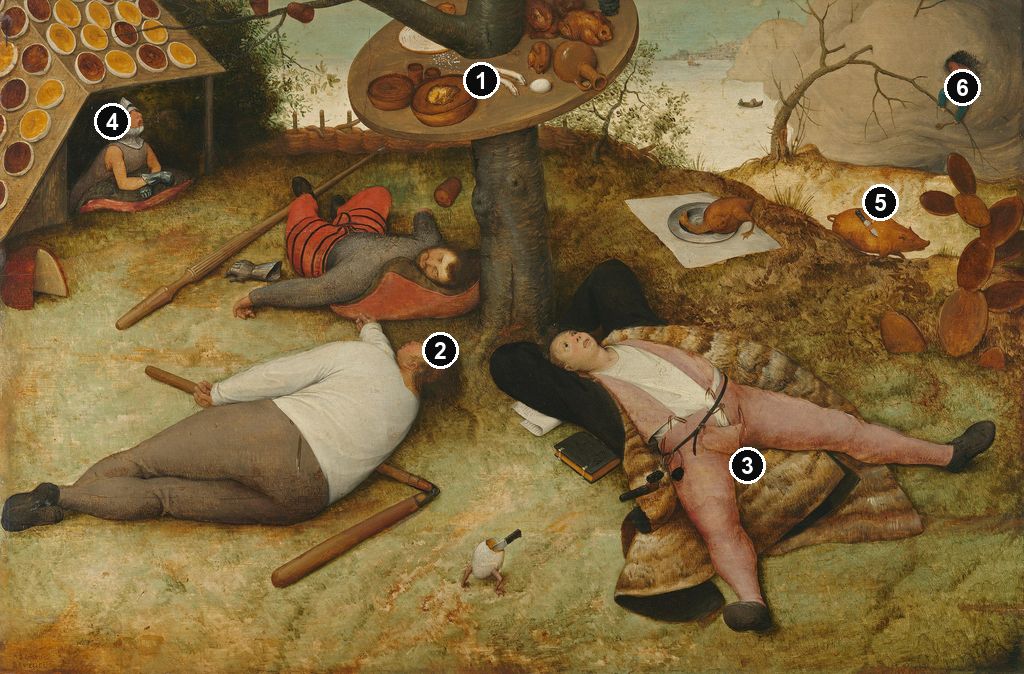
Start at the tree and follow the food and figures towards the edges.
Details from THE LAND OF COCKAIGNE
Six details locate the resting men and the food that comes to them.
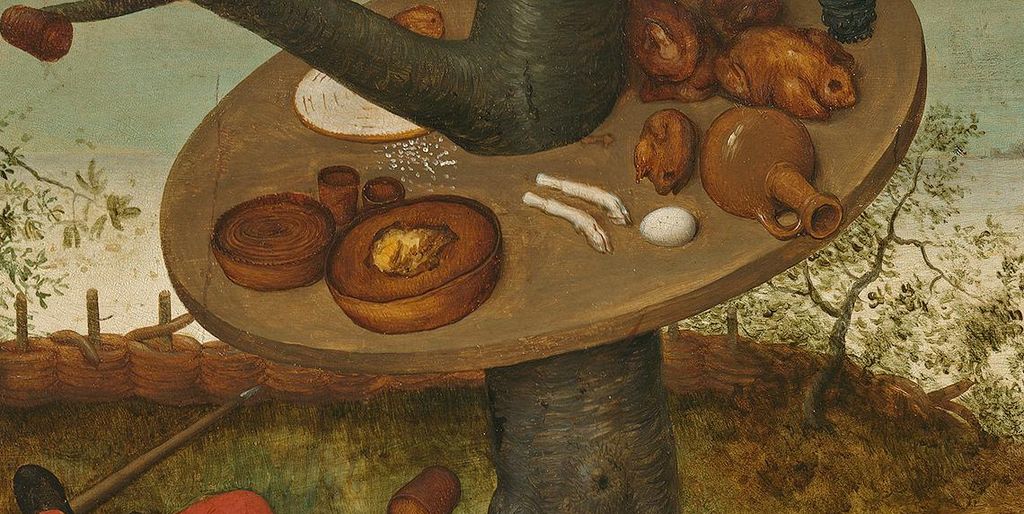
The table around the trunk
Food lies on a circular platform fastened to the tree.
The three resting men
Three bodies radiate out from the tree across the foreground.
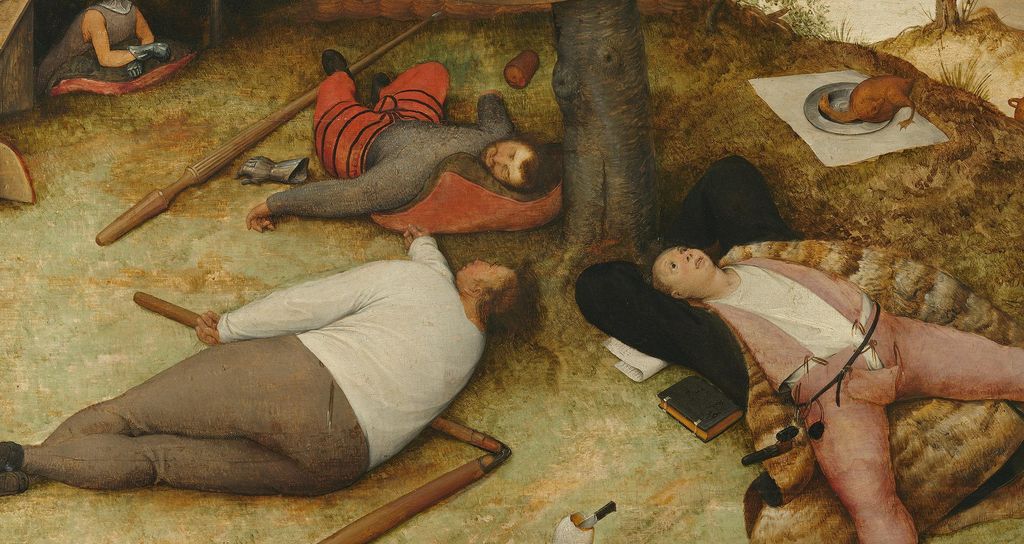
The scholar and his book
A book lies near the man in the pink stockings.
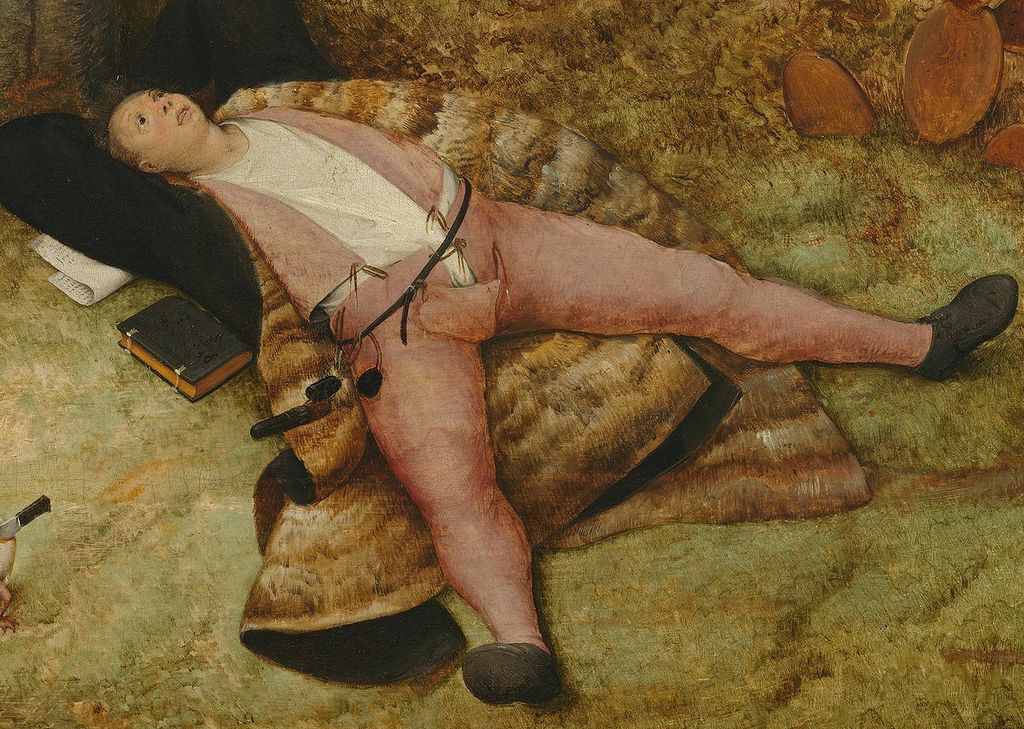
The roof covered in food
A figure waits beneath a roof set with round pastries.
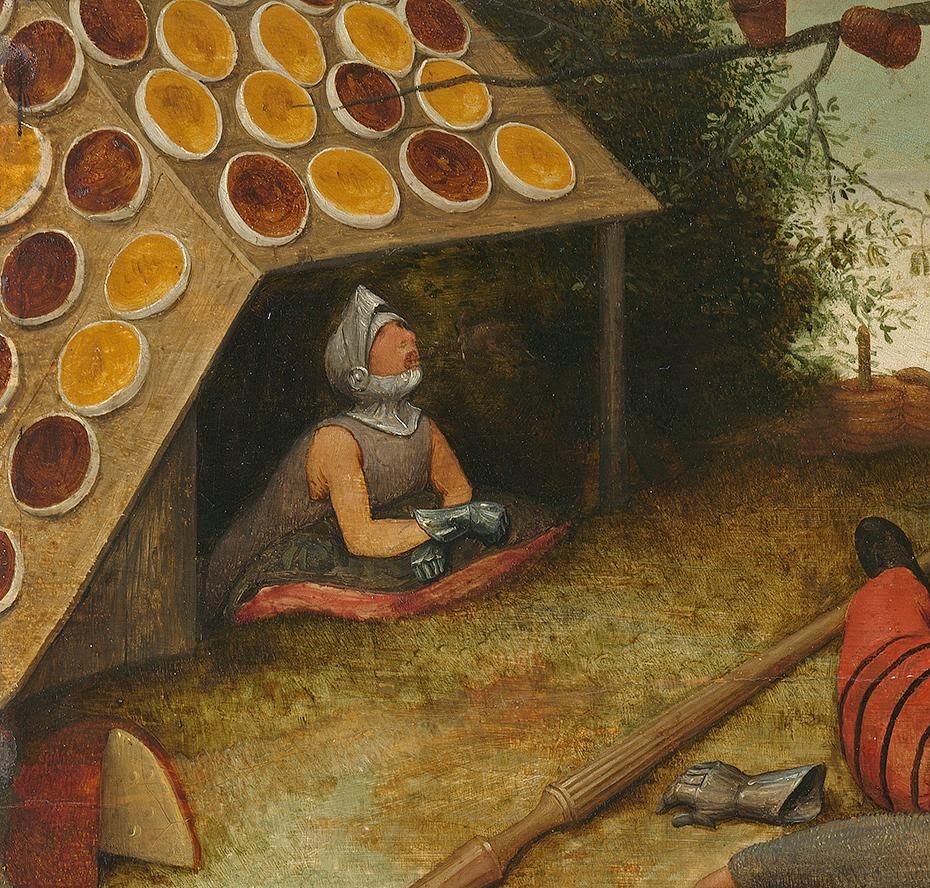
A pig ready to carve
The pig passes near the bird on a dish.
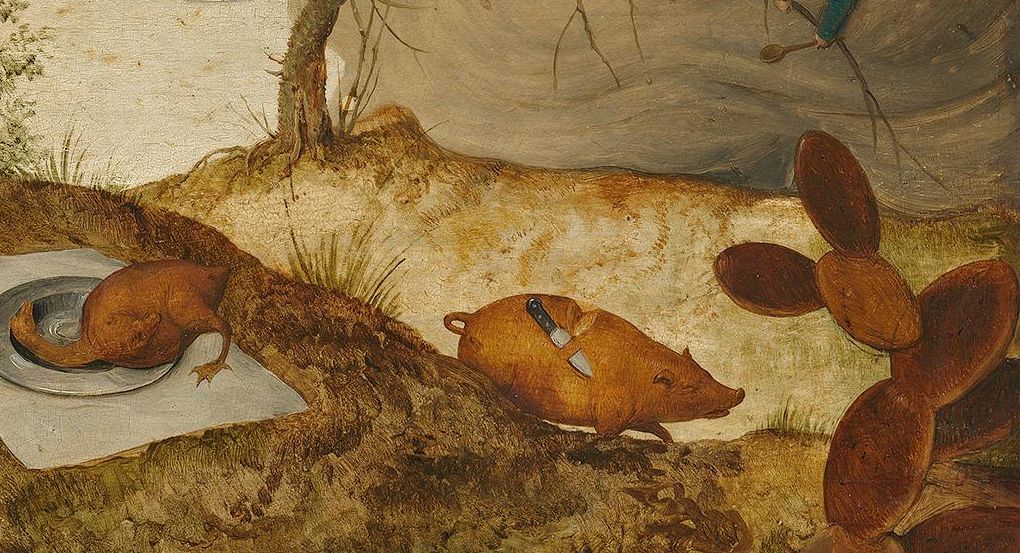
A way into Cockaigne
A small figure pushes through the pale bank in the distance.
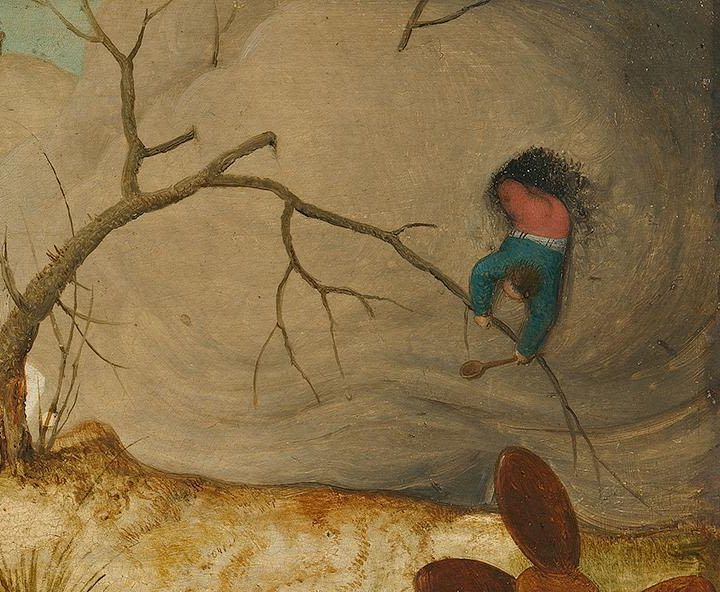
Pieter Bruegel the Elder, The Land of Cockaigne, 1567. Bayerische Staatsgemäldesammlungen – Alte Pinakothek, Munich, 8940. Museum reproduction and resized splash, marked overview and detail crops licensed CC BY-SA 4.0.
Food That Comes to You
The little egg near the lower edge of the painting stands upright on legs. It is easy to miss until you follow the line between the two nearest figures. Once found, it changes how you read the foreground. What first appeared to be open ground turns out to be a route by which food can approach the diner. The egg barely takes up more room than a hand. Giving it a short distance of its own to travel makes the country’s large promise of abundance legible in a single incident.
The pig farther back carries a knife. The small sharp object tells us that the animal brings the equipment needed to carve it. Near the tree a dish sits on a cloth, with space around it as though someone had prepared a place to eat. Move left across the picture to the steep roof, where row after row of tarts occupies the place of tiles. A person can reach these provisions without passing through a kitchen. Bruegel builds the promise of the story into the surfaces and paths of the country [2].
Look at the mound towards the upper right, beyond the meal. Part of a man comes into view through an opening. The Met identifies the mound as buckwheat. It gives a visitor something substantial to get through on his way into the country. Bruegel reserves most of the interior for people who have already arrived. The man at the opening therefore shows one of the few exertions in the picture, and even his passage takes him through food [2].
Where the Story Came From
The Dutch name Luilekkerland belongs to a literary tradition about a country where work is unnecessary and appetite is continually satisfied. Other versions circulated in European languages. A Middle English example survives in the Kildare manuscript, now British Library Harley MS 913. In that poem, food forms part of the construction of an abbey and cooked birds offer themselves to eat. The English poem offers a comparison for the premise of Bruegel’s picture. A house covered in tarts and buildings made of food both make abundance part of the architecture [2] [3].
The painted inhabitants are people whose positions in the world can usually be understood by what they do. A soldier carries a weapon, a farmer works with a tool and a scholar has books. All three occupations involve learned habits or sustained effort. Bruegel makes those habits visible through objects and then leaves the objects lying among the sprawled figures. The Alte Pinakothek sees a criticism of idleness and gluttony that extends across social groups. The joke depends in part on how evenly the country distributes its effects [1].
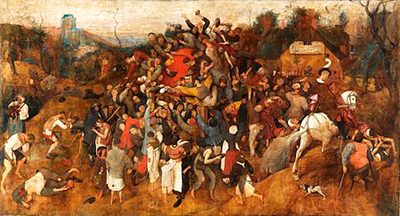
The print known as The Fat Kitchen, engraved by Pieter van der Heyden after Bruegel and published by Hieronymus Cock in 1563, offers a related image of plenty. It shows the activity that can go with a crowded room full of food. In The Wine of Saint Martin’s Day, people climb over one another to reach a barrel, while the diners in Cockaigne lie quiet. Food travels out into the world and the people are already horizontal. Looking at the two compositions together brings out the stillness below the tree and the work that ordinary food would demand [4] [1].
The Painting and the Engraving
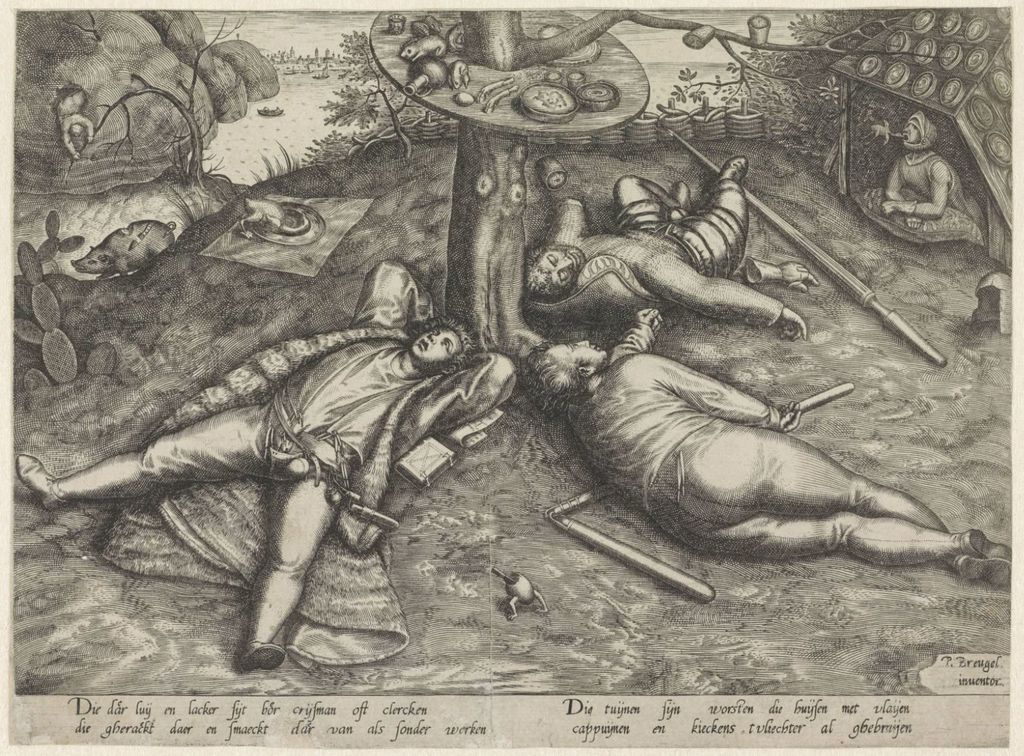
The Munich painting measures 51.5 by 78.3 centimetres and is recorded as inventory number 8940. The Met has a separate engraving, attributed to Pieter van der Heyden and tentatively dated after 1570. It reverses the composition. The scholar is at the left in the engraving and the tart-covered roof at the right. The print identifies Bruegel as the designer and adds a Dutch inscription about the inhabitants having everything to eat without cost. The Met leaves open whether Bruegel took part in making the engraving [1] [2].
The panel’s ownership history stretches from the imperial gallery in Prague to Skokloster Castle in Sweden. The Alte Pinakothek records its removal from Prague by Swedish troops during the Thirty Years’ War. It later belonged to Richard and Marie von Kaufmann in Berlin. At the 1917 auction, the surgeon Otto Lanz bid for the picture on behalf of the Munich museum. The museum’s record credits several donors and details Marie von Kaufmann’s decision to waive part of the proceeds [1] [5].
To see how the picture makes the country’s promise work, trace a route from its edge to the tree. Start with the opening in the mound, follow the pig towards the dish, and look for the egg farther down. At each step the means of finding or preparing a meal has changed. The travellers and objects around the edges make the land’s invention visible, while the quiet spread of bodies under the tree shows what its abundance has already allowed the diners to do.
Discussion
Which detail in this work most changes how you read it?
Frequently Asked Questions
The pig farther back carries a knife. The small sharp object tells us that the animal brings the equipment needed to carve it. [2]
References
- Bayerische Staatsgemäldesammlungen, The Land of Cockaigne, Alte Pinakothek inventory 8940, View source.
- The Metropolitan Museum of Art, The Land of Cockaigne, engraving attributed to Pieter van der Heyden, 26.72.44, View source.
- University College Cork, The Land of Cokaygne in The Kildare Poems, View source.
- The Metropolitan Museum of Art, The Fat Kitchen, engraving by Pieter van der Heyden, 26.72.42, View source.
- Alte Pinakothek, Das Schlaraffenland und seine Erwerbsgeschichte, View source.








