


 by Tom Gurney
Tom Gurney BSc (Hons) is an art history expert with over 20 years experience
Published on June 19, 2020 / Updated on August 16, 2026
Email: tomgurney1@gmail.com / Phone: +44 7429 011000
Pieter Bruegel Fall of the Rebel Angels: Introduction
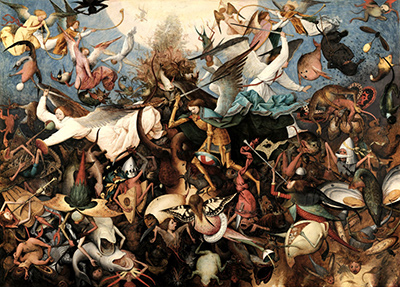
Pieter Bruegel the Elder's Fall of the Rebel Angels is one of his most compressed and startling visions of cosmic disorder. The Royal Museums of Fine Arts of Belgium identify the painting as La chute des anges rebelles, by Pieter I Bruegel, dated 1562, inventory number 584, oil on oak, signed and dated at the lower left with "M.D.LXII / BRVEGEL" [1]. Its subject is the war in heaven: Saint Michael and the faithful angels drive Lucifer and the rebel angels downward, where their bodies turn into demons, monsters, weapons, shells, fish, insects and broken fragments of the created world.
The painting stands in a powerful corridor between Pieter Bruegel the Elder and Hieronymus Bosch. Bosch matters here because sixteenth-century viewers and publishers associated him with fantastic monsters, moral warning and infernal invention. The Metropolitan Museum of Art notes that Bruegel's early print designs answered a market for images in the style or manner of Bosch, while the National Gallery describes Bosch's lasting influence on Bruegel in the sixteenth century [3] [4]. Yet Fall of the Rebel Angels is not simply Bruegel imitating Bosch. It is Bruegel using Boschian possibility to build a painting of his own: more crowded, more encyclopaedic, and more tightly organized around the instant when spiritual rebellion becomes visible collapse.
For readers who know Bruegel from landscapes, peasant scenes and proverb pictures, this work shows another side of his art. It is moral, biblical and fantastic, but it is also exact. Bruegel fills the fall from heaven with close observations of animals, objects, instruments and armor. The result is a painting about pride, transformation and disorder, but also about the eye's struggle to sort a world that is breaking apart.
At a Glance
- ArtistPieter Bruegel the Elder, listed by RMFAB as Pieter I Bruegel
- TitleLa chute des anges rebelles / Fall of the Rebel Angels
- Date1562
- Medium/supportOil on oak
- Dimensions117 x 162 cm
- CollectionRoyal Museums of Fine Arts of Belgium, Brussels
- Inventory584
- Signature/dateLower left: "M.D.LXII / BRVEGEL"
- AcquisitionAcquired from Felix Stappaerts, Brussels, 1846
- Main figuresSaint Michael, faithful angels, Lucifer, the rebel angels and the apocalyptic dragon
- Key comparisonBoschian monsters and moral fantasy, handled as context rather than direct dependence
This work across Bruegel’s career
Tower of Babel
1563The Harvesters
1565Peasant Wedding
1568Children's Games
1560Triumph of Death
1562–1563Fall of the Rebel Angels
This artworkContents
- Introduction
- Object Facts And RMFAB Context
- The Subject: Rebel Angels Falling From Heaven
- What Bruegel Shows
- Bosch Comparison
- Composition, Scale And Visual Pressure
- Signature, Attribution And Reception History
- Relation To Triumph Of Death
- Why The Painting Matters
- Annotated Details
Object Facts And RMFAB Context
The RMFAB object record gives the essential facts. Fall of the Rebel Angels is an oil painting on oak, measuring 117 by 162 cm, signed and dated at the lower left, and acquired from Felix Stappaerts in Brussels in 1846 [1]. The museum lists the artist as Pieter I Bruegel, the date as 1562 and the inventory number as 584 [1]. Those facts make the Brussels painting one of the secure anchors for Bruegel's early 1560s painted work.
The dimensions matter because they place the work in the same broad physical range as Bruegel's Triumph of Death, which the Prado records as 117 by 162 cm and dates to 1562-1563 [5]. The two paintings are not pendant pictures, and they should not be collapsed into a single program. But their scale and date help explain why they are so often discussed together. Both belong to the period when Bruegel was turning dark moral subjects into panoramic fields of action.
RMFAB's extended account also preserves an important attribution history. The museum acquired the painting in 1846 believing it to be by Pieter Brueghel the Younger. It was later attributed to Bosch until the signature and date were found in 1898 at the lower left, hidden by the frame [2]. That history should be stated carefully. It does not mean the painting is uncertain now; RMFAB's object record presents it as a signed and dated work by Pieter I Bruegel. It does show, however, how powerfully Bosch shaped early expectations around monstrous imagery. The painting looked Boschian enough to be misread until the physical evidence corrected the name.
This is why the page belongs beside the site's guide to workshop copies and attribution, but with a different emphasis. Some Bruegel works raise present-day questions of authorship, copies or later family repetition. Fall of the Rebel Angels instead gives a concise lesson in historical label confusion: a secure Bruegel painting whose Bosch-like appearance once obscured its identity.
Annotated Details from The Fall of the Rebel Angels
Find Michael in gold and follow the fall down into the crowded foreground.
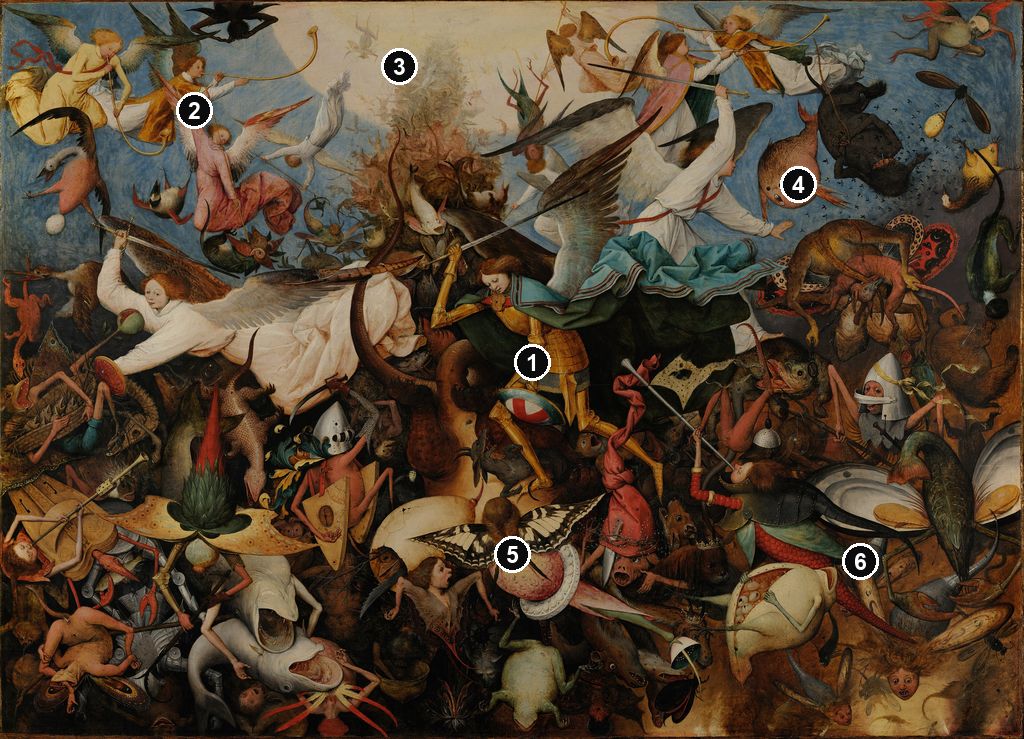
Details from THE FALL OF THE REBEL ANGELS
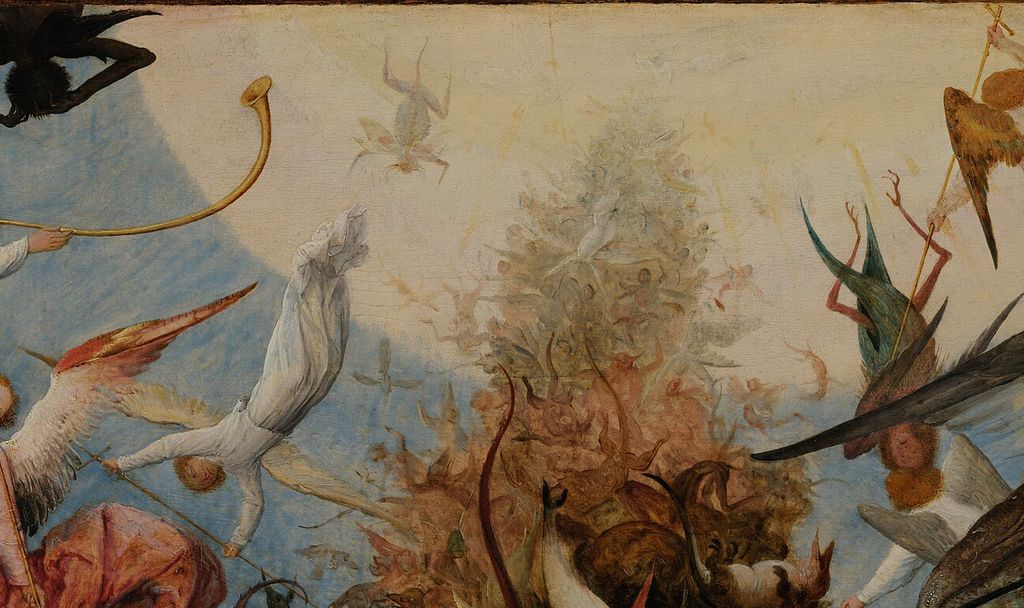
Six details trace the angels, creatures and open sky.
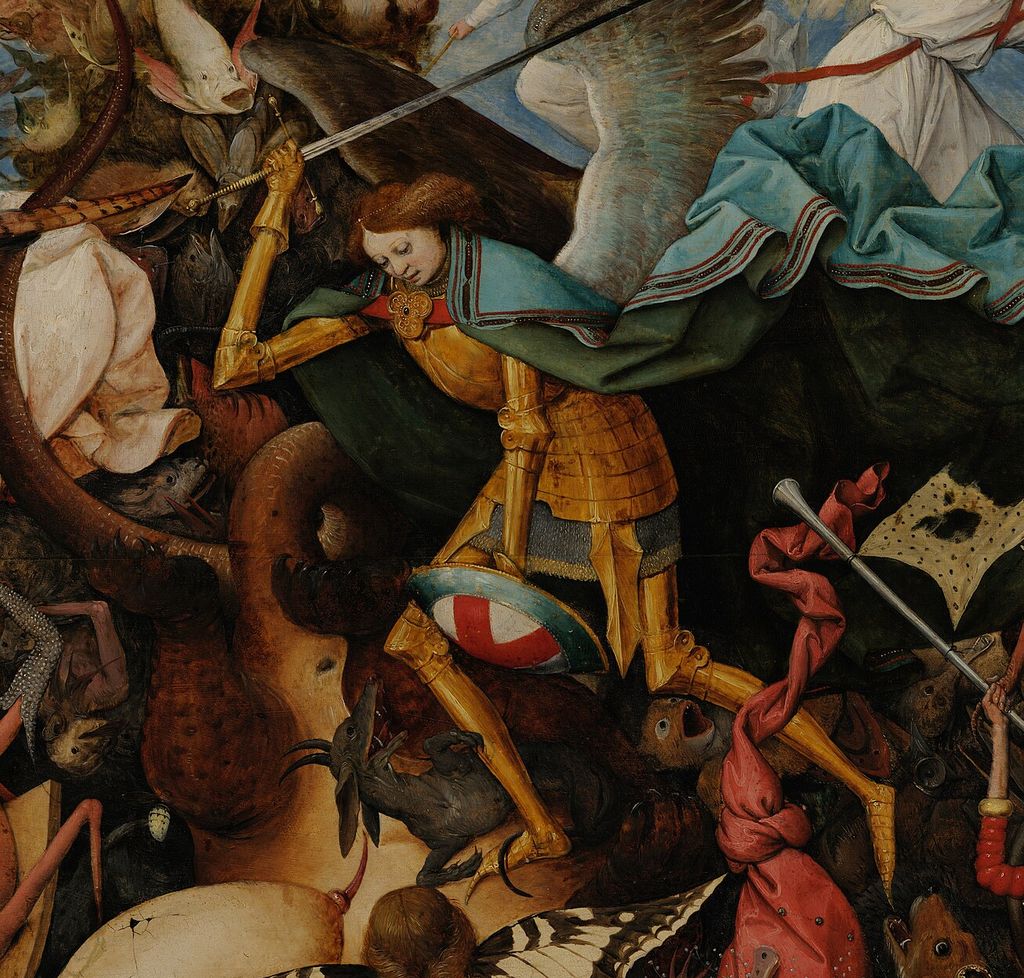
Michael at the centre
Michael’s gold armour stands out among dark wings and bodies.
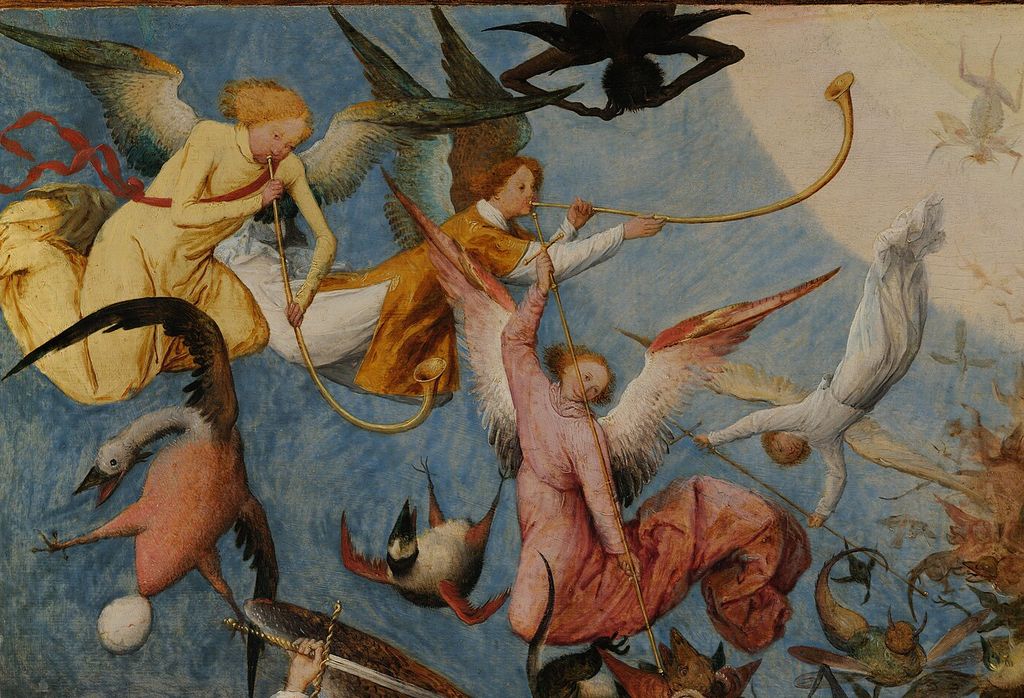
The trumpeters at upper left
Angels raise their trumpets above the descending figures.
The opening at the top
The pale sky opens above the most crowded part of the fall.
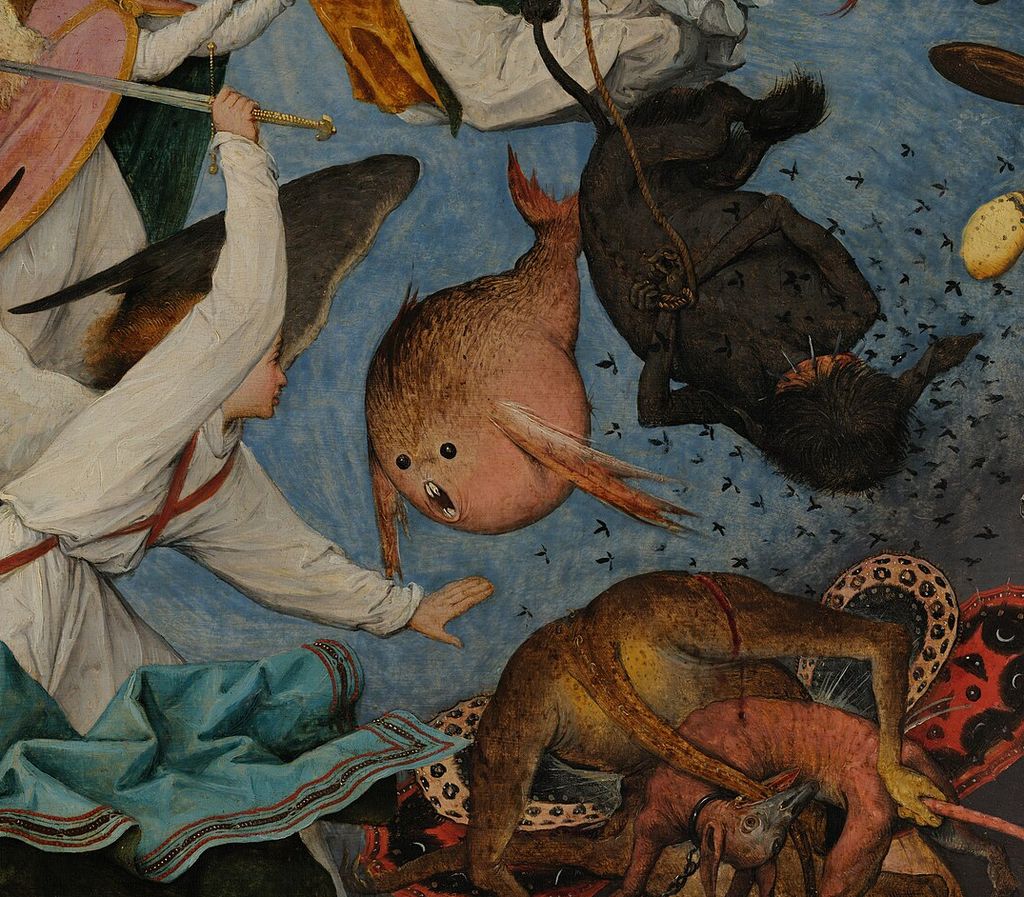
The falling fish-like body
A swollen body and fins take shape against the blue.
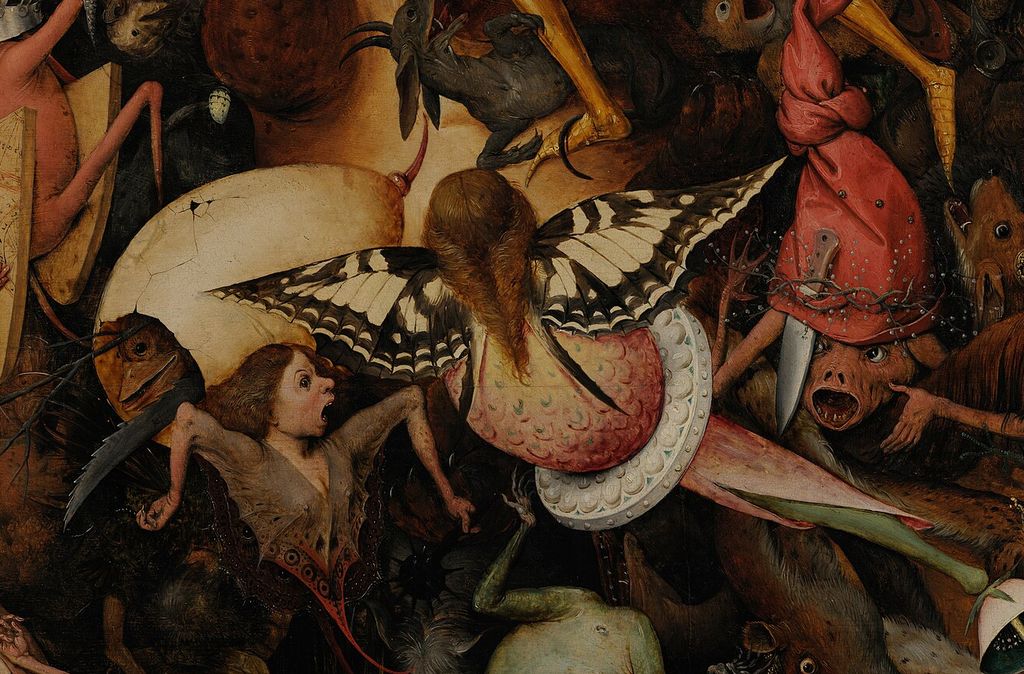
Insect wings in the foreground
Patterned wings spread over a body assembled from unlike parts.
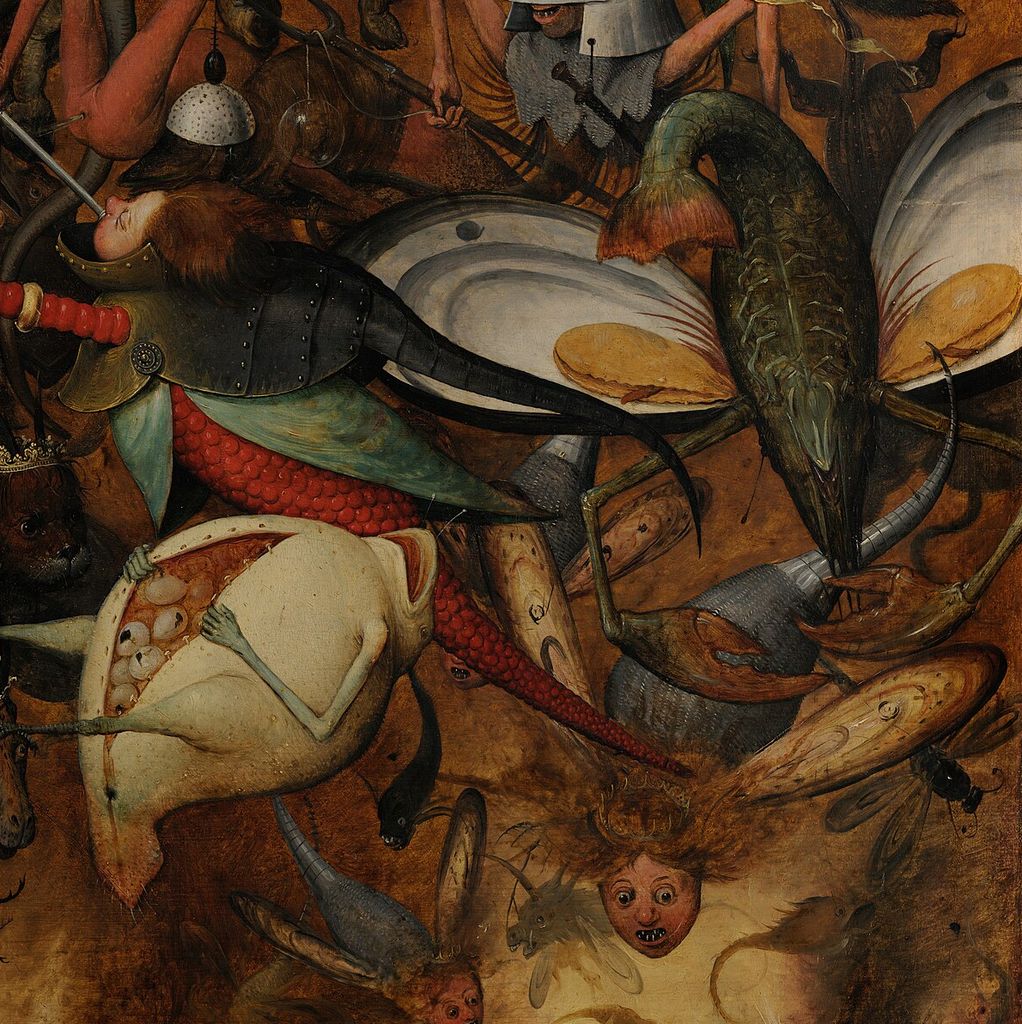
The lower-right hybrids
Shells and dark limbs crowd the edge beneath the angels.
Pieter Bruegel the Elder, The Fall of the Rebel Angels, 1562. Royal Museums of Fine Arts of Belgium, 584. Reproduction via Wikimedia Commons.
The Subject: Rebel Angels Falling From Heaven
The subject comes from the war in heaven, most directly associated with Revelation 12, where Michael and his angels fight the dragon and cast him down. RMFAB's Google Arts account frames the scene as the first confrontation between Good and Evil, before the Fall of Man: Lucifer rebels against divine authority, Saint Michael pursues him, and the rebel angels fall with him [2].
Bruegel paints the event not as a calm theological diagram but as a violent vertical crisis. Heaven occupies the upper register, bright and blue, with faithful angels in pale robes. Below, darkness gathers into ochres, browns and infernal density. Between the two zones, angels tumble, twist and change. Their fall is not only downward movement. It is metamorphosis. As the rebels lose their place in heaven, they also lose their angelic form.
Saint Michael appears at the center of the composition, armed and armored, his wings open and his sword raised. RMFAB's account draws attention to his calm face, his shining gold armor, and the shield marked with a red Latin cross on white [2]. This calm is crucial. Michael is surrounded by noise and transformation, but he does not become part of the chaos. He is the point of order around which the disorder falls.
At Michael's foot is the multi-headed apocalyptic monster. RMFAB notes that Bruegel brings together the Lucifer story and the dragon of Revelation, joining biblical material associated with the beginning and the end into one all-encompassing image [2]. That mixture is one of the painting's strongest ideas. Bruegel does not merely illustrate a single moment. He compresses cosmic time, rebellion, judgment and apocalypse into one falling mass.
The moral theme is pride. Lucifer's revolt is a refusal of order, and the painting turns that refusal into bodily consequence. The rebel angels do not simply move from one place to another. They become disordered creatures. Wings, scales, shells, claws, feathers, instruments and armor fuse into forms that cannot return to their original state. Bruegel makes spiritual collapse visible as material deformation.
What Bruegel Shows
The first impression is crowding. The painting seems almost too full for the eye to manage. Michael and the faithful angels occupy the center and upper field, while the fallen beings plunge into a lower zone packed with hybrid bodies. Heads point downward, limbs fly upward, wings fold into fins, shells become armor, instruments become bodies, and animals become demons. The viewer has to look repeatedly because the scene refuses to settle into a single readable group.
That pressure is not careless overcrowding. Bruegel uses density as the subject. The fall is a loss of hierarchy, and the composition makes the eye feel that loss. Heaven is brighter and more orderly. Hell is darker and more mixed. The descent from one to the other becomes a descent from distinction into confusion.
The monstrous forms are some of the painting's most memorable inventions. RMFAB's essay points to rebel angels transforming into demons and hybrid monsters with Boschian traits [2]. But Bruegel's creatures are not vague nightmares. They are made from things the viewer can partly identify: insects, fish, molluscs, crustaceans, birds, armor, musical instruments and collecting objects. The horror lies in combination. Familiar parts become unfamiliar beings.
One celebrated example is the creature below Michael whose wings resemble those of a swallowtail butterfly. RMFAB identifies the butterfly as Papilio machaon and connects its naturalistic detail to Bruegel's observation of the visible world [2]. Nearby, the museum points to an armadillo shell, a blowfish, crustaceans, molluscs and fish as sources for demonic forms [2]. These details matter because they show Bruegel's monsters emerging from knowledge, not ignorance. The strange is built from the studied real.
Bruegel also fills the lower world with human-made things. RMFAB distinguishes naturalia, objects of nature, from artificialia, man-made objects, and notes that Bruegel gives fallen beings scientific and musical instruments, arms, armor, ethnographic objects and works of art [2]. A sundial becomes a kind of breastplate. A hurdy-gurdy body joins with lobster-like parts. Helmets, trumpets, shields and armor appear among bodies that are no longer stable.
This gives the painting a sharp intellectual edge. The fall is not merely a bestiary of evil. It is a broken collection of the world. Natural things and crafted things, creatures and tools, knowledge and violence, music and warfare all tumble together. Bruegel's demons look like the contents of a cabinet of curiosities thrown into spiritual crisis.
Bosch Comparison
Some of the creatures have counterparts among the real objects that collectors studied. Tine Luk Meganck relates the painting’s fish-like forms and other bodies to the curiosities that circulated in Antwerp and courtly Brussels. One museum comparison places a dried blowfish beside the painted invention. The juxtaposition invites a close look at its swollen body and spines, and at what happens when recognisable forms are attached to unfamiliar limbs. Bruegel could use a specimen as an ingredient and make the result behave in a way that no specimen could [6] [2].
Meganck also connects the display of knowledge to the painting’s subject of allegiance and ambition. Art and natural knowledge could be sources of prestige in the worlds that knew these pictures. The fall of angels offers a way to imagine the dangers attached to intelligence and power. That is a reading of the combined visual and historical evidence. It leaves room for the religious narrative and for the immediate visual pleasure of recognising a fin, a shell or a wing in a body that appears only here [6].
The Bosch comparison is unavoidable, but it needs precision. Bosch had become a model for fantastic moral imagery in the Low Countries. The National Gallery describes Bosch as famous for disturbing detail, original visual symbolism and macabre invention, and notes that his work influenced Bruegel in the sixteenth century [4]. The Met likewise explains that Bruegel's Antwerp print designs answered demand for Bosch-like imagery and that one early design, Big Fish Eat Little Fish, was even issued under Bosch's name before later Bruegel inscriptions clarified the matter [3].
Fall of the Rebel Angels belongs inside that culture of Boschian expectation. Its monsters, hybrids and infernal energy would have been legible to viewers trained by Bosch and Bosch-inspired prints. RMFAB's account directly names Bosch as a source of reference and points to the hybrid creatures around Lucifer and the dragon as Boschesque in character [2].
Yet the painting is not best understood as a copy of Bosch's imagination. Bruegel's organization is different. Bosch often creates dreamlike moral theatres in which hybrid bodies, pleasures, punishments and symbolic machines unfold across separate zones. Bruegel compresses the drama into a more concentrated collapse. The picture's main action is the fall itself: a downward spiral of transformation around Michael's ordered center.
Bruegel also turns monstrous invention toward encyclopaedic attention. The demons do not only signify evil; they display a world of natural specimens, exotic creatures, instruments, armor and collectible objects. RMFAB's account links the painting to sixteenth-century collecting culture and to the desire to classify the objects of the world [2]. That context makes Bruegel's monsters feel more contemporary than merely inherited. They belong to a world of exploration, trade, curiosity and learned collecting as much as to the older tradition of hellish fantasy.
The old attribution to Bosch is therefore historically interesting but interpretively limited. It tells us what earlier viewers thought they were seeing. It does not settle what Bruegel made. The better question is not "How much Bosch is in the painting?" but "What does Bruegel do with the Boschian language available to him?" His answer is a cosmic scene that behaves like a visual inventory, a moral warning and a test of perception all at once.
Composition, Scale And Visual Pressure
Bruegel builds the painting around a strong central axis. Michael stands at the center, poised between heaven above and hell below. Around him, movement curls, drops and thickens. The faithful angels press downward from the bright upper field, while the rebel angels fall into the darker lower field. The picture can be described horizontally, with heaven above and hell below, but its real energy is vertical. Everything depends on the downward force.
The two zones are not equal in feeling. Heaven is airy, pale and relatively legible. Hell is darker, denser and more materially crowded. RMFAB's account describes the upper heavens in light hues and the lower region in rich, somber tones of ochre and brown [2]. That tonal contrast gives the viewer a moral map before individual details are even understood.
The center, however, is not empty or calm. Michael's body and the apocalyptic dragon create a momentary point of stability, but the surrounding forms are turbulent. The dragon turns belly-up, seven heads thrown back, while fallen bodies spiral downward behind it [2]. The viewer feels order only because Bruegel sets it against instability. Michael's composure is meaningful because almost nothing else in the painting shares it.
Scale intensifies the pressure. At 117 by 162 cm, the work is large enough for broad visual impact but dense enough to demand close looking [1]. From a distance, the painting reads as a cosmic battle: blue heaven, golden armor, falling darkness. Up close, it becomes a swarm of incidents. The eye keeps finding new conversions: a shell into armor, a fish into demon, an instrument into body, a wing into insect pattern.
This double viewing distance is central to Bruegel's proverb and iconographic art. In many of his pictures, the whole field gives one structure while the details supply dozens of smaller readings. Fall of the Rebel Angels uses that method for an apocalyptic subject. The viewer cannot master the painting instantly. The difficulty of seeing becomes part of the meaning: disorder is not just shown; it is experienced.
Signature, Attribution And Reception History
The lower-left signature and date are unusually important in the modern history of the painting. RMFAB records the inscription as "M.D.LXII / BRVEGEL" [1]. RMFAB's Google Arts account explains that the painting was acquired in 1846 as a work by Pieter Brueghel the Younger, then attributed to Bosch until the date and signature were discovered in 1898, hidden by the frame [2].
That story is a compact reminder of two larger problems in Bruegel study. First, the Bruegel and Brueghel family names caused real confusion because later family members, especially Pieter Brueghel the Younger, were deeply involved in repeating, adapting and circulating compositions associated with Pieter Bruegel the Elder. Second, Bosch's reputation created a category into which monstrous northern images could be placed too quickly.
In this case, the evidence now supports the opposite conclusion from uncertainty. The painting is not presented by RMFAB as a doubtful Bosch-related work. It is a signed and dated Bruegel painting whose earlier labels tell us about reception, taste and expectation. The distinction matters because the page should not make the old Bosch attribution sound like a current dispute.
The history also adds to the painting's interpretive interest. A work about transformation had its own identity transformed by viewers and cataloguers. It moved from the son's name, to Bosch's name, and finally back to the elder Bruegel through evidence physically present on the painting. That does not make the object unstable. It makes the act of looking more consequential.
Relation To Triumph Of Death
Fall of the Rebel Angels belongs beside The Triumph of Death because both works show Bruegel at his darkest and most panoramic. They are close in date, similar in scale, and invested in total moral catastrophe. Yet their kinds of catastrophe are different.
In Fall of the Rebel Angels, the crisis is cosmic and vertical. It begins in heaven, passes through Michael's battle, and ends in demonic transformation. The central problem is rebellion against divine order. Bodies fall because pride has broken hierarchy. The visual language is metamorphic: angels become creatures, instruments and fragments.
In The Triumph of Death, the crisis is earthly and horizontal. Skeletons overrun the living across a devastated landscape. The central problem is mortality, not angelic rebellion. The visual language is systematic rather than metamorphic: death becomes an army, a social order, a counter-world.
Together, the two paintings show how wide Bruegel's moral imagination could be. He could take Boschian monster-making and turn it into a cosmic fall. He could take Dance of Death and triumph imagery and turn it into a military occupation of the earth. Both pictures overwhelm the eye, but they do so for different reasons. Fall of the Rebel Angels overwhelms through transformation. The Triumph of Death overwhelms through inevitability.
Why The Painting Matters
Fall of the Rebel Angels matters because it is one of the clearest examples of Bruegel transforming inherited visual language into something unmistakably his own. The Bosch connection explains part of the painting's ancestry, but not its whole achievement. Bruegel takes monsters, moral warning and infernal fantasy and binds them to a distinctive structure: Michael's calm center, the fall's vertical force, and the crowded inventory of the natural and human-made world.
The painting also matters because it refuses a simple division between imagination and observation. Its demons are fantastical, but their parts are studied. Butterflies, fish, shells, armor, instruments and exotic objects are not random decorations. They show Bruegel thinking about how knowledge itself can become unstable when it is pulled into a moral catastrophe. The more closely the viewer looks, the more the painting seems to ask whether seeing and collecting the world is enough to understand it.
Its attribution history adds another layer. A painting once taken for Brueghel the Younger and then Bosch is now one of the Brussels museum's secure signed Bruegel works. That history helps explain why evidence, names and close inspection matter so much in old-master study. It also makes the painting a useful bridge between Bruegel's secure paintings, the wider Bosch tradition, and the questions of family repetition and attribution that surround parts of the Bruegel afterlife.
Most of all, the painting matters because it is visually inexhaustible. It can be read as a biblical image of Michael and the rebel angels, as a moral warning about pride, as a Bosch-related fantasy, as a reflection of collecting culture, or as a tour de force of crowded composition. None of those readings cancels the others. Bruegel's achievement is to make them fall together into one image: beautiful, alarming, learned and hard to escape.

Discussion
What feels most revealing about Pieter Bruegel the Elder: the village detail, the landscape setting, the moral wit, or the way everyday life becomes a complete world?
Reader Insights
Begin with one small action in a Bruegel scene, then follow how it connects to the surrounding figures, setting and rhythm of the whole image.
Connect the work to Northern Renaissance visual culture, printmaking, proverb traditions and Bruegel's interest in rural and urban life.
Which detail changes the interpretation most once you know the subject, date, proverb source or present collection?
Join the Conversation
Have a thought or observation about Pieter Bruegel the Elder? Share it below. Thoughtful responses may be added to this section as the Bruegel pages develop.
Frequently Asked Questions
Pieter Bruegel the Elder's Fall of the Rebel Angels is one of his most compressed and startling visions of cosmic disorder. The Royal Museums of Fine Arts of Belgium identify the painting as La chute des anges rebelles , by Pieter I Bruegel, dated 1562, inventory number 584, oil on oak, signed and dated at the lower left with "M.D.LXII / BRVEGEL" . [1]
The subject comes from the war in heaven, most directly associated with Revelation 12, where Michael and his angels fight the dragon and cast him down. RMFAB's Google Arts account frames the scene as the first confrontation between Good and Evil, before the Fall of Man: Lucifer rebels against divine authority, Saint Michael pursues him, and the rebel angels fall with him . [2]
The monstrous forms are some of the painting's most memorable inventions. RMFAB's essay points to rebel angels transforming into demons and hybrid monsters with Boschian traits . [2]
References
- Royal Museums of Fine Arts of Belgium, La chute des anges rebelles, View source.
- Royal Museums of Fine Arts of Belgium / Google Arts & Culture, The Fall of the Rebel Angels, View source.
- Jacob Wisse, Metropolitan Museum of Art, Pieter Bruegel the Elder (ca. 1525-1569), View source.
- National Gallery, London, Hieronymus Bosch, View source.
- Museo Nacional del Prado, The Triumph of Death, View source.
- Tine Luk Meganck, Pieter Bruegel the Elder, Fall of the Rebel Angels: Art, Knowledge and Politics on the Eve of the Dutch Revolt, Royal Museums of Fine Arts of Belgium and Silvana Editoriale, 2014, View source.







