


 by Tom Gurney
Tom Gurney BSc (Hons) is an art history expert with over 20 years experience
Published on June 19, 2020 / Updated on October 14, 2023
Email: tomgurney1@gmail.com / Phone: +44 7429 011000
The Magpie on the Gallows: Introduction
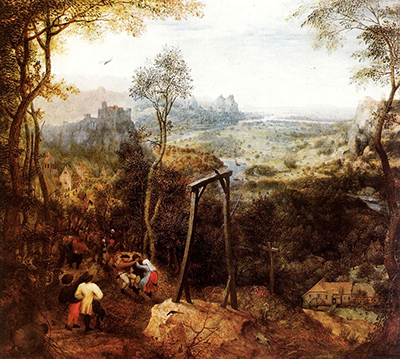
Pieter Bruegel the Elder’s The Magpie on the Gallows is a painting of 1568 in the Hessisches Landesmuseum Darmstadt. A wooden gallows stands in a clearing above a broad valley. A magpie rests on the crossbeam, dancers gather to the left and a winding river leads into the distance. The picture places a structure made to be seen from afar close enough for us to inspect. Across the valley, smaller buildings and little paths show how ordinary life continues beyond it [1] [2].
This work across Bruegel’s career
Tower of Babel
1563The Harvesters
1565Peasant Wedding
1568Children's Games
1560Triumph of Death
1562–1563Magpie on the Gallows
This artworkContents
- Introduction
- The Gallows and the Clearing
- The People to the Left
- Out through the Valley
- What the Magpie Might Mean
- Annotated Details
The Gallows and the Clearing
The gallows is the easiest structure to find. Its silhouette is sharply defined by the bright landscape beyond the beam and the dark foliage between the uprights. Move your eye from the top of either post down to where its foot reaches the ground. The lower ends are separated by a stretch of dirt. At the top, angles and braces come together in a small area of the painting. The difference makes it possible to feel both the height of the structure and the awkwardness of the inclined ground it occupies.
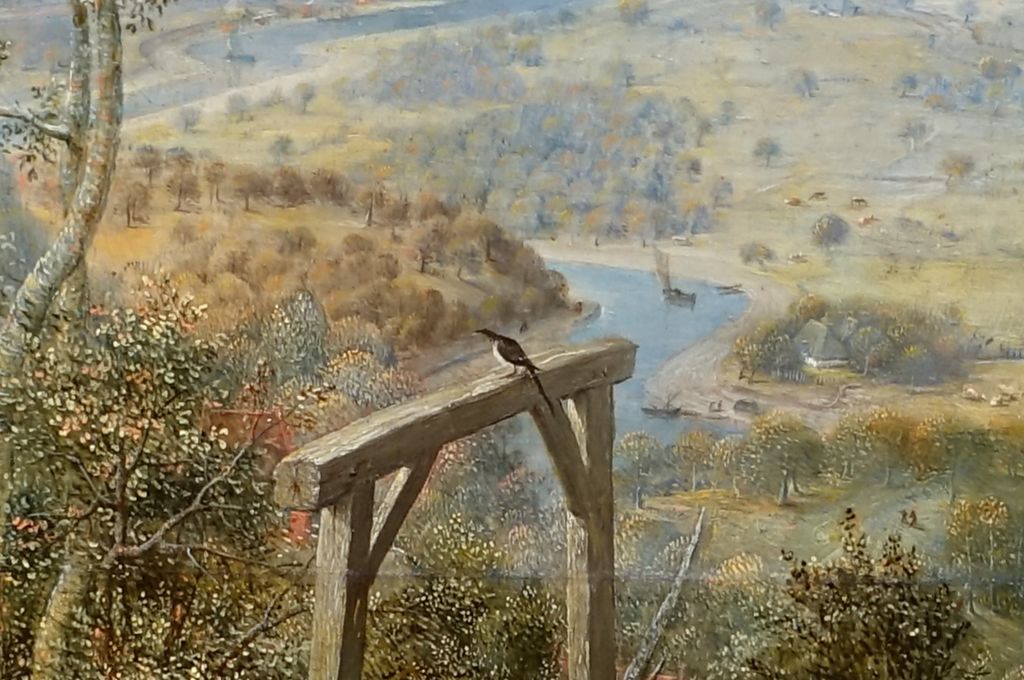
There is enough bare earth in front of the gallows to make its setting visible. Light reaches the rise from which it stands, and then diminishes amid the trees. Look closely at the top before going any farther into the landscape. The small bird interrupts the outline of the crossbeam. Its scale is important. The gallows could easily dominate the picture as a large object at the front. A viewer who notices the bird has a reason to look again at the same structure in detail.
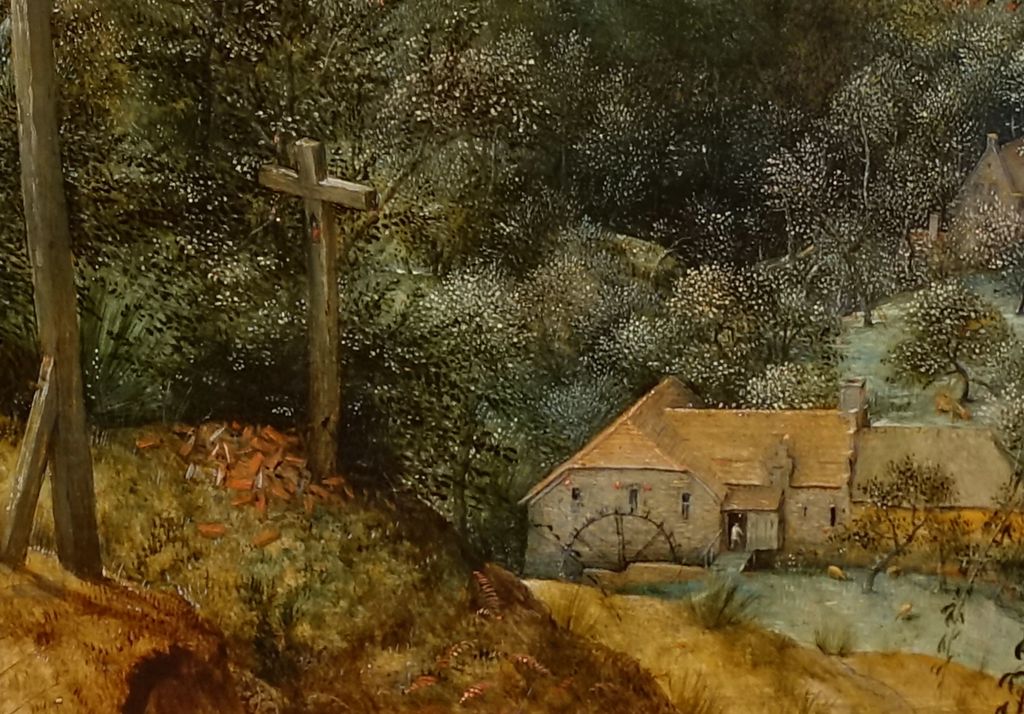
A cross stands a little way behind it, with more vegetation separating its foot from the path. Its smaller scale and lower contrast make it much easier to overlook. Both structures rise through the foreground terrain into a view that contains only scattered buildings. One is unmistakable at first sight and the other becomes clear later. This difference helps explain the persistence of the gallows as a point of reference. Having found it, the eye can turn away and still know where to return.
Annotated Details from The Magpie on the Gallows
Find the bird on the beam, then look down to the dancers and out across the valley.
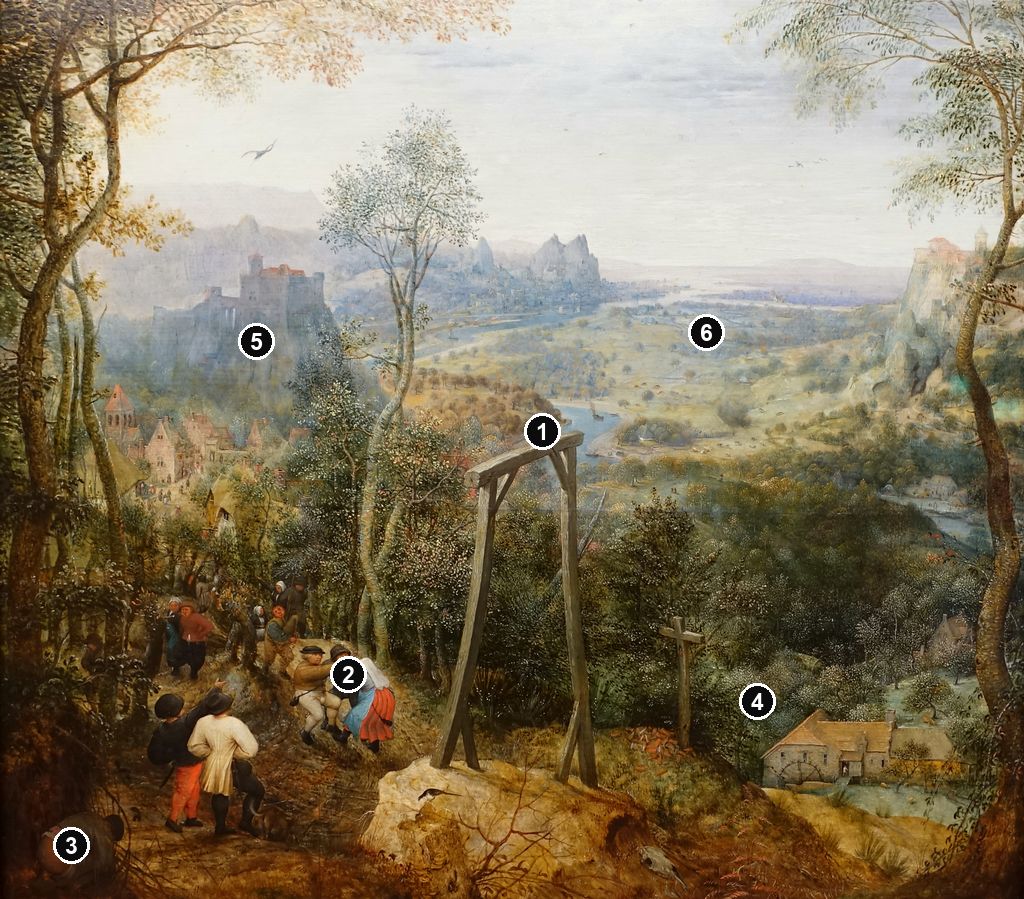
Details from THE MAGPIE ON THE GALLOWS
Six details trace the people, buildings and landscape around the gallows.
Magpie on the beam
The small black-and-white bird rests on the wooden beam.
Dancers in the clearing
Three figures turn together to the left of the gallows.
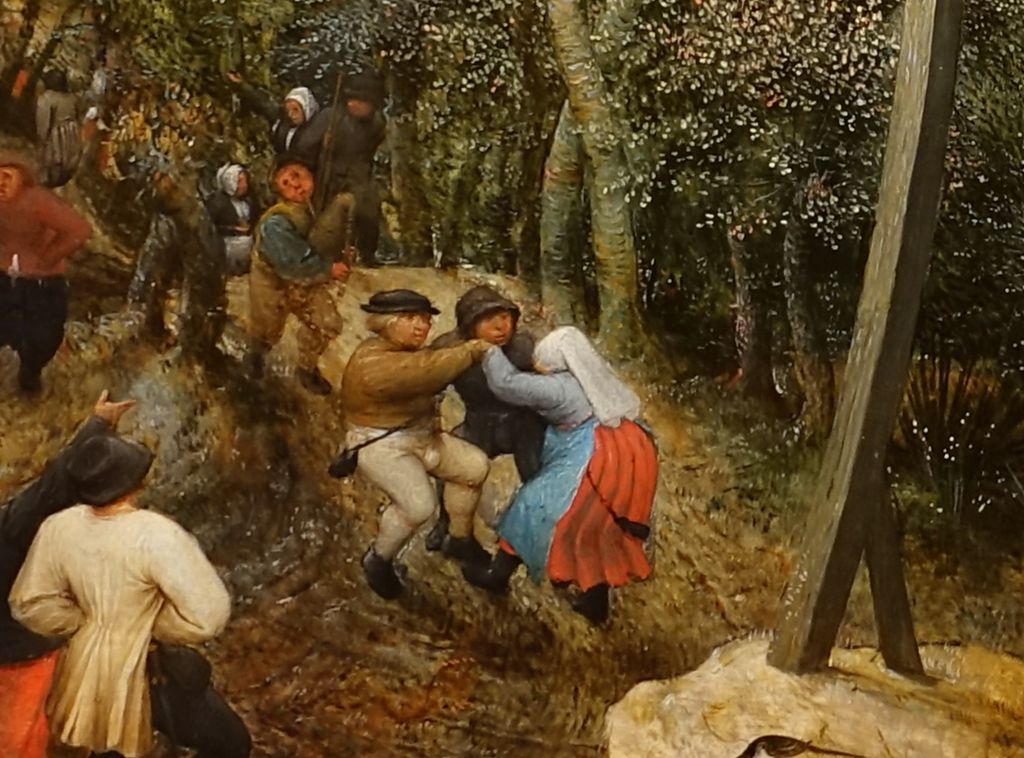
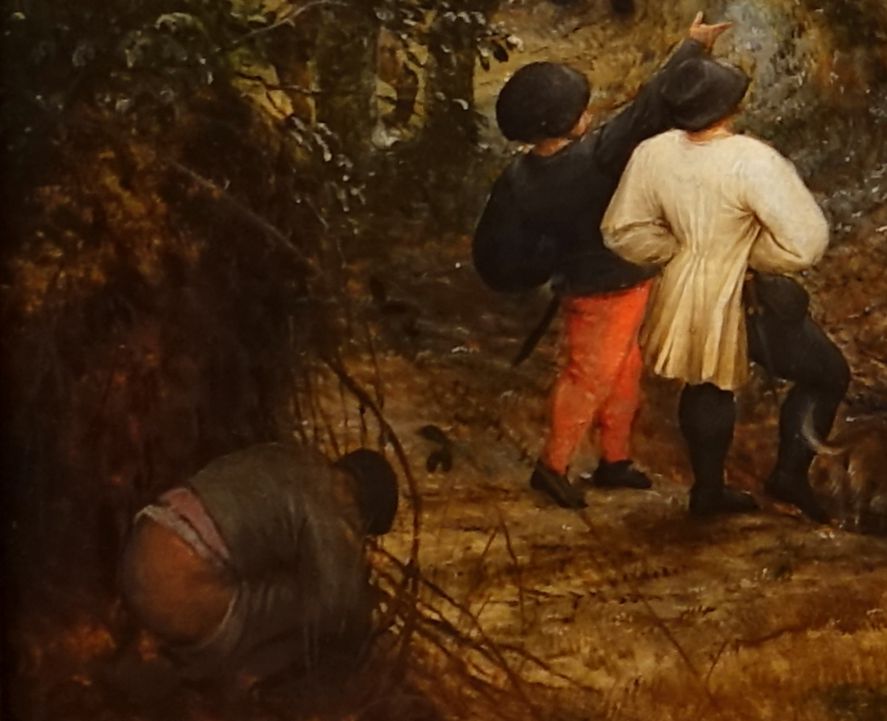
Figure at the lower edge
A crouching figure is almost hidden in the shaded corner.
The cross and the house
The cross stands on higher ground than the roof below it.
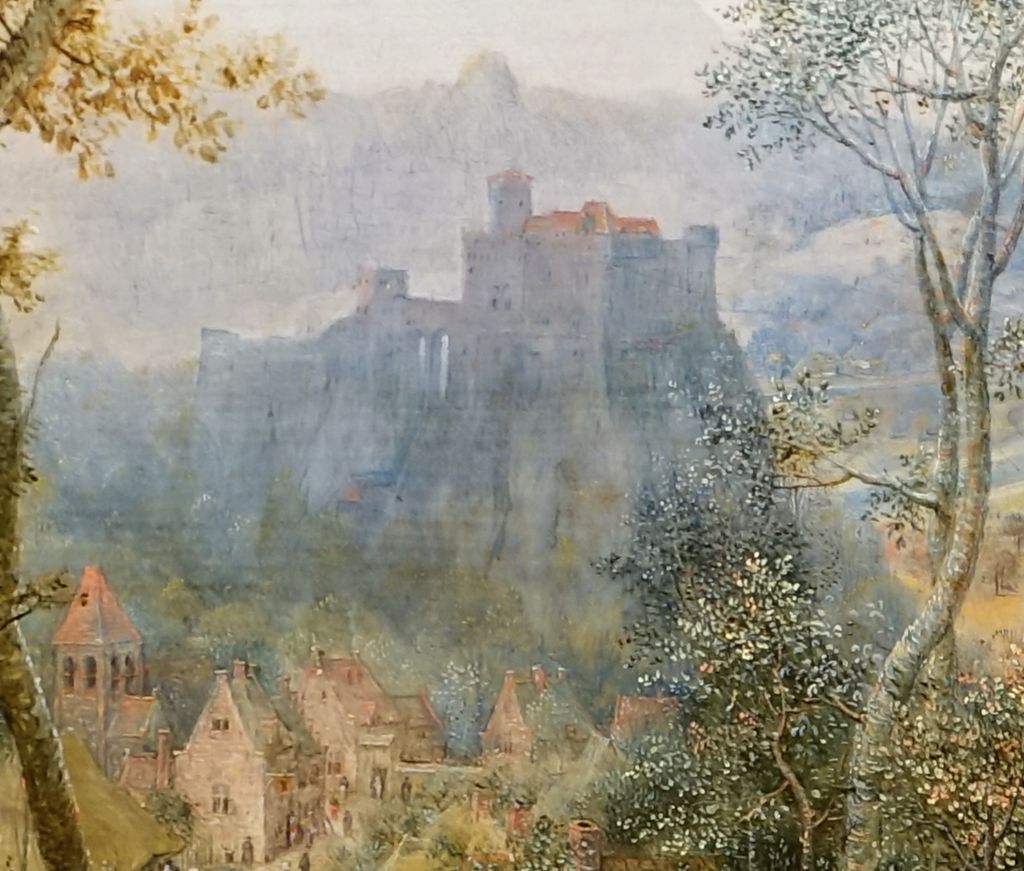
The rocky heights
Buildings sit above the dark roofs and wooded slope.
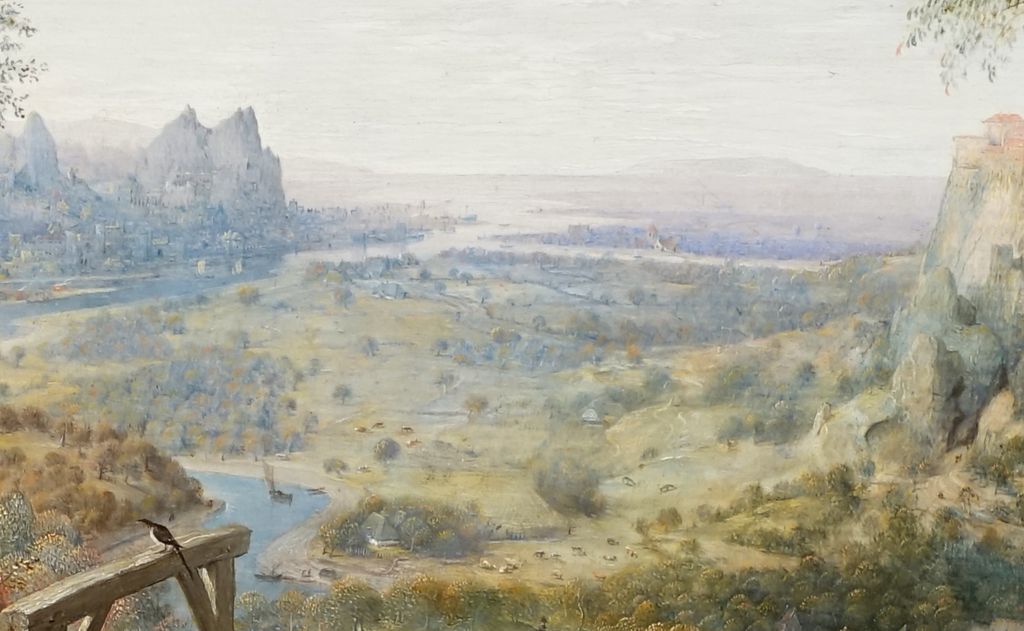
The valley beyond the beam
Pale water and overlapping slopes lead the eye into the distance.
Pieter Bruegel the Elder, The Magpie on the Gallows, 1568. Hessisches Landesmuseum Darmstadt. Photograph by Daderot, CC0. Cropped to the painted area.
The People to the Left
The bright clothing of the figures near the path provides another entry. Several dancers join in a small area beyond two larger figures. Arms, faces and cloth make this patch of ground unusually active. You can compare the direction of one dancer’s gesture with that of a neighbour. Most of the space to the right has been given to the gallows and the clearing. The dancers need little ground to establish that there are people busy with something of their own.
A different figure occupies the lower left. This crouching man, discussed by art historian Denis Ribouillault in relation to older landscape imagery, is relieving himself near the picture’s edge. The figure is easy to overlook among the dark marks of the foreground. Finding him changes what counts as an event in the painting. One group holds the attention by standing upright and turning together. A figure almost outside the scene is engaged in an action that would usually escape a sweeping view of the valley [4].
The figures and gallows are close enough for viewers to consider together, and Bruegel gives no obvious indication that the dancers have gathered to witness a particular execution. The beam is occupied by a bird. The dancers are absorbed in an activity that has its own rhythm. That leaves the viewer with a difficult juxtaposition. Laughter, dance and the possibility of punishment can inhabit adjacent pieces of terrain. The picture allows the eye to move easily between them while giving the imagination more work to decide how they belong together [2] [3].
Out through the Valley
The landscape opens above and beyond the beam. The river appears through intervening slopes, then leads the eye towards flatter and paler ground. A conspicuous rocky outcrop at the left carries buildings high above the trees. The small house at the lower right does different work in the picture. Its sloping roof and visible wall give the eye a familiar size to hold on to before looking out to terrain where a building can be difficult to distinguish from a rock.
The largest trees rise along the edges and leave a window of sky. The slender tree just to the left of the gallows carries leaves high above its first branches. Its form is easier to trace against the distance than against dark vegetation below. Planes of ground overlap between the trunks. They grow brighter and less distinct as the range of the view increases. These changes keep the distance open even while the dark trees above and alongside the viewer make the foreground feel enclosed.
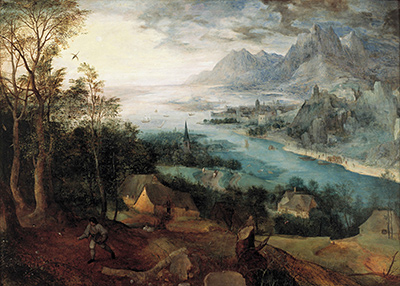
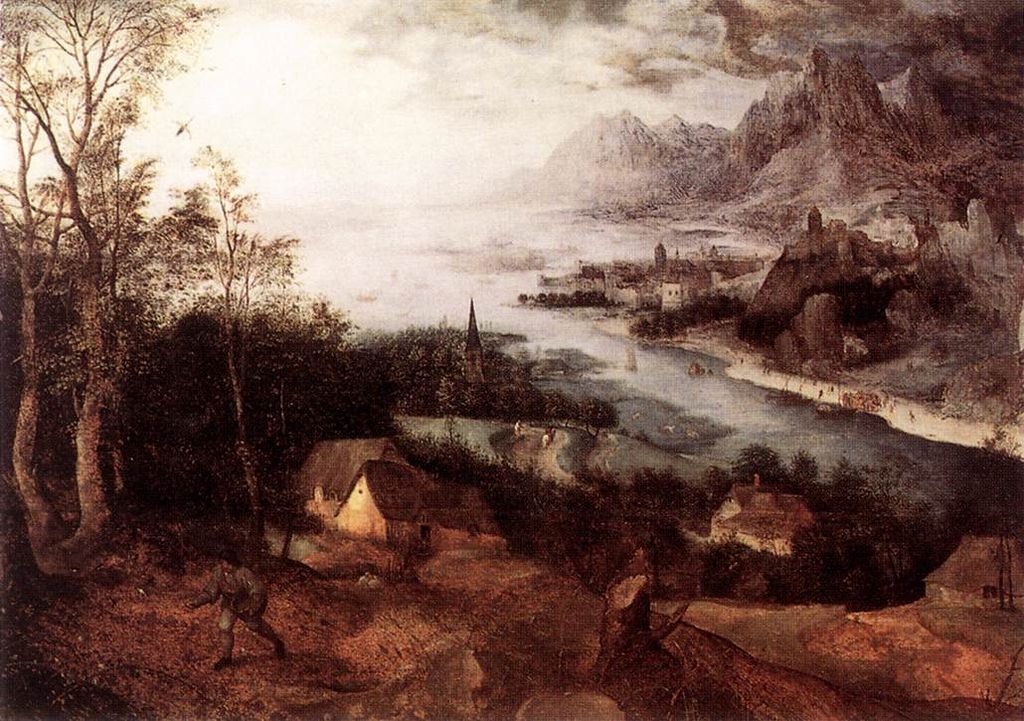
This is a useful work to compare with Landscape with the Parable of the Sower. In the earlier picture the foliage helps separate a nearby sower from a small crowd far across the water. The Darmstadt panel leaves most of its conspicuous activity in the foreground. It still allows the eye to travel a long way, from the beam to the river and beyond. In both works, following the action and following the view become distinct ways to spend time with the painting [1] [5].
What the Magpie Might Mean
In his 1604 account of the painter, Karel van Mander says Bruegel left his wife a picture of a magpie on a gallows. He understood the bird as an image of people with gossiping tongues and the gallows as a punishment to which Bruegel consigns them. This is early written evidence for how the painting’s central motif was understood. Van Mander wrote decades after Bruegel’s death, so the account gives us an interpretation from the period along with a claim about how a work passed from artist to family [3].
You can see what makes such an interpretation attractive. A bird known for its voice occupies the exact place where the upper part of the gallows is most exposed. The surrounding figures also make it possible to think about social life at the foot of a structure associated with punishment. A short explanation for the motif leaves much of the painting available for further looking. The cross, the turning dancers and the elaborate valley each ask for attention of their own [3] [4].
After finding the magpie, follow the outlines of the beam and posts all the way to the clearing. Then look left to the figures and farther out along the river. The distances between those subjects matter. Bruegel lets a bird visible in a glance remain the most specific detail in a landscape large enough to take several minutes to explore.
Discussion
Which detail in this work most changes how you read it?
Frequently Asked Questions
A different figure occupies the lower left. This crouching man, discussed by art historian Denis Ribouillault in relation to older landscape imagery, is relieving himself near the picture’s edge. [4]
In his 1604 account of the painter, Karel van Mander says Bruegel left his wife a picture of a magpie on a gallows. He understood the bird as an image of people with gossiping tongues and the gallows as a punishment to which Bruegel consigns them. [3]
References
- Hessisches Landesmuseum Darmstadt, Gemäldegalerie, The Magpie on the Gallows, View source.
- Hessisches Landesmuseum Darmstadt, Bildungsfolder, The Magpie on the Gallows, View source.
- Karel van Mander, Pieter Bruegel of Bruegel, translated by Constant van de Wall in the Columbia Art Humanities reader, View source.
- Denis Ribouillault, Regurgitating Nature, Journal of Historians of Netherlandish Art, View source.
- Timken Museum of Art, Parable of the Sower, collection record, View source.









