


 by Tom Gurney
Tom Gurney BSc (Hons) is an art history expert with over 20 years experience
Published on June 19, 2020 / Updated on October 14, 2023
Email: tomgurney1@gmail.com / Phone: +44 7429 011000
Landscape with the Parable of the Sower: Introduction
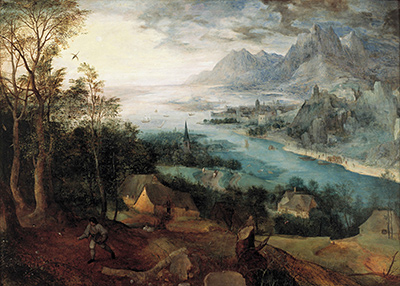
Pieter Bruegel the Elder’s Landscape with the Parable of the Sower is a signed painting of 1557 in the Timken Museum of Art, San Diego. A figure in the lower left scatters seed, and a group on a distant shore gathers to hear Christ. The picture gives more space to a valley and its surroundings than to either of these events. The Gospel story helps a viewer make sense of that wide view. Seed and soil, paths and water are part of what the picture asks the eye to look for [1] [2].
This work across Bruegel’s career
Tower of Babel
1563The Harvesters
1565Peasant Wedding
1568Children's Games
1560Triumph of Death
1562–1563Landscape with the Parable of the Sower
This artworkContents
- Introduction
- Finding the Sower
- Christ by the Water
- What the Landscape Does
- The Signature and the Title
- The Parable and Its Grounds
- Annotated Details
Finding the Sower
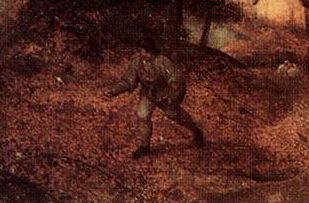
Begin under the trees at the left. The foreground has enough shade and vegetation to make the figure easy to pass over. His basket and the position of his arm help to distinguish him. He has turned his body in a way that makes the scattering of seed legible. Look close to where his gesture ends. The Timken identifies birds eating seed in this area. They turn a gesture of sowing into a small sequence of events that takes place as you watch [2].
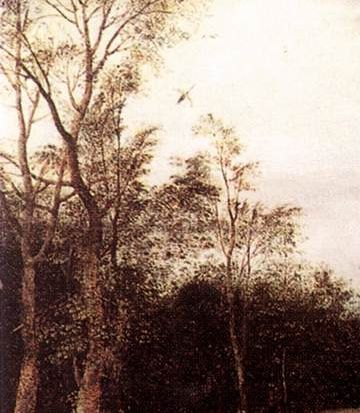
The leaves have sharp outlines at this distance. They are easiest to see where a branch projects against lighter land or the water. The sower occupies ground rendered on much the same scale as these leaves. From this area of the picture the eye has a choice. It can stay among the objects close enough to inspect, or it can follow the contours of the landscape to find out which surfaces are available for cultivation. The first route makes the figure recognisable. The second brings his task into relation with the rest of the picture.
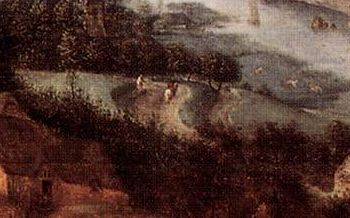
It is worth looking at the stretch of land immediately beyond him before searching for the biblical audience. The Timken distinguishes the seed lost in the foreground from the thriving fields in the middle distance. This gives the eye two different results to compare. The seed eaten by birds is close enough for us to watch the loss. The fields beyond are large enough to suggest what a successful season of sowing can produce. Putting these passages together takes the viewer from a single throwing gesture to a much longer interval of growth [2].
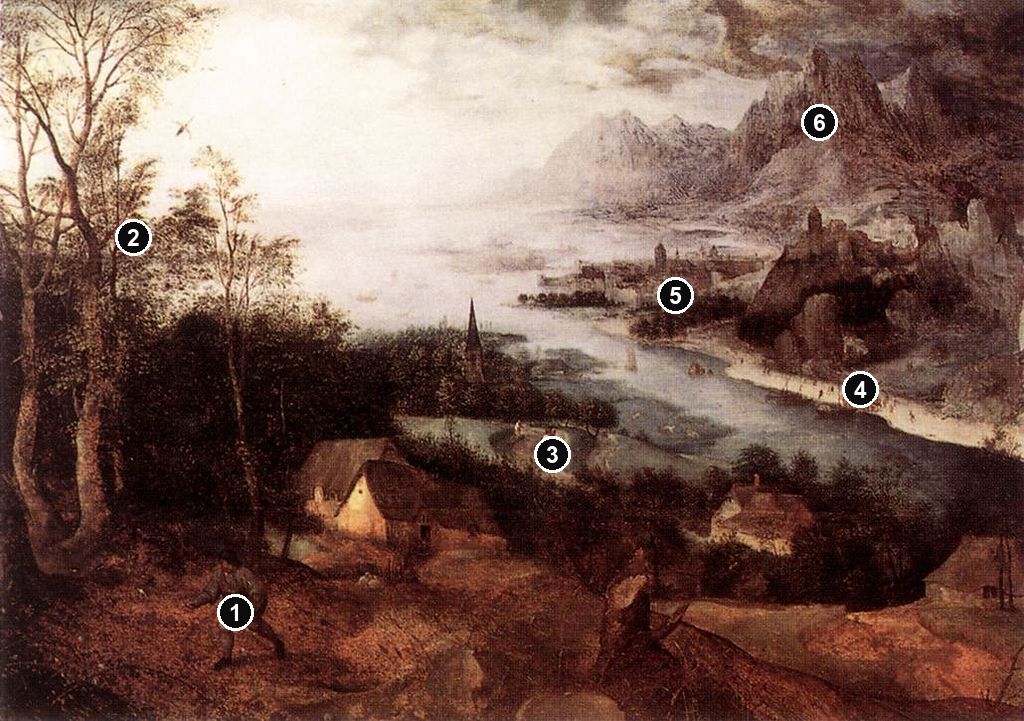
Annotated Details from The Parable of the Sower
Find the sower beneath the trees, then follow the water towards the small crowd.
Details from THE PARABLE OF THE SOWER
Six details trace the two episodes and the landscape that joins them.
The sower in the foreground
The sower steps across the brown ground beneath the trees.
The stand of trees
Branches and leaves stand out against the lighter distance.
Fields below the foreground
Cultivated ground curves between the near buildings and the water.
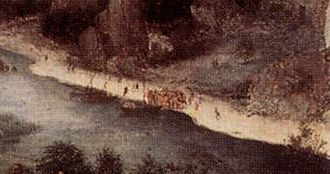
The gathering on the shore
Small marks on the pale shoreline resolve into the audience.
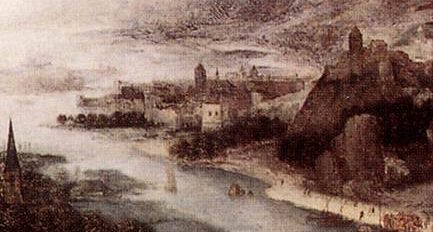
The settlement and water
Buildings cluster at a bend where water opens towards the horizon.
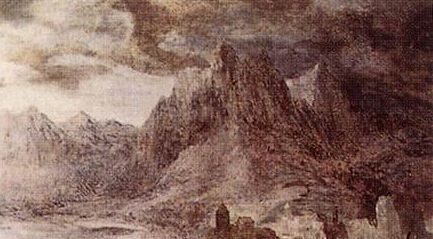
Peaks and clouds
A dark bank of cloud hangs above the mountains.
Pieter Bruegel the Elder, Parable of the Sower, 1557. Putnam Foundation, Timken Museum of Art, 1957:002. Web Gallery of Art reproduction via Wikimedia Commons.
Christ by the Water
The Gospel of Matthew presents the story of the sower in a setting of its own. Jesus goes to the shore, enters a boat and speaks to people on land. The parable takes his listeners away from the shore to imagine seed falling on ground of different kinds. Bruegel gives both places a position in the same painted landscape. The sower is close enough for viewers to see the birds around him. The speaker and his audience are far away, near a waterline that makes a plausible place for a crowd to collect [3] [1] [2].
To find the group, follow the edge of the water before trying to pick out individuals. At a distance, the line a crowd makes is easier to identify than any one face or gesture. The museum places the sermon in this passage of the picture. It interprets the boat and the assembly of people in relation to the scene in Matthew. A person who spots the group first can work backwards from the shore to the figure at the left and connect the scene of speaking with its subject [2] [3].
The distance between the sower and the crowd is one of the decisions that makes this painting unusual. Bruegel could have made a single group of people the centre of a narrative. Instead, the picture lets the viewer deal with two events of different sizes and places. This distributes the story across a coherent landscape. The reading depends on recognising which details hold their own at a great distance and which have the textures and outlines of something observed nearby.
What the Landscape Does
The painting sets the fine description of leaves and local tracks against softer passages in the distance. In the upper right the forms rise steeply. Once you locate the valley water, look upward from its surface and notice how rapidly the land seems to gain height. Seen from close to the field, such a view would be difficult to take in all at once. Bruegel gives it to the viewer from above. There is enough breadth to take in a set of mountains, a stretch of water and the foreground where a single day’s work is underway [2].
The Timken relates this breadth and atmospheric recession to Bruegel’s experience of crossing the Alps and to his landscape drawings. The connection is visible in the difference between a sharply articulated foreground and a distance that softens as the terrain recedes. Rocky peaks and finely observed leaves can coexist without describing a single identifiable locality. The foliage gives the near ground its density. The mountains let the farther ground open out in depth [1] [2].
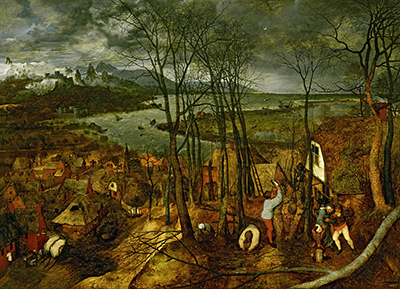
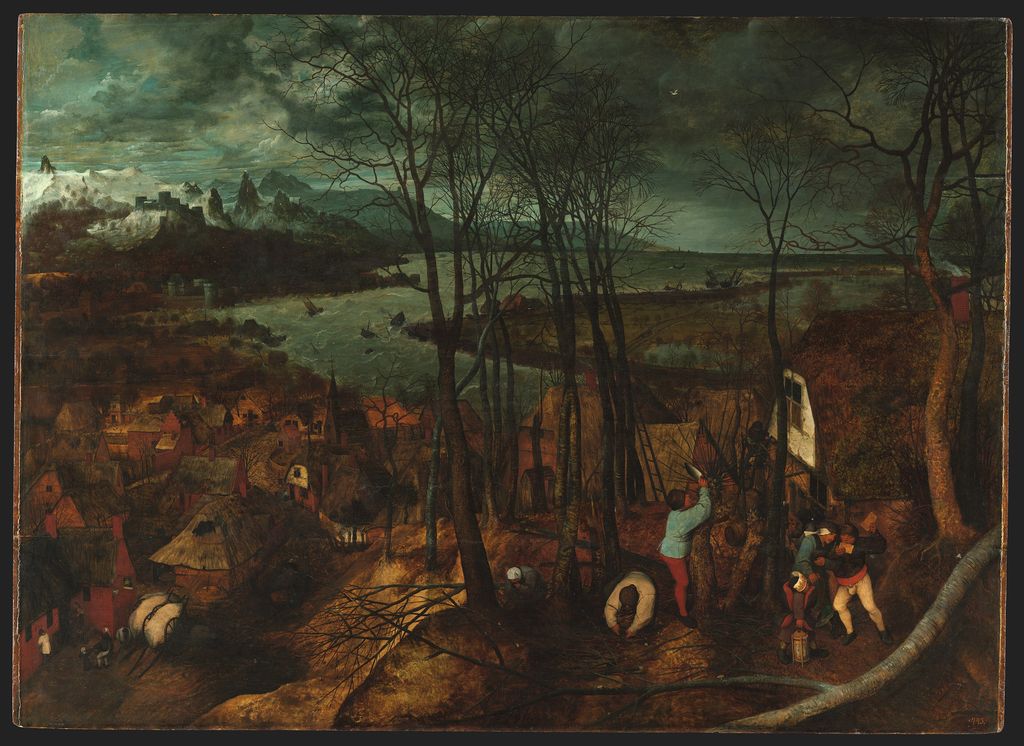
This handling of space makes an instructive comparison with the seasonal panels painted eight years later. In The Gloomy Day, the viewer has to look through or past bare branches to see a village and rough water. Both paintings give trees a role in calibrating distance. In the Timken panel they also help join the sower’s field to an extensive landscape that can be read through a biblical story. The seasonal cycle instead builds its chronology through recurring changes in weather and work [1] [4].
The Signature and the Title
The Timken identifies its oil on wood panel as accession 1957:002 and gives its dimensions as 73.7 by 102.9 centimetres. When the work appeared at auction in Brussels in 1924, it was catalogued as an anonymous seventeenth-century Flemish painting. Cleaning that year revealed the signature and date. The museum also lists a 1935 Brussels exhibition where it appeared as The Estuary. That earlier title makes sense of what meets the eye first. The title used by the museum today helps viewers find the small incidents that turn the view of land and water into a particular narrative [1].
The Parable and Its Grounds
In Matthew the seed’s fate depends on where it falls. Birds take what falls on the path. Some seed begins to grow in shallow ground and withers. Thorns choke another part, and seed in good soil yields a crop. Jesus later gives the disciples an interpretation based on different ways of hearing and receiving the message. The image’s birds therefore perform a recognisable part of the story. The fields beyond make it possible to think about the crop without asking the painting to offer a clearly marked example of each ground [3] [2].
On a second look it is possible to follow the work from the hand towards the ground, then move out towards the field and down to the place where the story is spoken. This sequence changes the scale of what you are looking at several times. A handful of seed matters at one distance and a crowd at another. The distinction between events that belong to the foreground and the shore also preserves a distinction that is clear in the text. The act of teaching takes place before listeners. The act of sowing is something they are invited to picture [3] [1].
That double action explains why much of the painting rewards a slow, practical look. Water marks out a place where a speaker and a crowd can gather. A margin of soil has to be wide enough for a person and a basket. Bruegel gives each place the kind of scale and detail it needs. Find the bird near the sower first, then find the audience near the water. The space you have to travel to join the two is part of how this particular telling of the story works.
Discussion
Which detail in this work most changes how you read it?
Frequently Asked Questions
Begin under the trees at the left. The foreground has enough shade and vegetation to make the figure easy to pass over. [2]
The painting sets the fine description of leaves and local tracks against softer passages in the distance. In the upper right the forms rise steeply. [2]
References
- Timken Museum of Art, Parable of the Sower, collection record, View source.
- Timken Museum of Art, Parable of the Sower (1557), Work of the Week, View source.
- United States Conference of Catholic Bishops, Matthew 13, View source.
- Kunsthistorisches Museum, The seasons à la Bruegel, View source.









