


 by Tom Gurney
Tom Gurney BSc (Hons) is an art history expert with over 20 years experience
Published on June 19, 2020 / Updated on October 14, 2023
Email: tomgurney1@gmail.com / Phone: +44 7429 011000
The Adoration of the Kings: Introduction
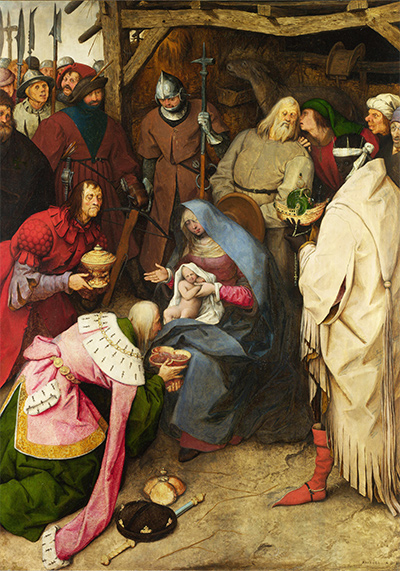
Pieter Bruegel the Elder signed and dated The Adoration of the Kings in 1564. The National Gallery’s oil painting on oak, NG3556, places Mary and the infant Christ near the centre of a tall panel. The kings and their attendants crowd close to them. A kneeling figure’s cloak trails into the foreground, while faces, weapons and the timbers of the shelter fill much of the space above. The gifts are elaborate, but the people offering or watching them have very different expressions. The arrangement makes it possible to look from an intimate exchange straight into a crowd [1] [2].
This work across Bruegel’s career
Tower of Babel
1563The Harvesters
1565Peasant Wedding
1568Children's Games
1560Triumph of Death
1562–1563Adoration of the Kings
This artworkContents
- Introduction
- Mary, the Child and the Kneeling King
- Melchior and Balthasar
- The Faces Above the Gifts
- Looking at the Paint and the Panel
- Annotated Details
Mary, the Child and the Kneeling King
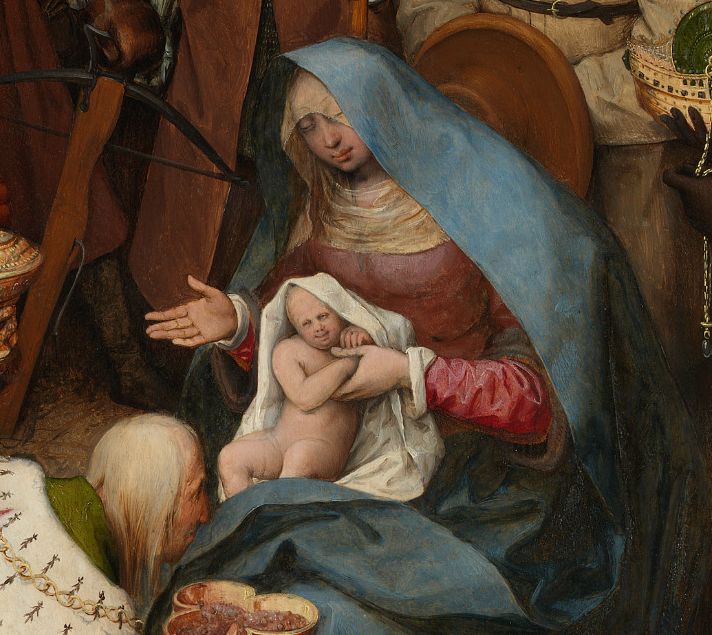
Begin with Mary’s blue mantle. Its upper edge runs down from her covered head and marks the division between the group at the front and the standing men behind her. The child is held close to her body. His uncovered legs contrast with the many layers of heavy cloth around him, and his arms are folded inwards. The National Gallery catalogue reads his pose as shrinking from the gift offered by Caspar, the old king at his feet. The small interval between the vessel and the child is where the encounter is easiest to see [2].
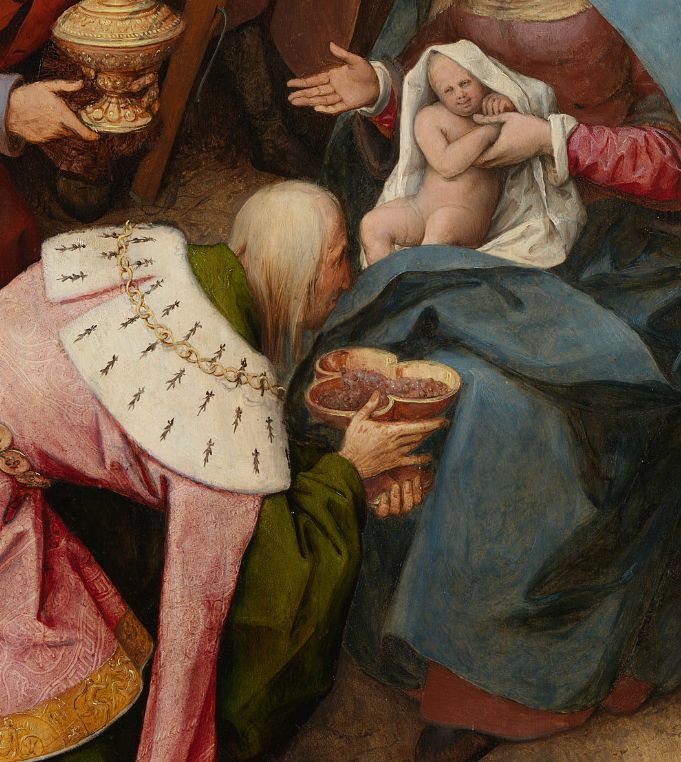
Caspar bends low. His coat, trimmed with white fur, extends in a diagonal from his shoulders to the pink fabric trailing near the bottom edge. The king’s body is close to the child while his robe requires a great deal of foreground. Look at the ground below him. A dark cap and a short sceptre occupy the open space left between him and the standing king at the right. The gifts bring the visitors inwards, but their dress and belongings keep pushing the eye back out across the panel [2].
Mary’s free hand opens towards the left. It sits above the kneeling king and below Melchior, in a part of the painting where several other hands support heavy vessels. Her gesture is much less occupied than theirs. An interval of dark fabric around the hand makes its fingers easy to read. By stopping there before moving to the child, the viewer can see how a small unencumbered gesture is given a place among the plates, folds and pieces of metal.
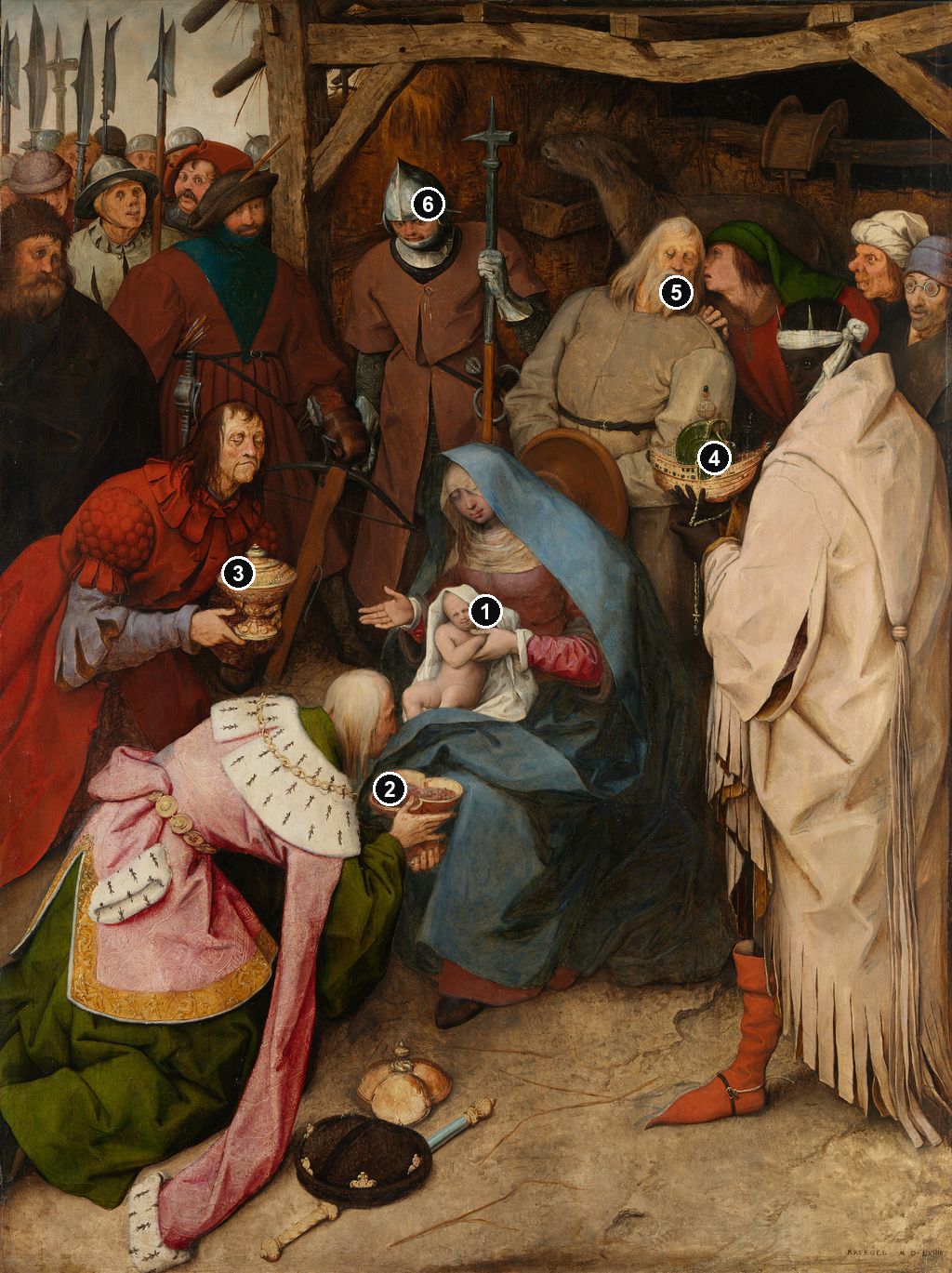
Annotated Details from The Adoration of the Kings
Start with Mary and the child, then follow the gifts and the faces gathered above them.
Details from THE ADORATION OF THE KINGS
Six details locate the three kings and the people watching the encounter.
Mary and the child
The shape of the blue mantle sets off Mary’s hand and the child she holds.
Caspar’s offering
The kneeling king holds an open vessel below the child, while his fur-trimmed cloak trails behind him.
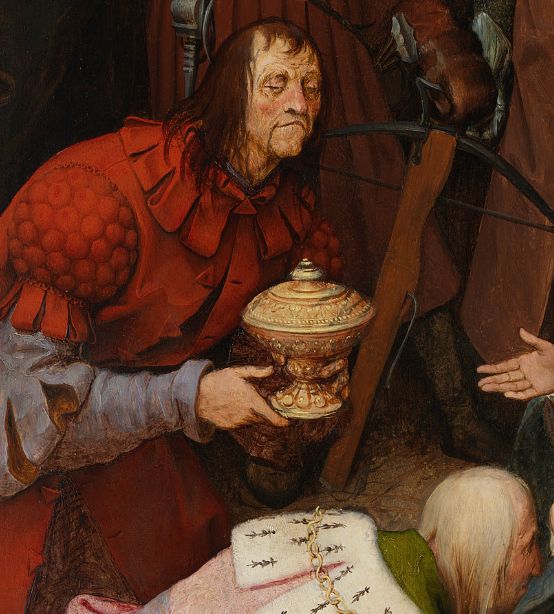
Melchior’s cup
Light falls on the rounded lid of the cup held by the king in red.
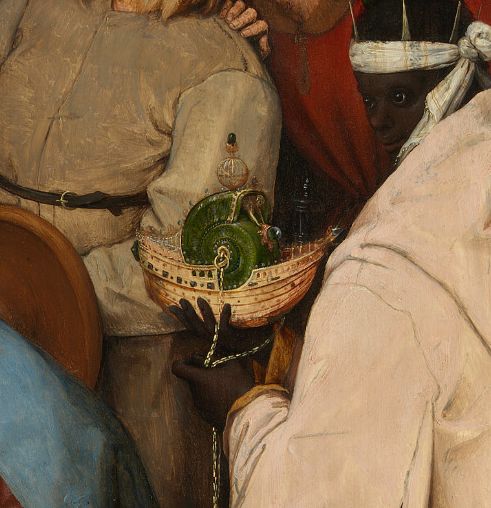
Balthasar’s gift
An elaborate gold ship and green shell stand out against darker fabric.
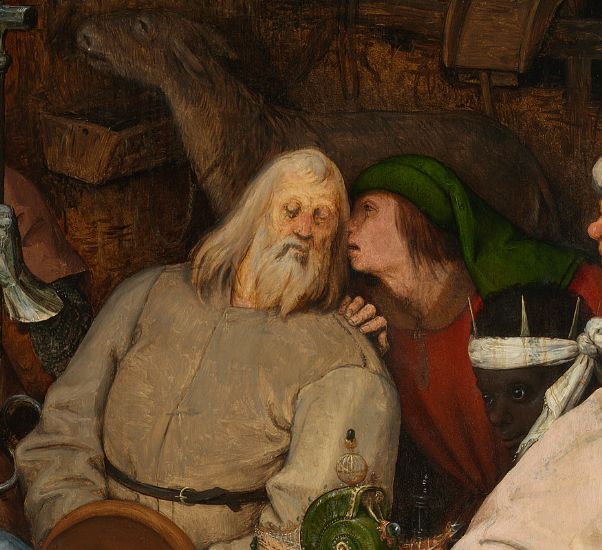
Joseph and the whisper
Joseph turns towards the man in the green cap who leans towards his ear.
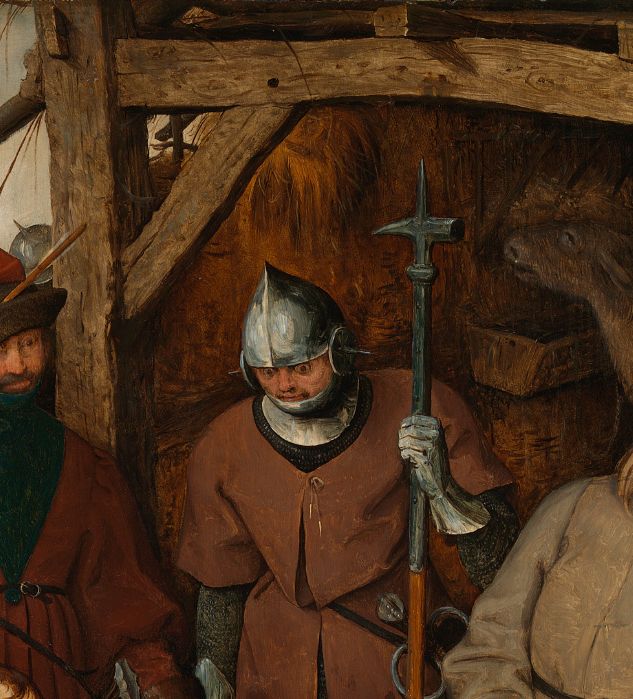
The soldier and the timber
The helmet, upright shaft and diagonal timber establish different directions above Mary.
Pieter Bruegel the Elder, The Adoration of the Kings, 1564, oil on oak. National Gallery, London, NG3556. Reproduction via Wikimedia Commons.
Melchior and Balthasar
Melchior is the king in red at the left. He bends forward with a covered golden cup. The rounded top of the vessel is picked out against dark cloth, and its position below his face gives him a clear relation to the seated pair. The catalogue notes that his left hand rests on the lid in the underdrawing. The final position of the vessel and hands is one of the places where the technical study helps a viewer separate Bruegel’s plan for the gesture from the one that was painted [1] [2].
Balthasar’s pale mantle runs down much of the right side and ends in long strips. A red boot is visible below it. His gift carries an elaborate gold ship and a green shell, with fine details described in the gallery catalogue. Its many small parts occupy a comparatively dark space against the light garment. Look from the folds of the mantle towards the object and then up to the simple band across his head. Bruegel sets an intricate object beside a much more economical sign of kingship [1] [2].
The catalogue discusses possible identifications of the contents of the vessels. Their forms can be studied even when the contents are uncertain. An open container is offered near the child, a lidded cup stands higher at the left and the ship at the right is built out of smaller forms that are hard to separate from a distance. Each gift gives its bearer a different way of holding himself. The arrangement makes rank and ceremony visible through things people have to carry [2].
The Faces Above the Gifts
Above Mary, Joseph turns his head towards a man in a green cap who leans close to speak. The men’s faces are near enough to make their exchange legible without knowing the words. Nearby, a helmeted figure looks down. The shaft he holds runs almost vertically, and more weapons rise at the upper left. These straight lines give the tightly packed heads a framework. A spectator can follow the bent heads in one direction and the tall rhythm of the shafts in another [1] [2].
At the far right a spectator wears spectacles. Bruegel describes the lenses with just enough paint for them to stand out against the face. Along with the whispering figures and the lowered head of the soldier, the spectacles make the act of looking part of the subject. The scene has people viewing it at several distances even within the tight limits of the shelter. The child is near the middle, but the faces tell us that attention moves through the picture by many routes [2].
Looking at the Paint and the Panel
The oak support is assembled from three vertical boards. The gallery measures the picture at 112.1 by 83.9 centimetres. Infrared examination revealed changes to the position of the toe of Balthasar’s boot, and close study also identified a fingerprint in paint on a timber at the upper right. These findings give two sorts of evidence about the work. One shows alternatives beneath the final outline. The other records physical contact with the paint in a place that appears from below as part of the stable’s structure [1] [2].
Campbell also finds places where the painter disturbed wet paint to make a pattern. The decoration on Caspar’s red tunic includes lines made by working into the surface. This kind of handling is worth comparing with the broader, less regular marks on the stable wall. The differences between rich clothing and rough shelter depend partly on the sorts of marks the brush leaves behind [2].
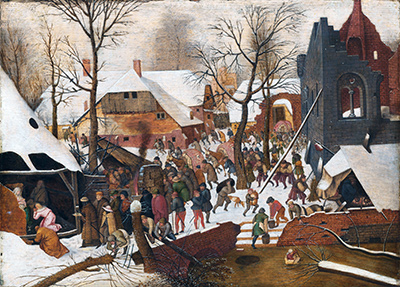
The narrow, upright panel makes the lowest objects part of the same climb through the picture as the loft and its rough timbers. In the Adoration of the Kings in the Snow, dated 1563 in Campbell’s study, Bruegel put the encounter within a much wider view of a settlement. The London panel lets a visitor read expressions at close quarters. Campbell also distinguishes these two works from the Brussels Adoration, whose attribution he questions. A similar title can therefore lead to very different compositions and different evidence of authorship [2].
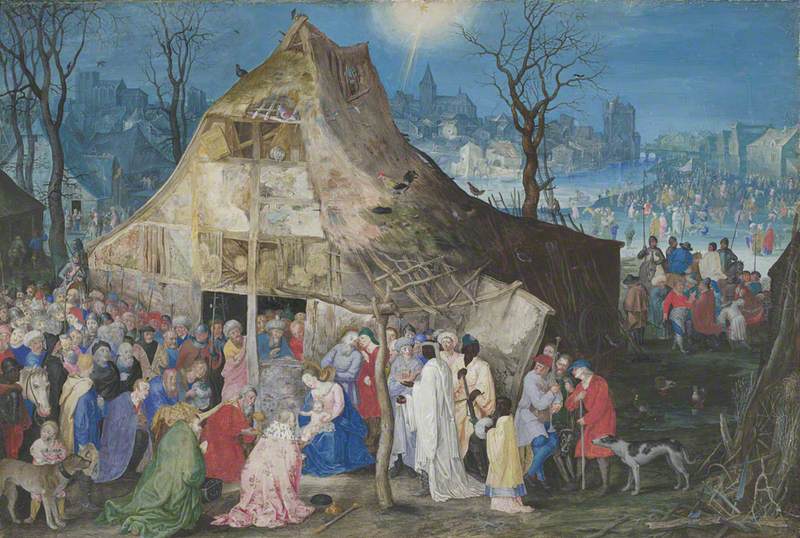
The smaller picture by Bruegel’s son Jan, shown below, is another work in the National Gallery. In 1598 Jan took up individual figures from the London panel, including Joseph and the man speaking to him, but placed them in a broader composition. Comparing the two gives a way to recognise a gesture after the space around it has changed. In the elder Bruegel’s panel the whisper is only a short distance above the child. In Jan’s work it belongs to a scene with much more room for the surrounding retinue [3] [2].
Discussion
Which detail in this work most changes how you read it?
Frequently Asked Questions
Begin with Mary’s blue mantle. Its upper edge runs down from her covered head and marks the division between the group at the front and the standing men behind her. [2]
References
- National Gallery, Pieter Bruegel the Elder, The Adoration of the Kings, NG3556, View source.
- Lorne Campbell, National Gallery catalogues, The Adoration of the Kings, NG3556, 2014, View source.
- National Gallery, Jan Brueghel the Elder, The Adoration of the Kings, NG3547, View source.







