


 by Tom Gurney
Tom Gurney BSc (Hons) is an art history expert with over 20 years experience
Published on June 19, 2020 / Updated on October 14, 2023
Email: tomgurney1@gmail.com / Phone: +44 7429 011000
The Drunkard Pushed into the Pigsty: Introduction
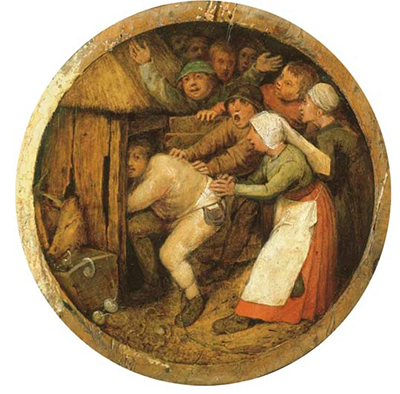
A man in pale clothes bends into a low doorway while a group presses against his back. To the left, a pig comes up to a trough. The encounter fills Pieter Bruegel the Elder’s The Drunkard Pushed into the Pigsty, an oil painting on a circular walnut panel. Christie’s recorded a diameter of eighteen centimetres when it offered the painting in 2002. The Kunsthistorisches Museum included the panel in its 2018 exhibition under the title The Drunk Cast into the Pigsty and dated it to 1557. A dated engraving by Johannes Wierix carried the composition into print eleven years later [1] [2] [3].
This work across Bruegel’s career
Tower of Babel
1563The Harvesters
1565Peasant Wedding
1568Children's Games
1560Triumph of Death
1562–1563The Drunkard Pushed into the Pigsty
This artworkContents
- Introduction
- At the Door of the Sty
- The Pig and the Painted Plate
- Interpreting the Shove
- From Painted Panel to Engraving
- Annotated Details
At the Door of the Sty
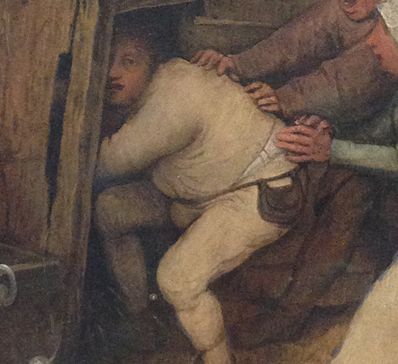
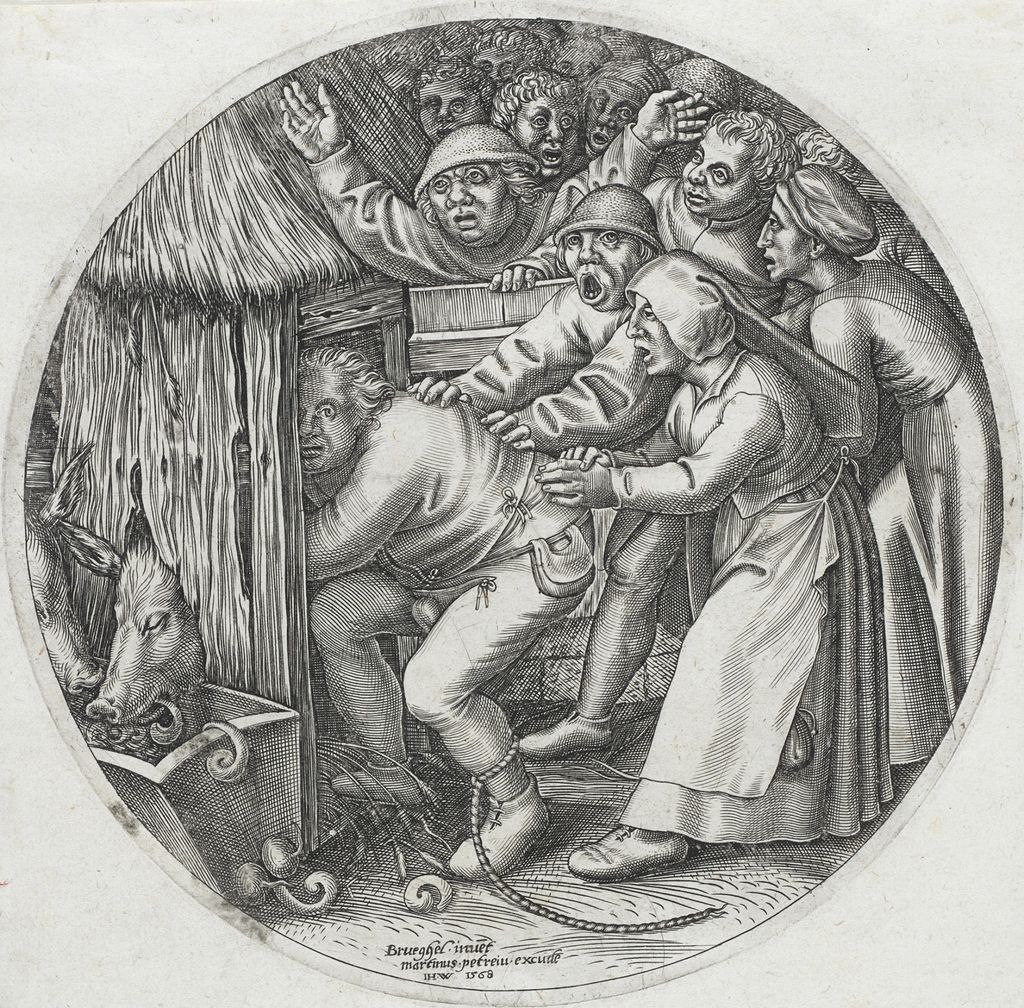
Start where the man’s pale shoulder meets the dark opening. His body turns towards the viewer at the hips, but his head has already passed behind the front edge of the building. A knee rises just inside the dark space while the other leg bends down and back. The face is still visible in the gap next to an upright plank. Bruegel gives us enough of the man to judge his awkward position, and the upright edge makes clear how far the shove has already taken him.
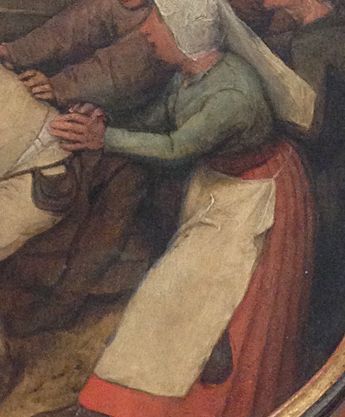
The woman in the foreground bends towards the man with both hands extended. Her pale apron slopes towards the lower left, and the tail of her white head covering points away from the door. Between the two pieces of white cloth, the green sleeve makes her reaching arm easy to follow. The man behind her grips the pale figure higher up. His mouth opens wide beneath a dark hat. The different levels of the hands help make sense of the bodies in the confined space. Both figures are close enough to touch their target, but they approach him at different angles.
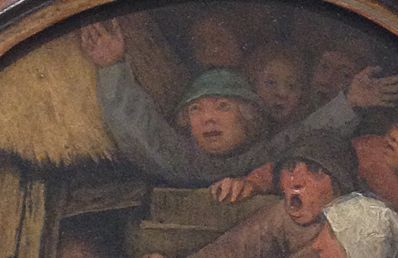
The onlookers rise behind the people doing the pushing. The figure in a green cap throws both hands high, one partly alongside the thatch and the other against the darker faces near the rim. Smaller heads appear in the gaps. At the right two faces turn in profile. This upper group is easier to follow through expressions and gestures than through continuous outlines. In the foreground the broad pale surfaces of the apron and the man’s clothes give the eye more space to see how the figures overlap.
Annotated Details from The Drunkard Pushed into the Pigsty
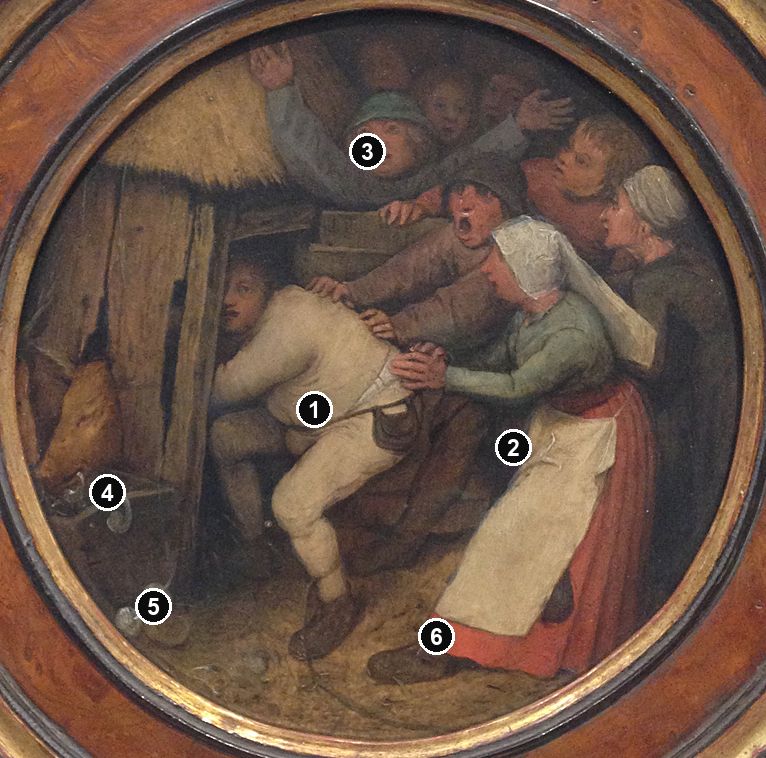
Follow the push towards the doorway, then look around the wooden roundel.
Details from THE DRUNKARD PUSHED INTO THE PIGSTY
Six details show how Bruegel fitted the figures, sty and trough inside the circle.
The man in the doorway
The bent figure passes behind the vertical boards of the sty.
The woman pushing
The green sleeve and pale head covering lead towards the hands at the man’s waist.
Hands above the crowd
The man in the green cap raises his arms above the other figures.
The pig and trough
The pig lowers its head beside the upright boards.
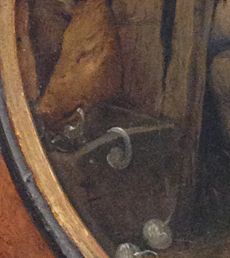
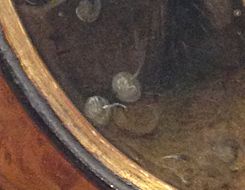
Vegetable scraps
Pale fragments and curling pieces catch the light near the base of the wall.
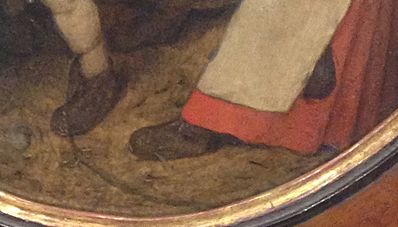
Feet along the rim
The pale apron leads down to a dark shoe near the curve of the panel.
Pieter Bruegel the Elder, The Drunkard Pushed into the Pigsty, 1557. Private collection. Christie’s, lot 37 (2002). Photograph via Wikimedia Commons.
The Pig and the Painted Plate
The pig occupies a small area at the left. Its snout reaches down close to the trough and its head partly blends with the brown boards behind it. The thatch makes a light wedge above this part of the building. Below it the vertical boards push the viewer’s attention back down towards the animal. Near the base of the wall, pale vegetable pieces and curling scraps stand out against the ground. They are easily missed when the action first draws attention to the pale figure, but they help give the pig’s corner of the picture a scale of its own.
The perimeter comes close to the group at the top and follows the slope of the ground below. It leaves room for the foreground woman’s foot and for the smaller forms by the trough. Look at the space between the man’s bent leg and the lower rim. The ground there holds the eye for a moment before the pale apron brings it round to the right, back into the crowd. The round shape also lets the thatched roof enter from one side as a tapering form, with little space left above it.
The wooden support contributes its own evidence. Christie’s describes grooves visible when light falls across the panel at an angle, consistent with shaping the walnut on a wheel. The catalogue places the work in the Netherlandish tradition of painted wooden plates and suggests it may once have belonged to a set. The first proposal concerns what can be examined on the object. The second concerns possible companions and depends in part on comparisons, including the later group of roundels in Bamberg [1].
Interpreting the Shove
The title calls the man a drunkard, although there is no clear sign of alcohol within the painting. The presence of the pig lends force to a proverb about sending the pig into its sty. As the Mauritshuis explains in its catalogue of Jan Steen’s later treatment, the saying could carry different meanings. A verse on a later print published by Claes Jansz Visscher links the encounter with squandering one’s possessions and compares the spender to a drunken pig. The verse offers evidence for an interpretation circulating in print. In Bruegel’s panel, the comparison is made through the practical business of fitting a man into the animal’s quarters [1] [4].
There is room to look at the crowd as well as at the man singled out by the title. The extended arms and open mouths can be followed independently of any reading of the proverb. An embarrassing punishment has drawn several people into the same tiny space, and the raised hands make clear how differently the participants respond to the commotion. The pig, with its head down at the trough, is occupied with something else entirely.
From Painted Panel to Engraving
The 1568 engraving at the Los Angeles County Museum of Art retains the round field and many elements of the painted arrangement. It shows the roof, doorway and pig on the same side as the panel. Its closely spaced strokes can pick out the rough thatch and the folds of clothing, while the printed faces and lettering deserve a look of their own. Christie’s points out that the print follows such small details as the scattered turnips. The design was also repeated in paint by Pieter Brueghel the Younger and his workshop. The engraving and those painted versions are separate objects, each with its own evidence about how the composition circulated [1] [3].
The earlier painting came back into focus through close examination. Josef de Coo published it with a tentative attribution in 1975. Roger van Schoute and Hélène Verougstraete subsequently identified traces of a signature and date and reported their findings in 2000. Christie’s records the panel on loan at the National Gallery in London in 2000–01. The technical study gave the panel a firmer place in Bruegel’s work, alongside the dated print that had long preserved knowledge of the design. The Vienna exhibition then brought the privately held painting into public view alongside other works in different media [1] [2].
Discussion
Which detail in this work most changes how you read it?
Frequently Asked Questions
The wooden support contributes its own evidence. Christie’s describes grooves visible when light falls across the panel at an angle, consistent with shaping the walnut on a wheel. [1]
References
- Christie’s, The Drunkard pushed into the Pigsty, lot 37, 10 July 2002, View source.
- Kunsthistorisches Museum, Bruegel 2018 exhibition, A Summit of Masterpieces, View source.
- Los Angeles County Museum of Art, The Drunken Peasant Pushed into a Pigsty, 58.21.1, View source.
- Mauritshuis, Jan Steen, ‘A Pig Belongs in the Sty’, 736, View source.









