


 by Tom Gurney
Tom Gurney BSc (Hons) is an art history expert with over 20 years experience
Published on June 19, 2020 / Updated on October 14, 2023
Email: tomgurney1@gmail.com / Phone: +44 7429 011000
The Death of the Virgin: Introduction
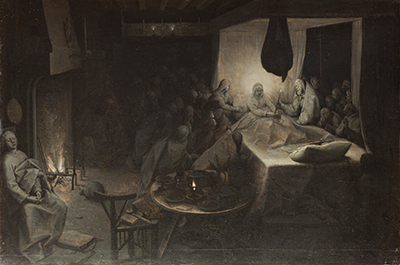
Pieter Bruegel the Elder’s The Death of the Virgin, also called The Dormition of the Virgin, is a small painting in shades of grey at Upton House in Warwickshire. The National Trust records it as oil on oak, inventory 446749. Mary raises herself in bed to receive a taper from Saint Peter. People gather at the bedside, while a fire and a little flame on a table light other parts of the room. Bruegel sets the central action in a much wider darkness, where faces, furnishings and individual gestures emerge at different speeds [1] [2].
This work across Bruegel’s career
Tower of Babel
1563The Harvesters
1565Peasant Wedding
1568Children's Games
1560Triumph of Death
1562–1563Death of the Virgin
This artworkContents
- Introduction
- Finding Mary in the Light
- Three Areas of Light
- What Grisaille Does in This Room
- From Ortelius’s Panel to Galle’s Engraving
- Annotated Details
Finding Mary in the Light
The bed occupies most of the right half. Its long edge runs down from Mary towards a chest and the near side of the room. Start where the white bedding is easiest to distinguish and follow it upwards. Near its head, the light broadens around Mary. Her face becomes visible above the cloth, with the shapes of other people close beside it. The large area of shade hanging into this part of the painting makes the pale surface behind the bed especially conspicuous [2].
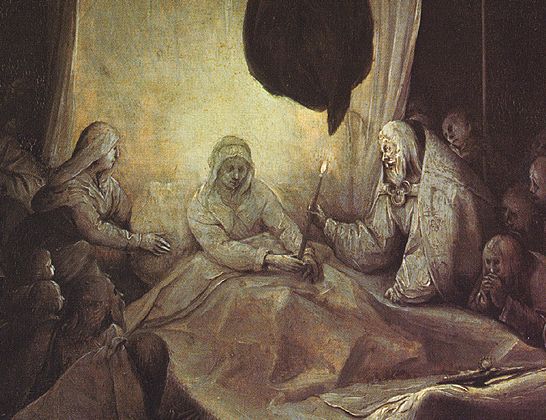
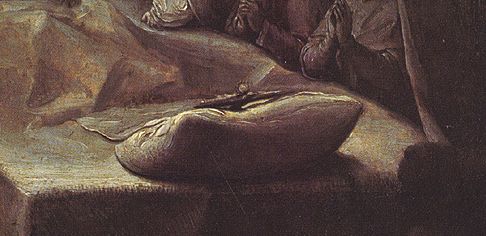
The Courtauld exhibition catalogue identifies Saint Peter as the person offering the taper and describes Mary’s gaze as directed towards a crucifix near her feet. The two objects give the movement of the central figure a precise setting. The taper is held within reach by another person. The crucifix is farther away and gives the eye another route along the bed. Mary’s act of rising brings those places into relation, while the other people keep the space around her occupied [2].
Look near the foot of the bed for the holy-water vessel and its sprinkler, which the Courtauld catalogue connects with Peter’s blessing of the deceased. These are small implements in a room with much larger furnishings. They locate part of the action that is about to follow. A viewer who first sees a person sitting up among her attendants can look further and recognise that preparations have already been made around her [2].
Annotated Details from Death of the Virgin
Follow the light from the hearth and table towards the bed.
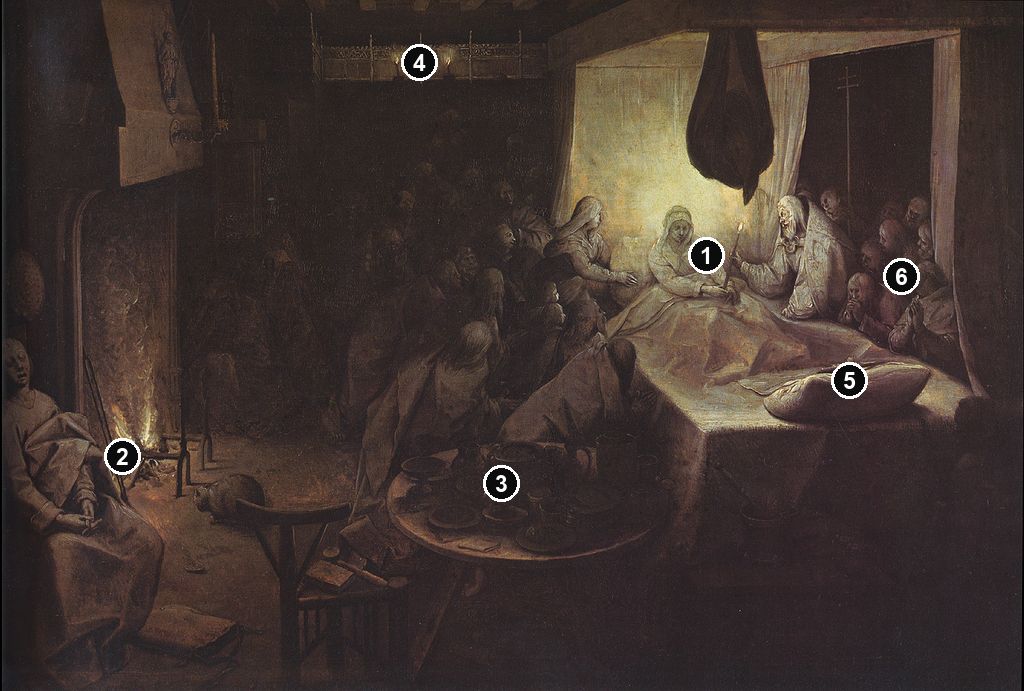
Details from DEATH OF THE VIRGIN
Six details locate the light sources and the people around Mary.
Mary and the taper
The light gathers around Mary and the figure offering the taper.
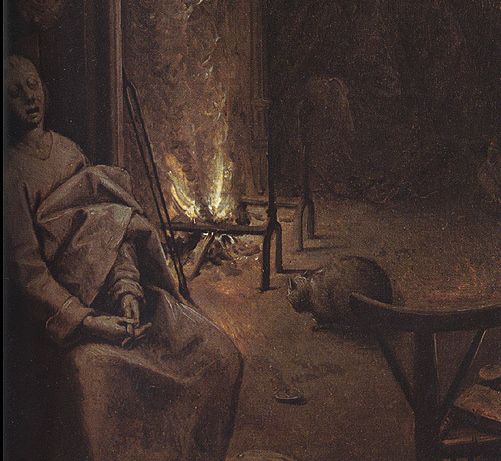
The hearth and sleeper
The fire lights part of the seated figure and the floor beside him.
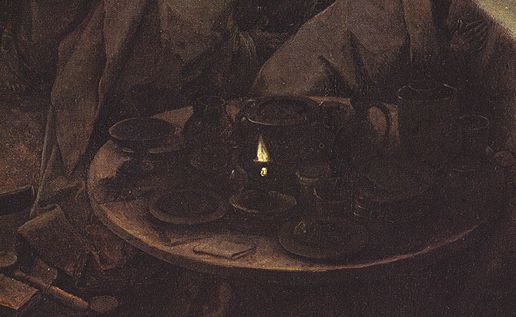
The flame on the table
A small flame stands among vessels on the round table.
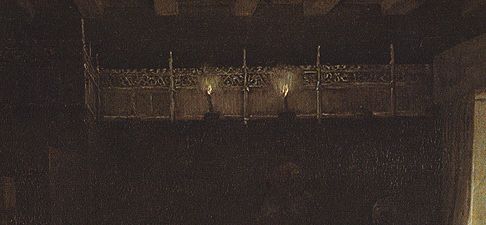
The lights above the doorway
Points of light pick out the frieze above the dark room.
The crucifix and pillow
A crucifix lies near the pillow at the foot of the bed.
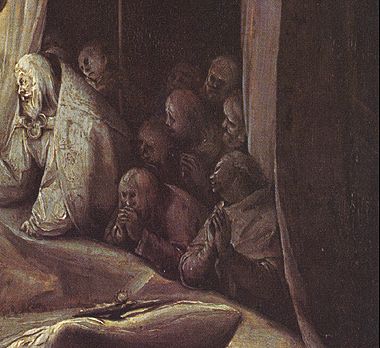
The figures on the right
Faces emerge from the shade behind the bed.
Pieter Bruegel the Elder, The Dormition of the Virgin, about 1562–65. Upton House, Bearsted Collection, National Trust, 446749. Reproduction via Wikimedia Commons.
Three Areas of Light
The hearth at the left has a flame close to the floor. The strip of light above it reaches the wall, while several surfaces nearby remain in shade. The fire also allows the eye to locate someone in a chair. The Courtauld catalogue describes this figure as asleep and draws attention to the cat curled up near the hearth. Both details are easy to overlook when the glow at the bed first takes hold of the eye. The fire gives these quieter parts of the room a degree of visibility of their own [2].
A smaller flame is visible among the objects on the table near the centre. Look for its reflection and for the change in tone around the edge of the table. The little glow is enough to show that there is something between the viewer and the bed. It also gives the foreground its own depth. A body can be left mostly in shadow while the front of a piece of furniture still catches the light. The illuminated bedside becomes more striking after the eye has attempted to follow those smaller areas.
The Courtauld describes the brilliance behind Mary as supernatural. Its scale differs from the firelight and the little flame on the table. The edges it makes visible are mostly at and above the bed, in a place where a number of figures have turned to Mary. As the eye moves from the hearth to the table and then to the head of the bed, the light changes what a viewer can recognise and how quickly it can be recognised [2].
What Grisaille Does in This Room
Grisaille describes painting chiefly in grey or another narrow monochrome range. Here it allows neighbouring forms to be distinguished by small changes in tone. Look at the dark passage in the middle where people stand close together. Some faces can be picked out after a moment. Further down, a piece of clothing can become visible where it meets an object that is darker still. Much of the scene becomes clearer through such comparisons, with many of the strongest values reserved for the bedside and the hearth [1] [2].
The Courtauld records a single oak support and gives the work’s approximate date as 1562 to 1565. The signed name is on the chest at the foot of the bed. The catalogue gives a maximum width of 55.5 centimetres. The small format matters when looking for the people along the walls. A relatively short move of the eye takes the viewer from the structure of the room to a flame or a hand. The dimensions and the tonal range give the picture its particular demand for close viewing [2].
From Ortelius’s Panel to Galle’s Engraving
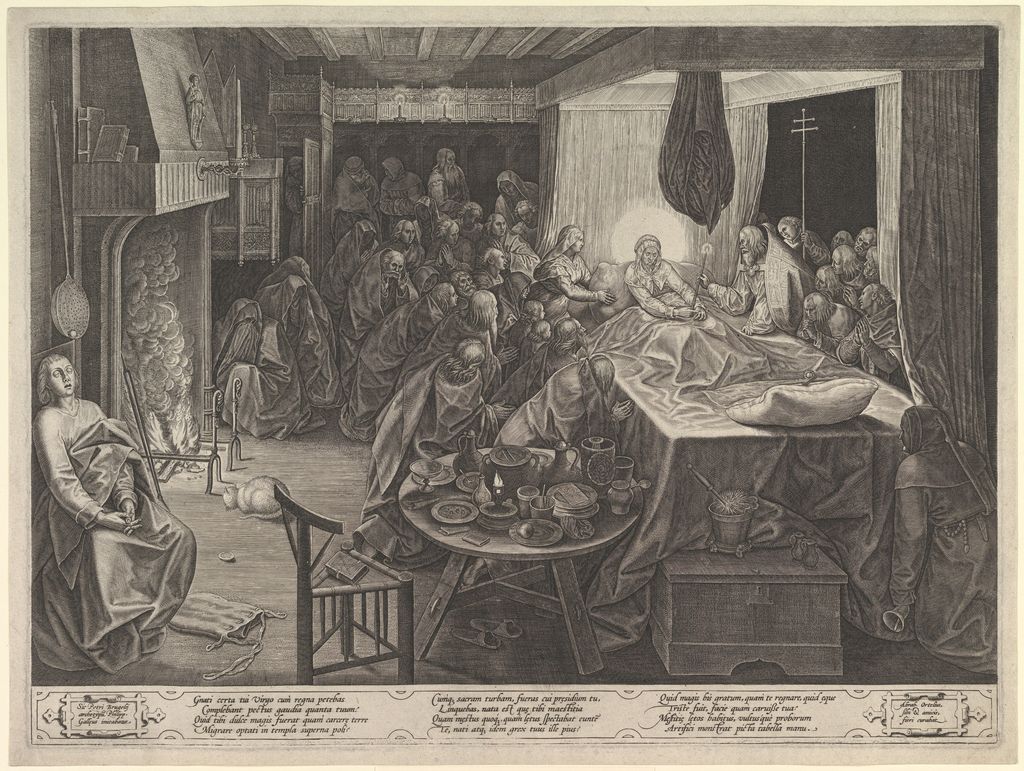
Bruegel’s friend Abraham Ortelius had the painting by 1574, when he commissioned Philips Galle to engrave it. The print made a privately held painting available to more viewers. The engraving’s inscription names the painted model and connects the commission to Ortelius’s wish to share it with friends. The Courtauld records that the panel later entered the collection of Peter Paul Rubens and came to the National Trust with Upton House and the Bearsted collection in 1948 [2] [3].
The engraving preserves the orientation of the room, with the hearth at left and the bed at right. Find the bed and the hearth first, then compare the figures nearest those two areas. The engraving uses the density and direction of its marks to preserve the changes of light and shade that the panel obtains with paint. It also places an inscription below the image, where the reader can see evidence of how it came to be made. The National Gallery of Art and Metropolitan Museum of Art hold impressions of Galle’s work. Their records establish the identity of a print separately from the oak panel in the National Trust’s care [2] [3] [4].
Galle’s print also makes a number of details conspicuous that can be slow to emerge in the painting. Follow the beams across the ceiling and look for the large dark piece of fabric hanging near the head of the bed. Then compare the crouched figures on the two sides of the table. The print allows their clothes to be followed through orderly sets of lines, while the panel can hold the same bodies in a larger patch of shadow. The two media give a viewer different amounts of time to locate the company standing around Mary [2] [4].
Look again from the hearth to the head of the bed. The small fires make the viewer wait for parts of the room to become clear. The light around Mary brings the group into focus while leaving quieter details available to someone who looks longer. That order of discovery is one of the things the engraving preserves when it translates the dark painted room into ink on paper.
Discussion
Which detail in this work most changes how you read it?
Frequently Asked Questions
The bed occupies most of the right half. Its long edge runs down from Mary towards a chest and the near side of the room. [2]
The hearth at the left has a flame close to the floor. The strip of light above it reaches the wall, while several surfaces nearby remain in shade. [2]
References
- National Trust Collections, The Dormition of the Virgin, Upton House, NT 446749, View source.
- Bruegel in Black and White, Courtauld Gallery exhibition catalogue, 2015, nos. 1–2, View source.
- National Gallery of Art, The Death of the Virgin, engraving by Philips Galle, View source.
- The Metropolitan Museum of Art, The Death of the Virgin, engraving by Philips Galle, second state, View source.








