


 by Tom Gurney
Tom Gurney BSc (Hons) is an art history expert with over 20 years experience
Published on June 19, 2020 / Updated on October 14, 2023
Email: tomgurney1@gmail.com / Phone: +44 7429 011000
The Three Soldiers: Introduction
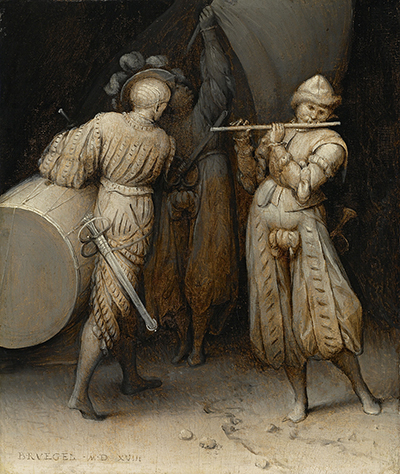
Pieter Bruegel the Elder signed and dated The Three Soldiers in 1568. The oil painting, now in the Frick Collection, measures just 20.3 by 17.8 centimetres. A drummer turns his back, a fifer faces out across the panel and a standard-bearer raises a flag between them. The painting is a grisaille, built from a narrow range of tones, with pale highlights on the musicians and darker paint over much of the figure behind them. The light catches enough of each instrument and garment to give three distinct roles to men standing very close together [1] [2].
This work across Bruegel’s career
Tower of Babel
1563The Harvesters
1565Peasant Wedding
1568Children's Games
1560Triumph of Death
1562–1563The Three Soldiers
This artworkContents
- Introduction
- The Drum and Fife
- The Standard-Bearer in Shadow
- Making a Small Grisaille
- A Different Work with a Similar Title
- Annotated Details
The Drum and Fife
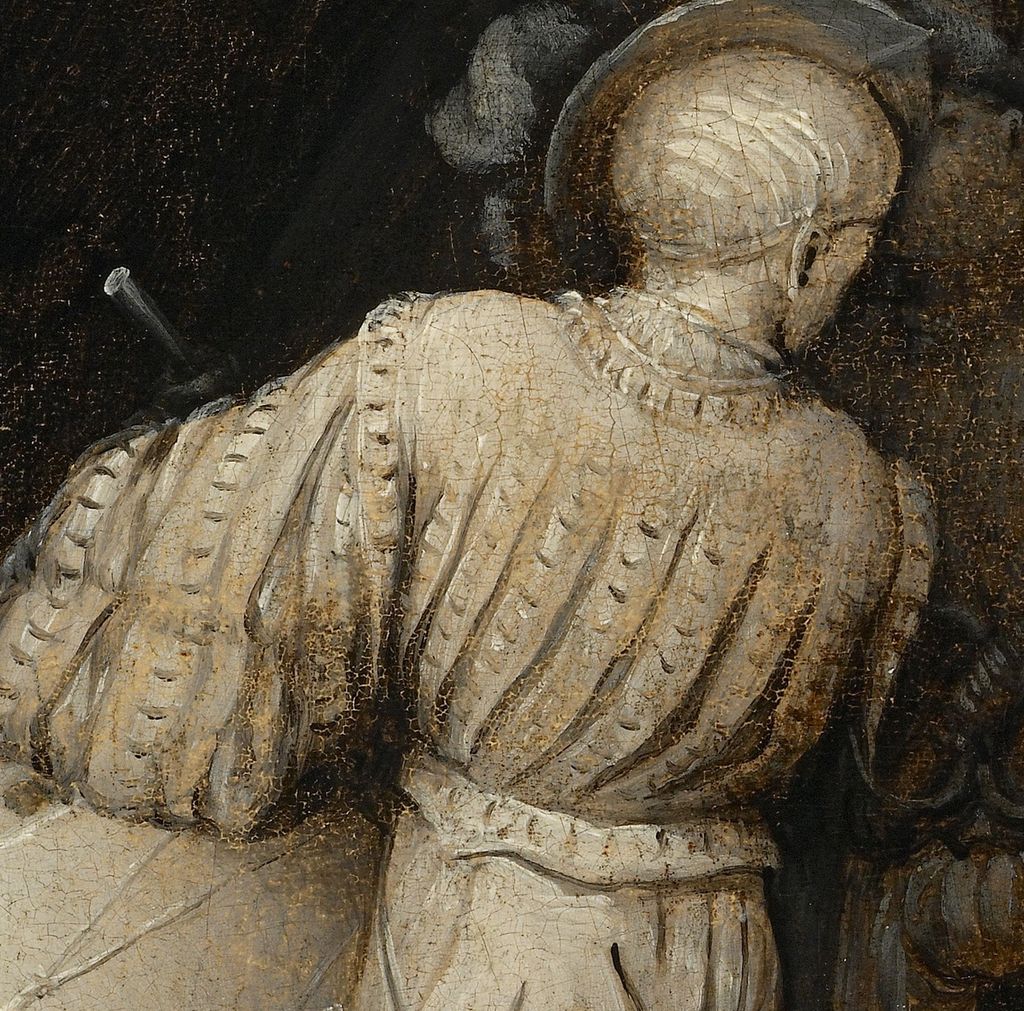
Start with the large drum at the lower left. Its pale face runs off the edge, leaving the body of the instrument and the soldier’s bent arm to explain how it sits beside him. The drummer turns away from us. Light travels across the back of his jacket and picks out the strips of fabric along the sleeves and shoulders. The narrow shadows between the strips make the breadth of his back easier to follow as he turns. The outline of the drum gives that twisting figure a relatively stable shape to lean towards.
A feathered hat sits high on the drummer’s head. It shows how Bruegel can distinguish one dark material from another without making either conspicuous at a distance. The upper part of the hat loosens into small shapes against the background. Lower down, a light diagonal at the drummer’s hip stands out against his folded clothing. Together those features give the viewer a line through the body from the turned head to the boot stepping forward [2].
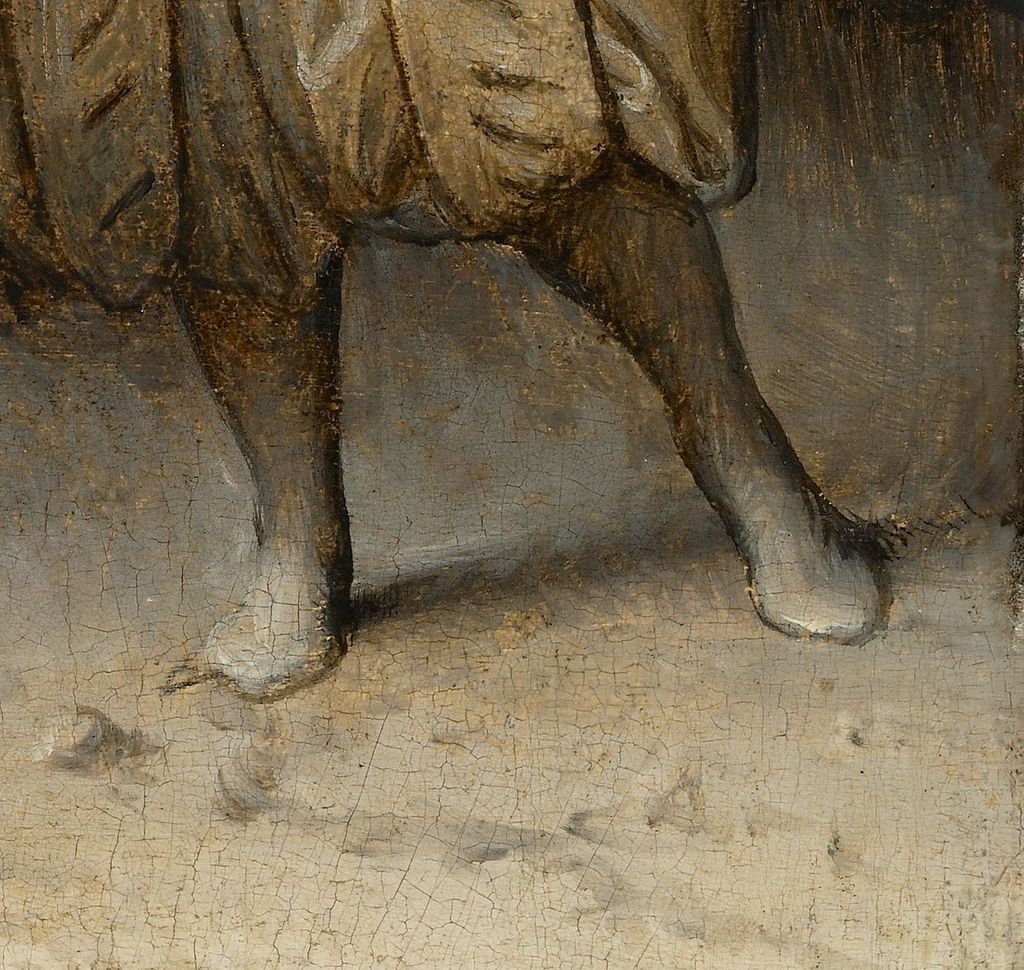
The fifer at the right has a clear face, though the instrument crosses it just below the eyes. The horizontal tube divides the picture at about shoulder height and makes it easy to see how differently the men carry their weight. The fifer’s elbow folds in and his feet spread across a light patch of ground. The space between his legs and the cut and swelling of his hose register at almost the same moment. Then the eye returns to the fingers on the thin instrument, where Bruegel gives a much smaller motion a place in the picture [1] [2].
Annotated Details from The Three Soldiers
Find the two instruments and the flag, then follow the light across the three figures.
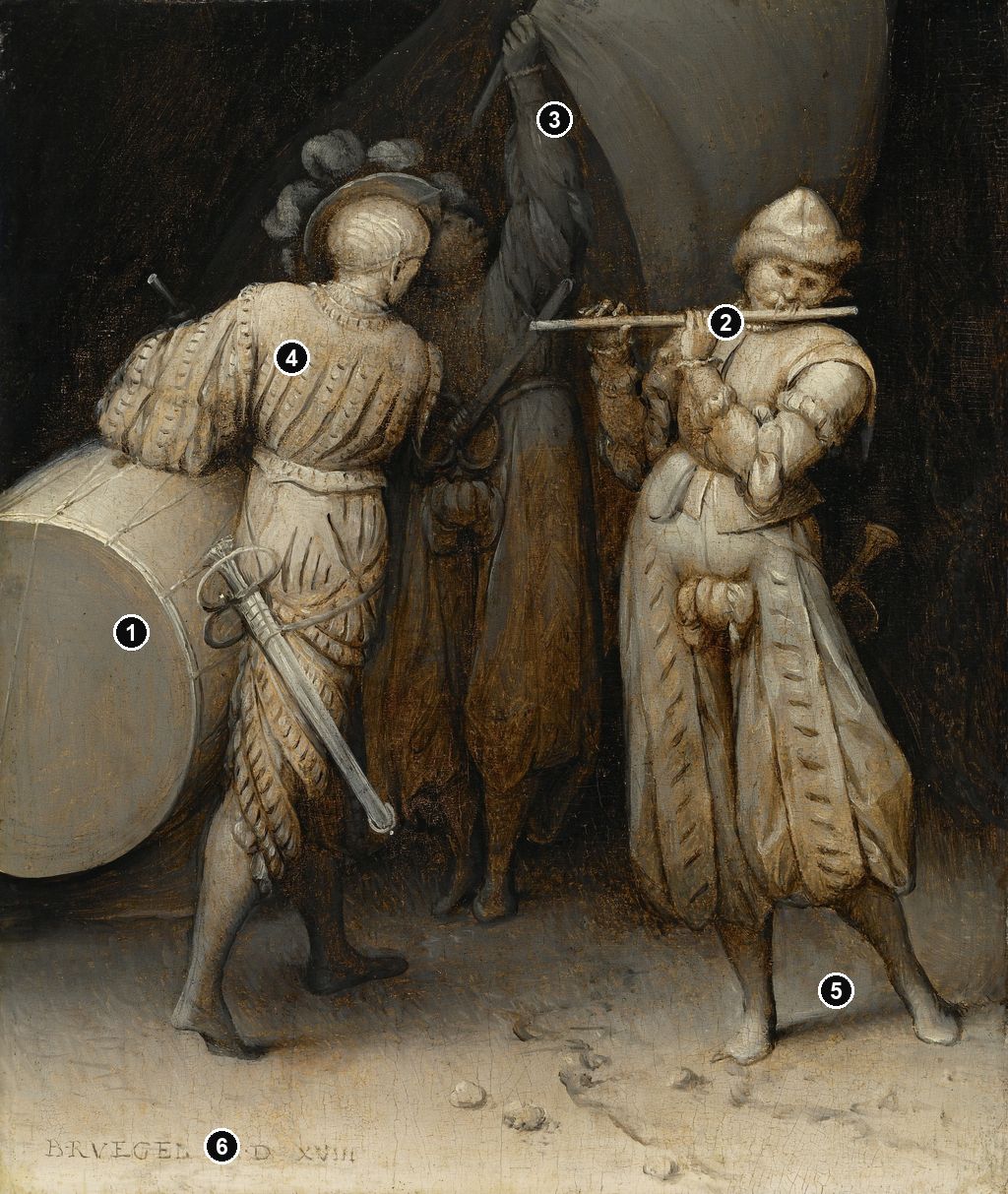
Details from THE THREE SOLDIERS
Six details show the figures, their gestures and the signed lower edge.
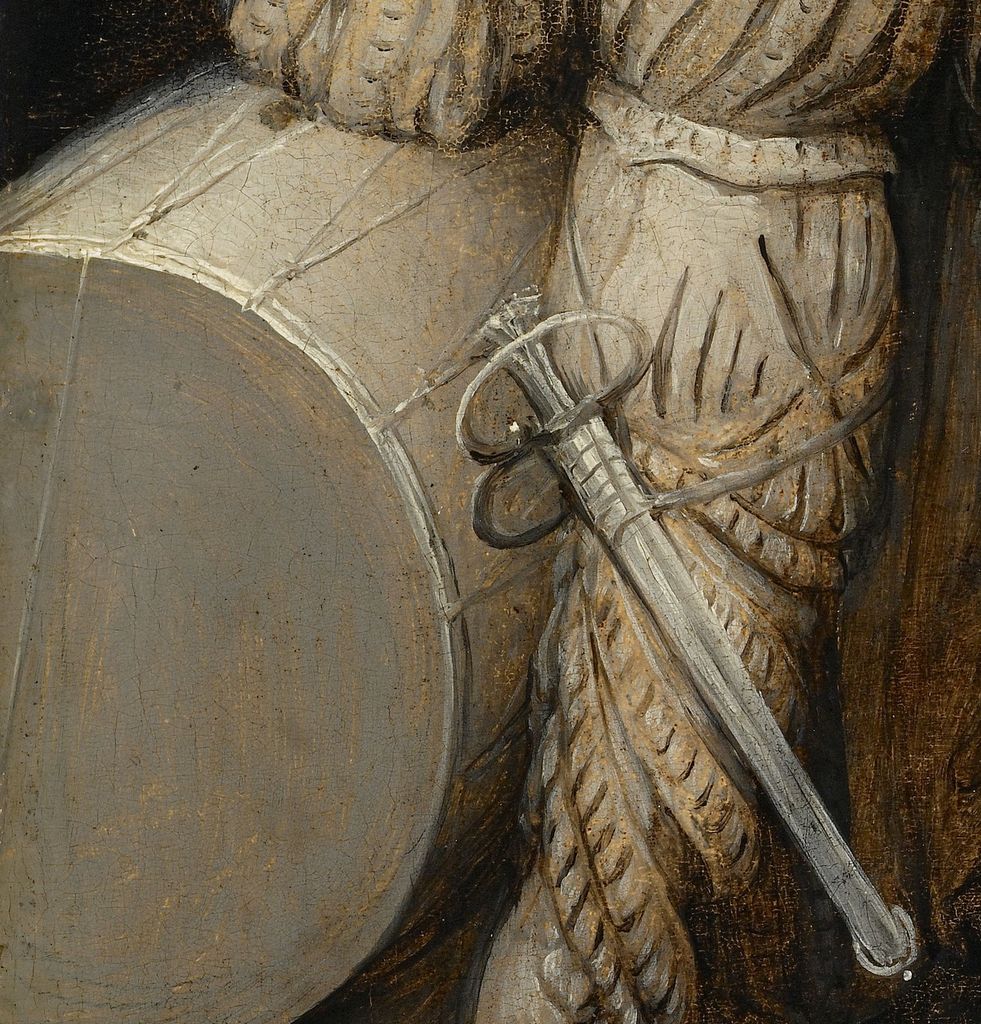
The drum
The pale front of the drum meets the edge of the panel. Its curve helps establish the drummer’s position.
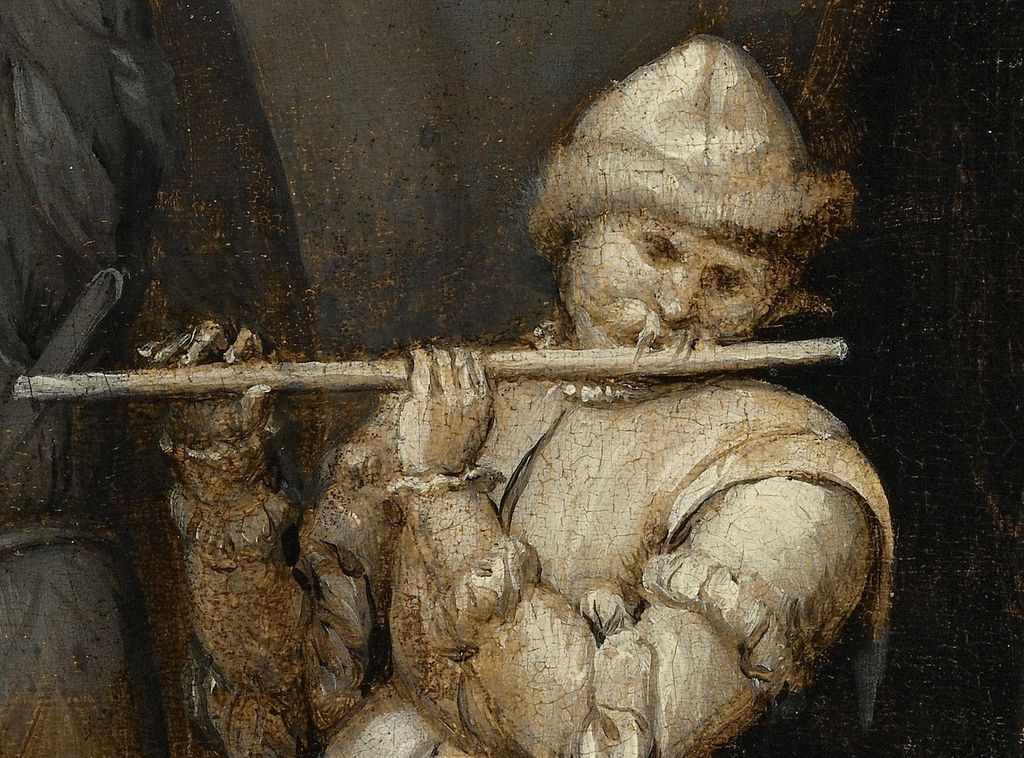
The fife
The horizontal instrument crosses just below the fifer’s face, while his fingers pick out a smaller gesture.
The raised standard
The dark sleeve leads upwards to the hand and the pale flag.
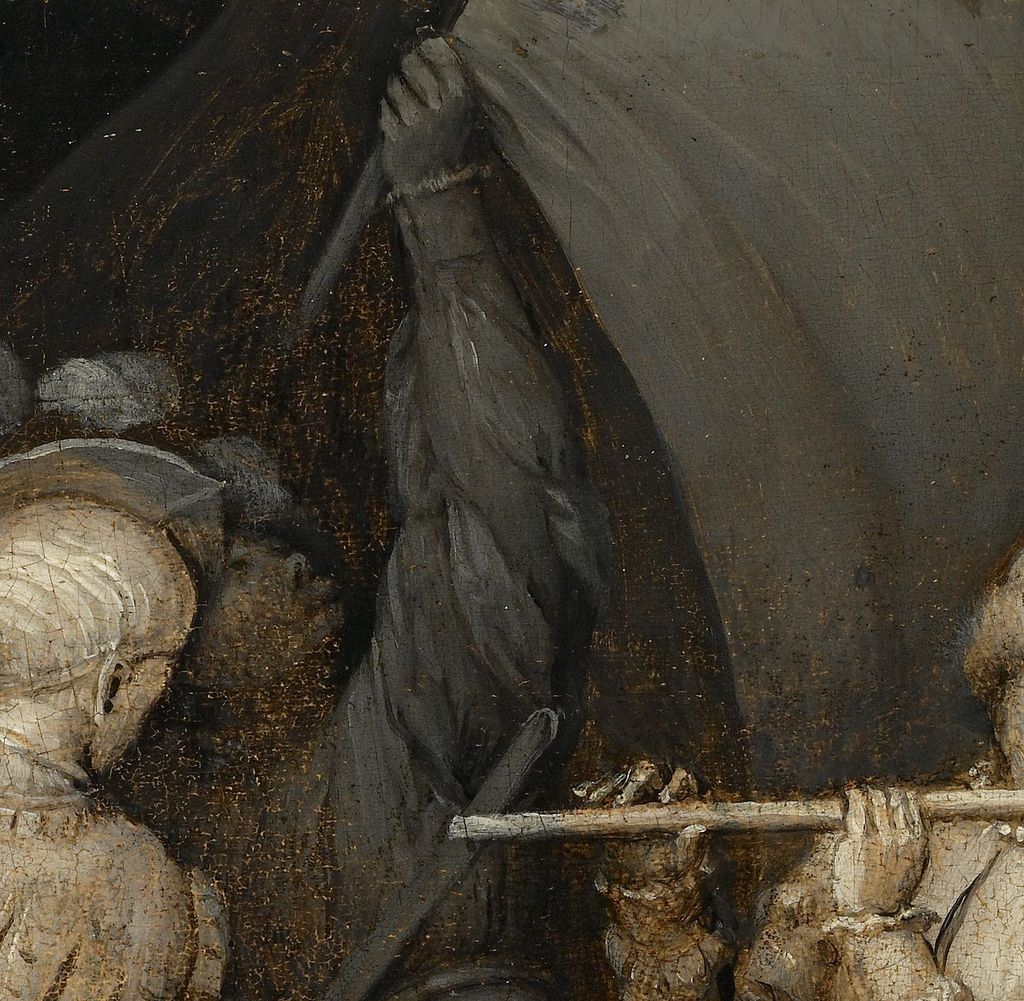
The drummer’s clothing
Dark slits and bright folds describe the turn of the drummer’s shoulders.
The fifer’s stance
The feet are separated across a pale stretch of ground. Infrared examination showed changes in this area.
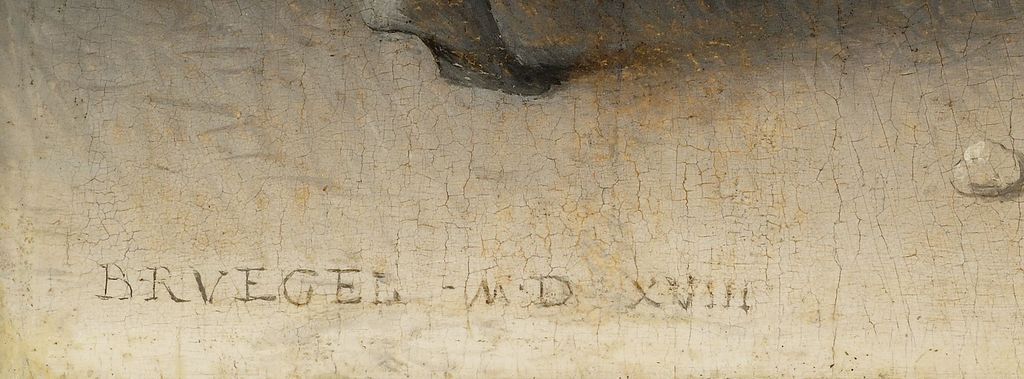
Signature and date
Bruegel signed and dated the panel at the lower left.
Pieter Bruegel the Elder, The Three Soldiers, 1568, oil on oak panel. The Frick Collection, New York, 1965.1.163. Frick photograph via Wikimedia Commons.
The Standard-Bearer in Shadow
The central figure stands farther back. His raised arm brings the eye towards the flag, whose cloth fills much of the upper right. The arm appears between the drummer’s head and the fife and is easy to miss if the light clothes have already drawn the eye to the two musicians. Look for the feet of the standard-bearer between theirs, then travel up the middle of the picture. His body remains darker than the two that flank it, while the flag helps bring his gesture out of the dark [2].
The Courtauld catalogue relates the three figures to prints of Landsknechte, German mercenary soldiers whose conspicuous clothing was familiar in sixteenth-century imagery. It compares the arrangement with an engraving by Allaert Claesz. in which a standard-bearer also stands between a drummer seen from behind and a fifer. Bruegel’s musicians wear the more voluminous hose fashionable later in the century. The comparison places the work in a tradition of military figures and gives a concrete example of the kind of detail that changed as artists revisited it [2].
On the panel, the pale ground carries a few scattered stones and provides a surface on which to compare the three stances. The setting remains spare. The Courtauld discusses the uncertainty surrounding the moment Bruegel chose. The flag and the instruments establish a group with a shared purpose, while the picture leaves the occasion open. Hunting for a battlefield or a particular regiment can take attention away from the plainly visible differences between the drummer’s turn, the fifer’s concentration and the flag-bearer’s upward reach [2].
Making a Small Grisaille
Bruegel painted the composition on a single oak panel. Infrared examination, discussed in the Courtauld catalogue, revealed preparatory drawing in a dry black medium on the white ground. The examination also showed revisions around the ellipse of the drum and the fifer’s feet. Those are two places where small adjustments would make a visible difference. The curve of the drum has to make sense even where it runs out of the picture. The feet hold the figure upright while his head and hands are occupied with the fife [2].
The grey range leaves Bruegel free to place the sharpest changes of tone where they explain the arrangement. The light along the drum’s front edge brings it forward. In the centre, the most visible parts of the standard-bearer are separated from one another by dark stretches. At the right, folds on the fifer’s sleeve appear as a series of steps between highlight and shadow. From a distance those steps blend into the shape of an elbow. Close up they show how the sleeve bunches where the arm bends.
The Frick considers whether the painting might have been made as a design for an engraving or as a small painting to be appreciated in its own right. The Courtauld catalogue records no known print after this composition. The panel was in Charles I’s collection, and examination of the reverse found a crowned mark associated with Charles as prince. The painting’s signature and date remain at the lower left on the front. Taken together, these markings refer to different parts of its history, its making and its ownership [1] [2].
Look low on the panel to read the inscription. It occupies the pale stretch below the drummer’s boot and runs roughly parallel to the bottom edge. The marks describing the stones nearby are much thicker. At actual size, the difference between them is easy to miss until a viewer comes close. The signature sits in the same narrow field as the soldiers, yet it needs a different distance from the painting to be read.
A Different Work with a Similar Title
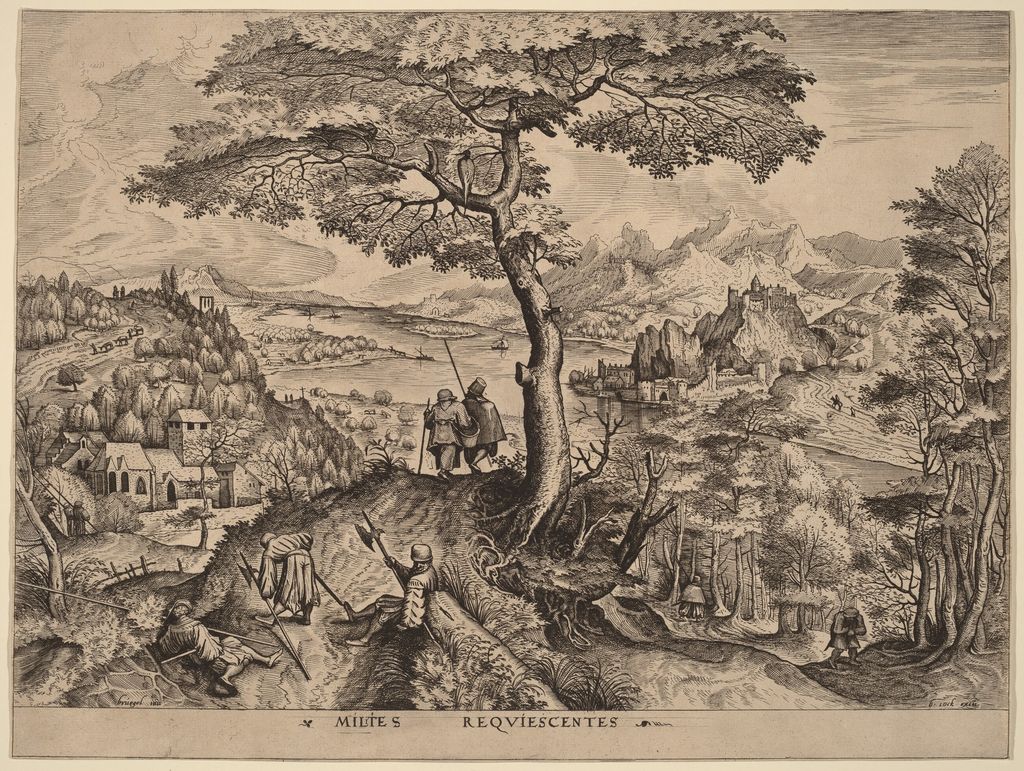
Soldiers at Rest, shown for comparison below, belongs to the Large Landscapes. It was made by Johannes and Lucas van Doetecum after Bruegel and published by Hieronymus Cock. The soldiers occupy part of a landscape that gives the viewer many other things to look at, including trees and the inhabited country beyond. The Frick panel gives nearly all its space to the figures themselves. Comparing the two shows how much the scale and medium determine what can be seen about soldiers in each work [3] [4].
Return to the thin line of the fife. It makes a bridge between the lit face at right and the area where the flag-bearer almost disappears. The drummer’s curved outline meets that same shadow from the other side. The three men remain distinct because Bruegel lets their instruments and banner carry their gestures across the small panel. Even the darkest of the three has something that directs the eye towards him.
Discussion
Which detail in this work most changes how you read it?
Frequently Asked Questions
A feathered hat sits high on the drummer’s head. It shows how Bruegel can distinguish one dark material from another without making either conspicuous at a distance. [2]
The central figure stands farther back. His raised arm brings the eye towards the flag, whose cloth fills much of the upper right. [2]
Bruegel painted the composition on a single oak panel. Infrared examination, discussed in the Courtauld catalogue, revealed preparatory drawing in a dry black medium on the white ground. [2]
References
- The Frick Collection, The Three Soldiers, 1965.1.163, object interpretation, View source.
- The Courtauld Gallery, Bruegel in Black and White, exhibition catalogue, 2015, cat. 8, View source.
- National Gallery of Art, Milites Requiescentes (Soldiers at Rest), 1943.3.2122, View source.
- The Metropolitan Museum of Art, Soldiers at Rest, from The Large Landscapes, View source.







