


 by Tom Gurney
Tom Gurney BSc (Hons) is an art history expert with over 20 years experience
Published on June 19, 2020 / Updated on August 16, 2026
Email: tomgurney1@gmail.com / Phone: +44 7429 011000
Pieter Bruegel Blind Leading the Blind: Introduction
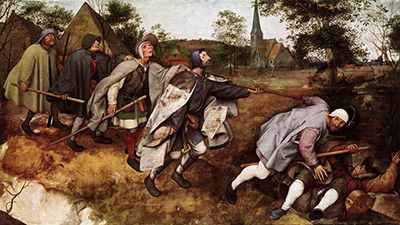
Pieter Bruegel the Elder's The Blind Leading the Blind is one of his most concentrated late allegories. Dated 1568 and held by the Museo e Real Bosco di Capodimonte in Naples, the painting shows six blind men moving together at the instant when the leader has stumbled into a ditch and the whole group is about to follow [1].
The subject comes from Christ's warning that when one blind person leads another, both fall. Bruegel turns that short biblical image into a complete visual sequence: a chain of bodies, sticks, tilted heads and uncertain steps set against a calm village landscape. The result is direct enough to understand at once, yet complex enough to reward long looking [1].
This page explains the object facts, the parable, the diagonal composition, the Sint-Anna-Pede setting, Bruegel's careful depiction of bodily difference, and the painting's place within his late work. For wider context, see the overview of Pieter Bruegel the Elder, his biography, his paintings, and the guide to Bruegel's proverbs and iconography.
At a Glance
- ArtistPieter Bruegel the Elder
- Common English titleThe Blind Leading the Blind
- Italian title in Getty CONALa parabola dei ciechi
- Date1568
- Medium and supportGoogle Arts and Culture lists tempera on canvas; Getty CONA gives distemper on linen canvas
- CollectionMuseo e Real Bosco di Capodimonte, Naples
- Main subjectSix blind men moving together as the leader falls into a ditch
- Biblical passagesMatthew 15:14 and Luke 6:39
- LandscapeIdentified in the museum record as Sint-Anna-Pede near Brussels
- Best reading habitFollow the diagonal from the fallen leader back through the line, then compare the human chain with the still landscape
This work across Bruegel’s career
Tower of Babel
1563The Harvesters
1565Peasant Wedding
1568Children's Games
1560Triumph of Death
1562–1563The Blind Leading the Blind
This artworkContents
- Introduction
- Object Facts And Capodimonte Context
- The Biblical Parable
- The Diagonal Fall
- Sint-Anna-Pede And The Landscape
- Blindness, Bodily Specificity And Respectful Looking
- Humanist, Proverb And Allegory Context
- Relationship To The Misanthrope And Late Bruegel
- How To Look At The Painting
- Why The Painting Still Matters
- Annotated Details
Object Facts And Capodimonte Context
Google Arts and Culture's Capodimonte partner page identifies the work as The Blind Leading the Blind, by Pieter Bruegel the Elder, dated 1568, in tempera on canvas, and held by the Museo e Real Bosco di Capodimonte [1]. Getty's Cultural Objects Names Authority identifies the work as a movable painting, gives the preferred Italian title as La parabola dei ciechi, lists the creator as Pieter Bruegel the Elder, gives the creation date as 1568, and describes the material as distemper on linen canvas [4].
Those records agree on the essentials: this is a late work by Bruegel the Elder, made in the year before his death in 1569, and now in Naples. The difference between "tempera on canvas" and "distemper on linen canvas" is not a contradiction for ordinary readers so much as a reminder that early Netherlandish cloth paintings can be described with related technical terms in different cataloguing systems. The key point is that the picture is not an oil-on-oak panel like many famous Bruegel paintings. It belongs to his rarer painted work on cloth [1] [4].
Capodimonte also places the painting within the Farnese collection. The museum's account of that collection explains that works by Bruegel the Elder entered the Farnese holdings after Ranuccio I Farnese suppressed a conspiracy in 1611 and confiscated property from rebellious feudal families [3]. Google Arts and Culture gives a closely related provenance note, saying that The Blind Leading the Blind and The Misanthrope entered the Farnese collection in Parma after the ruling dynasty seized them from the Masi family following an attempted coup [1].
That history matters because it helps explain why two of Bruegel's late allegories are in Naples rather than in Vienna, Brussels, Madrid or another northern European collection. Capodimonte owns both The Blind Leading the Blind and The Misanthrope, and the GAC text stresses that both were painted in the penultimate year of Bruegel's life [1]. Together they form a small but powerful late group: compact moral pictures in which proverb, parable, landscape and human movement are compressed into memorable forms.
Annotated Details from The Blind Leading the Blind
Follow the chain of hands and staffs down to the ditch.
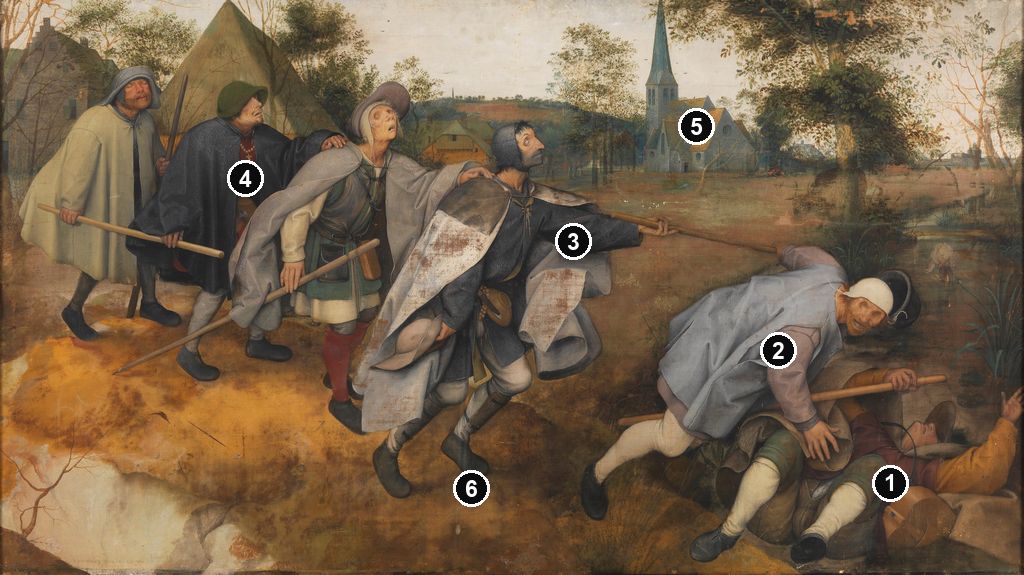
Details from THE BLIND LEADING THE BLIND
Six details show how the fall travels through the procession.
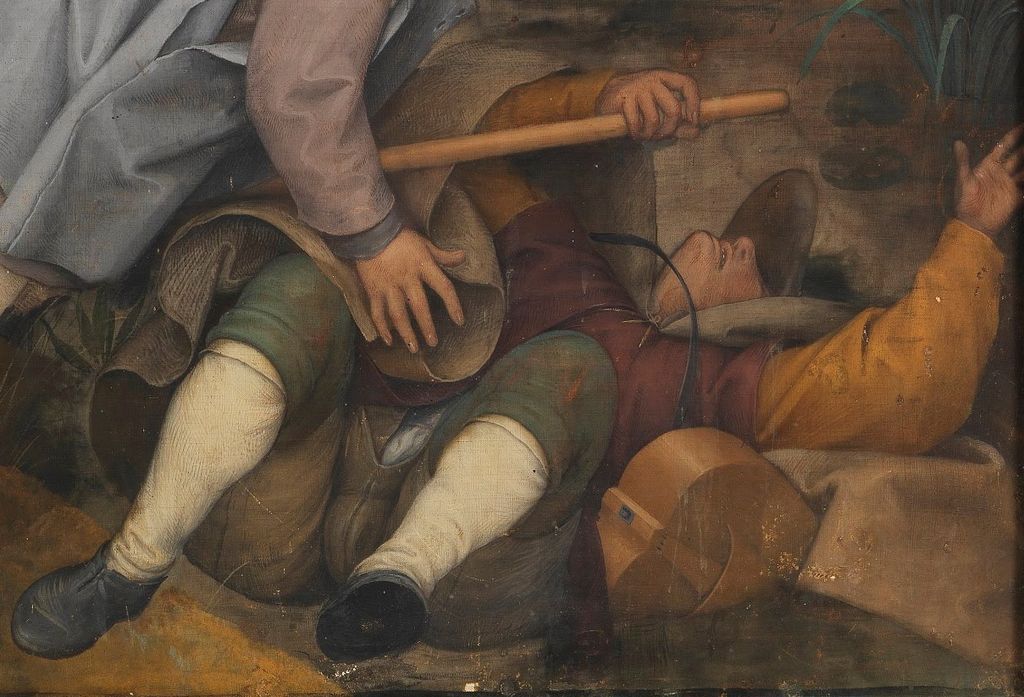
The leader in the ditch
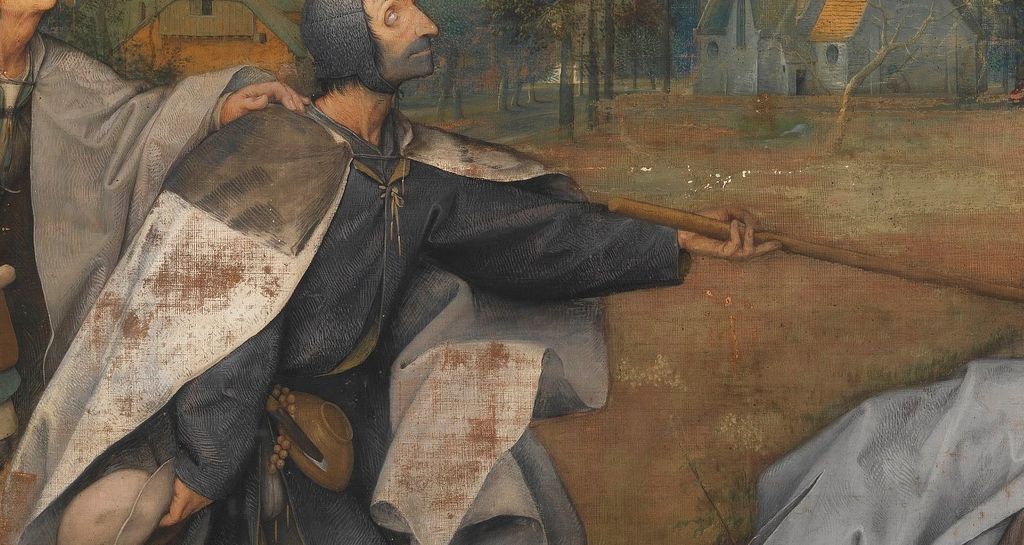
The leader lies back with his legs raised and his instrument beside him.
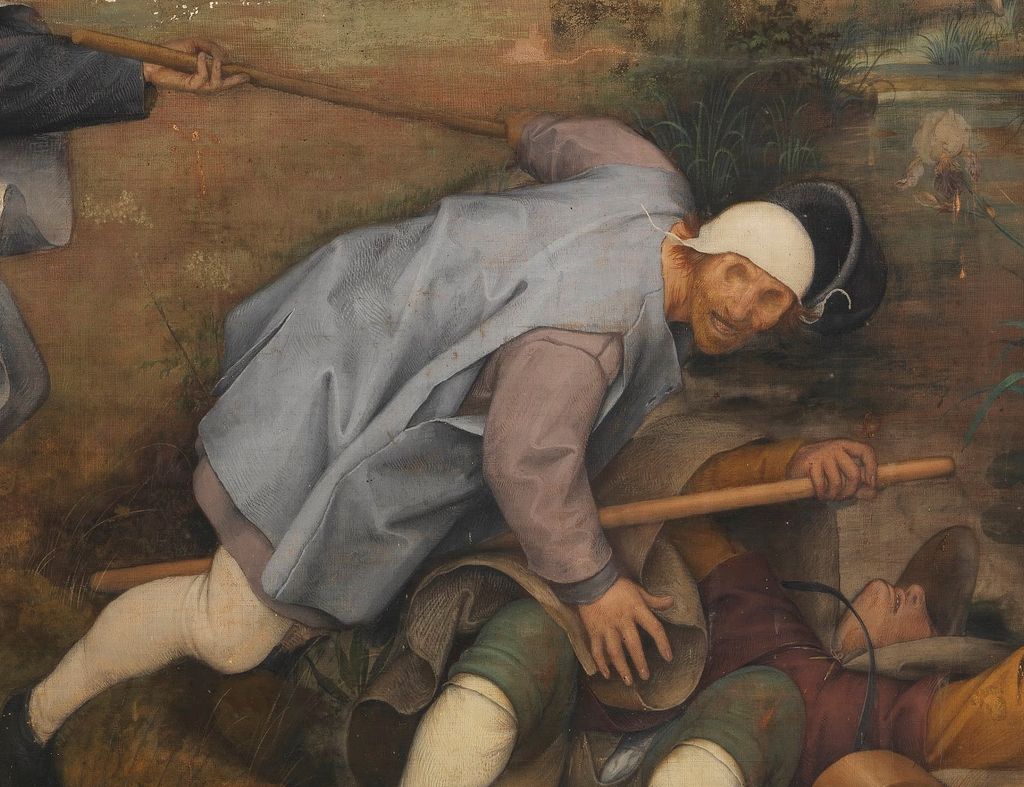
The man who loses his footing
The second man leans forward as his foot lifts behind him.
The staff at the centre
A horizontal staff connects the middle of the procession to the falling men.
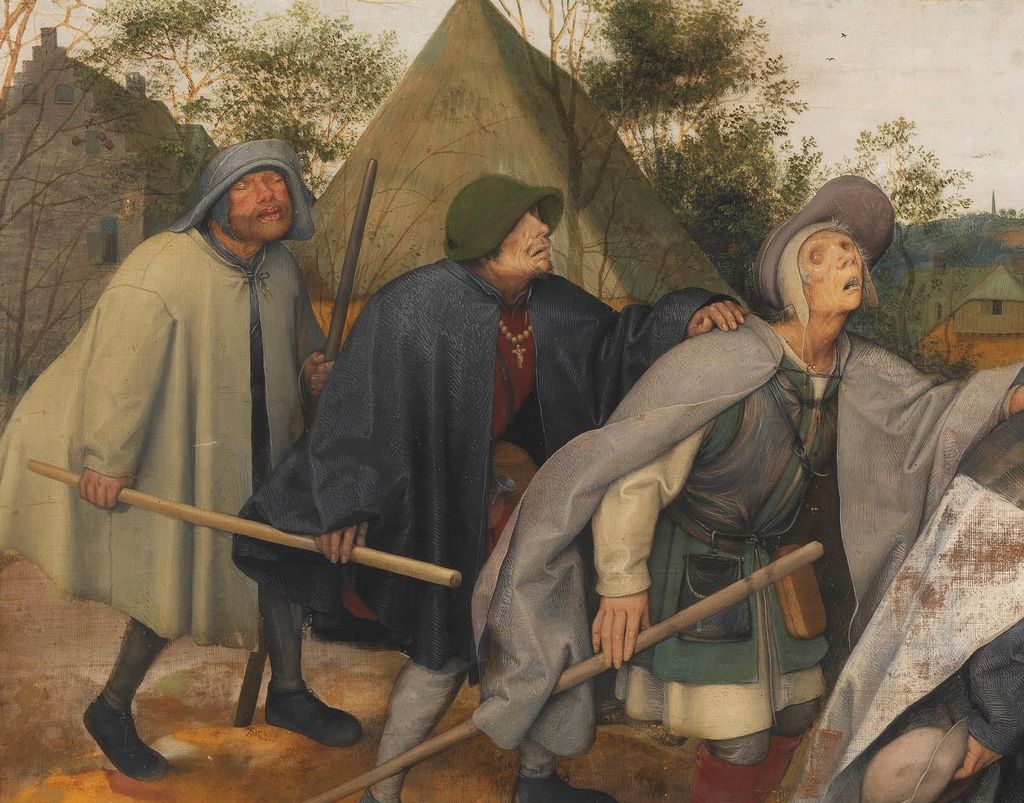
The group still upright
Hands, shoulders and staffs link the men still upright at the left.
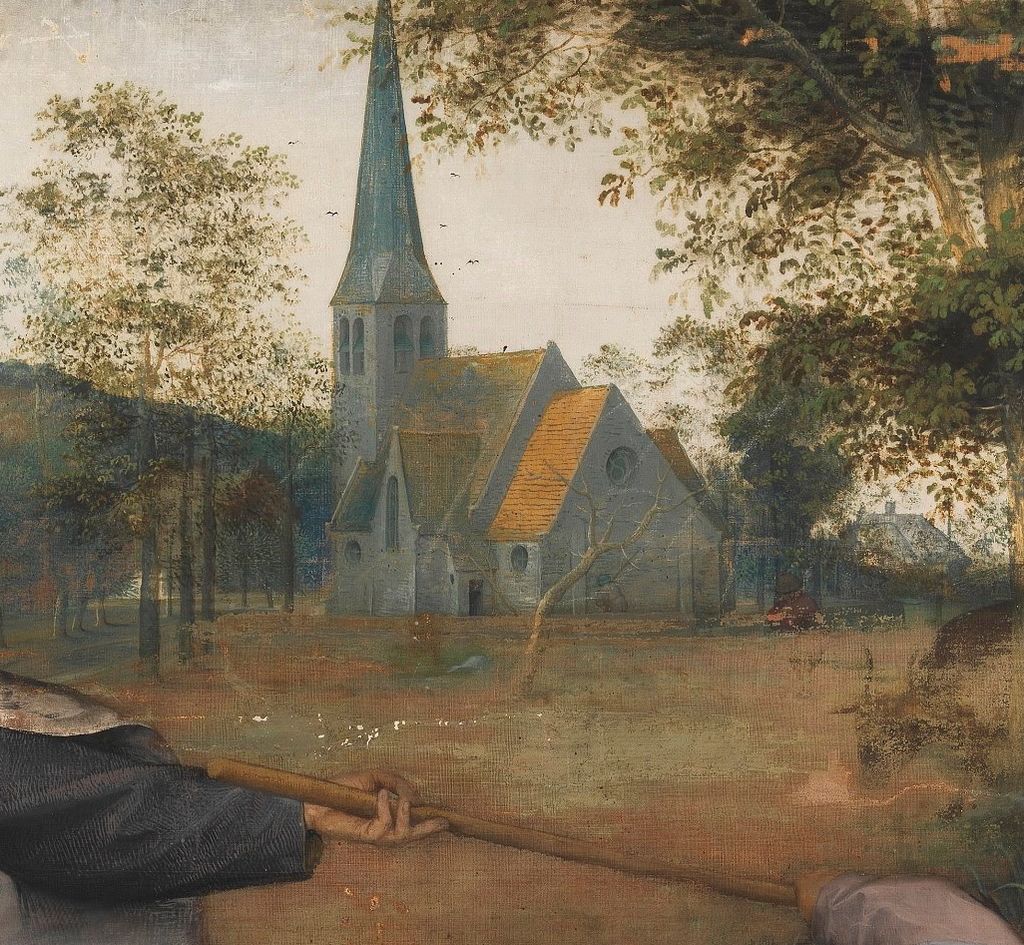
The church behind the path
The spire and roof stand above the open ground.
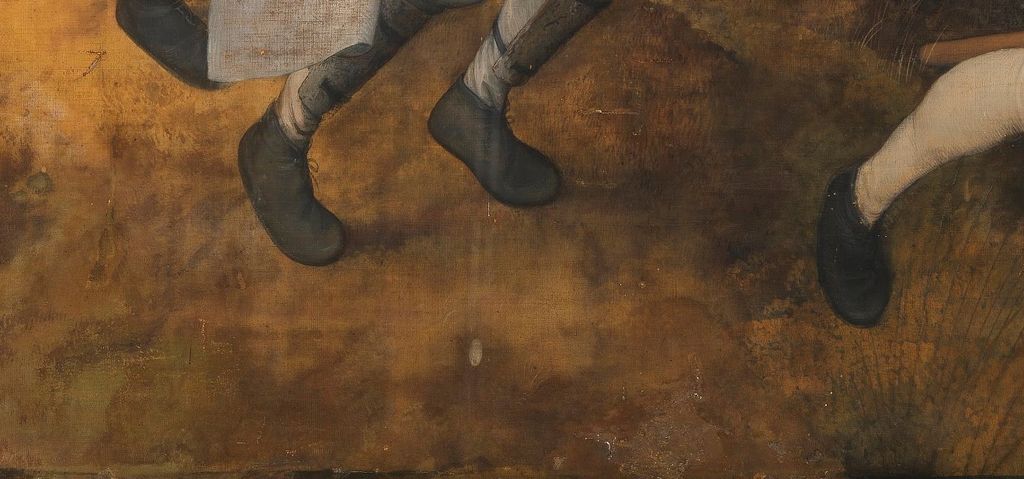
The bank at the front
The slope beneath the men darkens towards the ditch.
Pieter Bruegel the Elder, The Parable of the Blind, 1568. Museo e Real Bosco di Capodimonte, Q 1. Reproduction via Wikimedia Commons.
The Biblical Parable
The painting adapts a New Testament saying found in Matthew 15:14 and Luke 6:39. In both passages, blindness is used metaphorically to describe failed guidance. The warning is not about visual impairment as a medical condition. It is about authority, trust and the danger of following someone who cannot truly lead [1].
That distinction is important for modern viewers. Bruegel paints blind men with great physical specificity, but the biblical parable itself uses blindness as a moral metaphor. A careful reading must hold both facts at once. The figures are represented as people moving through a landscape, with bodies, faces, clothing and tools. At the same time, the picture turns their shared fall into an image of collective misdirection.
Bruegel does not write the lesson across the surface. He stages it. The first man has already lost his footing. The second is pitching forward. The third has not yet understood the danger. The others continue behind, still linked by staffs and by trust in the line ahead. The parable becomes suspense. We know what will happen before all the figures do.
This is one reason the painting remains so forceful. It does not show the aftermath of disaster. It shows the moment in which disaster is moving through a group. The viewer can read the future from the composition itself. The warning is therefore not static; it unfolds in time.
The Diagonal Fall
The most famous formal device in The Blind Leading the Blind is the slanted diagonal of the six figures. The GAC text notes that Bruegel conveys the coming fall by arranging the men along a downward diagonal [1]. The composition is simple in outline and extraordinarily subtle in effect.
At one end, the leader has gone down into the ditch. His body breaks the rhythm of walking and turns the whole line into a falling mechanism. The second man, pulled by his connection to the first, is beginning to lose balance. The men behind him still stand, but their bodies are already committed to the same direction. Each figure marks a different stage between walking and collapse.
This sequential structure makes the picture feel almost cinematic without losing its stillness. Bruegel paints one instant, yet he lets the viewer reconstruct several instants: the leader's misstep, the second man's alarm, the delayed recognition among those behind, and the fall that will soon carry the line down. The painting is not simply a row of men. It is time made visible through bodies.
The diagonal also gives the parable physical force. A horizontal line might have looked like procession. A vertical stack would have seemed emblematic. Bruegel's sloping chain converts trust into momentum. The men are not merely near one another; they are bound together by movement, dependency and consequence.
The calm landscape makes that movement sharper. Behind the line are low buildings, trees, open ground and a church. The world does not tilt with the figures. It remains steady while they fall. That contrast makes the human chain feel both fragile and exposed. The disaster is not caused by storm, battle or monstrous intervention. It comes from misdirected human movement inside an ordinary place.
Sint-Anna-Pede And The Landscape
The GAC page says the landscape represents the village of Sint-Anna-Pede near Brussels, and Getty CONA notes that the background perhaps depicts the village and its church [1] [4]. This setting gives the painting a local gravity. Bruegel is not placing the parable in an abstract biblical desert. He moves it into a Netherlandish countryside recognizable in relation to his own world.
That move is typical of Bruegel. Across his art, biblical and moral subjects often unfold in northern landscapes, towns or villages. The strategy does not make the subject less serious. It makes it more immediate. A biblical saying becomes something that can happen on a path near a church, beside water, under a familiar sky.
The church in the background is especially important, but it should be handled with caution. It is tempting to make the building unlock the whole picture as a narrowly anti-clerical or confessional statement. Capodimonte's focus text notes that critics have interpreted the parable as an accusation against corrupt clergy or as a warning against heretics, but it also says Bruegel does not openly side with either confession and remains deliberately ambiguous [2].
That ambiguity is valuable. The church belongs to the visual field. It strengthens the religious context of a New Testament parable. Yet Bruegel does not give the viewer a simple label saying who is right, who is wrong, or which contemporary group the blind men represent. The painting's warning is broader and more durable because it does not collapse into one polemical target.
The landscape also slows the eye. If the figures alone are urgent, the setting is patient. The path, ditch, buildings and trees let the viewer see the fall as part of a larger world. Bruegel's late allegory is therefore not only a moral emblem. It is also a landscape painting in which place and parable are inseparable.
Blindness, Bodily Specificity And Respectful Looking
The painting needs careful language because blindness is both the literal condition of the figures and the metaphorical language of the parable. Bruegel gives the men individual faces, postures and forms of visual impairment. The GAC text says the five standing men turn their faces upward because they rely on hearing, and that each man is depicted with a distinct form of blindness [1].
Medical writers have long been interested in this specificity. Karcioglu's ophthalmology article, indexed by PubMed, focuses largely on Bruegel's The Parable of the Blind Leading the Blind because it depicts six blind men who appear to have different causes of blindness [5]. That kind of study can help modern viewers notice how precise Bruegel's observation is. It can also become misleading if treated as the main meaning of the painting.
The safest approach is to describe visible facts and avoid turning the men into specimens. Their eyes, heads, hands, staffs, feet and garments are part of the picture's intelligence. Bruegel differentiates them rather than repeating one generic type. But the figures are not present simply so that viewers can diagnose them. They carry a parable through their bodies.
This difference affects tone. The painting is severe, but it should not be discussed with mockery. The fall is not funny because disabled people are falling. The force of the image lies in failed guidance, misplaced trust and collective vulnerability. Bruegel's realism makes the parable harder to dismiss. These are not abstract symbols floating in a moral diagram; they are human beings on uneven ground.
The faces turned upward are central to that effect. They show attention without sight. The men are listening, feeling the path, holding staffs, following the pressure of those ahead. Bruegel makes guidance a bodily system. When the first point of guidance fails, the whole system fails.
For students and museum visitors, the best first question is not "What disease does this figure have?" but "How does Bruegel show dependence, uncertainty and movement?" The medical observations may come later, with caution. The painting's power begins with the human chain.
Humanist, Proverb And Allegory Context
There are earlier pictures of blind travellers holding staffs or sharing a guide. Jürgen Müller draws attention to a British Museum sheet attributed to Hans Weiditz, where a pilgrim can be recognised from his equipment. This comparison shows the force of Bruegel’s decision to extend the group to six people. A viewer can follow the information about the fall from one end of the line to the other. The connection is physical: hands, shoulders and staffs make a disturbance at one point consequential somewhere else [6].
Pieter van der Heyden’s engraving of the parable provides another comparison. It circulated with an inscription crediting Bosch as inventor. The authorship implied by that inscription and the relationship of the design to Bosch’s imagery are separate questions, as Müller explains. Place the 1568 Naples painting beside such material to see the weight Bruegel gives to the terrain, the free space around the figures and the church beyond them. The differences are visible before a viewer chooses between competing interpretations of the church [6] [1].
Bruegel's painting belongs to a culture in which proverbs, parables and visual wit mattered deeply. The GAC text even points to a verbal and visual pun: within the illustrated parable, the downward movement of the figures suggests a parabola, the mathematical term for an arch-shaped curve [1]. Whether every modern viewer catches that immediately is less important than the broader point: Bruegel's late allegory was made for viewers who enjoyed layered meaning.
That context connects the painting to Bruegel's wider proverbs and iconography. His art repeatedly turns familiar speech into visible behavior. In Netherlandish Proverbs, painted in 1559, a village becomes a theatre of sayings. People perform errors, reversals, self-deceptions and comic acts of common wisdom. The Blind Leading the Blind takes one such proverb-like parable and gives it a larger, more concentrated form.
Capodimonte's focus text says the New Testament parable was widespread through contemporary prints and had already appeared in Bruegel's Netherlandish Proverbs [2]. That is a useful way to understand the Naples picture. It is not isolated from Bruegel's earlier crowded world of sayings. It is as if one motif from that world has been enlarged, slowed down and made tragic.
The comparison also reveals a change in scale and mood. Netherlandish Proverbs disperses folly across a whole community. The Blind Leading the Blind reduces the field to six men and one line of movement. The earlier painting encourages scanning. The later picture compels following. It narrows the viewer's attention until the moral sequence feels unavoidable.
This narrowing is one of Bruegel's late strengths. He does not need a town full of incidents to make a world. Six figures, a ditch, a church and a landscape are enough.
Relationship To The Misanthrope And Late Bruegel
Capodimonte owns both The Blind Leading the Blind and The Misanthrope, and Google Arts and Culture describes them as masterpieces painted in the penultimate year of Bruegel's life. It also says both recreate allegories seen in the 1559 Netherlandish Proverbs [1].
That relationship is revealing. Bruegel's late allegories often feel more compressed than his great crowd paintings. They still belong to the world of proverb, satire and moral reflection, but their scale of action is smaller and their emotional pressure is stronger. Instead of asking the viewer to range across dozens of details, they ask the viewer to stay with one sharply structured situation.
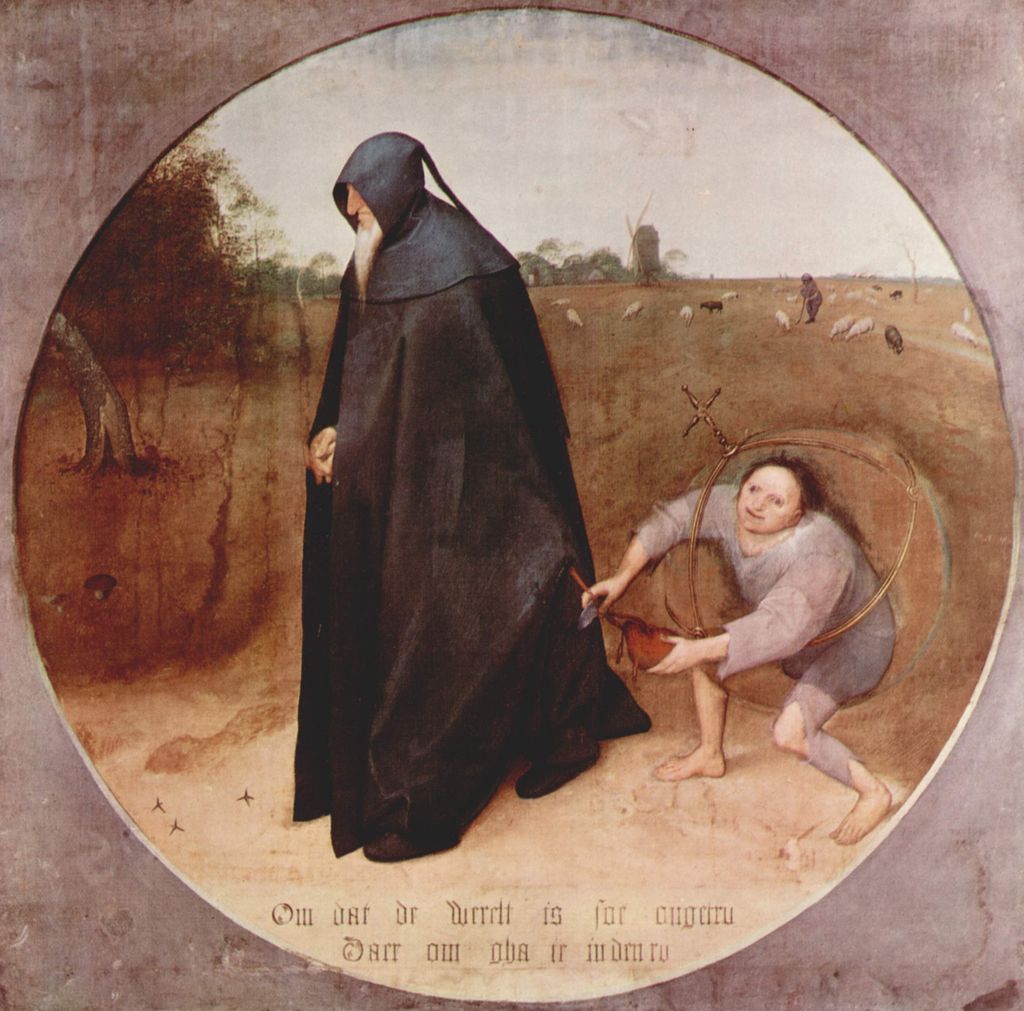
In The Misanthrope, the moral problem turns around withdrawal, deception and the figure who tries to separate himself from the world but remains caught in it. In The Blind Leading the Blind, the problem is not withdrawal but following. Both paintings are built from proverb-like ideas, and both use a landscape setting to make allegory feel physically real.
Seen beside Bruegel's broader paintings, the Naples work shows how much he could do with restraint. There is no enormous battle, no village packed with dozens of proverbs, no seasonal panorama full of tiny labors. The picture's drama comes from alignment, timing and implication. Its economy is part of its greatness.
The late date also matters for how we place the work in Bruegel's career. By 1568, he had already developed his major languages of landscape, peasant imagery, crowd composition, proverb and moral allegory. The Blind Leading the Blind does not abandon those languages. It distills them.
How To Look At The Painting
Begin with the whole diagonal. Follow the men from the left side of the line toward the fallen leader, or reverse the path and move from the ditch back through the figures still standing. Either direction teaches something. Moving toward the ditch gives the image its narrative pull. Moving away from it shows how danger travels backward through a chain of trust.
Next, look at the staffs. They connect the figures physically and visually. The men use them as aids, but the staffs also become lines of dependence. A hand on a staff, a hand near another body, a tilted shoulder or an uncertain foot all become part of Bruegel's grammar of guidance.
Then study the heads. Several faces turn upward. The gesture could be read as listening, searching or exposure. It also changes the emotional register of the picture. These are not anonymous bodies tumbling mechanically. Each man occupies his own moment of awareness or unawareness.
After that, compare the figures with the landscape. The ground is ordinary; the fall is extraordinary. The church, trees and buildings stand with quiet clarity behind the tilting procession. Bruegel lets the parable happen in a world that looks stable enough to trust. That is part of the warning.
Finally, return to the biblical sentence. The painting is not an illustration after the fact. It is a visual interpretation. Bruegel takes the proverb-like compression of the verse and stretches it into a sequence of linked bodies. By the end, the viewer does not merely know the saying. The viewer has watched it become inevitable.
Why The Painting Still Matters
The Blind Leading the Blind remains powerful because it is both immediately legible and morally unsettled. Anyone can understand the danger of following a leader who has lost the way. Yet the painting does not tell us exactly where to stand outside that danger. It asks whether misdirection is something only other people suffer, or whether it is a shared human risk.
The picture is also a masterpiece of timing. Bruegel could have painted the group already fallen. Instead, he gives us a moment of transition. Some bodies know the disaster; others do not. The viewer knows more than the figures behind the leader, but not enough to prevent what is coming. That painful knowledge gives the painting its tension.
Its realism still matters too. Bruegel's attention to faces and forms of blindness has drawn medical interest for good reason [5]. But the realism serves a larger humane and allegorical purpose. The men are particular enough to resist becoming empty symbols, and symbolic enough to carry a warning far beyond their own path.
The painting also shows why Bruegel is central to the history of visual thought. He turns a short saying into composition, movement, landscape and social relation. He makes the eye follow consequence. He lets a biblical parable become local, physical and unforgettable.
For modern viewers, the work is best approached with patience and respect. It is not a joke at the expense of blindness. It is a severe picture about guidance, dependence and human vulnerability. Its greatness lies in the way Bruegel makes those ideas visible without flattening them into a slogan.
In the end, The Blind Leading the Blind is one of Bruegel's most economical achievements. Six figures fall through a landscape, and a whole moral world opens beneath them.
Discussion
What feels most revealing about Pieter Bruegel the Elder: the village detail, the landscape setting, the moral wit, or the way everyday life becomes a complete world?
Reader Insights
Begin with one small action in a Bruegel scene, then follow how it connects to the surrounding figures, setting and rhythm of the whole image.
Connect the work to Northern Renaissance visual culture, printmaking, proverb traditions and Bruegel's interest in rural and urban life.
Which detail changes the interpretation most once you know the subject, date, proverb source or present collection?
Join the Conversation
Have a thought or observation about Pieter Bruegel the Elder? Share it below. Thoughtful responses may be added to this section as the Bruegel pages develop.
Frequently Asked Questions
Pieter Bruegel the Elder's The Blind Leading the Blind is one of his most concentrated late allegories. Dated 1568 and held by the Museo e Real Bosco di Capodimonte in Naples, the painting shows six blind men moving together at the instant when the leader has stumbled into a ditch and the whole group is about to follow . [1]
Google Arts and Culture's Capodimonte partner page identifies the work as The Blind Leading the Blind , by Pieter Bruegel the Elder, dated 1568, in tempera on canvas, and held by the Museo e Real Bosco di Capodimonte . Getty's Cultural Objects Names Authority identifies the work as a movable painting, gives the preferred Italian title as La parabola dei ciechi , lists the creator as Pieter Bruegel the Elder, gives the creation date as 1568, and describes the material as distemper on linen canvas . [1][4]
The painting adapts a New Testament saying found in Matthew 15:14 and Luke 6:39. In both passages, blindness is used metaphorically to describe failed guidance. [1]
The most famous formal device in The Blind Leading the Blind is the slanted diagonal of the six figures. The GAC text notes that Bruegel conveys the coming fall by arranging the men along a downward diagonal . [1]
References
- Google Arts and Culture / Museo e Real Bosco di Capodimonte, The Blind Leading the Blind, View source.
- Museo e Real Bosco di Capodimonte, L'Opera si racconta: La parabola dei ciechi di Bruegel. Poema per Orchestra, View source.
- Museo e Real Bosco di Capodimonte, Collezione Farnese, View source.
- Getty Research Institute, Cultural Objects Names Authority, La parabola dei ciechi, View source.
- Zeynel A. Karcioglu, Ocular pathology in The Parable of the Blind Leading the Blind and other paintings by Pieter Bruegel, Survey of Ophthalmology 47, no. 1, 2002, View source.
- Jürgen Müller, Of Churches, Heretics, and Other Guides of the Blind: The Fall of the Blind by Pieter Bruegel the Elder and the Aesthetics of Subversion, 2014, View source.









