


 by Tom Gurney
Tom Gurney BSc (Hons) is an art history expert with over 20 years experience
Published on June 19, 2020 / Updated on October 14, 2023
Email: tomgurney1@gmail.com / Phone: +44 7429 011000
The Misanthrope: Introduction
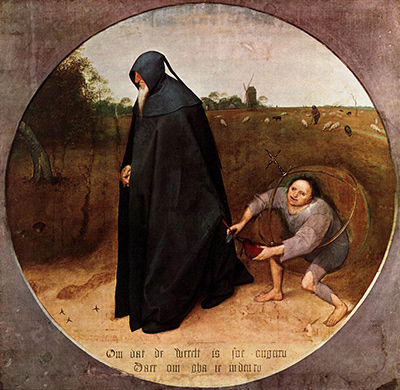
Pieter Bruegel the Elder’s The Misanthrope is a painting dated 1568 in the Museo e Real Bosco di Capodimonte, Naples. A black-cloaked man walks across a bare foreground while a figure inside a globe reaches for his purse. Behind them, a shepherd and scattered animals occupy an open field. A Flemish inscription below the figures explains the walker’s mourning as a response to the faithlessness of the world. The picture gives us enough room to see the world around him and enough detail to see what his lowered gaze misses [1] [2].
This work across Bruegel’s career
Tower of Babel
1563The Harvesters
1565Peasant Wedding
1568Children's Games
1560Triumph of Death
1562–1563The Misanthrope
This artworkContents
- Introduction
- The Man in Black
- A Purse inside a Globe
- Beyond the Two Men
- The Inscription and the Paint
- Annotated Details
The Man in Black
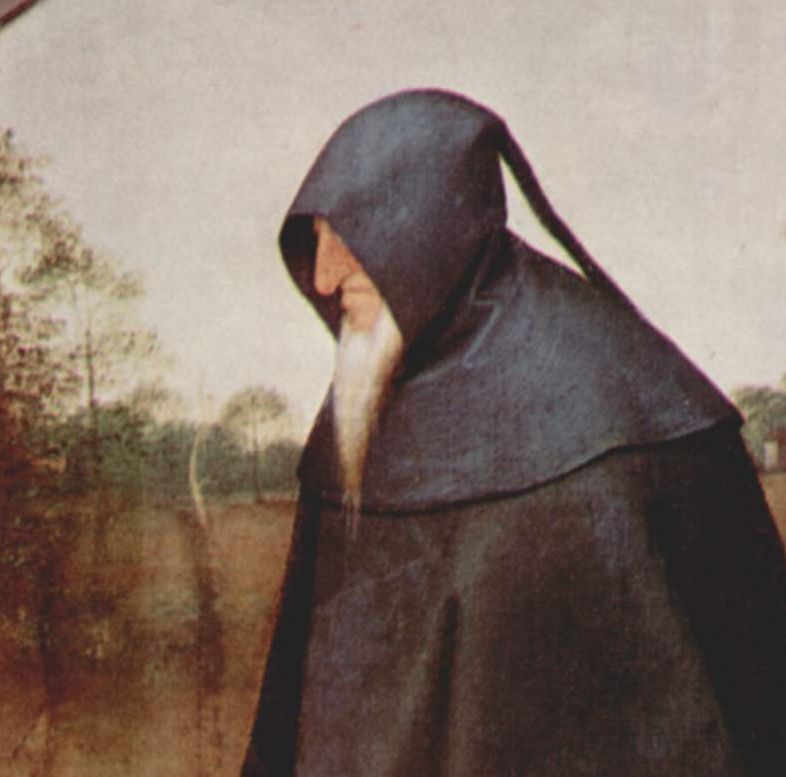
Find the small area of skin under the hood. The rim casts the upper part of the face into shadow, leaving a nostril, mouth and beard easier to pick out. The white beard gives the eye a route down into the cloak, where broad, dark folds occupy nearly the whole height of the foreground figure. At the left one hand emerges. The rest of the body is largely given over to cloth. Bruegel makes the man’s withdrawal visible through the few openings where the head and hand can still be seen [1].
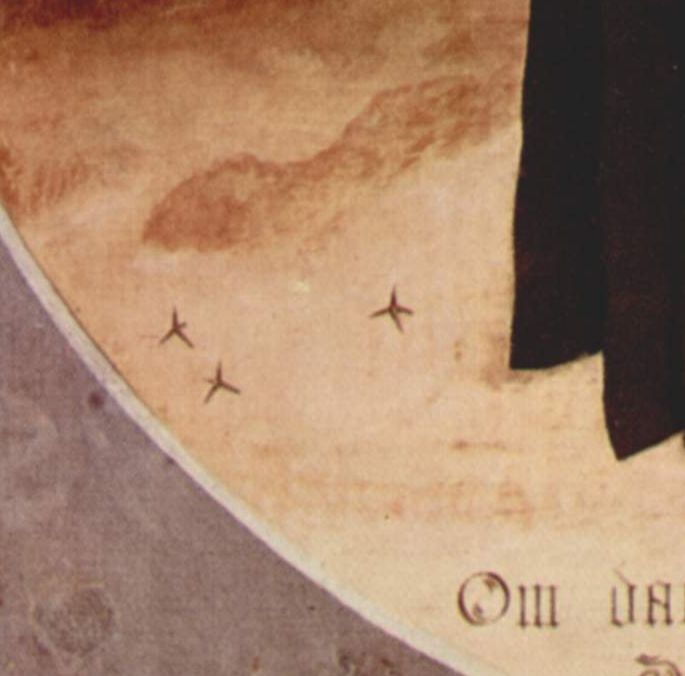
The man is moving towards the left. The angle of his head and the forward line of his cloak carry that direction without a clear view of either stride. A separate set of small shapes lies on the ground directly ahead of him. Capodimonte describes them as thorns or spikes. They give the walker a practical reason to attend to the path. Because his face is turned down but his eyes are hard to see, the viewer is left to decide just how much of the ground he has registered [1].
The dark clothing reads easily against the pale strip of earth. The hood and the upper line of the shoulder are similarly clear against the sky. The most substantial figure in the composition is also the most difficult person to read. A viewer can recover his outline from nearly anywhere in the circle, but has to concentrate on a narrow piece of the hood to see his expression. That disparity puts the size of the man and the narrowness of his attention into the same figure.
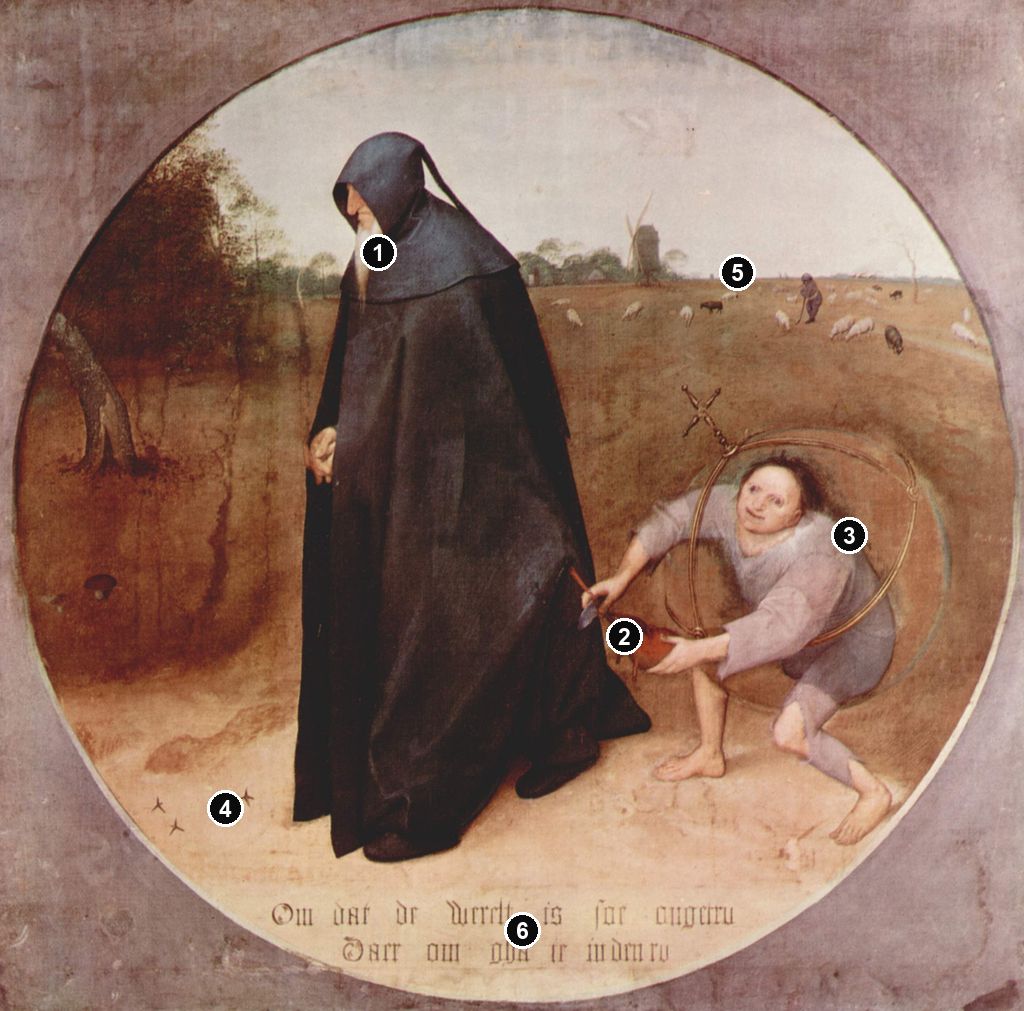
Annotated Details from The Misanthrope
Find the purse at the edge of the cloak, then look at the landscape behind the two men.
Details from THE MISANTHROPE
Six details trace the theft, the roundel and its inscription.
The face under the hood
The hood and beard make the lowered face easy to locate.
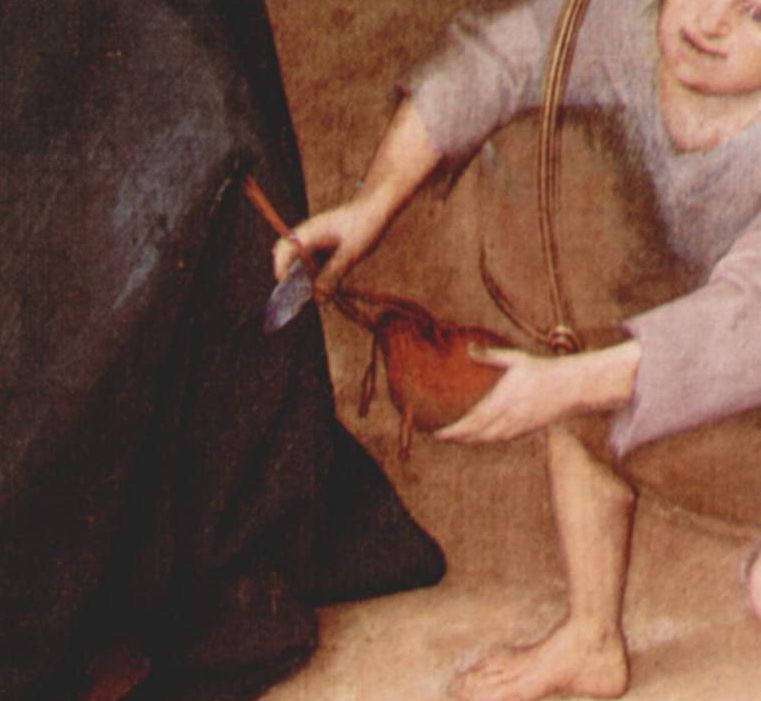
The purse at the hem
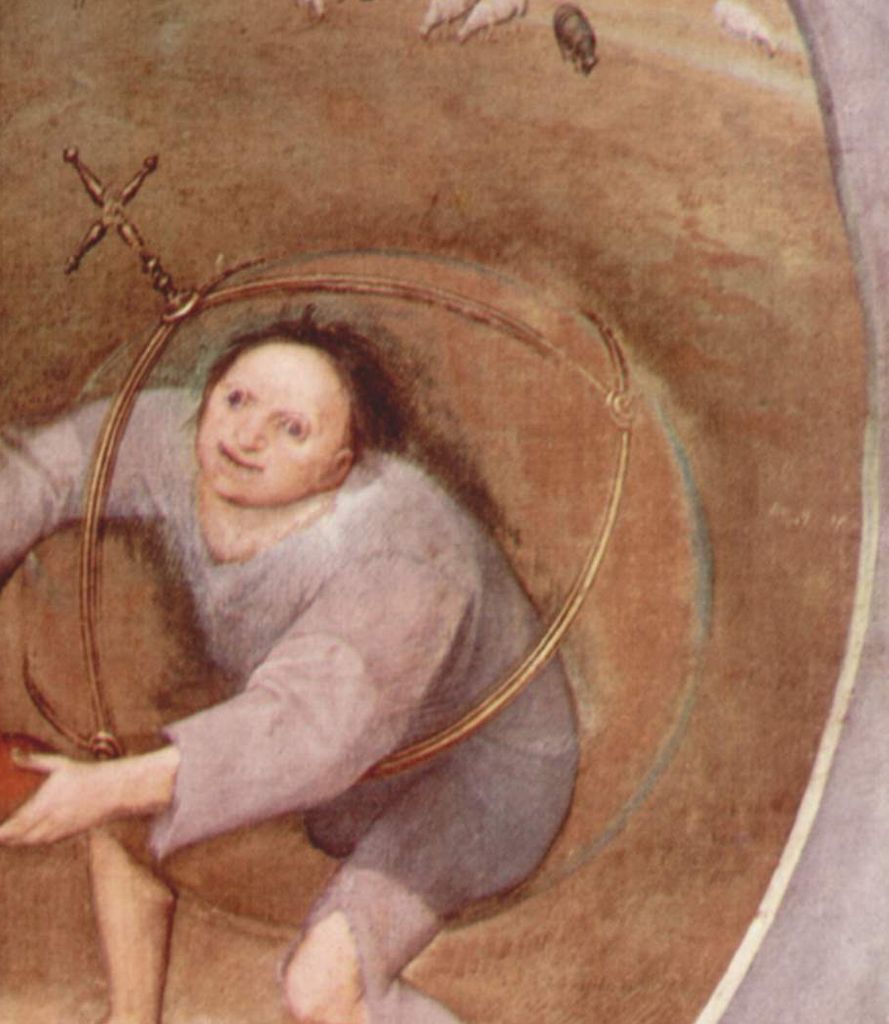
The smaller figure reaches for the purse below the dark cloak.
The globe and cross
The cross tops the curved outline around the figure.
The path below the cloak
Small pointed objects lie on the pale path.
The field and windmill
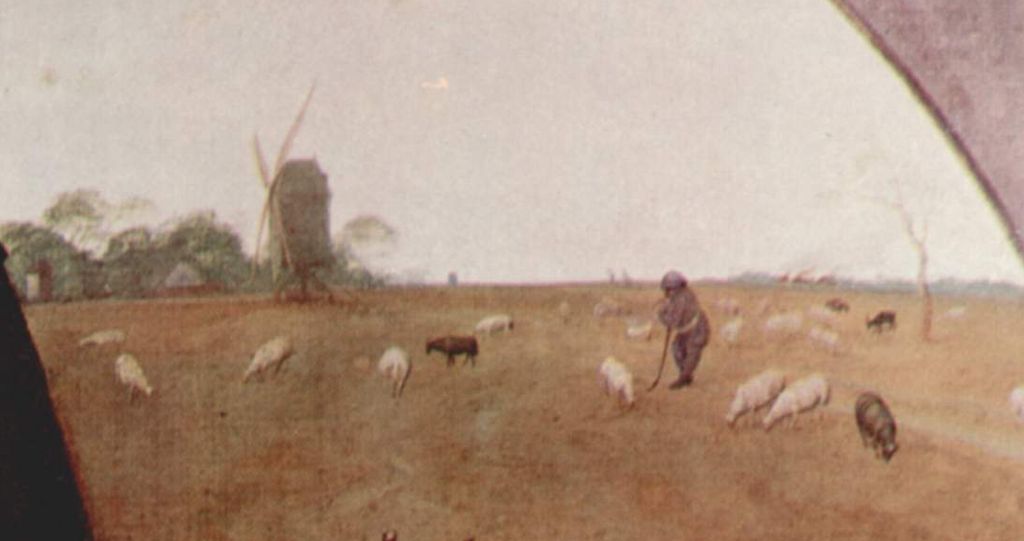
The distant figure and animals stand beneath the horizon.
The Flemish inscription
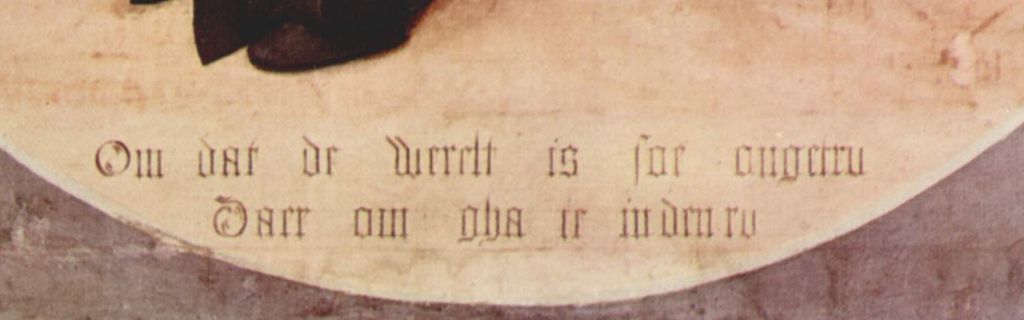
Two lines of lettering run beneath the figures.
Pieter Bruegel the Elder, The Misanthrope, 1568. Museo e Real Bosco di Capodimonte, Q 1930 no. 16. Italian national catalogue. Reproduction via Wikimedia Commons.
A Purse inside a Globe
The figure at the right is crouching with both arms extended. One hand reaches up to the cord at the cloak and the other supports a red pouch. A pale sleeve carries the action out of the globe and into the black area of the central figure. Start where the pouch meets the cloth, then follow the smaller man’s head and shoulders around the curve. The theft is a small movement close to the walker’s side, so the broad shape of the cloak almost hides it [1].
The globe brings the smaller figure forward while giving him an outline of his own. The curved edge is visible against the field, and the little cross at the top helps to distinguish the object from a mere loop of line. The thief has room to reach out with his arms and set his feet on the ground, even though much of his body is enclosed by the curved form. Taken with the inscription about the world, it makes the episode read as more than an encounter between strangers. The walker has turned away, yet the world reaches him at the hem of his cloak [1] [2].
The small figure’s face is open to the light, whereas the larger figure covers much of his own. One can look from their differences in visibility to their differences in movement. Every arm and leg needed for the theft has a clear place in the composition. The walker’s movement is mostly communicated through the tilt and shape of the black mass. Part of the irony is available before a viewer knows how to read the words at the bottom.
Beyond the Two Men
Follow the pale earth back into the field at the right. Several animals are visible as spots around a standing figure, and farther back a windmill rises on the horizon. The strongest gestures happen in the foreground. In the distance, it takes much less detail to show that the field is occupied. That difference makes the scale of the story clear. The removal of the purse needs a close view, while much of the world in which it happens can be seen in a patch of open country.
The landscape also helps a viewer tell one circular shape from the other. The thief’s globe is set against the field and the sky sits above it. The large circle of the painted scene holds both terrain and figures. It cuts off part of the path and foliage at the margins. The difference in size is emphatic enough for the two circles to be read separately, then brought together as an echo. Capodimonte likewise draws attention to the link between the enclosing form and the object around the thief [1].
The Inscription and the Paint
The two lines beneath the men give the walker something like a voice. In translation, he says that he goes in mourning because the world is faithless. The museum dates that Flemish inscription later than the execution of the picture. It is therefore evidence for a reading attached to the painting, while the signed date belongs to the work’s production. The museum proposes Timon of Athens as a possible identity for the man. The costume and gesture also allow viewers to follow the story without first identifying a classical figure [1] [2] [3].
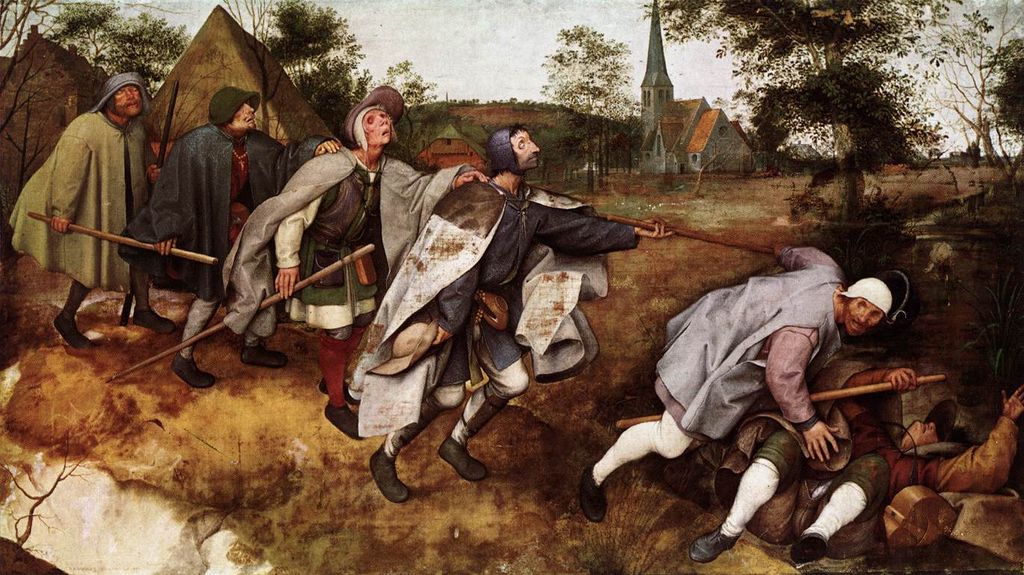
The painted circle belongs to a canvas measuring 86 by 85 centimetres, recorded as Q 1930 no. 16 in the Capodimonte inventory. Conservation research places the work alongside the same museum’s Parable of the Blind as an example of Bruegel’s glue-tempera on canvas. The fabric is part of what can still be seen, particularly in paler areas. Paint and support help explain the soft surfaces around the much darker cloak and show why a comparison with Bruegel’s oak panels begins with the materials [1] [4].
Look once more from the letters to the purse. The mourning clothes give the statement a visible form. The hand at the hem gives the complaint an immediate occasion. The path, animals and shepherd extend the scene beyond what either man does. Bruegel leaves these things within view, so that the figure who most emphatically turns away is also the figure around whom so much remains to be seen.
Discussion
Which detail in this work most changes how you read it?
Frequently Asked Questions
Find the small area of skin under the hood. The rim casts the upper part of the face into shadow, leaving a nostril, mouth and beard easier to pick out. [1]
The figure at the right is crouching with both arms extended. One hand reaches up to the cord at the cloak and the other supports a red pouch. [1]
The landscape also helps a viewer tell one circular shape from the other. The thief’s globe is set against the field and the sky sits above it. [1]
References
- Museo e Real Bosco di Capodimonte, The Misanthrope, collection interpretation, View source.
- Italian Ministry of Culture, Misantropo, record 1500625679, View source.
- Pieter Bruegel Complete Catalog, The Misanthropist, signature and inscription, View source.
- Angela Cerasuolo, The Parable of the Blind and The Misanthrope, in Bruegel. The Hand of the Master, Essays in Context, pp. 64–81, View source.









