


 by Tom Gurney
Tom Gurney BSc (Hons) is an art history expert with over 20 years experience
Published on June 19, 2020 / Updated on October 14, 2023
Email: tomgurney1@gmail.com / Phone: +44 7429 011000
The Peasant and the Nest Robber: Introduction
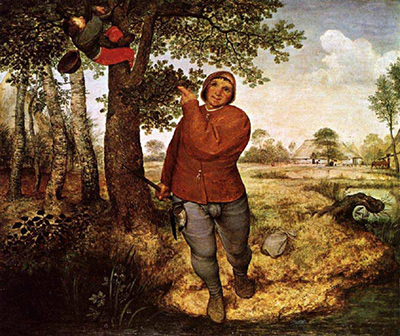
Pieter Bruegel the Elder’s The Peasant and the Nest Robber, also called The Birdnester, is a signed and dated oak-panel painting of 1568 in the Kunsthistorisches Museum. A man at the front points over his shoulder towards a climber, who grips a tree at the upper left. The man’s finger makes the climber easy to find, even though branches and leaves surround him. At the same time, the path beneath the nearer man ends at a dark stretch of water. The painting makes one danger conspicuous and puts the other where the person pointing has yet to look [1] [2].
This work across Bruegel’s career
Tower of Babel
1563The Harvesters
1565Peasant Wedding
1568Children's Games
1560Triumph of Death
1562–1563Peasant and the Nest Robber
This artworkContents
- Introduction
- Start with the Pointing Hand
- Look Up to the Climber
- A Proverb and a Second Reading
- The Scale of the Panel
- Annotated Details
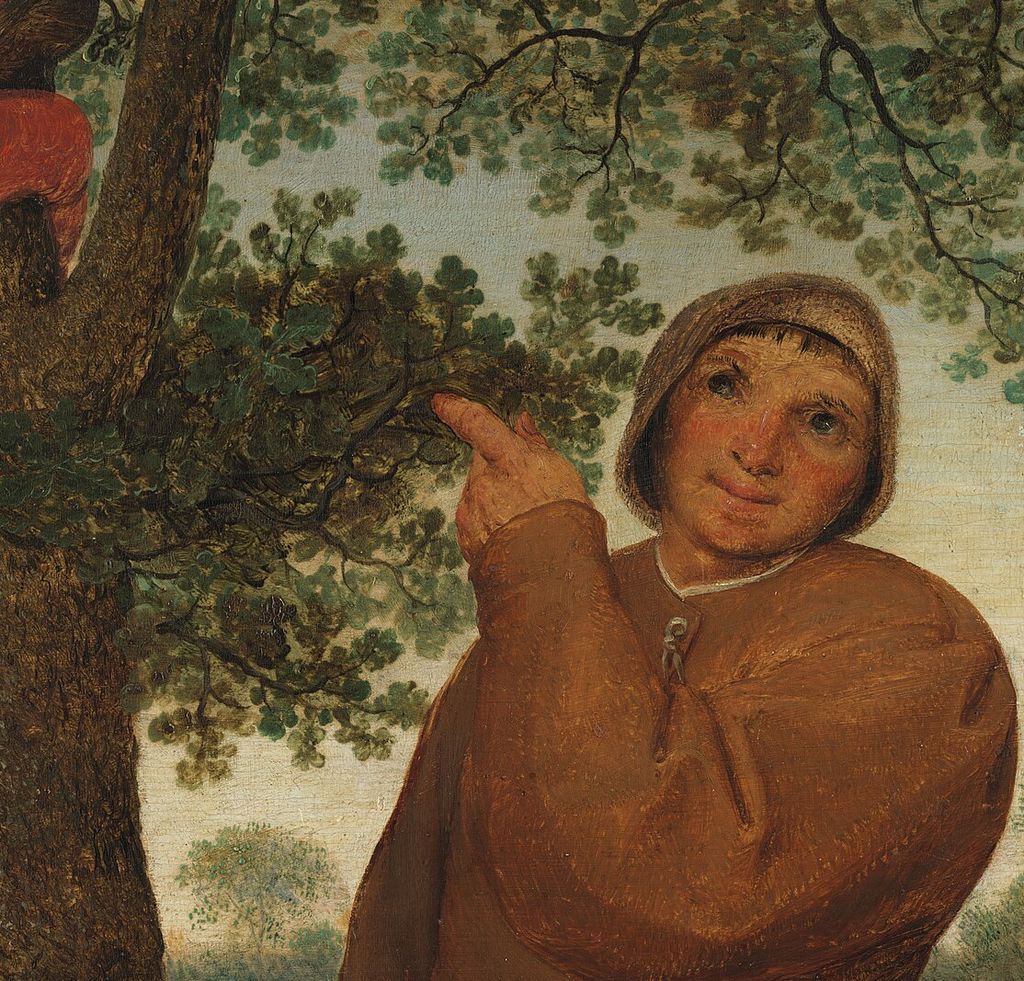
Start with the Pointing Hand
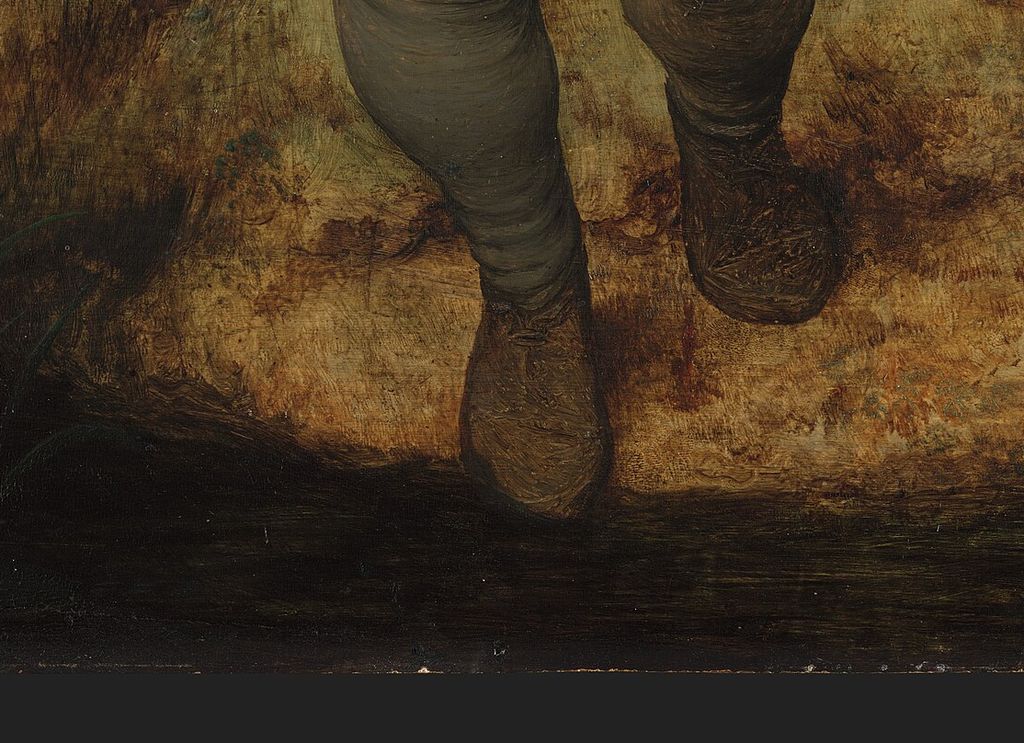
The nearer figure occupies the middle of the panel. The curve of his raised arm leads to a finger directed into the foliage. His face turns out towards the viewer, and the gesture works almost as an invitation to look past him. The largest figure in the painting therefore directs us to a much smaller one. His body, however, continues down past the gesture to a pair of feet that bring him very close to the edge of the bank. Bruegel lets the face, hand and feet tell different parts of the story.
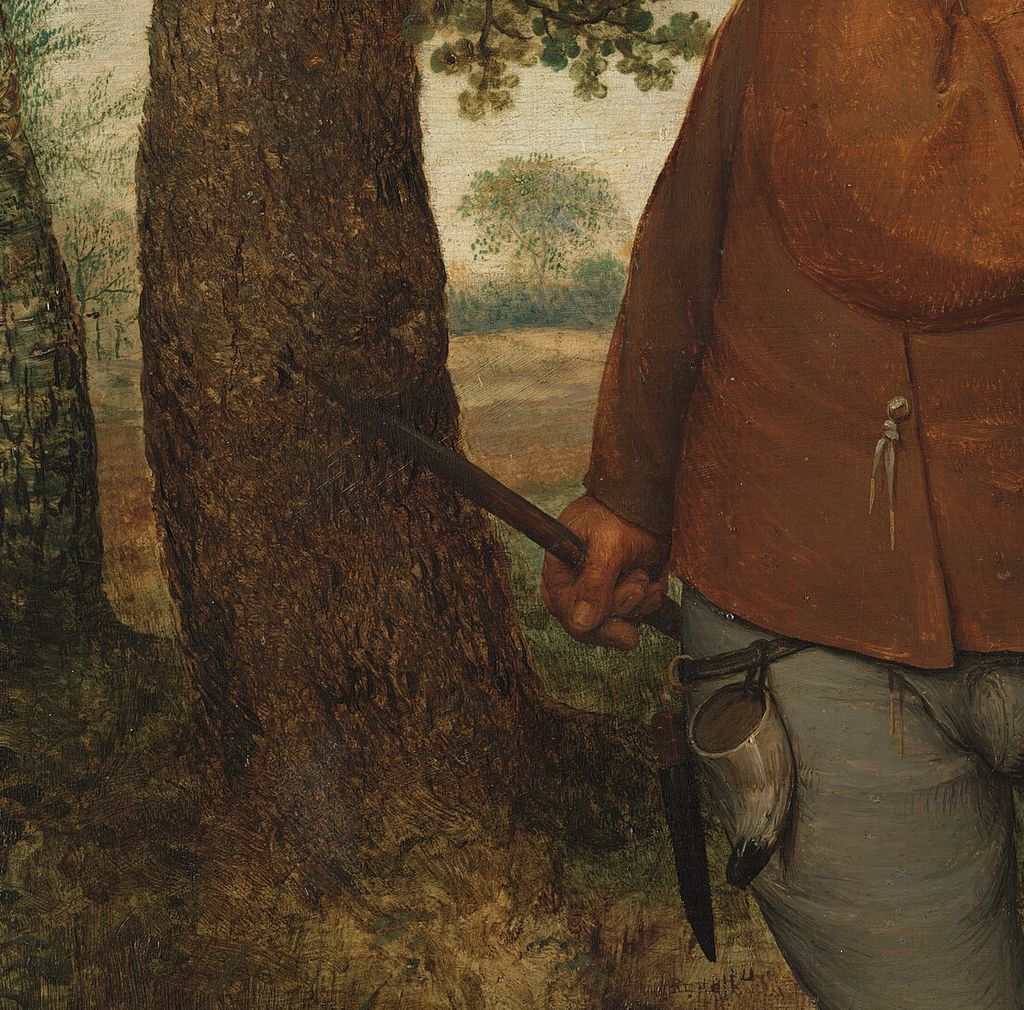
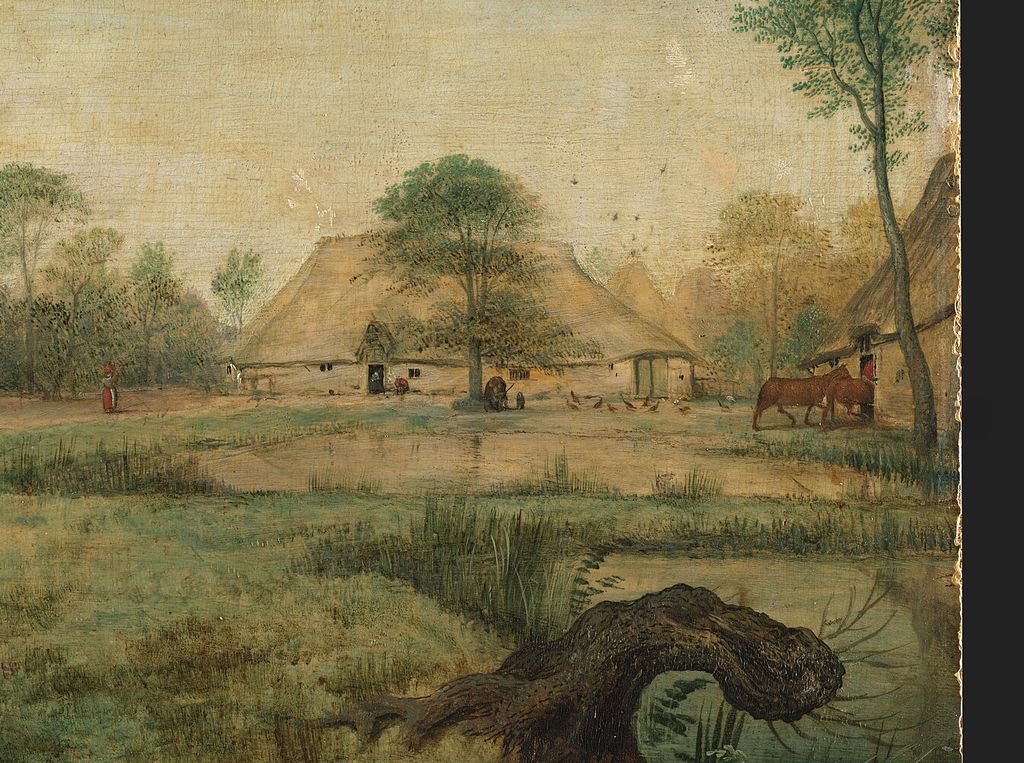
The man’s other hand grips a stick, held low at an angle towards the tree. Its direction connects him with the trunk again, while his boots carry the eye farther down the picture. The lower part of his jacket widens across the open field in the distance. Beyond his body there are roofs, a field and small signs of activity. They provide a sense of the distance implied by this landscape, but the figure appears close enough that the viewer can see his fingers and imagine his next step.
Notice the uneven strip of ochre ground under him. Its far edge curves away towards the right, following the dark water. The front foot extends towards the narrow part of the bank at the bottom. Margaret A. Sullivan reads this as the instant before he steps into the water. The painting makes the danger visible without showing him fall. The gap between what the man points to and where he is walking gives his gesture a different force on a second look [2].
Annotated Details from The Peasant and the Nest Robber
Follow the finger up to the climber, then look down at the ground in front of the peasant.
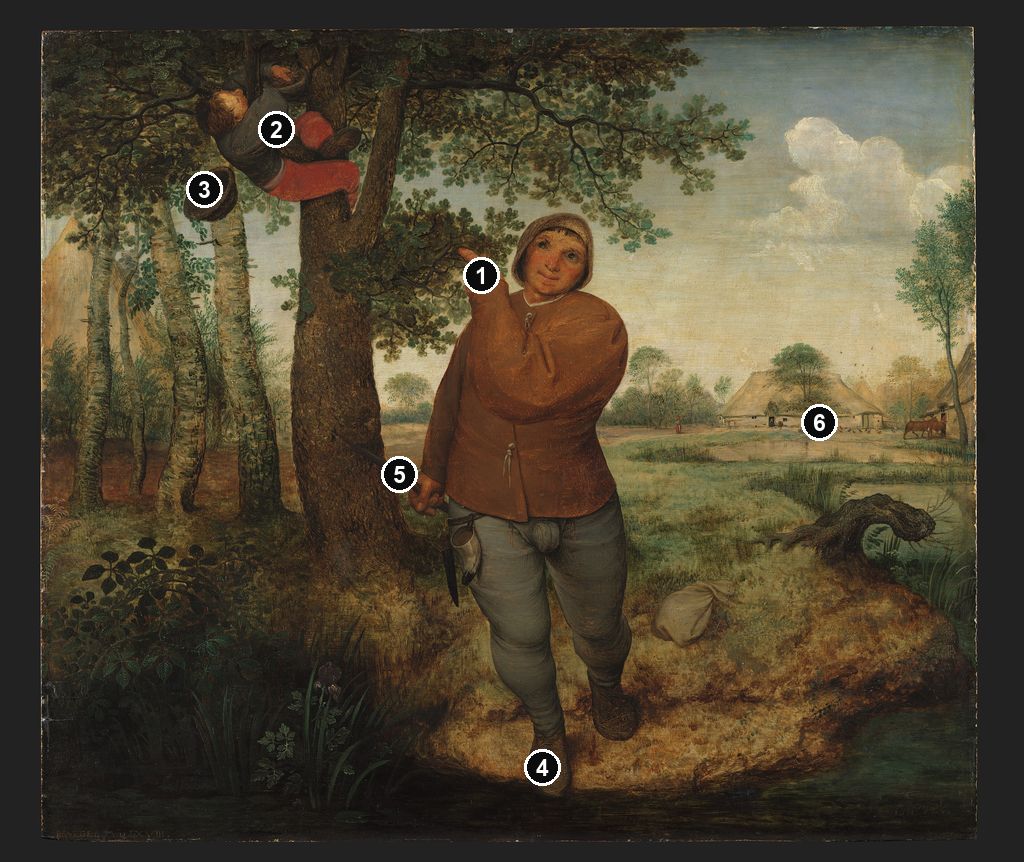
Details from THE PEASANT AND THE NEST ROBBER
Six details show how Bruegel directs the eye between the two figures and their surroundings.
The pointing hand
The raised finger directs attention from the nearest man towards the branches.
The climber
Red hose helps locate the figure pressed against the trunk.
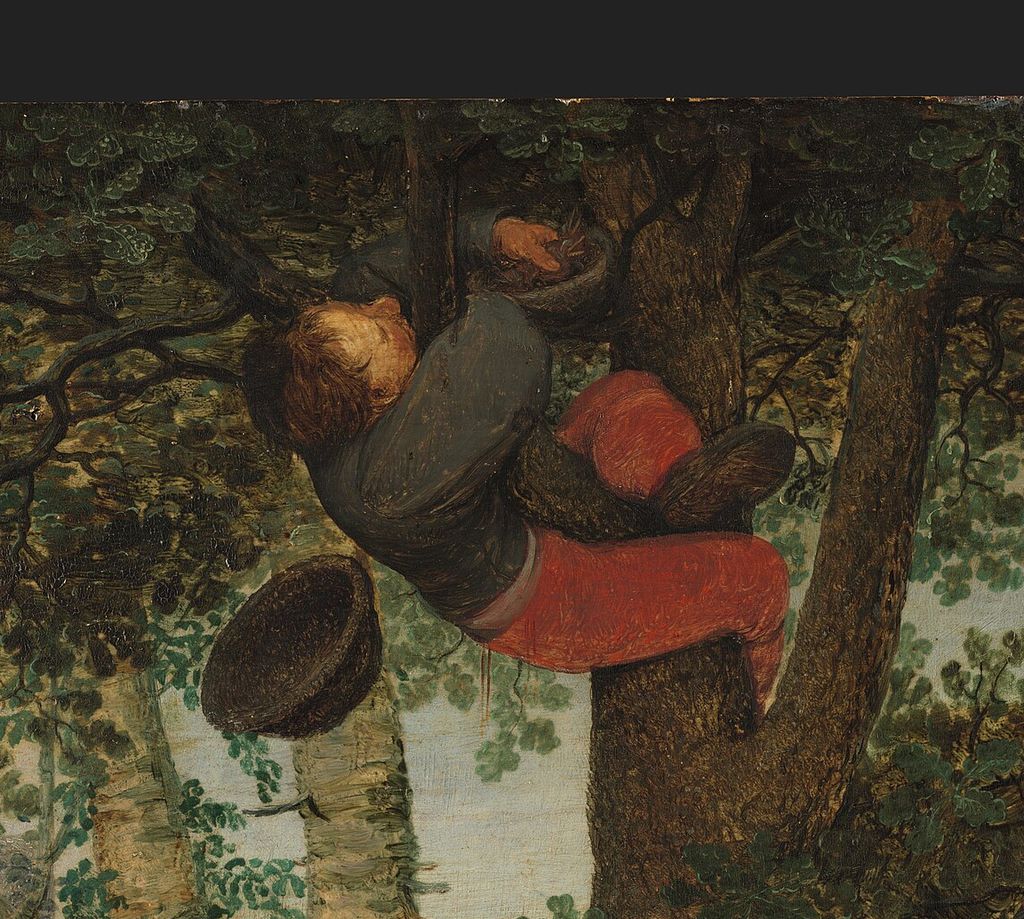
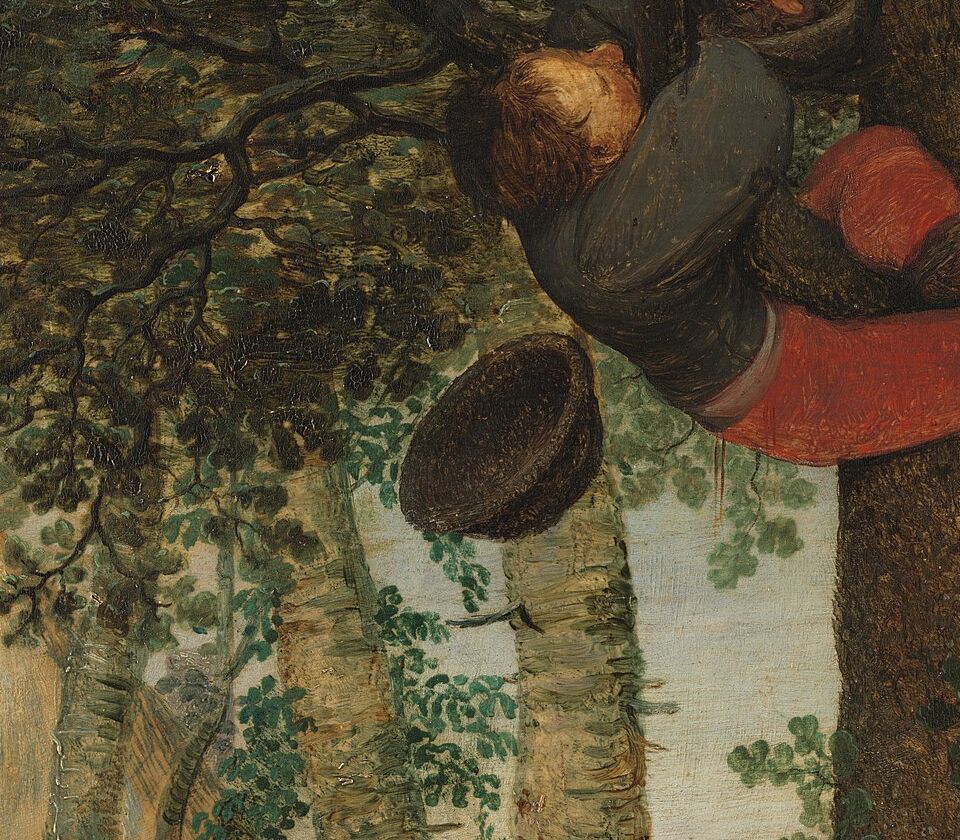
The hat below the branch
The hat below the climber’s head makes his position look precarious.
The foot at the water’s edge
The peasant’s boot reaches the narrow edge of the bank above the dark water.
The stick and trunk
The walking stick leads back from the peasant’s lowered hand towards the tree.
The open ground beyond
Small roofs and figures establish distance behind the peasant.
Pieter Bruegel the Elder, The Peasant and the Nest Robber, 1568, oil on oak. Kunsthistorisches Museum, Vienna, Gemäldegalerie 1020. Inside Bruegel image via Wikimedia Commons.
Look Up to the Climber
The climber wears red hose, one of the strongest pockets of colour within the woods. One leg bends around the trunk, and the body presses close against the branches. A fallen or falling hat is visible below his head. The figure takes up very little of the panel compared with the man at the front, but Bruegel makes the contrasts around his red clothing strong enough to hold attention. The exposed soles and the hat make his hold on the tree look precarious [2].
The trunk provides a line that can be traced down to the ground again. At the left, several more slender stems rise into the same patch of foliage. At the right, the land opens across the water into fields. Bruegel places the climber in a part of the picture where forms overlap and cover each other. The peasant’s head and shoulder, by contrast, have open air and distant country around them. The difference in setting helps explain why the large figure is visible at once and the smaller one needs to be pointed out.
Follow the tree back to the dark plants along the bank. Close to the ground, edges of leaves and stems are easier to separate from each other than the canopy above. The panel offers several measures of height, from the plants below the peasant to his own reach and then to the branch at which the climber stops. The tree spans those levels. Its size makes the climb plausible and puts the man in the tree far enough above the ground for his position to matter.
A Proverb and a Second Reading
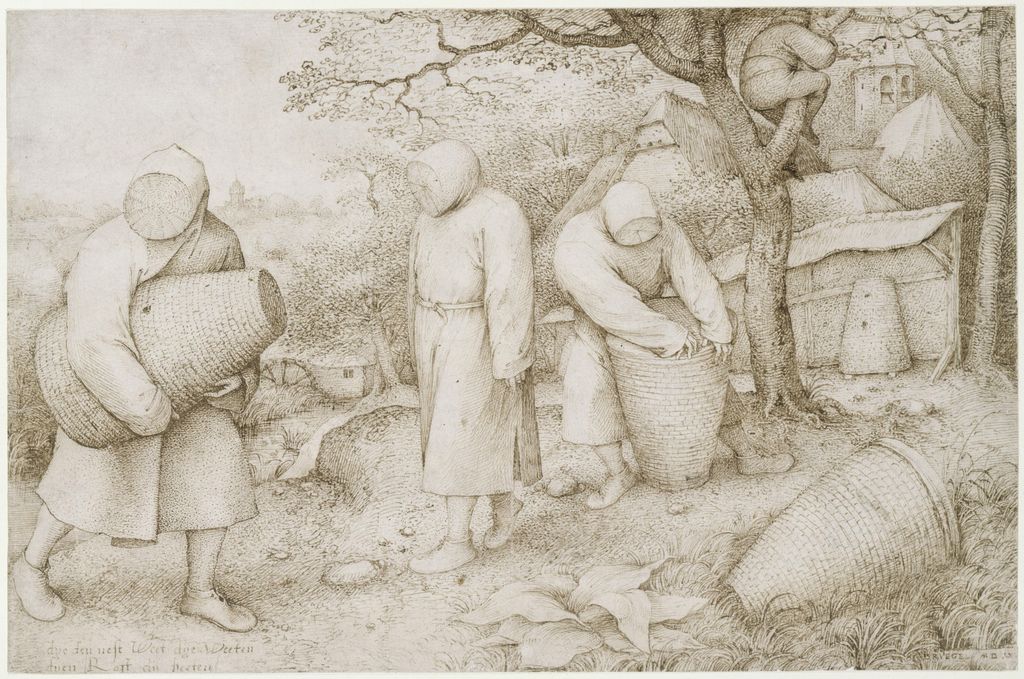
Bruegel’s Berlin drawing The Beekeepers and the Birdnester contains a climber and carries an inscription about a difference between knowing where a nest is and taking possession of it. The proverb supplies one way to think about the difference between the two people in the Vienna painting. One indicates what is happening and one is in the tree doing it. The drawing, shown below, sets the motif alongside the separate activity of beekeepers handling hives. Its inscription belongs to that sheet and gives a comparison for the painting [2] [3].
In Berlin, the mesh that covers the beekeepers’ faces leaves them without the outward gaze of the peasant in the painting. The person at the left carries a woven hive across his body, and the man next to the tree bends over another. Their work fills the space below the climber. The drawing thus sets the activity in the tree beside several other actions, which makes it a distinct composition even before the inscription is read [3].
Sullivan connects both protagonists in the painting with a chapter of Sebastian Brant’s Ship of Fools. In her reading, the climber who overreaches and the walker who strays from his course face related problems. The hat below the climber and the position of the peasant’s foot both matter to this interpretation. It also makes sense of why Bruegel gives the second danger so little emphasis at first. The peasant knows enough to point towards someone else’s trouble while remaining unaware of his own [2].
The two approaches begin with different kinds of evidence. The proverb has a close parallel on Bruegel’s drawing, while the reading through Brant asks how the picture works as a pair of actions. Trying both changes where the eye stops. A viewer can first ask what the successful climber might gain, then ask whether either figure is safely placed. The painting gives enough information to make those questions concrete in the space of a single look from the branch to the water [2] [3].
The Scale of the Panel
The Vienna painting measures 59.3 by 68.3 centimetres. The nearer man is large enough relative to the panel to give his raised hand an immediate presence. The climber is closer in scale to a detail a viewer might have to seek out. The gap in scale is one of the ways Bruegel controls the order of looking. The gesture introduces the distant action at the top, while the illuminated patch of ground can draw attention back down to the other action at the bottom [1].
Return to the finger one last time. It directs attention within the painting and offers a place from which to examine the painter’s own choices. The designated subject is surrounded by leaves, while the person making the designation stands in the open and has very little ground left in front of him. The point of the gesture becomes clearer once the eye has gone where it leads and then come back to see what the man himself is doing.
Discussion
Which detail in this work most changes how you read it?
Frequently Asked Questions
Notice the uneven strip of ochre ground under him. Its far edge curves away towards the right, following the dark water. [2]
The climber wears red hose, one of the strongest pockets of colour within the woods. One leg bends around the trunk, and the body presses close against the branches. [2]
References
- Kunsthistorisches Museum, Bauer und Vogeldieb, Gemäldegalerie 1020, View source.
- Margaret A. Sullivan, Peasant and Nestrobber, Bruegel as Witness of His Times, Journal of Historians of Netherlandish Art, View source.
- CODART Canon, The Beekeepers, Kupferstichkabinett Berlin, View source.







