


 by Tom Gurney
Tom Gurney BSc (Hons) is an art history expert with over 20 years experience
Published on June 19, 2020 / Updated on October 14, 2023
Email: tomgurney1@gmail.com / Phone: +44 7429 011000
Two Chained Monkeys: Introduction
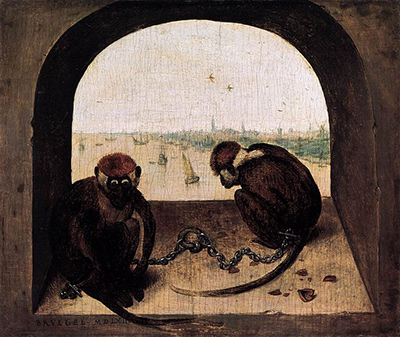
Pieter Bruegel the Elder’s Two Chained Monkeys is a small oak panel signed and dated 1562, now in the Gemäldegalerie in Berlin. One monkey faces out of the picture. The other curls forward beside it. The animals sit on a broad stone sill, held by chains that meet at the same iron ring. Through the arch behind them, ships travel along the Scheldt past Antwerp. Bruegel gives the two animals just enough room for their postures to differ, then gives the view beyond them room to run all the way to the horizon [1] [2].
This work across Bruegel’s career
Tower of Babel
1563The Harvesters
1565Peasant Wedding
1568Children's Games
1560Triumph of Death
1562–1563Two Chained Monkeys
This artworkContents
- Introduction
- Two Animals on a Sill
- How the Chain Works in the Picture
- Antwerp across the Water
- What Berlin Found in the Paint
- What the Two Monkeys Might Mean
- Annotated Details
Two Animals on a Sill
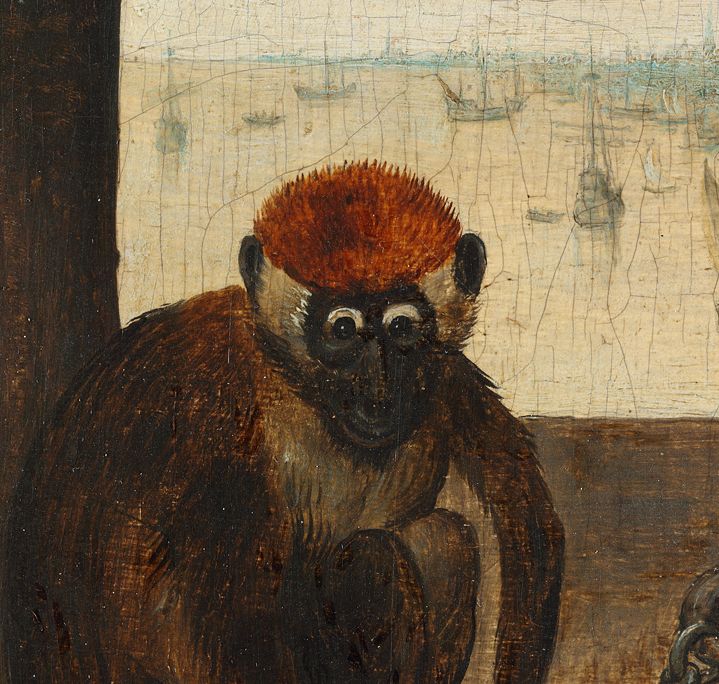
The monkey at the left sits with its head up and its face almost square to the viewer. There is a small area of light at the eyes and around the ears. Its bent limbs merge into the dark part of the sill and the shadow cast by the side of the opening. Bruegel leaves a patch of much lighter stone next to the animal, so that the difference between its body and the place where it sits becomes clearer as the eye reaches the lower part of the picture.
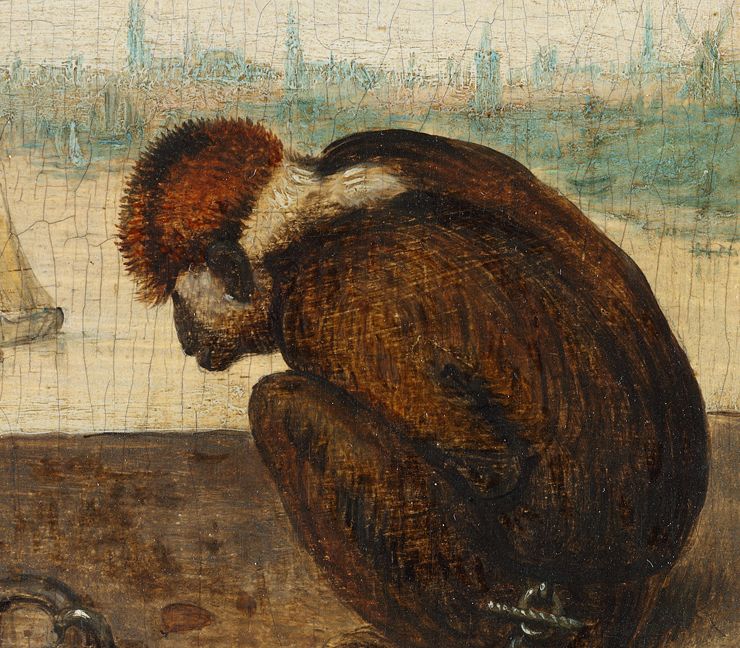
The second monkey’s posture becomes legible in a different way. Look first at the curve of the back and then follow it around towards the tucked head. The whole body folds inward, with the rounded mass of the back taking up much of its visible shape. The tail makes a long curve over the sill. Once you locate it, it brings the eye out of the shadow under the animal and back to the area where the chains lie. Both monkeys have room to change position. Bruegel shows the degree of that freedom through the extension of a tail, a bent limb and the different angles of the two heads [1].
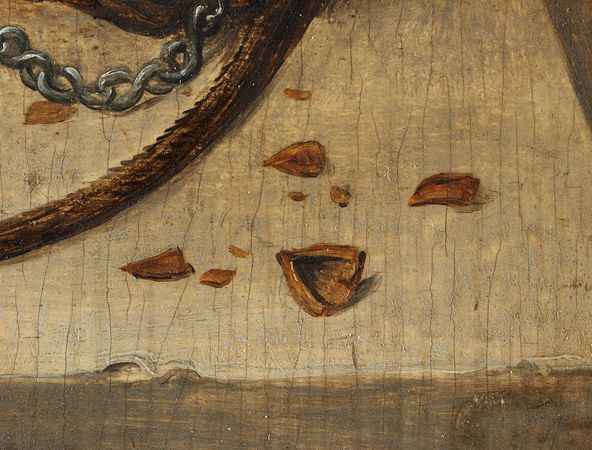
Several small pieces of debris lie by the right edge of the sill. They make its surface easier to read, giving the viewer more than the chain to judge the scale of this piece of stone. The recess is close enough to inspect the fall of light on each bit of material. That descriptive care leaves the animals time to be still. Their faces and movements occupy so little territory that a viewer can follow one of them closely without losing a sense of where the other sits.
Annotated Details from Two Chained Monkeys
Follow the chain across the sill, then look beyond the animals to ships on the Scheldt.
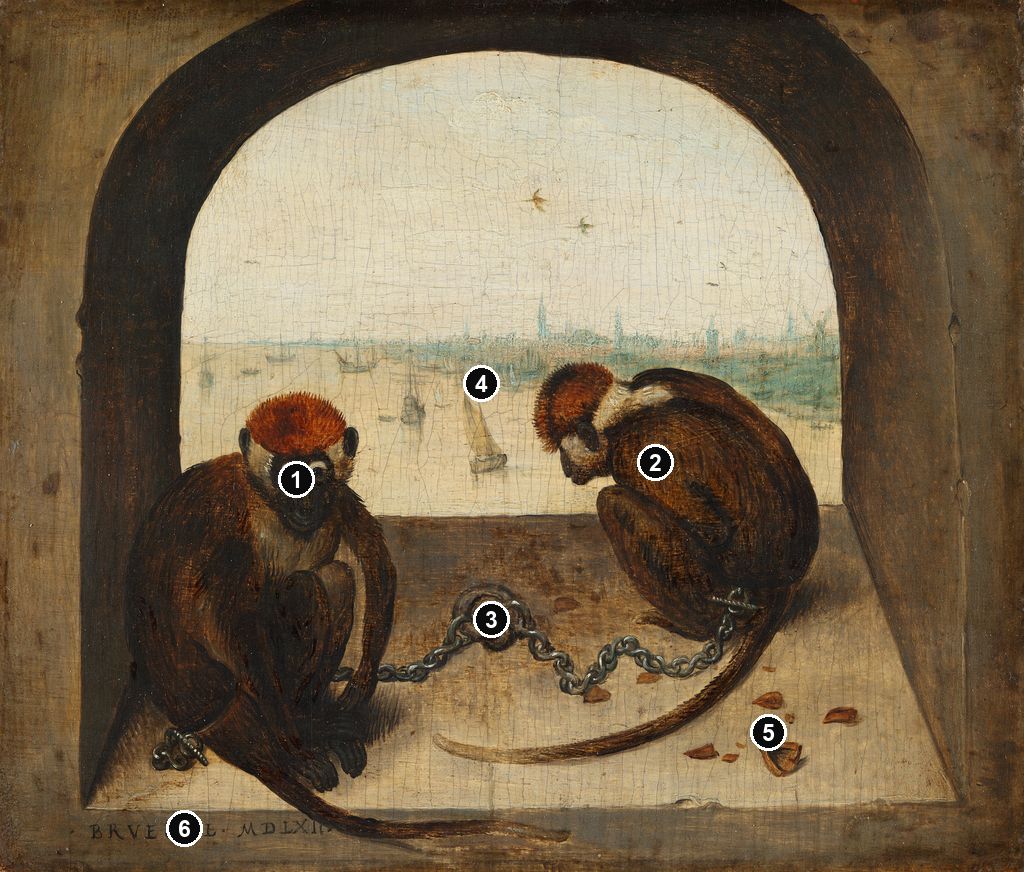
Details from TWO CHAINED MONKEYS
Six details trace the two poses, the window setting and Bruegel’s signature.
Monkey facing out
Light catches the eyes and ears. Follow the arm down to where it meets the shaded sill.
Monkey with lowered head
The curve of the back leads into the tucked head. The tail extends over a much wider stretch of stone.
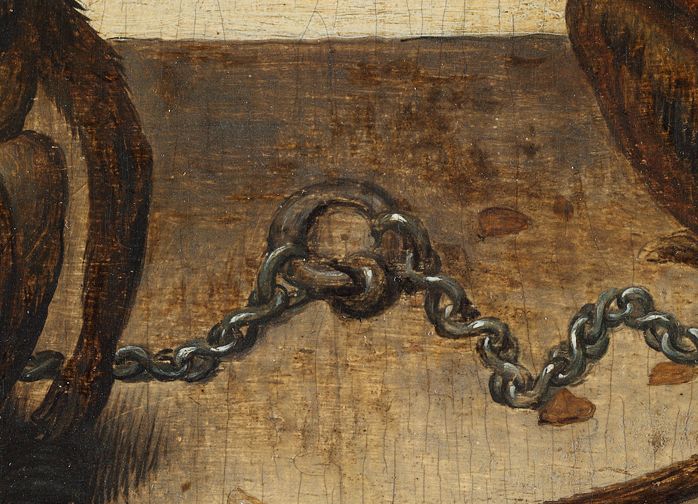
Iron ring and links
The central ring joins the two runs of chain. Small flashes of light separate the links from the stone.
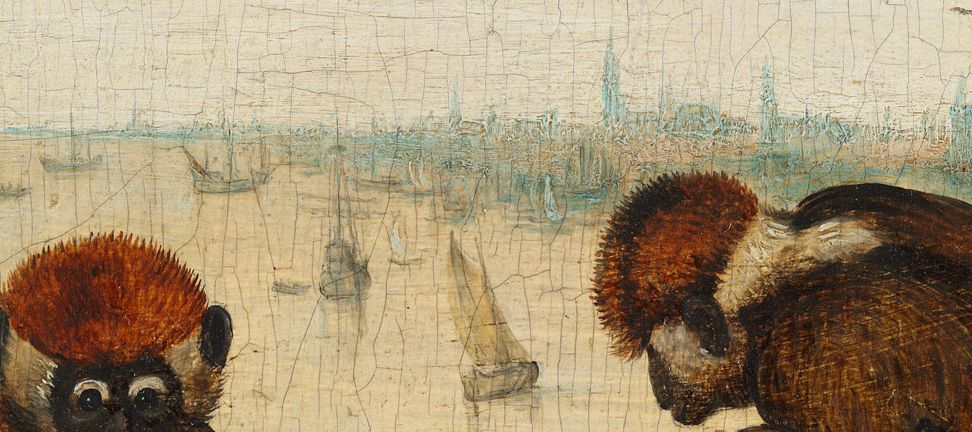
Ships and the Antwerp skyline
Sails mark distances across the Scheldt. The tall church tower rises just above the shore.
Fragments on the sill
The small scattered fragments and the shadow of the tail give the pale stone a sense of scale.
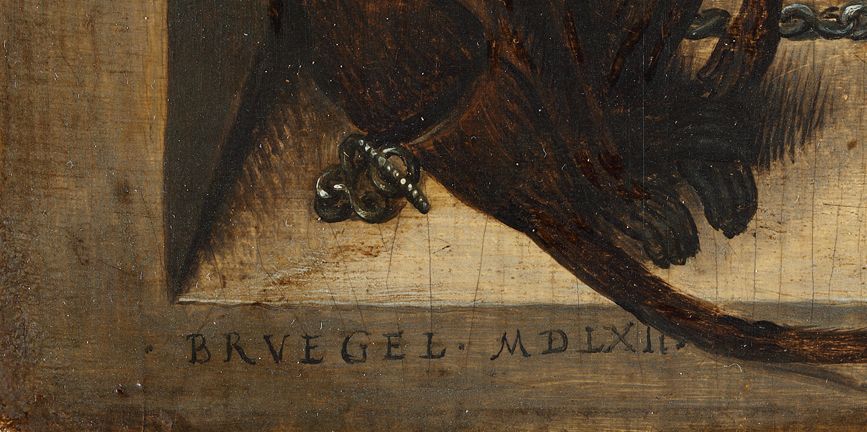
Signature and date
The lower-left edge of the stone carries Bruegel’s signature and the date 1562 in Roman numerals.
How the Chain Works in the Picture
At the centre of the sill is a single iron ring. From there the chain forms an irregular line in either direction. The upper faces of some links catch the light. Others turn away and are harder to distinguish from the shadows that they cast. Looking along this line is an efficient way to make sense of the composition. It links the animal at the left to the one at the right across a space that neither body occupies [1].
Look from the ring up towards the edge of the arch. The thickness of the masonry is visible in the shadow along its inner curve. The lower part of that shadow meets a wide sill with a very clear front edge. These surfaces make the room around the monkeys seem substantial. They also give a physical measure of confinement. The animals have a place to sit, face one another or turn away, while the attachments prevent them from travelling across the open country suggested by the view.
The arch is also a frame painted inside the rectangular oak panel. It gives the distant landscape an uneven border. The opening narrows near the top, and at its lower edge the animals partly block the view. If you start with the landscape, you still have to look between them to reach the nearest water. The same parts of the composition that give the port depth keep bringing the viewer back to the close stone sill and the chain.
Antwerp across the Water
The Berlin collection identifies the city as Antwerp, including the tall tower of the Church of Our Lady. The wide water in front is the Scheldt. Look for sails and hulls before trying to identify the city. They lead the eye through the open part of the window, after which the small upright lines of the buildings begin to separate from the shore. The skyline takes up little height. Ships have enough room below it to move diagonally through the water [1].
The city belongs to a region of more delicate marks than the sill. A single mark can suggest a ship, and the haze across the horizon reduces the distinction between pale sky and water. Closer in, a link in the chain needs several edges and highlights to make its shape convincing. Those changes in scale are part of the subject. A monkey almost at arm’s length and a ship far beyond the arch are both easy to locate, but each has to be seen with a different degree of attention.
What Berlin Found in the Paint
The panel measures 19.9 by 23.3 centimetres and is recorded as object 2077. For the Vienna exhibition on Bruegel, the Gemäldegalerie investigated the wood, underdrawing and paint. The team used infrared imaging and X-ray techniques among other methods, and discovered deterioration of the blue pigment smalt in the sky and water. This gives a reason for taking care when judging the almost neutral expanse beyond the arch. The paint that establishes the distance also has a history of its own [1] [2].
Restorer Bertram Lorenz used the evidence to reconstruct steps in the work on a sequence of panels at the original scale. That project takes the picture apart in a practical sense. Studying the original can reveal where materials occur and where lines survive below the visible surface. Applying the materials again in stages tests what it takes to move from an underdrawing to a painted result. The museum displayed six reconstructed stages as part of the exhibition. For a viewer, they make the little panel a particularly useful example of how evidence about paint and support can sharpen the observation of an image [2].
What the Two Monkeys Might Mean
Berlin’s catalogue discusses the monkey as a traditional image of a person held by appetites and desires. In that reading, the visible iron gives a familiar moral idea a physical form. The animals can also be studied through their individual postures. One looks out from the sill and the other sits folded in on itself. Each has a different relation to the most open passage of the picture, even though both belong to the same enclosure. Their stillness makes the port’s implied movement especially easy to notice [1].
Return to the ring, pick out the chain on either side and then find a ship in the opening. It takes very little movement of the eye to go from a fixed point in the stone to a vessel going somewhere. The painting can show both with precision on a panel small enough for a single person to take in at close quarters. The difference between those two kinds of movement gives its simplest details much of their force.
Discussion
Which detail in this work most changes how you read it?
Frequently Asked Questions
The second monkey’s posture becomes legible in a different way. Look first at the curve of the back and then follow it around towards the tucked head. [1]
At the centre of the sill is a single iron ring. From there the chain forms an irregular line in either direction. [1]
The Berlin collection identifies the city as Antwerp, including the tall tower of the Church of Our Lady. The wide water in front is the Scheldt. [1]
References
- Staatliche Museen zu Berlin, Zwei angekettete Affen, Gemäldegalerie 2077, View source.
- Staatliche Museen zu Berlin, Pieter Bruegel the Elder, Two Monkeys, technical research and reconstruction, View source.







