


 by Tom Gurney
Tom Gurney BSc (Hons) is an art history expert with over 20 years experience
Published on June 19, 2020 / Updated on October 14, 2023
Email: tomgurney1@gmail.com / Phone: +44 7429 011000
The Suicide of Saul: Introduction
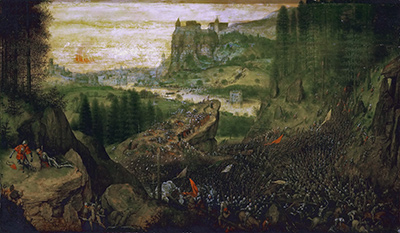
Pieter Bruegel the Elder’s The Suicide of Saul is a painting of a defeated king within a much larger battle. Saul and his armour-bearer occupy a patch of light on a rocky shelf at the left. At the right, rows of soldiers crowd into a narrow valley beneath the trees. The Kunsthistorisches Museum in Vienna keeps the painting in its Picture Gallery, inventory GG 1011. It dates the work to 1562 and gives the dimensions of the oak panel as 33.5 by 55 centimetres. On a panel of that size, the story can be difficult to locate until you have spent time looking at the terrain and the armies [1] [2].
This work across Bruegel’s career
Tower of Babel
1563The Harvesters
1565Peasant Wedding
1568Children's Games
1560Triumph of Death
1562–1563The Suicide of Saul
This artworkContents
- Introduction
- The Figures on the Left
- The Army in the Ravine
- From the Battlefield to the Horizon
- A Biblical Episode within a Landscape
- Annotated Details
The Figures on the Left
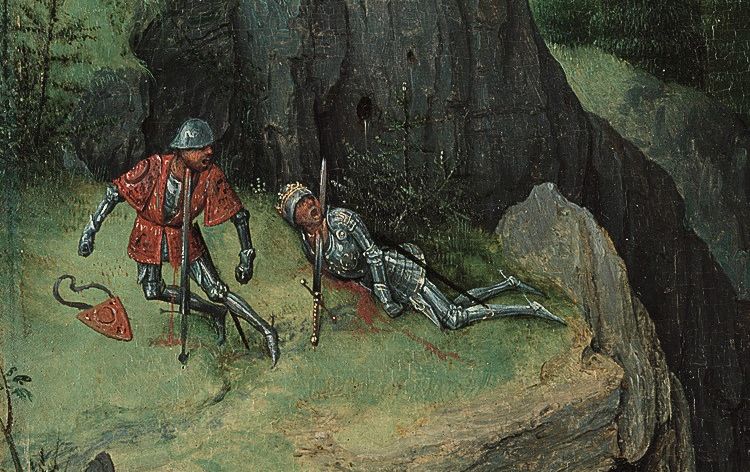
Start with the light ground at the left, below a dark group of rocks. There are two figures, one in red and another in armour, with a narrow interval between them. The red makes the first figure comparatively easy to see. The other is initially harder to distinguish because the reflective armour and the rock have some of the same grey and blue tones. The two occupy very little ground compared with the crowd across the ravine. The brighter shelf gives the eye somewhere to stop long enough to recognise the episode named in the title [1].
The painting takes its subject from the First Book of Samuel. In chapter 31 the Israelites are defeated by the Philistines on Mount Gilboa, Saul’s sons are killed, and the wounded king dies after his armour-bearer refuses to kill him. The armour-bearer then dies as well. Bruegel’s shelf places the two men together but cuts across the surrounding movement of the battle. The scene presents an episode in a defeat that is still visible across the rest of the picture [3] [1].
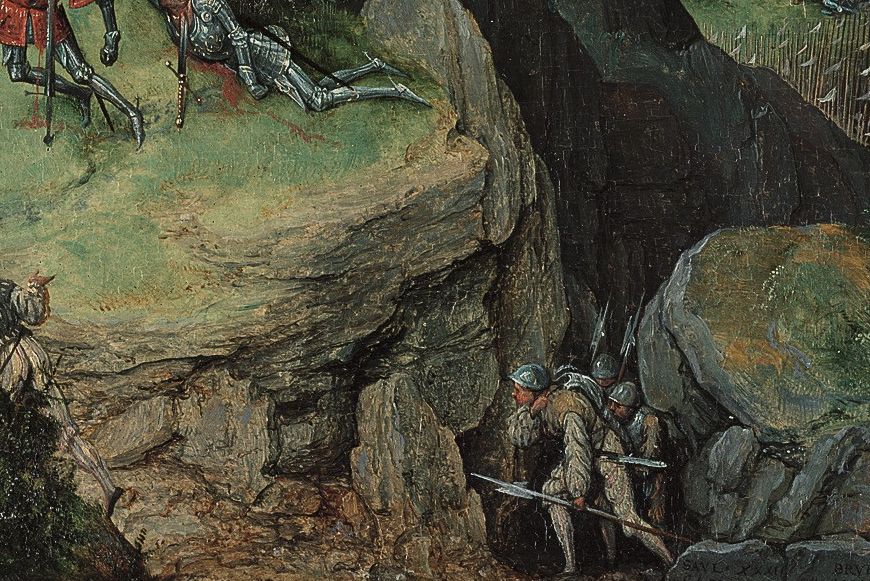
Below the ledge, further figures and rocks occupy a much darker interval. The green shelf ends abruptly, and a descending line takes the eye past the small figures below it towards the foreground. The change in height makes it harder to read the left side as one continuous piece of ground. The lines of movement on the other side will take the eye in another direction altogether. These differences explain why Saul can stand apart visually while remaining close to the soldiers who fill the rest of the panel.
Annotated Details from The Suicide of Saul
Find the two figures on the ledge and follow the terrain into the distance.
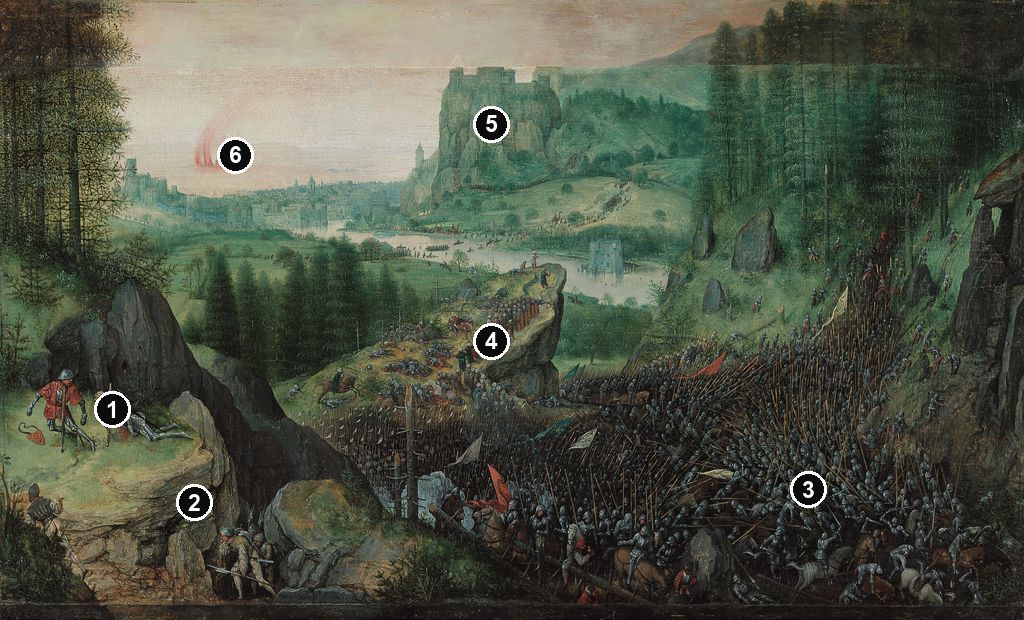
Details from THE SUICIDE OF SAUL
Six details show how the figures, the army and the valley relate to one another.
Saul and his armour-bearer
The two figures occupy a patch of light on the rocky shelf.
The edge of the shelf
The bright ground ends abruptly above a darker passage.
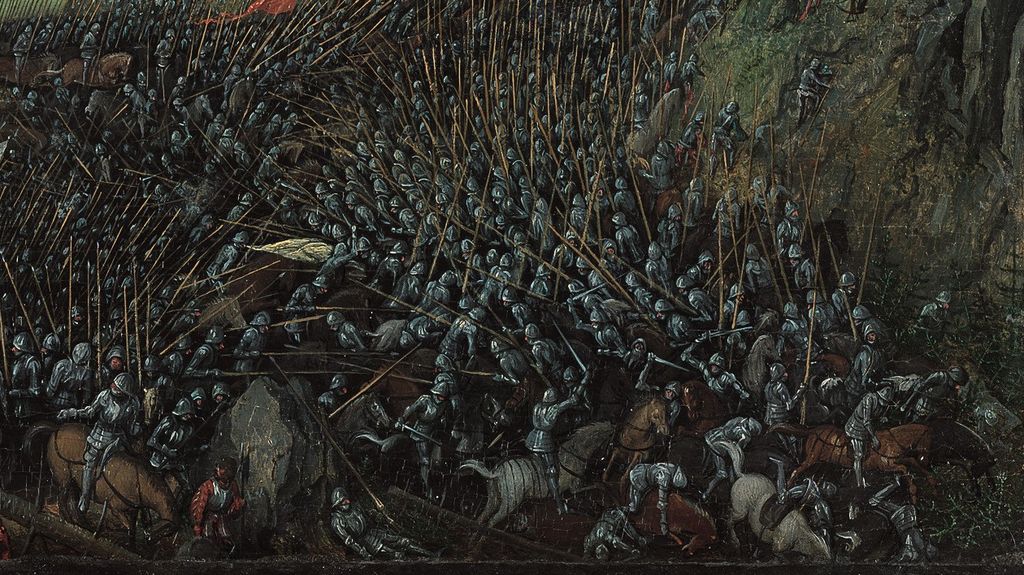
Soldiers in the ravine
Helmets, shafts and banners follow the slope.
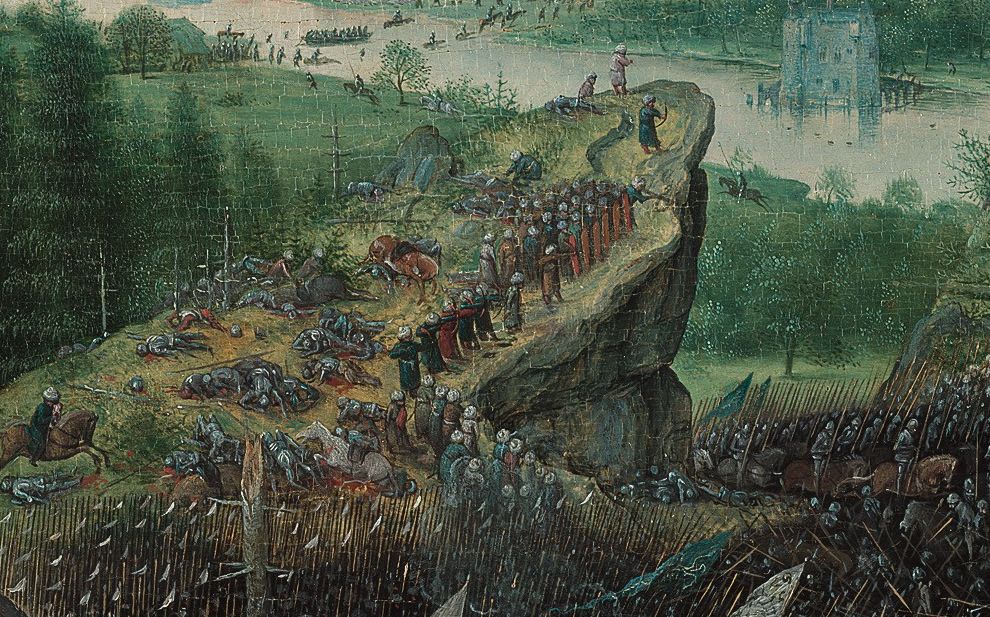
The central spur
Figures cross the exposed ground above the packed ravine.
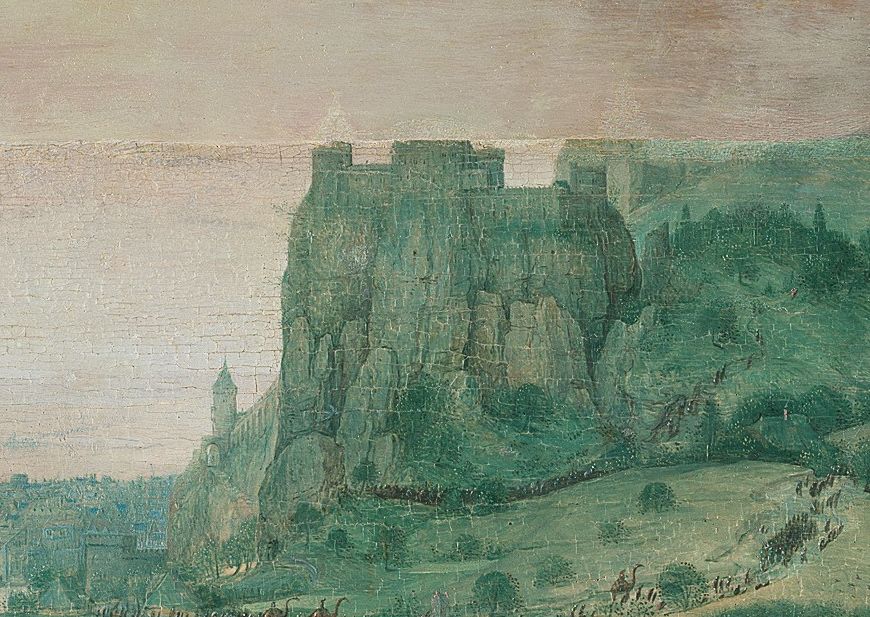
The distant fortress
Walls and towers stand high above the pale lowland.
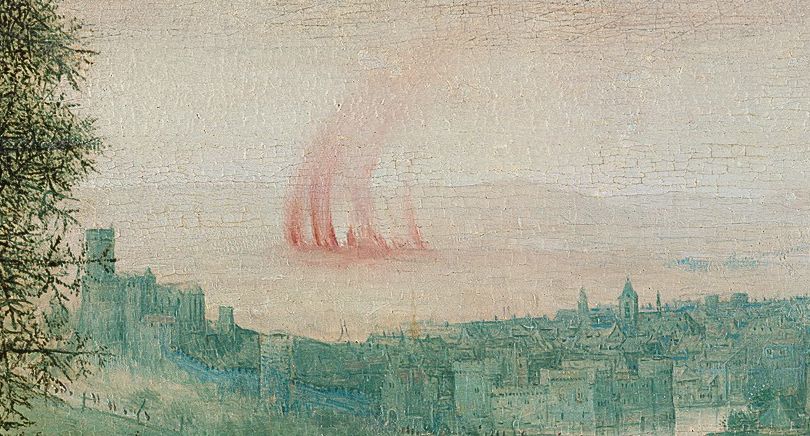
Smoke on the horizon
A reddish plume interrupts the pale atmosphere.
Pieter Bruegel the Elder, The Suicide of Saul, 1562. Kunsthistorisches Museum, Vienna, GG 1011. Reproduction via Wikimedia Commons.
The Army in the Ravine
The right foreground is dense with helmets and long shafts. The shafts run in several directions, many following the slope uphill. A few banners stand out against the darker crowd. They are among the first colours a viewer can pick out, before individual faces or figures become legible. Look from the nearest horses to the heads farther up the bank and you can see the scale of the crowd change within a short stretch. The soldiers become a pattern on the hillside, while the hillside still gives that pattern a recognisable shape.
Near the centre of the painting, a high spur projects above the main body of troops. Several small people occupy its top and others can be seen lower down. The edge of the spur appears sharp against the paler country behind it. It gives the viewer a place to look between the isolated figures at the left and the dense formation at the right. The battlefield contains quite different kinds of space, from the packed ravine to the exposed slope and the open country beyond. Bruegel allows the eye to move among them without losing the direction of the valley.
The trees also divide the surface. At the right, close dark trunks and upright lines stand above the rising cluster of soldiers. At the left, another mass of trees gives shade to the edge of the shelf. Between them, the view continues into a softer green. The wooded margins almost close in on the armies, while the distant section gives their movement somewhere to continue. This relation is especially clear if you look along the tops of the spears and then follow the line of trees rising behind them.
From the Battlefield to the Horizon
Beyond the central spur, figures thin out in the pale lowland. Their small size makes the open ground seem more extensive than the rocks immediately in front. Buildings are visible below a substantial fortress that occupies a cliff. The walls have a more regular outline than the broken rocks around Saul. That difference helps position the fortress at a distance even though it is painted in distinctly visible shapes. It is one of the few structures in the upper portion of the panel that can be located quickly.
At the left of the distant skyline, a plume of reddish smoke interrupts the pale atmosphere. It occupies very little area and can be located almost as quickly as the reds below. The haze around it makes the far buildings and landscape less distinct than the foreground trees. At another scale, the contrast resembles the effect of the banners among the soldiers. Bruegel uses small concentrations of colour to make disparate areas of the picture legible without giving all of them the same degree of detail.
A Biblical Episode within a Landscape
The battle takes place on Mount Gilboa in the biblical text. In the panel, the forested ridges, fortress and armoured soldiers form a landscape Bruegel has arranged for the story. The First Book of Samuel gives Saul the leading role in the account of his death. The painting creates a different order of recognition. Viewers may notice the crowded foreground and the brightly outlined distance before they recognise the king. Reading the title and returning to the shelf changes the relationship between that small group and the rest of the scene [3] [1].
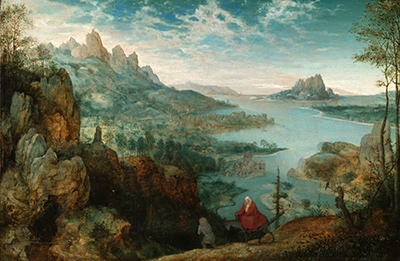
Another way to see that relationship is to compare Landscape with the Flight into Egypt, shown below. The Courtauld panel also uses a small travelling group and tall rocky formations to establish the scale of a biblical landscape. It was painted a year later. Its open water carries the eye into the distance, while the dense field of helmets and shafts in the Vienna panel delays the passage through the foreground. In both works the tiny figures give the view a particular story, and the wider landscape allows that story to unfold as the viewer looks from one area to another [4] [1].
Discussion
Which detail in this work most changes how you read it?
Frequently Asked Questions
Start with the light ground at the left, below a dark group of rocks. There are two figures, one in red and another in armour, with a narrow interval between them. [1]
References
- Kunsthistorisches Museum, Selbstmord Sauls, GG 1011, View source.
- Kunsthistorisches Museum, The Best of Bruegel, object notes, View source.
- United States Conference of Catholic Bishops, First Book of Samuel, chapter 31, View source.
- The Courtauld, Landscape with the Flight into Egypt, P.1978.PG.47, View source.








