


 by Tom Gurney
Tom Gurney BSc (Hons) is an art history expert with over 20 years experience
Published on June 19, 2020 / Updated on October 14, 2023
Email: tomgurney1@gmail.com / Phone: +44 7429 011000
Naval Battle in the Gulf of Naples: Introduction
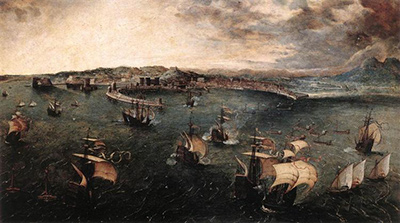
Ships with filled sails cross a green bay beneath an uneven bank of clouds in Pieter Bruegel the Elder’s Naval Battle in the Gulf of Naples. The port forms a long curve behind them, with buildings and defences at the water’s edge. The Galleria Doria Pamphilj in Rome calls the painting A Battle in the Bay of Naples. It is an oil on wood panel measuring 42.2 by 71.2 centimetres, inventory FC 546. The gallery identifies the port as Naples and considers the battle probably imaginary. A separate print after Bruegel’s design depicts the Strait of Messina [1] [2] [3].
This work across Bruegel’s career
Tower of Babel
1563The Harvesters
1565Peasant Wedding
1568Children's Games
1560Triumph of Death
1562–1563Naval Battle in the Gulf of Naples
This artworkContents
- Introduction
- Ships in the Foreground
- The Curve of the Port
- A View and a Battle
- The Different View of Messina
- Annotated Details
Ships in the Foreground
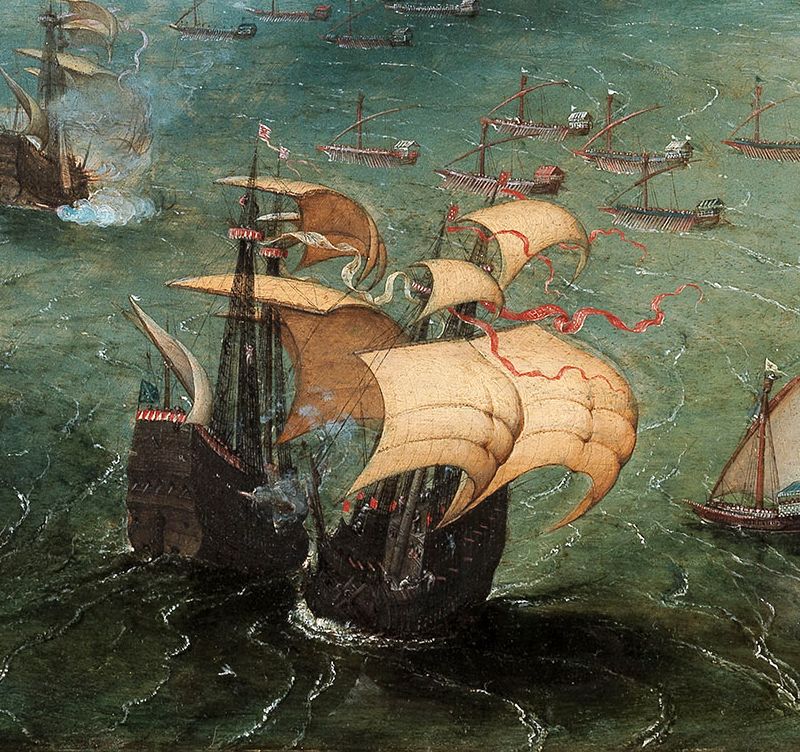
Start with the largest vessels near the lower right. The pale faces of their sails stand out against the dark hulls and water. Some of the sails curve broadly while others turn away or are partly hidden. Lines on the masts and narrow flags make it easier to distinguish one vessel from the next even where their forms overlap. The pair takes up a substantial part of the near water. It makes the smaller ships behind it seem much farther away, even when there is scarcely any clear interval between them on the panel.
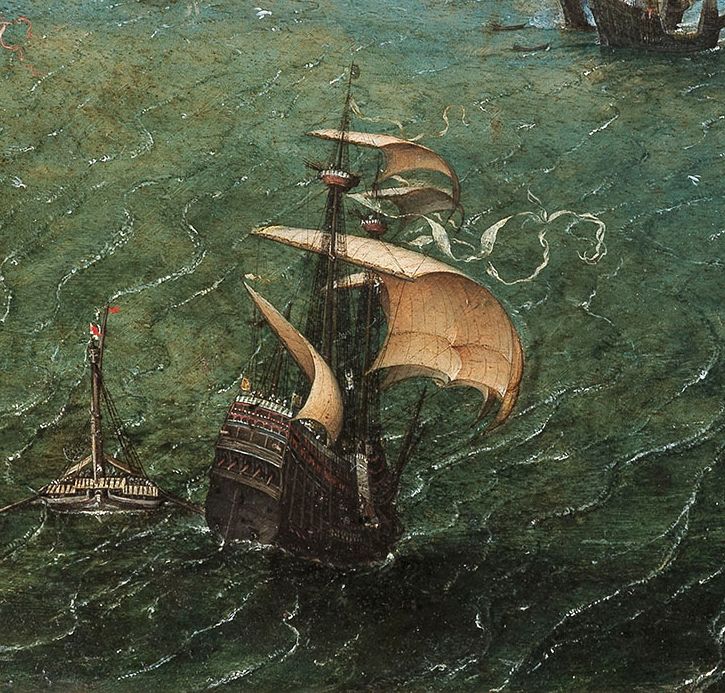
At the lower left another large ship shows a different angle of its hull. Its rigging rises against a stretch of lighter water. Small craft appear nearby, while at the right a group of pale triangular sails occupies a more open part of the bay. Look back and forth from these smaller sails to the full sails of the larger ships. The comparison gives a sense of distance and of the variety of movement within the painting. Bruegel has left enough water between groups for the direction of each to remain readable.
Near the centre, a vessel is surrounded by pale marks around its hull. Similar accents occur beside other boats, but here the contrast is strong against the green. Two rather different kinds of line describe the sea. Short bright curves pick out movement near the ships, while longer broken lines run through the foreground between them. The lower part of the painting has the darkest water. The lighter band near the harbour brings out how much distance lies beyond the foreground ships.
Several long, low craft are visible behind the nearest large sails. Their silhouettes interrupt the water with a different rhythm from the upright masts. They help distinguish the middle distance, where the boats are individually visible but occupy little of the bay.
Annotated Details from Naval Battle in the Gulf of Naples
Look from the largest ships to the curved harbour behind them.
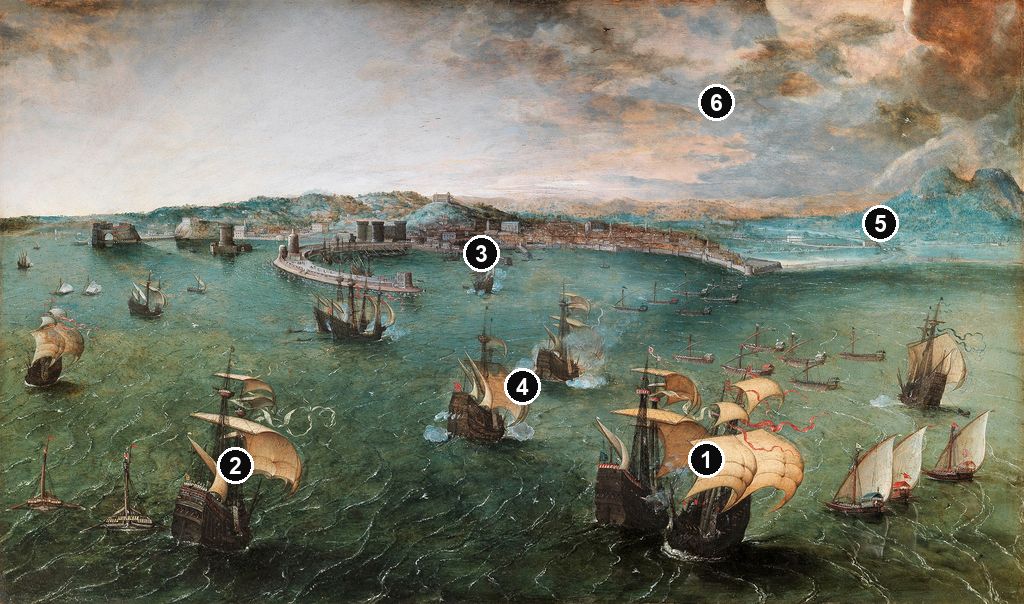
Details from NAVAL BATTLE IN THE GULF OF NAPLES
Six details show the ships, water and port.
The nearest ships
Light sails overlap above dark hulls at the lower right.
The ship at the left
One large ship shows a different angle of hull and rigging.
The harbour’s curve
A curved edge and dark towers make the far shore legible.
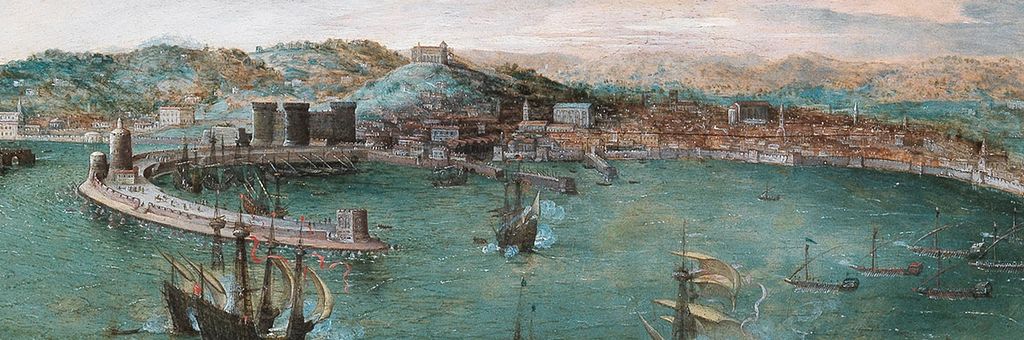
Pale water around the hulls
Pale touches describe the movement of water around the ships.
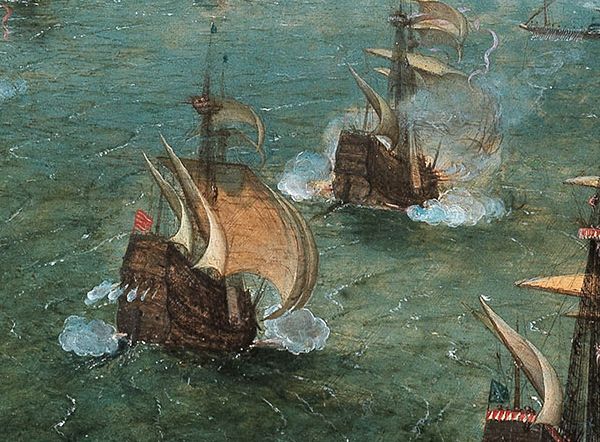
The far shoreline and mountain
The coast bends below a blue-green mountain.
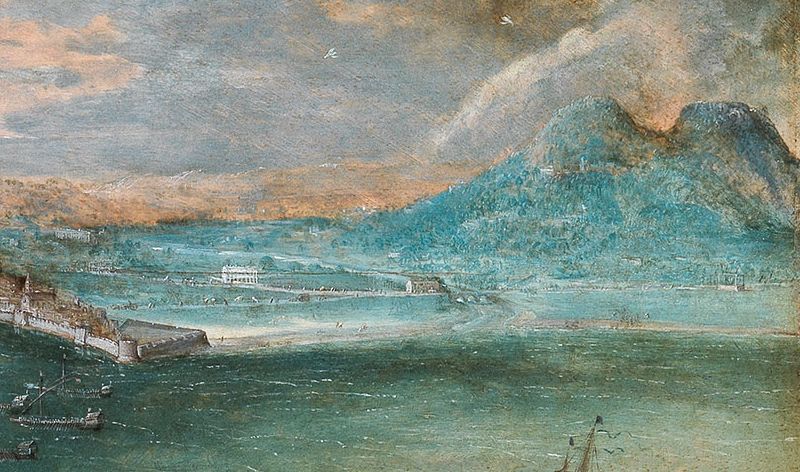
Clouds above the port
Darker clouds gather above the light horizon.
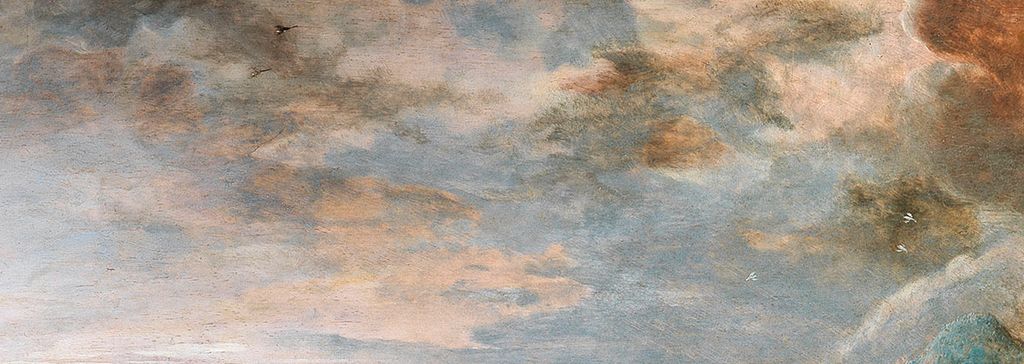
Pieter Bruegel the Elder, A Battle in the Bay of Naples. Galleria Doria Pamphilj, FC 546. Museum-sourced reproduction via Wikimedia Commons.
The Curve of the Port
The shore behind the ships is one of the clearest outlines in the painting. A pale harbour structure projects into the water and bends across the middle of the panel. Several dark towers or blocks rise behind it. Beyond those features a continuous stretch of buildings follows the land towards the right. The gallery associates the elevated view and the attention to small forms with Flemish landscape painting. The height of the viewpoint lets the harbour remain legible behind vessels whose sails would otherwise obscure much more of it [1].
The ends of the shore do different work. At the left, separate buildings stand close to the water and lead the eye out towards more open stretches of sea. At the right, the coastline turns beneath rising ground and the dark mountain. Between them the harbour describes a broad band through the picture, interrupted by the slender masts of more distant ships. The city is therefore both a place behind the action and an outline that helps a reader judge where each group of ships stands in the bay.
The clouds occupy most of the area above the port. A light opening towards the left makes the shore visible beneath it, and darker forms gather towards the right. The clouds and the bay repeat one another in their broad changes of tone. The sea is relatively light in the distance and dark beneath the nearest ships. The sky offers a second large interval across which those differences can be read. Against both, small buildings and flags are easier to pick out.
A View and a Battle
The gallery explains that the port is identifiable and that the battle is probably imaginary. The painting supplies a recognisable coast, and it provides evidence of ships approaching one another and moving across open water. The title names the kind of encounter the viewer is looking at. A specific historical engagement would require evidence beyond these features. It is possible to follow the painting’s interest in separation, crowding and distance while leaving the identity of the encounter open [1].
The gallery links the painting with Bruegel’s journey in Italy and draws attention to possible mentions in the inventories of Cardinal Granvelle and of Peter Paul Rubens. It presents those identifications as possibilities. The panel is documented in the collection of Prince Camillo Pamphilj. Those records concern the history of the object rather than the subject of the ships. They offer another way to follow the work, from the place it depicts to the collection in which it survives [1].
The Different View of Messina
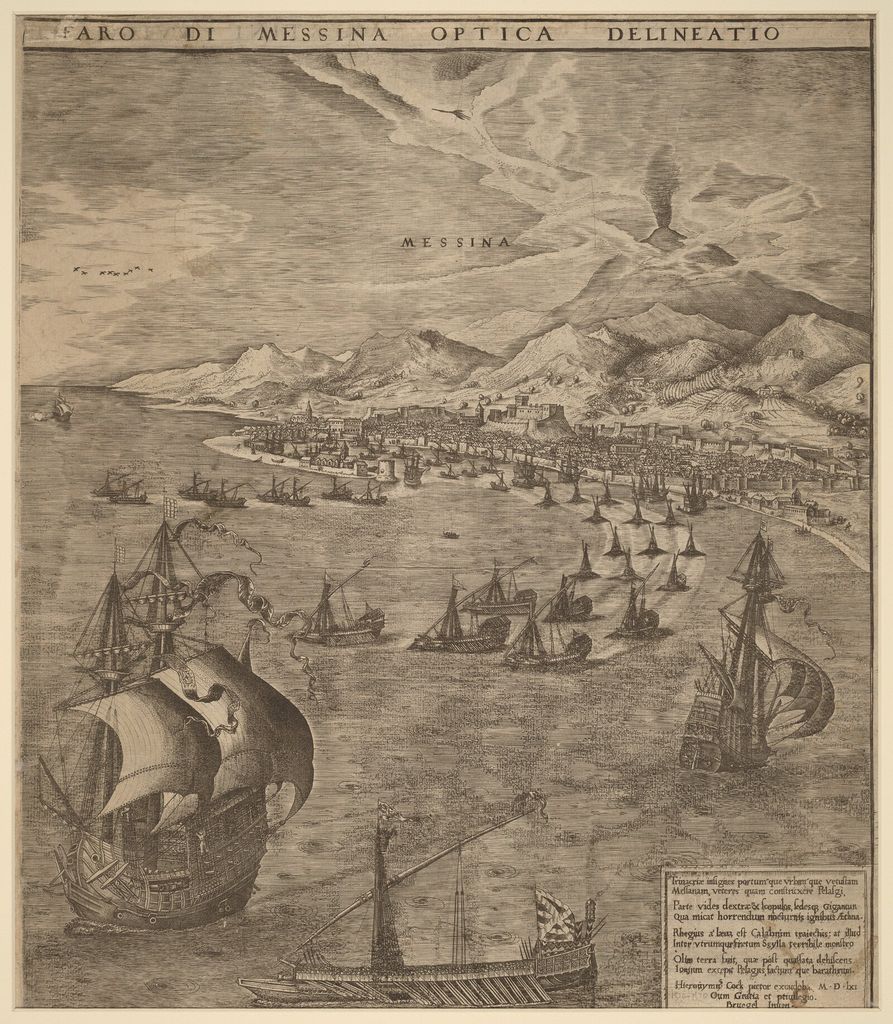
The engraving Naval Battle in the Straits of Messina belongs to a different design. Frans Huys made it after Bruegel, and Hieronymus Cock published it. Museum Boijmans Van Beuningen describes the two shores as Messina on the right and Reggio di Calabria on the left when the full print is assembled. The Washington impression is preserved as two sheets. The Messina sheet shown below has its own stretch of harbour, ships and mountains and carries lettering identifying the strait. That wording and the different coastline make it possible to distinguish the print from the Naples panel even before considering the medium [2] [3].
The high viewpoint and the distance between near ships and far buildings offer a reason to compare the two. Huys uses a range of engraved marks to separate the sails, water and shore. In the Naples panel, light colour and dark hulls do much of the work of distinguishing the nearest ships. The painted curve of the harbour also gives the city a different form from the labelled coast in the print. Each composition brings vessels and architecture into the same broad view, while the two records retain separate places, makers and objects [1] [2] [3].
Discussion
Which detail in this work most changes how you read it?
Frequently Asked Questions
The shore behind the ships is one of the clearest outlines in the painting. A pale harbour structure projects into the water and bends across the middle of the panel. [1]
The gallery explains that the port is identifiable and that the battle is probably imaginary. The painting supplies a recognisable coast, and it provides evidence of ships approaching one another and moving across open water. [1]
References
- Galleria Doria Pamphilj, A Battle in the Bay of Naples, FC 546, View source.
- Museum Boijmans Van Beuningen, Naval Battle in the Strait of Messina, BdH 10077 (PK), View source.
- National Gallery of Art, Naval Battle in the Straits of Messina, 1970.13.1, View source.








