


 by Tom Gurney
Tom Gurney BSc (Hons) is an art history expert with over 20 years experience
Published on June 19, 2020 / Updated on October 14, 2023
Email: tomgurney1@gmail.com / Phone: +44 7429 011000
Twelve Proverbs: Introduction
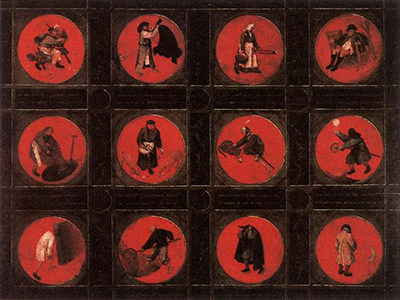
Pieter Bruegel the Elder painted the twelve round scenes now known as Twelve Proverbs on Wooden Plates in 1558. They are set into one dark panel in the Museum Mayer van den Bergh in Antwerp. The red circles mark out separate actions. A figure bends towards a well, another lifts a cloak and another approaches a wall head first. The objects are easy to recognise before the sayings are. The texts in the mount turn those physical actions into remarks about choices, habits and character [1] [2] [3].
This work across Bruegel’s career
Tower of Babel
1563The Harvesters
1565Peasant Wedding
1568Children's Games
1560Triumph of Death
1562–1563Twelve Proverbs
This artworkContents
- Introduction
- Reading from Left to Right
- The Well, the Pigs, the Cat and the Sun
- At the Bottom of the Panel
- From Separate Plates to One Panel
- The Roundels and Bruegel’s Berlin Painting
- Annotated Details
Reading from Left to Right
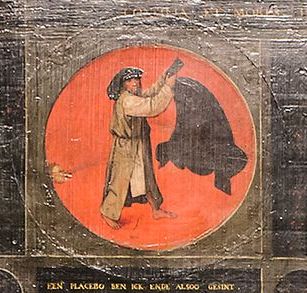
In the first circle, at the top left, the museum guide identifies the subject as gambling and drinking. The painted figure is compressed into a small space, while the inscription expands the consequences beyond the moment of the action. Loss of money and damage to one’s reputation are both at stake. The next figure faces a simpler task. He holds up a dark cloak, with enough red showing around the fabric to make its outline clear. The saying concerns a person who adjusts to whatever direction the wind takes, shaping his behaviour to suit the people or circumstances around him [2].
The third plate gives the figure two different burdens, fire in one hand and water in the other. One arm extends while the other hangs closer to the body. Those opposed positions make the pair of objects readable, although their connection with the speaker’s conduct depends on the accompanying words. The fourth plate shows a drinker who has lost what he had and now finds himself between two chairs. The saying becomes a physical predicament. The seated body has reached the place where a seat should be, with the available chairs to either side [2].
Annotated Details from Twelve Proverbs
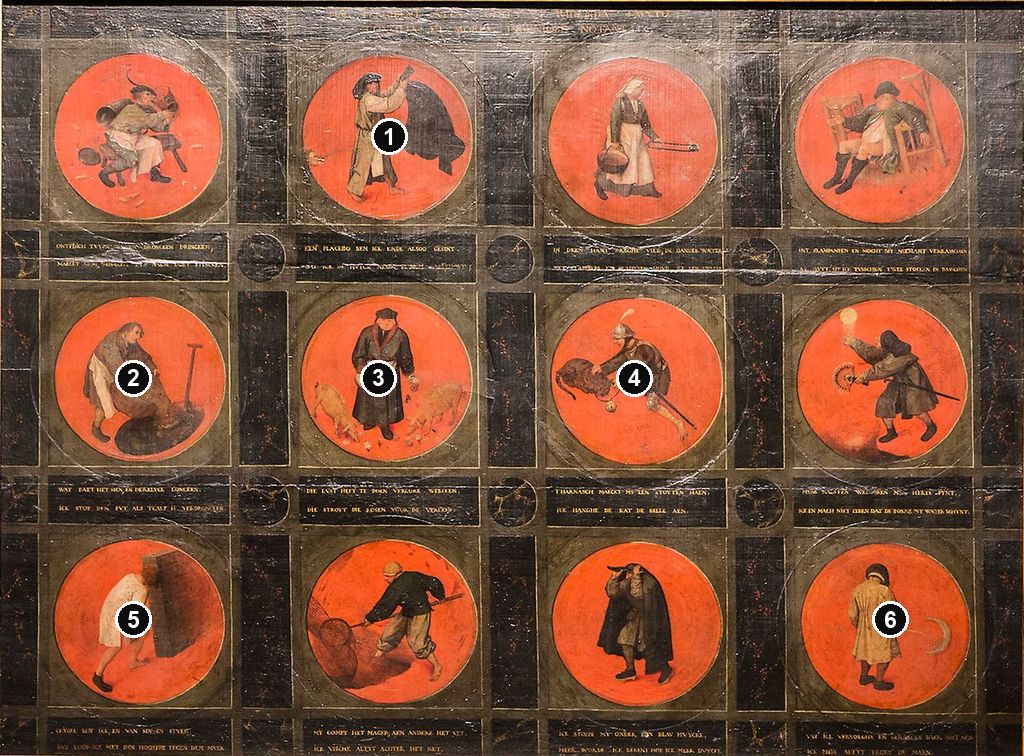
Read across the three rows and notice how gestures and props carry the sayings.
Details from TWELVE PROVERBS
Six selected details pair a visible action with the saying it illustrates.
Holding the cloak to the wind
The cloak projects into the red circle. The saying concerns someone who adapts to the prevailing wind.
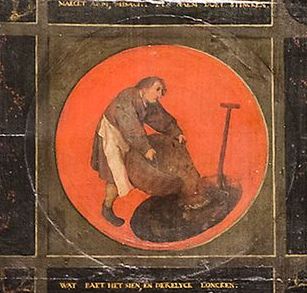
Closing the well too late
The opening lies beneath the man. The inscription explains that the calf has already drowned.
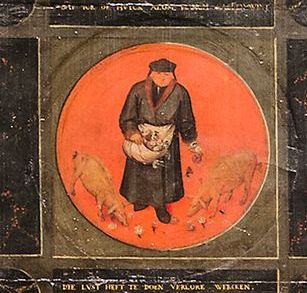
Roses before pigs
The standing figure illustrates wasted effort, comparable to casting pearls before swine.
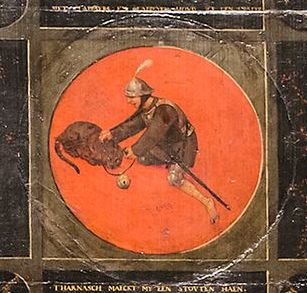
Belling the cat
An armoured figure reaches down to the cat. The caption connects the armour with his show of courage.
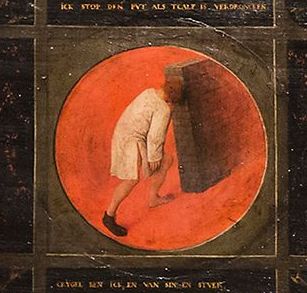
Running into a wall
The forward bend and the dark block turn a proverb about obstinacy into a picture.
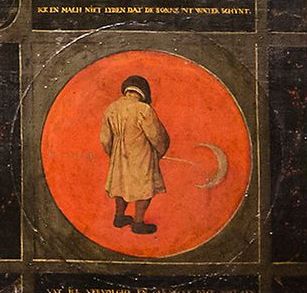
The man and the moon
The small crescent gives the action a target. The caption makes it an image of fruitless effort.
Pieter Bruegel the Elder, Twelve Proverbs on Wooden Plates, 1558. Museum Mayer van den Bergh, MMB.0046. Photograph by Ans Brys, CC0, via the Flemish Art Collection. Cropped to the panel.
The Well, the Pigs, the Cat and the Sun
The middle row begins with the man who closes the well after the calf has drowned. The opening can be found by its dark shape below the man’s bent body. The picture gives the viewer an action in progress, while the text supplies the event that makes the work too late. There is a comparable English saying about securing the stable after a horse has escaped. In both cases the lesson depends on the order of events. The task makes sense on its own, but its timing has made it useless [2].
Next comes the figure scattering roses before pigs. Look close to the feet, where small marks give a direction to the gesture. The museum compares this with the English expression about casting pearls before swine. On the third plate in the row, the cat is approached by an armoured figure intent on fastening a bell. The posture brings him almost down to the animal’s level. The inscription draws its humour from the confidence his armour gives him as he gets ready for the encounter [1] [2].
The fourth circle turns an emotion into a dispute with the landscape. A figure gestures under a small bright disc. The text describes someone who is so vexed by other people’s good fortune that he resents sunlight shining on water. Bruegel gives the complaint a clear direction in the little picture. The arm and the bright point organise the space, even for a viewer who needs the caption to make sense of the grievance [1] [2].
At the Bottom of the Panel
At the left of the bottom row, a man runs his head into a wall. The wall uses a large share of the disc, leaving a narrow interval in which to show the forward bend of the body. The next figure fishes behind the net. The point is that someone else gets the better part while the speaker comes away with the poorer share. Both pictures give a difficulty an ordinary object to work against. The broad face of the wall and the net close to the ground are enough to tell the two actions apart [2].
The third figure wraps himself in a cloak. According to the text, he draws more attention the harder he tries to conceal himself. Its setting makes that paradox easy to see. The dark garment is isolated against a vivid colour, so the attempt to disappear leaves a conspicuous shape. In the last plate, the crescent makes the object of the figure’s action easy to pick out. Urinating towards the moon makes a blunt image of effort directed towards something it cannot reach [1] [2].
From Separate Plates to One Panel
The museum explains that the scenes were painted on twelve individual wooden plates. KIK conservator Aline Genbrugge dates their insertion into the oak mount to the seventeenth century. A nineteenth-century intervention thinned the panel and added a parquet backing. Wood’s response to changing humidity helps explain the stresses and cracks that the conservators describe in both the mount and the plates. Their account also distinguishes later overpainting from the historical changes associated with setting the roundels into the panel [3].
The present mount draws the eye across the rows and down to the written strips. Above them, a Latin inscription frames the scenes as humorous counsel on conduct. It is possible to examine one roundel on its own, but the mounted group also gives the reader a rhythm. The red circles repeatedly bring the eye back to a body, while the smaller lettering slows the passage from one action to the next. Fritz Mayer van den Bergh bought the work at auction in Paris in 1899 [1] [4].
The regular arrangement can make the figures seem more alike than they are. Compare the raised arm and hanging cloak near the top with the bent back at the bottom left. Each painterly gesture takes up a different amount of space inside a circle of roughly the same size. The mount supplies a common format, and the figures show how much variety Bruegel could give an action within it.
The Roundels and Bruegel’s Berlin Painting
Bruegel signed the Berlin Netherlandish Proverbs in 1559, a year after the Antwerp plates. The same image of trying to fill the well too late has a place in the Berlin village. Here in Antwerp the gesture takes up one circle and has writing beside it. In Berlin, the well and its figure have to be found among houses, paths and the many other things people are doing. Follow the same action in both works to see how repetition need not make looking easier in the same way [2] [5].
The settings encourage different movements across the surface. In Berlin a road or the edge of a roof can take the eye from one saying to another. In Antwerp the gap between the red circles repeatedly brings the viewer to a stop. Even a saying that can be read from the pose alone takes on another inflection when the inscription below it gives the speaker a voice. That alternation between looking and reading is part of the object’s history as well as its present effect [1] [5].

Discussion
Which detail in this work most changes how you read it?
Frequently Asked Questions
In the first circle, at the top left, the museum guide identifies the subject as gambling and drinking. The painted figure is compressed into a small space, while the inscription expands the consequences beyond the moment of the action. [2]
The middle row begins with the man who closes the well after the calf has drowned. The opening can be found by its dark shape below the man’s bent body. [2]
At the left of the bottom row, a man runs his head into a wall. The wall uses a large share of the disc, leaving a narrow interval in which to show the forward bend of the body. [2]
References
- Museum Mayer van den Bergh, Twelve Proverbs on Wooden Plates, object interpretation, View source.
- Museum Mayer van den Bergh, English gallery guide, MMB.0046 and the translations of the twelve inscriptions, View source.
- Museum Mayer van den Bergh, interview with Aline Genbrugge of the Royal Institute for Cultural Heritage, View source.
- Museum Mayer van den Bergh, A Fascination for Bruegel, acquisition history, View source.
- Staatliche Museen zu Berlin, Die niederländischen Sprichwörter, Gemäldegalerie 1720, View source.






