


 by Tom Gurney
Tom Gurney BSc (Hons) is an art history expert with over 20 years experience
Published on June 19, 2020 / Updated on October 14, 2023
Email: tomgurney1@gmail.com / Phone: +44 7429 011000
The Beggars: Introduction
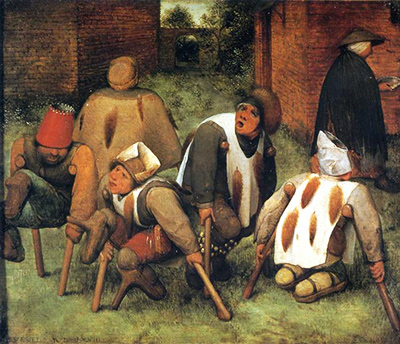
Pieter Bruegel the Elder’s The Beggars is a signed and dated oil painting of 1568 in the Louvre. Five people using crutches or other supports occupy a small piece of ground between brick walls. A sixth figure in a dark cloak stands farther back at the right. Red and white headwear and the tails attached to some garments make the group unusually conspicuous. The Louvre discusses possible links to carnival and to the rebels known as the Gueux. It leaves the scene’s meaning and the significance of the tails unresolved [1] [2].
This work across Bruegel’s career
Tower of Babel
1563The Harvesters
1565Peasant Wedding
1568Children's Games
1560Triumph of Death
1562–1563The Beggars
This artworkContents
- Introduction
- On the Ground between the Walls
- Hats and Tails
- The Small Panel and Its Inscriptions
- Looking at the Group
- Annotated Details
On the Ground between the Walls
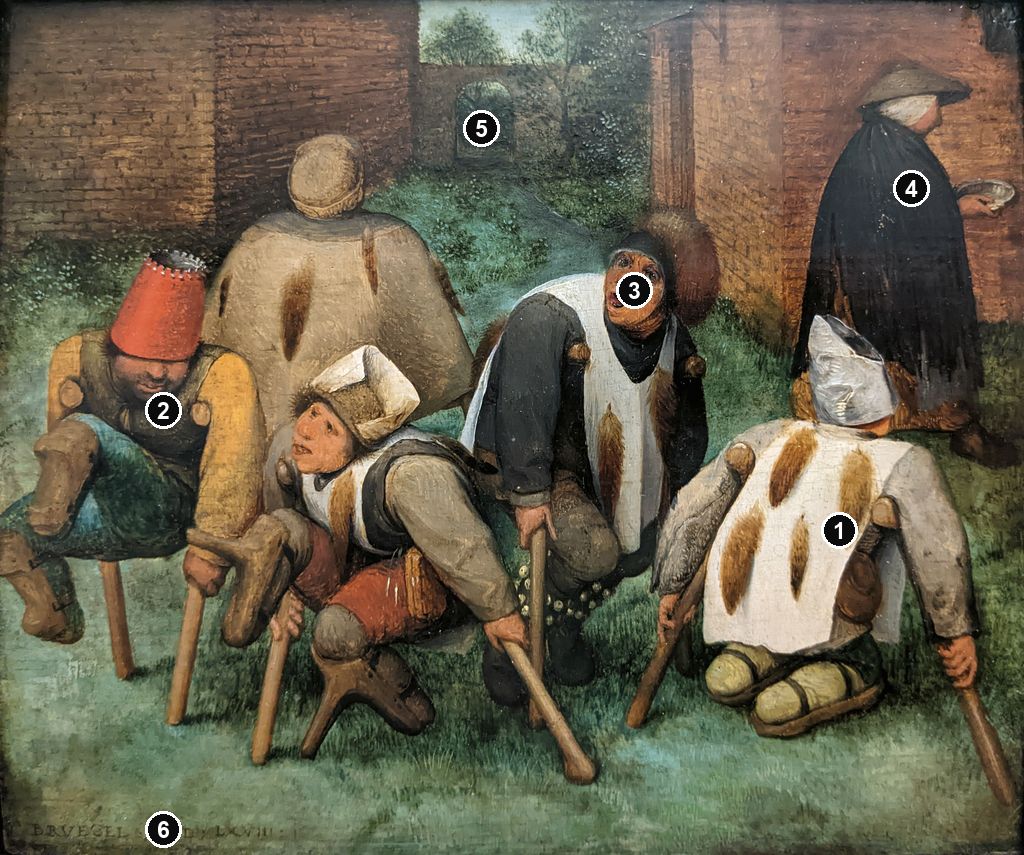
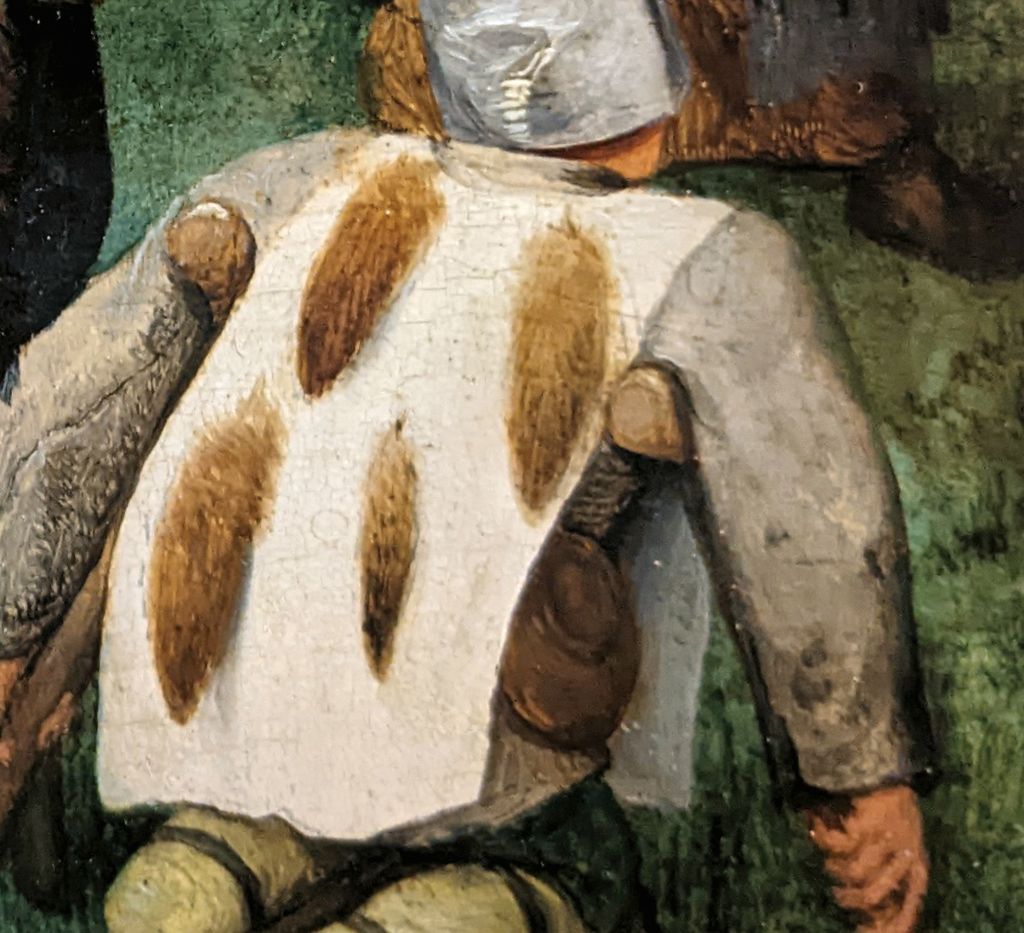
Begin with the figure near the lower right. The white garment gives the eye an easy way in, and the darker attachments break it into several distinct areas. The figure’s back is turned and both arms extend towards the supports on either side. Follow one of those supports down to the grass. Its angle and point of contact give a sense of what the figure is doing on the ground even though the face is hidden. Bruegel paints several different relations between a body and the implements that help it move.
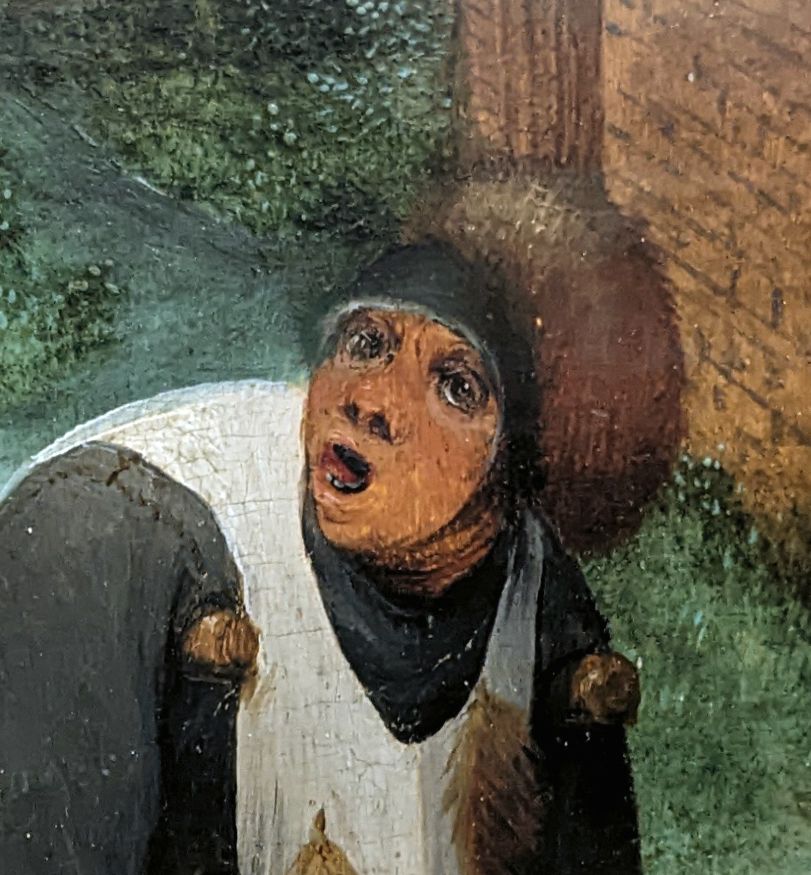
The figure in the middle turns the face up and to the side. The light garment and the dark area around the throat make this movement easy to see. Close by, the person with a light-coloured hat is lower to the ground and turns towards the left. The figures face different directions within a narrow space. Try following the line of each head or shoulder to the ground and comparing where the crutches reach. Their shapes hold the little group together even though its members have no single direction of travel.
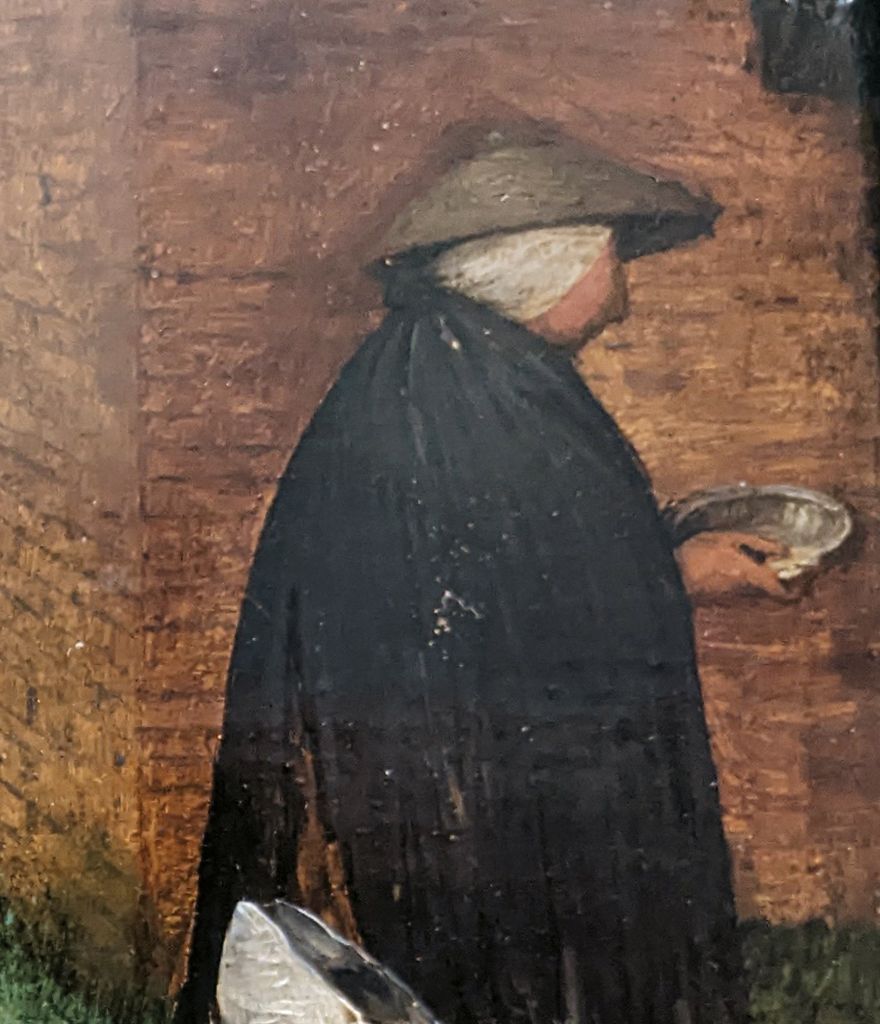
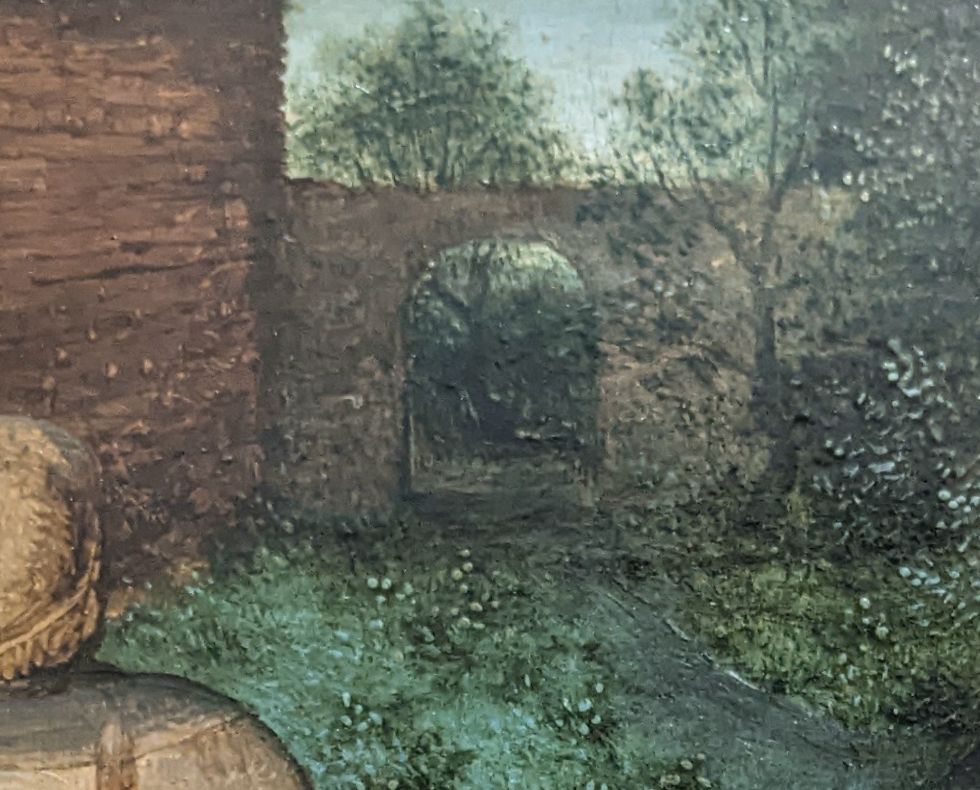
The grass continues into the passage behind the figures. Across that strip of space there is a small dark opening with foliage around it. Compare it with the broad, nearby brick walls. The far opening gives the group a setting with more depth than the space occupied by the bodies alone. At the right, the standing figure wears a dark cloak close to a wall. The spacing makes it possible to register that person separately from the cluster in front, an interval that becomes more visible once we have followed the movement of the nearest figures.
Look for the shallow object in the standing figure’s hand at the right edge. Its light rim interrupts the brick, much as the pale brim interrupts the cloak. The turn of the head and the extension of the hand carry attention away from the five people on the grass. The object gives the standing figure an action of their own and makes the spacing between that figure and the group matter.
Annotated Details from The Beggars
Look at how the group uses the ground, then trace the hats and garments through the painting.
Details from THE BEGGARS
Six details bring the figures, setting and dated signature into view.
Tails on a white garment
The light cloth brings the shapes of the tails into sharp relief. The garments provide clues to the occasion, and their exact meaning remains open.
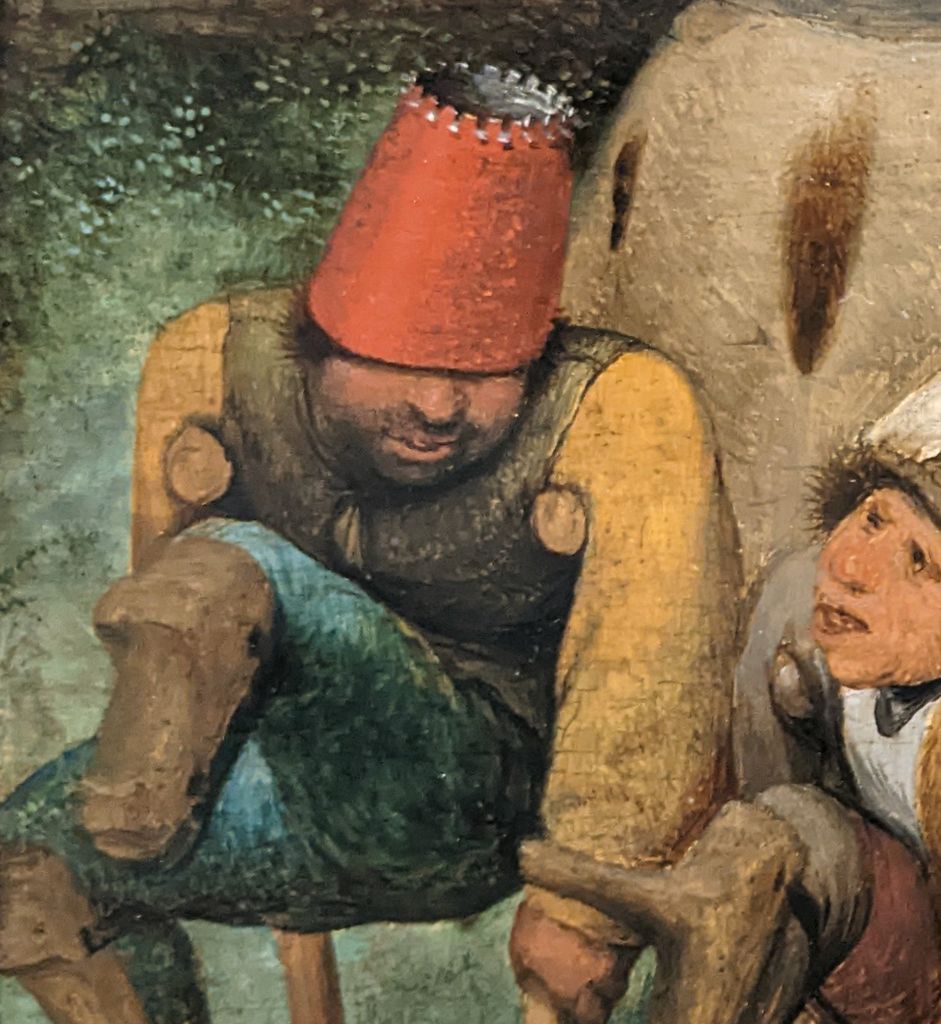
Red headwear and supports
The red headwear identifies a figure near the wall. Follow the arms down to the points where the supports meet the grass.
A face turned upward
The upward angle of the face is clear against the dark collar and hat. Nearby figures look in different directions.
The standing figure
The dark cloak sets the figure apart against the brick. A shallow object is held at the right edge.
An opening beyond the grass
The eye can follow the grass into the distance. Foliage partly encloses the small dark arch.
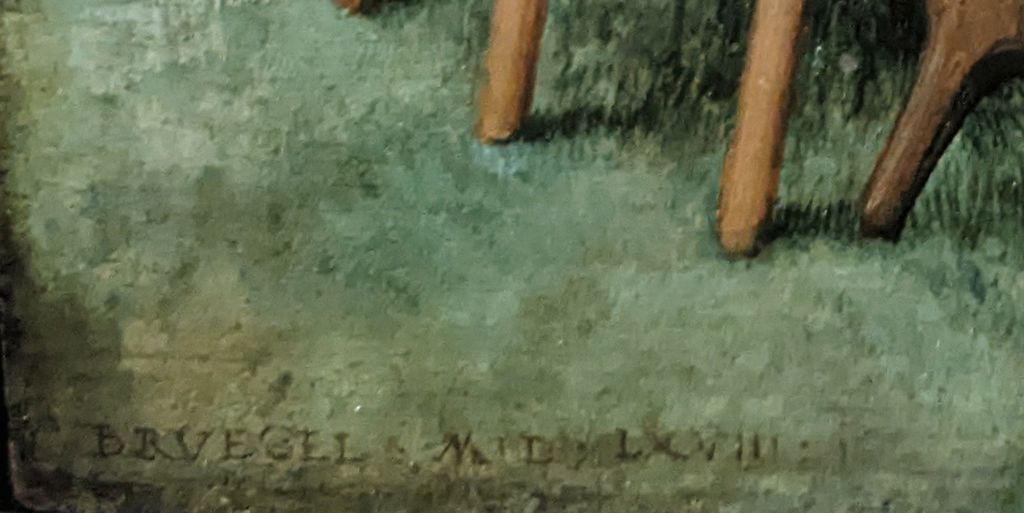
Signature and date
Bruegel’s name and the Roman date for 1568 sit at the lower left, nearly lost amid the marks of the grass.
Artwork source for the main image and annotated details: Musée du Louvre, RF 730. Photograph by Shonagon via Wikimedia Commons, Public Domain.
Hats and Tails
The hats differ in height, colour and shape. The red one at the left rises against the wall, while lighter pieces of headwear help separate the figures near the centre and right. The Louvre draws attention to a paper mitre and the possibility of a mock bishop associated with carnival. A hat shaped to evoke a position of authority can make sense at a festival, where roles may be adopted or played for a short time. Its presence raises a question about what people in this group are wearing for the occasion [1].
The tails are easier to follow on the back of a light garment. The Louvre identifies fox tails and notes that the motif was also associated with the Gueux, rebels who appeared in Brussels in 1567. It also discusses the possibility of a folk custom associated with carnival, particularly Shrove Tuesday. Both readings begin with a detail we can see. The distribution of the tails across clothing gives them a clear role in the composition, while the available evidence leaves their precise historical meaning unsettled [1].
Read the clothes alongside the crutches. The bright shapes point along heads and backs, and the supports lead down to very particular points on the grass. Those two paths through the painting can be followed independently. One directs attention to garments that invite interpretation. The other shows the way the individuals occupy the ground. A costume can be read as a sign, while a support helps describe the work of moving within the confined space.
The Small Panel and Its Inscriptions
The Louvre records the painting as RF 730 and gives the panel itself as 18.5 centimetres high by 21.5 wide. Bruegel signed and dated it at the lower left with his name and the year in Roman numerals. The size changes how a viewer encounters the work. Seen at a distance, the wall, grass and pale clothes form a few broad areas. Viewed nearer, the supports, tails and faces take on shapes of their own. The painting gives so much of the panel to the figures that even a small distinction in posture can change the way the foreground reads [1] [2].
The museum also records old inscriptions on the reverse. It describes a difficult-to-read Flemish inscription that addresses the people represented and a Latin inscription concerning the painter’s ability to rival nature. They are part of the history of how the panel has been read. Their subjects point in different directions, towards the people pictured and towards the maker’s skill. They give the reverse of the panel a record of responses which a viewer concentrating on the faces and garments would otherwise never see [1].
The Louvre lists several early owners with question marks, including the identification with a painting of beggars recorded in an Amsterdam sale in 1607. The more firmly documented later history includes the collector Alfred Sensier and Paul Mantz, who gave the panel in 1892. That chronology is another place where the picture’s evidence has different degrees of certainty. The dated signature can be read directly, while an early inventory title needs enough other information to establish which painting it describes [1].
Looking at the Group
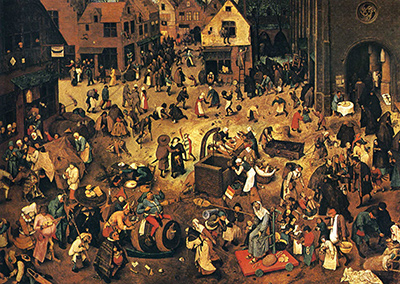
In The Fight Between Carnival and Lent, the town square has room for several festivities and observances to occur at once. Here the walls close off much of the view, and the costumes have to be read in a much smaller gathering. The possibility of a festival helps explain why the Louvre considers the headwear. The unusual details are still visible whether a viewer accepts that account or keeps the date and setting open to further interpretation [1].
Look once more from one of the crutches to a face, then follow the grass towards the passage between the walls. The crowded foreground allows the individual movements to remain distinct. The depth behind it is only just large enough to suggest somewhere else to go. Much of the panel’s force comes from the care Bruegel gives those movements, even as the clothes continue to raise questions about the occasion on which the people have come together.
Discussion
Which detail in this work most changes how you read it?
Frequently Asked Questions
The hats differ in height, colour and shape. The red one at the left rises against the wall, while lighter pieces of headwear help separate the figures near the centre and right. [1]
In The Fight Between Carnival and Lent , the town square has room for several festivities and observances to occur at once. Here the walls close off much of the view, and the costumes have to be read in a much smaller gathering. [1]
References
- Musée du Louvre, Les Mendiants ou Les Culs-de-jatte, RF 730, View source.
- French Ministry of Culture, Les Mendiants ou Les Culs-de-jatte, Joconde record 00000081322, View source.








