


 by Tom Gurney
Tom Gurney BSc (Hons) is an art history expert with over 20 years experience
Published on June 19, 2020 / Updated on October 14, 2023
Email: tomgurney1@gmail.com / Phone: +44 7429 011000
The Conversion of Paul: Introduction
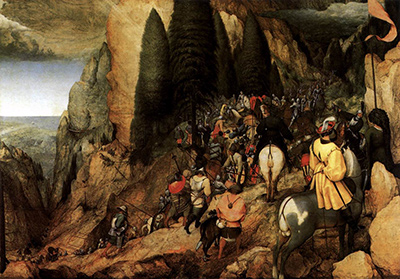
Pieter Bruegel the Elder’s The Conversion of Paul, also called The Conversion of Saul, is a signed oak-panel painting of 1567 in the Kunsthistorisches Museum, Vienna. Riders and foot soldiers negotiate a mountain pass. Saul, the man whose encounter with Christ gives the painting its subject, lies in the middle distance among them. Start with the conspicuous rider in yellow at the right, then follow the line of horses and people up the rocky path. A figure in blue-green comes into view below a horse, where the travelling company bunches together [1] [2].
This work across Bruegel’s career
Tower of Babel
1563The Harvesters
1565Peasant Wedding
1568Children's Games
1560Triumph of Death
1562–1563Conversion of Paul
This artworkContents
- Introduction
- The Riders at the Front
- Finding Saul
- A Ray in the Underdrawing
- The Mountain Route and the Copies
- Annotated Details
The Riders at the Front
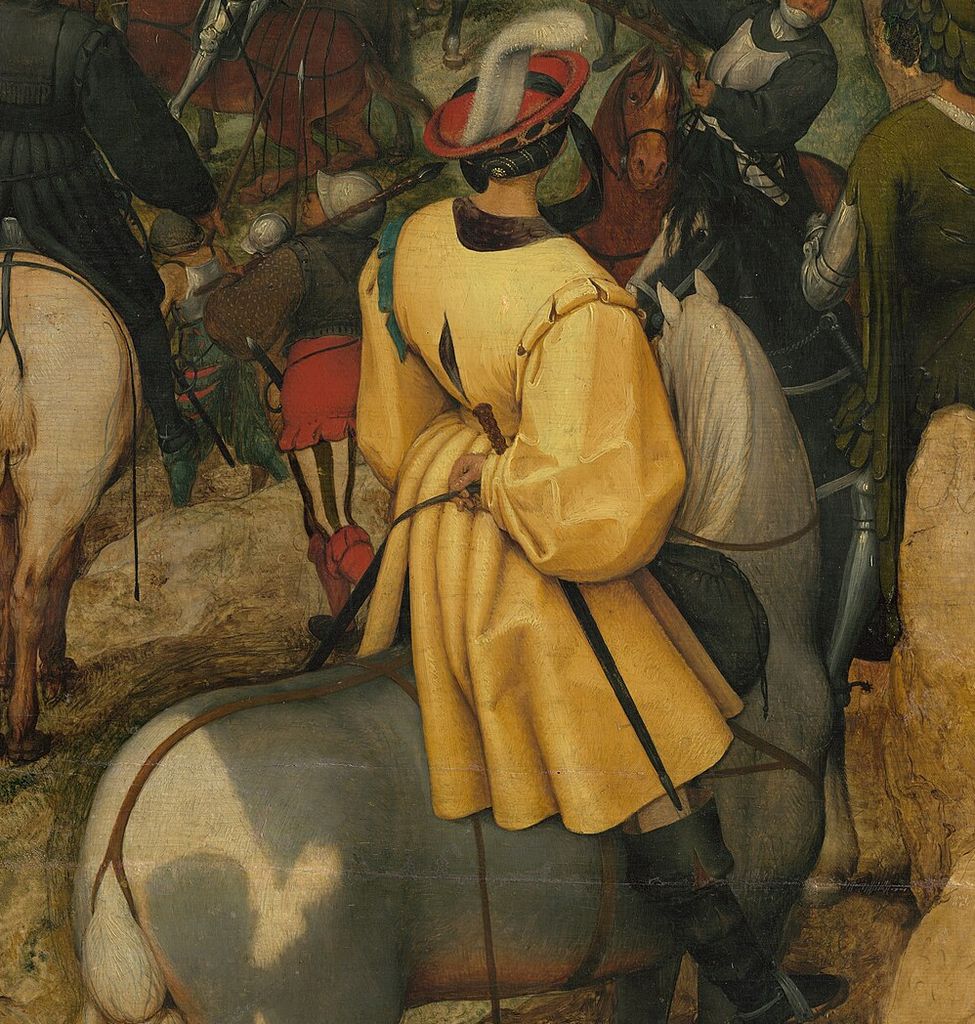
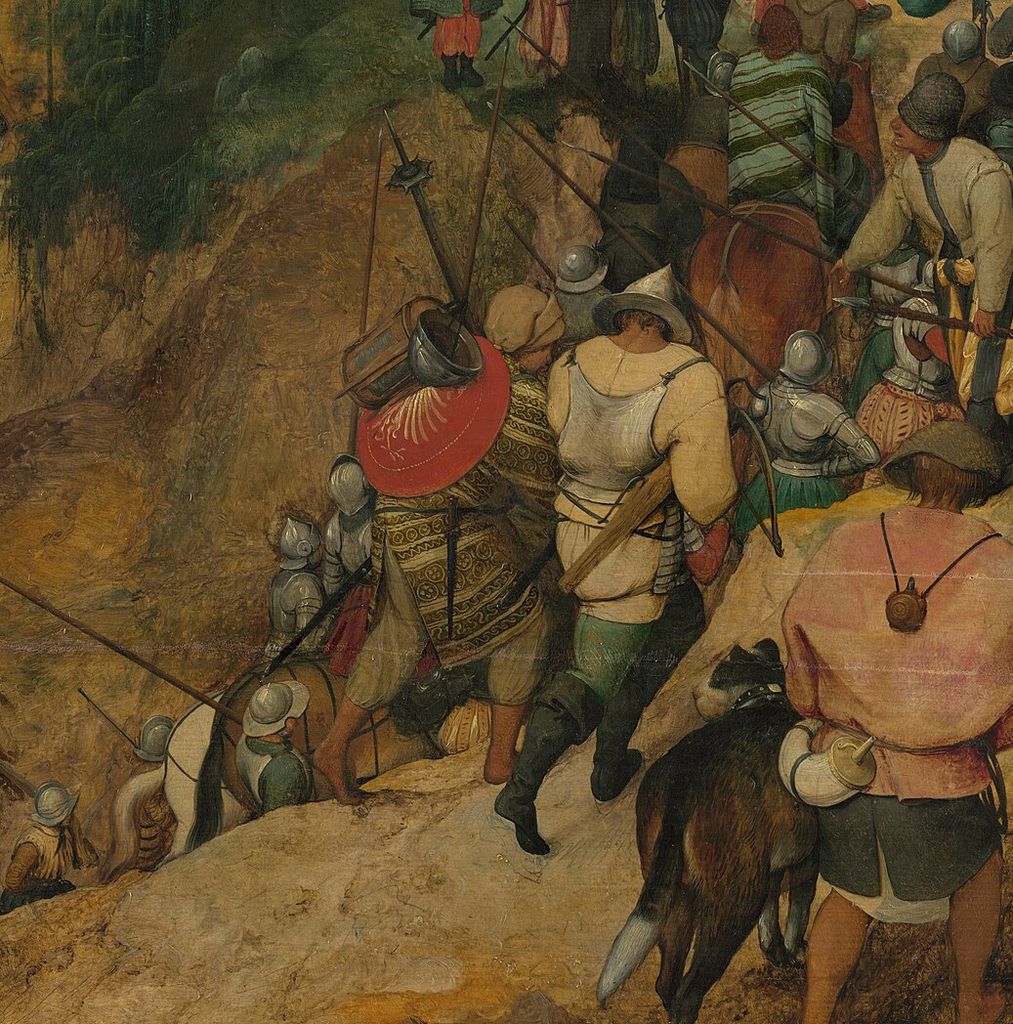
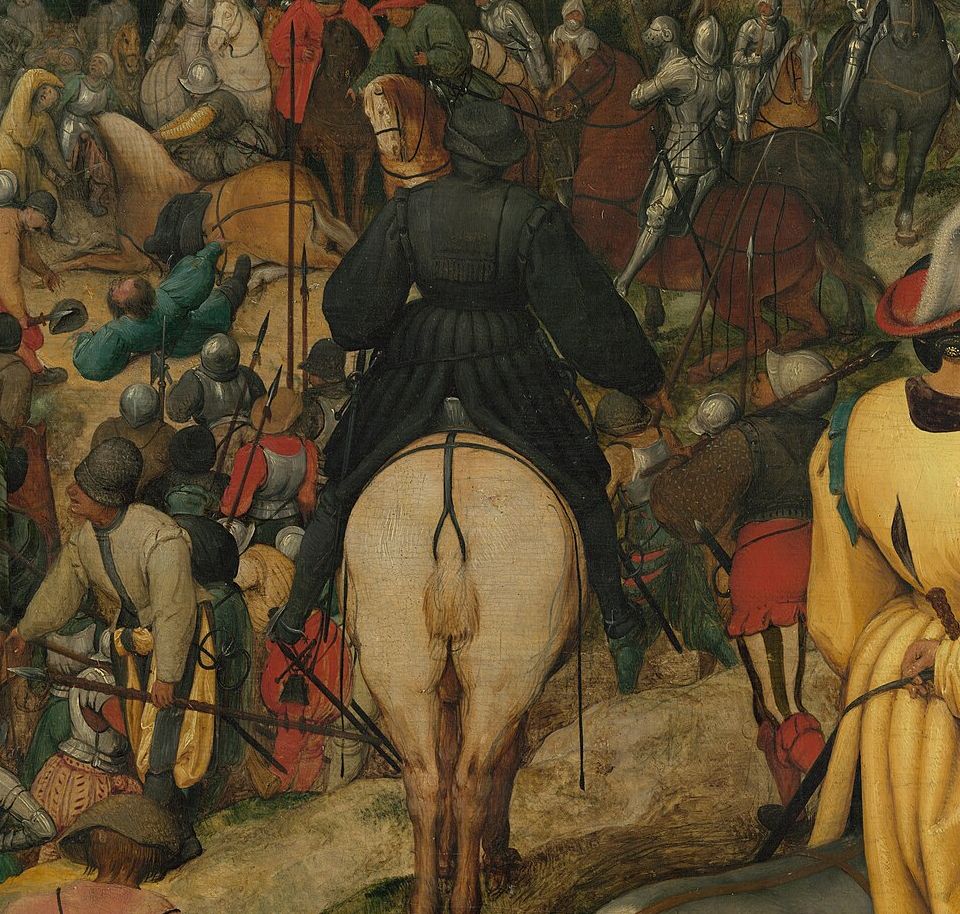
The yellow clothing is among the first things to stand out. Its folds spread over the saddle and give the rider greater visual weight than people farther along the route. The horse turns into the scene, and the rider’s back gives the eye a direction to follow. Nearby a pale horse is seen directly from behind. Its body offers a clear measure of the width of the path. The distance between the two horses becomes more apparent once the eye begins to follow the nearer horse’s legs and then looks to the smaller shapes ahead.
Other figures come up through a stretch of rock below them. Look from a person’s head down to the position of their feet before moving to the next. It is possible to see the slope change as the people climb. Men in armour also carry long shafts that can be traced beyond the space occupied by their bodies. The marks made by these tools help to connect groups who would otherwise be separated by rock or by the bulk of one of the horses. The company extends into much more ground than can be seen from any single rider’s place in the pass.
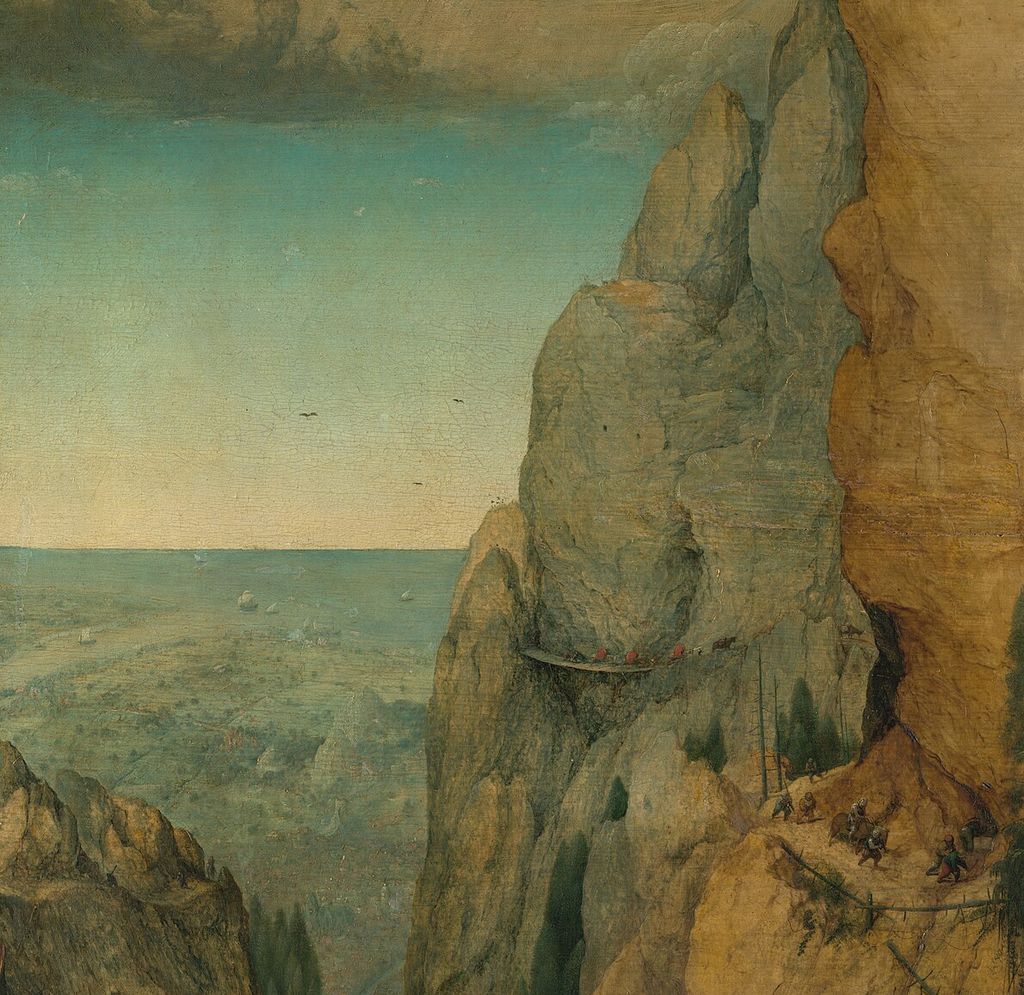
The right side leaves little space between the riders and the rock. At the other end of the painting the open distance becomes visible beyond a steep drop. These two edges of the scene make different demands on the eye. At the right, a rider’s clothing and the movement of a horse can be followed in detail. Across the gorge, much smaller forms suggest land extending to a horizon. The mountain route separates those two scales and gives Bruegel a reason to place a column of figures between them.
Annotated Details from The Conversion of Paul
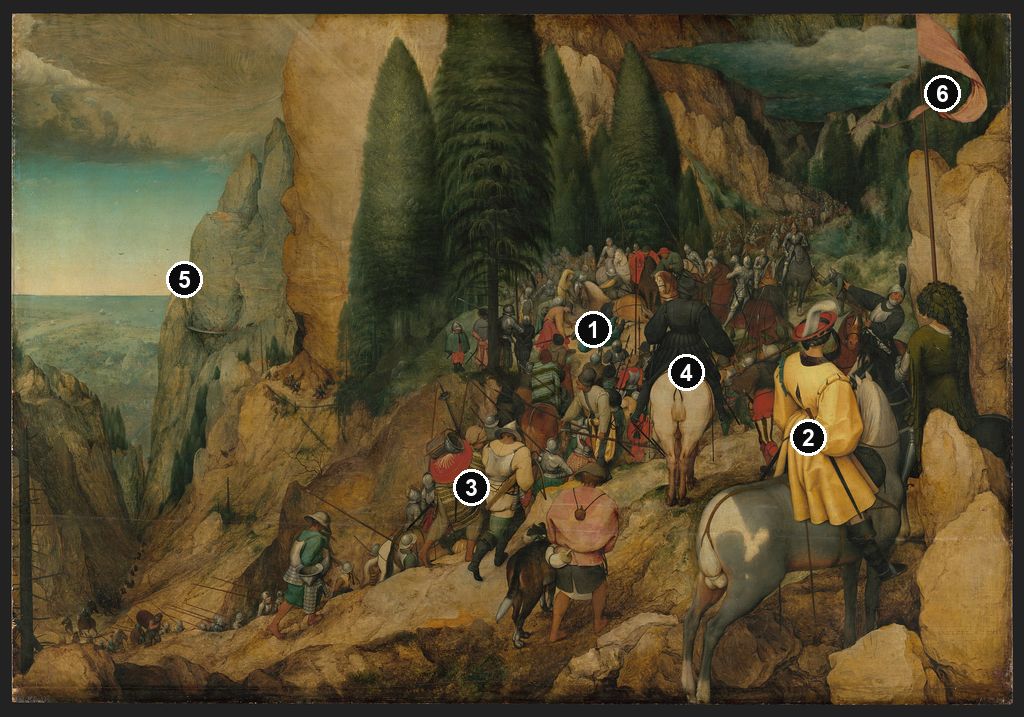
Start at the front of the column and follow the winding path to Saul.
Details from THE CONVERSION OF PAUL
Six details show the route, the scale of the figures and the position of the conversion.
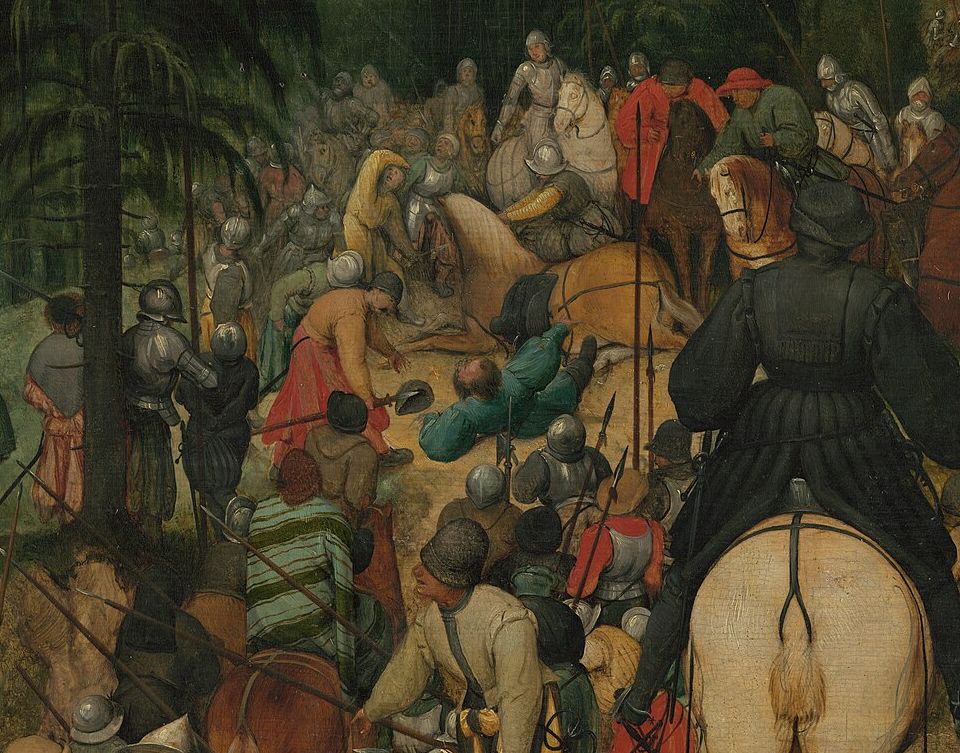
Saul on the ground
The blue-green figure lies low below a horse. The figures around him make this part of the pass busy even as the journey is interrupted.
The rider in yellow
The bright folds and the broad flank of the horse stand out at the front. Both turn the eye towards the rising path.
People climbing the pass
Folds of rock separate the nearest figures. Long shafts link them to others already higher on the route.
The pale horse from behind
The hindquarters mark the width of the path and give the eye a point from which to look farther into the company.
Distance across the gorge
The ridge opens to distant ground and a low horizon. The nearer cliff occupies much more of the view.
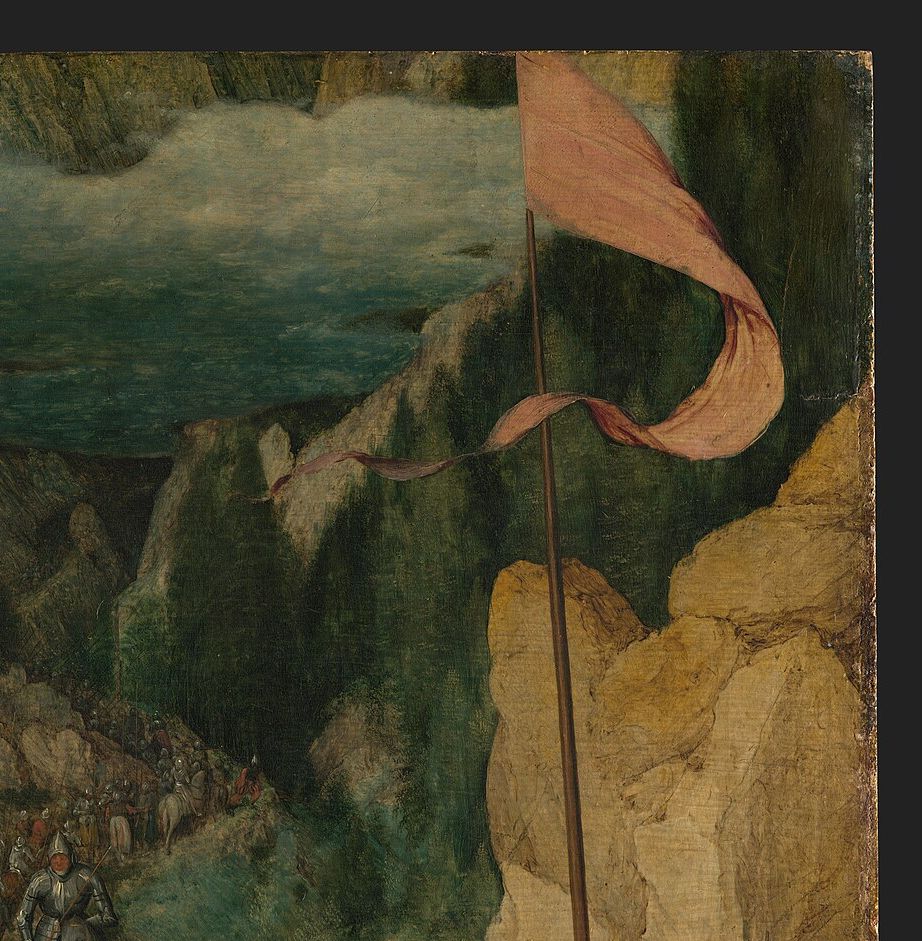
The flag above the route
The raised flag is easy to see against rock and sky. Follow its pole back down towards the riders.
Artwork source for the main image and annotated details: Kunsthistorisches Museum, Inside Bruegel, GG 3690. Public Domain.
Finding Saul
Look beyond the pale horse into the compact area where several people bend or turn. Saul is down on the ground in blue-green. That position is one of the clues to identifying him. Other figures are moving along the path on foot or horseback, and he occupies only a short stretch of it among the legs and bodies. Currie and Allart describe how easily the incident can be overlooked within the larger company. The distance to Saul makes the search for him part of looking at the painting [1].
In Acts 9, Saul has authority to bring followers of Jesus to Jerusalem from Damascus. As he approaches Damascus, a light surrounds him and he falls, hears the voice of Jesus and rises unable to see. His companions lead him by the hand into the city. The text describes his fall to the ground, while the painting includes horses as part of the journey. The crowd here supplies the practical setting for an interruption. People have to make room in a place where the way ahead is narrow [3] [1].
The forward motion in the foreground helps establish how small that interruption can initially seem. It is possible to follow the line of people deeper into the rocks before recognising that somebody is down nearer the centre. Once you find him, some of the nearby poses and intervals acquire a different significance. The painting keeps the event visible even as so many other people have their own next steps to take.
A Ray in the Underdrawing
The Vienna panel is inventory GG 3690. Currie and Allart record dimensions of 108 by 156.3 centimetres and study the design beneath the visible paint. They identify an incised horizon and an underdrawn ray from the sky leading towards Saul, with evidence of a second trial line. These marks show a practical effort to determine the direction from which the revelation would come. The landscape’s long horizon and the much smaller incident among the horses both required decisions about straight lines [1] [2].
The researchers also discuss evidence that the panel was cut at the upper and left edges. They connect a surviving trace at the top with what may once have been a fuller celestial orb. A copy in a British private collection preserves an orb and gives a comparison for the altered upper edge. In the Vienna painting today, the foreground figures and the body of Saul are easier to follow than the origin of the ray. Attention to the object’s history helps explain why the incident reads as it does now [1].
The authors describe the underdrawing of the foreground figures as exploratory. They suggest Bruegel worked out contours directly on the panel. That finding makes the relationship between people and rocks more interesting to inspect. The crowd looks as if it had to find usable ground, and the surviving lines show the artist trying out placements of his own. In this work the technical study helps a viewer distinguish a planned direction, such as the ray, from the searching lines used to arrange several nearby bodies [1].
The Mountain Route and the Copies
In the original, a row of dark trees rises alongside the climbing company. They divide sections of rock from the men and horses, and their height gives the nearer people something against which to measure their size. Above and behind the trees the path turns again. A viewer who first noticed the yellow garment can now follow that route past Saul and into the distance. This does not require identifying the gorge with a real location. The painting makes its terrain legible through the varying spaces available to the people travelling in it.
The study distinguishes the Vienna original from two known copies, including one in the Villa Vauban in Luxembourg. Infrared examination of the Luxembourg work revealed upside-down groups of figures beneath the sky, related to versions of the Procession to Calvary associated with Pieter Brueghel the Younger. That discovery concerns the support reused for the later copy. It has a separate significance from the underdrawn ray and horizon in the Elder’s oak panel. The comparison shows how evidence beneath two similar compositions can tell different stories about how they were made [1].
Go back to the nearest horse and move towards Saul once more. Now the animals and figures supply a sequence of distances, each taking the eye deeper along the route. The fallen man hardly changes that overall shape. He changes what the company’s movements mean once you have recognised the incident they surround.
Discussion
Which detail in this work most changes how you read it?
Frequently Asked Questions
Look beyond the pale horse into the compact area where several people bend or turn. Saul is down on the ground in blue-green. [1]
The study distinguishes the Vienna original from two known copies, including one in the Villa Vauban in Luxembourg. Infrared examination of the Luxembourg work revealed upside-down groups of figures beneath the sky, related to versions of the Procession to Calvary associated with Pieter Brueghel the Younger. [1]
References
- Christina Currie and Dominique Allart, Observations on the Genesis of Pieter Bruegel the Elder’s The Conversion of Saul and the Examination of Two Copies, in Bruegel, The Hand of the Master, Essays in Context, 2019, View source.
- Royal Institute for Cultural Heritage, La Conversion de saint Paul, BALaT record 11027025, View source.
- United States Conference of Catholic Bishops, Acts of the Apostles 9, View source.








