


 by Tom Gurney
Tom Gurney BSc (Hons) is an art history expert with over 20 years experience
Published on June 19, 2020 / Updated on October 14, 2023
Email: tomgurney1@gmail.com / Phone: +44 7429 011000
The Alchemist: Introduction
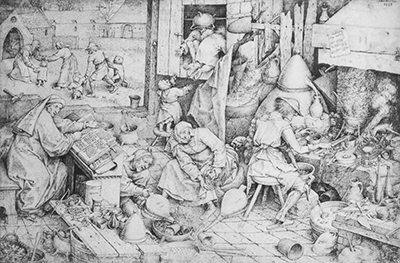
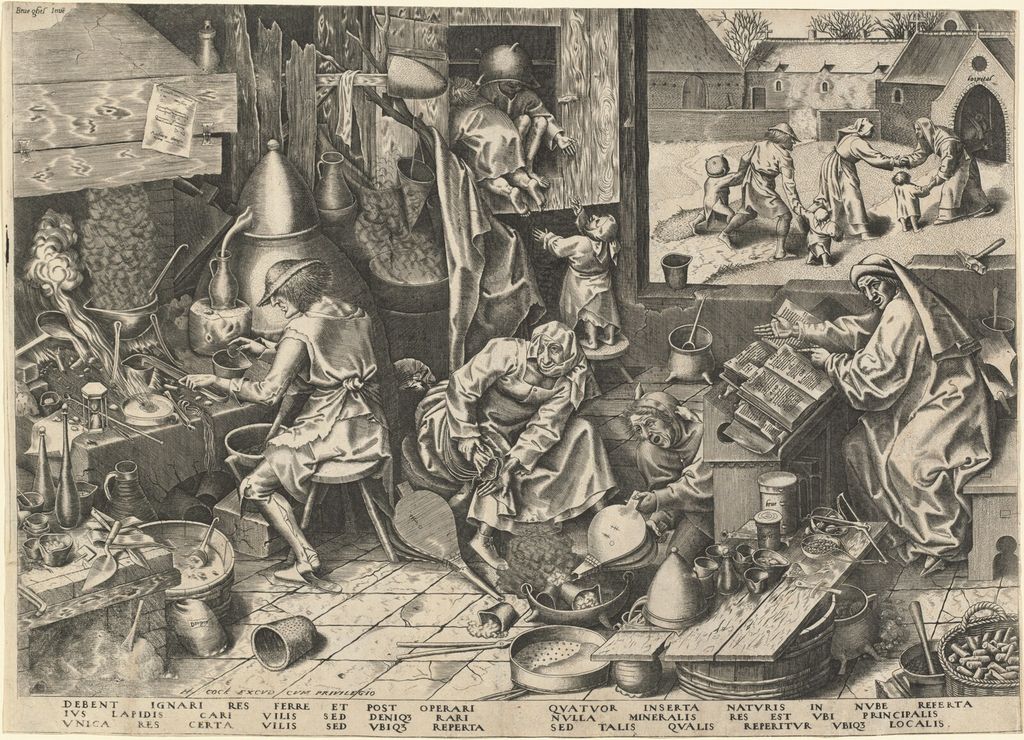
Pieter Bruegel the Elder’s The Alchemist is a drawing in the Kupferstichkabinett in Berlin, usually dated around 1558. The drawing above shows a family living and working among the instruments of an alchemist. He sits beside a fire and prepares to drop a coin into a vessel. A woman displays an empty purse. Behind them, an opening gives a view of the family arriving at a poorhouse. Philips Galle engraved Bruegel’s design for Hieronymus Cock, reversing the arrangement [1] [2] [3].
This work across Bruegel’s career
Tower of Babel
1563The Harvesters
1565Peasant Wedding
1568Children's Games
1560Triumph of Death
1562–1563Alchemist
This artworkContents
- Introduction
- A Coin at the Hearth
- An Empty Purse and an Empty Cupboard
- The Book and the View into the Future
- Bruegel’s Drawing and Galle’s Print
- Annotated Details
A Coin at the Hearth
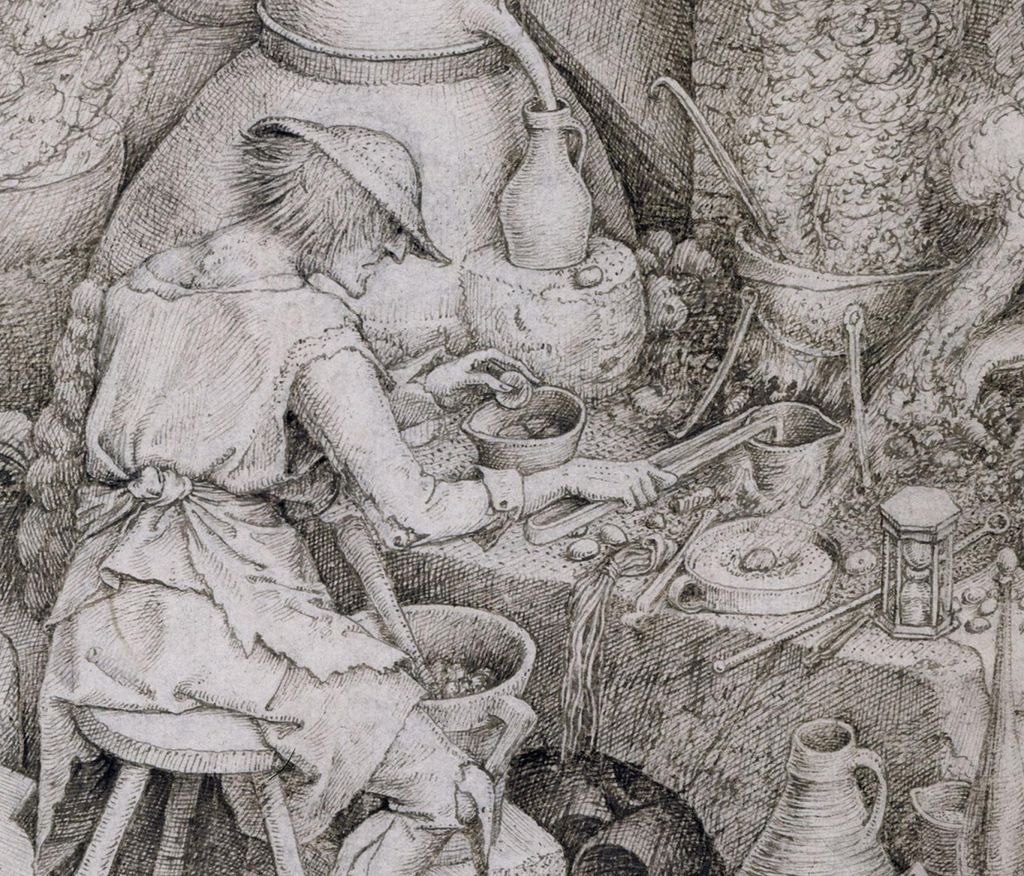
Find the seated man beside the hearth at the right of the drawing. His elbows, the edge of the stool and the vessels in front of him make a small working area. Follow the hand reaching towards the mouth of a container. According to the exhibition catalogue edited by Nadine Orenstein, the object poised above it is a coin. It is a small detail at the meeting point of two activities. Money is being spent, and the equipment is arranged as though it might bring something of greater value into being [1].
The hearth and its smoke occupy much of the right edge. Many smaller objects sit in front of it, including containers at different heights and angles. Seen together they establish the extent to which the room has been given over to the undertaking. Look at a container by itself and it may seem to belong in an ordinary household. Trace the vessels, the fire and the seated man from one to the next, and they begin to look like a workshop assembled in the space of a home [1] [2].
A person works a pair of bellows nearer the middle. The catalogue identifies him as a fool. His face and the angle of the bellows allow a viewer to see the effort that goes into maintaining the heat. The fire could be described through its flames alone. Bruegel includes someone who has to help keep it going, which makes the experiment look like an occupation requiring repeated work. The bellows, smoke and vessels give a concrete shape to the time and resources being spent [1].
Annotated Details from The Alchemist
Follow the coin, purse and distant doorway through Bruegel’s drawing.
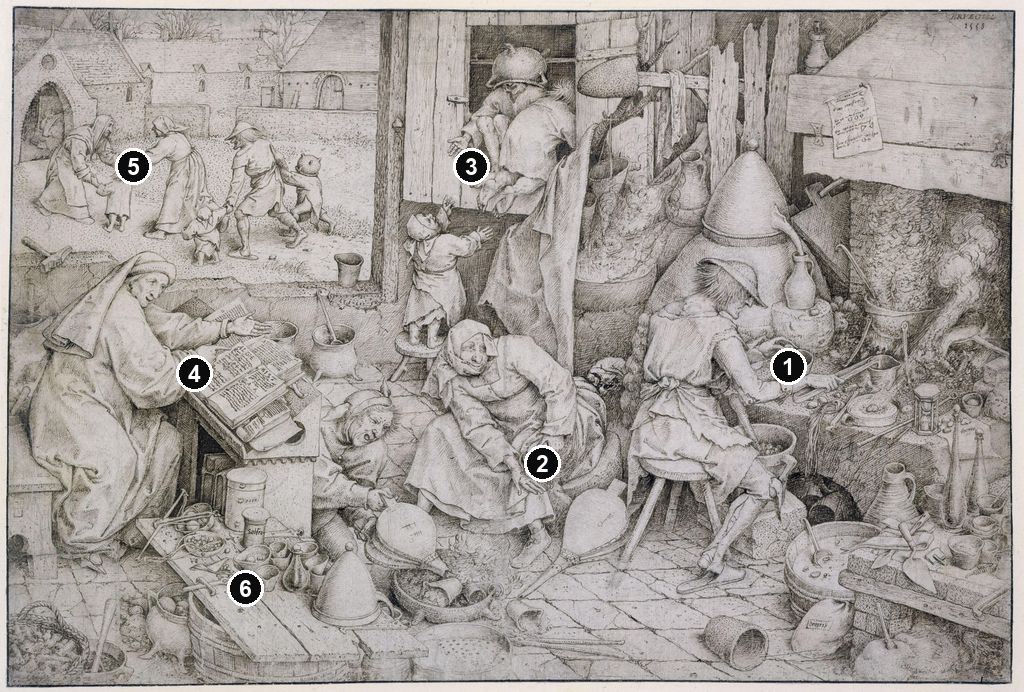
Details from THE ALCHEMIST
Six details show the work taking place inside and what becomes of the household.
The alchemist at the hearth
Follow the seated man’s hand towards the vessel. The coin is a small part of a much larger arrangement.
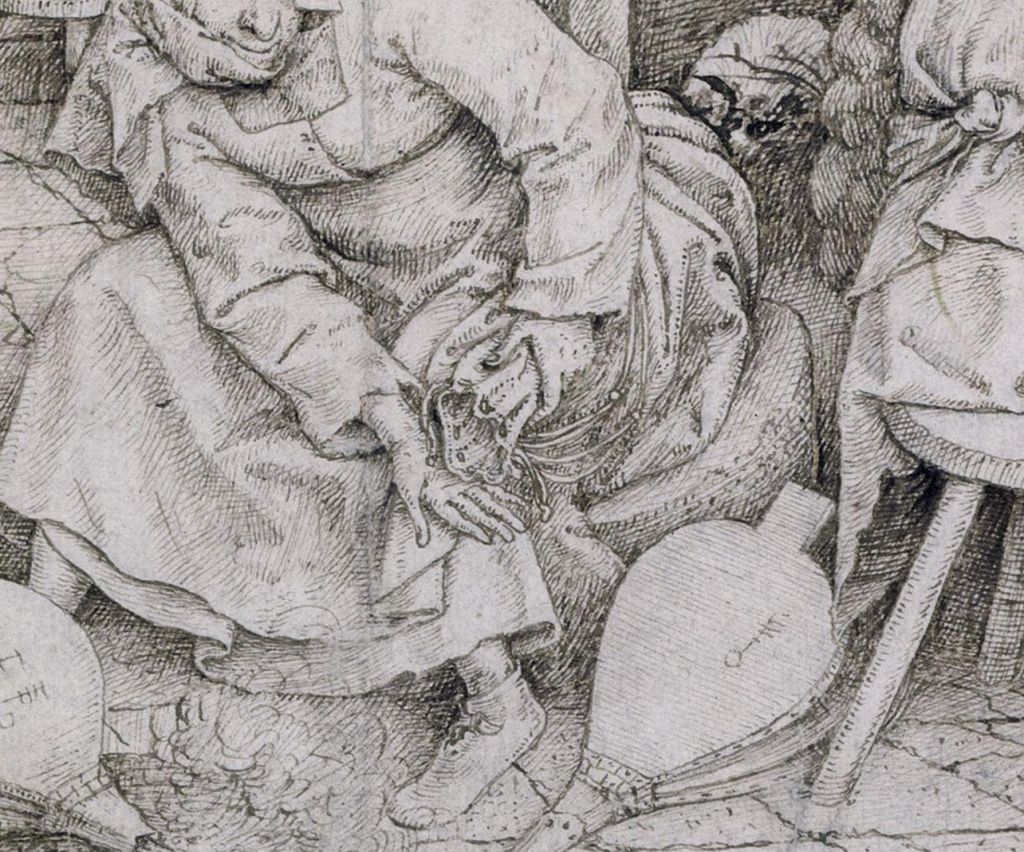
The empty purse
The woman displays an empty purse at the centre of the room, close to the work that consumes the household’s money.
Children at the cupboard
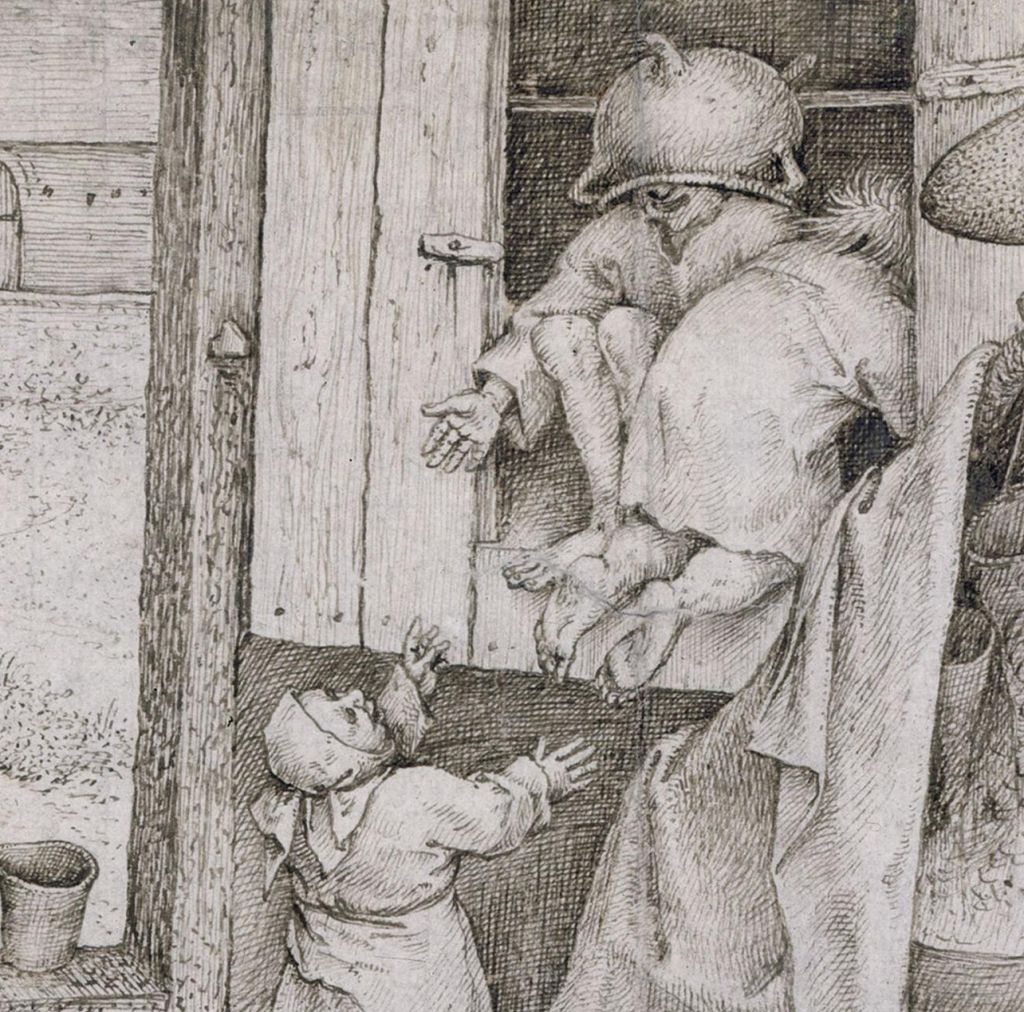
The children occupy an opening above the adults. The upper child wears a pot.
The scholar and his book
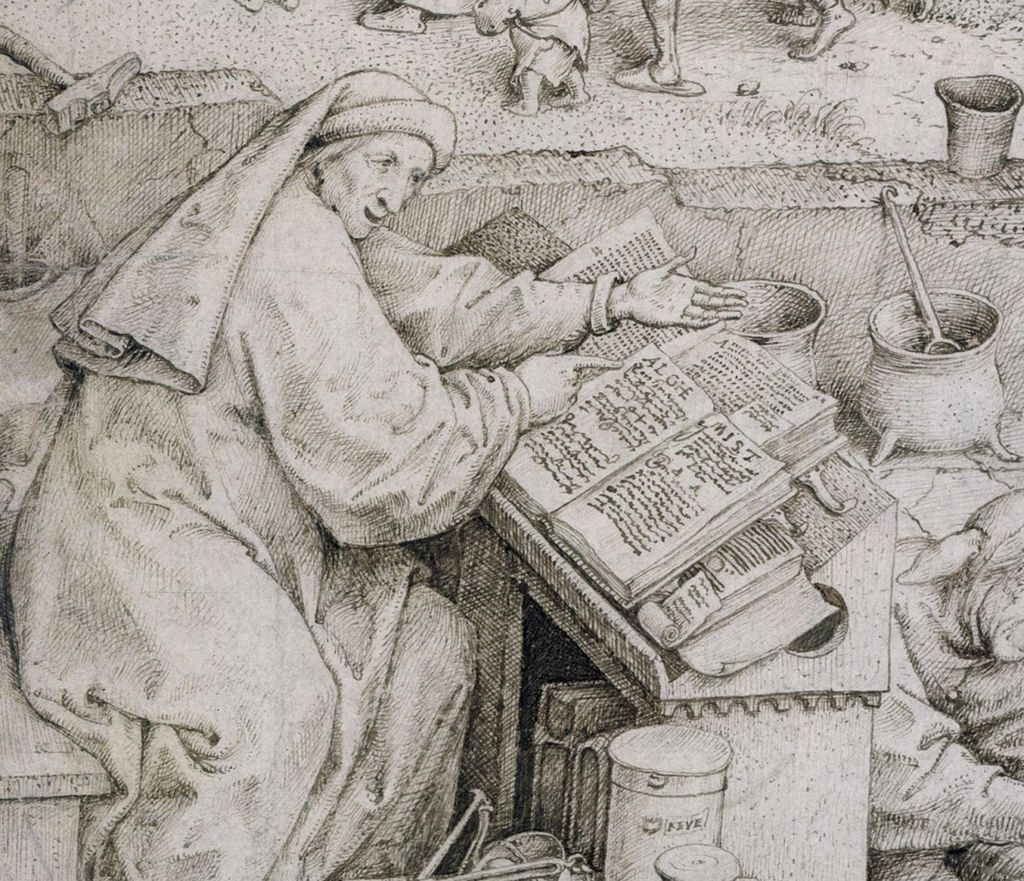
The scholar gestures from the lectern. His book is one of the elements that supplies the scene with a verbal comment.
The poorhouse doorway
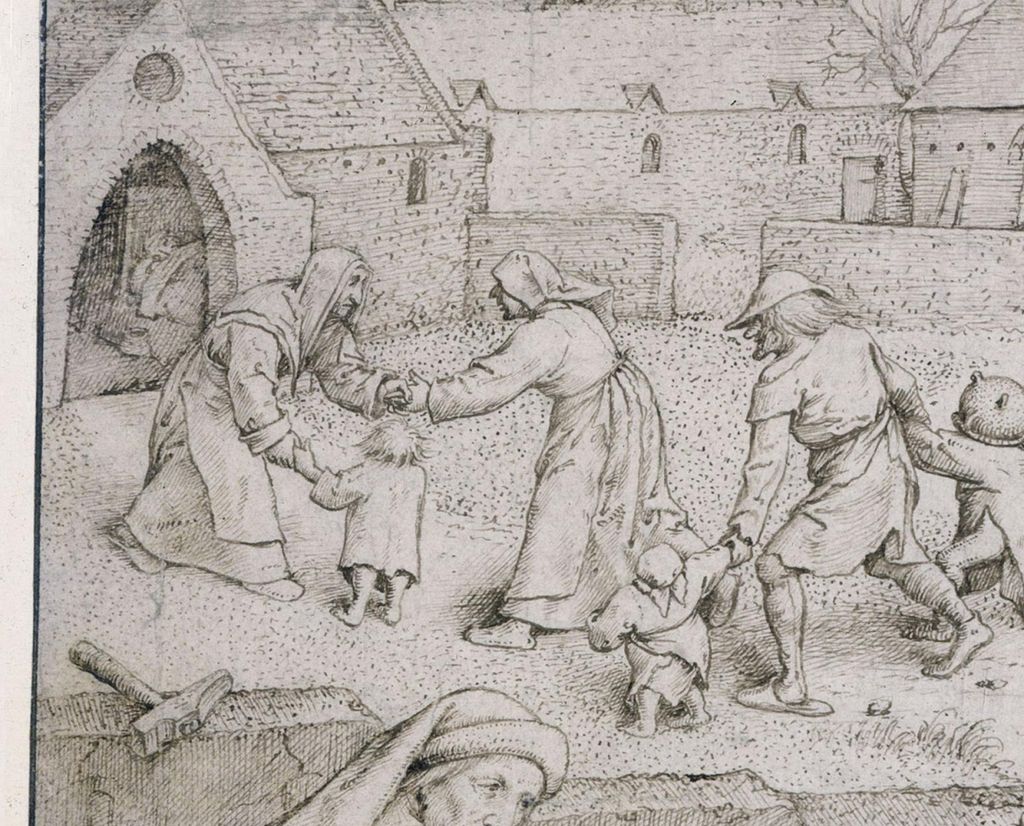
The distant scene shows the family received at the poorhouse. It is the later outcome of the work below.
Still life on a shutter
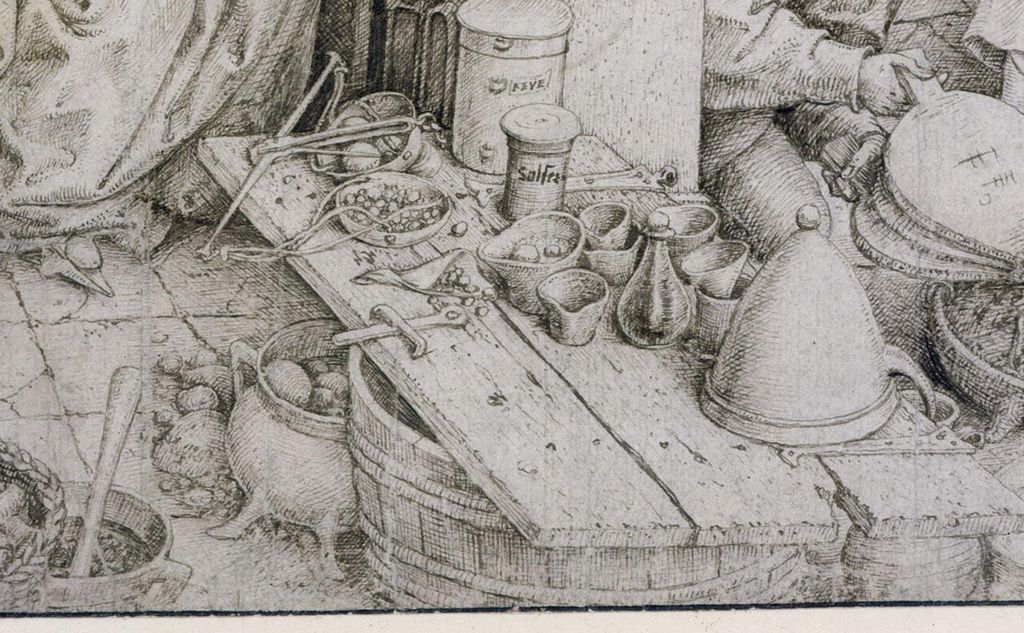
Several objects crowd a surface that serves as a table. The scale and the vessels can be picked out among the smaller marks.
Drawing source for the main image and annotated details: Staatliche Museen zu Berlin, Kupferstichkabinett, KdZ 4399. Public Domain.
An Empty Purse and an Empty Cupboard
The woman near the centre holds out an empty purse. The gesture is easy to compare with the alchemist’s movement at the hearth. The same household has a coin to put into an experiment and a purse with nothing left to show. Bruegel makes those two facts visible close together. The figures bend or turn towards different tasks, so the viewer has to join the purse to the coin even if the people give little sign of having done so themselves [1] [2].
Several children are visible behind the adults. One has a pot over the head, and they scramble around the opening of a cupboard. Look from the pots in use by the fire to the pot carried by the child. The two situations occupy different heights in the same room. The child can turn the vessel into a piece of play, while the person at the hearth sees a tool for his work. The cupboard offers little else. Bruegel allows signs of disorder and scarcity to occupy a place that ought to be used for storing household supplies [1].
The table at the front is piled with smaller objects. The exhibition catalogue describes it as an old window shutter placed on a barrel, with vessels and a collapsed scale on top. Those details reward a look at what is nearest before the eye returns to the larger figures. Objects are being used for whatever purpose the household can find for them. The improvised support beneath the vessels makes that visible without the need for a separate scene [1].
The Book and the View into the Future
At the left a scholar sits at a lectern and gestures toward an open book. The drawing gives the book the words Alghe Mist. The exhibition catalogue explains the phrase as a play on the name for the alchemist and a Dutch expression for something spoiled or foul. A reader can follow the scholar’s pointing hand and take the name as a comment on the activity taking place alongside him. His clothes and his place at the lectern give him a different position from the people mixing, heating and carrying things [1].
The next stage is visible above the scholar, through the opening at the back. The family approaches a doorway outside, where they are received at a poorhouse. In the room the work remains underway. In the distant view its outcome has already arrived. Bruegel can keep both moments visible by giving them different places and scales. He makes the cupboard and the purse part of the immediate evidence, and the distant doorway makes it possible to see where their depletion leads [1] [2].
Bruegel’s Drawing and Galle’s Print
The Berlin sheet is KdZ 4399. Its pen-and-brown-ink lines were indented for transfer, and the catalogue notes that the date at the upper right may be in another hand. It also identifies a revised leg of the alchemist’s stool. The trace of the earlier outline gives a viewer a small instance of Bruegel working out the arrangement on the page. The image had to be legible enough to supply the engraver with a design while still allowing changes to individual objects [1].
In the National Gallery of Art’s engraving, the hearth moves to the left, and the scholar and the view of the poorhouse appear on the right. The engraved impression also carries wording below its border. That margin and the credited maker roles provide separate evidence about the publication. Bruegel made the design, Galle engraved it and Cock put the print into circulation. The main objects of the workshop remain recognisable on either side of the comparison [1] [3].
The National Gallery of Art records Latin lines beneath its impression concerning the supposed stone and the materials it might transform. Their elaborate language differs from the directness of the little story above. Look at where the family ends up and then read the printed words as a reader might have done with the sheet in hand. The promises attached to the search for a precious substance have to share the page with a purse that has nothing in it and a family whose next stop is already shown [1] [3].
Return to the coin, then find the purse and finally the doorway in the distance. These details are small in proportion to the whole work. Their positions allow the household’s choices and their consequences to be read without leaving the room. A reader can spend time recognizing the equipment or follow the sequence straight through, from the experiment to the point where the family has to ask for help.
Discussion
Which detail in this work most changes how you read it?
Frequently Asked Questions
Find the seated man beside the hearth at the right of the drawing. His elbows, the edge of the stool and the vessels in front of him make a small working area. [1]
At the left a scholar sits at a lectern and gestures toward an open book. The drawing gives the book the words Alghe Mist . [1]
References
- Nadine M. Orenstein, ed., Pieter Bruegel the Elder, Drawings and Prints, Metropolitan Museum of Art, 2001, nos. 60–61, View source.
- Maarten Bassens and Joris Van Grieken, Bruegel, The Complete Graphic Works, 2019, View source.
- National Gallery of Art, The Alchemist, engraving after Bruegel by Philip Galle, View source.








