


 by Tom Gurney
Tom Gurney BSc (Hons) is an art history expert with over 20 years experience
Published on June 19, 2020 / Updated on October 14, 2023
Email: tomgurney1@gmail.com / Phone: +44 7429 011000
Alpine Landscape: Introduction
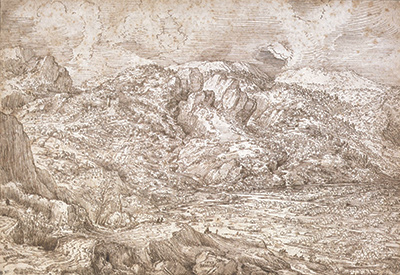
Pieter Bruegel the Elder’s Alpine Landscape opens onto a wide plain below a broken wall of mountains. The foreground is almost as precipitous as the cliffs in the distance. A narrow path holds several small travellers, each easy to miss amid the strokes that describe the ground. The Louvre keeps the drawing in its Department of Graphic Arts as INV 19728, recto. The pen and brown ink sheet measures 23.6 by 34.3 centimetres. The museum dates it to 1553, a year also written on the sheet by a later hand. The case for that date rests partly on comparison with a related drawing in London [1] [2].
This work across Bruegel’s career
Tower of Babel
1563The Harvesters
1565Peasant Wedding
1568Children's Games
1560Triumph of Death
1562–1563Alpine Landscape
This artworkContents
- Introduction
- The Path above the Plain
- Cliffs, Trees and Sky
- The Inscription and the Date
- Other Landscapes with Similar Titles
- Annotated Details
The Path above the Plain
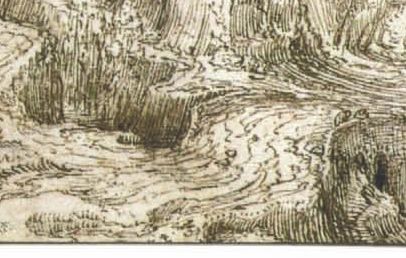
Start at the lower left, where the ground forms a succession of ledges. A pale track occupies some of the space between them. The cliff faces are darker where the pen lines gather vertically and turn with the rock. The track then shifts direction across the lower part of the sheet, towards a rise near the centre. Its light passages look almost unmarked beside the walls of the gullies. That contrast makes the path easy to find once you know where to look, even though the drawing leaves it much less strongly defined than the rock.
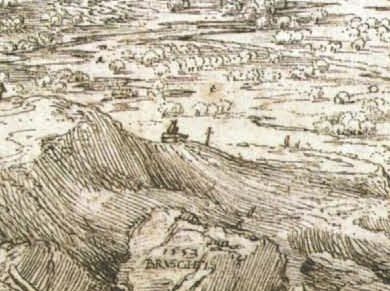
Two small figures on the rise give the nearer terrain a human scale. Further along, other travellers appear in similarly small groups. The exhibition catalogue observes how much smaller they are than their surroundings. It also raises the possibility that the journey represents a passage through life, comparing the treatment of travellers here with those in Bruegel’s London drawing. The landscape supports that reading through the way it asks the eye to discover and follow the route. The travellers’ scale leaves their identities and destination open [2].
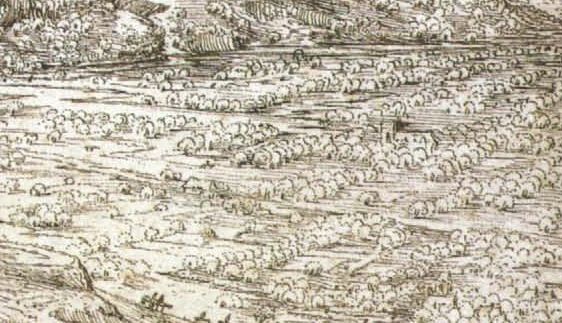
Following the track down towards the plain changes the apparent size of the sheet. Ground that looked like a narrow foreground strip now contains a succession of slopes, dips and turns. At the right, the view widens into flatter ground with groups of trees defined by short loops. Horizontal marks pass between them. The distant trees are as small as the figures had seemed on first looking, but the route has supplied an intermediate scale. You can trace the passage from an individual traveller to the expanse that lies below.
Annotated Details from Alpine Landscape
Begin at the path and follow it from the steep foreground to the plain.
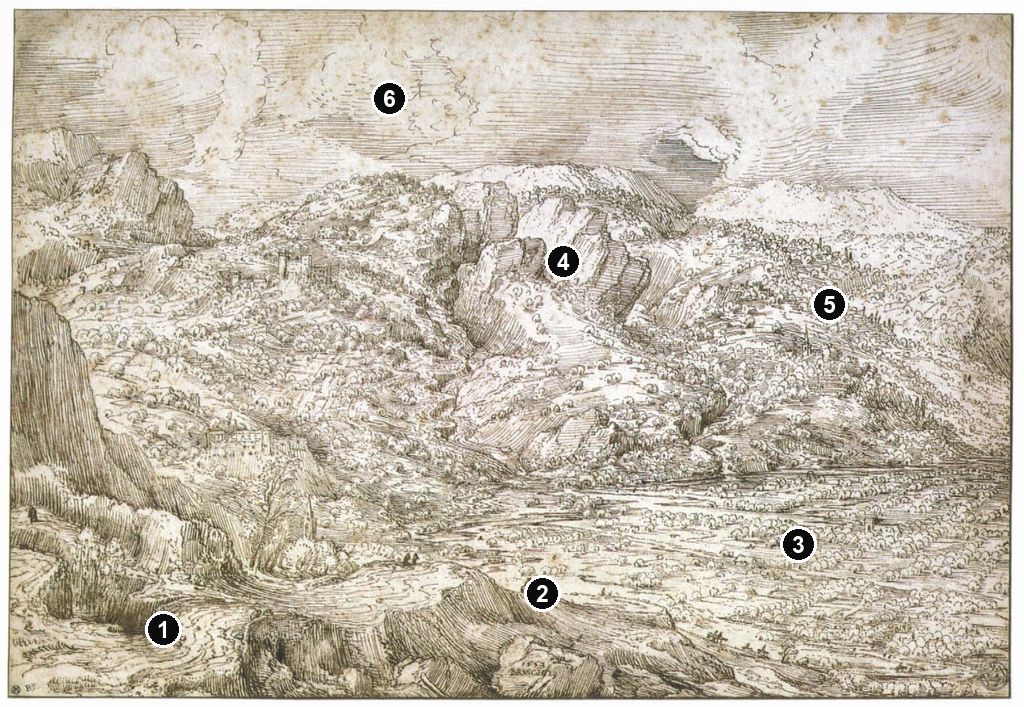
Details from ALPINE LANDSCAPE
Six details show the marks that describe rock, trees, sky and tiny travellers.
The path at the lower left
The path bends between ridges drawn in densely spaced lines.
Travellers on the rise
Two figures stand above the shaded foreground rock.
The broad plain
Brief tree shapes and horizontal strokes mark distant ground.
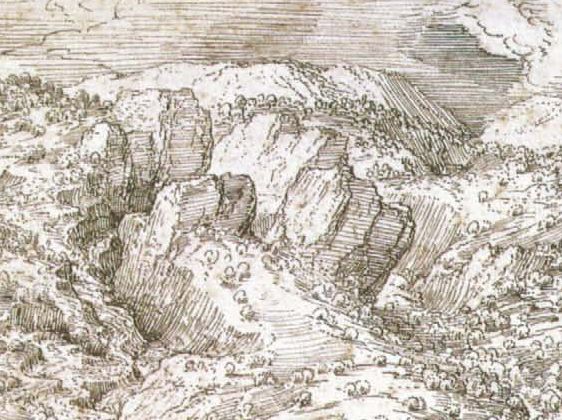
Cliff faces
The direction of the pen strokes changes from face to face.
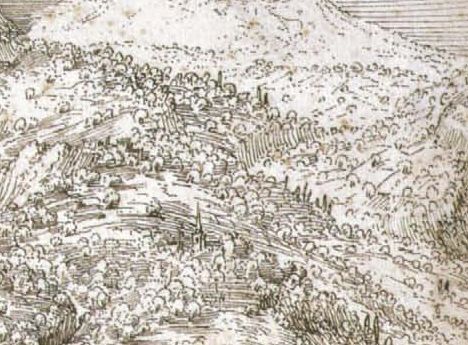
Woodland on the slopes
Legible patches of trees emerge from clusters of loops.
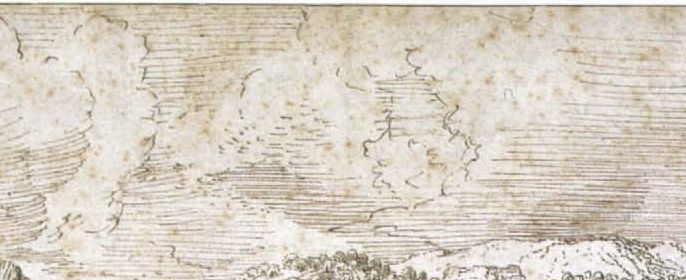
Hatching around the clouds
Bands of pen lines bend around the light areas of sky.
Pieter Bruegel the Elder, Alpine Landscape, Musée du Louvre, INV 19728 recto. Reproduced from the 2001 exhibition catalogue, cat. no. 12. Public domain.
Cliffs, Trees and Sky
Look at the large outcrops near the middle of the sheet. Bruegel gives one face a bank of parallel strokes and leaves another much lighter. Where the ground curls around a ledge, the direction of the hatching also turns. Small patches of foliage cling to some of the inclines or occupy the intervals between the cliff faces. The sequence makes the mountain look built out of sloping surfaces with different orientations. Orenstein relates the curved patterns of parallel marks to the example of Venetian draughtsmen including Titian and Domenico Campagnola [2].
The same kind of differentiation occurs at a smaller scale on the mountainsides. A patch of trees becomes a succession of rounded marks with gaps between them. Follow such a patch uphill and the gaps begin to outline shelves or bare rock. The right side of the sheet contains enough of these marks to convey extensive woodland, while individual trees remain difficult to isolate. The pen can describe the extent of the forest by tracing where the recurring marks stop, leaving the open surfaces of the hill among them.
The sky also uses parallel lines, especially in the stretches between irregular cloud contours. In the foreground a tight grouping of strokes indicates a steep surface. In the sky the lines run in more shallow bands and curve in places without giving the clouds the solidity of a cliff. Against the lighter cloud shapes, the peaks interrupt the hatching. The skyline therefore marks a change both in subject and in the direction of the lines.
The Inscription and the Date
The Louvre describes the name and the numerals at bottom centre as additions by a later hand. The inscription records an attribution and date that someone put on the sheet at a later point in its history. The museum’s entry connects the year with the stylistic resemblance of the drawing to Mountain Landscape with River and Travelers, the sheet in the British Museum catalogued in the 2001 exhibition as number 9. The London work and other comparisons are especially important because the hand responsible for the inscription cannot be identified with Bruegel’s [1] [2].
Orenstein understands the landscape as a studio composition informed by mountain scenery Bruegel had observed. Ludwig Münz allowed for more direct work from nature in parts of the drawing. The surviving sheet brings very different views together within one frame, from the land seen obliquely at the bottom to the wide plain and the mountains rising behind it. Looking closely at those changes of viewpoint explains why the composition itself has mattered as much as the question of where Bruegel might have encountered particular forms [2].
The drawing also has an earlier history in French collections. The exhibition catalogue traces it through Pierre Crozat’s collection and then that of Pierre-Jean Mariette. It records Mariette’s mark at the lower left and Louvre marks near the lower edges. The Louvre also records earlier museum inventory numbers. The inscription and the collection marks occupy some of the same margin, but they belong to different episodes in the history of the paper [1] [2].
Other Landscapes with Similar Titles
The Louvre owns another Bruegel drawing catalogued as Grand paysage alpestre. It is the surviving design associated with the Alpine Landscape print in the Large Landscapes. The print shows another mountain composition, with steep expanses and small travellers. The print and its larger Louvre drawing have an established relationship to one another. Orenstein discusses the suggestion that INV 19728 was intended for a print of its own and favours seeing it as a finished drawing. Its smaller dimensions and separate composition are useful checks when comparing reproductions published under similar English titles [1] [3] [2] [4].
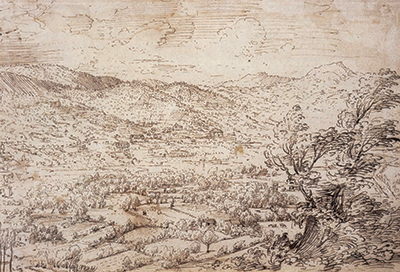
Bruegel’s Mountain Landscape with Ridge and Valley, reproduced below, offers another comparison among the early drawings. In the Braunschweig sheet the dark bush at the right is the nearest clearly visible feature. The Louvre sheet gives that role to the ridges and cuts in the ground itself. Both works use small trees and marks in the low country to signal distance. Looking from one foreground to the other shows how Bruegel could change the way into a wide view while still giving the eye many small places to stop once it reached the valley [2].
Discussion
Which detail in this work most changes how you read it?
Frequently Asked Questions
Two small figures on the rise give the nearer terrain a human scale. Further along, other travellers appear in similarly small groups. [2]
Look at the large outcrops near the middle of the sheet. Bruegel gives one face a bank of parallel strokes and leaves another much lighter. [2]
References
- Musée du Louvre, Paysage alpestre, INV 19728, recto, View source.
- Nadine M. Orenstein, ed., Pieter Bruegel the Elder, Drawings and Prints, 2001, nos. 4, 9, 12 and 29, View source.
- Musée du Louvre, Grand paysage alpestre, View source.
- National Museum of Western Art, Alpine Landscape, G.2010-0005, View source.







