


 by Tom Gurney
Tom Gurney BSc (Hons) is an art history expert with over 20 years experience
Published on June 19, 2020 / Updated on October 14, 2023
Email: tomgurney1@gmail.com / Phone: +44 7429 011000
Big Fish Eat Little Fish: Introduction
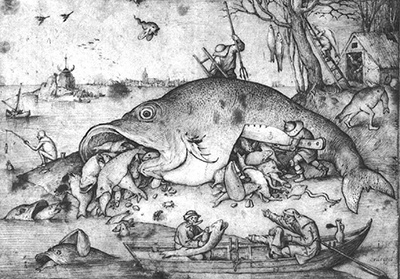
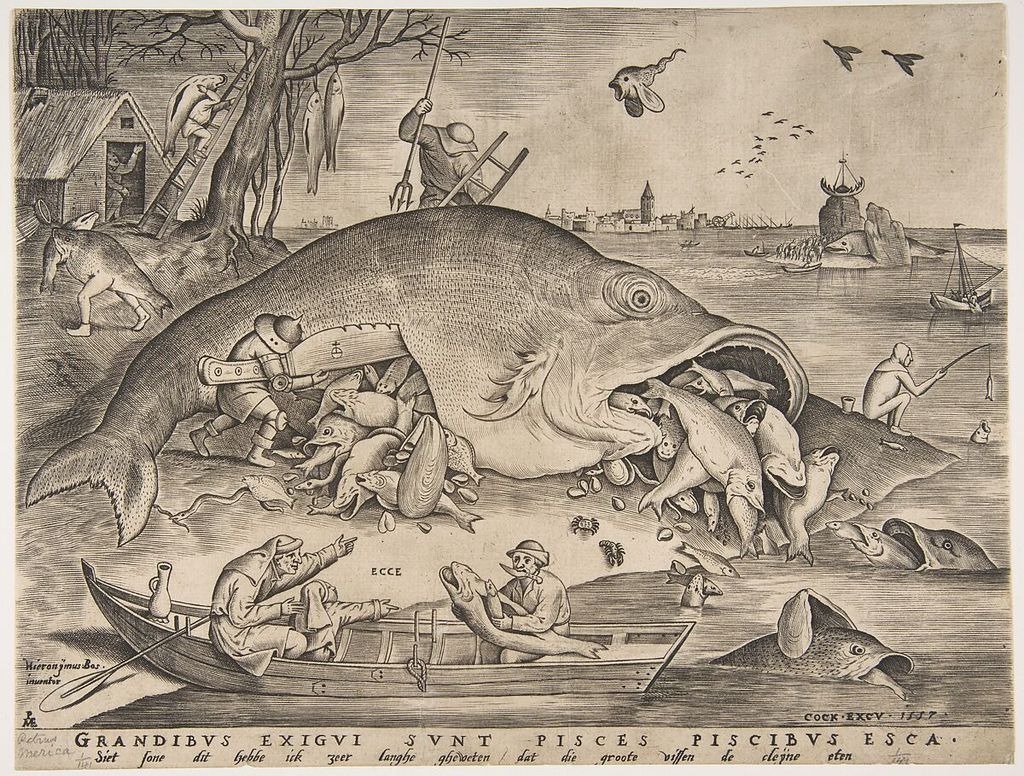
Pieter Bruegel the Elder’s Big Fish Eat Little Fish is a signed drawing of 1556 in the Albertina, Vienna. Its huge stranded fish spills smaller fish from its mouth and from a cut in its belly. Some of those fish have swallowing or feeding to do in their turn. The image above shows the drawing, with the great mouth at the left. The engraving published by Hieronymus Cock in 1557 reverses the composition and adds a printed proverb. It also credits Hieronymus Bosch as the designer, although Bruegel’s signed drawing survives [1] [2].
This work across Bruegel’s career
Tower of Babel
1563The Harvesters
1565Peasant Wedding
1568Children's Games
1560Triumph of Death
1562–1563Big Fish Eat Little Fish
This artworkContents
- Introduction
- At the Mouth of the Fish
- A Lesson in the Boat
- Bosch on the Print, Bruegel on the Drawing
- Where the Proverb Travels
- Annotated Details
At the Mouth of the Fish
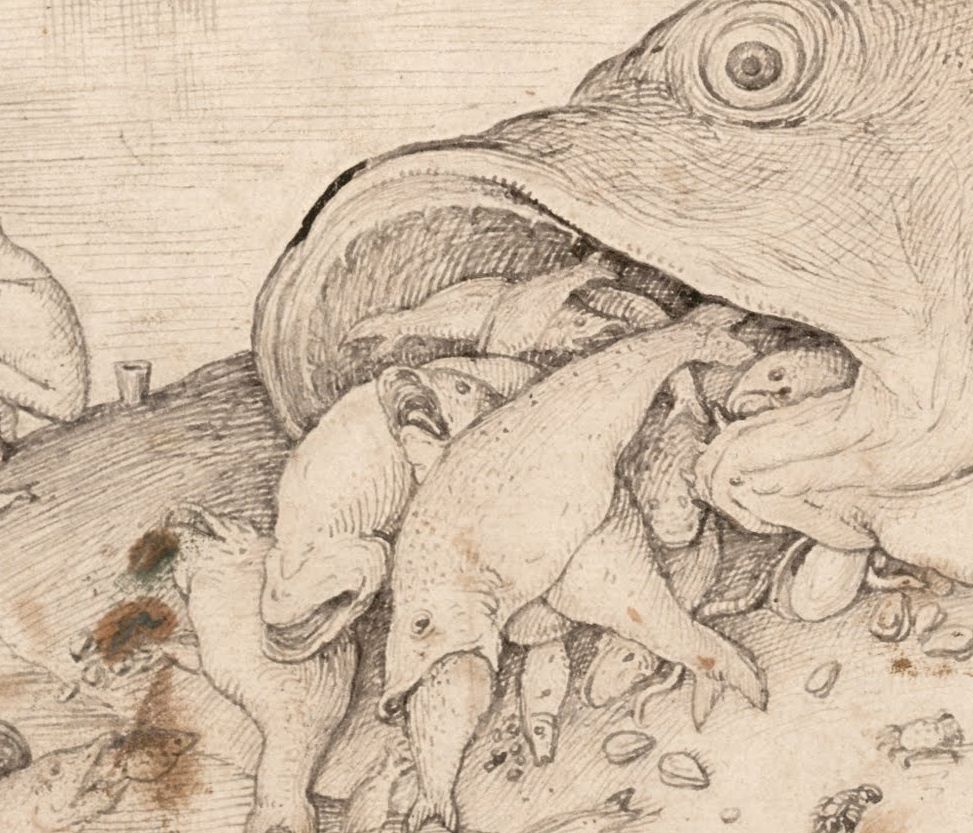
Start with the open mouth. Its width gives the viewer a rough sense of the animal’s size even before the body is taken in. Fish drop through it and pile against one another. There are so many that a first glance may register them as one mass. On a second look it becomes possible to separate the shapes of tails, mouths and fins. Finding those smaller parts is a way of seeing where one fish ends and another begins. The body of the giant is enormous partly because so many others can be contained within it [1] [2].
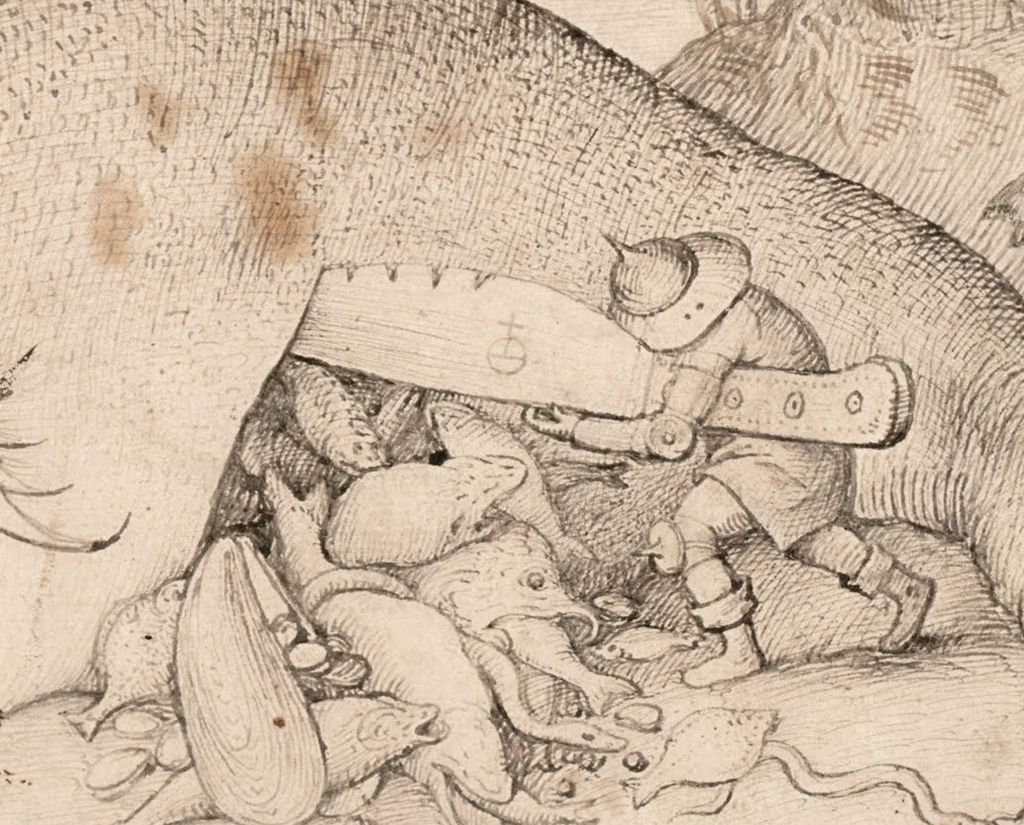
The incision gives the same body another opening. The small helmeted figure and the oversized knife help establish where to look. The outline of the blade is easy to follow among fish that bend or turn at different angles. It also marks an action performed by someone outside the fish. Predation has already taken place within the giant body. The knife reveals its extent and adds a new participant to the chain. The Met draws attention to the mismatch of scale between the figure holding the knife and the large tool he uses [2].
As you move away from the two openings, watch what happens to the difference between large and small. A fish can look insignificant near the great mouth and still be big enough to hold another in its jaws. Bruegel makes that relation visible several times, at sizes a viewer can compare without having to count every fish. The pattern depends on the point from which it is seen. Each animal’s size means something different when the eye moves from the giant to what has spilled out of it [1].
Annotated Details from Big Fish Eat Little Fish
Follow the two openings in the giant fish, then look at the two gestures in the boat.
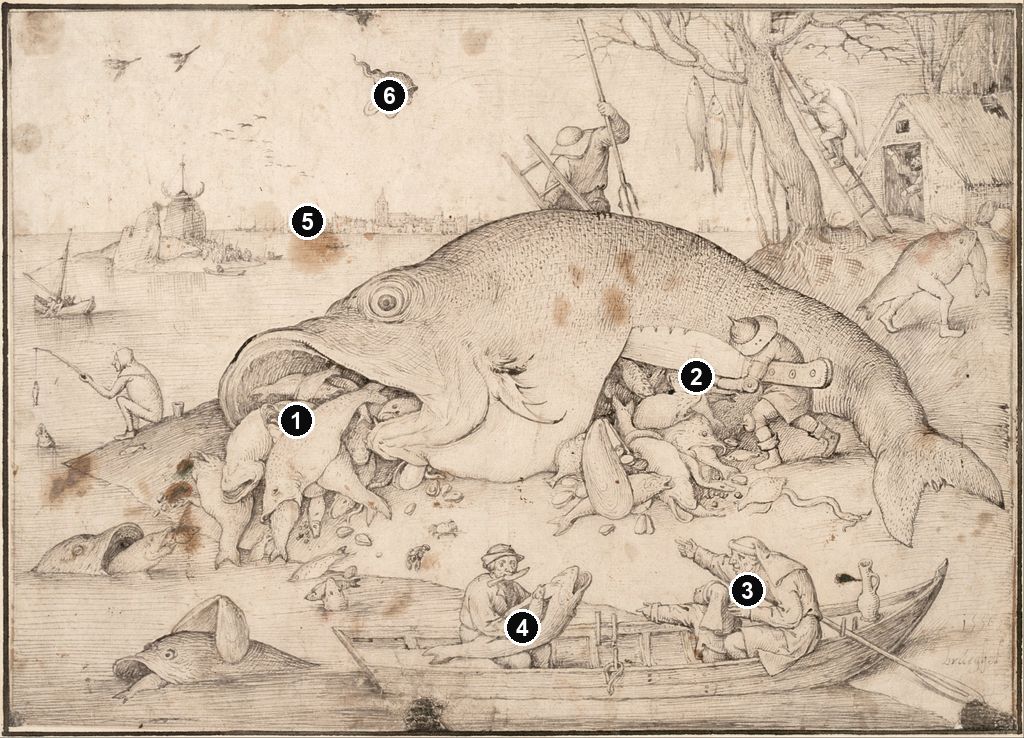
Details from BIG FISH EAT LITTLE FISH
Six details connect the great stranded fish with the smaller events on the water and along the shore.
Fish spilling from the mouth
The overlapping tails and open jaws make the size of the giant clear. Some of the escaping fish are carrying smaller fish themselves.
The cut and the knife
A person with an oversized knife opens the belly. Look for the blade above the cluster coming out of the cut.
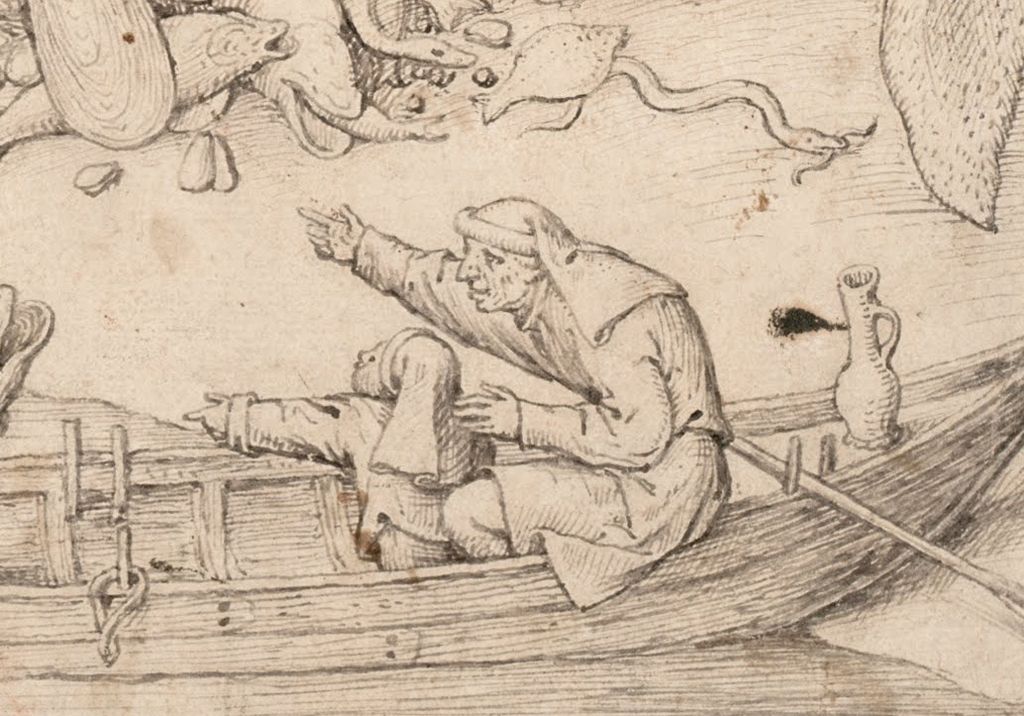
The father points from the boat
The man on the right leans forward and directs the child’s attention towards the shore.
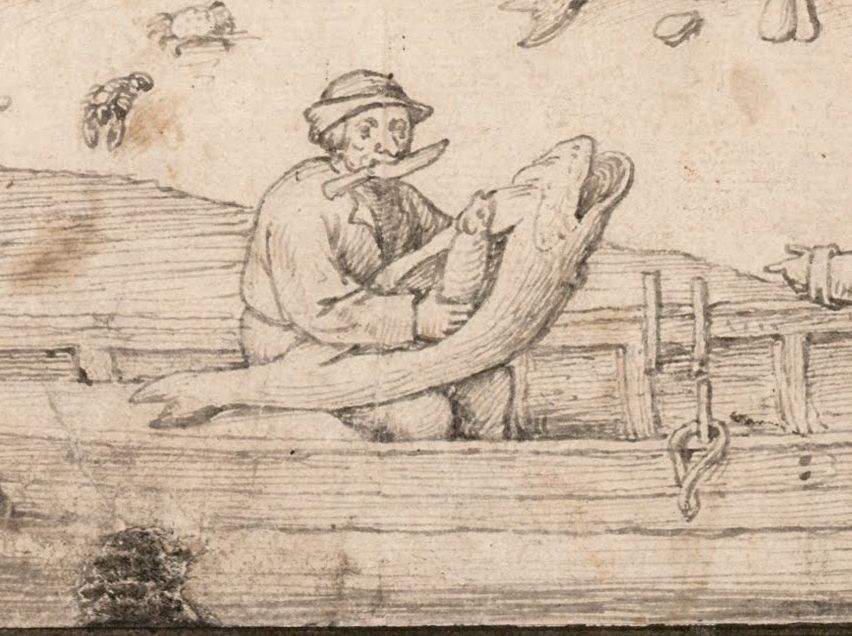
The smaller example in the boat
Another person works with a fish in the same boat. His hands bring the lesson close enough for the boy to see it.
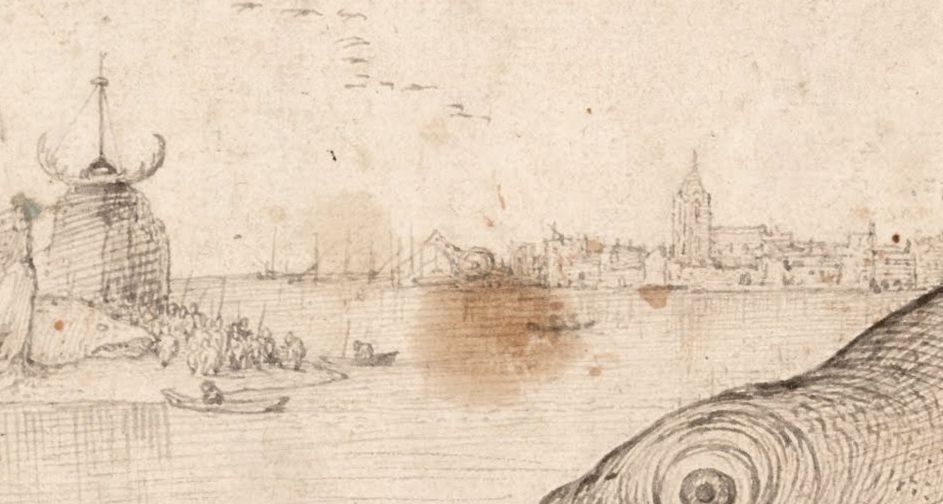
Distant settlement
Low buildings and small boats suggest the scale of the distant shore.
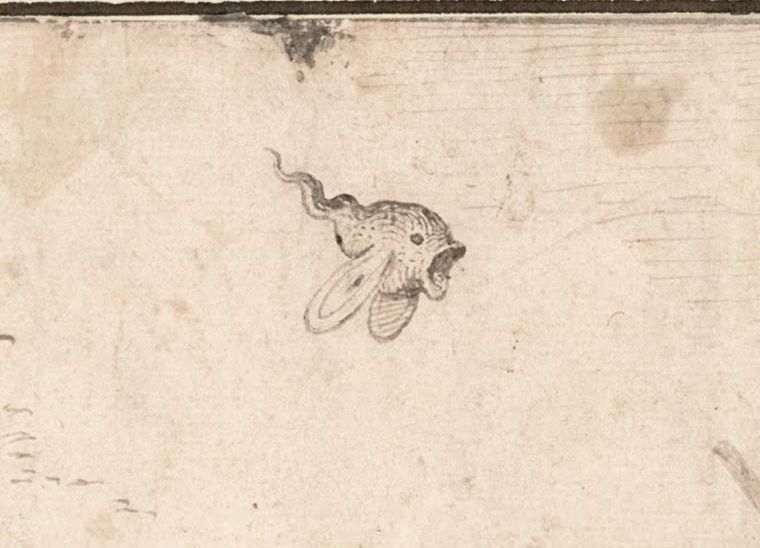
A fish in the air
Over the water a fishlike creature has left its usual element. Its scale helps separate it from the much larger animal on land.
A Lesson in the Boat
The three people in the nearest boat make the action intelligible in human terms. The Albertina reads two as father and son. Follow the father’s arm from the boat towards the huge animal on land. His extended hand gives the child a direction to look and gives the viewer a convenient route towards the middle of the image. The scene is already far enough from the boat for the gesture to matter. It moves attention across a patch of water and makes the stranded fish a subject for someone to discuss [1] [2].
The child has a gesture of his own. The third person in the boat is handling another fish and extracting a smaller one. The boy directs attention back towards this familiar piece of work. The sequence can be read in either direction. A parent can point from a small boat towards something astonishing on shore. A child can answer by drawing attention to an example within reach. The small fish in the boat and the great body on the land present the same relation in actions of very different sizes [1] [2].
The printed version gives the exchange words. The Met identifies a Latin proverb and a vernacular line in which the father tells his son that he has long known the big fish eat the small. Below the image the words are available to readers before they notice the boy’s response. Once they follow the two gestures, the exchange has a more precise meaning. The father’s claim concerns the way the world works. The child can point to something happening at the very moment they are talking [2].
Bosch on the Print, Bruegel on the Drawing
The Albertina records the drawing as inventory 7875, measuring 21.6 by 30.7 centimetres and made with pen and brush in gray and black. At the lower right it carries Bruegel’s name and the date 1556. Both help establish the object behind the design. The Met’s engraving, accession 17.3.859, belongs to a first state of four and names Bosch as inventor at the lower left. The two inscriptions are evidence on separate objects, made in different media and at different stages in the publication of the design [1] [2].
Pieter van der Heyden engraved the print, and Cock published it. The Albertina and the Met discuss the prominence of Bosch’s name in the market for prints and paintings. The Met suggests that Cock was probably responsible for the choice of name. That remains an explanation for the inscription. The imprint and the printed attribution can be read on the sheet, while the strongest evidence for Bruegel’s design is the name and date on his surviving drawing. The fish with unfamiliar limbs and the creatures moving through air and over land also show why an association with Bosch could be intelligible to a reader of the print [1] [2].
The Albertina also notes scored transfer marks and places where a contour was gone over in another ink. Read those findings alongside the large outlines that remain clear through the change of medium. They tell us that the drawing had to make decisions about shape available to another person. The direction of a fish and the shape of the knife could be preserved even as the whole scene was reversed. The design and the print therefore share the same main events while retaining evidence of the different hands and processes involved in making them [1] [2].
Where the Proverb Travels
The distant settlement gives the central scene an ordinary world beyond the extraordinary animal. The Albertina proposes Antwerp as a possible identification. The buildings are small enough that the first thing a viewer is likely to recognise is their general arrangement on the horizon. That distance lets the settlement and the fantastic shore appear in the same view. The fish carry the lesson in a literal form. The presence of a city gives viewers another place in which to consider the relation between the powerful and the weak [1] [2].
The open terrain and the strip of water matter to that reading. The habitat of the fish extends beyond the place where the largest body has washed up. As the viewer moves to its surroundings, more incidents can be read without that body as a reference point. The proverb becomes a rule illustrated by separate examples, including a human taking an animal apart in a boat [1] [2].
Bruegel works with that movement between a recognizable action and a verbal idea elsewhere. In Netherlandish Proverbs, the viewer has a whole settlement of sayings to identify. The fish design lets a single proverb recur at different scales. It has room for flights of invention and for the precise work of a person in a boat. On a last look, follow the father’s gesture to the great mouth, then the child’s towards the other man. The distance between their examples is what makes a common expression into a picture worth searching [1] [2].
Discussion
Which detail in this work most changes how you read it?
Frequently Asked Questions
References
- Albertina, Die großen Fische fressen die kleinen, signed drawing 7875, View source.
- The Metropolitan Museum of Art, Big Fish Eat Little Fish, 1557 engraving, first state, 17.3.859, View source.







