


 by Tom Gurney
Tom Gurney BSc (Hons) is an art history expert with over 20 years experience
Published on June 19, 2020 / Updated on October 14, 2023
Email: tomgurney1@gmail.com / Phone: +44 7429 011000
Elck (Everyman): Introduction
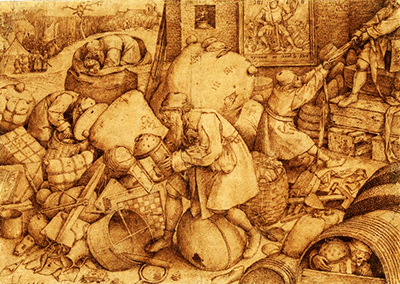
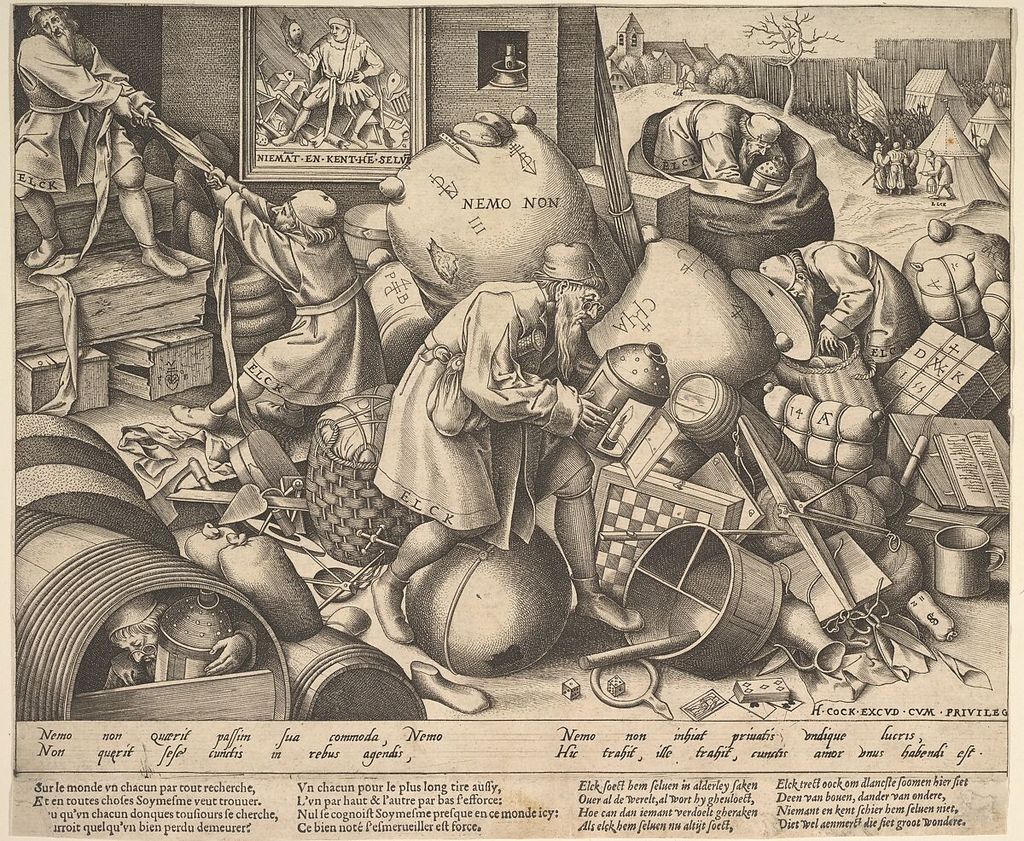
Pieter Bruegel the Elder’s Elck, or Everyman, is a pen-and-ink drawing signed and dated 1558 in the British Museum. An old man bends over a lantern amid barrels, sacks and bundles, surrounded by other figures busy with their own searches. The image above is a cropped view of the drawing. The complete sheet also offers a view into the distance and a small picture of a fool with a mirror. The related engraving, published by Hieronymus Cock, makes Everyman’s name explicit by adding it in several places [1] [2] [3].
This work across Bruegel’s career
Tower of Babel
1563The Harvesters
1565Peasant Wedding
1568Children's Games
1560Triumph of Death
1562–1563Elck
This artworkContents
- Introduction
- Among the Bundles
- Two Men Pulling
- Nobody and the Mirror
- From Drawing to Engraving
- Annotated Details
Among the Bundles
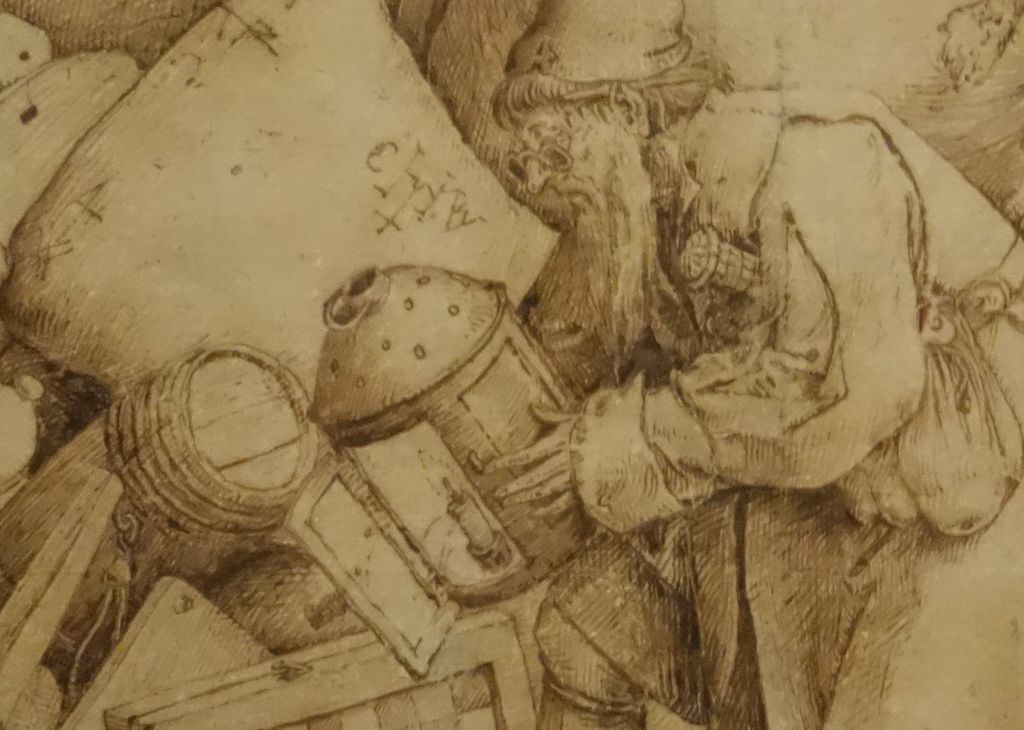
The large figure near the centre bends forward with a lantern. Find the rim of his hat and the small outline of his beard, then follow the direction of his face. The light he carries takes up only part of the space between him and his surroundings. He can bring it close to a piece of merchandise, but he still has to move from sack to barrel and look where the objects touch or overlap. The design puts a great deal within reach of his hands and relatively little within a single view.
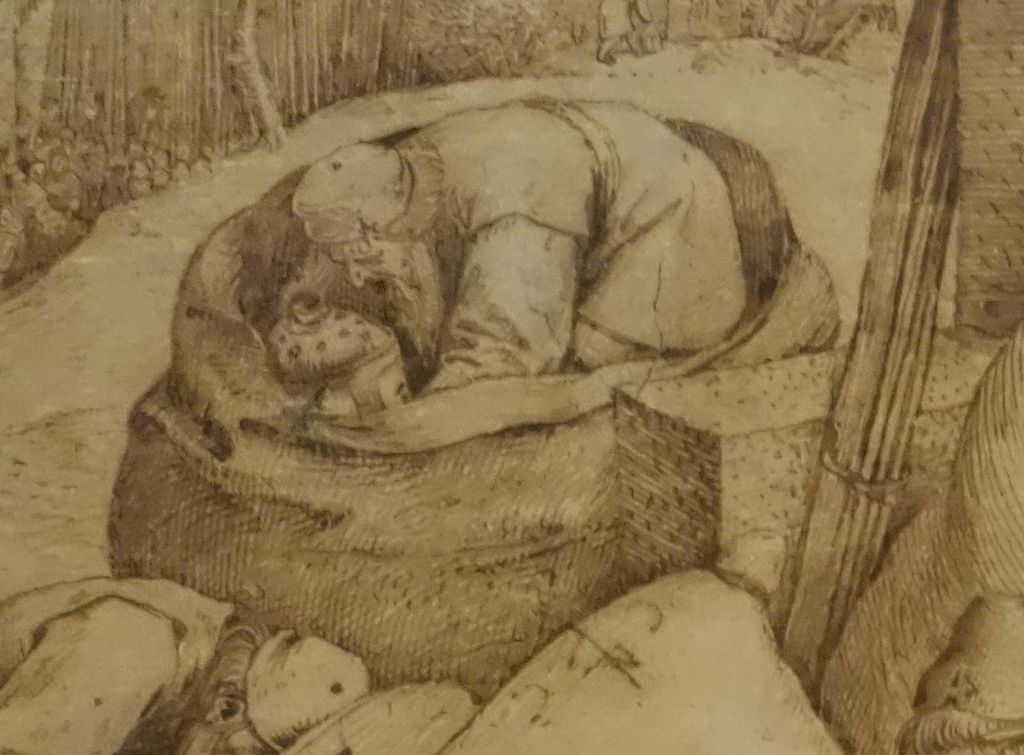
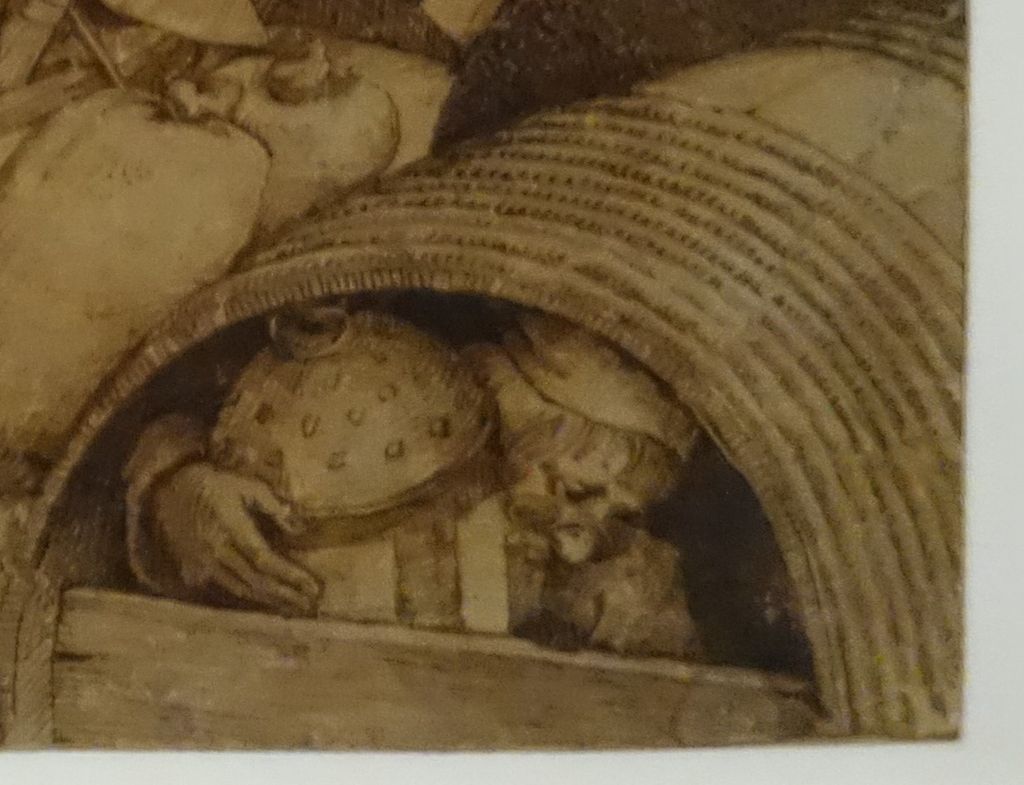
At the left a man bends far into a container. Another body appears higher up, folded so sharply that the back makes an arch over the rim of a barrel. Follow the position of the arms or head in each case. The bent figures look at goods from different heights. Each has a space to search, even when a neighbouring figure is looking into a basket close by. Bruegel repeats the old man’s posture without requiring every figure to stand on the same level or handle the same kind of object [1].
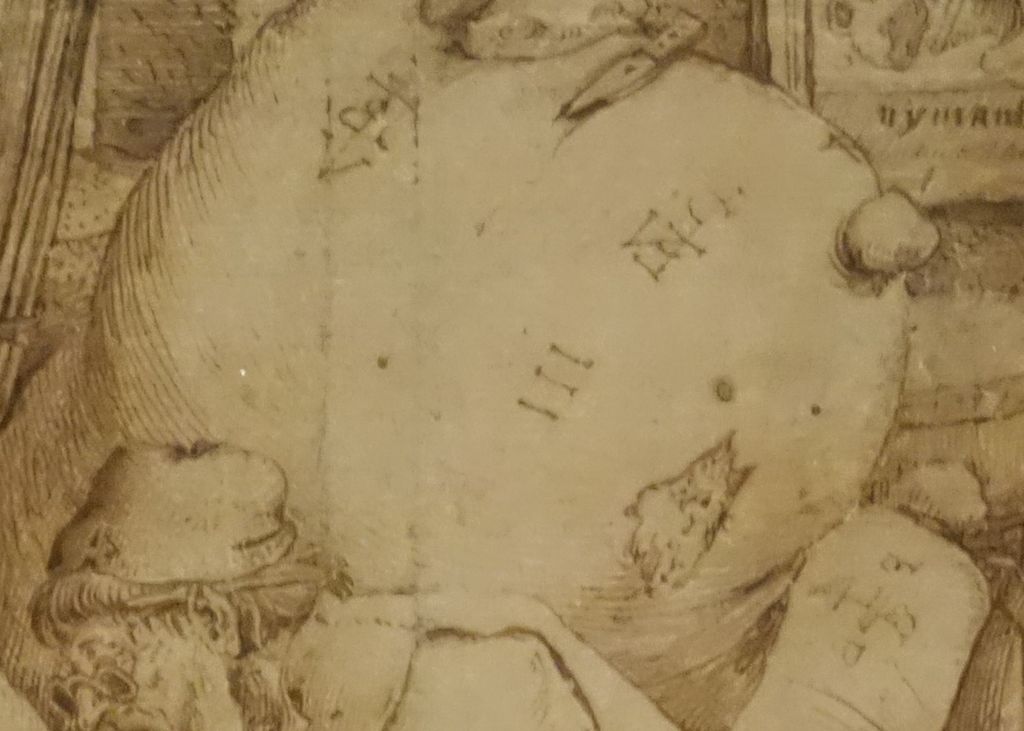
Notice how often one piece of merchandise blocks another. A sack has a broad surface where a mark can be made, while the bands of a barrel show whether it is upright or on its side. Large shapes tilt towards the viewer or away into the pile. This makes the mound easy to follow by fragments and difficult to take in as a whole. The process of looking begins to resemble the action of the old men. One can identify an object by the piece of it that remains visible, then move to the next.
Annotated Details from Elck or Everyman
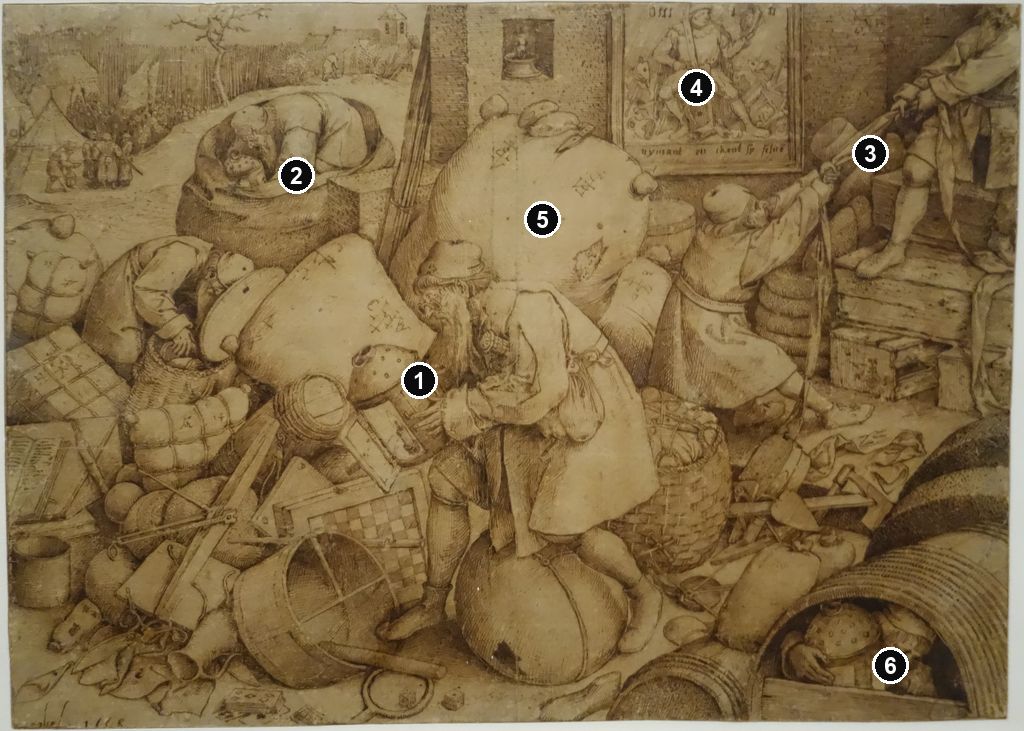
Follow the repeated searchers from the lantern in the centre to the opening at the lower right.
Details from ELCK OR EVERYMAN
Six details locate the searchers and the small scene on the wall.
The lantern at the centre
Everyman brings a lantern close to the objects he searches.
Searching inside a container
A second figure bends deep into a round container.
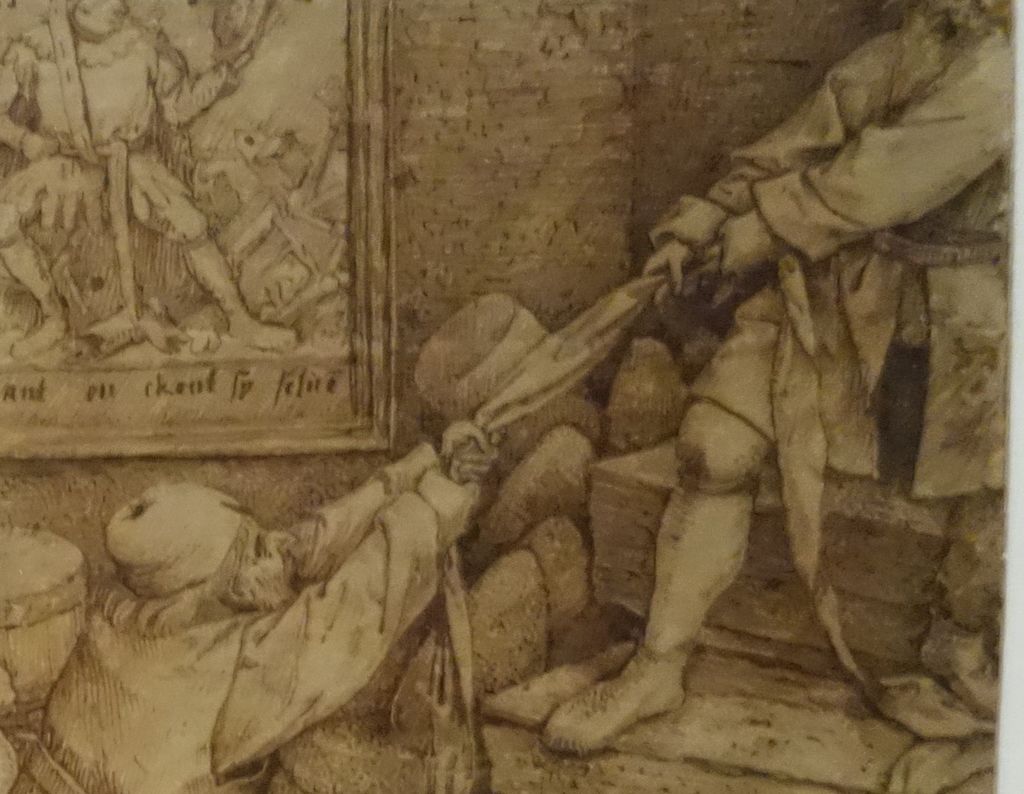
The contest over a length of cloth
Two figures pull on the same length of fabric.
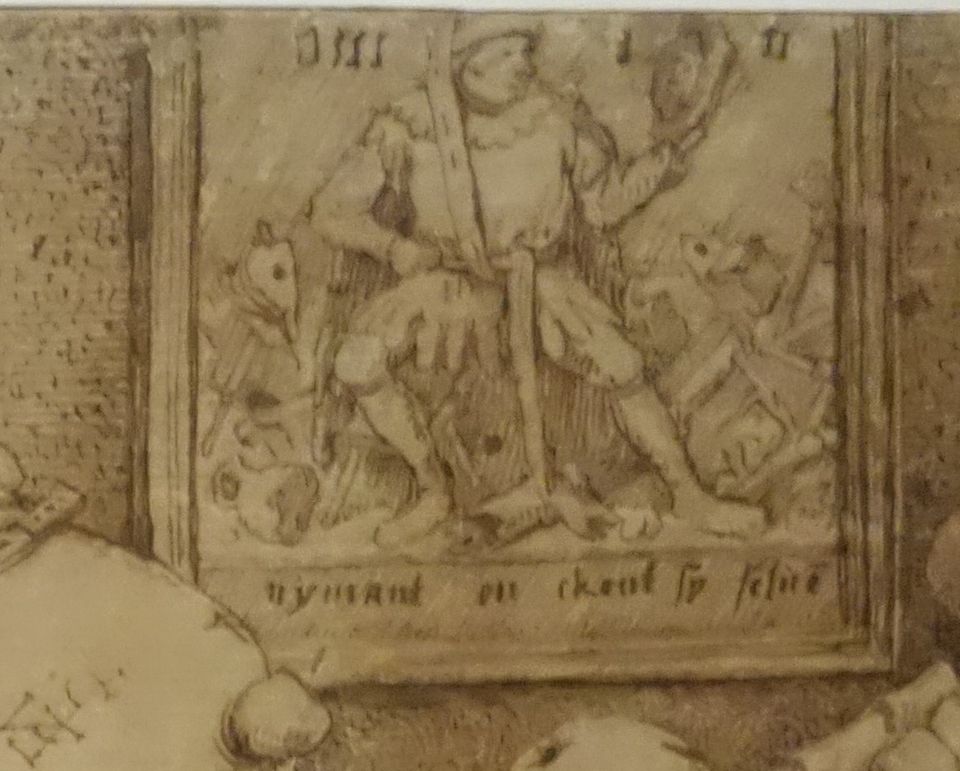
Nobody and the mirror
A figure looks in a mirror in the pictured scene on the wall.
Marks on the sacks
Light-coloured sacks carry small marks amid the crowded objects.
The figure inside the barrel
A man peers out from a barrel at the lower right.
Pieter Bruegel the Elder, Elck or Everyman, 1558. British Museum, 1854,0628.36. Photograph by Karmakolle. Photograph, resized splash, marked overview and crops licensed CC BY-SA 4.0.
Two Men Pulling
At the right of the drawing two men take hold of the same length of cloth. One is lower down and the other has a higher place to stand. Their arms extend towards each other along a strong diagonal. The cloth gives their different positions a common purpose. Compare this action with the figure whose attention is absorbed by his lantern. The men pulling are able to identify what they want and where it is. Their trouble begins when the other person wants the same thing [1].
The tugging gives movement a different shape from rummaging. The men dealing with the barrels narrow their attention to a patch of merchandise. The pullers are joined across an interval of ground. Their cloth can get tighter or slip in either direction, and the eye can follow that possibility from one end to the other. In the engraving a set of lines below the image refers to the way people pull for themselves. That text builds a connection between the men’s small struggle and the conduct of the other Everymen [1] [2].
Nobody and the Mirror
Look behind the merchandise for the picture on the wall. Bruegel drew a fool looking into a mirror, with a phrase below the little scene conveying that nobody knows himself. The print keeps this incident, though its reversal places it on the other side. Here the person searching has a smooth surface in which to look, while the men in the foreground turn their attention to bags and containers. The image of the fool takes up much less room than the goods. Finding it gives a reason to think again about the object of all the searching [1].
A figure can look intently at something and still have trouble seeing what it has to do with him. The mirror makes that question specific. The fool has a reflection close at hand, while the surrounding figures search in the physical world. The inscription attached to his picture gives self-knowledge a place in a scene otherwise full of objects. The repeated Everyman and the singular Nobody are both needed for the joke. An action shared by many people can coexist with a kind of knowledge that none of them has managed to secure [1].
From Drawing to Engraving
The British Museum drawing is accession 1854,0628.36. The Metropolitan Museum’s 2001 exhibition catalogue records pen and brown ink and notes the indentations along contours used for transfer. These are traces of a stage in the production of a print design. A viewer can understand them alongside the marks that belong to the pictured objects. The folds of garments establish the men’s attitudes and the marks along the contours show how this sheet could help guide the next stage of work [1].
The Met records the engraving around 1558, with Pieter van der Heyden responsible for engraving and Hieronymus Cock for publication. Its catalogue entry for the exhibition discusses the attribution to Van der Heyden, since the plate lacks the engraver’s signature. The print identifies the Everymen with the word Elck, repeated on hems and near distant figures. Find the edge of the central figure’s tunic in a print impression. The lettering sits close enough to his body to become a label for the person who wears it. The drawing lets the repetitions emerge through poses and lanterns [1] [2] [3].
Catalogues distinguish a state of the plate from the letterpress text found below an impression. The Met has two impressions from the first state with different versions of the letterpress, accession 26.72.38 for version A and 28.4(24) for version B. Thus two impressions can share a stage of the engraved image and still carry different printed wording. That is essential when comparing what readers were invited to see with what they were given to read [2] [3].
Start again with the central lantern and follow the folded bodies into the pile. Then find the conflict over the cloth and the much smaller fool on the wall. Each gives the viewer a different object to attend to. The work’s central puzzle emerges across all three. People can be busy searching a common world and still direct their efforts chiefly towards what they hope to gain from it.
Discussion
Which detail in this work most changes how you read it?
Frequently Asked Questions
At the left a man bends far into a container. Another body appears higher up, folded so sharply that the back makes an arch over the rim of a barrel. [1]
At the right of the drawing two men take hold of the same length of cloth. One is lower down and the other has a higher place to stand. [1]
Look behind the merchandise for the picture on the wall. Bruegel drew a fool looking into a mirror, with a phrase below the little scene conveying that nobody knows himself. [1]
References
- Nadine M. Orenstein, ed., Pieter Bruegel the Elder, Drawings and Prints, Metropolitan Museum of Art, 2001, nos. 58–59, View source.
- The Metropolitan Museum of Art, Everyman, first state with letterpress version A, 26.72.38, View source.
- The Metropolitan Museum of Art, Everyman, first state with letterpress version B, 28.4(24), View source.








