


 by Tom Gurney
Tom Gurney BSc (Hons) is an art history expert with over 20 years experience
Published on June 19, 2020 / Updated on October 14, 2023
Email: tomgurney1@gmail.com / Phone: +44 7429 011000
The Pilgrimage to Molenbeek: Introduction
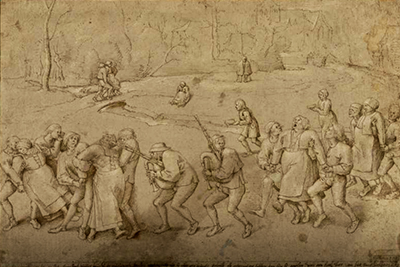
Two bagpipers stride across the foreground of a drawing in the Rijksmuseum. On either side of them, groups of pilgrims and companions lean into one another as they move through a landscape. The drawing is known in Amsterdam as Pelgrimage naar Molenbeek. The Rijksmuseum dates the sheet to 1569 and catalogues it as the work of an anonymous draughtsman after a painting by Pieter Bruegel the Elder. It is drawn in brown pen on brown-tinted paper and measures 27 by 40.3 centimetres. The pilgrimage took place on Saint John’s Day at Sint-Jans-Molenbeek near Brussels [1].
This work across Bruegel’s career
Tower of Babel
1563The Harvesters
1565Peasant Wedding
1568Children's Games
1560Triumph of Death
1562–1563The Pilgrimage to Molenbeek
This artworkContents
- Introduction
- The Groups in the Foreground
- A Path Behind the Procession
- Saint John’s Day and the Titles
- The Drawing and the Later Prints
- Annotated Details
The Groups in the Foreground
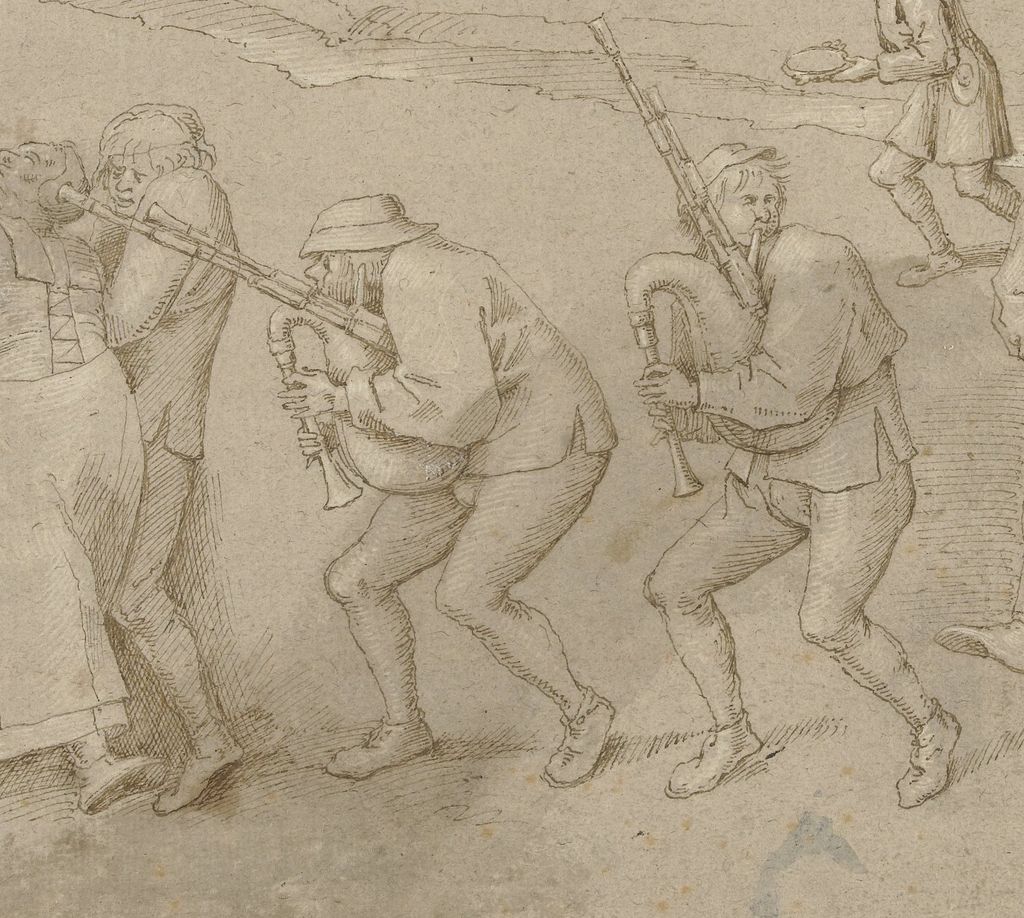
The nearest figures are arranged in three groups. Start with the two musicians, who occupy the interval between the pilgrims at either side. Both bend their knees and incline their bodies in the direction of travel. A curved bag and the long pipes help identify their instruments. One pipe cuts diagonally across the open ground behind them. That diagonal is especially easy to pick out because it rises above the low curve of the musician’s back. The two figures have a similar outline, but their feet fall at different points and the instruments are held at different angles.
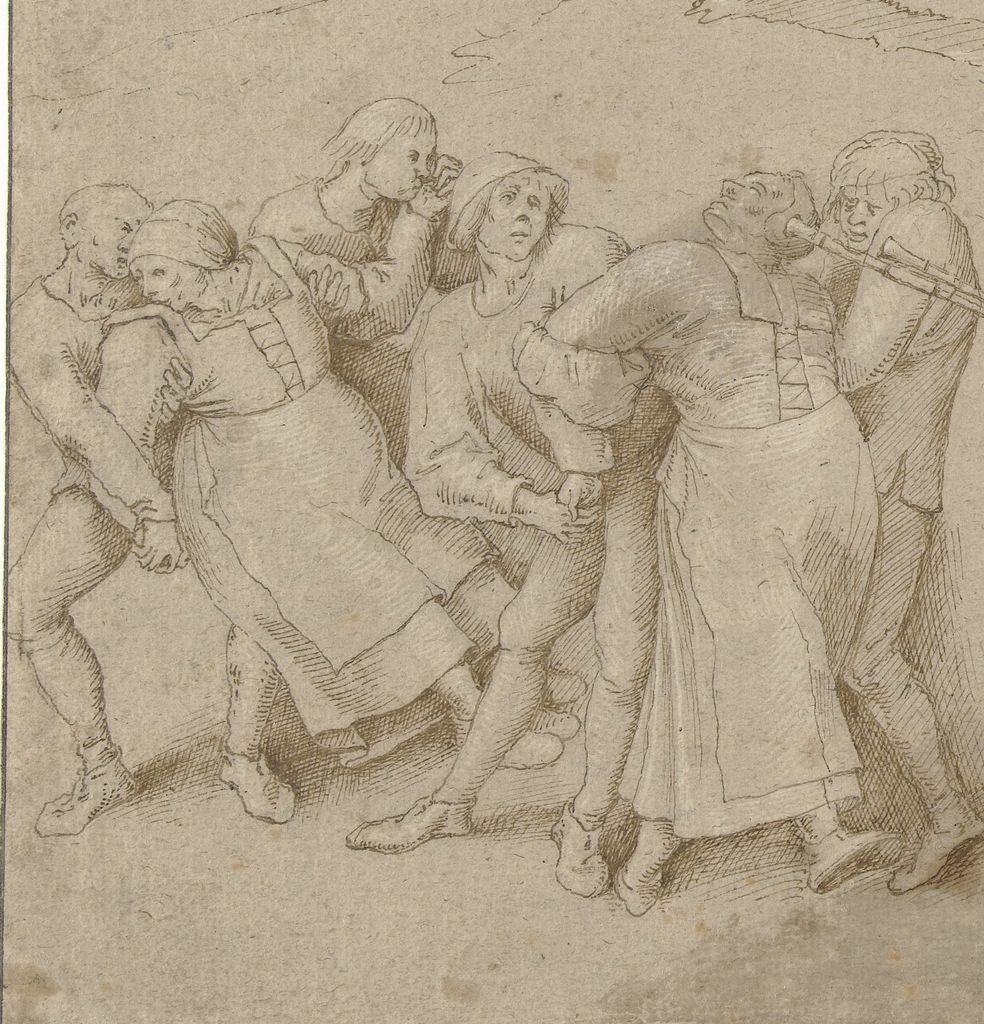
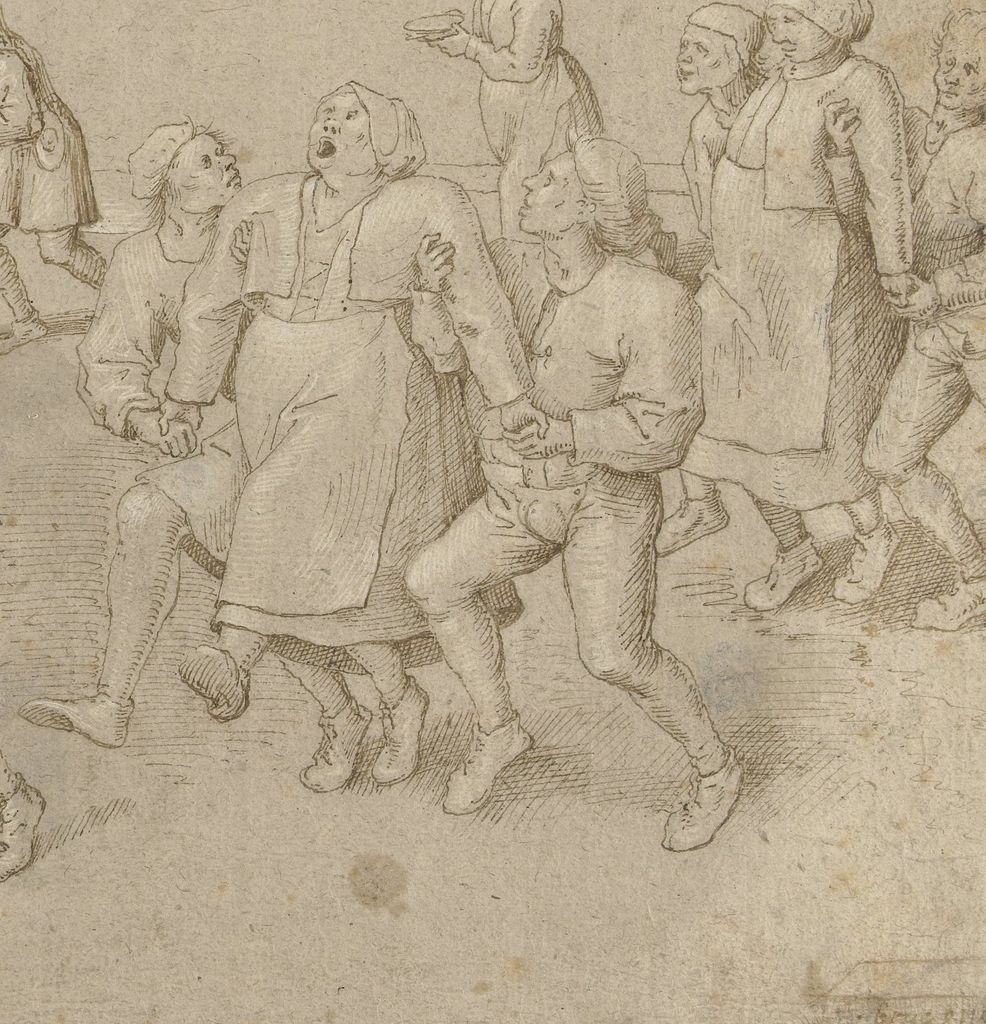
The group at the left is more closely packed. Pale skirts hang in long folds, and bent arms cross or disappear into the darker contours of sleeves. One woman’s body tilts backwards while a companion holds her close. A second woman stands nearer the musicians with her head tipped back and her body supported at either side. The points of contact take longer to read than the outlines of the skirts. Looking for a hand at a waist or an arm against a shoulder makes it possible to follow how the figures are joined even where the pen marks cross.
At the right, a woman stands out in a light skirt framed by the darker legs of those around her. Her position can be read in relation to several different feet. Some of the figures beside her take energetic strides, and a raised foot is visible in front of the skirt. Further figures extend the group towards the edge of the sheet. The long foreground band holds together as a procession because these separate groups share a direction, while their exact spacing and the different ways they carry their weight keep the line from becoming uniform.
Annotated Details from The Pilgrimage to Molenbeek
Follow the procession past the musicians, then look for the crossing further back.
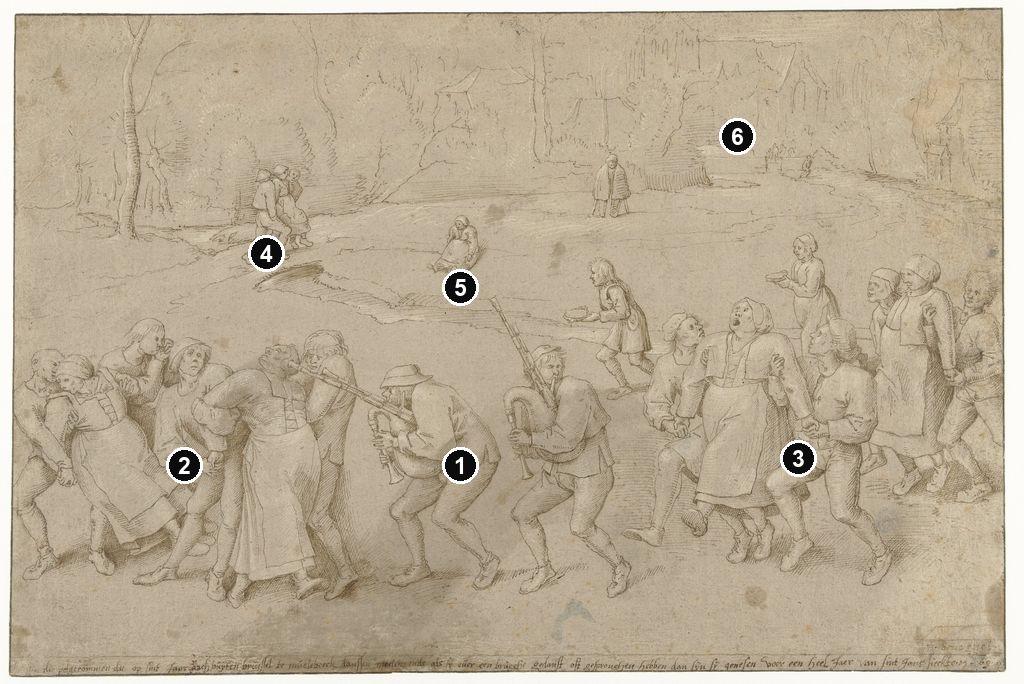
Details from THE PILGRIMAGE TO MOLENBEEK
Six details trace the pilgrims and the route through the landscape.
The two bagpipers
The pipe rises over two bent figures in the middle of the procession.
The left group
Companions support women at the front of the procession.
The right group
A light skirt is framed by the striding figures.
A distant crossing
Small travellers appear near a crossing.
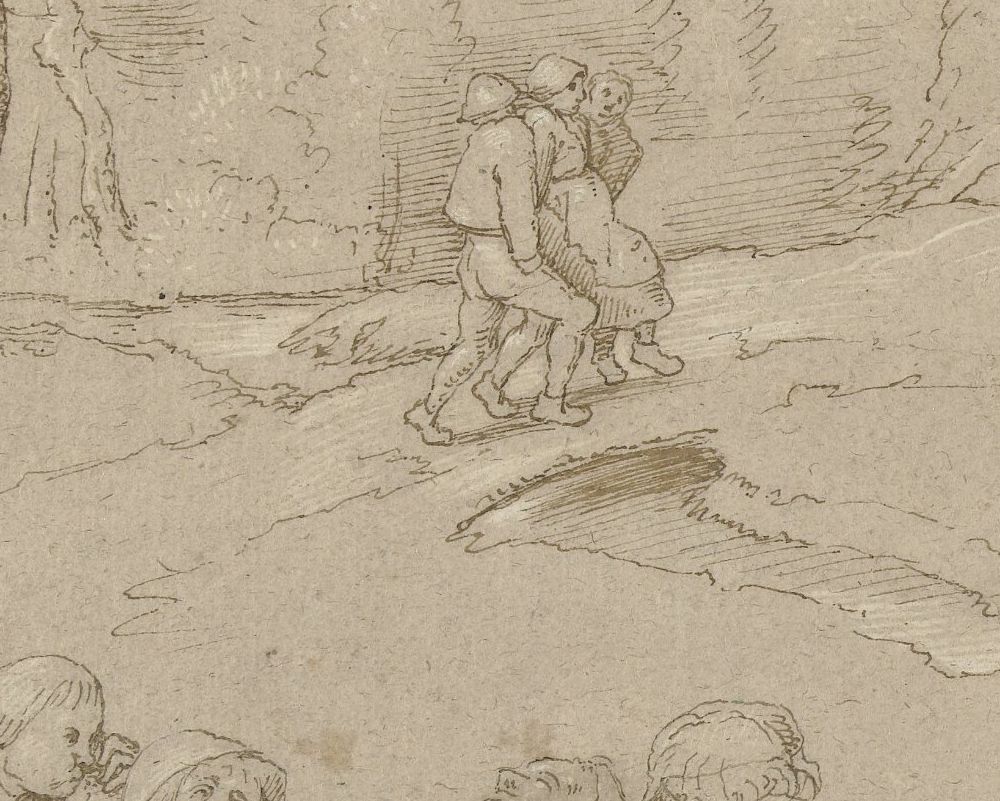
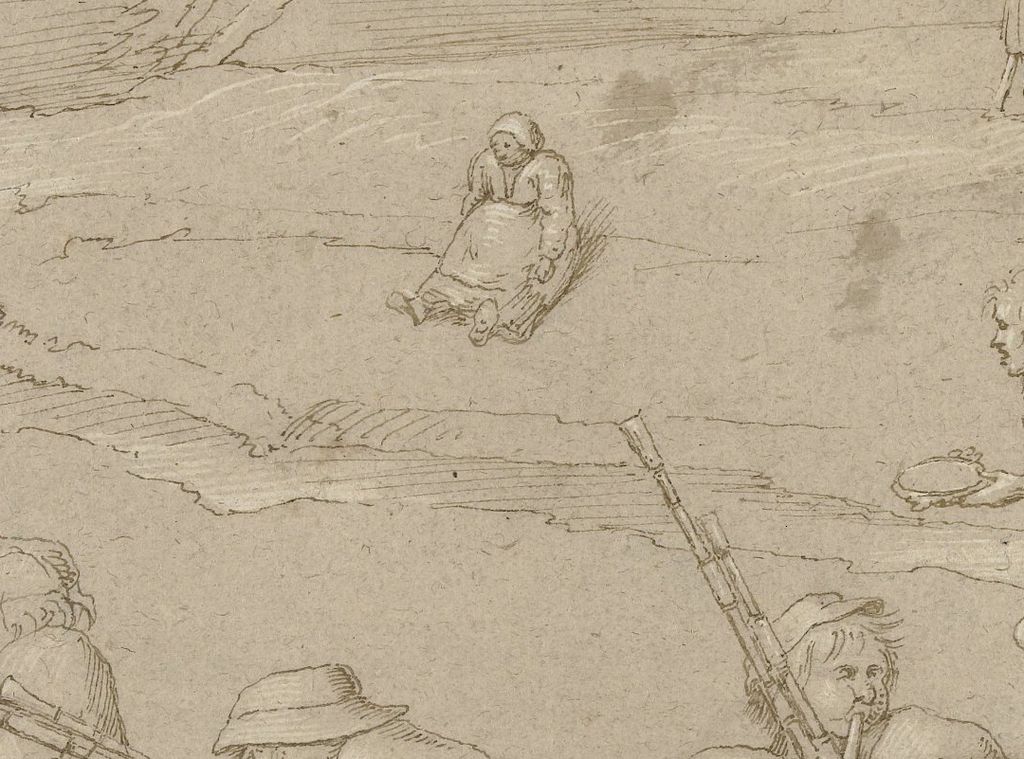
Figure by the bend
A seated figure appears on open ground beyond the musicians.
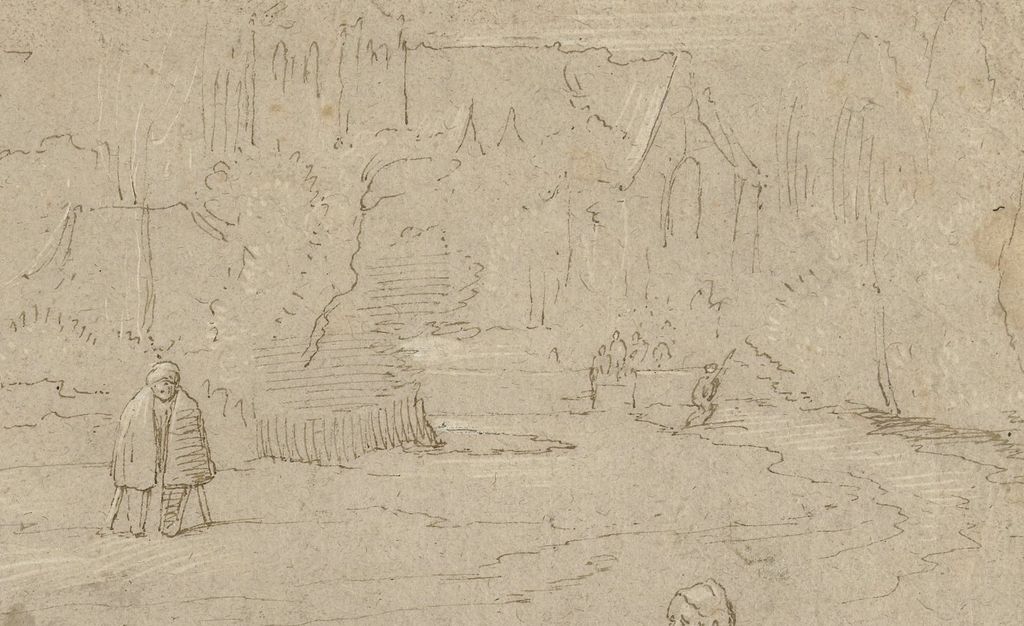
The distant buildings
Faint outlines mark buildings behind the path.
Anonymous, after Pieter Bruegel the Elder, Pelgrimage naar Molenbeek, 1569. Rijksmuseum, RP-T-1892-A-2489. Public domain.
A Path Behind the Procession
The landscape is much lighter than the main figures. The eye can follow a winding edge through the middle distance towards a small crossing at the left. Tiny figures stand or walk in several places beyond the nearest groups, including just beyond the crossing and near the buildings. One figure sits nearer the bend, separated from the others by bare ground. These small forms place the foreground action in a wider area that people can enter and leave. The paths, planting and structures also give the figures somewhere to go beyond the edges of the sheet.
The largest trees belong to the upper part of the picture. The trunk at the left rises above the crossing, and intermittent branches and upright marks lead across towards the distant buildings. The contrast between sparse landscape marks and heavier lines around clothes and instruments helps the viewer judge distance. The foreground also has more dark marks immediately beneath the figures, where short strokes follow the direction of their feet. The paper’s shared brown tone holds both areas together even when the strength of the line changes considerably from one to the other.
Saint John’s Day and the Titles
The English title Epileptics at Meulebeke uses historical language for the participants and an older spelling associated with the composition. The Rijksmuseum identifies the place as Sint-Jans-Molenbeek and the occasion as Saint John’s Day. It also catalogues related engravings by Hendrick Hondius, including one that explicitly identifies the pilgrims as heading towards the bridge. The place, occasion and crossing help explain why the sheet brings together walkers, companions and musicians. The visible gestures can be described on their own terms, without assigning a diagnosis to any individual from a pose [1] [3].
The crossing is a small part of the Amsterdam sheet, but it offers a reason to look beyond the crowd. A viewer following the route sees different kinds of movement within the same landscape. Several people appear to walk together, others stand apart, and the nearest groups advance with considerable physical effort. The picture records the collective character of a pilgrimage through those differences. Its subject includes the companions’ participation and the work of moving as a group as much as the individual postures that first attract attention.
The Drawing and the Later Prints
The drawing in the Rijksmuseum is one witness to a design associated with Bruegel. The Kupferstichkabinett in Berlin preserves a separate version in brown pen heightened with white on grey-toned laid paper. Its catalogue places it in Bruegel’s following and records an attribution to David Vinckboons the Elder. The Amsterdam catalogue identifies its own sheet as anonymous. The figures and broad landscape organisation make the relationship visible, while the different cataloguing, materials and contours give each surviving sheet its own identity [1] [2].
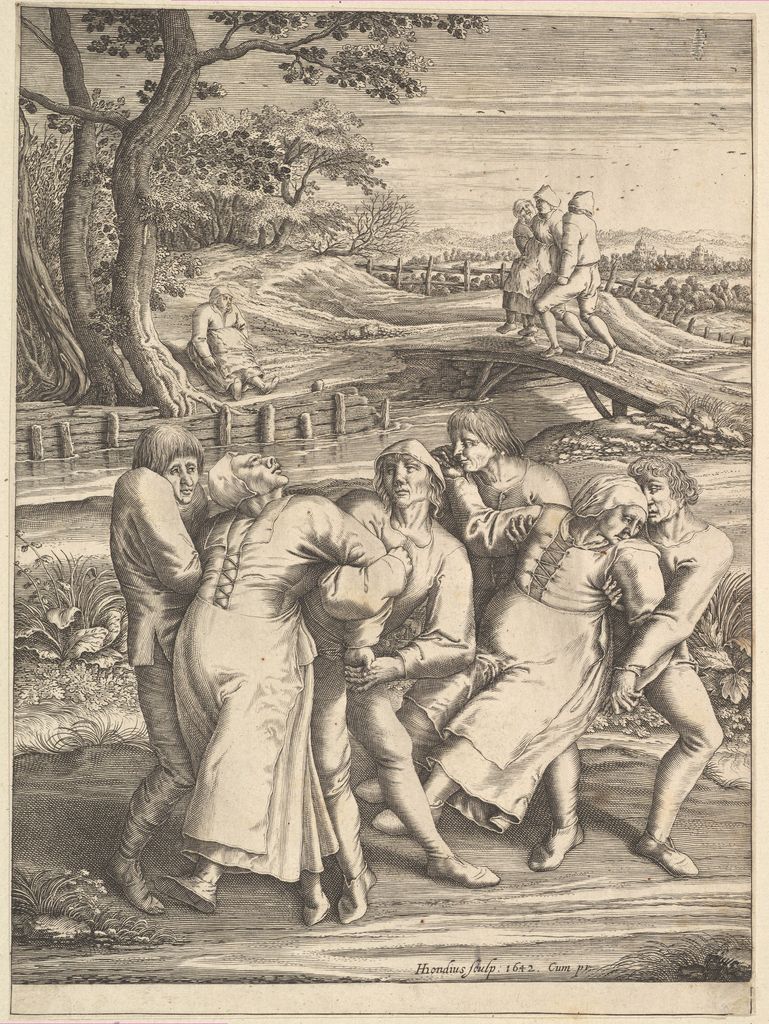
Hendrick Hondius’s engraving in the Metropolitan Museum of Art dates to 1642. The Met catalogues it as a first-state impression after Bruegel. Compare the two closely supported women at the lower left of the Amsterdam drawing with the figures in the lower half of the engraving. Their arrangement is reversed, and the engraving gives the crossing, boat and trees much more room above them. The print’s neatly ruled sky and dense marks in the ground further distinguish it from the pale spaces between the drawing’s foreground groups [4].
The different formats change how the subject is encountered. On the wide sheet the eye moves from the musicians towards two different crowds and discovers the crossing in the distance. The narrow engraving can make the supported figures and crossing prominent at the same time, since there is room for them to sit one above the other. The Rijksmuseum also records a separate engraving of the bagpipers among the related objects. Seeing what each print selects helps explain how different elements of a single composition could circulate independently [1] [4].
Discussion
Which detail in this work most changes how you read it?
Frequently Asked Questions
Two bagpipers stride across the foreground of a drawing in the Rijksmuseum. On either side of them, groups of pilgrims and companions lean into one another as they move through a landscape. [1]
Two bagpipers stride across the foreground of a drawing in the Rijksmuseum. On either side of them, groups of pilgrims and companions lean into one another as they move through a landscape. [1]
References
- Rijksmuseum, Pelgrimage naar Molenbeek, RP-T-1892-A-2489, View source.
- Staatliche Museen zu Berlin, Die Epileptikerinnen von Meulebeke, KdZ 383, View source.
- Rijksmuseum, Epileptici en hun begeleiders op weg naar de brug bij Molenbeek, View source.
- Metropolitan Museum of Art, Epileptics Walking to the Left from Pilgrimage of the Epileptics to the Church at Molenbeeck, 49.95.2249, View source.







